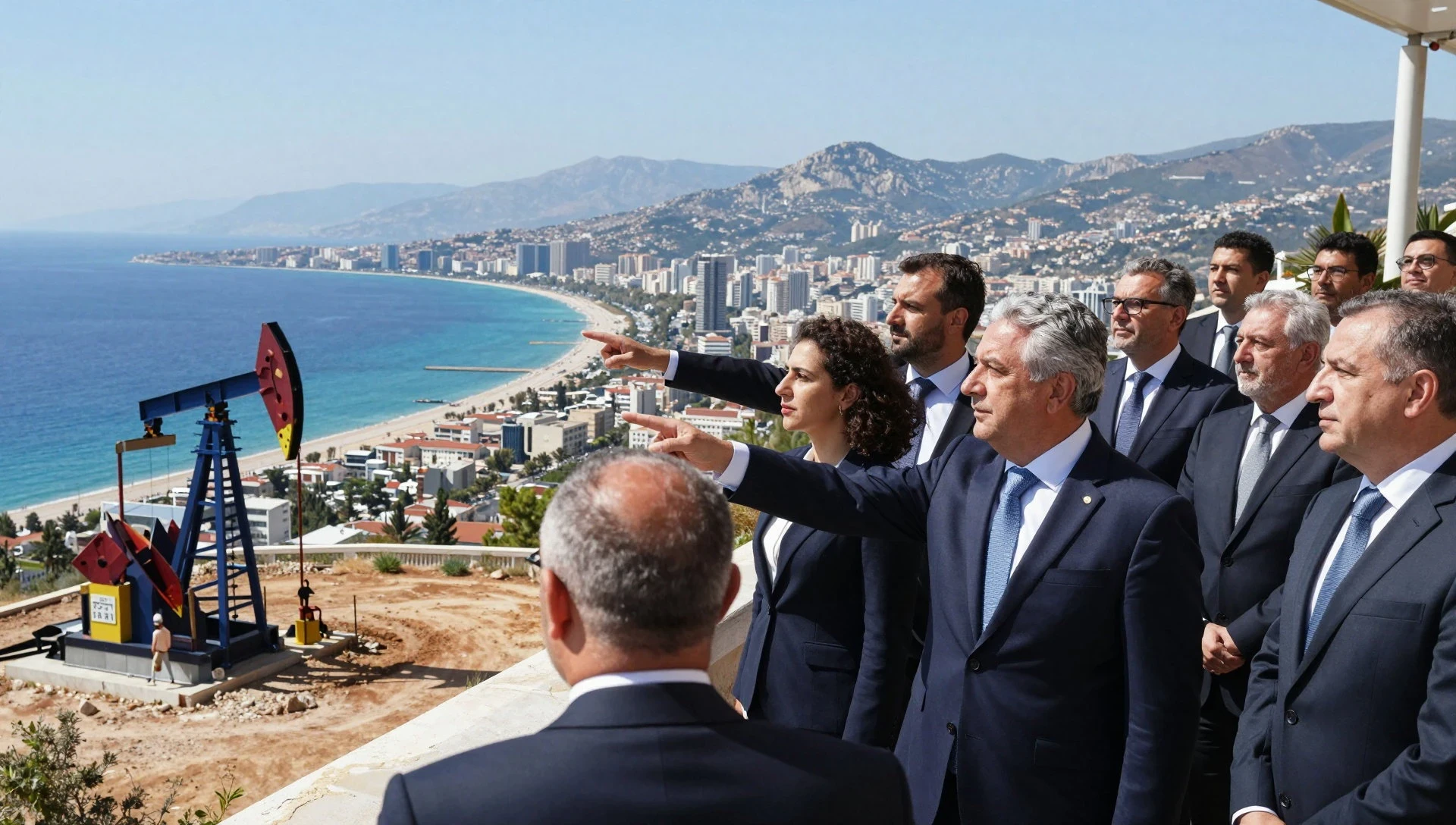
When the gavel hovered over the final plenary in Antalya, the world witnessed something rarer than a diplomatic breakdown: a negotiation that ran past every previous record for endurance and still could not produce a text capable of commanding consent. COP31, hosted by Turkey and presided over by Murat Kurum, stretched into the longest climate summit ever convened, yet closed in open division after the European Union, the United Kingdom and a coalition of developing-world partners refused to endorse a proposed agreement that made no reference to fossil fuels. The rejection was not procedural theatre; it was a substantive verdict on what the science demands and what the draft delivered.
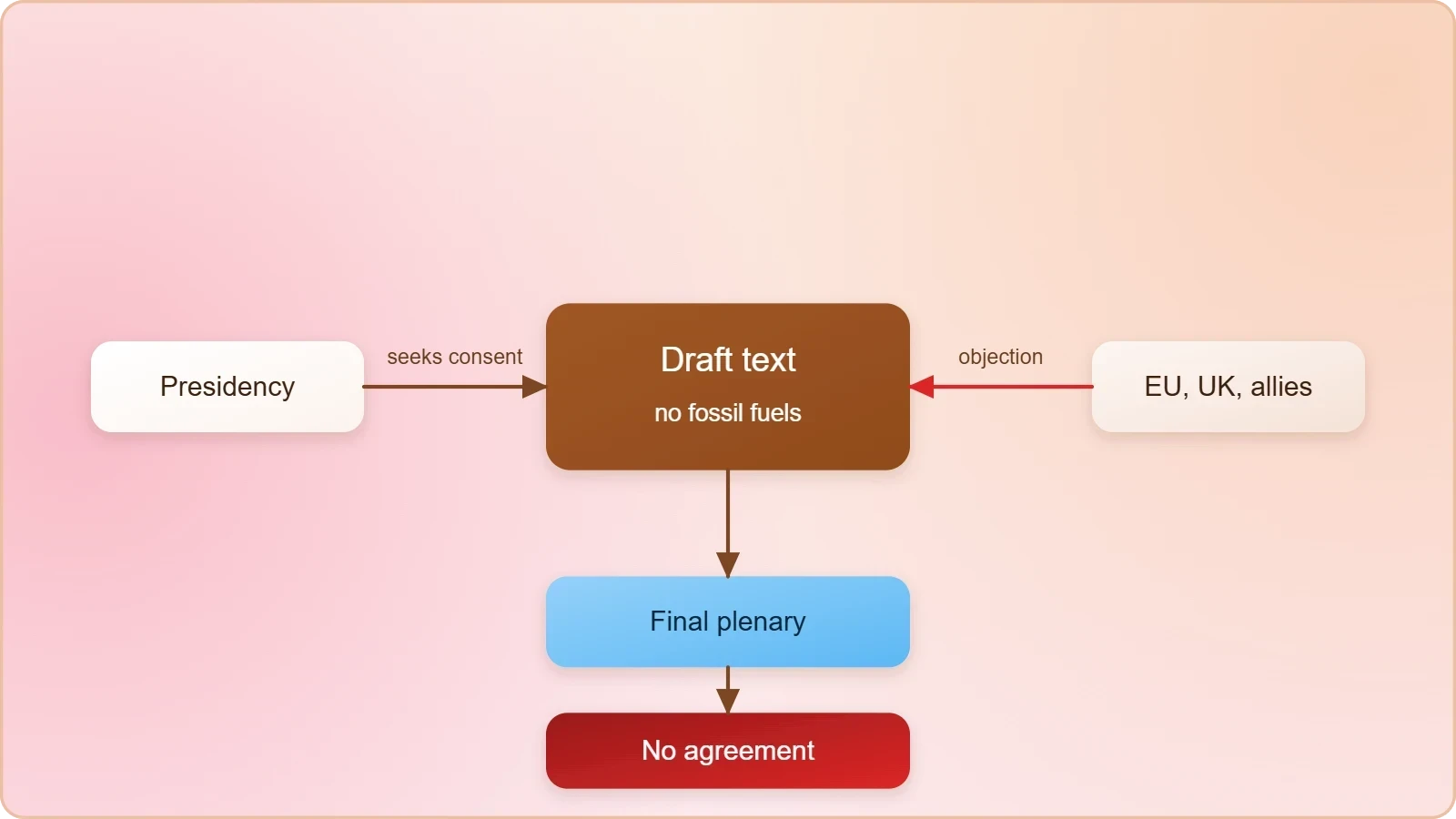
The episode matters far beyond the conference halls of Antalya. It exposes the widening chasm between the architecture of global climate commitments and the measurable action required to keep temperature goals within reach. Ireland's environment minister, Darragh O'Brien, speaking on behalf of the EU, framed the refusal in precisely those terms, arguing that the proposal "failed to meet the moment" and would only deepen the gap between pledges and delivery. That language carries weight because it comes from a bloc that has staked considerable credibility on being the conscience of the process, and because it was echoed by allies in the developing world whose exposure to climate risk is most acute.
What follows is a close reading of the Antalya outcome: the politics that produced the deadlock, the meaning of a final text that omits the words "fossil fuels," the coalition arithmetic that made rejection viable, and the consequences for the next negotiating cycle. The analysis also examines what the collapse reveals about the institutional limits of consensus diplomacy and why the absence of agreement may, paradoxically, preserve the possibility of a stronger one later.
On This Page
- The Anatomy of a Failed Final Plenary
- The Fossil Fuel Question and the Science Gap
- Coalition Arithmetic: Who Rejected and Why
- Institutional Strain: Consensus Diplomacy Under Pressure
- Economic and Market Reverberations
- Geopolitics of Climate: A Fractured Negotiating Landscape
- Reading the Outcome: What Antalya Actually Decided
TL;DR COP31 in Antalya became the longest climate summit on record and ended without agreement after the EU, the UK and developing-world allies rejected a draft that omitted any reference to fossil fuels. The rejection, voiced by Ireland's environment minister on behalf of the EU, reflected a judgment that the text failed to match the science and would widen the gap between commitments and action. The outcome leaves the conference without a key negotiated text, sharpens divisions over the future of climate action, and shifts the burden of progress to the next summit cycle.
The Anatomy of a Failed Final Plenary
The closing session of COP31 was less a negotiation than an accounting of irreconcilable positions. A presidency typically enters the final plenary with a text it believes can survive objection; here, the draft arrived already wounded, having been stripped of language that a significant bloc regarded as non-negotiable. When the moment of adoption came, the objection was not a single voice but a coordinated refusal spanning the European Union, the United Kingdom and developing-world allies, a configuration that denied the presidency the political cover it needed to gavel through.
That coalition is itself the story. Climate diplomacy has long assumed a rough division between high-emitting developed economies and vulnerable developing states, with the two camps pulling in opposite directions on finance and mitigation. Antalya inverted that assumption. Countries with vastly different historical responsibilities and adaptation needs found common cause in the conviction that a text silent on fossil fuels was worse than no text at all, because silence would legitimise business as usual under the banner of consensus.
The Presidency's Dilemma
Murat Kurum's task was structurally impossible from the outset. A presidency must broker, cajole and ultimately deliver a text that enough parties can live with, but it must also protect the integrity of the process it stewards. When the draft omitted fossil fuels, the presidency faced a choice between forcing adoption over principled objection and accepting visible failure. It chose the latter, or had it chosen for it, and the conference ended without agreement on a key text rather than with an agreement that would have been repudiated by major parties.
This is a familiar trap in consensus-based institutions. The rule that nothing is agreed until everything is agreed gives any determined bloc a veto, but it also gives any determined bloc a shield. The EU and its allies used that shield deliberately, calculating that a weak text adopted by acclamation would be harder to reopen than a failed conference that leaves the question open. Whether that calculation proves correct depends on what happens in the months before the next summit.
Why the Longest Summit Produced the Thinnest Outcome
Duration is often mistaken for progress. COP31 ran longer than any predecessor, and the exhaustion of delegates became a pressure tactic in its own right, with the implicit argument that weary parties would accept almost anything to go home. That logic failed because the objection was not tactical but foundational. A conference can extend indefinitely; it cannot extend past the point where a party concludes that signing would betray its own stated science-based obligations.
The length of the summit also magnified the visibility of the failure. Extended sessions generate rolling coverage, and every additional hour of deadlock communicated to publics and markets that the multilateral machinery was straining. For governments already facing domestic pressure on energy costs and industrial competitiveness, the spectacle of a record-length summit collapsing over two words was a difficult image to defend.
The Fossil Fuel Question and the Science Gap
At the centre of the Antalya rupture sits a deceptively simple omission. The proposed agreement did not mention fossil fuels, the dominant source of global greenhouse gas emissions and the one variable most directly within the reach of policy. For the EU and its allies, that silence was not a drafting oversight to be fixed in a later session; it was a signal that the text had been engineered to avoid the central question. A climate agreement that cannot name the principal cause of the problem is, on this reading, an agreement about something other than climate.
The objection was framed explicitly in the language of scientific adequacy. O'Brien's statement that the proposal "failed to meet the moment" invoked the standard against which any climate text is now measured: whether it responds to the science and narrows, rather than widens, the gap between commitments and required action. That standard has become the organising principle of high-ambition diplomacy, and it converts a procedural objection into a moral and empirical one. You cannot claim to be implementing the science while declining to address its primary driver.
Reading the Omission as a Signal
Diplomatic texts are read as much for what they exclude as for what they contain. The absence of fossil fuel language in a final draft does not happen by accident; it reflects the accumulated pressure of parties whose economies remain tied to hydrocarbon extraction and whose negotiators treat explicit phase-down language as an existential threat to their bargaining position. When that pressure succeeds, the resulting text communicates to investors, regulators and civil society that the multilateral process has declined to price in the transition.
The signal travels further than the conference hall. Energy markets, insurers and infrastructure planners watch these texts for indications of policy direction, and a document that avoids naming fossil fuels reduces the perceived urgency of stranded-asset risk. That is precisely why the omission became a red line for the EU and its partners: conceding it would have handed a durable rhetorical asset to those arguing that the transition can be deferred without consequence.
Commitments Versus Action: Measuring the Gap
The gap between pledged ambition and delivered policy is not a rhetorical flourish; it is a quantifiable distance. Current national commitments, if fully implemented, still leave the world short of the temperature goals set out in the Paris framework, and the shortfall grows when commitments are discounted for implementation credibility. A conference text that declines to address the largest emissions source widens that gap further, because it removes the mechanism by which commitments are translated into sectoral policy.
Formally, the adequacy of a mitigation pathway can be expressed as the difference between the emissions trajectory implied by pledges and the trajectory consistent with the temperature target:
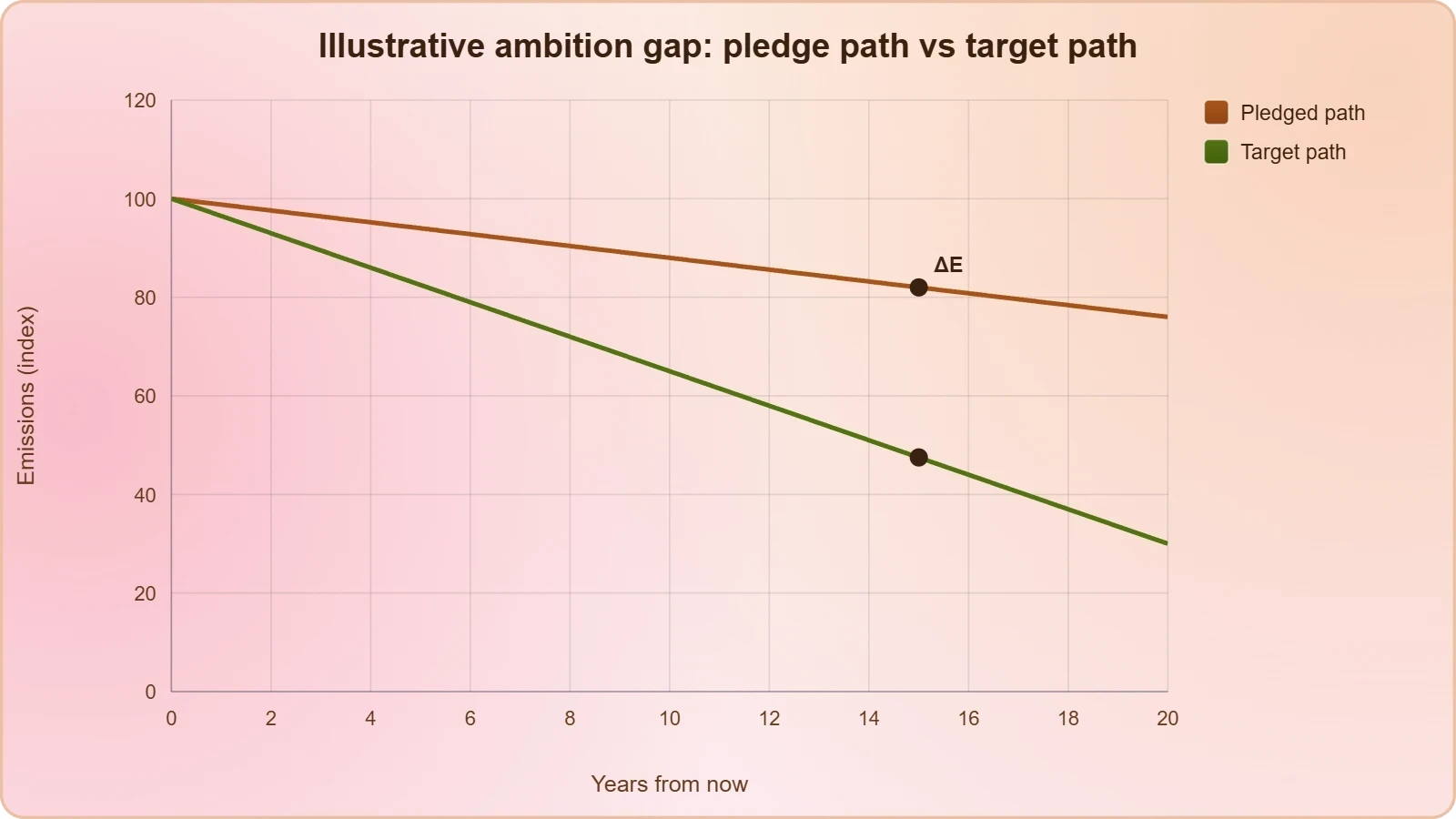
When ##\Delta E > 0##, the world is on a pathway that overshoots the target, and the size of that overshoot is the measure of the ambition gap. A text silent on fossil fuels does not change the arithmetic, but it removes the policy lever most capable of reducing ##\Delta E##, which is why the EU treated the omission as a substantive failure rather than a semantic one.
Coalition Arithmetic: Who Rejected and Why
The rejection was notable for its breadth. The European Union, represented in the plenary by Ireland's environment minister, supplied the institutional weight and the public rationale. The United Kingdom added a post-Brexit voice that has consistently positioned itself within the high-ambition camp. Crucially, allies in the developing world joined them, and that participation dismantled the familiar framing in which ambition is a rich-world preoccupation and developing states are concerned only with finance and adaptation.
That coalition reflects a genuine convergence of interest. For vulnerable developing countries, a text without fossil fuel language is not a neutral compromise but an active threat, because it postpones the mitigation that determines whether adaptation remains feasible. For the EU and UK, the text implicated their credibility as brokers who had promised domestic audiences that multilateralism could deliver. Different motives, same conclusion: the draft could not be endorsed.
The EU and UK Position
Brussels and London arrived in Antalya with a shared red line and different domestic constraints. The EU has embedded climate ambition in its legislative architecture, and endorsing a text that omitted fossil fuels would have contradicted the direction of its own regulatory programme. The UK, meanwhile, has sought to project continuity of ambition despite political turbulence at home, and signing a weakened text would have undercut that projection at precisely the moment it needed reinforcement.
O'Brien's phrasing as EU spokesperson was carefully calibrated. By saying the proposal "failed to meet the moment," he located the failure in the text rather than in the process, preserving the EU's commitment to multilateralism while refusing to bless an inadequate outcome. That distinction matters for the next round: it leaves the door open to a stronger agreement without conceding that the current draft was acceptable.
The Developing-World Alliance
The participation of developing-world allies transformed the politics of the plenary. Had the objection come only from wealthy blocs, it could have been characterised as a dispute between large emitters over burden-sharing. With vulnerable states alongside them, the rejection became a statement about the adequacy of the text relative to the risk faced by those least responsible for historic emissions and most exposed to climate impacts.
This alignment also complicates the traditional finance bargain, in which mitigation ambition is traded against adaptation funding. Developing-world negotiators signalled that they will not accept a text that trades away mitigation for money, because adaptation has physical limits and no quantity of finance can compensate for a climate trajectory that exceeds them. That position hardens the terms of future negotiations and narrows the space for the kind of lowest-common-denominator drafting that produced the Antalya text.
Institutional Strain: Consensus Diplomacy Under Pressure
COP31 did not invent the weaknesses of consensus diplomacy, but it displayed them with unusual clarity. A process that requires unanimity for adoption gives every party a veto and none a mandate. When the parties most committed to ambition conclude that the veto is their only remaining instrument, they will use it, and the institution's output falls to the level acceptable to its least ambitious participant or to nothing at all. Antalya produced the second outcome, which at least has the virtue of honesty.
The strain is compounded by the sheer scale of the agenda. Modern climate negotiations encompass mitigation, adaptation, finance, loss and damage, transparency and technology transfer, each with its own coalition and its own red lines. Packaging these into a single text creates a combinatorial bargaining problem in which any one element can sink the whole. The fossil fuel omission was the proximate cause of failure, but the structural vulnerability was the packaging itself.
The Veto as a Shield
Vetoes are usually described as obstructive, but in Antalya the veto functioned as a protective device. By refusing to adopt a text they regarded as inadequate, the EU and its allies prevented the creation of a precedent that future negotiators could cite as the acceptable floor. In institutional terms, they traded a short-term reputational cost for the preservation of a longer-term standard, betting that a reopened question is more tractable than a locked-in weak answer.
That bet carries risk. Repeated failure erodes confidence in the process and strengthens the hand of those who argue that multilateral climate governance is incapable of delivering. The counter-argument is that the alternative, adopting texts that fail the science, erodes confidence more slowly but more completely, because it converts the process into a ritual without consequence. Which risk is greater is the central strategic question facing high-ambition governments.
What Failure Preserves
Failure is not always loss. By declining to adopt a text that omitted fossil fuels, the rejecting coalition kept the question open and denied legitimacy to a lowest-common-denominator outcome. The next presidency will inherit an unresolved mandate rather than a settled precedent, and unresolved mandates can be reopened with new science, new coalitions and new pressure. The Antalya collapse may therefore function as a pause rather than a terminus.
There is precedent for this pattern. Climate negotiations have repeatedly produced moments of apparent breakdown that later yielded stronger texts once the political configuration shifted. The difference now is the compression of time: the emissions budget consistent with the temperature goals shrinks with every year of delay, so each pause is more costly than the last. Preserving the possibility of a stronger agreement is valuable only if the next attempt arrives quickly.
We Also Published
Economic and Market Reverberations
Climate summits are watched in financial markets not for their communiqués but for their signals about policy direction. A conference that ends without agreement on a key text sends a muddled message: it suggests that the political will to accelerate the transition is contested, which can be read as a reprieve for carbon-intensive assets and a delay for transition-aligned investment. That reading is likely to be temporary, but temporary signals move capital.
The more durable effect is on planning horizons. Utilities, insurers and industrial firms build capital allocation around expected regulatory trajectories, and ambiguity at the multilateral level pushes decisions back to the national and regional level, where policy is more concrete but more fragmented. Fragmentation raises compliance costs and complicates cross-border investment, which is precisely the outcome that a coherent international framework is meant to prevent.
Signals to Carbon-Intensive Assets
For holders of hydrocarbon assets, the Antalya outcome offers a modest rhetorical reprieve. A text that declines to name fossil fuels can be cited in boardrooms and investor calls as evidence that the transition timeline remains politically negotiable. That citation is weak, because national policies, court rulings and capital markets have their own momentum, but in the short run it may slow the pace at which some institutions provision for stranded-asset risk.
The reprieve should not be overstated. The direction of travel in the EU, the UK and a growing set of developing economies is embedded in legislation, not merely in summit texts, and legislation does not require annual consensus. The Antalya failure affects the speed and coordination of the transition more than its ultimate direction, and markets that mistake a diplomatic setback for a policy reversal are likely to be corrected.
Transition Finance and Investor Confidence
Transition finance depends on credible policy signals, and credibility is cumulative. Each failed summit makes it marginally harder for institutional investors to justify long-horizon allocations to emerging-market transition projects, because the policy risk premium rises when the multilateral anchor is uncertain. That effect is small in any single year but compounds, and it falls hardest on developing economies that need external capital to decarbonise while growing.
There is a countervailing dynamic. The rejection was led by a coalition that included developing-world partners, which signals to investors that the demand for transition capital in those economies is backed by political commitment rather than passive expectation. If that coalition consolidates into a durable negotiating bloc, it could become a source of policy certainty that compensates for the absence of a global text.
- 01
- 02
- 03
- 04
Geopolitics of Climate: A Fractured Negotiating Landscape
Antalya exposed a negotiating landscape that no longer maps onto the categories inherited from the Kyoto and Paris eras. The old binary of developed versus developing has been replaced by a more fluid geometry in which blocs form around specific texts rather than around fixed identities. The EU and UK found themselves aligned with vulnerable developing states against a draft that other developing economies were willing to accept, and that alignment is likely to recur.
Energy security has reshaped the calculus. Since the supply shocks of the early 2020s, governments have weighted reliability and affordability more heavily, and some have extended the life of hydrocarbon infrastructure to manage transition risk. That shift has made explicit fossil fuel language harder to negotiate even as the scientific case for it has strengthened, producing the paradox at the heart of Antalya: the text became less ambitious precisely when ambition became more urgent.
Energy Security and the Transition
The tension between security of supply and decarbonisation is real, but it is often overstated as a binary. Diversification into renewables, storage and efficiency improves energy security by reducing exposure to imported fuel price volatility, which is why many governments pursue both agendas simultaneously. The political difficulty lies in sequencing and cost distribution, not in the underlying logic, and that difficulty is what negotiators were unable to resolve in a single text.
Antalya's failure means the resolution will be attempted elsewhere: in national energy plans, regional markets and bilateral deals. That fragmentation is less efficient than a coordinated framework, but it is not paralysis. The risk is that without a multilateral anchor, the transition proceeds at different speeds in different regions, producing competitive distortions and leaving the most vulnerable economies dependent on external support that may not materialise.
What the Next Cycle Must Resolve
The next negotiating cycle inherits three unresolved questions. First, whether fossil fuel language is a precondition for any agreement or a bargaining chip to be traded. Second, how mitigation ambition is balanced against finance and adaptation commitments without one being used to suppress the other. Third, whether consensus adoption remains viable or whether the process needs procedural reform to prevent a single bloc from determining the outcome for all.
None of these questions has an easy answer, and the Antalya outcome suggests that the parties are not yet close to one. What the conference did establish is that a significant coalition is prepared to accept visible failure rather than endorse an inadequate text. That is a meaningful datum for anyone modelling the future of climate governance, because it tells us where the floor now sits and who is willing to defend it.
Reading the Outcome: What Antalya Actually Decided
The plain reading of COP31 is that it decided nothing, and in a formal sense that is correct: no key text was adopted, and the conference closed without agreement. But institutions also decide through refusal. By rejecting a draft that omitted fossil fuels, the coalition established that such a text is no longer adoptable, which is a substantive constraint on future presidencies and a meaningful clarification of where the acceptable floor lies.
That clarification has value precisely because it was costly. A statement of principle issued at a press conference carries little weight; a refusal that forces a summit to end without agreement carries a great deal, because it demonstrates willingness to bear the reputational and diplomatic costs of the position. Future negotiators will calibrate their drafts against that demonstrated resolve, which changes the bargaining equilibrium even without a signed text.
Assessing the Costs of No Deal
The costs are real and unevenly distributed. Vulnerable states lose the adaptation finance and programmatic support that a concluded package would have mobilised, and the delay compounds physical risk that cannot be recovered. The multilateral system loses a measure of credibility, which strengthens arguments for minilateral and regional approaches that may be faster but less inclusive. And the next presidency inherits a harder task with less political capital to spend.
Against these costs must be set the cost of the alternative. Adopting a text silent on fossil fuels would have created a reference point that future drafts could cite, lowering the ambition baseline for years. It would also have demoralised the domestic constituencies that governments need in order to sustain climate policy, by demonstrating that their efforts at home could be traded away in a final plenary. On balance, the refusal appears defensible, though not costless.
Signals for the Road Ahead
Three signals deserve attention. The first is the durability of the rejecting coalition: if the EU, UK and developing-world allies formalise their coordination, they become a standing bloc capable of setting the terms of future texts. The second is the posture of the presidency and of states that were willing to accept the draft, whose preferences will shape the next negotiation. The third is the pace of national policy, which will determine whether the multilateral pause translates into a real-world slowdown.
The most useful way to read Antalya is as a stress test that the system passed in one respect and failed in another. It passed by demonstrating that a coalition will defend a science-based floor even at the cost of visible failure. It failed by showing that the machinery cannot yet convert that resolve into an adopted text. Closing that gap is the work of the next cycle, and the credibility of the entire process depends on how quickly it is done.
From our network :
- The Final Descent: How ESA Retired the Legendary Cluster Constellation After 24 Years of Space Weather ScienceAfter 24 years mapping Earth’s magnetosphere, ESA’s Cluster mission concluded with a precisely controlled reentry over the South Pacific. This analysis explores the scientific legacy, engineering decisions, and debris mitigation principles behind one of space exploration’s most responsible retirements.
- The Hidden Cost of AI Convenience: Why Over-Permissioned Agents Are a Security Time BombDiscover why AI agents with excessive permissions create dangerous single points of failure, and learn how implementing least privilege principles can protect your organization from exploitation.
- Forbidden Matrix Patterns and Visible Lattice Points: A Geometric DictionaryExplore how multidimensional 0–1 matrices encode geometric truths, linking forbidden patterns to visible lattice points and hypergraph theory, with applications in combinatorics and computational geometry.
- Live Online English Classes for Kids: Do They Actually Reduce Anxiety?A ten-week study reveals that synchronous online English classes can significantly reduce child language anxiety while improving listening and reading skills. Discover what makes these programs effective and how parents can select the right one.
- How AI Agents Will Change the Way We Manage Personal FinancesExplore how AI agents are transforming personal finance through automated budgeting, bill payment, and investment management, while examining the critical security protocols and governance frameworks required for safe deployment.
- CISA’s Ten-Advisory Wave: Why Generic Patching Fails in OT and How to Build Product-Specific PlaybooksCISA released ten ICS advisories in one week, exposing critical infrastructure risks. Generic patching fails in OT. Learn to build product-specific remediation playbooks.
- University Language Proficiency Exams: Why Institutional Tests Demand Different Preparation Than IELTS and TOEFLDiscover why university-specific language proficiency examinations differ fundamentally from IELTS and TOEFL, and learn strategic preparation approaches for institutional assessment success.
- Mobile Learning and VR in English: What Global Evidence Reveals About Effective Language TechnologyA systematic review across 14 countries reveals which language-learning technologies genuinely work. Mobile learning, AI, and VR show measurable benefits when pedagogically integrated. This evidence-based guide helps educators and learners select technology that delivers real return on investment.
- Committed Mediterranean Precipitation Decline: Why Emissions Cuts Alone Cannot Restore Winter RainsNew NOAA research reveals that Mediterranean winter rains may decline irreversibly even with emissions cuts. Explore the science of committed climate change and regional impacts.
RESOURCES
- Cop31 climate talks set to end in deep division as key deal rejectedtheguardian.com3 hours ago ... We will not endorse a cover decision or an Antalya pact that does not even mention fossil fuels, which is…
- COP31 climate talks in Antalya, Turkey fail to agree deal after fossil ...bbc.com2 hours ago ... COP31 climate talks fail to agree deal as EU and others reject draft over fossil fuels row ... rejected a…
- COP31 climate talks on the brink as new draft deal faces scrutinyaljazeera.com5 hours ago ... The draft omits mention of the fossil fuels that scientists say are driving climate change, an issue that has been…
- COP31 climate talks set to collapse as EU and others reject dealreuters.com17 hours ago ... ... fuel, no reference to transitioning away from fossil fuels," he said. ... Turkey hosts COP31 UN Climate Change Conference…
- COP31 climate talks break down as E.U. and others reject dealcnbc.com3 hours ago ... ... Antalya Expo Centre, in Antalya on November 22, 2026. (Photo by ... fuel, no reference to transitioning away from…
- Cop31 climate talks collapse as EU rejects deal that omits fossil fuelsrfi.fr2 hours ago ... The Cop31 climate summit in Antalya reached a dramatic conclusion on Sunday when summit president Murat Kurum acknowledged that the…
- COP31 climate talks see no consensus as EU, others reject dealal-monitor.com4 hours ago ... ANTALYA, Turkey, Nov 22 (Reuters) - The COP31 climate talks in Turkey ... fossil fuels, the principal driver of (the)…
- COP31 ends without deal as EU rejects final text for omitting ...france24.com1 day ago ... Australian Minister for Climate Change and Energy and President of COP31 Negotiations Chris Bowen, Simon Cover ...
- COP31: Climate deal 'not adopted,' summit president says - DW Newsdw.com2 days ago ... EU cannot accept deal that 'greenwashes fossil fuels': Irish minister. Ireland's Climate Minister Darragh O'Brien has said the European Union…
- COP31 climate talks break down after angry dispute over fossil fuelsnbcnews.com3 hours ago ... U.N. climate action talks in Turkey broke down Sunday after the European Union and other nations rejected an agreement intended…
- Climate talks on the brink as EU rejects deal that 'green washes ...ft.com22 hours ago ... The EU would not “accept negotiating backward in time” and would “not accept a COP that green washes fossil fuels”,…
- EU rejects COP31 draft climate deal over fossil fuel omission as ...turkiyetoday.com4 hours ago ... EU rejects COP31 draft climate deal Sunday in Antalya for omitting fossil fuels, deepening the deadlock as negotiations entered overtime.
- COP31 climate talks collapse as EU and others reject dealasia.nikkei.com2 hours ago ... ANTALYA, Turkey (Reuters) -- U.N. climate talks collapsed on ... fuel, no reference to transitioning away from fossil fuels," he…
- COP31 climate talks break down as European Union and others ...japantimes.co.jp8 hours ago ... COP31 climate talks break down as European Union and others reject deal ... fossil fuels. The text acknowledged for the…
- COP31 climate talks in Antalya, Turkey fail to agree deal after fossil ...bbc.co.uk3 hours ago ... The EU and others have rejected the latest draft, two days after the UN summit had been due to end.
- 01
- 02
- 03
- 04
- 05
- 06
- 07
- 08
0 Comments