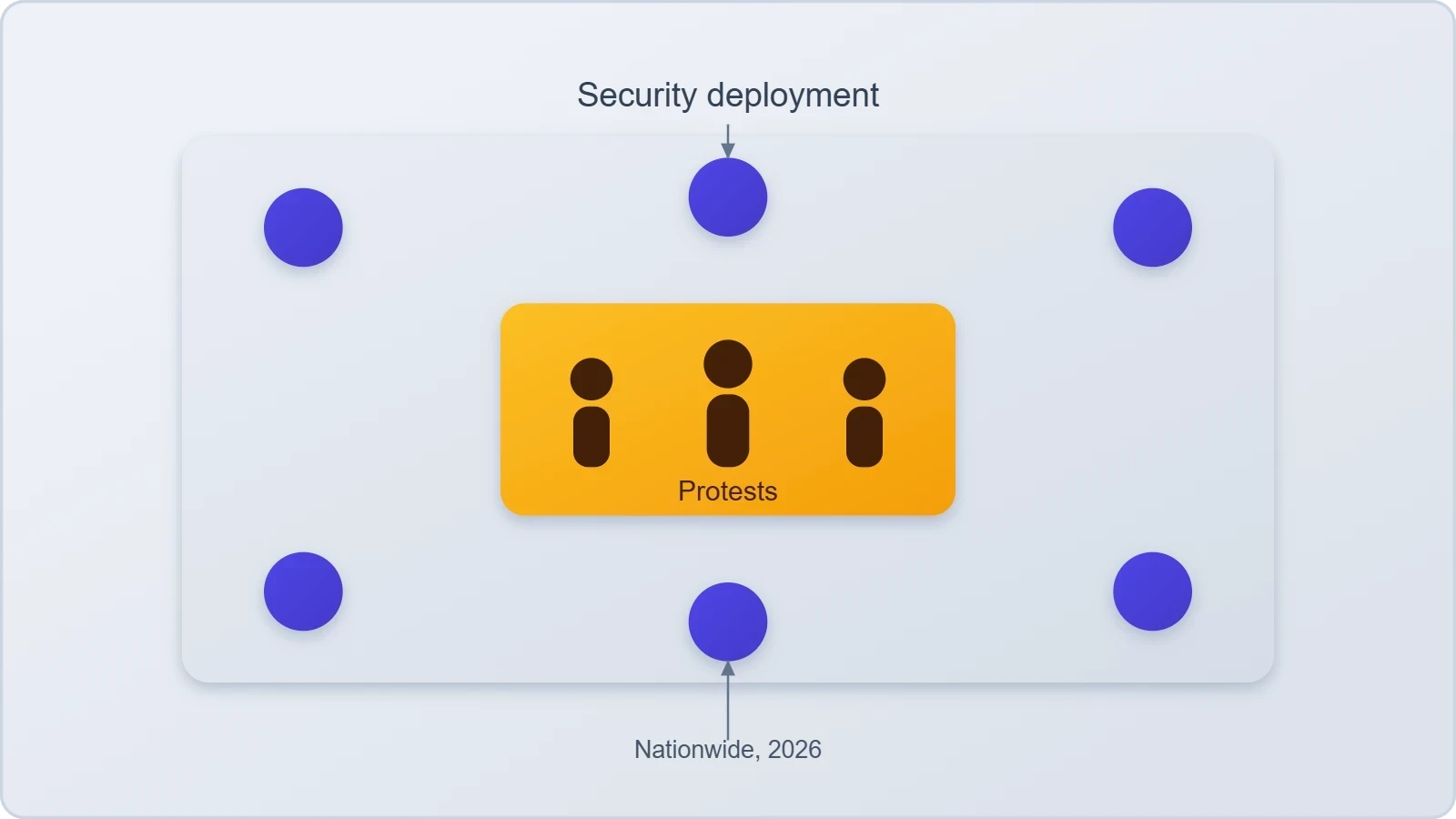
France stands at a volatile inflection point as it braces for nationwide protests on Saturday, exactly one week after some of the most severe civil unrest the nation has witnessed in decades.
The interior ministry has confirmed a massive security deployment of 70,000 police officers across French cities, a scale of mobilization that signals how seriously the state regards the coming weekend.
Hundreds of thousands of demonstrators are still expected to gather in Paris and regional urban centers, despite sweeping restrictions and outright bans imposed by local authorities.
On This Page
- The Security Architecture: 70,000 Officers and the Calculus of Containment
- The Student Movement: From Classroom Grievances to National Revolt
- The Yellow-Vest Revival: A Movement Reborn from Economic Rage
- The Political Calculus Inside the Élysée: Macron's Narrow Options
- The Anatomy of Unrest: From Peaceful March to Riot and Looting
- What Saturday Means: A Nation at a Crossroads
The unrest did not emerge from a single grievance but from a convergence of pressures: rising living costs, warnings of deep future spending cuts, and a student movement demanding better school conditions and more staff.
What began as high school students protesting educational neglect has metastasized into a broader anti-government sentiment, drawing in trade unions, radical left groups, and a revived yellow-vest movement. President Emmanuel Macron met student representatives on Friday and pledged a series of commitments on high school education starting Monday, yet student leaders insisted mobilization should continue.
This analysis dissects the anatomy of the crisis — the security architecture, the fragmented protest landscape, the political calculations inside the Élysée, and the economic anxieties fueling public anger.
It examines how authorities are balancing the constitutional right to demonstrate against the imperative of public order, and why the coming Saturday represents a decisive test for both the government and the movements arrayed against it.
TL;DR France is deploying 70,000 police officers ahead of nationwide protests one week after severe unrest, with hundreds of thousands expected to demonstrate despite bans and restrictions in cities like Lyon, Nice, and Montpellier. The movement, which began with high school students demanding better conditions, has expanded into broad anti-government sentiment fueled by rising living costs and anticipated spending cuts. President Macron has offered education commitments, but organizers and a revived yellow-vest movement demand his resignation, setting the stage for a high-stakes confrontation between state authority and popular discontent.
The Security Architecture: 70,000 Officers and the Calculus of Containment
The French interior ministry's decision to deploy 70,000 police officers represents one of the largest domestic security mobilizations in recent memory, reflecting authorities' determination to prevent a repeat of the rioting and looting that scarred the previous Saturday.
Interior Minister Laurent Nuñez has adopted an uncompromising posture, vowing zero tolerance for vandals, looters, and anyone committing violence during the demonstrations.
Restrictions, Bans, and the Geography of Prohibition
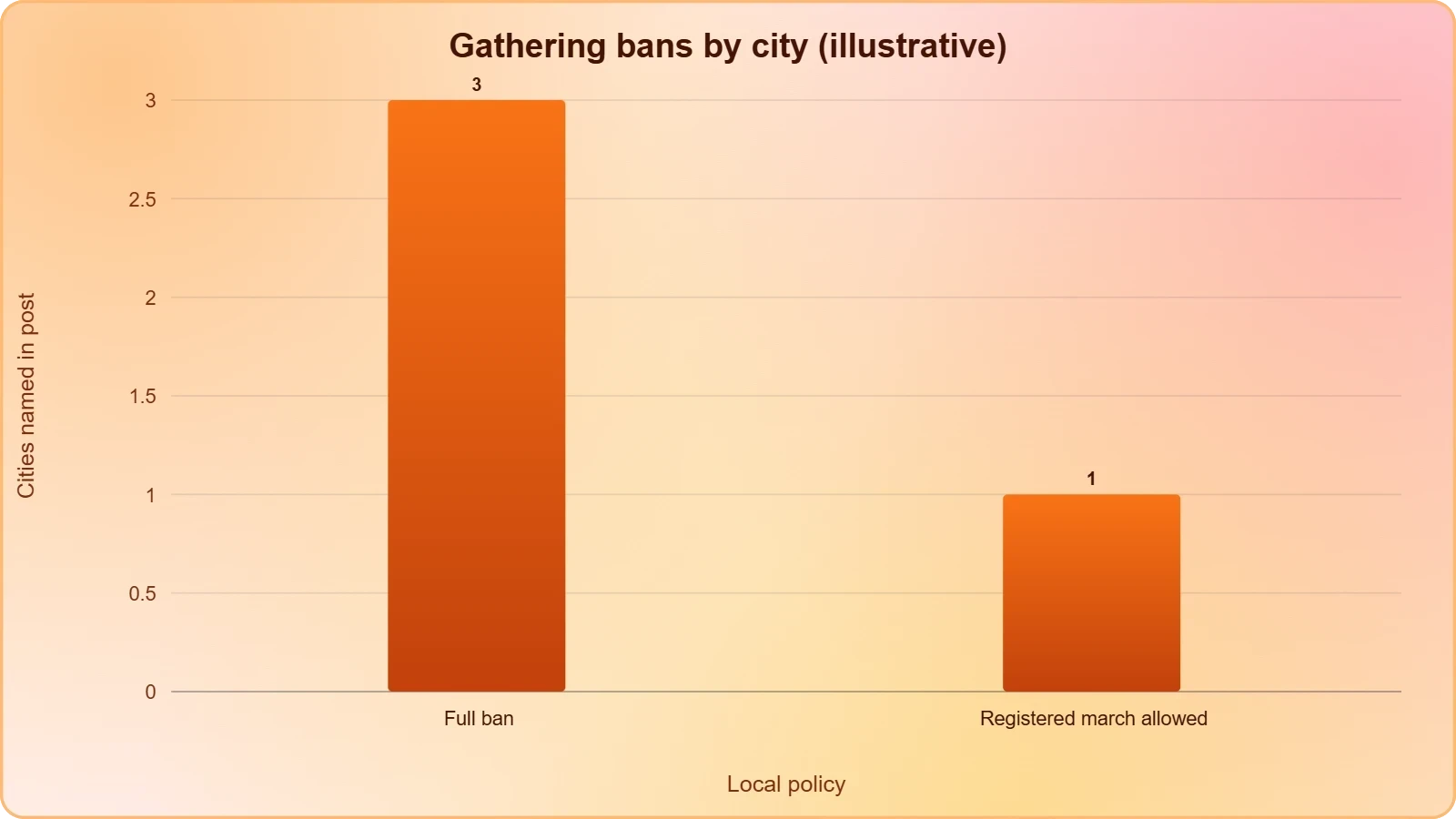
Authorities have layered a complex patchwork of restrictions across French territory, with several cities including Lyon, Nice, and Montpellier announcing full bans on gatherings. Some mayors have imposed broad prohibitions while others permit registered demonstrations, creating a fragmented legal landscape that varies sharply from one municipality to the next. In Marseille, an order banning all protests was swiftly reversed to allow a union-organized march.
In Paris, a march organized by the student union and backed by labor groups must follow a route deliberately designed to avoid the city center, though preparations for possible unrest in well-known districts are already underway.
The Louvre, Orsay, and Picasso museums will close their doors, and a scheduled PSG home football match has been postponed to Monday. Some businesses have boarded up windows in anticipation.
Intelligence Warnings and the Radical Fringe
Nuñez disclosed that numerous calls for violence had been detected on social media emanating from far-left and radical extreme-left groups, distinct from the planned protests themselves. This intelligence dimension complicates the security picture, forcing authorities to distinguish between legitimate demonstrators and those seeking confrontation.
In recent days, hundreds of people have been jailed following fast-track court hearings for vandalism, arson, and looting.
The rapid judicial processing signals a deliberate deterrent strategy: swift consequences intended to dissuade would-be rioters before the weekend. Yet critics argue that such fast-track measures risk inflaming tensions further, particularly among communities that already view the state's policing as heavy-handed and disproportionately targeted.
The Student Movement: From Classroom Grievances to National Revolt
The protests originated with high school students demanding better school conditions and more staff, a focused educational grievance that rapidly transcended its original boundaries. President Macron met with student representatives on Friday, and according to his advisers, he told them his government would make a series of commitments to improve high school education starting Monday. Student leaders acknowledged he made clear commitments but insisted students should continue to mobilize.
Macron's Concessions and the Limits of Persuasion
The president's willingness to engage directly with student representatives demonstrates a recognition that the movement's leadership must be addressed rather than simply suppressed. Yet the gap between government commitments and student expectations remains wide, and the insistence on continued mobilization suggests that concessions offered so far are viewed as insufficient.
The political risk for Macron is acute: appearing to negotiate under pressure while failing to quell the unrest.
Macron stated earlier this week that only demonstrations organized by recognized trade unions would be permitted on Saturday, an attempt to divide legitimate labor action from what the government frames as radical disruption.
This distinction, however, has been rejected by organizers who view it as an arbitrary restriction on the right to assemble and express dissent.
The Union-Student Alliance and Its Political Weight
The alliance between student unions and labor groups gives the movement a structural durability that purely spontaneous protests often lack. Trade unions bring organizational capacity, legal expertise, and the ability to sustain mobilization over time, while students supply moral urgency and media attention. This combination has historically proven potent in French politics, capable of forcing governments into retreat.
Organizers still plan hundreds of large and small demonstrations across France despite official announcements, signaling that the movement's decentralized character makes it resilient to targeted bans. The variance in local rules — some mayors imposing broad prohibitions, others allowing registered demonstrations — creates opportunities for organizers to exploit legal inconsistencies.
The Yellow-Vest Revival: A Movement Reborn from Economic Rage
Protesters linked to a revived yellow-vest movement may also be out in force on Saturday, injecting a volatile and unpredictable element into an already tense security environment. That movement, which draws support from both the left and right, led large disruptive demonstrations during Macron's first term and remains a potent symbol of anti-establishment fury in provincial France.
Five Hundred Demonstrations and a Demand for Resignation
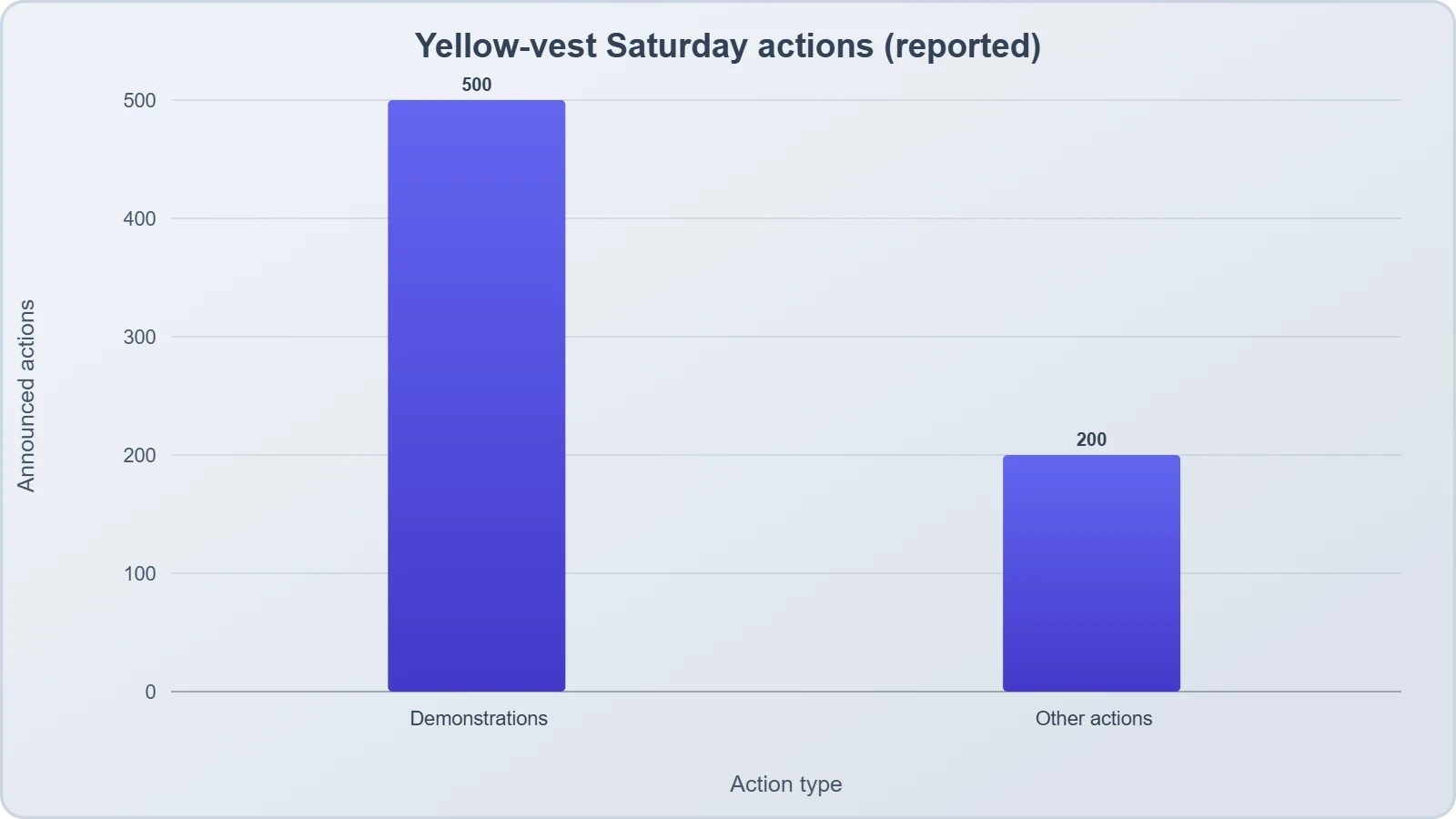
A website associated with the group listed more than 500 planned demonstrations and 200 other actions on Saturday, alongside an explicit demand that Macron resign. This scale of coordination suggests organizational infrastructure that has survived years of suppression and internal fragmentation.
The yellow vests' refusal to join criticism of the 17 October violence, and their accusation that police attacked protesters, reveals a deep distrust of state institutions.
The movement's ideological heterogeneity — spanning left and right — makes it difficult for any single political actor to co-opt or negotiate with. This structural ambiguity is both its strength and its weakness: it can mobilize broadly but struggles to translate discontent into coherent political demands beyond the removal of the president.
Economic Anxiety as the Unifying Fuel
Public dissatisfaction is running high, with many citizens confronting rising living costs and warnings that future governments will likely need deep spending cuts. These economic pressures provide the common fuel that unites students, workers, and yellow-vest protesters who might otherwise disagree on ideology. The prospect of austerity measures transforms diffuse frustration into a concrete political threat for the governing class.
France's fiscal trajectory — constrained by European Union rules and mounting debt obligations — leaves little room for the kind of generous concessions that might defuse the crisis. This structural bind means that even a government willing to spend cannot easily satisfy demands for improved public services and higher wages without breaching fiscal limits.
We Also Published
- 01
- 02
- 03
- 04
The Political Calculus Inside the Élysée: Macron's Narrow Options
President Macron confronts a political dilemma with no clean resolution: he must appear decisive on public order while avoiding the appearance of authoritarian overreach, and he must offer concessions without signaling weakness.
His meeting with student representatives on Friday was calibrated to project engagement, yet the commitments offered — improvements to high school education starting Monday — may prove too modest to satisfy a movement now animated by broader grievances.
The Trap of Selective Legitimacy
By declaring that only demonstrations organized by recognized trade unions would be permitted on Saturday, Macron attempted to draw a line between legitimate labor action and radical disruption. This strategy of selective legitimacy carries inherent risks: it can alienate unaffiliated protesters, energize claims of state repression, and hand organizers a potent narrative of exclusion. The distinction also proves practically unenforceable given the decentralized nature of the planned actions.
Several cities have announced full bans on gatherings, while others have allowed registered demonstrations, producing a legal patchwork that invites accusations of arbitrary governance. In Marseille, the rapid reversal of a blanket ban to permit a union march illustrates how legal restrictions can buckle under political and practical pressure.
Historical Parallels and the Risk of Escalation
France's political history is punctuated by moments when street mobilization has reshaped national trajectories, from May 1968 to the yellow-vest uprising of 2018-2019. The current convergence of student energy, union organization, and yellow-vest fury echoes those episodes, suggesting that the government's response will be scrutinized as a test of its capacity to govern through dissent.
The fast-track jailing of hundreds for vandalism and arson signals a punitive turn that could either deter violence or inflame it.
The closure of major cultural institutions — the Louvre, Orsay, and Picasso museums — and the postponement of a PSG football match underscore the extent to which the unrest is disrupting ordinary civic life.
Such disruptions carry economic costs and amplify public frustration, creating a feedback loop that complicates the government's effort to restore calm.
The Anatomy of Unrest: From Peaceful March to Riot and Looting
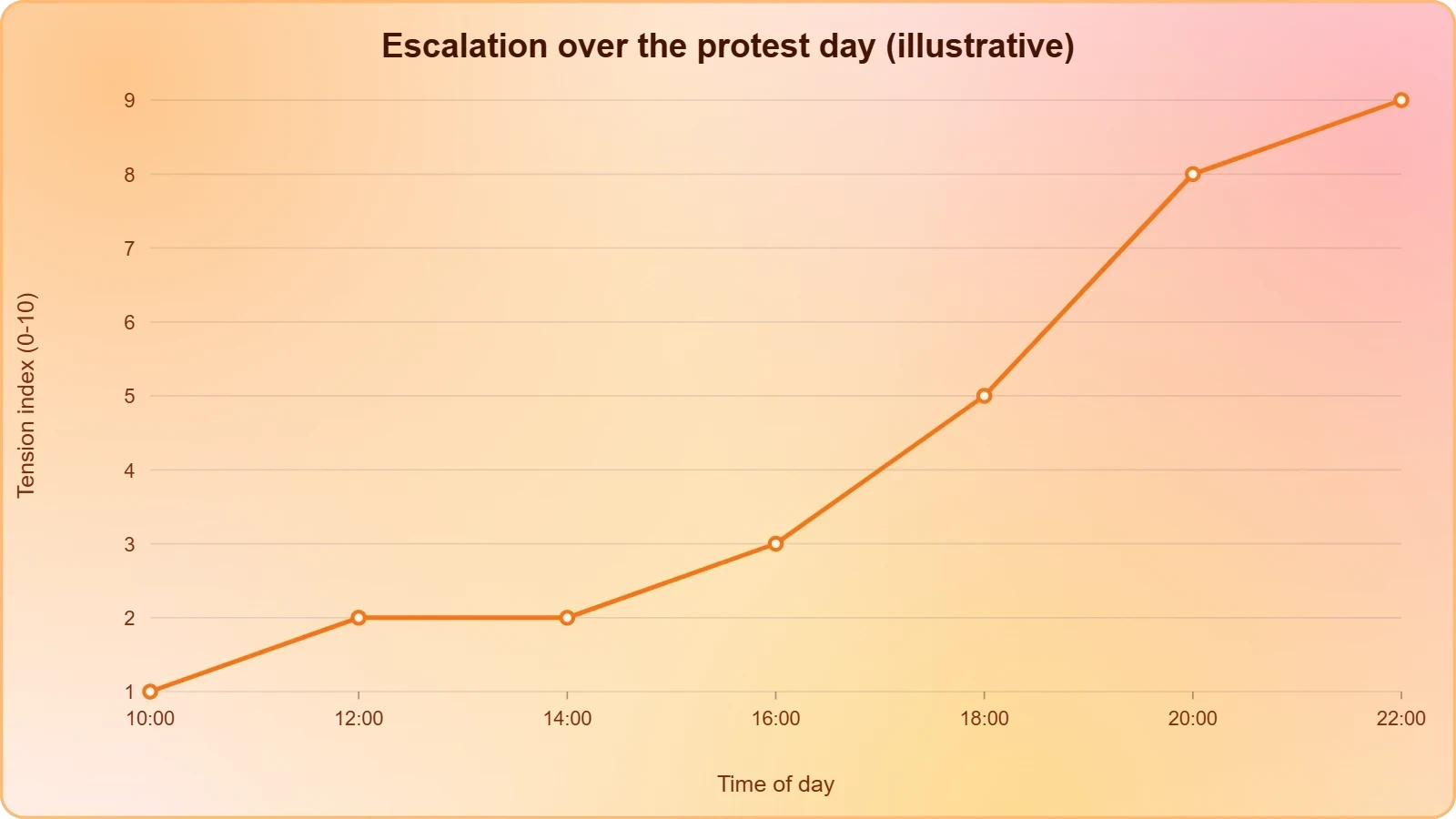
Last Saturday's events provide a cautionary template for what may unfold again: largely peaceful demonstrations in Paris organized by students and unions turned into rioting and looting as the day progressed.
This pattern — daylight civility giving way to nocturnal chaos — has become familiar in French protest culture, and it shapes how authorities plan their deployments and how businesses prepare for disruption.
The Temporal Dynamics of Escalation
Violence tends to erupt as organized marches conclude and crowds disperse, when radical elements can operate with greater anonymity and reduced accountability. The interior ministry's intelligence warnings about far-left and radical extreme-left calls for violence suggest authorities anticipate this temporal pattern and are positioning resources accordingly.
The fast-track jailing of hundreds for vandalism, arson, and looting represents an attempt to impose consequences swiftly enough to alter cost-benefit calculations.
Businesses boarding up windows and the closure of major museums reflect a learned response to recurring unrest, an acknowledgment that symbolic and commercial spaces become targets when order breaks down. The relocation of the PSG match to Monday removes a potential flashpoint and reduces crowd concentration in sensitive areas.
Policing Legitimacy and the Contest Over Violence
The yellow-vest movement's refusal to condemn the 17 October violence, coupled with its accusation that police attacked protesters, highlights a fundamental contest over narrative legitimacy. Who is the aggressor — the state or the demonstrators — becomes a political question with real consequences for public sympathy and future mobilization.
This contest plays out across social media, where calls for violence and claims of police brutality circulate with equal velocity.
Interior Minister Nuñez's uncompromising rhetoric targets vandals and looters, but the line between protester and rioter is often blurred in practice, and heavy-handed policing can radicalize bystanders. The government's challenge is to maintain order without validating claims that it is waging war on its own citizens.
What Saturday Means: A Nation at a Crossroads
Saturday's demonstrations will serve as a referendum on the government's capacity to manage dissent and on the movement's ability to sustain momentum without descending into the violence that erodes public sympathy.
The deployment of 70,000 officers, the patchwork of bans and permits, and the closure of cultural institutions all signal a state bracing for the worst while hoping for the best. The outcome will shape France's political trajectory for months to come.
The Stakes for French Democracy
At stake is not merely public order but the perceived legitimacy of France's governing institutions. If the government is seen to have provoked or mishandled the unrest, the political damage could be severe; if the movement is seen to have embraced violence, it risks losing the broad public support that gives it power.
Both sides understand that the battle for public opinion is as consequential as the battle in the streets.
The convergence of economic anxiety, educational grievance, and anti-government fury creates a combustible mixture that no single concession can neutralize. Macron's commitments on high school education, however sincere, address only one strand of a multi-stranded crisis.
The deeper challenge is restoring faith that the political system can deliver tangible improvements in ordinary people's lives.
Scenarios and Consequences
A relatively peaceful Saturday would strengthen the government's hand and weaken calls for further escalation, while widespread violence would deepen the crisis and invite more severe security responses. A middle scenario — scattered clashes amid largely peaceful marches — seems most likely given the pattern of the previous weekend. Whatever unfolds, the underlying grievances will persist beyond Saturday.
The yellow-vest movement's demand for Macron's resignation, the student unions' insistence on continued mobilization, and the economic pressures that fuel public anger all point toward a prolonged period of instability.
France's capacity to navigate this period without deeper rupture will depend on whether its institutions can adapt to the demands of a population that feels unheard and economically squeezed.
From our network :
- The Final Descent: How ESA Retired the Legendary Cluster Constellation After 24 Years of Space Weather ScienceAfter 24 years mapping Earth’s magnetosphere, ESA’s Cluster mission concluded with a precisely controlled reentry over the South Pacific. This analysis explores the scientific legacy, engineering decisions, and debris mitigation principles behind one of space exploration’s most responsible retirements.
- Forbidden Matrix Patterns and Visible Lattice Points: A Geometric DictionaryExplore how multidimensional 0–1 matrices encode geometric truths, linking forbidden patterns to visible lattice points and hypergraph theory, with applications in combinatorics and computational geometry.
- The Hidden Cost of AI Convenience: Why Over-Permissioned Agents Are a Security Time BombDiscover why AI agents with excessive permissions create dangerous single points of failure, and learn how implementing least privilege principles can protect your organization from exploitation.
- CISA’s Ten-Advisory Wave: Why Generic Patching Fails in OT and How to Build Product-Specific PlaybooksCISA released ten ICS advisories in one week, exposing critical infrastructure risks. Generic patching fails in OT. Learn to build product-specific remediation playbooks.
- Mobile Learning and VR in English: What Global Evidence Reveals About Effective Language TechnologyA systematic review across 14 countries reveals which language-learning technologies genuinely work. Mobile learning, AI, and VR show measurable benefits when pedagogically integrated. This evidence-based guide helps educators and learners select technology that delivers real return on investment.
- University Language Proficiency Exams: Why Institutional Tests Demand Different Preparation Than IELTS and TOEFLDiscover why university-specific language proficiency examinations differ fundamentally from IELTS and TOEFL, and learn strategic preparation approaches for institutional assessment success.
- Committed Mediterranean Precipitation Decline: Why Emissions Cuts Alone Cannot Restore Winter RainsNew NOAA research reveals that Mediterranean winter rains may decline irreversibly even with emissions cuts. Explore the science of committed climate change and regional impacts.
- Live Online English Classes for Kids: Do They Actually Reduce Anxiety?A ten-week study reveals that synchronous online English classes can significantly reduce child language anxiety while improving listening and reading skills. Discover what makes these programs effective and how parents can select the right one.
- How AI Agents Will Change the Way We Manage Personal FinancesExplore how AI agents are transforming personal finance through automated budgeting, bill payment, and investment management, while examining the critical security protocols and governance frameworks required for safe deployment.
RESOURCES
- France to deploy troops, admits to failures over weekend unrestreuters.com5 days ago ... PARIS, Oct 20 (Reuters) - France will reinforce police with troops and mount a huge security operation for more protests…
- France to deploy 70000 police as country braces for weekend protestsaljazeera.comPublished On 23 Oct 202623 Oct 2026. French authorities are preparing for a massive ... Interior Minister Laurent Nunez said about 70,000 police would…
- France to deploy 70,000 police for fresh weekend protests - AFP.comafp.com1 day ago ... France will deploy about 70000 police nationwide as it braces for new protests ... security measures and imposed restrictions on…
- French PM blames 'ultra-left' groups for weekend riots, promises ...france24.com5 days ago ... ... riots, promises 'massive' security deployment. French Prime Minister ... Read more'Like we had a war': France left reeling after…
- France to deploy 70,000 security forces for protests this weekendlemonde.frPublished on October 23, 2026, at 1:56 pm (Paris), updated ... France will deploy some 70,000 security personnel nationwide for new protests this weekend, ...
- France prepares for day of protest a week after nationwide riots - BBCbbc.com1 day ago ... The interior ministry has said it will deploy 70,000 police officers, ramping up the security presence in French cities, after…
- France to deploy 70000 police on Saturday to prevent civil unresttheguardian.com2 days ago ... Security forces to include elite units usually used for counter-terrorism after worst street violence in years.
- France: Clashes break out as protests go nationwide - DW Newsdw.com19 hours ago ... French police deployed more than 70,000 police and elite security forces across France to contain the unrest. This live blog…
- France Deploys 70,000 Police Officers Nationwide Ahead of ...instagram.com1 day ago ... ... France protest security measures | French demonstrations public order | nationwide security deployment France ... 2026/oct/23/france-police ...
- Demonstration Alert: Nationwide Protests About the Presidential ...co.usembassy.govAug 7, 2026 ... The U.S. Embassy will be closed. The Colombian government is deploying security personnel throughout the country to ensure a peaceful…
- France plans to deploy 70,000 security personnel nationwide during ...facebook.com2 days ago ... The crowd's presence was a reaction to recent violent protests, including "yellow jacket" activism that took place at the Arc…
- France faces new wave of nationwide protests - Anadolu Ajansım.aa.com.tr1 day ago ... ... protests in Paris, France on October 23, 2026. ... France to deploy police trainees as security measures tighten ahead…
- France announces 'massive' security deployment for weekend protestsen.yenisafak.comThe French government announced a massive security deployment ... 10:25, 21/10/2026, Wednesday. AA. Google See Yeni Şafak News More Often: Click and Add to ...
- France bolsters security as businesses fear renewed unrest during ...euronews.com2 days ago ... A massive security operation has been deployed across France for major protests on Saturday. Businesses across the country remain tense ...
- France Vows 'Extremely Firm' Response Ahead Of Saturday Protests ...bernama.com2 days ago ... ISTANBUL, Oct 23 (Bernama-Anadolu) -- French Interior Minister Laurent Nunez announced on Friday the deployment of 70,000 security personnel ...
- 01
- 02
- 03
- 04
- 05
- 06
- 07
- 08
0 Comments