
The disclosure, reported by The New York Times on 23 October 2026, that previously undisclosed financing arrangements for an Alaskan gas project surfaced during bilateral United States–Russia negotiations with the Kremlin constitutes a significant, if deliberately opaque, development in transcontinental energy diplomacy.
The original report is notably sparse: it confirms the emergence of hidden funding within the context of gas talks but furnishes neither the identity of the financiers, the magnitude of the capital involved, nor the precise mechanism by which the information entered the negotiating record.
Such informational asymmetry is itself analytically consequential, because it suggests that the revelation may function as a strategic signal rather than a conventional journalistic disclosure.
On This Page
Alaska occupies a structurally distinctive position within North American hydrocarbon geography. Its proven natural gas reserves, concentrated principally in the North Slope and historically anchored by the Prudhoe Bay complex, have long been constrained by the absence of commercial export infrastructure capable of reaching Pacific markets at competitive cost.
Successive proposals for liquefied natural gas terminals and pipeline corridors have faltered on questions of capital intensity, permitting timelines, and price risk. The emergence of undisclosed financing therefore intersects with a decades-old structural bottleneck, raising questions about whether unconventional capital sources are being mobilised to circumvent conventional project-finance constraints.
The geopolitical dimension warrants careful qualification. Any financial entanglement between Russian interests and Alaskan energy infrastructure would encounter a dense lattice of sanctions, export controls, and investment-screening mechanisms imposed following the 2022 invasion of Ukraine. Consequently, the reported financing may involve intermediaries, sovereign-adjacent vehicles, or third-country entities rather than direct Kremlin-linked investment.
This analysis examines the disclosure through five lenses: the strategic logic of Arctic energy diplomacy, the architecture of opaque project finance, the sanctions and compliance environment, the domestic political economy of Alaskan resources, and the broader implications for energy security and market transparency.
TL;DR A New York Times report dated 23 October 2026 indicates that undisclosed financing for an Alaskan gas project emerged during United States–Russia gas negotiations with the Kremlin. The disclosure is fragmentary, omitting financier identities, capital volumes, and contractual mechanics, yet it carries substantial analytical weight. It suggests that Arctic hydrocarbon development may be attracting capital flows that bypass conventional transparency channels, potentially complicating sanctions enforcement and investment screening. This analysis situates the revelation within the structural economics of Alaskan gas, the architecture of opaque project finance, and the contested terrain of energy diplomacy, concluding that the episode illustrates how informational ambiguity itself functions as an instrument of strategic leverage in contemporary resource geopolitics.
The Strategic Logic of Arctic Energy Diplomacy
Arctic energy diplomacy has historically operated as a domain in which commercial and strategic interests interpenetrate with unusual intensity. The region's hydrocarbon endowment, combined with its extreme logistical demands, generates projects whose viability depends as much on political guarantees as on geological prospectivity.
Negotiations between major powers over Arctic gas therefore rarely confine themselves to price and volume; they encompass infrastructure access, shipping corridors, insurance regimes, and the political risk premia that determine whether capital can be mobilised at all.
The Structural Economics of Alaskan Gas
Alaskan natural gas development confronts a cost structure that distinguishes it sharply from contiguous United States production. North Slope fields lie approximately 1,300 kilometres from tidewater, requiring either an 800-mile pipeline to a southern LNG terminal or an Arctic port facility capable of seasonal operation.
Both configurations entail capital expenditure measured in tens of billions of dollars, extended construction horizons, and environmental review processes that can span a decade or more.
The economics are further complicated by the absence of a captive regional market. Alaskan gas must compete in Pacific Basin LNG markets against Australian, Qatari, and increasingly Canadian supply, all of which benefit from shorter transport distances or lower upstream costs.
Project sponsors have consequently sought long-term offtake agreements with Asian buyers as a precondition for financial close, a structure that renders the projects acutely sensitive to counterparty creditworthiness and geopolitical alignment.
Historically, the Alaska LNG project, backed by the state through the Alaska Gasline Development Corporation, has struggled to assemble a bankable consortium. Major oil companies have repeatedly withdrawn or declined to commit, citing price risk and capital discipline.
This chronic financing gap constitutes the essential background against which any undisclosed funding arrangement must be interpreted, since it implies that conventional capital markets have judged the projects marginal.
The strategic value of Alaskan gas extends beyond commercial returns. For Washington, export capacity from Alaska represents a means of reinforcing energy security commitments to Asian allies while reducing their exposure to adversarial suppliers.
For Moscow, any involvement, however indirect, in Alaskan infrastructure would constitute a foothold in a domain from which it has been systematically excluded since 2022, conferring both intelligence value and symbolic leverage.
The Kremlin's Calculus in Bilateral Gas Talks
Russia's willingness to engage in gas discussions with Washington reflects a recalibration of its export geography following the loss of European markets. The diversion of pipeline volumes toward China and India has proceeded more slowly than anticipated, constrained by infrastructure bottlenecks and pricing disputes.
In this context, bilateral talks serve multiple purposes: probing for sanctions relief, signalling flexibility, and gathering intelligence on Western energy planning.
The introduction of Alaskan financing into these discussions may therefore be interpreted as a bargaining tactic. By revealing knowledge of undisclosed arrangements, Moscow could be signalling its awareness of Western financial vulnerabilities, implicitly threatening disclosure, or seeking reciprocal concessions on matters such as Arctic shipping or sanctions carve-outs for agricultural and medical trade.
Alternatively, the revelation may have originated with the American side, whether through deliberate briefing or inadvertent leakage. If Washington possesses intelligence indicating that sanctioned entities are financing Alaskan infrastructure, publicising the fact through a major newspaper could serve to deter further capital inflows and to justify enhanced screening measures without formally attributing blame.
Either interpretation underscores a structural feature of contemporary energy diplomacy: information about financing has become a strategic asset in its own right. The opacity that surrounds project finance, with its layered special-purpose vehicles and syndicated lending, creates opportunities for leverage that did not exist when energy projects were financed through transparent corporate balance sheets.
Historical Precedents and Comparative Cases
Precedent exists for foreign capital penetrating North American energy infrastructure through indirect channels. During the 1970s and 1980s, European and Japanese consortiums financed Canadian tar sands development through complex joint ventures that obscured ultimate beneficial ownership.
More recently, Chinese state-linked entities have acquired minority stakes in Arctic LNG projects through holding companies domiciled in third jurisdictions.
The Alaskan case differs in one crucial respect: the sanctions environment. Unlike earlier episodes, any Russian-linked financing of United States infrastructure after 2022 would constitute a potential violation of Executive Order 14024 and related measures, exposing financial institutions to secondary sanctions and correspondent banking restrictions. This raises the probability that the financing, if genuine, operates through intermediaries deliberately structured to obscure provenance.
Comparative analysis of the Nord Stream 2 financing consortium offers instructive parallels. That project assembled a syndicate of European energy companies whose commitments were structured to distribute political risk while maintaining commercial plausibility.
The Alaskan arrangement, if analogous, would likely involve entities with plausible non-Russian commercial rationales, layered through jurisdictions with permissive disclosure regimes.
Signalling Theory and Informational Ambiguity
In strategic interactions characterised by incomplete information, ambiguity itself can function as a communicative device. A party that reveals partial knowledge of an adversary's concealed arrangements signals both capability and intent without committing to full disclosure, preserving optionality while imposing uncertainty costs on the counterparty.
The fragmentary nature of the reported disclosure is consistent with this logic. By confirming the existence of hidden financing without specifying its details, the report generates pressure on multiple actors simultaneously: project sponsors must address reputational risk, regulators must assess enforcement exposure, and foreign governments must recalibrate their assessments of Western financial controls.
Formally, the value of such a signal can be represented as a function of the receiver's uncertainty regarding the sender's information set. If ##I## denotes the sender's private information and ##\hat{I}## the portion revealed, the strategic effect depends on the receiver's posterior belief about the residual ##I - \hat{I}##.
A sender who reveals a small but verifiable fraction of a larger information set can induce disproportionate belief revision.
This formulation, while stylised, captures the essential dynamic: the marginal effect of partial disclosure on the receiver's expected payoff depends on how the revealed information updates beliefs about undisclosed adverse contingencies. In the Alaskan case, confirmation that hidden financing exists may be more consequential than any specific detail about its composition.
The Architecture of Opaque Project Finance
Project finance is structurally predisposed toward opacity. Large infrastructure ventures are typically financed through special-purpose vehicles incorporated in jurisdictions selected for favourable treatment of secured lending, and capital is assembled through syndicated facilities involving dozens of institutions.
Ultimate beneficial ownership can be several corporate layers removed from the operating entity, and disclosure obligations vary substantially across regulatory regimes.
Special-Purpose Vehicles and Layered Ownership
The standard architecture involves a project company, often domiciled in a jurisdiction such as Delaware, the Netherlands, or Singapore, which holds the operating assets. Equity is contributed by sponsors through intermediate holding companies, frequently registered in Luxembourg, Mauritius, or the Cayman Islands.
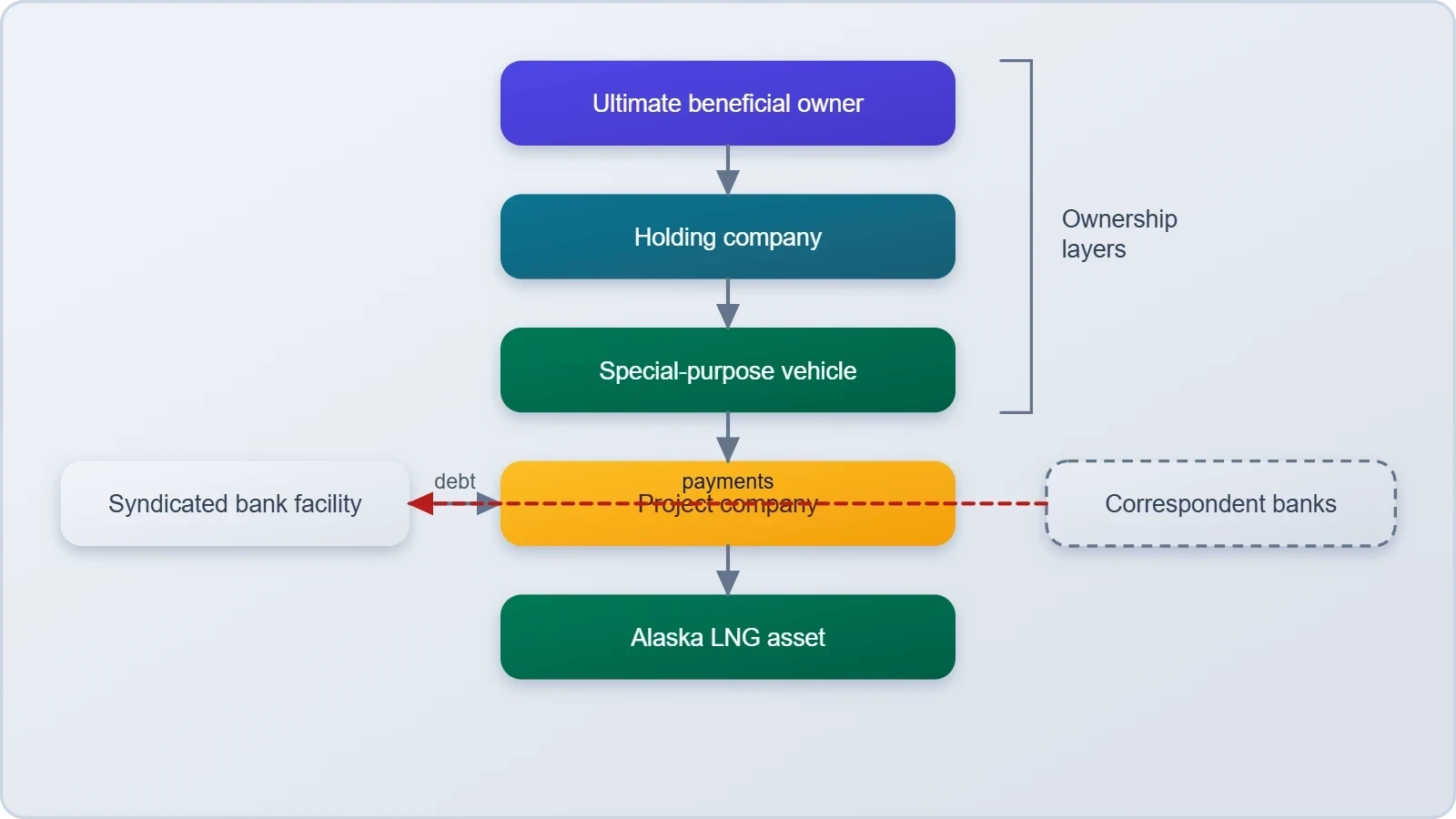
Debt is raised through syndicated facilities arranged by commercial banks and, in many cases, supplemented by export credit agencies.
Each layer serves legitimate commercial purposes: ring-fencing liabilities, optimising tax treatment, satisfying lender security requirements, and accommodating diverse investor classes. Simultaneously, each layer attenuates the visibility of ultimate ownership.
A financier seeking to conceal its participation need only ensure that its stake is held through an intermediate entity whose disclosure obligations are minimal.
Regulatory frameworks have attempted to address this opacity through beneficial ownership registers, but coverage remains uneven. The United States Corporate Transparency Act, implemented from 2024, requires reporting of beneficial owners for many entities, yet exemptions for large operating companies and regulated financial institutions create gaps. European registers, following the Court of Justice's 2022 ruling on public access, have restricted general availability.
Consequently, a financing arrangement involving Russian-linked capital could be structured to satisfy formal disclosure requirements while remaining substantively opaque. The relevant question for enforcement is not whether the arrangement is technically legal, but whether it evades the policy intent of sanctions through formalistic compliance.
Syndicated Lending and Correspondent Banking
Syndicated lending introduces further complexity. A facility of several billion dollars may involve lead arrangers, sub-participants, and secondary market traders, with participation interests changing hands repeatedly. Each transfer creates an opportunity for sanctioned capital to enter the syndicate through a participant whose identity is not disclosed to the borrower or to other lenders.
Correspondent banking relationships provide an additional channel. Dollar-denominated transactions must clear through United States financial institutions, which are subject to strict sanctions screening. However, transactions denominated in other currencies, or routed through non-dollar clearing systems, may evade this scrutiny, particularly where the participating institutions operate in jurisdictions with limited enforcement capacity.
The Financial Action Task Force has documented persistent weaknesses in trade-based money laundering and in the monitoring of complex corporate structures. These weaknesses are not incidental; they reflect the tension between the commercial demand for transactional efficiency and the regulatory demand for transparency, a tension that sanctions regimes continually struggle to resolve.
Sanctions Evasion Typologies
Contemporary sanctions evasion employs a recognisable repertoire of techniques. These include the use of front companies with nominee directors, the fragmentation of transactions below reporting thresholds, the exploitation of free trade zones, and the substitution of goods and services to obscure financial flows.
Each technique has been documented extensively in enforcement actions by the Office of Foreign Assets Control and equivalent authorities.
In the energy sector specifically, evasion frequently involves the misrepresentation of cargo origins, the use of ship-to-ship transfers to obscure provenance, and the interposition of trading houses in jurisdictions with limited regulatory oversight. Financing arrangements mirror these techniques, employing layered entities and non-standard documentation to distance capital from its ultimate source.
The Alaskan case, if it involves sanctioned capital, would likely exhibit several of these typologies. The capital might be routed through a private equity fund with diverse limited partners, or through a sovereign wealth fund whose investment decisions are formally independent of government direction. Such structures are legally defensible yet substantively problematic.
Detection Mechanisms and Their Limits
Detection of opaque financing relies on a combination of intelligence, whistleblowing, and forensic financial analysis. Intelligence agencies monitor capital flows through signals intelligence and human sources; financial intelligence units analyse suspicious transaction reports; investigative journalists cross-reference corporate registries and leaked documents.
Each mechanism has structural limitations. Signals intelligence can identify communications but not necessarily the substance of financial arrangements. Suspicious transaction reports are generated by institutions with commercial incentives to avoid over-reporting. Corporate registry analysis is constrained by the uneven quality of disclosure across jurisdictions.
The reported emergence of hidden financing during diplomatic talks suggests that intelligence channels may have detected the arrangement before public disclosure. This raises the question of why the information was surfaced in this particular manner, whether as a deliberate leak, an inadvertent disclosure, or a negotiating tactic.
Sanctions, Compliance, and the Regulatory Perimeter
The regulatory perimeter governing Russian-linked investment in United States energy infrastructure is extensive but not seamless. Executive Order 14024, issued in April 2021, authorises sanctions against entities determined to operate in the technology, defence, and financial sectors of the Russian economy. Subsequent determinations have extended prohibitions to new investment, certain imports, and the provision of services.
The Scope of Executive Order 14024
Executive Order 14024 operates through a determination-based mechanism, whereby the Secretary of the Treasury, in consultation with the Secretary of State, identifies sectors subject to prohibitions. This structure permits rapid expansion of restrictions without new legislation, but it also creates interpretive uncertainty for market participants seeking to assess compliance obligations.
The prohibition on new investment is particularly relevant to the Alaskan case. If Russian-linked capital were deployed into a new project, it would potentially violate the order regardless of whether the investing entity itself is designated.
The critical question becomes one of attribution: whether the capital is sufficiently connected to the Russian Federation to fall within the order's scope.
Attribution analysis is inherently fact-specific. Treasury guidance indicates that entities owned 50 percent or more by designated persons are themselves subject to blocking, a rule that extends through chains of ownership.
However, capital contributed by non-designated entities with indirect Russian state connections may fall outside this rule, creating a grey zone that compliance officers must navigate.
Investment Screening and CFIUS
The Committee on Foreign Investment in the United States provides a second layer of scrutiny. CFIUS reviews transactions that could result in foreign control of United States businesses, with particular attention to critical infrastructure and energy assets.
The Foreign Investment Risk Review Modernization Act expanded the committee's jurisdiction to include non-controlling investments in critical technologies and infrastructure.
CFIUS review is confidential, and the committee's determinations are rarely disclosed. This opacity is justified on national security grounds but complicates public understanding of how foreign investment in energy infrastructure is assessed. A transaction that clears CFIUS review may nonetheless involve parties whose ultimate ownership is opaque to the public.
The Alaskan project, if it involves foreign capital, would likely have been subject to CFIUS review at some stage. The absence of public disclosure about such review does not imply its absence; it may simply reflect the confidentiality that surrounds the process.
Secondary Sanctions and Financial Institution Exposure
Secondary sanctions extend the reach of United States restrictions to non-United States persons engaging in certain transactions with designated entities. For financial institutions, the risk of losing access to dollar clearing is existential, and compliance departments therefore exercise considerable caution in screening counterparties and transactions.
This caution creates a chilling effect that extends beyond the formal scope of sanctions. Institutions may decline to participate in transactions that are technically permissible but carry reputational or regulatory risk. The result is a de facto tightening of the regulatory perimeter that exceeds its de jure boundaries.
For the Alaskan project, this dynamic may explain why conventional financing has proven elusive. Even if a particular capital source is not formally sanctioned, the perceived risk of future designation may deter participation by institutions whose compliance functions are conservative.
Enforcement Patterns and Deterrence
Enforcement actions by the Office of Foreign Assets Control have increased substantially in volume and severity since 2022. Penalties in the tens of millions of dollars are now routine, and the agency has emphasised the importance of robust compliance programmes. These actions serve both to punish violations and to signal expectations to the market.
Deterrence, however, depends on the probability of detection as well as the magnitude of penalties. Where financing arrangements are structured to obscure provenance, detection becomes more difficult, and the deterrent effect of enforcement is correspondingly weakened. This is the structural challenge that opaque finance poses to sanctions regimes.
The reported emergence of hidden financing suggests that detection mechanisms are functioning, at least partially. Whether they are sufficient to prevent the arrangement from proceeding, or merely to document it after the fact, remains an open question that the available evidence cannot resolve.
- 01
- 02
- 03
- 04
The Domestic Political Economy of Alaskan Resources
Alaska's political economy is defined by a paradox: extraordinary resource wealth combined with chronic fiscal fragility. Oil and gas revenues account for a substantial share of state government income, yet production has declined from its late-1980s peak, and the state has repeatedly faced budget shortfalls. Gas development is therefore viewed not merely as an economic opportunity but as a fiscal necessity.
State Ownership and the Alaska Permanent Fund
The Alaska Permanent Fund, established in 1976 through a constitutional amendment, receives a portion of resource royalties and invests them on behalf of all residents. Its value exceeds seventy billion dollars, and its annual dividend distribution constitutes a significant component of household income in many communities. The fund embodies a distinctive model of resource governance.
The fund's investment strategy is diversified across global asset classes, and its managers have historically emphasised transparency and fiduciary independence. However, the fund's exposure to energy investments has attracted scrutiny from climate-conscious stakeholders, and its governance structure has been tested by political pressures to increase dividend distributions.
Any undisclosed financing arrangement for Alaskan gas development would intersect with the fund's interests in complex ways. If the project proceeds, it could generate royalties that replenish the fund; if it fails, the state may bear stranded costs.
The fund's managers would therefore have strong incentives to understand the financing structure, even if they are not direct participants.
Federal-Local Tensions Over Resource Development
Resource development in Alaska is characterised by persistent tension between federal and state authorities. The federal government controls vast tracts of land, including the National Petroleum Reserve-Alaska and the Arctic National Wildlife Refuge, and federal permitting decisions can delay or block projects for years.
Successive administrations have adopted divergent positions on Alaskan development. The first Trump administration opened the Arctic Refuge to leasing; the Biden administration suspended those leases and imposed additional environmental reviews. This policy oscillation creates uncertainty that discourages long-term capital commitment.
The reported financing arrangement may therefore be interpreted as an attempt to circumvent federal policy risk by securing capital from sources less sensitive to United States regulatory volatility. Whether such circumvention is feasible, given the sanctions environment, is a question that the available evidence cannot definitively answer.
Indigenous Rights and Land Claims
Alaska Native corporations, established under the Alaska Native Claims Settlement Act of 1971, hold substantial land and resource rights. Their consent is often required for major projects, and their participation can take the form of equity stakes, royalty agreements, or impact benefit agreements.
The involvement of Alaska Native corporations in gas development raises questions about the distribution of benefits and the adequacy of consultation. These questions are not merely procedural; they bear on the legitimacy of projects and their susceptibility to legal challenge.
Any undisclosed financing arrangement would need to navigate this complex web of rights and interests. The opacity of the financing may complicate the ability of affected communities to assess the project's implications, raising concerns about informed consent.
Public Opinion and Environmental Contestation
Public opinion in Alaska on resource development is neither uniformly supportive nor uniformly opposed. Many residents depend on resource extraction for their livelihoods, while others prioritise environmental preservation and subsistence practices. This heterogeneity is reflected in state politics, which oscillates between resource-friendly and conservation-oriented coalitions.
Environmental organisations have consistently challenged Alaskan gas projects on climate grounds, arguing that new fossil fuel infrastructure is incompatible with decarbonisation commitments. These challenges have resulted in litigation that has delayed projects and increased their cost of capital.
The disclosure of undisclosed financing may provide additional grounds for contestation, particularly if the financing involves entities with poor environmental or human rights records. Such revelations can mobilise opposition and complicate the project's social licence to operate.
We Also Published
Implications for Energy Security and Market Transparency
The Alaskan disclosure carries implications that extend well beyond the specific project. It illustrates a broader pattern in which the financing of strategic infrastructure becomes entangled with geopolitical competition, and in which the opacity of financial structures complicates the enforcement of policy objectives.
These dynamics affect not only the United States and Russia but the entire architecture of global energy governance.
Energy Security and Supply Diversification
Energy security doctrine emphasises diversification of supply sources and routes as a hedge against disruption. Alaskan gas exports would contribute to this objective by providing Pacific allies with an additional supplier outside the Middle East and Southeast Asian production centres. However, the security benefit depends on the reliability of the supplier and the integrity of the financing.
If the project's financing involves adversarial capital, the security benefit may be compromised. A supplier whose ownership structure is opaque may be vulnerable to pressure or coercion, undermining the diversification rationale. This tension between commercial viability and strategic autonomy is central to contemporary energy policy.
The United States has sought to resolve this tension through mechanisms such as the Group of Seven's coordination on energy security and the establishment of critical minerals partnerships. These frameworks aim to channel investment toward trusted suppliers, but they operate through incentives rather than prohibitions and cannot fully exclude adversarial capital.
Market Transparency and Price Formation
Transparent markets facilitate efficient price formation and reduce the risk of manipulation. Opaque financing arrangements can distort price signals by concealing the true cost of capital and the identity of market participants. In the LNG sector, where long-term contracts dominate, opacity can obscure the relationship between contract prices and underlying costs.
The Alaskan project, if it proceeds with undisclosed financing, would contribute to this opacity. Market participants would be unable to assess the project's cost structure accurately, potentially leading to mispricing of competing supply and inefficient investment decisions.
Regulatory authorities have limited tools to address this opacity. Disclosure requirements apply primarily to publicly traded entities, and private project companies are subject to far lighter obligations. The result is a structural information asymmetry that favours insiders and disadvantages the market as a whole.
Alliance Management and Diplomatic Signalling
The disclosure occurred in the context of bilateral talks, a setting in which signalling is intrinsic to the interaction. By allowing the information to surface, one or both parties may have sought to communicate resolve, capability, or willingness to escalate. The interpretation of such signals depends on the receiver's prior beliefs and the credibility of the sender.
For United States allies, the disclosure may raise questions about the reliability of American commitments to sanctions enforcement. If Russian-linked capital can penetrate Alaskan infrastructure despite extensive restrictions, allies may doubt the effectiveness of the broader sanctions architecture and adjust their own policies accordingly.
For Russia, the disclosure may signal that its financial activities are being monitored and that concealment is imperfect. This could deter further attempts to penetrate Western infrastructure or, conversely, prompt more sophisticated methods of obfuscation. The net effect is uncertain and depends on the Kremlin's assessment of costs and benefits.
Precedents for Future Disclosure Regimes
The episode may accelerate efforts to strengthen disclosure regimes for strategic infrastructure. Legislative proposals in the United States have sought to expand CFIUS jurisdiction and to require more granular reporting of beneficial ownership for entities involved in critical sectors. Similar initiatives are under consideration in the European Union and the United Kingdom.
Enhanced disclosure, however, imposes compliance costs that may deter legitimate investment. Policymakers must balance the benefits of transparency against the burden on market participants. The optimal regime is likely to be risk-based, concentrating scrutiny on transactions that present the greatest national security concerns.
The Alaskan case provides a test case for such regimes. If the financing arrangement can be identified and assessed through existing mechanisms, the case for additional disclosure may be weaker. If it remains opaque despite scrutiny, the case for reform is strengthened.
Analytical Synthesis and Prospective Assessment
The available evidence permits only provisional conclusions. The report confirms that undisclosed financing for an Alaskan gas project emerged during United States–Russia talks, but it does not establish the identity of the financiers, the scale of the capital, or the legal character of the arrangement. Any assessment must therefore be framed in terms of conditional probabilities rather than definitive findings.
Weighing the Available Evidence
Three interpretive hypotheses are consistent with the reported facts. First, the financing may involve Russian state-linked capital seeking to penetrate United States infrastructure despite sanctions. Second, it may involve non-Russian capital whose opacity is commercially motivated rather than politically directed.
Third, the disclosure may be a deliberate strategic signal by one or both governments, with the underlying financing being of secondary importance.
Each hypothesis generates distinct observable implications. The first would predict subsequent enforcement actions, congressional inquiries, and enhanced screening of the project's investors. The second would predict a more muted response, with regulators satisfied that existing mechanisms are adequate. The third would predict continued ambiguity, with neither government confirming or denying the substance of the arrangement.
The available evidence does not permit discrimination among these hypotheses with confidence. The absence of follow-up reporting may reflect either the sensitivity of the information or the limited newsworthiness of a story that cannot be substantiated.
Analysts should therefore treat the disclosure as a data point requiring further corroboration rather than as a settled finding.
Scenarios for Project Development
Under a benign scenario, the financing is identified, assessed as compliant, and the project proceeds with enhanced disclosure. This outcome would demonstrate the resilience of existing regulatory mechanisms and would strengthen confidence in the sanctions architecture. It would also provide a template for managing similar cases in the future.
Under an adverse scenario, the financing is found to involve sanctioned capital, and the project is delayed or restructured. This outcome would impose costs on the project sponsors and the state of Alaska, while demonstrating the effectiveness of enforcement. It would also intensify scrutiny of other infrastructure projects with opaque ownership.
Under an ambiguous scenario, the financing remains partially opaque, and the project proceeds with unresolved questions about its ownership. This outcome would perpetuate uncertainty and would leave the sanctions architecture vulnerable to criticism. It is, on balance, the most likely outcome given the structural features of project finance.
Methodological Caveats
Analysis of this episode is constrained by the limited evidentiary base. The source report is brief and does not provide the documentary foundation that would permit definitive conclusions. Secondary reporting has not yet emerged to corroborate or elaborate the initial disclosure. Analysts should therefore exercise appropriate caution in drawing inferences.
The temptation to over-interpret fragmentary information is considerable, particularly in domains where geopolitical stakes are high. Rigorous analysis requires distinguishing between what is known, what is inferred, and what is speculated. The present assessment has sought to maintain this distinction, but the boundaries are inevitably blurred.
Future reporting may resolve some of these uncertainties. If additional details emerge about the financing structure, the identities of the participants, or the response of regulators, the analysis can be refined. Until then, the conclusions offered here should be regarded as provisional and subject to revision.
Concluding Observations
The Alaskan disclosure illustrates a structural feature of contemporary energy geopolitics: the financing of strategic infrastructure has become a domain of contestation in which state and commercial interests interpenetrate. The opacity that characterises project finance creates opportunities for adversarial capital to penetrate infrastructure that is nominally protected by sanctions and screening regimes.
Addressing this challenge requires more than incremental reform. It requires a reconceptualisation of transparency as a security asset rather than a compliance burden. Disclosure regimes should be designed to illuminate the ownership structures that matter for national security, while minimising the costs imposed on legitimate market participants.
The episode also underscores the importance of information as an instrument of statecraft. The manner in which the disclosure emerged, during diplomatic talks and through a major newspaper, suggests that information about financing is being deployed strategically.
Understanding these dynamics is essential for anyone seeking to comprehend the intersection of finance, energy, and geopolitics in the contemporary world.
From our network :
- Mobile Learning and VR in English: What Global Evidence Reveals About Effective Language TechnologyA systematic review across 14 countries reveals which language-learning technologies genuinely work. Mobile learning, AI, and VR show measurable benefits when pedagogically integrated. This evidence-based guide helps educators and learners select technology that delivers real return on investment.
- How AI Agents Will Change the Way We Manage Personal FinancesExplore how AI agents are transforming personal finance through automated budgeting, bill payment, and investment management, while examining the critical security protocols and governance frameworks required for safe deployment.
- The Hidden Cost of AI Convenience: Why Over-Permissioned Agents Are a Security Time BombDiscover why AI agents with excessive permissions create dangerous single points of failure, and learn how implementing least privilege principles can protect your organization from exploitation.
- Committed Mediterranean Precipitation Decline: Why Emissions Cuts Alone Cannot Restore Winter RainsNew NOAA research reveals that Mediterranean winter rains may decline irreversibly even with emissions cuts. Explore the science of committed climate change and regional impacts.
- CISA’s Ten-Advisory Wave: Why Generic Patching Fails in OT and How to Build Product-Specific PlaybooksCISA released ten ICS advisories in one week, exposing critical infrastructure risks. Generic patching fails in OT. Learn to build product-specific remediation playbooks.
- The Final Descent: How ESA Retired the Legendary Cluster Constellation After 24 Years of Space Weather ScienceAfter 24 years mapping Earth’s magnetosphere, ESA’s Cluster mission concluded with a precisely controlled reentry over the South Pacific. This analysis explores the scientific legacy, engineering decisions, and debris mitigation principles behind one of space exploration’s most responsible retirements.
- University Language Proficiency Exams: Why Institutional Tests Demand Different Preparation Than IELTS and TOEFLDiscover why university-specific language proficiency examinations differ fundamentally from IELTS and TOEFL, and learn strategic preparation approaches for institutional assessment success.
- Forbidden Matrix Patterns and Visible Lattice Points: A Geometric DictionaryExplore how multidimensional 0–1 matrices encode geometric truths, linking forbidden patterns to visible lattice points and hypergraph theory, with applications in combinatorics and computational geometry.
- Live Online English Classes for Kids: Do They Actually Reduce Anxiety?A ten-week study reveals that synchronous online English classes can significantly reduce child language anxiety while improving listening and reading skills. Discover what makes these programs effective and how parents can select the right one.
RESOURCES
- Russia secretly financed Alaska gas project | Ukrainska Pravdapravda.com.ua3 days ago ... Almost the entire management team of the US$25 billion US gas project Polar Train LNG has left the company following…
- Russia secretly financed Alaska gas projectfinance.yahoo.com3 days ago ... Almost the entire management team of the US$25 billion US gas project Polar Train LNG has left the company following…
- While Korea denies President Trump's announcement that it is ...facebook.com2 days ago ... ... Russia has actually been secretly funding a separate Alaska gas project. ... In U.S. Gas Talks With Kremlin, Hidden…
- Anne-Sophie Corbeau | 24 comments - LinkedInlinkedin.com3 days ago ... ... US-sponsored Ukraine peace plan that would include Russian gas returning to Europe. Now, we're seeing report of Novatek financing…
- On this day in 1867 America bought Alaska from Russia for $7.2 ...reddit.comMar 30, 2021 ... r/alaska - US executives quit $25bn gas venture over claims of secret Russian ... U.S. Gas Talks With Kremlin, Hidden…
- Energy News | Top Energy Headlines | Reutersreuters.comPutin says curbing Russian gas raises consumer costs, hints at US cooperation. Any attempts to exclude Russia from gas market raise costs for consumers,…
- Russian Offensive Campaign Assessment, February 3, 2026 | ISWunderstandingwar.orgFeb 3, 2026 ... ... US-Ukraine-Russia talks in Abu Dhabi. The Russian MFA stated on ... Russia and the United States allegedly agreed upon…
- Top stories - Google Newsnews.google.comIn U.S. Gas Talks With Kremlin, Hidden Financing for Alaska Project Emerges · U.S. Energy Execs Say They Quit Startup Over Undisclosed Russian Funding…
- Russia in Review, Aug. 15-22, 2025russiamatters.orgAug 22, 2025 ... ... Russia and China as trade talks with the U.S. stall. The U.S. ... projects with the United States in…
- Ukraine's push to cripple Russia in Crimea is just getting started ...seattletimes.comAug 9, 2026 ... ... Russia in 2014 — unusable as a staging ground for Russian forces. Make us a preferred source. See more…
- Ukraine Invasion Updates, February 2026 - Critical Threatscriticalthreats.orgMar 9, 2026 ... Russian officials largely condemned the February 28 US and Israeli strikes against Iran, consistent with Russian rhetoric around the June ...
- Weaponization of information key part of Russian military doctrineseattletimes.comAug 28, 2016 ... ... unidentified soldiers in Crimea in March 2014. Russian President Vladimir Putin admitted after the fact that unidentified soldiers in...
- Russia in Review, Nov. 14–21, 2025russiamatters.orgNov 21, 2025 ... The plan, which has been reportedly developed by U.S. envoy Steve Witkoff with Russian envoy Kirill Dmitriev, and delivered to…
- 2025 Annual Report to Congress: Military and Security ... - War.govmedia.defense.govDec 23, 2025 ... In July 2024, China and Russia flew a combined bomber patrol into the U.S. Alaska Air Defense ... United States…
- 01
- 02
- 03
- 04
- 05
- 06
- 07
- 08
0 Comments