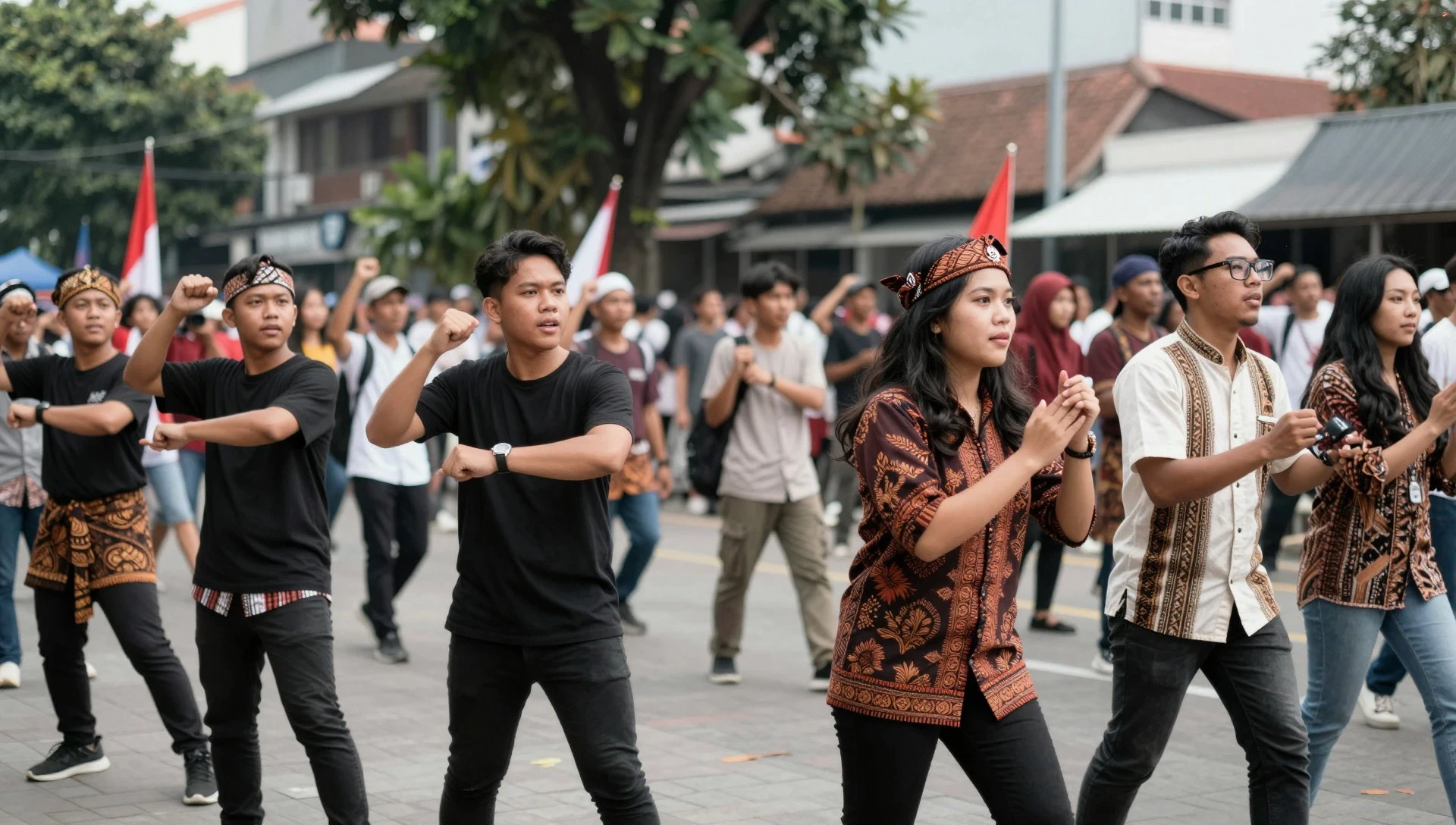
Indonesia's civic space has contracted measurably over the past decade, and the response from its youngest citizens has been neither petition nor party membership but something closer to cultural improvisation.
A report documented in late October 2026 describes how Indonesian youth are turning to decentralized, culturally rooted movements to voice political dissent as formal channels narrow. These formations, described as "rhizomatic," spread laterally through cultural venues, art schools, and informal networks rather than through hierarchical organizations with offices and spokespeople.
The model matters because it sidesteps the registration requirements, surveillance exposure, and co-optation risks that accompany conventional political organizing in restricted environments.
On This Page
The most concrete illustration comes from Dongker, a punk band formed by students at the Bandung Institute of Technology's School of Art and Design. At a 10 October 2026 show at Plaza Kalibaru in Cilincing, North Jakarta, admission cost two kilograms of rice and a book rather than cash.
When a generator caught fire mid-set, thousands of attendees stayed and illuminated the band with phone flashlights as it continued acoustically. By night's end, 4,000 books had been collected for local distribution, and the rice went to communities operating waste banks, exchanged for plastic waste. The format was designed with the Dago Elos Resistance Forum.
What distinguishes this episode from standard protest culture is its economic architecture. Organizers deliberately avoided what they called a "Santa Claus trap," in which the donor is positioned as more virtuous than the recipient.
By pricing entry in rice and books, the concert converted cultural consumption into reciprocal exchange, distributing agency alongside goods. Vocalist and guitarist Delpi Suhariyanto has long used anti-institutional language on stage, at times urging audiences not to pay taxes to a government he considers corrupt. The political content is explicit; the organizational form is deliberately diffuse.
TL;DR Indonesian youth are expressing political dissent through decentralized, culturally embedded movements as formal civic space contracts. The punk band Dongker exemplifies the model: a 2026 Jakarta concert priced at two kilograms of rice and a book drew thousands, collected 4,000 books, and redirected rice to waste-bank communities. Analysts credit such rhizomatic formations with political education and expression but note they have not yet translated into systemic change. The tension between cultural resonance and institutional impact defines the movement's next phase.
The Architecture of Rhizomatic Political Expression
The term "rhizomatic" borrows from Deleuzian philosophy, describing structures that spread horizontally without a central root or command node. Applied to Indonesian youth politics, it captures a shift from membership-based organizations toward networked cultural scenes that share tactics and grievances without sharing leadership.
This structure offers resilience: there is no headquarters to raid, no roster to subpoena, and no single spokesperson whose arrest decapitates the movement. It also imposes costs, because diffuse networks struggle to negotiate, sustain campaigns, or convert cultural energy into legislative pressure.
Why Decentralization Functions as Strategy, Not Accident
Indonesia's legal environment imposes real constraints on organized political activity, particularly for groups outside established party structures. Registration requirements, permit regimes, and surveillance exposure raise the cost of formal association.
Decentralized cultural movements reduce that exposure by embedding politics inside art, music, and community exchange, where the state's justification for intervention is weaker. The strategy is adaptive rather than ideological, a rational response to institutional friction.
The rhizome metaphor also describes how ideas propagate. A band in Bandung influences a poetry collective in Yogyakarta, which informs a zine network in Makassar, without any of them reporting to a center. Each node adapts the message to local conditions.
This produces variation and redundancy, so the failure of one node does not collapse the network. It also produces incoherence, since no authority arbitrates what the movement actually demands.
Scholars of social movements have documented similar patterns across Southeast Asia, where student networks, art collectives, and religious youth groups often substitute for banned or co-opted political vehicles. The Indonesian case fits this regional pattern but adds a distinctive cultural vocabulary drawn from punk, poetry, and design education. That vocabulary travels well across class lines in ways that policy manifestos do not.
The decentralization carries an evident trade-off. Movements that cannot negotiate cannot extract concessions, and movements without representatives cannot be held to agreements. Indonesian organizers interviewed for the report acknowledge this limitation directly, arguing that cultural expression is a starting point rather than an endpoint. The question is whether the network can develop coordinating capacity without acquiring the vulnerabilities that centralization brings.
Political Education Through Cultural Participation
Experts cited in the report credit these movements with genuine political education. Attendance at a benefit concert is not merely consumption; it introduces participants to organizing logistics, resource distribution, and collective decision-making. The rice-for-entry mechanism required attendees to negotiate with local waste banks, creating direct contact between cultural audiences and community infrastructure. That contact is where political consciousness becomes practical rather than rhetorical.
The educational function operates through modeling rather than instruction. A band that refuses corporate sponsorship and prices tickets in staple goods demonstrates an alternative economic logic in practice. Audiences absorb the argument by participating in it.
This is pedagogically distinct from lectures or manifestos, and it explains why the format resonates with young people who have grown skeptical of formal political rhetoric.
Critics note that participation without structured reflection can produce enthusiasm rather than understanding. A concert audience may leave with solidarity and a book, but without a framework for interpreting what they experienced.
Organizers counter that the books themselves supply that framework, and that distribution to local communities extends the educational reach beyond the paying audience.
The Dago Elos Resistance Forum's involvement suggests deliberate design rather than spontaneous energy. By structuring the event around reciprocal exchange, organizers embedded a critique of charity into the event's mechanics. Participants gave and received simultaneously, which is a different political lesson than donating to a cause. The pedagogy is in the format, not the speeches.
The Limits of Cultural Resistance
The report is candid about the ceiling on cultural strategies. Expression is not the same as influence, and a movement that can fill a plaza with thousands may still fail to alter a single regulation.
Indonesian youth have demonstrated capacity for mobilization and for creative resource distribution; they have not demonstrated capacity to force institutional response. The gap between the two is the central unresolved problem.
Systemic change typically requires sustained pressure on identifiable decision-makers, which in turn requires organizations capable of negotiating, threatening, and delivering. Rhizomatic networks excel at the first two functions only intermittently and at the third almost never.
The report's experts argue that more work is needed precisely here, without specifying what organizational form could bridge the gap without reintroducing the vulnerabilities that decentralization was designed to avoid.
There is also the question of durability. Cultural scenes rise and fade with generational turnover, and the institutional memory of a punk band is not transferable to a policy campaign. Movements that depend on specific venues, specific bands, and specific moments may dissipate when those conditions change. The rhizome spreads quickly but roots shallowly, which is both its protection and its limitation.
None of this renders the movements inconsequential. Political education, network formation, and the demonstration that alternatives are possible all have downstream effects that resist measurement. The report's framing suggests that cultural resistance should be understood as infrastructure-building rather than as a substitute for conventional politics.
Judged on that basis, the 4,000 books and the rice exchanged for plastic waste represent tangible civic output.
Economic Design as Political Critique
The concert's pricing structure deserves scrutiny as a piece of political argument in its own right. By requiring rice and books instead of cash, organizers rejected the transactional logic of commercial entertainment and the paternalistic logic of charity simultaneously.
Attendees were not donors and not customers; they were participants in a redistribution system with rules. That distinction carries more analytical weight than any lyric delivered from the stage.
Rejecting the Santa Claus Trap
Jim Alberka of the Dago Elos Resistance Forum named the design principle explicitly: the band wanted to avoid a "Santa Claus trap," in which the giver is perceived as more noble than the receiver. Conventional charity positions the donor above the beneficiary, reinforcing hierarchies even as it transfers resources. The rice-and-book entry fee dissolves that hierarchy by making every attendee both contributor and recipient.
The mechanism is elegant because it requires no ideological instruction. A person who brings two kilograms of rice to hear a band has already participated in a reciprocal economy before the first chord sounds. The political content is embedded in the transaction, not appended to it. This is a more durable form of persuasion than rhetoric because it shapes behavior rather than opinion.
Waste banks add a second layer. Rice collected at the gate flowed to communities that operate waste banks, where plastic waste is exchanged for value. The concert thus connected cultural consumption to environmental infrastructure, creating a chain from punk performance to waste management. Few political organizations achieve that kind of cross-sector linkage in a single event.
The design also protects against co-optation. Cash-based fundraising invites sponsors who expect influence; rice and books do not scale into corporate sponsorship arrangements. By choosing a currency that corporations cannot easily supply, organizers insulated the event from the patronage dynamics that often dilute movement independence. The economics enforce the politics.
Alternative Spaces as Political Infrastructure
Cultural venues, art schools, and public plazas function as political infrastructure in this model, substituting for the meeting halls and party offices that formal organizing requires. The Bandung Institute of Technology's School of Art and Design supplied both the band's members and its aesthetic vocabulary.
Plaza Kalibaru supplied the physical space where thousands could gather without the permits a political rally would require.
This infrastructure is fragile by design. Venues close, permits lapse, and student cohorts graduate. But the fragility is offset by multiplicity: when one space becomes unavailable, others absorb the activity. The rhizome's strength is redundancy, and redundancy is precisely what centralized political organizations lack. A party that loses its headquarters loses capability; a scene that loses a venue relocates.
The reliance on alternative spaces also shapes what can be said. Messages delivered through art and music carry ambiguity that explicit political speech does not, and that ambiguity provides deniability. A band urging audiences not to pay taxes can be read as performance art or as incitement, depending on the listener's disposition. The state must choose which reading to prosecute, and that choice is itself costly.
Whether alternative spaces can mature into durable institutions is an open question. Art schools graduate new cohorts annually, which sustains the scene but also prevents institutional memory from accumulating. The infrastructure renews itself but does not deepen. Building depth would require the very formalization that the model was designed to avoid.
We Also Published
From Cultural Expression to Systemic Pressure
The report's central tension is between expression and change. Indonesian youth have built effective machinery for the former and have not yet built machinery for the latter. Experts acknowledge that the movements help young people articulate political positions and learn how politics operates, but they argue that more work is required to push for systemic change.
That argument is easier to state than to operationalize, because the organizational forms that produce systemic pressure are the ones the movement has deliberately avoided.
What Systemic Change Requires
Systemic change generally requires three capabilities: identifying decision-makers, applying sustained pressure, and negotiating enforceable outcomes. Rhizomatic networks can occasionally mobilize pressure through spectacle, as the Plaza Kalibaru concert demonstrated. They struggle with the other two.
Without representatives, there is no one to negotiate with; without continuity, pressure cannot be sustained across the years that policy change demands.
The historical record offers mixed guidance. Cultural movements have preceded political change in many contexts, from the civil rights era to Eastern European dissident scenes, but in each case cultural energy was eventually channeled through organizations capable of negotiating. The cultural phase was necessary but not sufficient. Indonesian youth appear to be in that necessary phase, with the sufficient phase not yet visible.
Some analysts argue that the distinction is overstated. Cultural movements that shift public opinion create the conditions under which formal organizations can operate, lowering the political cost of reform. On this reading, the concert's 4,000 books are an investment in future political capacity rather than a substitute for it. The returns are real but deferred, and deferred returns are difficult to measure.
The report does not resolve this debate, and its refusal to do so is appropriate. What it documents is a generation experimenting with political forms suited to constrained conditions. Whether that experimentation produces systemic change depends on factors outside the movement's control, including the state's tolerance and the economy's trajectory.
Generational Politics Under Constraint
Indonesia's young generation inherited a political environment with narrowed civic space and diminished trust in formal institutions. Their response, building political expression into cultural practice, reflects rational adaptation to those conditions.
The punk band that tells audiences not to pay taxes is not naive about state power; it is choosing a venue where that statement can be made and heard.
The generational dimension matters because political habits formed in youth persist. A cohort that learned to organize through cultural scenes may carry different assumptions into later political life than one that learned through party structures.
Those assumptions, favoring decentralization and suspicion of hierarchy, will shape how this generation engages institutions when it eventually holds power.
There is also a demographic weight to consider. Indonesia's youth population is large, and cultural movements that reach thousands at a single concert have aggregate reach that formal organizations envy. If even a fraction of that audience translates cultural participation into sustained civic engagement, the political arithmetic shifts. The report's experts are betting on that translation; the evidence is not yet in.
The constraint that produced rhizomatic politics, shrinking civic space, may also be what limits it. Movements designed to survive repression are not designed to exploit openness, and if civic space expands, the decentralized model may prove less effective than the organizations it replaced. The form is adapted to its environment, which means it changes when the environment does.
Comparative Perspective on Youth Movements
Indonesia's experience parallels youth movements elsewhere in Southeast Asia, where restricted civic space has pushed political expression into cultural and digital channels. The pattern is consistent enough to suggest a regional adaptation rather than a national anomaly.
What varies is the cultural vocabulary: punk in Bandung, poetry in Manila, digital satire in Bangkok, each calibrated to local aesthetic traditions.
The comparison with earlier Indonesian movements is instructive. Student activism in 1998 played a decisive role in ending the Suharto regime, but it operated through campus organizations with identifiable leaders and clear demands.
The current generation faces a different state, one that has learned to tolerate diffuse cultural expression while neutralizing organized opposition. The rhizomatic form may be a response to that learning.
International observers sometimes misread decentralized movements as apolitical because they lack platforms and spokespeople. The Indonesian case suggests the opposite: the absence of a platform is itself a political statement, a refusal to participate in the formal channels that the movement considers compromised. Reading the form as carefully as the content is essential to understanding what is being communicated.
The report's contribution is to document this form without romanticizing it. It records the concert, the rice, the books, and the fire, and it records the experts' caution that expression is not change.
That balance is analytically honest and politically useful, because it identifies the specific gap that the next phase of the movement must address.
Assessing the Movement's Trajectory
The evidence assembled in the report supports a measured conclusion. Indonesian youth have built a functioning system for political expression under constrained conditions, demonstrated through a concert that collected 4,000 books and redirected rice to waste-bank communities. They have not built a system for converting that expression into policy change.
The gap is real, acknowledged by the movement's own participants, and not obviously bridgeable within the current organizational model.
What the movement has achieved should not be minimized. Political education at scale, network formation across cities, and the practical demonstration of alternative economic logic are durable contributions that formal organizations often fail to deliver.
The 4,000 books will circulate; the waste-bank partnerships will persist; the attendees will carry the experience into future political activity. These are measurable outputs even if their downstream effects resist quantification.
The unresolved question is whether cultural infrastructure can mature into political infrastructure without losing the properties that made it effective. Every historical example of successful cultural-to-political transition involved some formalization, and every formalization created new vulnerabilities.
Indonesian youth are experimenting with that trade-off in real time, and the report captures them mid-experiment rather than at its conclusion.
For observers outside Indonesia, the case offers a general lesson about political expression under constraint. When formal channels narrow, expression migrates to cultural forms, and those forms develop their own logic, economics, and pedagogy. Reading them requires attention to structure as well as content.
The punk band that prices admission in rice is making an argument that no manifesto could make as effectively, and understanding why is the analytical task the report sets.
From our network :
- Live Online English Classes for Kids: Do They Actually Reduce Anxiety?A ten-week study reveals that synchronous online English classes can significantly reduce child language anxiety while improving listening and reading skills. Discover what makes these programs effective and how parents can select the right one.
- How AI Agents Will Change the Way We Manage Personal FinancesExplore how AI agents are transforming personal finance through automated budgeting, bill payment, and investment management, while examining the critical security protocols and governance frameworks required for safe deployment.
- The Hidden Cost of AI Convenience: Why Over-Permissioned Agents Are a Security Time BombDiscover why AI agents with excessive permissions create dangerous single points of failure, and learn how implementing least privilege principles can protect your organization from exploitation.
- CISA’s Ten-Advisory Wave: Why Generic Patching Fails in OT and How to Build Product-Specific PlaybooksCISA released ten ICS advisories in one week, exposing critical infrastructure risks. Generic patching fails in OT. Learn to build product-specific remediation playbooks.
- The Final Descent: How ESA Retired the Legendary Cluster Constellation After 24 Years of Space Weather ScienceAfter 24 years mapping Earth’s magnetosphere, ESA’s Cluster mission concluded with a precisely controlled reentry over the South Pacific. This analysis explores the scientific legacy, engineering decisions, and debris mitigation principles behind one of space exploration’s most responsible retirements.
- Mobile Learning and VR in English: What Global Evidence Reveals About Effective Language TechnologyA systematic review across 14 countries reveals which language-learning technologies genuinely work. Mobile learning, AI, and VR show measurable benefits when pedagogically integrated. This evidence-based guide helps educators and learners select technology that delivers real return on investment.
- Forbidden Matrix Patterns and Visible Lattice Points: A Geometric DictionaryExplore how multidimensional 0–1 matrices encode geometric truths, linking forbidden patterns to visible lattice points and hypergraph theory, with applications in combinatorics and computational geometry.
- University Language Proficiency Exams: Why Institutional Tests Demand Different Preparation Than IELTS and TOEFLDiscover why university-specific language proficiency examinations differ fundamentally from IELTS and TOEFL, and learn strategic preparation approaches for institutional assessment success.
- Committed Mediterranean Precipitation Decline: Why Emissions Cuts Alone Cannot Restore Winter RainsNew NOAA research reveals that Mediterranean winter rains may decline irreversibly even with emissions cuts. Explore the science of committed climate change and regional impacts.
RESOURCES
- How Global Gen Z Protests Have Shocked and Transformed ...cfr.orgNov 20, 2025 ... The recent rise in youth-led protests follows a larger trend of political movements ... cultural references, and learn tactical lessons ...
- RHIZOME VS REGIME - ISEAS – Yusof Ishak Instituteiseas.edu.sg6 I argue it is also a fitting metaphor for digitally mediated youth movements and the novel types of political knowledge processes, practices and…
- Words in Motion: Language and Discourse in Post-New Order ...press.uchicago.eduWhile contributors to this volume discuss Indonesian-language expression at ... Sociology: Social Change, Social Movements, Political Sociology. Nus ...
- Reformasidikorupsi and Digital Politics in the Social Media Erapenerbitadm.pubmedia.idJun 28, 2026 ... ... expression without leading to tangible policy outcomes. Similarly ... Youth Political Participation and Digital Movement in Indonesia.
- Muslim Youth Activism and Political Expression on Social Mediajournal.perhaki.orgFeb 27, 2026 ... “Student Movements and the Palestinian Cause in Indonesia: Continuity and Change Since Reformasi.” Palestine Issues on Indonesian Society 2 (2).
- Reimagined history and local patriotism: rural youth activism in ...frontiersin.orgNov 3, 2025 ... Rural youth movements in Indonesia have long been ... youth to build organization, leadership, and new forms of political expression.
- The Rise and Spread of Gen Z Protests - Vision of Humanityvisionofhumanity.orgOct 1, 2025 ... The rise of youth-led protests in Madagascar, Morocco, Kenya and Nepal adds to growing evidence that Gen Z is actively…
- Humor, Satire, and Youth Political Expression on Social Mediajournal.perhaki.orgUsers can. Page 3. Amandha. Indonesian Discourse on Communication, Democracy, and Political Movements 3(1) 2026 [ 27 ] simultaneously occupy the positions of ...
- Digital activism and youth participation in Indonesia: A qualitative ...researchgate.netOct 1, 2025 ... public sphere in the ongoing struggle for social change. Keywords: digital activism; social media; youth; Indonesia; social movements; political ...
- youth resistance and the reimagining of global futures in Madagascartandfonline.comUrban spaces, cultural expression, and the formation of youth political identity. The 1972 student movement was the first political insurrection of Madagascar's ...
- From Arab Spring to Generation Z: Youth Activism and Mobilization ...mdpi.comOct 24, 2026 ... ... decentralized activism within the contemporary youth movements [1]. Moroccan youth activists frequently organize protests, share political ...
- Connective spaces of radical hope: rhizomatic youth struggles for ...tandfonline.comSep 13, 2025 ... ... politics that jeopardize their generation's freedoms and future aspirations. The rise of massive youth protest movements in Indonesia (2019 ...
- Rhizomatic Protest, Generational Affinity and Digital Refugelink.springer.comJun 8, 2024 ... Regime: Southeast Asia's Digitally Mediated Youth Movements, Trends in Southeast Asia, No. ... political and cultural kinship and common destiny.
- The flashpoint generation: How Gen Z is rewriting the rules of protest ...forus-international.orgNov 25, 2025 ... “Movements like this have already begun reshaping political culture, influencing policy debates, and shifting public opinion.” As documented ...
- Gen Z's digital activism: youth-led protests and political crises in Asianature.comDigital humor, memes, and pop-culture references became protest symbols, reflecting how Gen Z redefines political expression (Twinomurinzi, 2024). In Indonesia ...
- 01
- 02
- 03
- 04
- 05
- 06
- 07
- 08
0 Comments