The People's Bank of China's decision to cut the interest rate on its stock buyback re-lending facility by 25 basis points to 1 percent represents far more than a routine monetary adjustment. It signals a deliberate, carefully calibrated policy posture in which the central bank treats equity market stability as a legitimate objective of liquidity management. By lowering the cost at which banks can on-lend funds for share repurchases and increased holdings, Beijing is effectively subsidizing corporate confidence at a moment when investor sentiment remains fragile. The move, effective immediately, applies to 21 national banks and five major city commercial banks, giving the program unusually broad reach across the financial system.
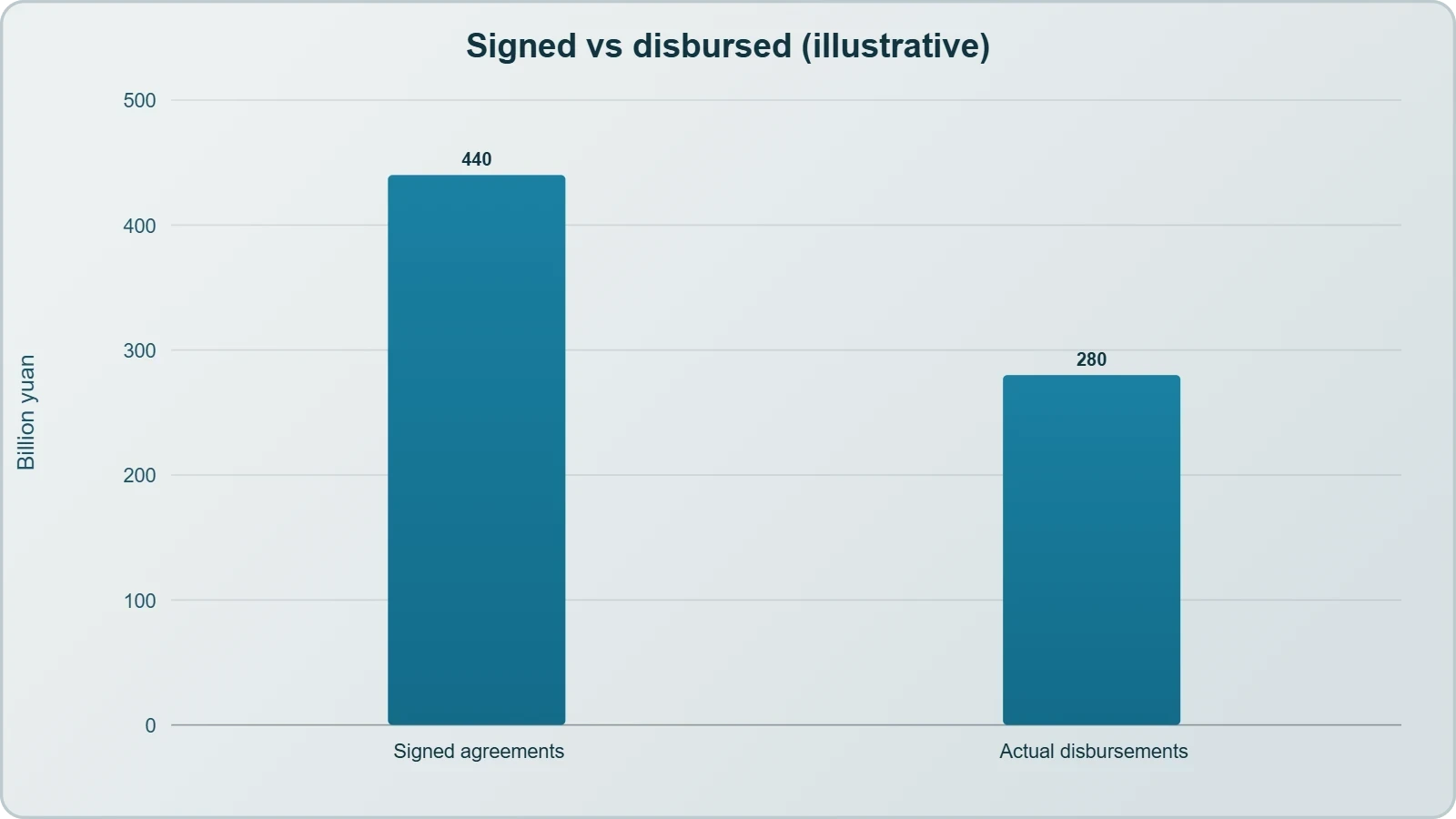
What makes this intervention notable is its architecture. Rather than purchasing equities directly, the PBOC channels support through the banking sector, allowing listed companies and their major shareholders to borrow cheaply against the promise of buybacks. The facility carries a one-year term and can be extended at the banks' discretion, while lenders are permitted to add a suitable margin when pricing individual loans. This design preserves the appearance of market-driven allocation while ensuring that the cost of capital for stabilization activity falls sharply. Since the facility's launch in October 2024, signed amounts have reached roughly 440 billion yuan, with disbursements exceeding 280 billion yuan, evidence that the mechanism has moved well beyond symbolic gesture.
The timing and coordination behind the announcement deserve close attention. A meeting on November 2 involving the PBOC, the National Financial Regulatory Administration, and the China Securities Regulatory Commission preceded the rate cut, and banks subsequently applied for more than 200 billion yuan in fresh quotas. That sequence reveals a joined-up regulatory effort spanning monetary policy, banking supervision, and securities oversight. The central bank has also pledged to deploy the Securities, Funds and Insurance companies Swap Facility more actively, expand its participating institutions, and adjust swap fees where appropriate. Together, these instruments form a layered toolkit aimed at sustaining what officials describe as the smooth operation of the capital market.
On This Page
- The Mechanics of China's Buyback Re-Lending Facility
- Why Beijing Is Prioritizing Market Value Management
- The Coordinated Regulatory Toolkit Beyond Re-Lending
- Assessing the Economic Impact and Transmission Channels
- Historical Context and the Evolution of PBOC Tools
- Implications for Investors and the Road Ahead
TL;DR China's central bank cut the rate on its stock buyback re-lending facility by 25 basis points to 1 percent, widening access to cheap funding for listed companies and major shareholders seeking to repurchase shares. The facility, launched in October 2024, has already generated about 440 billion yuan in signed agreements and over 280 billion yuan in disbursements. Coordinated with the securities regulator and banking authority, the move reflects a broader strategy of using targeted credit tools, alongside the SFISF swap facility, to stabilize equity markets without direct central bank equity purchases.
The Mechanics of China's Buyback Re-Lending Facility
Understanding the facility requires distinguishing it from conventional monetary easing. The PBOC does not lend to companies directly; instead it provides low-cost funding to a designated set of banks, which then extend loans to eligible listed companies and their controlling shareholders for the specific purpose of repurchasing shares or increasing holdings. The 1 percent re-lending rate sets a floor beneath which banks can profitably intermediate, and the one-year term with extension options gives borrowers planning certainty. This structure keeps the central bank at arm's length from individual corporate decisions while still shaping the price of capital for stabilization activity.
How the Re-Lending Channel Operates
The operational chain runs from the PBOC to 21 national banks and five major city commercial banks, each of which must apply for quotas before disbursing funds. Banks are permitted to add a suitable margin to the re-lending rate, meaning the final cost to a corporate borrower will exceed 1 percent but remain well below typical unsecured lending rates. The PBOC has explicitly asked lenders to accelerate disbursement and to assist listed companies in improving market value management, language that frames buybacks as a governance tool rather than mere price support. Quotas are not fixed; the central bank has committed to meeting banks' demand as it evolves.
Scale and Take-Up Since Launch
The numbers tell a story of rapid adoption. Since the facility's creation in October 2024, signed agreements for buybacks and increased holdings have reached approximately 440 billion yuan, while actual disbursements have surpassed 280 billion yuan. The gap between signed and disbursed amounts is itself informative, suggesting that some companies have secured credit lines but not yet drawn them, perhaps waiting for more favorable entry points or completing internal approvals. Following the November 2 meeting, banks requested more than 200 billion yuan in additional quotas, a clear signal that demand for the cheap funding remains strong and possibly accelerating.
We Also Published
Why Beijing Is Prioritizing Market Value Management
Chinese policymakers have grown increasingly explicit about the connection between equity valuations and broader economic confidence. When share prices languish, household wealth erodes, consumption weakens, and the cost of equity capital rises for state-owned and private enterprises alike. Buybacks offer a politically palatable remedy: they support prices without requiring the central bank to hold equities on its balance sheet, and they allow companies to signal conviction in their own prospects. The PBOC's language about helping listed companies improve market value management reflects a view that corporate governance and share price performance are intertwined responsibilities rather than separate domains.
The Political Economy of Share Repurchases
Buybacks carry different connotations in China than in Western markets. Regulators have historically viewed large repurchase programs with suspicion, wary of manipulation and of capital being diverted from productive investment. The re-lending facility reframes buybacks as a stabilizing public good, provided they are financed through transparent bank credit rather than opaque off-balance-sheet vehicles. By setting eligibility criteria and channeling funds through supervised banks, the PBOC retains visibility into which companies are repurchasing and on what terms. This oversight dimension helps explain why the program has been embraced by the securities regulator, which shares an interest in orderly markets.
Signals Sent to Domestic and Foreign Investors
For foreign institutional investors, the rate cut is a signal that Chinese authorities remain willing to deploy unconventional tools when sentiment deteriorates. The facility's existence and expansion suggest a policy floor beneath equity markets, though not an unconditional one. Domestic retail investors, who have endured repeated cycles of volatility, may read the move as evidence of official commitment to preventing disorderly declines. Yet the program's reliance on corporate borrowing means its effectiveness depends on companies actually choosing to buy back shares, a decision shaped by their own cash flow positions, valuation views, and confidence in future earnings.
The Coordinated Regulatory Toolkit Beyond Re-Lending
The buyback facility does not operate in isolation. The PBOC's announcement explicitly links it to the Securities, Funds and Insurance companies Swap Facility, a separate instrument that allows eligible non-bank financial institutions to swap assets for liquid, high-quality collateral. Together, the two facilities address different parts of the market: re-lending supports corporate demand for shares, while the swap facility supports institutional liquidity and the capacity of funds and insurers to hold equities through periods of stress. The central bank's promise to conduct swap operations in a timely way, add participating institutions, and lower swap fees where appropriate indicates that this second channel is being actively tuned.
Inside the SFISF Swap Arrangement
The swap facility works by allowing securities firms, fund managers, and insurers to exchange less liquid holdings for central bank paper that can be pledged for funding. This improves their liquidity positions without forcing asset sales during downturns, a mechanism analogous in spirit to lender-of-last-resort support for non-bank institutions. Expanding the roster of participating institutions broadens the reach of this liquidity backstop, while adjustments to swap fees reduce the cost of using it. The PBOC's willingness to refine collateral and operational arrangements suggests the facility is being treated as a permanent feature of the crisis toolkit rather than a temporary expedient.
Coordination Among Three Regulators
The November 2 meeting brought together the PBOC, the National Financial Regulatory Administration, and the China Securities Regulatory Commission, a triad whose combined mandates cover monetary policy, banking supervision, and securities market oversight. Such coordination is essential because buyback lending touches all three domains: it involves bank credit creation, prudential risk management, and disclosure obligations for listed companies. The joint approach reduces the risk of regulatory arbitrage and ensures that banks applying for quotas do so with consistent expectations. It also signals to market participants that support for equities is a shared priority across the regulatory apparatus, not the preference of a single agency.
Assessing the Economic Impact and Transmission Channels
The facility's influence travels through several channels simultaneously. Most directly, it lowers the financing cost for companies that choose to repurchase shares, improving the arithmetic of buyback decisions. Indirectly, it signals official support, which can shift investor expectations and reduce risk premia even before significant funds are deployed. A third channel operates through bank behavior: when lenders know they can access cheap central bank funding for this purpose, they may compete more aggressively for corporate buyback mandates, compressing spreads and broadening access. The relative importance of each channel determines whether the program produces lasting valuation effects or merely temporary relief.
Cost of Capital Arithmetic for Listed Firms
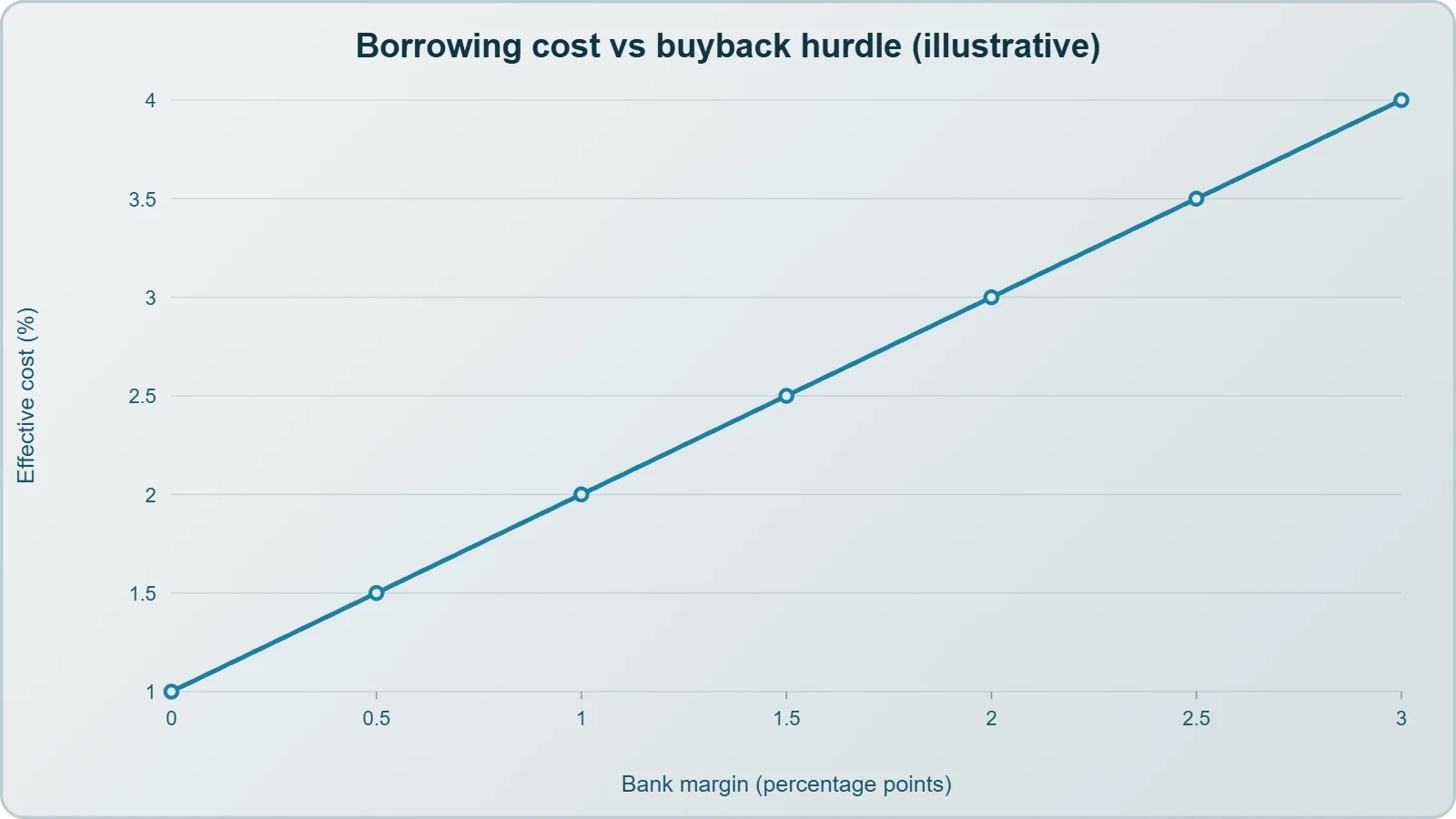
Consider a company weighing a buyback against alternative uses of cash. If it can borrow at a rate modestly above 1 percent, the hurdle for a repurchase to be accretive to earnings per share falls considerably. The effective cost depends on the margin banks add, but even at 2 to 3 percent, the funding is attractive relative to many corporate borrowing alternatives. The calculation becomes more compelling when the company's shares trade below management's estimate of intrinsic value, a condition that policymakers believe prevails across much of the Chinese market. The facility thus converts a theoretical argument for buybacks into a practical financing option.
Risks of Leverage-Fueled Buybacks
Cheap credit for share repurchases carries familiar hazards. Companies may borrow to support their stock at prices that later prove unsustainable, leaving them with higher leverage and diminished financial flexibility. If earnings deteriorate, the combination of debt service and reduced equity buffers can amplify distress. Regulators appear conscious of this tension, which is why the facility channels funds through banks subject to prudential oversight rather than offering direct corporate credit. The one-year term with extension options also limits the duration of exposure, though repeated rollovers could effectively extend leverage if not carefully monitored. The balance between stabilization benefits and balance-sheet risk will determine the program's long-run legacy.
- 01
- 02
- 03
- 04
Historical Context and the Evolution of PBOC Tools
China's central bank has spent the past decade building a repertoire of structural tools that sit between traditional interest rate policy and direct credit allocation. Targeted medium-term lending, relending quotas for small businesses and green projects, and now equity-linked facilities all share a common logic: the PBOC identifies a sector or activity it wishes to support, then subsidizes bank lending to that end. The buyback facility extends this approach to capital markets, a domain the central bank once treated with greater distance. The shift reflects both the growing importance of equity markets to household wealth and the limitations of conventional rate cuts in an economy with ample liquidity but uneven credit demand.
From Relending for SMEs to Relending for Equities
The lineage is instructive. Relending programs for agriculture and small enterprises date back years and have been repeatedly expanded during periods of economic stress. Each iteration refined the mechanics of quota allocation, bank eligibility, and rate setting. The equity facility borrows these design elements but applies them to a novel purpose, demonstrating how institutional infrastructure built for one objective can be repurposed. The October 2024 launch and the November 2026 rate cut together trace a learning curve in which the PBOC has grown more comfortable using credit policy to influence asset prices, albeit through intermediated channels that preserve a measure of market discipline.
Comparisons With Global Central Bank Practice
Western central banks have generally avoided instruments explicitly tied to equity prices, preferring broad asset purchases and liquidity facilities that affect markets indirectly. The Federal Reserve's corporate credit facilities during 2020 came closest, purchasing bonds and loans rather than supporting buybacks. The PBOC's approach is distinctive in targeting share repurchases specifically, a choice rooted in the structure of China's market, where state-linked shareholders and policy signals carry unusual weight. Whether this model proves durable or invites unintended consequences will be watched closely by other emerging-market central banks facing similar pressures to support domestic equities.
Implications for Investors and the Road Ahead
For equity investors, the facility's expansion reinforces a view that Chinese authorities will intervene when market conditions threaten broader stability, but it does not guarantee rising prices. The program supports demand for shares at the margin and lowers the cost of corporate buybacks, yet its scale remains modest relative to total market capitalization. Its greater significance may lie in the signal it sends about policy priorities and the willingness to innovate with credit tools. Investors who interpret the move as an unconditional backstop risk overestimating its reach; those who dismiss it as symbolic risk underestimating the cumulative effect of repeated interventions.
What to Watch in Coming Quarters
Several indicators will reveal whether the rate cut achieves its aims. The pace of new quota applications, the gap between signed agreements and actual disbursements, and the volume of announced buyback programs will all show whether cheaper funding is translating into corporate action. Movements in the SFISF's usage and the roster of participating institutions will indicate whether the liquidity channel is functioning as intended. Most importantly, the durability of any valuation improvement will depend on earnings fundamentals, which monetary tools can support but not manufacture. A sustained rally requires profit growth, not merely cheaper leverage.
Balancing Stabilization With Market Discipline
The deepest question raised by the facility concerns the boundary between stabilization and distortion. When the state subsidizes share repurchases, it influences the price discovery process and may delay necessary adjustments in overvalued sectors. Yet in a market prone to sharp sentiment swings, some official presence is arguably unavoidable. The PBOC's intermediated design, with banks bearing credit risk and regulators retaining oversight, attempts to thread this needle. Whether that balance holds as the program scales will shape not only China's equity market but also the broader debate over how far central banks should go in supporting asset prices.
From our network :
- Forbidden Matrix Patterns and Visible Lattice Points: A Geometric DictionaryExplore how multidimensional 0–1 matrices encode geometric truths, linking forbidden patterns to visible lattice points and hypergraph theory, with applications in combinatorics and computational geometry.
- Committed Mediterranean Precipitation Decline: Why Emissions Cuts Alone Cannot Restore Winter RainsNew NOAA research reveals that Mediterranean winter rains may decline irreversibly even with emissions cuts. Explore the science of committed climate change and regional impacts.
- University Language Proficiency Exams: Why Institutional Tests Demand Different Preparation Than IELTS and TOEFLDiscover why university-specific language proficiency examinations differ fundamentally from IELTS and TOEFL, and learn strategic preparation approaches for institutional assessment success.
- CISA’s Ten-Advisory Wave: Why Generic Patching Fails in OT and How to Build Product-Specific PlaybooksCISA released ten ICS advisories in one week, exposing critical infrastructure risks. Generic patching fails in OT. Learn to build product-specific remediation playbooks.
- Live Online English Classes for Kids: Do They Actually Reduce Anxiety?A ten-week study reveals that synchronous online English classes can significantly reduce child language anxiety while improving listening and reading skills. Discover what makes these programs effective and how parents can select the right one.
- The Final Descent: How ESA Retired the Legendary Cluster Constellation After 24 Years of Space Weather ScienceAfter 24 years mapping Earth’s magnetosphere, ESA’s Cluster mission concluded with a precisely controlled reentry over the South Pacific. This analysis explores the scientific legacy, engineering decisions, and debris mitigation principles behind one of space exploration’s most responsible retirements.
- The Hidden Cost of AI Convenience: Why Over-Permissioned Agents Are a Security Time BombDiscover why AI agents with excessive permissions create dangerous single points of failure, and learn how implementing least privilege principles can protect your organization from exploitation.
- Mobile Learning and VR in English: What Global Evidence Reveals About Effective Language TechnologyA systematic review across 14 countries reveals which language-learning technologies genuinely work. Mobile learning, AI, and VR show measurable benefits when pedagogically integrated. This evidence-based guide helps educators and learners select technology that delivers real return on investment.
- How AI Agents Will Change the Way We Manage Personal FinancesExplore how AI agents are transforming personal finance through automated budgeting, bill payment, and investment management, while examining the critical security protocols and governance frameworks required for safe deployment.
RESOURCES
- China's PBOC Lowers Relending Rate for Stock Buybacksmorningstar.com1 day ago ... China's central bank is ramping up efforts to stabilize the country's capital markets, cutting rates on a lending facility for…
- China's Stock Buyback Special Re-lending Facility - NYU Shanghaicdn.shanghai.nyu.eduIn late 2024, the People's Bank of China (PBOC) introduced a targeted stock buyback re-lending ... reserve requirement ratio (RRR) cuts and mortgage rate ...
- Chinese Stock Selloff Resumes as Rescue Tools Face Skepticismbloomberg.com2 days ago ... Separately, the PBOC will cut the rate on its relending facility to 1% from 1.25%, make the program permanent, and…
- China rolls out support measures to aid struggling stocks - Reutersreuters.com3 days ago ... The PBOC also said a relending scheme designed to fund share buybacks ... The interest rate of the expanded scheme…
- China to expand share buyback support, cut relending rate to 1%chinadaily.com.cn2 days ago ... China's financial regulators are expanding the use of a dedicated relending facility for share buybacks and stake increases, ...
- third batch of swap facility approvals tops 100 billion yuanfinance.biggo.com3 days ago ... China's PBOC cuts relending rate for stock buybacks and shareholding ... Facility and a symposium on the Stock Buyback and…
- BREAKING PBOC Conducts 100 Billion Yuan Swap Facility ... - Xx.com2 days ago ... They also announced that the related stock buyback and shareholding increase relending facility would become a permanent institutional ...
- China's PBOC cuts relending rate for stock buyback, shareholding ...finance.biggo.com1 day ago ... China's People's Bank of China (PBOC) will cut the interest rate on its Stock Buyback and Shareholding Increase Relending facility…
- PBOC cuts stock-buyback re-lending rate 25bps to 1% from Nov. 4 - Xx.com1 day ago ... 4; 26 banks eligible The People's Bank of China will intensify a re-lending facility to support stock buybacks and shareholding…
- China announces fresh policy boost to fuel economic recoveryenglish.www.gov.cnMay 7, 2025 ... PBOC on Wednesday also announced its decision to cut the rate for ... Pan said this policy rate reduction is…
- China's stimulus package not enough to tackle low growth, say ...thebanker.comSep 24, 2024 ... The People's Bank of China on Monday announced a 20 basis point cut ... Stock swap facilities and a re-lending…
- Ten Stimulus Questions - Citicitigroup.comOct 10, 2024 ... On the monetary-policy front, the People's Bank of China (PBoC) ... cut the medium-term lending facility rate 30 bps. The…
- #China's central bank announced on Wednesday stepped-up efforts ...facebook.com1 day ago ... China's central bank has kicked off a specialized re- lending facility ... PBOC Starts Share Buyback, Equity Swap Tools to…
- China Steps Up Monetary Policy Support to Bolster Stock Marketichongqing.info2 days ago ... ... relending facility for share buybacks and shareholding increases. The PBOC said it will conduct SFISF operations in a timely…
- Support for relending facilities dedicated to stock buybacks and ...moomoo.com22 hours ago ... ② Banks will correspondingly lower lending rates, expected to align with the People's Bank of China's rate cuts. However, rates…
- 01
- 02
- 03
- 04
- 05
- 06
- 07
- 08
0 Comments