The case of Jamie Foster, a former New Zealand police officer convicted of sexually violating a colleague, has re-entered public discourse not because of a new verdict, but because of a fresh procedural gambit. Foster, sentenced in April 2020 to six years in prison, has exhausted his conventional appellate routes and is now preparing a petition to the Criminal Cases Review Commission (CCRC), the independent body empowered to refer convictions back to the courts where a miscarriage of justice may have occurred. His application rests on a blend of contested trial evidence, alleged procedural defects, and new material assembled by a private investigator with a notable track record.
What makes this matter more than a routine post-conviction filing is the coalition behind it. Foster's fiancée, Sera Cruickshank, a business owner and social media influencer, has become the public face of the campaign, while private investigator and former detective Tim McKinnel supplies the investigative credibility. McKinnel's résumé carries weight in New Zealand legal circles: he helped overturn the murder convictions of Teina Pora, Alan Hall, and Gail Maney. The case therefore sits at an uncomfortable intersection of criminal law, evidentiary integrity, media influence, and the emotional architecture of a family built around a man the state says is a rapist.
The underlying facts remain sharply disputed. A jury accepted that Foster groped a female co-worker who entered his motel room for a drink in the early hours of 5 February 2019, that she told him to stop, and that she later woke around 2:30am to find him raping her. Foster's defence was that the encounter was consensual and that her initial resistance meant "not yet." Both officers were in Kerikeri to assist with Waitangi Day events, and CCTV footage showed drunken and lewd behaviour by several officers at the motel, including a senior sergeant exposing himself and drinking from a hollowed-out police baton.
On This Page
- The Architecture of Post-Conviction Review in New Zealand
- The Evidence at Trial and the Consent Question
- Tim McKinnel and the Credibility of the Review Campaign
- The Complainant, the Public, and the Ethics of Re-Litigation
- What the Case Reveals About Police Conduct and Institutional Trust
- The Road Ahead: Prospects, Precedent, and Public Interest
TL;DR Jamie Foster, a former New Zealand police officer convicted in 2020 of indecently assaulting and sexually violating a colleague at a Kerikeri motel, has exhausted his Court of Appeal and Supreme Court remedies and is now petitioning the Criminal Cases Review Commission. His application is backed by his fiancée, influencer Sera Cruickshank, and private investigator Tim McKinnel, who has previously helped overturn several high-profile murder convictions. The case turns on whether acknowledged flaws in the trial are sufficient to call the integrity of the convictions into question, and it raises broader questions about consent, police culture, and the threshold for post-conviction review.
The Architecture of Post-Conviction Review in New Zealand
New Zealand's Criminal Cases Review Commission, established in 2020, was designed to fill a gap that had long troubled common-law jurisdictions: what happens when a convicted person has exhausted appeals but still insists the verdict was wrong. The CCRC does not retry cases. It investigates whether a miscarriage of justice may have occurred and, if so, refers the matter back to the appellate courts. Its threshold is deliberately lower than the "beyond reasonable doubt" standard of a criminal trial, but higher than mere dissatisfaction with the outcome. Understanding this architecture is essential to assessing Foster's prospects.
The Commission's Statutory Mandate and Its Limits
The CCRC operates under the Criminal Cases Review Commission Act 2019, which empowers it to investigate convictions and sentences and to refer them to the Court of Appeal or the Supreme Court where it considers a miscarriage of justice may have occurred. Crucially, the Commission is not bound by the ordinary appeal rules that require "fresh" evidence to be genuinely new and compelling. It can consider evidence that was available at trial but not presented, and it can examine procedural irregularities that the appellate courts declined to entertain. This flexibility is precisely what makes it attractive to applicants who have already lost in the Court of Appeal and the Supreme Court.
Yet the Commission's discretion is not unlimited. It must be satisfied that there is a real possibility the conviction would not stand, and it must weigh the public interest in finality against the individual interest in justice. In practice, referral rates are low, and the Commission's decisions are themselves subject to judicial review. For Foster, the question is whether McKinnel's new evidence and the acknowledged trial flaws cross that threshold, or whether they merely re-litigate matters the courts have already considered and rejected.
Why Exhausted Appeals Matter
Foster's path to the CCRC has been paved with failure at every conventional stage. He appealed his convictions to the Court of Appeal, arguing that a miscarriage of justice occurred due to evidential and procedural issues at trial, but that appeal was rejected. The Supreme Court then declined two applications for leave to hear his appeal. This history is significant because it means the CCRC is not reviewing a fresh conviction but a conviction that has already survived multiple layers of judicial scrutiny. The Commission will therefore be acutely aware that it is being asked to second-guess not one but three courts.
That said, the CCRC was created precisely because appellate courts sometimes get it wrong, and because the adversarial system does not always surface evidence that emerges later. McKinnel's involvement signals that the applicant's team believes there is material the courts have not properly weighed. Whether that belief is well-founded will depend on the quality of the new evidence and the seriousness of the procedural defects, not on the prominence of the people advocating for review.
The Evidence at Trial and the Consent Question
The trial record, as reported, presents a stark contest of narratives. The Crown's case was that Foster groped the complainant when she entered his room to get a drink, that she told him to stop, and that she later woke around 2:30am to find him raping her. Foster's defence was that any sexual activity was consensual and that he interpreted her initial reaction as "not yet," an invitation for him to come to her room later. The jury rejected that defence, and the Court of Appeal declined to disturb the verdict. The consent question is therefore not merely factual but interpretive, turning on how a reasonable person should read ambiguous signals in a drunken, late-night setting.
Reading "Not Yet" in Criminal Law
The phrase "not yet" sits at the heart of the case's legal difficulty. In New Zealand, consent must be freely given and can be withdrawn at any time; a belief in consent must be reasonable. Foster's argument that "not yet" was an invitation rather than a refusal raises the question of whether his belief was reasonable in the circumstances. The jury evidently thought not. But the CCRC may be asked to consider whether the trial judge's directions on consent and reasonable belief were adequate, and whether the jury was properly equipped to assess the nuances of a drunken, late-night encounter between colleagues.
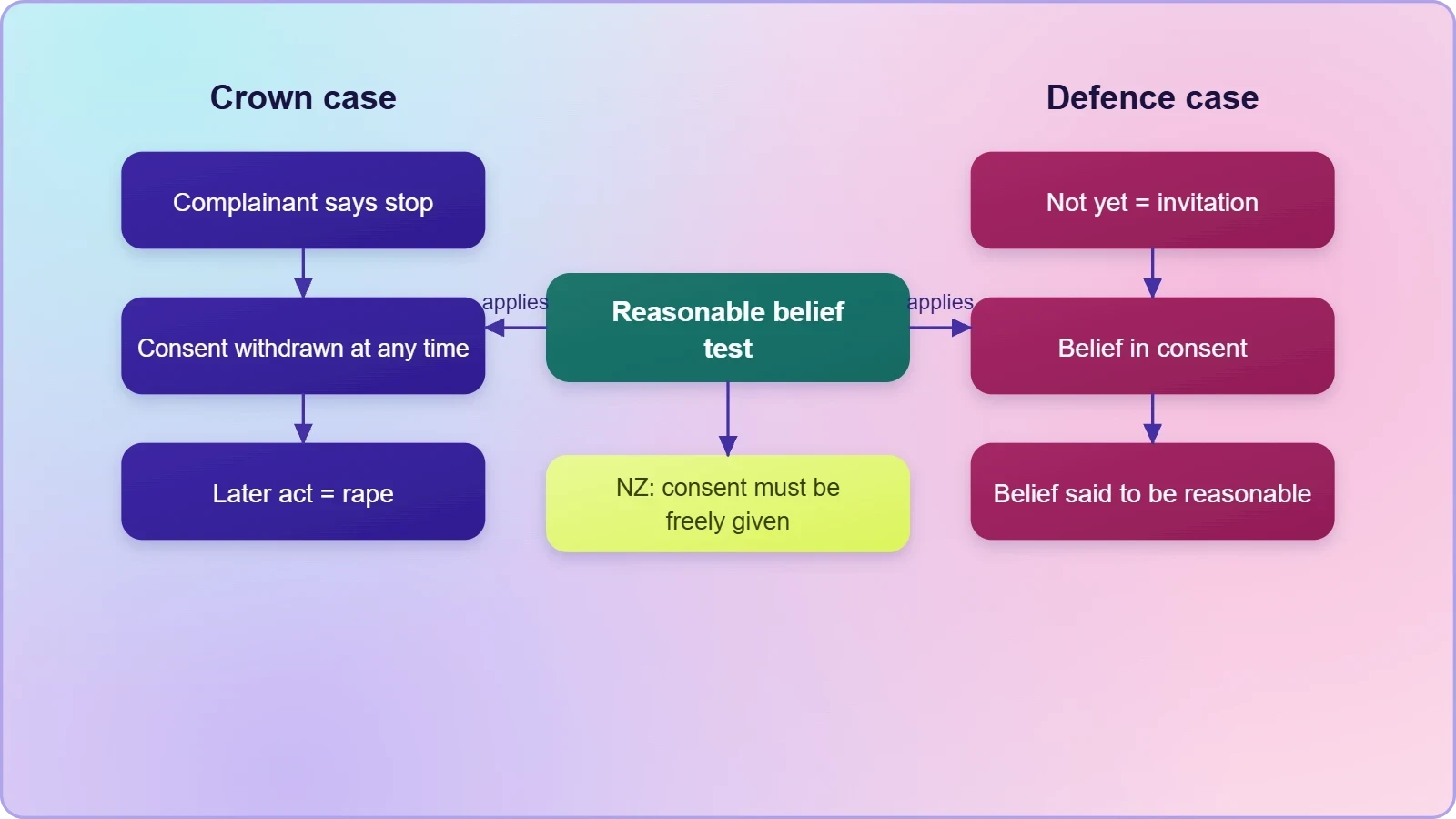
This is not a purely academic question. Consent law in New Zealand has evolved significantly, and appellate courts have repeatedly emphasised that a belief in consent must be grounded in the complainant's actual words and conduct, not in the accused's wishful interpretation. If Foster's defence rested on a misreading of "not yet," the conviction may be legally sound even if the encounter was morally ambiguous. The CCRC will have to weigh whether the trial process adequately tested that distinction.
The CCTV Footage and Police Culture
The CCTV footage shown at trial depicted drunken and lewd behaviour by several officers at the motel, including a senior sergeant exposing himself and drinking from a hollowed-out police baton. This material served multiple purposes: it contextualised the night's events, it challenged the credibility of police witnesses, and it exposed a culture of alcohol-fuelled misconduct within the deployment. For the defence, the footage was evidence of a chaotic environment in which reliable recollection was difficult. For the Crown, it was background noise that did not undermine the complainant's account of what happened in Foster's room.
The footage also raises a broader institutional question. If officers were behaving in this manner while on deployment, what does that say about supervision, discipline, and the reliability of the official record? McKinnel's investigation may have uncovered further material about the deployment that was not before the jury. Whether that material is sufficiently probative to warrant referral is the crux of the CCRC application.
Tim McKinnel and the Credibility of the Review Campaign
Tim McKinnel's involvement is the single most consequential fact in Foster's favour. A former detective, McKinnel has built a reputation as one of New Zealand's most effective private investigators in miscarriage-of-justice cases. He helped overturn the murder convictions of Teina Pora, who spent two decades in prison before his convictions were quashed, Alan Hall, whose conviction was overturned after decades, and Gail Maney. That track record does not guarantee success in Foster's case, but it does mean the CCRC will take the application seriously rather than dismissing it as the work of an amateur.
What McKinnel Brings to the Table
McKinnel's method is typically to re-examine the original investigation, identify evidence that was overlooked or suppressed, and assemble a coherent alternative narrative. In Foster's case, he has said there are substantial flaws in the case, some of which have been recognised by the courts, and that the question is whether they are sufficient to call the integrity of the convictions into question. That framing is careful and legally sophisticated: it acknowledges that flaws exist, concedes that some have already been judicially noted, and focuses the CCRC's attention on the cumulative effect rather than any single defect.
The reference to flaws "recognised by the courts" is telling. It suggests that the Court of Appeal and Supreme Court did not reject Foster's appeal on the basis that the trial was flawless, but on the basis that the flaws did not rise to the level of a miscarriage of justice. The CCRC's task will be to decide whether new evidence or a fresh analysis tips the balance. McKinnel's credibility gives that argument a hearing it might not otherwise receive.
The Role of Sera Cruickshank
Sera Cruickshank's role is more complicated. As Foster's fiancée and the mother of his five-month-old son, she is an interested party whose advocacy is both natural and potentially double-edged. She has said that new evidence gathered by McKinnel is compelling and shows that Foster was jailed for something he did not do, and that the case has damaged both his life and hers. Her public profile as a business owner and social media influencer gives the campaign reach, but it also invites scrutiny of whether the campaign is being conducted in the court of public opinion rather than the CCRC's hearing room.
That tension is familiar in high-profile miscarriage-of-justice cases. Public advocacy can keep a case alive, attract resources, and pressure institutions to act. But it can also polarise opinion and make it harder for the complainant, who has already been through a trial, to feel that her account is being taken seriously. The CCRC will decide the case on the evidence, not on the influencer campaign, but the campaign shapes the environment in which that decision is made.
We Also Published
- 01
- 02
- 03
- 04
The Complainant, the Public, and the Ethics of Re-Litigation
Every post-conviction campaign carries a human cost that is rarely captured in the legal analysis. The complainant in Foster's case has already testified, been cross-examined, and seen her account accepted by a jury. A CCRC petition asks her, in effect, to relive the process, and a referral would expose her to the possibility of a retrial. The ethics of re-litigation are therefore not abstract: they concern the dignity and safety of a person who has already been through a criminal trial, and the public interest in ensuring that finality is not endlessly deferred.
The Complainant's Stake
The complainant's perspective is largely absent from the public reporting, which is itself a feature of how these cases are framed. The focus tends to fall on the convicted person, his family, and his advocates, while the person who made the complaint recedes into the background. That asymmetry is understandable, since the complainant has no campaign to publicise, but it matters for how the case is understood. A CCRC referral would not be a vindication of Foster; it would be a decision that the conviction may be unsafe, which is a different and more limited proposition.
The Commission is required to consider the interests of justice as a whole, and that includes the complainant's interest in the finality of a verdict that was reached after a full trial. If the new evidence is genuinely compelling, that interest may have to yield. But if the application amounts to a re-argument of matters already considered, the Commission may conclude that the public interest in finality outweighs the applicant's interest in another hearing.
Media, Influence, and the Integrity of Review
The involvement of a social media influencer adds a dimension that the legal system is still learning to handle. Cruickshank's platform can amplify the case, attract donations, and keep the story in the news, but it can also create a parallel trial in which the complainant is judged without the protections of the courtroom. The CCRC is insulated from public opinion by design, but its decisions are made in a social context, and the way the case is presented publicly can affect how the complainant, the police, and the courts are perceived.
This is not to say that public advocacy is illegitimate. Miscarriage-of-justice campaigns have historically relied on publicity to correct institutional failures. But the line between advocacy and trial by media is thin, and the Foster case tests it. The most defensible position is that the CCRC should decide on the evidence, that the complainant should be treated with dignity, and that the public should resist the temptation to reach a verdict before the Commission has spoken.
What the Case Reveals About Police Conduct and Institutional Trust
Beyond the individual parties, the Foster case illuminates a broader institutional problem. The CCTV footage of officers drinking heavily, exposing themselves, and engaging in lewd behaviour while on deployment is not merely colourful background; it is evidence of a culture that undermines public confidence in policing. If officers cannot conduct themselves with basic professionalism during a national commemoration, the reliability of their evidence and the adequacy of their supervision become legitimate questions. The case therefore connects to wider debates about police discipline, alcohol culture, and the handling of sexual misconduct allegations within the force.
Discipline, Culture, and the Reliability of Evidence
The behaviour captured on CCTV raises a chain of inference that the defence sought to exploit. If officers were intoxicated and behaving recklessly, their recollections of the night's events may be unreliable, and their credibility as witnesses may be compromised. The Crown's response was that the complainant's account was clear and consistent, and that the misconduct of other officers did not affect her testimony. The jury accepted that response, but the CCRC may be asked to consider whether the trial process adequately explored the extent of the misconduct and its implications for the reliability of the police evidence as a whole.
There is also a question of institutional accountability. The senior sergeant who exposed himself and drank from a hollowed-out baton was not, on the reported facts, the subject of the trial. Yet his conduct formed part of the context in which the alleged offending occurred. Whether the police investigated that conduct, and whether disciplinary action followed, is a matter of public interest. A case that begins as an individual prosecution can end up exposing systemic failures, and that is part of what makes it significant beyond the courtroom.
Sexual Violence, Consent, and the Limits of the Criminal Law
The case also sits within a wider conversation about how the criminal law handles sexual violence, consent, and the credibility of complainants. New Zealand, like many jurisdictions, has been reforming its sexual violence laws and improving the way complainants are treated in court. Foster's defence, which relied on an interpretation of "not yet" as an invitation, tests the boundaries of those reforms. If the Court of Appeal and Supreme Court have already rejected that defence, the CCRC application is unlikely to succeed on consent grounds alone; it will need new evidence or a procedural defect of a different order.
That is why McKinnel's investigation matters. If he has uncovered material that was not before the jury, or if he can show that the trial process was unfair in a way the appellate courts did not fully appreciate, the application has a chance. If, on the other hand, the application amounts to a re-argument of the consent question, it is likely to fail. The distinction between new evidence and re-argument is the fault line on which the case will turn.
The Road Ahead: Prospects, Precedent, and Public Interest
Foster's application now enters a process that is deliberately slow, evidence-focused, and resistant to publicity. The CCRC will review the file, commission its own inquiries, and decide whether to refer the case back to the courts. There is no timetable for that decision, and the Commission is not obliged to give reasons in the same way a court would. For Foster, the wait is another chapter in a legal saga that has already consumed years of his life. For the complainant, it is a period of uncertainty that no verdict can fully resolve.
How the CCRC Weighs New Evidence
The Commission's central task is to assess whether the new evidence, taken together with the trial record, creates a real possibility that the conviction would not stand. That is a lower bar than the criminal standard, but it is not a low bar. The evidence must be credible, relevant, and capable of affecting the verdict. McKinnel's material will be tested against those criteria, and the Commission may seek independent expert opinion or further investigation. If the evidence is merely cumulative or impeaching, it is unlikely to meet the threshold; if it is genuinely new and material, the case may be referred.
The Commission will also consider whether the interests of justice favour a referral, taking into account the seriousness of the offence, the length of time since the trial, and the impact on the complainant. These are not mechanical calculations, and the Commission has discretion. The Foster case, with its high public profile and its coalition of advocates, will test how that discretion is exercised in a media-saturated environment.
What a Referral Would Mean
If the CCRC refers the case, the Court of Appeal would hear the matter afresh, and it could quash the conviction, order a retrial, or dismiss the appeal. A retrial would require the complainant to testify again, which is a significant burden and a factor the courts weigh carefully. A quashed conviction without a retrial would leave Foster free but not necessarily exonerated in the public mind. Either outcome would be legally significant, but neither would resolve the underlying factual dispute, which is why miscarriage-of-justice cases often leave a residue of ambiguity that no verdict can clear.
The broader significance of the case lies in what it says about the system's capacity for self-correction. The CCRC exists because courts sometimes get it wrong, and because the people most affected by those errors deserve a route to review that does not depend on wealth, celebrity, or luck. Foster's application will be judged on its merits, but the fact that it is being made at all is a reminder that the criminal justice system is not a single decision but a process, and that process is only as good as its willingness to revisit its own conclusions.
From our network :
- The Final Descent: How ESA Retired the Legendary Cluster Constellation After 24 Years of Space Weather ScienceAfter 24 years mapping Earth’s magnetosphere, ESA’s Cluster mission concluded with a precisely controlled reentry over the South Pacific. This analysis explores the scientific legacy, engineering decisions, and debris mitigation principles behind one of space exploration’s most responsible retirements.
- Forbidden Matrix Patterns and Visible Lattice Points: A Geometric DictionaryExplore how multidimensional 0–1 matrices encode geometric truths, linking forbidden patterns to visible lattice points and hypergraph theory, with applications in combinatorics and computational geometry.
- The Hidden Cost of AI Convenience: Why Over-Permissioned Agents Are a Security Time BombDiscover why AI agents with excessive permissions create dangerous single points of failure, and learn how implementing least privilege principles can protect your organization from exploitation.
- Mobile Learning and VR in English: What Global Evidence Reveals About Effective Language TechnologyA systematic review across 14 countries reveals which language-learning technologies genuinely work. Mobile learning, AI, and VR show measurable benefits when pedagogically integrated. This evidence-based guide helps educators and learners select technology that delivers real return on investment.
- How AI Agents Will Change the Way We Manage Personal FinancesExplore how AI agents are transforming personal finance through automated budgeting, bill payment, and investment management, while examining the critical security protocols and governance frameworks required for safe deployment.
- Live Online English Classes for Kids: Do They Actually Reduce Anxiety?A ten-week study reveals that synchronous online English classes can significantly reduce child language anxiety while improving listening and reading skills. Discover what makes these programs effective and how parents can select the right one.
- CISA’s Ten-Advisory Wave: Why Generic Patching Fails in OT and How to Build Product-Specific PlaybooksCISA released ten ICS advisories in one week, exposing critical infrastructure risks. Generic patching fails in OT. Learn to build product-specific remediation playbooks.
- Committed Mediterranean Precipitation Decline: Why Emissions Cuts Alone Cannot Restore Winter RainsNew NOAA research reveals that Mediterranean winter rains may decline irreversibly even with emissions cuts. Explore the science of committed climate change and regional impacts.
- University Language Proficiency Exams: Why Institutional Tests Demand Different Preparation Than IELTS and TOEFLDiscover why university-specific language proficiency examinations differ fundamentally from IELTS and TOEFL, and learn strategic preparation approaches for institutional assessment success.
RESOURCES
- Resources will be updated soon.
- 01
- 02
- 03
- 04
- 05
- 06
- 07
- 08
0 Comments