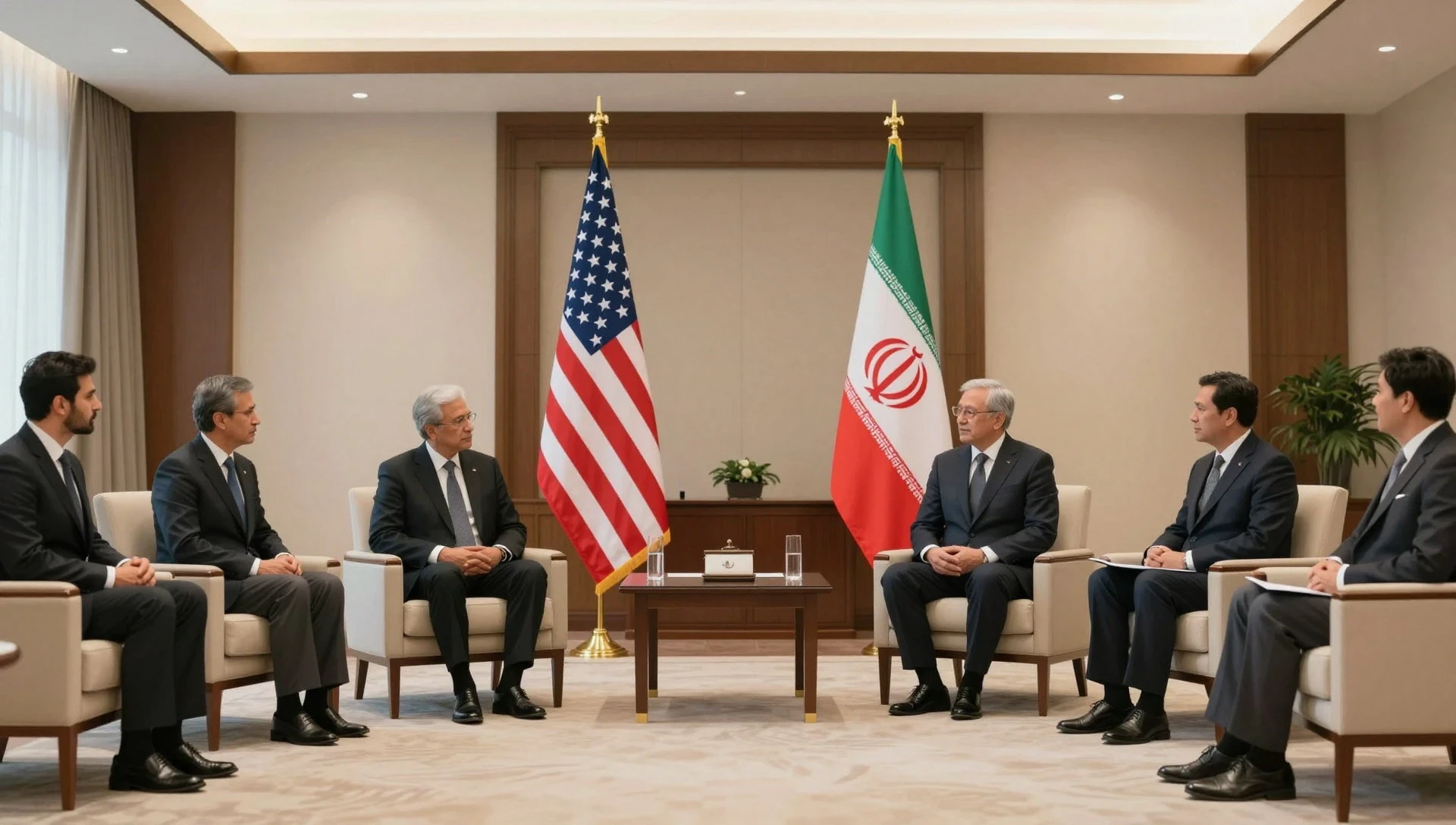
Pakistan's military establishment has signalled a calibrated, conditional openness to acting as a diplomatic bridge between Washington and Tehran, a posture conveyed through the office of the Director General of Inter-Services Public Relations and reported by Dawn.
The phrasing matters more than the substance: "cautiously optimistic" is a deliberately hedged formulation that commits Islamabad to nothing while preserving its value as an intermediary. In strategic communication terms, the DG ISPR's intervention is itself the message, signalling to both capitals that Pakistan is available, attentive, and unwilling to overpromise.
The disclosure arrived with no accompanying detail on the mechanics of the mediation, the identity of the interlocutors beyond the United States and Iran, or the specific disputes under discussion. That silence is analytically significant.
On This Page
Militaries rarely publicise diplomatic roles without a purpose, and the absence of operational specifics suggests a positioning statement rather than a progress report. Pakistan appears to be testing whether the parties will validate its channel before it invests further political capital in a process whose outcome it cannot control.
Understanding this episode requires situating it within Pakistan's broader balancing act: a nuclear-armed state with a long border with Iran, a history of security cooperation with the United States, and deep exposure to Gulf capital and energy markets. The cautious optimism is therefore best read as risk management rather than enthusiasm.
This analysis examines the strategic logic behind the statement, the structural constraints on Pakistani mediation, and the indicators that would confirm whether the channel is substantive or merely declaratory.
TL;DR Pakistan's military spokesman described Islamabad as cautiously optimistic about mediating between the United States and Iran, according to Dawn, without disclosing the mechanics, interlocutors, or agenda. The hedged language reflects a deliberate diplomatic posture: Pakistan is signalling availability as a bridge while limiting exposure to a process it cannot control. The statement is best understood as strategic positioning rather than evidence of diplomatic progress, and its significance lies in what it reveals about Pakistan's balancing between Washington, Tehran, and Gulf patrons.
The Strategic Logic of Cautious Optimism
The phrase "cautiously optimistic" performs a precise function in diplomatic communication. It conveys willingness without commitment, signals relevance without claiming credit, and preserves the option to disengage if talks collapse. For a military spokesperson to adopt this register is notable, because armed forces typically speak in declarative terms. The hedge therefore indicates institutional awareness that mediation carries reputational risk.
Why Militaries Speak on Diplomacy
Pakistan's foreign policy has long been shaped by its military establishment, and the DG ISPR's office functions as a semi-official channel for strategic messaging. When that office comments on US-Iran mediation, it is communicating to multiple audiences simultaneously: Washington, Tehran, domestic opinion, and Gulf capitals. Each audience reads the same words differently, which is precisely the utility of ambiguous phrasing.
The choice of Dawn as the reporting outlet reinforces this reading. Dawn is Pakistan's most established English-language daily, widely read by diplomats, analysts, and international correspondents. A statement placed there reaches the foreign policy community directly, bypassing the noise of vernacular media and ensuring the message is received in the language of international diplomacy.
There is also an institutional dimension. Pakistan's military has historically managed the country's most sensitive external relationships, including the Afghan frontier and India policy. Extending that role to US-Iran mediation consolidates the military's centrality in national security decision-making, a dynamic that civilian governments have contested but rarely reversed.
The Geography of Intermediary Advantage
Pakistan's mediating credentials rest on geography and relationships rather than institutional neutrality. It shares roughly 900 kilometres of border with Iran, maintains diplomatic ties with both Washington and Tehran, and hosts a significant Shia population with cultural links to Iran. These attributes make Islamabad a plausible conduit, though not a disinterested one.
Comparable intermediaries in recent decades include Oman, Qatar, and Switzerland, each of which has cultivated a reputation for discretion and reliability. Oman's facilitation of US-Iran back-channel talks before the 2015 nuclear agreement is the standard reference point. Pakistan's candid, public framing contrasts with that quiet model, suggesting a different diplomatic style.
The distinction matters because mediation succeeds on trust, and trust is eroded by publicity. A spokesman's on-the-record comment is not the same as a confidential channel, and the two can coexist. Pakistan may be signalling publicly while negotiating privately, a common dual-track approach in states with limited diplomatic bandwidth.
Reading the Silence Around the Statement
The most informative element of the report is what it omits. No agenda, no timeline, no named counterpart, and no indication of which disputes are under discussion. In intelligence analysis, such gaps are treated as data.
They suggest the channel is exploratory, or that disclosure would compromise it, or that no channel yet exists beyond informal contact.
Dawn's report attributes the assessment to the spokesman without elaboration, which is consistent with a briefing that conveyed tone rather than content. Journalists covering security affairs in Islamabad routinely receive such briefings, and their value lies in signalling intent. The absence of follow-up detail may reflect genuine uncertainty inside the system about where the process stands.
Analysts should therefore treat the statement as a claim about posture, not about progress. It tells us Pakistan wants to be seen as useful. It does not tell us that Washington or Tehran has accepted that usefulness, nor that either capital regards Islamabad as a preferred conduit over established alternatives.
We Also Published
Constraints, Risks, and the Balance Sheet
Mediation is not a costless diplomatic gesture. It requires credibility with both parties, tolerance for failure, and the capacity to absorb blame if talks collapse. Pakistan's position on each dimension is mixed, which explains the caution embedded in the spokesman's language. The constraints are structural and unlikely to dissolve quickly.
The Credibility Deficit Problem
Pakistan's relationships with both Washington and Tehran carry historical friction. Washington has repeatedly accused Pakistani institutions of tolerating militant proxies, while Tehran has periodically clashed with Islamabad over cross-border militancy in Balochistan. Each capital therefore approaches Pakistani mediation with reservations that a single optimistic statement cannot erase.
Credibility in mediation derives from consistency, and Pakistan's foreign policy has oscillated with changes in government and military leadership. Interlocutors remember these shifts. A channel that might close after a change of command is less valuable than one anchored in institutions, which is why Oman and Switzerland have endured as conduits across decades.
There is also the question of leverage. Effective mediators offer something beyond a meeting room: sanctions relief, security guarantees, or economic inducements. Pakistan's capacity to deliver any of these to Iran or the United States is limited, which constrains its usefulness to facilitation and message-passing rather than substantive bargaining.
Economic Exposure and Energy Dependence
Pakistan's interest in US-Iran de-escalation is partly economic. The country has pursued the Iran-Pakistan gas pipeline for years, a project stalled by American sanctions. Reduced tension could revive that option, though financing and technical hurdles would remain substantial even under a permissive sanctions environment.
Remittances from Gulf states and loans from Gulf sovereign funds also shape Islamabad's calculus. Saudi Arabia and the United Arab Emirates have provided repeated financial support, and both have their own tense relationships with Iran. Pakistan must therefore mediate without appearing to align too closely with Tehran, a narrow path.
Energy import dependence compounds the sensitivity. Pakistan's LNG contracts and fuel purchases expose it to price shocks linked to Gulf security incidents. Any mediation that lowers the risk of regional escalation therefore has direct fiscal value, independent of its diplomatic merits.
Domestic Politics and Sectarian Sensitivity
Mediation with Iran carries domestic political weight in a country where sectarian dynamics are delicate. Pakistan's Shia community, estimated at 15 to 20 percent of the population, maintains cultural and religious ties to Iran.
Any perception that Islamabad is pressuring Tehran could generate domestic backlash, while excessive warmth toward Iran alarms Gulf partners.
The military spokesman's careful phrasing may partly reflect this domestic calculus. "Cautiously optimistic" is a formulation that neither promises success nor invites blame for failure. It gives the institution room to retreat if the initiative stalls, and it avoids the appearance of a sectarian alignment that could be exploited politically.
Civilian authorities have their own interests in the process. A diplomatic success would strengthen the foreign ministry's standing, while a failure would reinforce the military's dominance over security policy. The public framing by a military spokesman rather than a civilian official is itself a signal about where authority resides.
Indicators, Scenarios, and What to Watch
Statements of cautious optimism are common in diplomacy and frequently precede nothing. The analytical task is to identify observable indicators that would distinguish a substantive channel from a declaratory one. Several are available, and each can be tracked through public reporting over the coming months.
Signals That Would Confirm Substance
A confirmed channel would likely produce reciprocal statements from Washington or Tehran acknowledging Pakistani facilitation. Neither capital has an incentive to publicise such a role prematurely, but quiet acknowledgements in background briefings would be meaningful. Absence of any corroboration would suggest the initiative remains unilateral.
Movement on humanitarian or consular issues would be another indicator. Prisoner exchanges, the release of frozen assets, or facilitated medical travel are typical early deliverables in back-channel diplomacy. These are low-cost, verifiable, and politically safe for both parties, making them reliable markers of genuine engagement.
Changes in the frequency of high-level visits would also matter. A surge in consultations between Islamabad and both capitals, particularly involving intelligence and military officials, would indicate operational coordination. Routine diplomatic traffic, by contrast, would suggest the statement was positioning rather than preparation.
Scenario Analysis and Probability Weighting
Three broad scenarios merit consideration. In the first, Pakistan serves as a genuine facilitator, producing modest confidence-building measures within a year. In the second, the initiative remains declaratory, with no corroboration and no deliverables. In the third, the channel collapses amid renewed escalation, leaving Islamabad exposed.
Historical base rates favour the second scenario. Most announced mediation efforts produce no measurable outcome, and states frequently claim diplomatic roles for domestic and international consumption. The first scenario requires sustained buy-in from Washington and Tehran, neither of which has signalled enthusiasm for Pakistani facilitation in this instance.
The third scenario carries the greatest cost. If talks fail and relations deteriorate, Pakistan could be blamed by one or both parties for raising expectations. This asymmetry between modest upside and meaningful downside explains why the spokesman chose caution rather than confidence, and why the language deserves attention.
- 01
- 02
- 03
- 04
Regional Reactions and the Wider Order
Other regional actors will read the statement closely. Saudi Arabia and the UAE may view Pakistani mediation with suspicion if it appears to strengthen Iran's position. Turkey and Qatar, both active in regional diplomacy, may see it as competition. India will monitor for any shift in Pakistan's international standing.
China's reaction is particularly relevant given its own ties to Iran and its investment in Pakistan. Beijing has generally preferred quiet diplomacy and may view a public Pakistani role as either useful or destabilising, depending on whether it advances or complicates Chinese interests in Gulf energy security.
The broader lesson concerns the changing architecture of middle-power diplomacy. States with limited material power increasingly seek influence through facilitation, and public signalling has become a tool of statecraft.
Pakistan's statement belongs to this trend, and its significance lies less in what it promises than in what it reveals about how secondary powers now compete for relevance.
Frequently Asked Questions
Readers encountering the Dawn report may have questions about what the statement means in practice and how much weight to give it. The following answers address the most common points of confusion, distinguishing between what is documented and what remains speculative.
What Did Pakistan's Military Spokesman Actually Say?
According to Dawn, the DG ISPR described Pakistan as cautiously optimistic about efforts to mediate between the United States and Iran. No further details were provided about the nature of the mediation, the parties involved beyond the two states, or the timeline. The statement was an assessment of posture, not an announcement of a formal role.
Does This Mean Pakistan Is Officially Mediating?
Not necessarily. Cautious optimism about mediation efforts is distinct from confirmation that Pakistan has been asked to mediate or has accepted such a role. The statement indicates openness and awareness, but it does not establish that Washington or Tehran has endorsed Pakistani involvement in any formal capacity.
Why Would Iran or the United States Accept Pakistani Facilitation?
Both capitals maintain diplomatic relations with Islamabad, and Pakistan's proximity to Iran offers logistical convenience. However, neither has publicly signalled a preference for Pakistani mediation, and established conduits such as Oman and Qatar remain available. Acceptance would depend on whether Pakistan offers something those alternatives cannot.
How Should This Statement Be Interpreted Analytically?
It is best read as strategic signalling rather than a progress report. The hedged language, the absence of operational detail, and the choice of a military spokesman all point to positioning. Analysts should watch for corroboration from Washington or Tehran, and for concrete deliverables such as consular arrangements, before revising that assessment.
From our network :
- Forbidden Matrix Patterns and Visible Lattice Points: A Geometric DictionaryExplore how multidimensional 0–1 matrices encode geometric truths, linking forbidden patterns to visible lattice points and hypergraph theory, with applications in combinatorics and computational geometry.
- How AI Agents Will Change the Way We Manage Personal FinancesExplore how AI agents are transforming personal finance through automated budgeting, bill payment, and investment management, while examining the critical security protocols and governance frameworks required for safe deployment.
- The Final Descent: How ESA Retired the Legendary Cluster Constellation After 24 Years of Space Weather ScienceAfter 24 years mapping Earth’s magnetosphere, ESA’s Cluster mission concluded with a precisely controlled reentry over the South Pacific. This analysis explores the scientific legacy, engineering decisions, and debris mitigation principles behind one of space exploration’s most responsible retirements.
- Mobile Learning and VR in English: What Global Evidence Reveals About Effective Language TechnologyA systematic review across 14 countries reveals which language-learning technologies genuinely work. Mobile learning, AI, and VR show measurable benefits when pedagogically integrated. This evidence-based guide helps educators and learners select technology that delivers real return on investment.
- The Hidden Cost of AI Convenience: Why Over-Permissioned Agents Are a Security Time BombDiscover why AI agents with excessive permissions create dangerous single points of failure, and learn how implementing least privilege principles can protect your organization from exploitation.
- University Language Proficiency Exams: Why Institutional Tests Demand Different Preparation Than IELTS and TOEFLDiscover why university-specific language proficiency examinations differ fundamentally from IELTS and TOEFL, and learn strategic preparation approaches for institutional assessment success.
- Live Online English Classes for Kids: Do They Actually Reduce Anxiety?A ten-week study reveals that synchronous online English classes can significantly reduce child language anxiety while improving listening and reading skills. Discover what makes these programs effective and how parents can select the right one.
- Committed Mediterranean Precipitation Decline: Why Emissions Cuts Alone Cannot Restore Winter RainsNew NOAA research reveals that Mediterranean winter rains may decline irreversibly even with emissions cuts. Explore the science of committed climate change and regional impacts.
- CISA’s Ten-Advisory Wave: Why Generic Patching Fails in OT and How to Build Product-Specific PlaybooksCISA released ten ICS advisories in one week, exposing critical infrastructure risks. Generic patching fails in OT. Learn to build product-specific remediation playbooks.
RESOURCES
- Pakistan military 'cautiously optimistic' on Iran-US mediation - Reutersreuters.com3 days ago ... Pakistan military 'cautiously optimistic' on Iran-US mediation ... RAWALPINDI, Pakistan, Oct 30 (Reuters) - Pakistan's military is “cautiously ...
- Pakistan army 'cautiously optimistic' about US-Iran mediation effortsaljazeera.com3 days ago ... Pakistan's army is “cautiously optimistic” about mediation efforts between Iran and the United States as regional countries seek to revive…
- 'Cautious optimism' on resumption 'soon' of stalled US-Iran talks ...aa.com.trAug 2, 2026 ... Pakistani and Qatari mediators have "cautious optimism" about the resumption of stalled talks between Washington and Tehran "soon" after US ...
- After talks in Tehran, Pakistan military 'cautiously optimistic' on US ...timesofisrael.com3 days ago ... Army chief Field Marshal Asim Munir — Pakistan's chief mediator in its efforts to de-escalate the now eight-month-old Iran war…
- Mediators hold 'cautious optimism' on US-Iran talks resumptionen.yenisafak.comAug 2, 2026 ... Pakistani and Qatari mediators hold 'cautious optimism' for US-Iran talks resumption this week after convincing President Trump to cancel ...
- Pakistan's military expresses cautious optimism regarding its ...facebook.com3 days ago ... Pakistan military 'cautiously optimistic' on Iran-US mediation. 1d. Almir Ciadza. Pakistan is the problem. #FreeImranKhanNow. 1d · 2 likes.
- Pakistan military 'cautiously optimistic' on Iran-US mediationarabnews.com3 days ago ... Pakistan's military expresses cautious optimism regarding its mediation role between Iran and the United States, following a high-level ...
- Pakistan's military has expressed cautious optimism about its efforts ...facebook.com2 days ago ... https://www.khaama.com/pakistan-army-us -iran-mediation-optimism/. khaama.com. Pakistan Army Cautiously Optimistic About US-Iran Mediation. 40m ...
- Pakistan's military spokesperson Ahmed Sharif Chaudhry says ...instagram.com3 days ago ... ... cautiously optimistic” about mediation efforts between Iran and the US, but warns “powerful spoilers and detractors” could seek to…
- DG ISPR says Pakistan 'cautiously optimistic' on US-Iran mediationdawn.com3 days ago ... Pakistan is “cautiously optimistic” about its mediation between Iran and the United States, the military's spokesman said on Friday in…
- warns of 'powerful spoilers' | Newsquawknewsquawk.com3 days ago ... Pakistani military spokesman says the Pakistani military is 'cautiously optimistic' on Iran-US mediation; warns of 'powerful spoilers'.
- Pakistan's Army “Cautiously Optimistic” About Mediation Between ...8am.media2 days ago ... However, Pakistan's mediation efforts to end the war between the United States and Iran have failed to produce tangible results…
- Pakistan Cautiously Optimistic on US-Iran Diplomacy, But Hurdles ...roic.ai3 days ago ... Pakistan's military signals cautious optimism on US-Iran mediation after Army Chief Asim Munir's two visits to Tehran in October. A…
- Pakistan army 'cautiously optimistic' about US-Iran mediation effortsyahoo.com3 days ago ... Pakistan's army is "cautiously optimistic" about mediation efforts between Iran and the United States as regional countries seek to revive ...
- 01
- 02
- 03
- 04
- 05
- 06
- 07
- 08
0 Comments