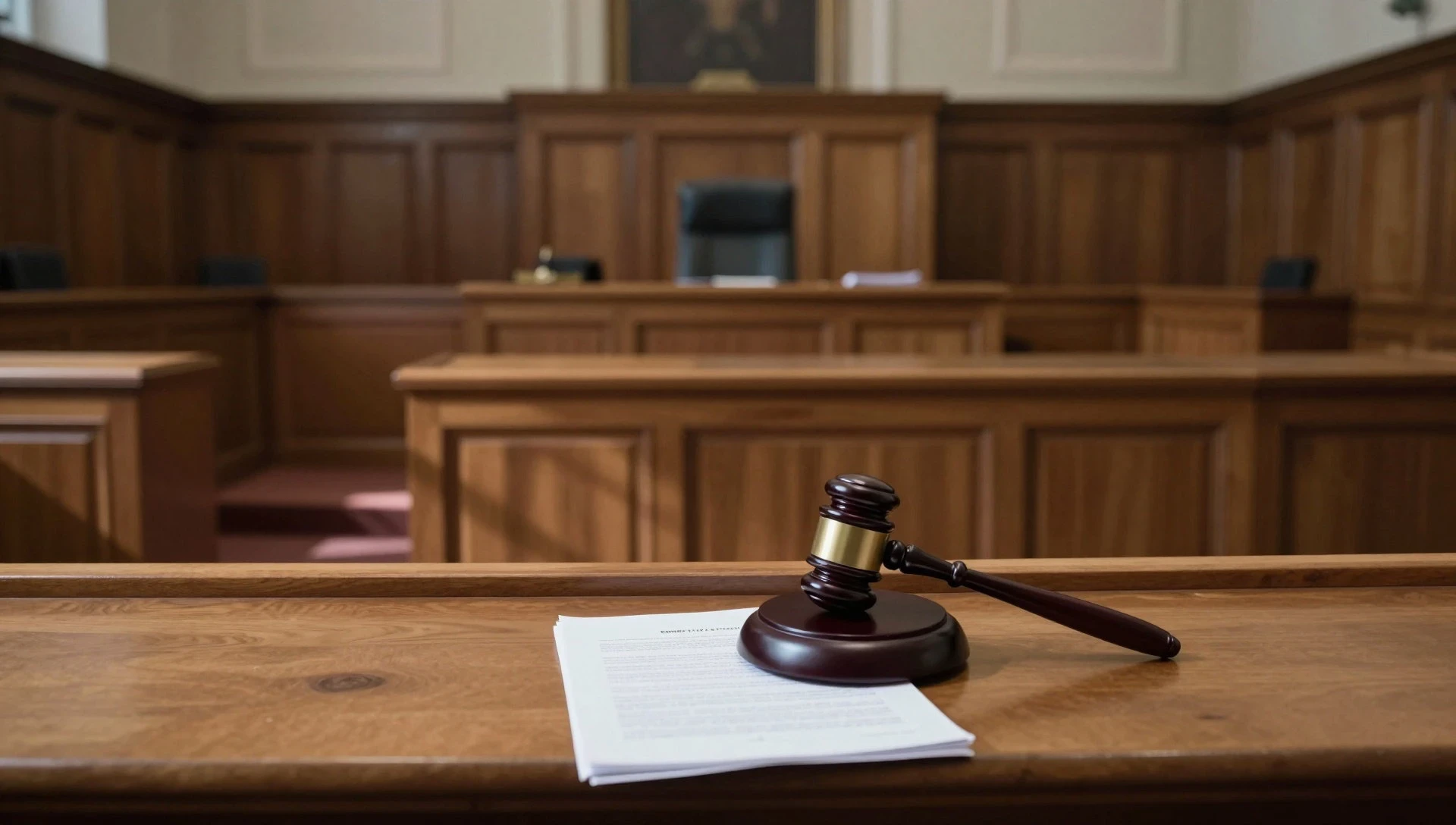
Poland's constitutional crisis has moved from courtroom argument to street confrontation, and the sequence of events matters more than any single headline. On a Friday night in Warsaw, hundreds of demonstrators assembled outside the Constitutional Tribunal after judges installed by the current parliamentary majority suspended the court's president, Bogdan Świeczkowski, and his deputy, Bartłomiej Sochański.
Riot police sealed the building, three people were arrested attempting to enter the complex, and the far-right opposition Law and Justice party condemned the action outright.
The dispute is not a sudden rupture but the latest phase of a conflict running since 2015, when power shifted from Civic Platform to PiS. What appears on the surface as a procedural quarrel over judicial appointments conceals a deeper contest over who may legitimately interpret Poland's constitution, and whether European Union law outranks domestic constitutional rulings.
On This Page
President Karol Nawrocki, a PiS ally, cut short a trip to Senegal and returned home, signalling that the executive will not treat the matter as routine.
This analysis reconstructs the mechanics of the standoff: the contested 2015 appointments, the tribunal's own finding that only three of five seats were lawfully filled, the refusal to swear in valid judges, and the European rulings that followed.
It also weighs what the confrontation implies for judicial independence, coalition politics and Poland's standing inside the European Union, using documented dates, institutional roles and comparative benchmarks rather than partisan framing.
TL;DR Poland's Constitutional Tribunal crisis is a decade-long dispute over judicial appointments that escalated when judges elected by the current majority suspended the court's president and deputy, prompting protests in Warsaw and arrests outside the building. The core question is whether the tribunal can function as an independent arbiter when its membership is contested. European courts have repeatedly found deficiencies, and the standoff now tests the limits of executive, legislative and judicial authority simultaneously.
The Institutional Mechanics Behind the Warsaw Standoff
The Constitutional Tribunal decides whether legislation conforms to Poland's constitution, and its rulings can halt laws before they take effect. That power explains why membership is fought over so intensely: control of the bench translates directly into control over the legal boundaries of government action.
When the court's own leadership is suspended by judges whose mandates are disputed, the institution's capacity to arbitrate collapses into circularity.
How the 2015 Appointment Dispute Originated
The current conflict traces to a single transfer of power. The outgoing parliament elected five judges before PiS took office, but the tribunal subsequently held that only three of those appointments rested on a valid legal basis.
The incoming PiS majority then elected replacements, including for the three seats that had already been lawfully filled, creating a duplicate mandate problem the system had no clean mechanism to resolve.
Then-President Andrzej Duda refused to swear in the three validly elected judges, which meant the seats they were entitled to occupy remained vacant in practice. This refusal converted a legal ambiguity into a durable institutional defect.
From that point, every subsequent ruling carried a question mark over the composition of the panel that issued it, and that question mark has never been erased.
The arithmetic is straightforward and damaging. Five seats were contested, three were found lawful, and replacements were elected for all five. The result is a bench whose legitimacy depends on which legal premise an observer accepts, and no domestic authority has been able to settle the premise conclusively. Legal certainty, the very thing the tribunal exists to provide, became its first casualty.
During eight years in government, PiS introduced broader judicial changes that critics said increased political influence over the courts. The cumulative effect was to shift the tribunal from arbiter to participant.
Aleksandra Kustra-Rogatka, an associate professor at Nicolaus Copernicus University in Toruń, told Al Jazeera that after Julia Przyłębska became tribunal president the rule-of-law crisis worsened, and the court came to be seen as a rubber-stamp body and an active political player supporting illiberal policies.
The Suspension of Świeczkowski and Sochański
Judges elected by the current parliamentary majority suspended the tribunal's president and his deputy, an act without clear precedent in the institution's history. Police in riot gear blocked access to the building, and three arrests followed attempts to enter the court complex.
The physical sealing of a constitutional court is a visible marker of institutional breakdown, not a routine security measure.
Prime Minister Donald Tusk argues that firm action is needed to restore the rule of law after years of political interference under PiS. His centrist government, in office since December 2023, has refused to recognise the tribunal's legitimacy in its current form and has sought to disregard its rulings.
That position creates a paradox: a government committed to legality is simultaneously declining to obey a constitutional body.
The opposition frames the suspension as an assault on judicial independence. PiS, now the main opposition, condemned the move immediately, and President Nawrocki's return from Senegal signals that the executive branch may become a direct participant rather than a neutral arbiter.
When three branches contest the same institution's composition, the dispute stops being legal and becomes constitutional in the rawest sense.
Wojciech Przybylski, editor-in-chief of Visegrad Insight, told Al Jazeera that the former PiS government wanted a court system and tribunal that would support its ideological views and its claim of sovereignty over the EU.
That framing explains why the tribunal's composition carries weight far beyond domestic jurisprudence: it determines which legal order prevails when the two collide.
Why the Tribunal's Composition Carries Political Weight
Because tribunal rulings can stop legislation from taking effect, the bench functions as a gatekeeper over the entire legislative programme. A government that cannot rely on the court's composition cannot guarantee its laws survive review.
Conversely, an opposition that controls the bench retains a structural veto, which is precisely why appointment fights become existential for both sides.
The European dimension compounds the domestic stakes. In 2021 the European Court of Human Rights ruled that an improperly appointed judge's participation had deprived a company of its right to a tribunal established by law.
That judgment established a template: individual rulings can be invalidated retroactively when panel composition is defective, exposing years of decisions to challenge.
In December 2025 the EU's highest court ruled that the tribunal had not met the requirements of an independent court. It further found that tribunal judgments challenging the authority of EU law breached Poland's obligations as a member state.
These findings convert a domestic appointment quarrel into a question of treaty compliance, with financial and voting consequences available to Brussels.
The practical effect is that Polish litigants now face uncertainty at two levels simultaneously. Domestically, the validity of tribunal rulings depends on contested appointments; at European level, those same rulings may be treated as incompatible with membership obligations. Legal certainty, the foundation of investment and governance alike, erodes in both directions at once.
Competing Claims of Legitimacy and the Rule of Law
Both sides in this confrontation invoke the rule of law, and both can point to defensible premises. Tusk's government argues that a tribunal staffed through defective appointments cannot credibly review legislation, so disregarding its rulings restores rather than undermines legality.
PiS and its allies argue that a government may not suspend constitutional judges it dislikes, because that substitutes political preference for constitutional order.
The Government's Case for Disregarding Rulings
The centrist coalition's position rests on the claim that the tribunal's current form lacks legitimacy, a conclusion supported by the December 2025 EU court finding. If the tribunal is not an independent court, its rulings arguably carry no binding force, and compliance would validate a defective institution. This reasoning has precedent in Polish legal debate, though never before applied at governing level.
Critics counter that selective non-compliance sets a durable precedent regardless of intent. A future government could invoke the same logic against a tribunal it considers hostile, and the argument would be structurally identical.
The mechanism, once used, becomes available to any majority with sufficient parliamentary control and sufficient confidence in its own constitutional judgment.
The practical consequence is that legal obligation becomes contingent on political assessment. When compliance depends on whether a government accepts an institution's legitimacy, the distinction between constitutional review and political negotiation dissolves. That dissolution is the substance of the crisis, and it is not resolved by winning the current argument.
Public reaction reflects the stakes. Hundreds gathered outside the tribunal on a Friday night, and three arrests followed attempts to enter the complex. Protest at this scale over a judicial appointment signals that the dispute has escaped the legal profession and entered the broader contest over national direction, where compromise carries electoral cost.
The Opposition's Defence of Judicial Independence
PiS frames the suspension as proof that the current majority intends to subordinate the judiciary. Its argument draws on a simple principle: judges may be criticised, but they may not be removed by political actors who disagree with their rulings. President Nawrocki's return from Senegal reinforces the claim that this is a constitutional emergency requiring executive engagement.
The opposition's difficulty is that its own record complicates the defence. During eight years in government, PiS introduced judicial changes that critics said increased political influence over the courts, and the tribunal's composition under Przyłębska became the central exhibit. Defending judicial independence now requires explaining why earlier restructuring was compatible with it.
Kustra-Rogatka's assessment that the court came to be seen as a rubber-stamp body and an active political player supporting illiberal policies captures the reputational cost. Once an institution is perceived as aligned with a political programme, its defenders must argue for the principle while acknowledging the practice. That tension weakens the opposition's moral clarity even where its legal point stands.
The result is a confrontation in which neither side holds a clean position. Each can identify the other's inconsistencies with precision, and neither can demonstrate that its own conduct has been consistent with the principle it now invokes. This symmetry does not produce moderation; it produces escalation, because concession would validate the opponent's narrative.
How the Dispute Became a European Question
The conflict acquired a European dimension because the tribunal's rulings touched the authority of EU law. When a constitutional court asserts primacy over treaty obligations, it challenges the legal architecture of membership itself. The EU court's December 2025 finding that such judgments breached Poland's obligations therefore addresses sovereignty, not merely judicial appointments.
Przybylski's observation that the former PiS government sought a tribunal supporting its claim of sovereignty over the EU identifies the ideological core. A court willing to declare EU law subordinate to the national constitution serves a political project directly.
That is why external review became unavoidable: the dispute could not be settled within a legal order one party sought to subordinate.
Membership obligations carry material leverage. Infringement proceedings, funding conditionality and voting rights provide Brussels with instruments that domestic actors cannot ignore indefinitely. Each escalation therefore raises the cost of intransigence for whichever side holds office, and the calculation shifts with every European ruling issued.
The comparative picture is instructive. Hungary's conflicts with Brussels followed a similar trajectory of judicial restructuring, external findings and financial conditionality, without producing a settled constitutional equilibrium. Poland's case adds a distinctive element: the confrontation now runs between a government and a tribunal both claiming to defend legality against the other.
- 01
- 02
- 03
- 04
We Also Published
Consequences for Governance, Markets and Democratic Stability
The immediate consequence is legal uncertainty at the point where businesses and citizens need it least. Companies operating in Poland rely on the finality of constitutional review when challenging regulation, and that finality now depends on which appointments an adjudicating body accepts.
The 2021 ECHR ruling demonstrated that defective composition can void outcomes retroactively, exposing settled transactions to renewed challenge.
Legal Uncertainty and Its Economic Cost
Investment decisions price legal risk, and constitutional uncertainty is among the least diversifiable forms. When the validity of a tribunal's rulings is contested by the government itself, counterparties cannot model the probability that a given law survives review. That ambiguity raises the cost of capital for long-horizon projects and favours jurisdictions with settled constitutional orders.
The retroactive dimension compounds the problem. If past rulings can be challenged because a panel included an improperly appointed judge, then contracts, permits and regulatory approvals resting on those rulings become contestable.
The number of affected decisions grows with each year the composition dispute remains unresolved, and the backlog of potential challenges accumulates silently.
European findings add a second layer of exposure. A ruling that breaches membership obligations may invite infringement proceedings and funding conditionality, both of which carry fiscal consequences. For firms with EU-linked financing or cross-border operations, the dispute introduces a variable that domestic legal analysis alone cannot capture or hedge.
The comparative evidence is not encouraging. Jurisdictions that have experienced prolonged constitutional uncertainty tend to see delayed investment, higher risk premia and a shift toward shorter-duration commitments. Poland's growth record has been strong, but growth and legal certainty are separate variables, and the latter is deteriorating independently of the former.
Institutional Precedents and Their Durability
The most consequential outcome may be procedural rather than substantive. A government disregarding constitutional rulings, and judges suspending their own president, together establish that institutional norms yield under sufficient political pressure. Once demonstrated, that lesson is available to every future majority, regardless of its ideological composition.
Restoring equilibrium requires more than winning the current dispute. It requires a mechanism that both sides accept as authoritative, and no such mechanism currently exists in Polish constitutional practice. The tribunal was that mechanism, and its contested composition removed it from the role precisely when the role mattered most.
External actors can impose costs but cannot supply domestic legitimacy. European rulings establish that the tribunal falls short of independence standards; they cannot determine who should sit on it.
The gap between identifying a defect and remedying it is where the crisis lives, and it is a gap that only domestic institutions can close.
The likely trajectory is prolonged contestation punctuated by external rulings and periodic street mobilisation. Neither bloc can secure a decisive victory without the other's acquiescence, and neither appears willing to concede the principle at stake.
In that configuration, the crisis becomes a standing feature of Polish governance rather than an episode to be resolved.
What the Standoff Signals for European Democracy
Poland's case illustrates a pattern visible across the continent: judicial appointments have become the primary battleground for control of the state's legal boundaries. The reason is structural. Courts that can invalidate legislation hold a veto, and political actors who cannot win that veto electorally seek to shape the bench instead.
The December 2025 EU court finding that tribunal judgments challenging EU law authority breached membership obligations marks a significant escalation. It establishes that constitutional restructuring with external legal effects falls within European review, narrowing the space for member states to redefine their judicial orders unilaterally. That principle extends well beyond Poland.
For democratic stability, the critical variable is whether losers accept institutional outcomes. When both government and opposition treat the tribunal as an instrument rather than an arbiter, acceptance collapses and every ruling becomes provisional.
The Warsaw protests and the arrests outside the court complex are symptoms of that collapse, not causes of it.
The dispute will not be settled by a single ruling or election. It requires a negotiated reconstruction of the tribunal's composition and a shared acceptance of the resulting body's authority, neither of which is currently in prospect.
Until then, Poland operates with a constitutional court whose legitimacy is contested by the government it is meant to check.
From our network :
- University Language Proficiency Exams: Why Institutional Tests Demand Different Preparation Than IELTS and TOEFLDiscover why university-specific language proficiency examinations differ fundamentally from IELTS and TOEFL, and learn strategic preparation approaches for institutional assessment success.
- Live Online English Classes for Kids: Do They Actually Reduce Anxiety?A ten-week study reveals that synchronous online English classes can significantly reduce child language anxiety while improving listening and reading skills. Discover what makes these programs effective and how parents can select the right one.
- Mobile Learning and VR in English: What Global Evidence Reveals About Effective Language TechnologyA systematic review across 14 countries reveals which language-learning technologies genuinely work. Mobile learning, AI, and VR show measurable benefits when pedagogically integrated. This evidence-based guide helps educators and learners select technology that delivers real return on investment.
- The Final Descent: How ESA Retired the Legendary Cluster Constellation After 24 Years of Space Weather ScienceAfter 24 years mapping Earth’s magnetosphere, ESA’s Cluster mission concluded with a precisely controlled reentry over the South Pacific. This analysis explores the scientific legacy, engineering decisions, and debris mitigation principles behind one of space exploration’s most responsible retirements.
- CISA’s Ten-Advisory Wave: Why Generic Patching Fails in OT and How to Build Product-Specific PlaybooksCISA released ten ICS advisories in one week, exposing critical infrastructure risks. Generic patching fails in OT. Learn to build product-specific remediation playbooks.
- How AI Agents Will Change the Way We Manage Personal FinancesExplore how AI agents are transforming personal finance through automated budgeting, bill payment, and investment management, while examining the critical security protocols and governance frameworks required for safe deployment.
- The Hidden Cost of AI Convenience: Why Over-Permissioned Agents Are a Security Time BombDiscover why AI agents with excessive permissions create dangerous single points of failure, and learn how implementing least privilege principles can protect your organization from exploitation.
- Committed Mediterranean Precipitation Decline: Why Emissions Cuts Alone Cannot Restore Winter RainsNew NOAA research reveals that Mediterranean winter rains may decline irreversibly even with emissions cuts. Explore the science of committed climate change and regional impacts.
- Forbidden Matrix Patterns and Visible Lattice Points: A Geometric DictionaryExplore how multidimensional 0–1 matrices encode geometric truths, linking forbidden patterns to visible lattice points and hypergraph theory, with applications in combinatorics and computational geometry.
RESOURCES
- Polish constitutional crisis - Wikipediaen.wikipedia.orgThe Polish constitutional crisis, also known as the Polish rule-of-law crisis, is a political conflict ongoing since 2015 in which the Polish government has ...
- Poland's ongoing rule-of-law crisis explainednotesfrompoland.comMar 17, 2025 ... What is Poland's Constitutional Tribunal crisis? ... Beyond reviewing the compatibility of laws, the TK tackles several other essential tasks, ...
- Polish Constitutional Tribunal crisis - Wikipediaen.wikipedia.orgThe Polish Constitutional Tribunal crisis has been an ongoing political conflict in Poland starting in the second half of 2015 over the appointment of…
- The Polish Constitutional Tribunal Crisis from the Perspective of the ...cambridge.orgMar 30, 2022 ... The facts of the Xero Flor case are related to the crisis over the Polish Constitutional Tribunal. This crisis began…
- A New Step in the Polish Constitutional Crisis: Should Fire be ...iconnectblog.comDec 11, 2025 ... On September 23, 2025[1], the Polish Constitutional Tribunal issued a ruling declaring unconstitutional the provisions of the law of July…
- The Collapse of Judicial Independence in Poland: A Cautionary Talejudicature.duke.eduOnce the Constitutional Tribunal had been packed with enough PiS-friendly judges, the PiS Minister of Justice threatened disciplinary sanction against any judge ...
- Constitutional Crisis in Poland 2015–2016 in the Light of the Rule of ...link.springer.comJan 6, 2021 ... The constitutional crisis in Poland began in October 2015. It was triggered by appointing, by the outgoing Parliament (elected for…
- Judicial Change to the Law-in-Action of Constitutional Review of ...utrechtlawreview.orgMay 5, 2022 ... The constitutional crisis centred around the Constitutional Tribunal proved to be a catalyst for a new phase in the diffuse…
- Poland: Constitutional Tribunal is illegitimate, unfit to interpret ...europarl.europa.euOct 21, 2021 ... In a resolution adopted on Thursday with 502 votes for, 153 against, and 16 abstentions, MEPs emphasised that the Polish…
- Polish(ing) a Broken Tribunal. How to Restore Constitutional Justice ...tandfonline.comMar 31, 2026 ... In his view, the Tribunal lost its legitimacy on 8 February 2017, when the first ruling involving a double judge…
- Polish PM Tusk vows support for tribunal amid court crisis - Reutersreuters.com1 day ago ... A long-running political dispute over the Constitutional Tribunal has effectively paralysed the institution, with the pro-European government ...
- Poland crisis explained: a dispute over legitimacy and the courtseuronews.com2 days ago ... The dispute over Poland's Constitutional Tribunal began in 2015, when the two main political camps, PO and PiS, clashed over…
- Hostile Takeover: How Law and Justice Captured Poland's Courtsfreedomhouse.orgLaw and Justice's campaign to capture Poland's Constitutional Tribunal was the central component of its wider push to seize control of the judicial institutions ...
- Protests outside Poland's constitutional court: What's the crisis about?aljazeera.com2 days ago ... Riot police have been deployed outside Poland's Constitutional Tribunal as a dispute over who should serve on the court escalates…
- From Parallel Constitutions to Schrödinger's Tribunals: Poland's ...populismstudies.orgAug 27, 2026 ... Kamil Jonski examines Poland's protracted constitutional crisis through the prospect of what he calls “Schrödinger's Tribunals”: parallel ...
- 01
- 02
- 03
- 04
- 05
- 06
- 07
- 08
0 Comments