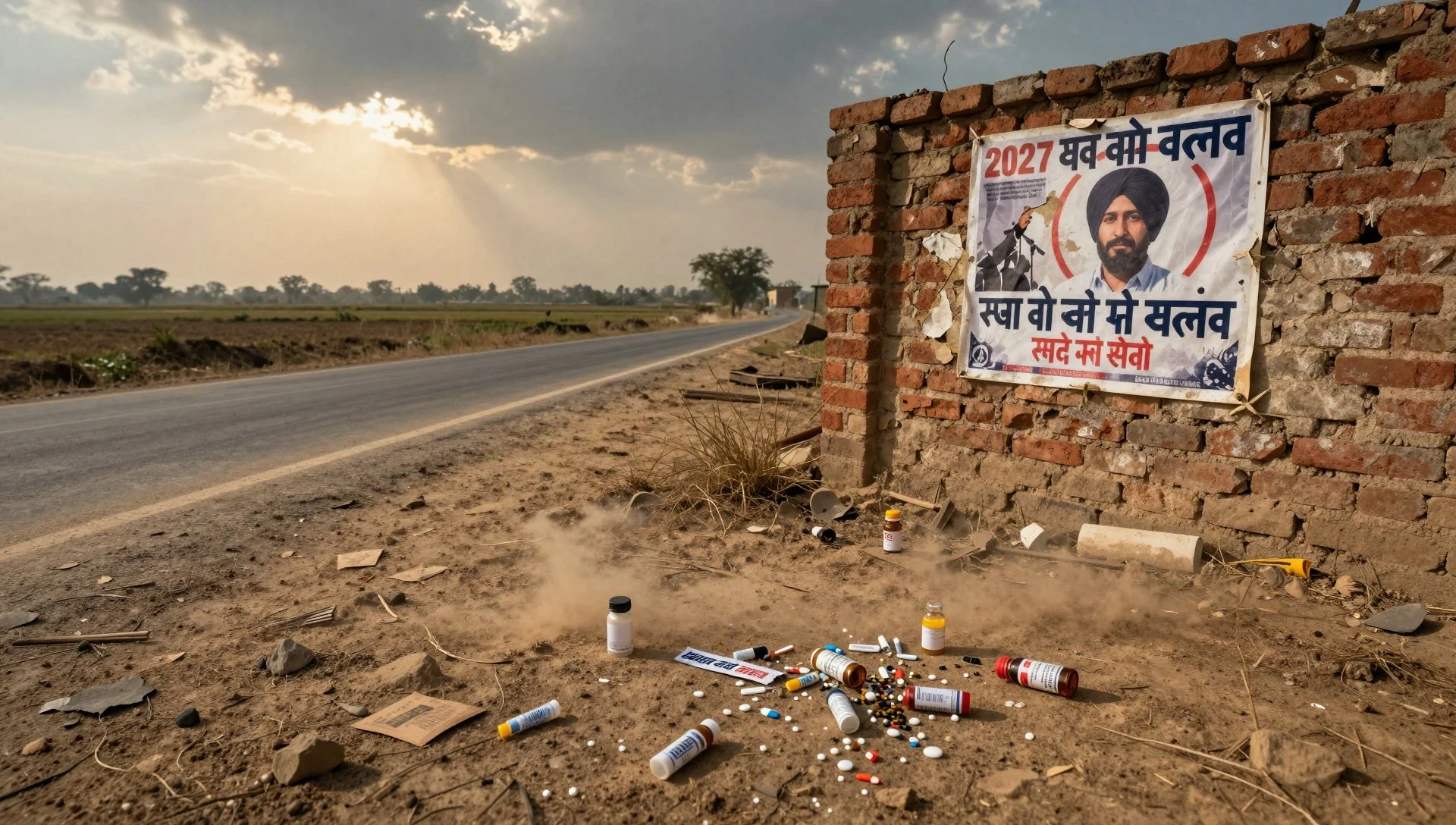
Punjab's narcotics economy has re-entered the centre of state politics ahead of the 2027 assembly election, and the timing is not incidental. The killing of anti-drug campaigner Parvinder Singh Jhota in Mansa on 13 October 2026 converted a long-running public grievance into an electoral flashpoint, prompting protests on 27 October that demanded the resignation of both the Chief Minister and the state Director General of Police.
What distinguishes this cycle from earlier episodes is the convergence of street-level anger with expert consensus that the trade is structurally entrenched rather than merely under-policed.
Policing specialists and academic researchers converge on a single diagnosis: profitability, decades-old smuggling corridors and alleged protection by police and political patrons have woven narcotics into Punjab's informal economy. That combination makes eradication a multi-decade project rather than a single-term promise.
On This Page
The Congress, BJP, Shiromani Akali Dal and the ruling Aam Aadmi Party have each placed the issue at the centre of their campaigns, with the AAP claiming drugs are its foremost priority and opposition parties alleging the government has shielded traffickers instead of dismantling them.
This analysis examines the structural mechanics behind Punjab's drug crisis, the political economy that sustains it, and the measurable gaps between enforcement rhetoric and outcomes. It draws on the reporting trail around the Jhota killing, comparative data on narcotics enforcement across Indian states, and the published positions of each major party.
The central question is not whether Punjab has a drug problem — that is settled — but why successive governments have failed to shrink it, and what the 2027 contest will actually change.
TL;DR Punjab's drug crisis has become the defining issue of the 2027 assembly election following the 13 October 2026 killing of campaigner Parvinder Singh Jhota in Mansa and the 27 October protests demanding the Chief Minister's and DGP's resignations. Experts attribute the persistence of the trade to high profitability, entrenched smuggling networks and alleged police and political patronage. All four major parties — AAP, Congress, BJP and Shiromani Akali Dal — are campaigning on the issue, but structural evidence suggests enforcement alone cannot deliver measurable reduction within a single electoral term.
The Structural Anatomy of Punjab's Narcotics Economy
Punjab's drug trade is best understood as an economic system with supply chains, margins and protection costs, not as a moral failure of individuals. Proximity to Pakistan's border, a dense network of rural roads and a history of cross-border smuggling of goods have created logistics infrastructure that adapts easily to contraband. Researchers consistently identify these geographic and historical factors as the substrate on which the narcotics trade grew.
Why Profitability Defeats Conventional Policing
Narcotics enforcement faces an asymmetry that conventional crime policing does not. A single successful interdiction removes a small fraction of supply, while the price premium created by prohibition sustains recruitment of new couriers and distributors.
Economists describe this as a substitution effect: enforcement raises prices, prices raise margins, and margins fund replacement capacity faster than agencies can dismantle it.
The arithmetic is stark when expressed as a simple relationship between enforcement intensity and retail price. Where ##E## represents enforcement pressure and ##P## the street price, the trade's resilience follows an approximately inverse relationship, ##P \propto 1/E##, meaning each marginal enforcement gain is offset by a proportionally larger price incentive for new entrants.
In this formulation, ##C_{supply}## is the landed cost of the substance, ##C_{risk}## the expected cost of interception and prosecution, and ##\rho## the protection premium extracted by patrons. As ##\rho## rises, retail prices fall and consumption expands — which is precisely why allegations of police and political involvement matter economically, not just morally.
The Mansa Killing and the Cost of Local Resistance
Parvinder Singh Jhota's shooting on 13 October 2026 in Mansa illustrates the risk premium attached to grassroots resistance. Campaigners who disrupt distribution networks impose direct costs on traffickers, and the violent response signals that informal enforcement is cheaper than formal prosecution for those protecting the trade. The 27 October protests demanding resignations reflected public recognition of this dynamic.
Local mobilisation has historically been the most effective pressure point in Punjab's drug politics, because it converts diffuse harm into identifiable political accountability. When a campaigner is killed, the cost of inaction becomes visible to every household in the district, and electoral calculations shift accordingly.
That is why the Mansa episode escalated so rapidly from a local crime to a statewide campaign theme.
Institutional Incentives and the Protection Economy
Allegations of police and political patronage are not incidental to the trade's persistence; they are central to its economics. Protection lowers operational risk for traffickers and raises the returns on capital deployed in distribution.
Where protection is reliably purchasable, the trade behaves like a licensed industry with informal taxation rather than a clandestine operation.
This creates a governance trap. Dismantling the trade requires investigating the protectors, but the protectors are embedded within the institutions tasked with investigation. Reform therefore depends on external oversight — courts, central agencies, media — rather than internal discipline. Punjab's experience mirrors patterns documented in other regions where narcotics economies have outlasted multiple administrations.
We Also Published
The Electoral Contest Over Blame and Remedy
All four major parties have made the drug crisis central to their 2027 campaigns, but they disagree sharply on causation and remedy. The ruling Aam Aadmi Party frames eradication as its top priority and points to enforcement actions as evidence of intent.
Opposition parties argue the government has failed to reduce the problem and has instead protected the trade, converting a public health emergency into a corruption allegation.
The AAP Government's Record and Its Constraints
The ruling party's position rests on the claim that political will, rather than structural reform, is the binding constraint. That framing is electorally attractive because it promises results within a single term.
It is also analytically fragile, because the drivers identified by researchers — profitability, smuggling infrastructure and patronage — do not respond quickly to willpower alone.
Measurable outcomes in narcotics enforcement typically lag policy changes by several years, which means any government inherits the consequences of its predecessor's enforcement posture. The AAP therefore faces a structural disadvantage: it can claim credit for arrests and seizures, but those metrics do not reliably track reductions in consumption or distribution density.
Opposition Strategies and the Risk of Overpromising
Congress, the BJP and the Shiromani Akali Dal have each positioned themselves as more credible stewards of enforcement, but their proposals face the same structural constraints. Promising rapid elimination of a decades-old trade invites the same credibility gap that opposition parties now attribute to the AAP. The political incentive to overpromise is strong and bipartisan.
The more substantive divide concerns institutional reform. Parties differ on whether to prioritise central agency involvement, judicial oversight of police conduct, or community-level rehabilitation. These choices matter more than campaign rhetoric, because they determine whether enforcement targets distributors or merely displaces them to neighbouring districts.
Public Opinion and the Accountability Threshold
The 27 October protests demonstrated that public patience has a measurable threshold, and that threshold is now defined by deaths rather than statistics. When a campaigner is killed, abstract policy failure becomes a concrete accountability demand directed at named officials. This shifts the political cost calculus for every party contesting the election.
Survey evidence from comparable state elections suggests that law-and-order failures penalise incumbents most when a specific, identifiable victim becomes a symbol. Jhota's killing fits that pattern precisely, which explains why opposition parties have moved so quickly to attach the government to the case. The electoral salience of the issue is therefore likely to persist through the campaign.
What Measurable Reduction Would Actually Require
If the structural diagnosis is correct, then the policy question shifts from whether to act to what sequence of interventions could plausibly reduce harm within a decade. Comparative evidence from jurisdictions that have reduced entrenched narcotics economies points to three requirements: disruption of protection networks, sustained supply-side pressure, and demand reduction through treatment capacity. Punjab's current debate addresses the first only rhetorically.
Disrupting Protection Before Disrupting Supply
Supply-side enforcement without protection reform produces displacement rather than reduction. When distributors face credible risk from police, they relocate to jurisdictions with weaker oversight, which explains why district-level seizure statistics can improve while state-level consumption remains flat. Protection reform must therefore precede or accompany enforcement escalation.
Practical mechanisms include independent oversight of police narcotics units, asset tracing of officials with unexplained wealth, and judicial supervision of high-profile trafficking cases. Each of these measures imposes costs on the protection economy that enforcement alone cannot.
Their absence is the single most cited reason experts expect the crisis to outlast the 2027 election cycle.
Treatment Capacity as a Demand-Side Lever
Demand reduction is the slowest but most durable lever available. Treatment capacity determines whether users exit the market or remain captive consumers, and Punjab's rehabilitation infrastructure has historically lagged behind the scale of need. Expanding capacity reduces the customer base that sustains distribution networks.
The economics are straightforward: every user who enters sustained treatment removes recurring revenue from the retail layer, which compresses margins at the bottom of the supply chain. Over time, this reduces the number of viable distribution points and lowers the recruitment pressure on new couriers. Demand-side investment therefore complements rather than substitutes for enforcement.
Metrics That Would Signal Genuine Progress
Seizure volumes and arrest counts are poor indicators because they rise with enforcement intensity regardless of underlying consumption. Credible progress requires metrics that track prevalence, treatment retention and overdose mortality, alongside protection-related prosecutions. Punjab's public reporting currently emphasises the former and under-reports the latter.
A defensible accountability framework would publish district-level prevalence estimates annually, report treatment waiting times, and disclose the disposition of cases against officials accused of complicity. Without such transparency, electoral debate will continue to recycle blame rather than measure outcomes. The 2027 election is therefore a test of whether accountability metrics enter the campaign at all.
Reading the 2027 Election Through the Drug Crisis
The 2027 assembly election will not resolve Punjab's drug crisis, but it will determine which accountability framework governs the next five years. If the campaign continues to trade in seizure statistics and resignation demands, the structural drivers will remain untouched. If it shifts toward protection reform and treatment capacity, the state may finally begin measuring what matters.
- 01
- 02
- 03
- 04
Scenarios for the Post-Election Period
Three scenarios are plausible. In the first, the incumbent retains power and continues enforcement-led messaging, producing flat prevalence and rising public frustration. In the second, an opposition coalition wins and discovers the same structural constraints, generating a credibility crisis. In the third, sustained pressure forces bipartisan institutional reform, which is the only path to measurable reduction.
Historical evidence from comparable states suggests the third scenario requires an external shock — a judicial intervention, a central agency probe, or a sustained media investigation — rather than electoral competition alone. Punjab's current trajectory most closely resembles the first scenario, with the second available if the incumbent loses narrowly.
Why Experts Expect the Crisis to Outlast the Cycle
Policing experts and academic researchers are unusually unified in their expectation that the crisis will persist beyond 2027. Their reasoning rests on the time required to dismantle protection networks, rebuild treatment capacity and disrupt smuggling logistics. None of these can be completed within a single term, and each requires sustained political capital.
That consensus is itself politically significant, because it undercuts promises of rapid elimination from every party. Voters who understand the timeline may reward honesty about sequencing over confident claims of imminent success. The party that articulates a credible decade-long framework could therefore gain an advantage that outlasts a single election.
What to Watch in the Coming Months
Several indicators will reveal whether the issue is being addressed substantively. Watch for the disposition of cases against officials accused of complicity, the publication of district-level prevalence data, and the expansion of treatment capacity in Mansa and adjoining districts. Each is measurable and each is currently underreported.
Also watch the language of campaign promises. Commitments to specific institutional reforms — independent oversight, asset tracing, judicial supervision — signal seriousness, while commitments to eliminate drugs within a fixed short period signal the opposite. The distinction between these two rhetorical modes will define the quality of the 2027 debate.
From our network :
- CISA’s Ten-Advisory Wave: Why Generic Patching Fails in OT and How to Build Product-Specific PlaybooksCISA released ten ICS advisories in one week, exposing critical infrastructure risks. Generic patching fails in OT. Learn to build product-specific remediation playbooks.
- Mobile Learning and VR in English: What Global Evidence Reveals About Effective Language TechnologyA systematic review across 14 countries reveals which language-learning technologies genuinely work. Mobile learning, AI, and VR show measurable benefits when pedagogically integrated. This evidence-based guide helps educators and learners select technology that delivers real return on investment.
- University Language Proficiency Exams: Why Institutional Tests Demand Different Preparation Than IELTS and TOEFLDiscover why university-specific language proficiency examinations differ fundamentally from IELTS and TOEFL, and learn strategic preparation approaches for institutional assessment success.
- The Final Descent: How ESA Retired the Legendary Cluster Constellation After 24 Years of Space Weather ScienceAfter 24 years mapping Earth’s magnetosphere, ESA’s Cluster mission concluded with a precisely controlled reentry over the South Pacific. This analysis explores the scientific legacy, engineering decisions, and debris mitigation principles behind one of space exploration’s most responsible retirements.
- Live Online English Classes for Kids: Do They Actually Reduce Anxiety?A ten-week study reveals that synchronous online English classes can significantly reduce child language anxiety while improving listening and reading skills. Discover what makes these programs effective and how parents can select the right one.
- The Hidden Cost of AI Convenience: Why Over-Permissioned Agents Are a Security Time BombDiscover why AI agents with excessive permissions create dangerous single points of failure, and learn how implementing least privilege principles can protect your organization from exploitation.
- How AI Agents Will Change the Way We Manage Personal FinancesExplore how AI agents are transforming personal finance through automated budgeting, bill payment, and investment management, while examining the critical security protocols and governance frameworks required for safe deployment.
- Committed Mediterranean Precipitation Decline: Why Emissions Cuts Alone Cannot Restore Winter RainsNew NOAA research reveals that Mediterranean winter rains may decline irreversibly even with emissions cuts. Explore the science of committed climate change and regional impacts.
- Forbidden Matrix Patterns and Visible Lattice Points: A Geometric DictionaryExplore how multidimensional 0–1 matrices encode geometric truths, linking forbidden patterns to visible lattice points and hypergraph theory, with applications in combinatorics and computational geometry.
RESOURCES
- Resources will be updated soon.
- 01
- 02
- 03
- 04
- 05
- 06
- 07
- 08
0 Comments