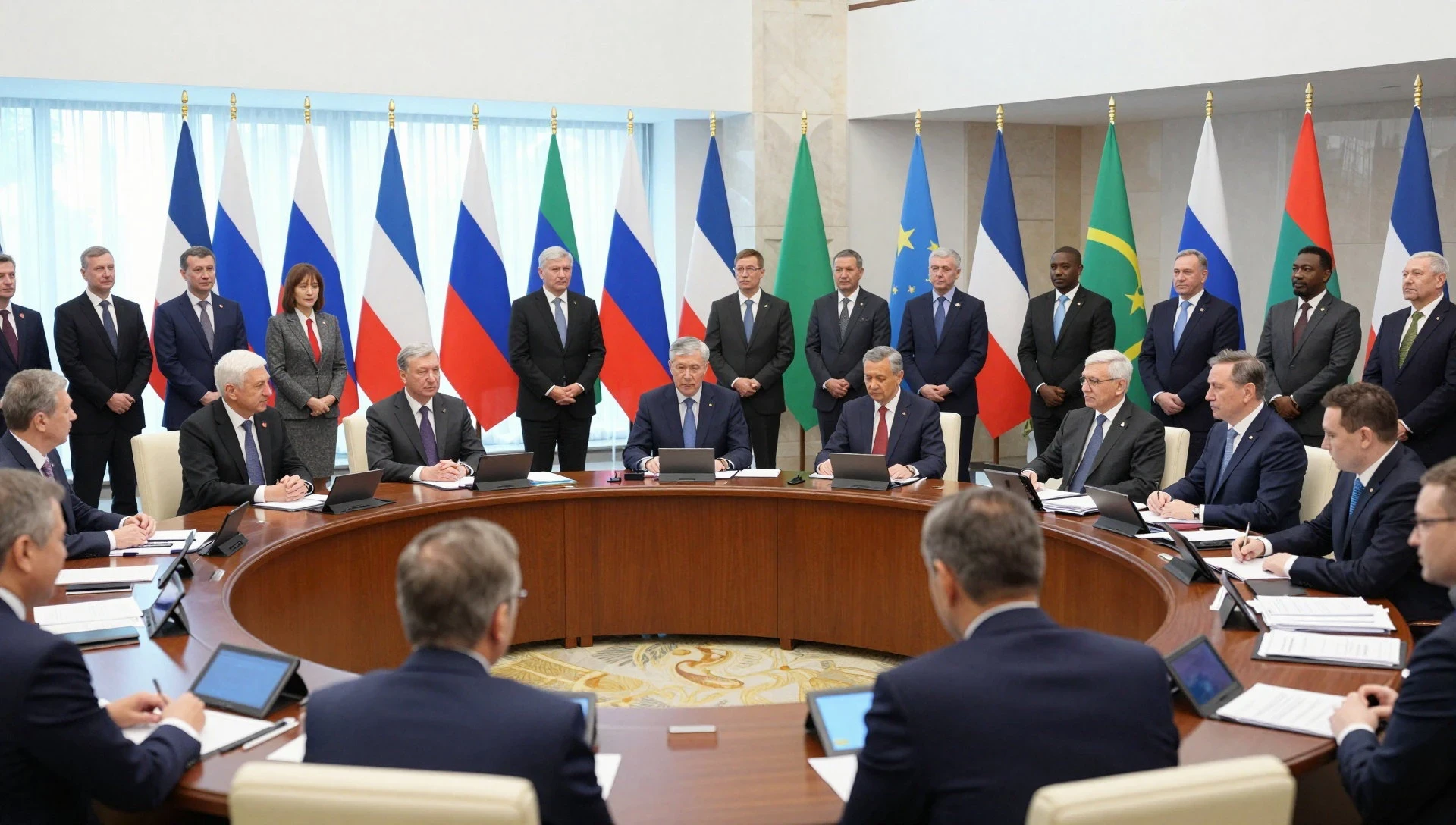
The third Russia-Africa Summit concluded in Moscow on October 29, drawing delegations from 48 African countries, including 22 heads of state, according to Kremlin aide Yury Ushakov. Speaking to a reporter from the Vesti program, Ushakov confirmed that attempts to disrupt the gathering did not succeed, even though several participating delegations encountered logistical difficulty reaching the Russian capital. The statement frames the event as a logistical and political success against measurable friction.
The summit's lineage matters for interpretation. Earlier editions were held in Sochi in autumn 2019 and St. Petersburg in summer 2023, so the 2026 Moscow venue represents a westward shift in symbolic geography rather than a change in format.
Attendance of 48 delegations against the continent's 54 recognized states implies roughly 89 percent representation, a figure that anchors any claim about the summit's diplomatic reach and its limits.
On This Page
Ushakov's remarks carry a dual function: they acknowledge disruption attempts while asserting resilience, a rhetorical pattern common in Russian official communications about multilateral events. The absence of named obstructing parties, specific disruption methods, or quantified travel impediments leaves the causal picture incomplete.
What remains verifiable is the outcome — the summit convened, delegations arrived, and the program proceeded as planned.
TL;DR The third Russia-Africa Summit took place in Moscow on October 29, 2026, with 48 African delegations and 22 heads of state attending despite what Kremlin aide Yury Ushakov described as unsuccessful attempts to disrupt it. Some delegations struggled to reach Moscow, but the event proceeded as scheduled. The summit follows earlier editions in Sochi (2019) and St. Petersburg (2023), and the official framing emphasizes continuity and resilience over disclosed operational detail.
What the Kremlin Statement Actually Establishes
Official statements about summits typically blend verified attendance data with interpretive claims about intent and resilience. Ushakov's comment to Vesti supplies both: a concrete participation count and an assertion that disruption efforts failed.
Separating the two layers is essential for any accurate reading of what the Kremlin disclosed and what it deliberately left unstated.
The Verified Participation Figures
The numbers are the most defensible element of the announcement. Forty-eight delegations and 22 heads of state constitute specific, checkable claims that can be cross-referenced against national foreign ministries and embassy dispatches. These figures also permit direct comparison with prior summits, which is where the analytical value concentrates.
Representation of 48 out of 54 African states equals approximately 88.9 percent continental coverage. That is a strong headline figure, though delegation composition matters as much as headcount. A delegation led by a head of state carries different diplomatic weight than one represented by a deputy minister or ambassador, and the 22-to-48 ratio quantifies that distinction precisely.
The ratio of heads of state to total delegations stands at roughly 45.8 percent. This metric, more than raw attendance, indicates the political ceiling of the event. It suggests that slightly fewer than half of participating states elevated their representation to the highest executive level, a proportion worth tracking across summit cycles.
The Unspecified Obstacles
Ushakov referred to attempts to disrupt the summit and to delegations facing difficulty reaching Moscow, but supplied no actors, methods, or magnitudes. This omission is analytically significant because disruption claims are unfalsifiable without attribution. The statement asserts resilience while withholding the variables that would allow independent verification.
Logistical friction in reaching Moscow could stem from aviation routing constraints, visa processing delays, or scheduling conflicts, each carrying different implications. The official text collapses these possibilities into a single phrase. Readers should treat the obstacle narrative as a framing device rather than a documented operational account.
Why the Framing Matters
Multilateral summits function as signaling instruments as much as negotiating forums. By emphasizing that the event "went ahead despite obstacles," the Kremlin positions the summit as evidence of durable partnerships under pressure. The rhetorical structure implies external resistance and internal resolve without naming either.
This pattern is consistent with prior Russian messaging around international gatherings. The emphasis falls on completion and attendance rather than on outcomes, communiqués, or signed agreements. Absent those specifics, the summit's substantive yield remains an open question that the official statement does not address.
Historical Trajectory Across Three Summits
Comparing the three editions reveals a stable format with shifting venues and, potentially, shifting participation. Sochi 2019 established the template, St. Petersburg 2023 continued it, and Moscow 2026 consolidated it.
The venue sequence moves from the Black Sea coast to the Baltic to the capital, each choice carrying symbolic weight about Russia's intended audience.
Sochi 2019 as the Baseline
The inaugural summit in Sochi set expectations for scale and ambition. It established the precedent of hosting African delegations on Russian soil at head-of-state level, creating a benchmark against which later editions are measured. Without published comparable attendance data, precise trend analysis remains constrained.
Baseline events matter because they define what counts as success. If Sochi drew a certain number of heads of state, then Moscow's 22 can be read as growth, stagnation, or decline depending on the reference point. The absence of a consolidated public dataset across all three summits limits definitive judgment.
St. Petersburg 2023 and Continuity
The 2023 edition in St. Petersburg tested whether the format could persist under changed geopolitical conditions. Its occurrence demonstrated institutional commitment to the Africa track. The Moscow 2026 edition then inherited that momentum, suggesting the summit has become a recurring fixture rather than a one-off diplomatic gesture.
Continuity itself is a data point. Recurring summits require sustained bureaucratic investment, scheduling coordination across dozens of capitals, and political will on both sides. The fact that three editions have now occurred at multi-year intervals indicates a durable, if not necessarily deepening, engagement architecture.
Moscow 2026 and the Capital Venue
Holding the summit in Moscow concentrates diplomatic attention on the capital and simplifies protocol for visiting heads of state. It also raises the symbolic stakes, since the venue itself becomes part of the message. The choice signals that the Africa track retains priority at the center of Russian decision-making.
Venue shifts across the three editions — Sochi, St. Petersburg, Moscow — trace a path toward the political core. Whether this reflects growing institutional confidence or logistical pragmatism cannot be determined from the available statement. Both interpretations remain plausible given the disclosed facts.
We Also Published
Reading the Diplomatic Signal and Its Limits
The summit's significance lies less in any single announcement than in the pattern it reinforces. Russia continues to convene African delegations at scale, and the Kremlin presents this as evidence of durable relationships. The analytical task is to weigh that signal against the absence of disclosed outcomes, agreements, or quantified disruption evidence.
Attendance as a Diplomatic Indicator
Forty-eight delegations represent a substantial convening power. For context, comparable multilateral gatherings often struggle to reach such breadth, and achieving it under stated logistical pressure strengthens the Kremlin's narrative. Attendance alone, however, does not establish the depth of bilateral commitments or the durability of agreements.
The 22 heads of state deserve separate attention. Executive-level participation typically correlates with anticipated deliverables, whether energy contracts, security cooperation, or grain arrangements. Without a published outcome document, the relationship between attendance and substance remains inferential rather than demonstrated.
The Missing Outcome Record
Summits are judged by deliverables as much as attendance. The source statement mentions no joint declaration, no signed agreements, and no sectoral commitments. This silence may reflect reporting focus rather than absence of substance, but it constrains any assessment of what the gathering actually produced.
Analysts should therefore treat the Moscow edition as a confirmed event with unconfirmed yield. The distinction matters because diplomatic momentum claims often rest on attendance optics rather than documented cooperation. Future reporting on follow-through agreements would be the appropriate test of substance.
Implications for the Africa Track
A third consecutive summit indicates institutionalization. Recurring events build bureaucratic familiarity, standardize agendas, and create expectations of continuity. For African participants, the calculus involves balancing multiple partnerships, and attendance at Moscow signals willingness to maintain diversified diplomatic channels rather than exclusive alignment.
The 48-delegation figure suggests broad, if uneven, engagement. Six African states were not represented among delegations, a gap that invites questions about which capitals abstained and why. The source does not identify them, leaving a meaningful analytical hole in any complete map of the summit's reach.
Methodological Notes for Interpreting Official Dispatches
State-sourced summit reporting follows predictable conventions: attendance figures are foregrounded, obstacles are acknowledged but not specified, and outcomes are either summarized broadly or omitted. Recognizing these conventions prevents over-reading and allows readers to distinguish disclosed facts from framing choices embedded in the text.
- 01
- 02
- 03
- 04
Separating Fact from Framing
The verifiable core of the dispatch is narrow: a summit concluded in Moscow on October 29, 2026, with stated attendance of 48 delegations and 22 heads of state. Everything else — disruption attempts, travel difficulties, resilience — belongs to the interpretive layer that requires independent corroboration before acceptance.
This separation is not cynicism but standard analytical hygiene. Official statements from any government blend fact and narrative, and the appropriate response is to weight each element by its evidentiary basis. The Moscow dispatch is no exception to this general rule of diplomatic reporting.
What Corroboration Would Require
Independent verification would involve confirmations from participating foreign ministries, published summit communiqués, and reporting on which delegations encountered travel problems. None of these appear in the source. Their absence defines the boundary between what is known and what is merely asserted by an interested party.
Future dispatches may fill these gaps. Until then, the summit should be characterized as a confirmed convening with unverified participation details and undisclosed substantive outcomes. That characterization is accurate, cautious, and consistent with the available evidence.
Comparative Context for Readers
Placing the Moscow edition alongside Sochi 2019 and St. Petersburg 2023 shows a format that has persisted across seven years and three venues. Persistence is itself meaningful: it indicates sustained institutional commitment and a recurring diplomatic calendar that both Russian and African officials have chosen to maintain.
Whether persistence translates into influence depends on factors the source does not address, including trade volumes, security arrangements, and voting alignment in multilateral forums. Those metrics, not summit attendance, ultimately determine the weight of any diplomatic track. The Moscow statement speaks to the former, not the latter.
From our network :
- CISA’s Ten-Advisory Wave: Why Generic Patching Fails in OT and How to Build Product-Specific PlaybooksCISA released ten ICS advisories in one week, exposing critical infrastructure risks. Generic patching fails in OT. Learn to build product-specific remediation playbooks.
- Mobile Learning and VR in English: What Global Evidence Reveals About Effective Language TechnologyA systematic review across 14 countries reveals which language-learning technologies genuinely work. Mobile learning, AI, and VR show measurable benefits when pedagogically integrated. This evidence-based guide helps educators and learners select technology that delivers real return on investment.
- Forbidden Matrix Patterns and Visible Lattice Points: A Geometric DictionaryExplore how multidimensional 0–1 matrices encode geometric truths, linking forbidden patterns to visible lattice points and hypergraph theory, with applications in combinatorics and computational geometry.
- Live Online English Classes for Kids: Do They Actually Reduce Anxiety?A ten-week study reveals that synchronous online English classes can significantly reduce child language anxiety while improving listening and reading skills. Discover what makes these programs effective and how parents can select the right one.
- How AI Agents Will Change the Way We Manage Personal FinancesExplore how AI agents are transforming personal finance through automated budgeting, bill payment, and investment management, while examining the critical security protocols and governance frameworks required for safe deployment.
- University Language Proficiency Exams: Why Institutional Tests Demand Different Preparation Than IELTS and TOEFLDiscover why university-specific language proficiency examinations differ fundamentally from IELTS and TOEFL, and learn strategic preparation approaches for institutional assessment success.
- The Hidden Cost of AI Convenience: Why Over-Permissioned Agents Are a Security Time BombDiscover why AI agents with excessive permissions create dangerous single points of failure, and learn how implementing least privilege principles can protect your organization from exploitation.
- The Final Descent: How ESA Retired the Legendary Cluster Constellation After 24 Years of Space Weather ScienceAfter 24 years mapping Earth’s magnetosphere, ESA’s Cluster mission concluded with a precisely controlled reentry over the South Pacific. This analysis explores the scientific legacy, engineering decisions, and debris mitigation principles behind one of space exploration’s most responsible retirements.
- Committed Mediterranean Precipitation Decline: Why Emissions Cuts Alone Cannot Restore Winter RainsNew NOAA research reveals that Mediterranean winter rains may decline irreversibly even with emissions cuts. Explore the science of committed climate change and regional impacts.
RESOURCES
- Russia–Africa Summit 2026: Strategic Signals, Partnerships and ...africansecurityanalysis.com4 days ago ... ... attending and by whether Moscow succeeded in demonstrating continued diplomatic support despite tensions with Western governments.
- At the Third Russia-Africa Summit, Moscow Talked Big. But Who ...themoscowtimes.com3 days ago ... Many of the attending nations depend on Russian military or diplomatic support in one way or another, noted Joseph Siegle,…
- Russia-Africa Summit: What is on the agenda, and why does it matter?aljazeera.com5 days ago ... Moscow aims to strengthen economic and security ties with African leaders during the two-day gathering.
- Russia–Africa Summit: Moscow is engaging more with Africa, but its ...chathamhouse.orgThe summit alone is unlikely to change this. Expert comment. Published 27 October 2026 — 3 minute READ. Image — A Russian flag hangs…
- Joint Statement of the African Union–Russian Federation High-Level ...au.intJul 7, 2026 ... ... Russia Summit, scheduled on 28-29 October 2026, in Moscow. Political ... The two sides highlighted the significance of the…
- Putin woos African leaders, says Russia a better partner ... - Reutersreuters.com4 days ago ... Summary; Companies. Delegations from 48 countries attend two-day Moscow summit, including 22 African leaders; Russia supplied 13 million ...
- Third Russia – Africa Summiten.kremlin.ru4 days ago ... The third Russia – Africa Summit took place in the Grand Kremlin Palace in Moscow under the chairmanship of President…
- Russia-Africa Summit 2026: Consolidating Policy Strategiesmoderndiplomacy.euOct 18, 2026 ... Many African capitals have already confirmed their attendance and declared their intention to send representative delegations to Moscow, ...
- President Netumbo Nandi-Ndaitwah to Participate in Russia–Africa ...facebook.comOct 24, 2026 ... ... Summit, held under the theme “For Peace, Security and Development. ... Russia-Africa Summit 2026: Key Agenda and Expected Attendance…
- Briefing by Foreign Ministry Spokeswoman Maria Zakharova ...mid.ruAug 20, 2026 ... ... Moscow, including government officials and business leaders. There is no doubt that the 3rd Russia-Africa Summit will be held…
- Deputy Minister Alvin Botes met with SADC Heads of Mission in ...instagram.comDec 11, 2023 ... ... Moscow, Russian Federation, to attend the 3rd Africa-Russia Summit. ... Russia–Africa Summit gathering scheduled for 28–29 October 2026.
- RAM 66: Here Is Your Russia-Africa Summit Briefingklyszcz.substack.comOct 4, 2026 ... The Moscow 2026 Russia-Africa Summit will end with a new plan, extending to 2029. As of writing, no detailed agenda…
- Moroccan Head of government Fatima Zahra Mansouri arrived in ...instagram.com5 days ago ... El Mansouri has served as Morocco's head of government since October 2026. The third Russia-Africa Summit and Economic and Humanitarian…
- Press Briefing: Previewing the Second Russia–Africa Summit - CSIScsis.orgJul 20, 2023 ... So I'm going to introduce them in the order in which they'll be speaking, and then after they provide some…
- 01
- 02
- 03
- 04
- 05
- 06
- 07
- 08
0 Comments