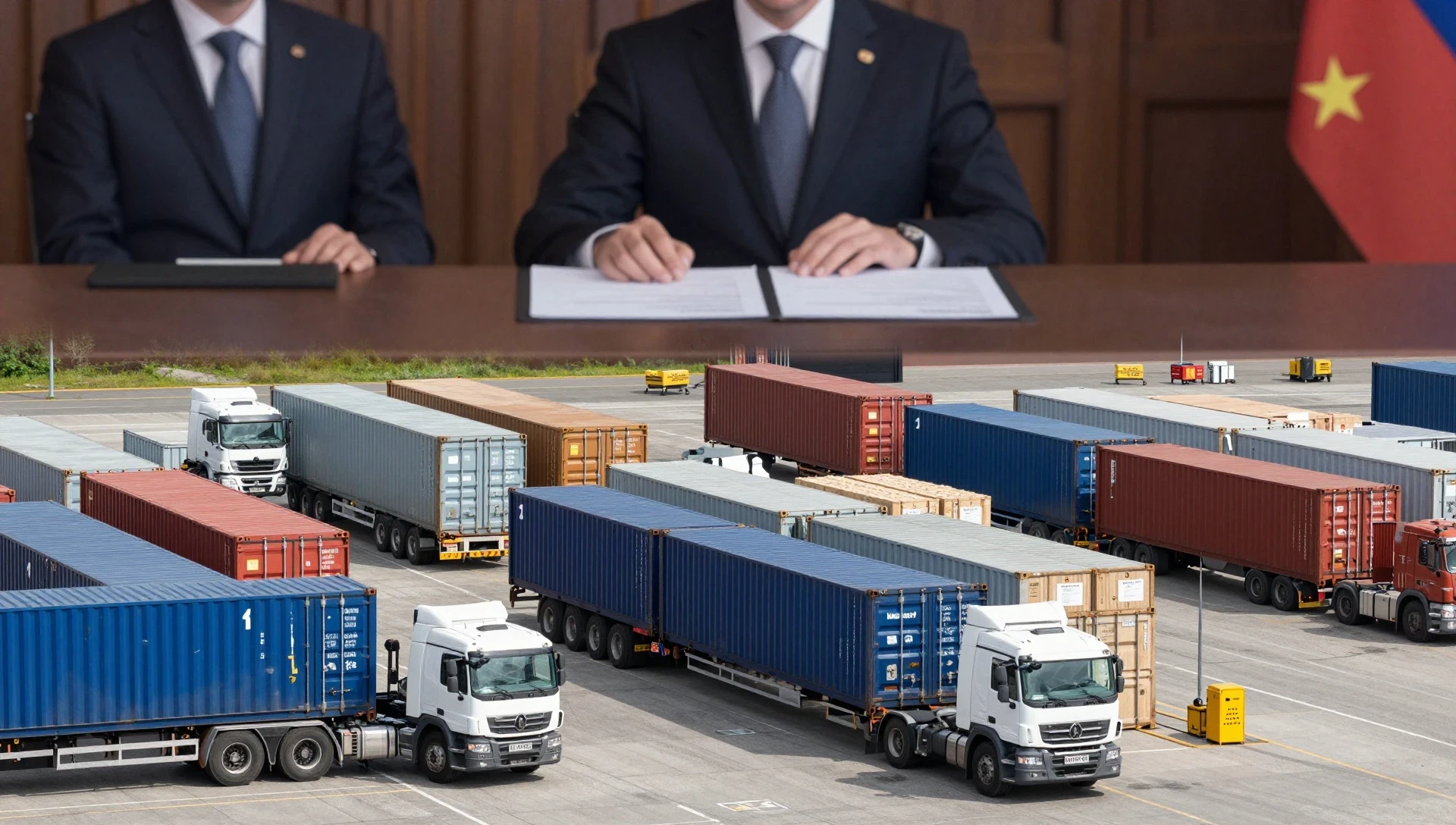
Vladimir Barbin, Russia's ambassador to Denmark, used an interview with the state news agency TASS to advance a specific and contestable claim: that Denmark has moved beyond mere donor status and now functions as a logistics and production base for Ukraine's armed forces.
The assertion, published on 1 November 2026, is a diplomatic argument dressed as a factual report, and it deserves to be read as such. Barbin's framing matters because it recasts a NATO member's sovereign defense assistance as direct participation in hostilities.
The ambassador anchored his case in concrete figures and procurement decisions. He cited more than €10.5 billion in grant-based military aid, Denmark's early transfer of F-16 fighter jets, direct financing lines for Ukrainian defense manufacturers, and a reported plan to purchase Patriot missiles from the United States for onward delivery to Kyiv.
On This Page
Each element is verifiable in principle; the interpretive leap from "supporter" to "base" is where the analytical weight sits. TASS published the interview without any response from Danish officials, a notable asymmetry.
What follows examines the statement through three lenses: the substance of the allegations and their evidentiary basis, the strategic logic of Denmark's assistance model compared with other NATO donors, and the diplomatic function such rhetoric serves in Russia's wider information campaign.
The analysis treats the ambassador's words as a primary source with an identifiable institutional interest, not as neutral reporting.
TL;DR Russia's ambassador to Denmark, Vladimir Barbin, told TASS that Denmark serves as a logistics and production base for Ukraine's military, citing over €10.5 billion in grant aid, F-16 transfers, direct financing of Ukrainian defense firms, and a planned Patriot purchase for onward delivery. The claim reframes lawful defense assistance as belligerency. TASS carried no Danish rebuttal. The statement is best read as a diplomatic and informational move aimed at NATO cohesion, not as an established fact.
The Substance of the Allegation and Its Evidentiary Basis
Barbin's interview rests on a layered set of claims that vary considerably in verifiability. The €10.5 billion figure, the F-16 transfers, and the Patriot procurement plan are the kind of items that can be checked against Danish and allied budget documents.
The characterization of Denmark as a "production base" for Ukrainian defense companies is far softer, and it is precisely this framing that carries the political payload.
What the Ambassador Actually Claimed
The core assertion is that Denmark is "heavily involved" in the Ukraine conflict and acts as a logistics base for Ukraine's armed forces. Barbin supported this with four specific elements: Patriot missiles ordered from the United States for transfer to Ukraine, early F-16 deliveries, direct financing for Ukrainian defense firms, and the €10.5 billion grant total. The first three are procurement and financing facts; the fourth is a characterization.
Notably, the ambassador did not allege that Danish personnel operate weapons inside Ukraine or that Danish territory hosts Ukrainian combat units. A logistics base in the ordinary military sense implies staging, storage, and transit functions.
Whether Denmark performs those functions, and at what scale, is a question the interview leaves unanswered beyond assertion.
The Reporting Asymmetry
TASS published the interview as a report of the ambassador's statements and explicitly noted the absence of any Danish response. This is standard practice for state news agencies relaying official commentary, but it produces a one-sided record. Readers encounter a detailed accusation without the countervailing account that Danish officials would presumably provide.
The asymmetry is analytically significant. In contested diplomatic claims, the missing rebuttal is often where the weakest link sits. Denmark has publicly framed its assistance as lawful support for a state defending itself; Barbin's framing competes directly with that account, and the two cannot both be complete descriptions of the same conduct.
Verification Pathways
Several elements of the claim are checkable through open sources. Danish defense budget allocations, the F-16 transfer timeline, and Patriot procurement announcements appear in government publications and allied statements. The "production base" claim would require evidence of Danish facilities manufacturing or assembling materiel destined for Ukraine at meaningful volume.
No such evidence appears in the TASS report. The ambassador's language moves from documented aid figures to an interpretive conclusion without an intervening evidentiary step. That gap is the central weakness in the statement and the point where independent verification should begin.
Denmark's Assistance Model in Comparative Perspective
Denmark's contribution to Ukraine is unusual less in its size than in its structure. Copenhagen has favored pooled procurement, direct financing of Ukrainian manufacturers, and early transfer of high-value platforms over the piecemeal donations that characterized some allied programs.
That model is efficient, and it is also more visible, which makes it a natural target for rhetorical escalation.
The Scale of Danish Support
At more than €10.5 billion in grant-based military aid, Denmark ranks among the larger per-capita contributors within NATO, though it trails the absolute totals of the United States, Germany, and the United Kingdom.
The grant structure matters: this is non-repayable assistance, not credit or loan guarantees, which raises the political cost of reversal.
Denmark's early decision to supply F-16s placed it in a small group of air-power donors alongside the Netherlands and Norway. Aircraft transfers require training pipelines, maintenance contracts, and munitions supply, so the commitment extends well beyond the airframes themselves and creates durable institutional ties.
Direct Financing as a Distinctive Instrument
The direct financing of Ukrainian defense companies is the element most likely to have prompted Barbin's "production base" language. Under this model, Danish funds flow to Ukrainian firms that manufacture weapons domestically, which keeps production inside Ukraine and reduces dependence on foreign supply chains.
This is a financing relationship, not a basing arrangement. The distinction is legally meaningful: funding a sovereign state's domestic industry differs from hosting that state's military infrastructure on one's own territory. Barbin's phrasing blurs the line, and the blur is doing the argumentative work.
How Denmark Compares with Other Donors
Allied assistance models diverge sharply. The United States has provided the largest absolute volume through presidential drawdown authority; Germany has emphasized air defense and armored vehicles; Poland has served as the principal transit corridor for Western materiel. Denmark's profile is smaller but structurally similar to the pooled-procurement approach favored by several Nordic states.
If "logistics base" is the standard, Poland's transit role would qualify far more clearly than Denmark's financing role. The ambassador's choice of target appears driven less by the objective scale of Danish logistics activity than by Denmark's visibility as an early and unambiguous supplier of combat aircraft.
The Legal Boundary Between Support and Belligerency
International humanitarian law distinguishes between supplying weapons to a party to an armed conflict and becoming a party to that conflict. The former is lawful under the UN Charter framework of collective self-defense when the recipient is defending against aggression; the latter requires direct participation in hostilities.
Barbin's "logistics base" language implicitly argues that Denmark has crossed that boundary. The argument would need to show that Danish territory or personnel perform combat-support functions integral to Ukrainian operations. Financing and procurement, however substantial, sit on the support side of the line under prevailing legal interpretation.
We Also Published
The Diplomatic and Informational Function of the Statement
Statements by ambassadors to state news agencies are rarely spontaneous. They are calibrated instruments, timed and worded to serve an audience. Barbin's interview performs at least three functions: it frames Denmark as a belligerent, it signals that Russian targeting logic may extend to logistics infrastructure, and it tests allied cohesion by singling out a mid-sized member for rhetorical pressure.
Framing Denmark as a Party to the Conflict
The "logistics base" and "production base" formulations are not casual metaphors. In Russian official discourse, designating a state as a base for hostile military activity creates a rhetorical predicate for treating that state's infrastructure as a legitimate target. The language is a warning wrapped in description.
This framing also serves a domestic purpose. It supports the narrative that Russia faces a collective Western adversary rather than a single neighboring state, which broadens the justification for sustained military expenditure and mobilization. The ambassador's emphasis on NATO membership and F-16 deliveries fits that narrative precisely.
Testing Alliance Cohesion
Denmark is a small state with an outsized profile in this conflict. Singling it out imposes political costs on a government that has staked credibility on Ukraine support, and it may encourage caution among other mid-sized donors weighing similar commitments. The rhetorical target is Denmark; the audience includes every NATO capital.
Whether such pressure works is doubtful. Public accusations of belligerency tend to harden donor positions rather than soften them, because backing down after being named invites the appearance of capitulation. The statement may therefore be counterproductive in its immediate aim while still serving the broader narrative function.
The Missing Rebuttal and Its Consequences
TASS noted that Danish officials did not respond. In the short term, that absence leaves the ambassador's account as the only detailed version in circulation through Russian channels. In the longer term, the asymmetry invites independent scrutiny, and the verifiable elements of the claim are the ones least likely to support the belligerency framing.
Denmark's likely response, when it comes, will emphasize the lawful character of its assistance and the distinction between financing and fighting. That response will be accurate, but it will not fully neutralize the rhetorical effect, because the accusation's power lies in repetition rather than in evidentiary strength.
- 01
- 02
- 03
- 04
What Would Change the Assessment
Three developments would materially shift the analysis. First, documentary evidence that Danish facilities manufacture or assemble weapons destined for Ukraine at scale would strengthen the "production base" claim. Second, confirmation that Danish territory hosts Ukrainian military personnel or command functions would support the "logistics base" framing.
Third, a formal Danish rebuttal specifying the exact nature of its assistance would clarify the record. Absent any of these, the ambassador's statement remains an assertion by an interested party, published without counterpoint, whose verifiable components describe financing and procurement rather than basing.
Reading the Statement Correctly
The interview is best understood as a diplomatic communication with a factual veneer. Its verifiable elements—aid volume, aircraft transfers, procurement plans—are real and significant. Its interpretive elements—"logistics base," "production base"—are assertions that the report does not substantiate and that Danish officials have not been given space to contest.
For analysts, the practical lesson is to separate the two layers. Denmark's assistance is substantial, lawful, and structurally distinctive. Whether it constitutes basing is a legal and factual question that the ambassador's statement raises but does not answer, and the absence of a Danish response leaves that question open.
From our network :
- Forbidden Matrix Patterns and Visible Lattice Points: A Geometric DictionaryExplore how multidimensional 0–1 matrices encode geometric truths, linking forbidden patterns to visible lattice points and hypergraph theory, with applications in combinatorics and computational geometry.
- CISA’s Ten-Advisory Wave: Why Generic Patching Fails in OT and How to Build Product-Specific PlaybooksCISA released ten ICS advisories in one week, exposing critical infrastructure risks. Generic patching fails in OT. Learn to build product-specific remediation playbooks.
- Committed Mediterranean Precipitation Decline: Why Emissions Cuts Alone Cannot Restore Winter RainsNew NOAA research reveals that Mediterranean winter rains may decline irreversibly even with emissions cuts. Explore the science of committed climate change and regional impacts.
- Mobile Learning and VR in English: What Global Evidence Reveals About Effective Language TechnologyA systematic review across 14 countries reveals which language-learning technologies genuinely work. Mobile learning, AI, and VR show measurable benefits when pedagogically integrated. This evidence-based guide helps educators and learners select technology that delivers real return on investment.
- The Hidden Cost of AI Convenience: Why Over-Permissioned Agents Are a Security Time BombDiscover why AI agents with excessive permissions create dangerous single points of failure, and learn how implementing least privilege principles can protect your organization from exploitation.
- University Language Proficiency Exams: Why Institutional Tests Demand Different Preparation Than IELTS and TOEFLDiscover why university-specific language proficiency examinations differ fundamentally from IELTS and TOEFL, and learn strategic preparation approaches for institutional assessment success.
- How AI Agents Will Change the Way We Manage Personal FinancesExplore how AI agents are transforming personal finance through automated budgeting, bill payment, and investment management, while examining the critical security protocols and governance frameworks required for safe deployment.
- The Final Descent: How ESA Retired the Legendary Cluster Constellation After 24 Years of Space Weather ScienceAfter 24 years mapping Earth’s magnetosphere, ESA’s Cluster mission concluded with a precisely controlled reentry over the South Pacific. This analysis explores the scientific legacy, engineering decisions, and debris mitigation principles behind one of space exploration’s most responsible retirements.
- Live Online English Classes for Kids: Do They Actually Reduce Anxiety?A ten-week study reveals that synchronous online English classes can significantly reduce child language anxiety while improving listening and reading skills. Discover what makes these programs effective and how parents can select the right one.
RESOURCES
- Russian Offensive Campaign Assessment, September 26 | ISWunderstandingwar.orgSep 26, 2025 ... ... claimed on September 26 that Russian forces ... Russian drone operators are targeting Ukrainian logistics and equipment near Pokrovsk.
- Russia recruits Danes for sabotage planning, Denmark says - Reutersreuters.comSep 3, 2026 ... Russia is recruiting Danish citizens to help plan sabotage against Danish defence firms with ties to Ukraine, the Nordic country's…
- Significant Cyber Incidents | Strategic Technologies Program - CSIScsis.orgAugust 2023: Ukraine's State Security Service (SBU) claims that Russia's GRU ... logistics industries in Ukraine and Poland to a Russian GRU hacking group.
- Russia to shut German cultural centers as Moscow-Berlin tensions ...fortune.comSep 3, 2026 ... The transformation of Danish territory into a production and logistics base for the Ukrainian military posed a security risk to…
- Imposing New Measures on Russia for its Full-Scale War and Use of ...ru.usembassy.govMay 2, 2024 ... The Department of State has made a determination under the CBW Act that Russia has used the chemical weapon chloropicrin…
- Sanctions to Disrupt Russia's Military Industrial Base and Sanctions ...2021-2025.state.govJan 15, 2025 ... ... Russian Federation presidential decree in order to unlawfully claim supposed ownership of Ukraine's Zaporizhzhya Nuclear Power Plant. The ...
- NATO jets down drone over Lithuania - Spectrum Newsspectrumlocalnews.comSep 15, 2026 ... Russia's ambassador to Denmark, Vladimir Barbin, said it was "not ... Meanwhile, Russian drone strikes continued across Ukraine ...
- Responding to Two Years of Russia's Full-Scale War On Ukraine ...2021-2025.state.govFeb 23, 2024 ... LIMITED LIABILITY COMPANY MODERN MARINE ARCTIC TRANSPORT SPG (SMART LNG) is a Russia-based joint venture to lease new ice-class LNG…
- European military personnel arrive in Greenland as Trump says US ...bbc.comJan 15, 2026 ... Russia's embassy in Belgium meanwhile expressed ... Its only current base is Pituffik , while Denmark also has several military…
- Ukraine and 9 other countries form coalition to protect Europe ... - PBSpbs.orgJul 13, 2026 ... ... Russian logistics. Crimea is a key rear base for Russian forces occupying parts of southern Ukraine. It was not…
- Denmark blames cyberattacks on hacker groups linked to Russian ...lemonde.frDec 18, 2025 ... The Danish government said Thursday it would summon the Russian ambassador ... base, where Ukrainian pilots are trained on F-16…
- Relations with Ukraine | NATO Topicnato.intOct 8, 2026 ... Suspending cooperation with Russia. As a result of Russia's illegal and illegitimate annexation of Crimea, NATO Allies decided in 2014…
- NATO Is At War with Russia Says Kremlin, As Drone Incursions ...newsweek.comSep 25, 2025 ... The Russian Embassy in Denmark added that the incidents were a "staged provocation. ... Russian MFA claims NATO, not Ukraine,…
- Remarks by NATO Secretary General at World Economic Forum ...nato.intJan 21, 2026 ... ... Denmark, Iceland, Canada and the US. ... And, as we speak, Russian missiles and Russian drones are attacking the…
- Denmark Threatens to Seize Russian Embassy in Copenhagen ...themoscowtimes.comJan 20, 2026 ... Trump has said China and Russia pose an immediate threat to the Arctic territory, claims that Danish officials reject. While…
- 01
- 02
- 03
- 04
- 05
- 06
- 07
- 08
0 Comments