
The decision by the U.S. Army to forgo a cleaner disposal method for lead-contaminated explosives in Iowa is a small administrative choice with outsized implications for how industrial-military hazardous waste is governed. At its core, the story concerns a familiar tension: an institution with a legitimate operational mandate weighs a safer, more environmentally sound option against cost, speed, and logistical convenience, and the public is left to infer the reasoning from a thin public record. The reporting, attributed to The New York Times, confirms the rejection of the alternative method but offers no explanation of what that method was or why it was set aside, which itself becomes part of the story's meaning.
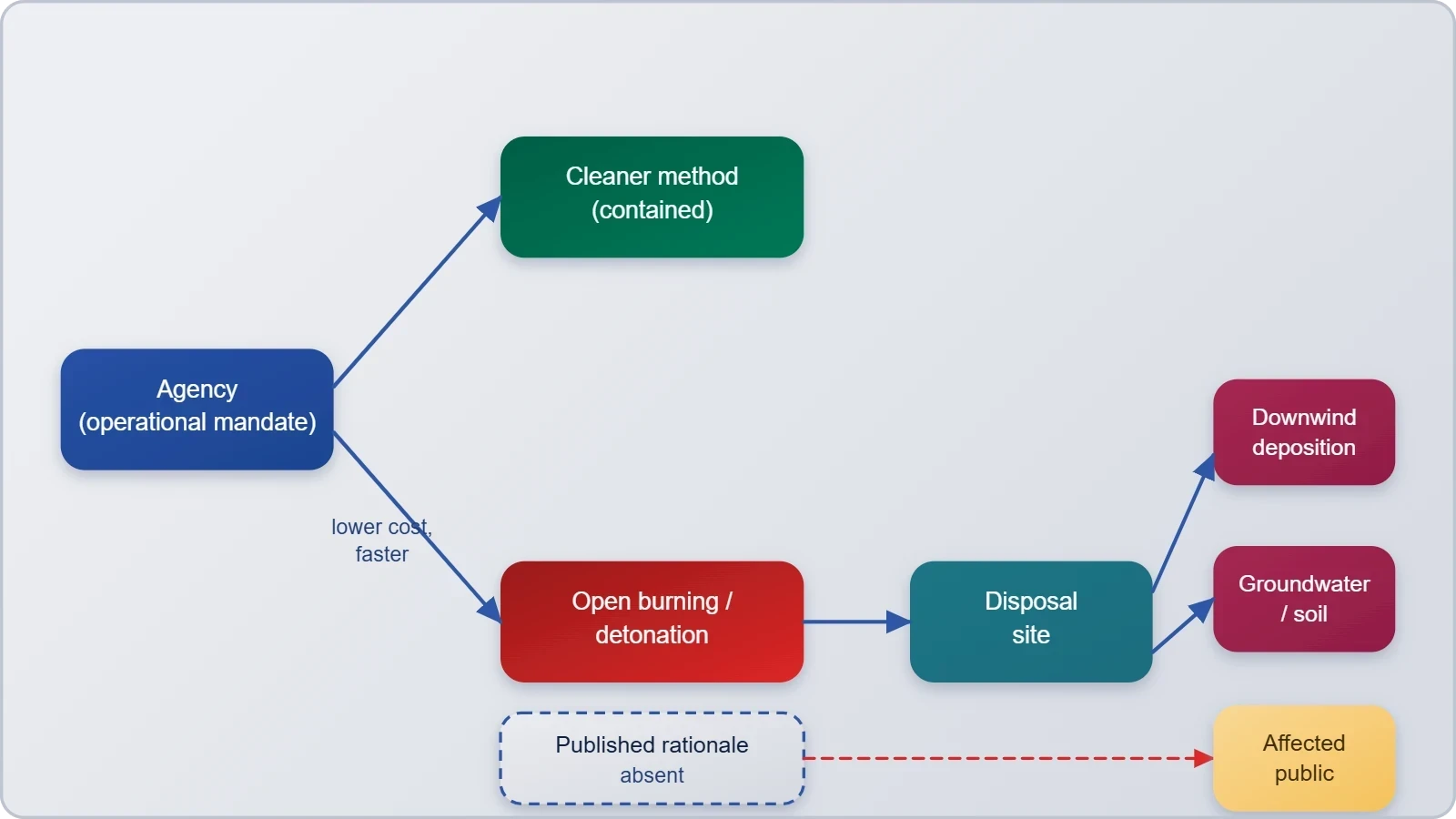
What makes the episode instructive is not the specific chemistry of lead azide or the mechanics of open burning, but the governance gap it exposes. When a federal agency declines a demonstrably cleaner pathway, the legitimacy of that decision depends almost entirely on transparency. Absent a published rationale, communities near disposal sites, environmental regulators, and even congressional overseers are forced to rely on inference. The absence of detail is therefore not a neutral omission; it is a substantive fact that shapes how the decision should be read and how accountability can be exercised.
This analysis examines the decision through the lenses that matter most: the science of lead-contaminated energetics, the regulatory architecture that governs military waste, the economics of disposal alternatives, and the public-trust consequences of opaque agency choices. It situates a single Iowa disposal decision within the broader pattern of how defense environmental programs balance mission readiness against environmental protection, and it considers what a more defensible decision-making process would look like.
On This Page
TL;DR The U.S. Army declined to use a cleaner method for destroying lead-contaminated explosives in Iowa, opting instead for a different disposal approach without publicly explaining the alternative or its rejection. The decision matters because lead-bearing energetics pose well-documented environmental and health risks, and because agency legitimacy in hazardous-waste management depends on transparent, documented rationale. This analysis unpacks the science, regulation, economics, and public-trust dimensions of the choice, and argues that a published decision record would strengthen both environmental outcomes and institutional credibility.
The Science of Lead-Contaminated Energetics
Lead-based primary explosives, most notably lead azide and lead styphnate, occupy a peculiar place in munitions engineering. They are prized for reliable initiation, sensitivity characteristics, and long shelf stability, which is precisely why they remain embedded in detonators, primers, and initiatory trains across decades of stockpiled ordnance. The same properties that make them dependable also make them difficult to dispose of safely, because the lead they contain is a persistent, bioaccumulative neurotoxin that does not degrade in soil or groundwater. Disposal therefore is not merely a demolition problem but a contamination-management problem.
The environmental behavior of lead in disposal settings is well characterized. When lead-bearing energetics are destroyed by open burning or open detonation, a fraction of the metal is volatilized and can be deposited downwind, while the remainder persists in ash and soil at the disposal site. Solubility depends on the specific compound and on soil chemistry; lead azide, for instance, can release azide ion, which is itself acutely toxic to aquatic organisms, alongside lead. These dual hazards mean that the choice of destruction method has measurable consequences for air emissions, soil loading, and groundwater risk at and around the disposal location.
Why Alternative Destruction Methods Exist
Cleaner alternatives to open burning and open detonation have been developed and, in some cases, permitted for exactly this class of waste. Closed incineration with scrubbing, chemical destruction or neutralization of the energetic compound, and contained detonation chambers are among the approaches that can capture or destroy lead and azide residues rather than dispersing them. These methods typically carry higher per-unit costs and require specialized facilities, permitting, and trained operators, which is why agencies often weigh them against the lower cost and greater logistical flexibility of open techniques.
The existence of these alternatives is not speculative; they are part of the established hazardous-waste management toolkit and have been used for munitions constituents in various jurisdictions. The relevant question in any specific case is therefore comparative: what does the cleaner method cost in dollars, time, and operational disruption, and what environmental benefit does it deliver? A decision to decline such a method is defensible only if that comparison has been made explicitly and can be examined by parties outside the agency.
Exposure Pathways and Community Risk
Communities near disposal sites are exposed through several pathways: inhalation of particulates and vapors during destruction events, ingestion of contaminated soil or dust, and consumption of water from affected aquifers. Children are especially vulnerable because lead's neurological effects are most pronounced during developmental windows, and because play behavior increases soil and dust ingestion. These pathways are well documented in environmental health literature and are the reason lead is regulated so stringently in air, water, and soil across the United States.
The significance for the Iowa decision is that the choice of method directly modulates these pathways. A contained process reduces dispersion; an open process increases it. When an agency declines the contained option, it is effectively accepting a higher dispersion profile, and the acceptability of that trade-off should be justified with reference to site-specific conditions, monitoring data, and cumulative exposure estimates rather than left implicit.
We Also Published
The Regulatory Architecture Governing Military Waste
Military hazardous waste does not sit outside environmental law, but the framework that governs it is layered and sometimes permissive in ways that civilian waste management is not. The Resource Conservation and Recovery Act establishes the baseline for hazardous waste handling, while the Comprehensive Environmental Response, Compensation, and Liability Act governs cleanup of contaminated sites. Overlaying these are Department of Defense-specific policies, installation-level permits, and in some cases statutory exemptions or conditional authorities that allow open burning and open detonation under defined circumstances.
The practical effect of this layering is that the legality of a disposal choice can be clear while its wisdom remains contestable. An agency may lawfully select an open technique if it satisfies applicable permit conditions, even where a cleaner alternative exists. The regulatory question and the policy question therefore diverge, and public debate often conflates them. Understanding the Iowa decision requires keeping that distinction in view: the issue is less whether the Army acted unlawfully than whether it exercised its discretion in a manner that can withstand scrutiny.
Permitting, Oversight, and the Role of States
State environmental agencies frequently play a substantial role in permitting and overseeing disposal activities within their borders, even on federal installations, through delegated programs and negotiated agreements. Iowa's regulators would therefore have had a formal channel through which to review the proposed destruction method, comment on alternatives, and impose conditions. The strength of that channel depends on the specificity of the permit application and the willingness of the state to press for cleaner approaches when they are technically feasible.
Congressional oversight provides a second layer, exercised through armed services and appropriations committees, and through the Government Accountability Office's periodic reviews of defense environmental programs. These mechanisms are most effective when they have a documented decision record to examine. A decision made without a published rationale narrows the aperture for oversight, because overseers can question outcomes but cannot easily evaluate the reasoning that produced them.
Transparency as a Regulatory Instrument
Environmental governance increasingly treats transparency not as a courtesy but as an instrument of accountability. Requirements to document alternatives analysis, publish findings of fact, and respond to public comment are designed to force agencies to articulate why a chosen path is preferable. When those requirements are thin or waived, the quality of the decision itself tends to degrade, because unstated reasoning is rarely stress-tested reasoning.
The Iowa case illustrates the point sharply. The public knows the outcome but not the comparison. That asymmetry makes it impossible to determine whether the Army weighed environmental performance against cost and schedule, whether it considered site-specific exposure, or whether it simply followed established practice. Each of those possibilities implies a different assessment of the decision's defensibility, and only a published record could distinguish among them.
The Economics of Cleaner Disposal
Cost is the most frequently cited reason for preferring open burning and open detonation, and the cost differential is real. Contained chambers require capital investment, maintenance, and qualified operators; closed incineration requires air pollution control equipment and continuous monitoring; chemical neutralization requires reagent handling and process control. For a stockpile of modest size, the fixed costs of a cleaner pathway can dwarf the variable costs of an open technique, making the comparison appear lopsided on a narrow accounting basis.
That narrow basis, however, omits several categories of cost that accrue to someone. Downwind deposition may require soil remediation; groundwater contamination may require long-term monitoring and treatment; community exposure may generate health costs and litigation; and the reputational cost of a contested decision can be substantial. When these externalities are internalized, the gap between methods narrows considerably, and in some cases reverses. The analytical question is whether the agency's comparison accounted for them.
Life-Cycle Costing and Its Discontents
Life-cycle costing is the standard remedy for narrow accounting, and it is well established in environmental economics. The method requires estimating costs across the full temporal horizon of a disposal decision, including monitoring, remediation contingencies, and liability. Its weakness is that it depends on assumptions about future events, which makes it vulnerable to manipulation and to genuine uncertainty. Agencies can produce widely different conclusions by varying discount rates, remediation probabilities, and the valuation of health endpoints.
For a decision like the Iowa one, a credible life-cycle analysis would need to specify the waste quantity and form, the site's hydrogeology, the proximity of receptors, the monitoring regime, and the probability distribution of remediation scenarios. None of that is public. The absence of such analysis does not prove the decision was wrong, but it does mean the economic case for it cannot be independently evaluated, which is a meaningful deficiency in a decision involving persistent toxic metals.
Procurement, Capacity, and Institutional Inertia
Beyond pure economics, institutional factors shape disposal choices. The defense industrial base has limited capacity for contained destruction of energetics, and scheduling constraints at permitted facilities can make open techniques the only option available within a required timeline. Procurement rules, contract structures, and the distribution of expertise within installations further bias outcomes toward established practice. These are legitimate constraints, but they are also the kind of constraints that transparency would reveal and that policy could address over time.
Inertia deserves particular attention because it is self-reinforcing. Each open disposal reinforces the infrastructure, training, and contracting patterns that favor open disposal, while cleaner alternatives remain underused and therefore expensive. Breaking that cycle typically requires an external prod, whether from regulation, litigation, or leadership attention. A single decision to decline a cleaner method is thus not merely a local choice; it is a data point in a longer pattern of path dependence.
- 01
- 02
- 03
- 04
Public Trust and the Politics of Environmental Decisions
Environmental decisions are legitimacy-sensitive in a way that many administrative choices are not, because their consequences are involuntary and spatially concentrated. Communities near disposal sites did not choose to bear the associated risks, and their consent cannot be assumed. When an agency declines a cleaner method without explanation, it signals that the affected public's interest in the comparison is not a priority, which erodes trust independently of whether the decision was substantively sound.
That erosion has practical consequences. Trust is the currency that allows agencies to operate without constant contestation; it reduces litigation, smooths permitting, and makes future consultation more productive. Decisions that squander it impose costs that are difficult to quantify but easy to observe in delayed projects and adversarial proceedings. The Iowa decision, whatever its merits, spends a portion of that currency without visibly purchasing anything in return.
Environmental Justice Dimensions
Disposal sites are not randomly distributed with respect to population. Decades of research document that hazardous facilities and waste handling operations disproportionately affect low-income communities and communities of color, a pattern that environmental justice scholarship has traced to siting practices, land markets, and political marginalization. A decision to accept higher dispersion at a given site therefore has distributional implications that extend beyond aggregate risk estimates.
Whether the Iowa site fits this pattern is not established by the available reporting, and it would be irresponsible to assert it without evidence. What can be said is that any decision to decline a cleaner method should be evaluated for its distributional consequences, and that such evaluation requires the kind of site-specific demographic and exposure data that a published decision record would contain. The absence of that record forecloses the analysis.
Precedent and Signaling Effects
Administrative decisions function as precedents even when they are not formally binding. A choice to decline a cleaner method in one instance makes similar choices easier elsewhere, both because it establishes a template and because it reduces the perceived cost of departing from best practice. Conversely, a decision to adopt a cleaner method, even at higher cost, can shift expectations across an agency's portfolio of disposal activities.
This signaling dimension is why seemingly minor disposal decisions attract attention from policy analysts and advocacy organizations. They are read as indicators of institutional priorities. If the Army's rejection of the alternative method reflects a considered judgment that the cleaner pathway was infeasible for this specific waste stream, the signal is benign. If it reflects a default preference for convenience, the signal is concerning, and the public has no way to tell the difference.
What a Defensible Decision Process Requires
A defensible disposal decision is not simply one that reaches the right answer; it is one that can be shown to have reached the right answer through a process that considered relevant alternatives and documented its reasoning. The elements of such a process are well established in environmental decision theory and in agency practice: problem definition, alternatives analysis, impact assessment, public consultation, and a written record that connects evidence to conclusion. Each element is unremarkable in isolation; together they constitute the difference between a decision that can be defended and one that must merely be asserted.
Applied to the Iowa case, this framework suggests a straightforward test. Was the cleaner alternative identified and characterized? Was its performance compared against the chosen method on environmental, cost, and schedule dimensions? Were site-specific exposure pathways assessed? Were affected communities and state regulators given a meaningful opportunity to review the comparison? Was the resulting analysis published? The available reporting indicates that the public cannot answer these questions, which is itself the central finding.
Documentation Standards and Their Practical Value
Documentation standards are sometimes dismissed as bureaucratic overhead, but their practical value is considerable. A written alternatives analysis forces analysts to confront assumptions, exposes weak reasoning to internal review, and creates an artifact that can be revisited when circumstances change. It also protects the agency itself, providing a record that can be cited in litigation and congressional inquiry. The cost of producing such a record is trivial relative to the cost of a contested disposal program.
Where documentation is absent, the agency forfeits these benefits and assumes the burden of defending an unrecorded judgment. That burden is difficult to discharge, particularly when the judgment favors a method with known environmental drawbacks. The asymmetry is stark: a few pages of analysis could have converted a questionable decision into a reviewable one, and their absence has the opposite effect.
Toward a Default of Disclosure
The most durable reform is not case-by-case exhortation but a change in default. If agencies were required to publish alternatives analyses for hazardous waste disposal decisions above a defined threshold, the Iowa situation would resolve itself: either the cleaner method would be adopted, or the reasons for declining it would be available for scrutiny. Defaults shape behavior more reliably than discretionary guidance, because they remove the option of silence.
Such a default would not guarantee better environmental outcomes in every instance. There are cases where cleaner methods are genuinely infeasible, and a published analysis would simply document that fact. But it would ensure that infeasibility is demonstrated rather than assumed, and that the public can distinguish between a constrained choice and a convenient one. That distinction is the foundation of legitimate environmental governance.
Reading the Decision in Context
The Iowa decision is best understood not as an isolated controversy but as an instance of a recurring pattern in environmental administration. Agencies with operational missions face persistent pressure to prioritize speed and cost, and the methods that serve those priorities tend to become institutional defaults. Cleaner alternatives exist but require deliberate effort to adopt, and that effort is most likely to be made when transparency requirements force a comparison. The pattern is structural, and so are the remedies.
For observers, the lesson is to resist two temptations. The first is to treat the decision as proof of bad faith; the available evidence does not support that conclusion, and the Army may have had sound reasons that were simply not published. The second is to treat the absence of explanation as unimportant; it is precisely the feature that makes the decision difficult to evaluate and therefore difficult to trust. Holding both points simultaneously is the analytically honest position.
Questions That Remain Open
Several questions would need to be answered before the decision could be assessed on its merits. What was the alternative method, and had it been demonstrated at comparable scale for comparable waste? What quantity and form of lead-contaminated explosive was involved, and what were the site's hydrogeological characteristics? What monitoring regime will accompany the chosen method, and who will bear the cost of remediation if contamination occurs? What did state regulators conclude during any permitting review?
These are not rhetorical questions; each has a factual answer that presumably exists within the agency's records. Their absence from public reporting is a function of disclosure practice rather than of the underlying facts. A request under the Freedom of Information Act, a congressional inquiry, or a state regulatory filing could supply them. Until then, the decision remains an outcome without a visible rationale, which is the condition this analysis has sought to characterize.
The Broader Stake
Beyond the specific site and substance, the case touches a question of general importance: how democratic institutions supervise technical decisions that carry involuntary risks. The answer cannot be that agencies simply defer to expertise, because expertise does not resolve value questions about acceptable risk and distributional fairness. Nor can it be that every technical choice is subject to referendum. The workable middle ground is procedural: transparent comparison, documented reasoning, and meaningful consultation, with deference to technical judgment on matters that are genuinely technical.
That middle ground is available in the Iowa case at modest cost. Publishing the alternatives analysis and the reasons for the choice would not require reversing the decision; it would merely make the decision intelligible. The fact that such a step is not routine, and that its absence is unremarkable, suggests that the procedural middle ground is less secure than it appears. The value of attending to small decisions like this one is that they reveal the state of that ground.
From our network :
- How AI Agents Will Change the Way We Manage Personal FinancesExplore how AI agents are transforming personal finance through automated budgeting, bill payment, and investment management, while examining the critical security protocols and governance frameworks required for safe deployment.
- The Final Descent: How ESA Retired the Legendary Cluster Constellation After 24 Years of Space Weather ScienceAfter 24 years mapping Earth’s magnetosphere, ESA’s Cluster mission concluded with a precisely controlled reentry over the South Pacific. This analysis explores the scientific legacy, engineering decisions, and debris mitigation principles behind one of space exploration’s most responsible retirements.
- Forbidden Matrix Patterns and Visible Lattice Points: A Geometric DictionaryExplore how multidimensional 0–1 matrices encode geometric truths, linking forbidden patterns to visible lattice points and hypergraph theory, with applications in combinatorics and computational geometry.
- University Language Proficiency Exams: Why Institutional Tests Demand Different Preparation Than IELTS and TOEFLDiscover why university-specific language proficiency examinations differ fundamentally from IELTS and TOEFL, and learn strategic preparation approaches for institutional assessment success.
- Live Online English Classes for Kids: Do They Actually Reduce Anxiety?A ten-week study reveals that synchronous online English classes can significantly reduce child language anxiety while improving listening and reading skills. Discover what makes these programs effective and how parents can select the right one.
- Committed Mediterranean Precipitation Decline: Why Emissions Cuts Alone Cannot Restore Winter RainsNew NOAA research reveals that Mediterranean winter rains may decline irreversibly even with emissions cuts. Explore the science of committed climate change and regional impacts.
- CISA’s Ten-Advisory Wave: Why Generic Patching Fails in OT and How to Build Product-Specific PlaybooksCISA released ten ICS advisories in one week, exposing critical infrastructure risks. Generic patching fails in OT. Learn to build product-specific remediation playbooks.
- The Hidden Cost of AI Convenience: Why Over-Permissioned Agents Are a Security Time BombDiscover why AI agents with excessive permissions create dangerous single points of failure, and learn how implementing least privilege principles can protect your organization from exploitation.
- Mobile Learning and VR in English: What Global Evidence Reveals About Effective Language TechnologyA systematic review across 14 countries reveals which language-learning technologies genuinely work. Mobile learning, AI, and VR show measurable benefits when pedagogically integrated. This evidence-based guide helps educators and learners select technology that delivers real return on investment.
RESOURCES
- Resources will be updated soon.
- 01
- 02
- 03
- 04
- 05
- 06
- 07
- 08
0 Comments