's state election on 28 November 2026 has become a referendum on public safety, with all four major political forces —
, the
,
, and
— placing crime and policing at the centre of their bids for power. The pledges now on the table are unusually detailed and unusually expensive: thousands of new officers, sweeping bail reform, expanded youth sentencing, and billion-dollar prevention schemes all compete for the same pool of taxpayer money. What follows is a structured reading of those commitments, drawn from party announcements and the independent
, and an assessment of what each promise would actually mean for Victorian communities.
The scale of the contest is striking. Labor has committed to 1,500 additional police and a second academy, while the Coalition counters with 3,000 officers and the reopening of more than 40 stations. The Greens, by contrast, propose redirecting roughly $1 billion into prevention and diversion, and One Nation leans on recruitment bonuses and hard-line sentencing. These are not marginal adjustments to a shared framework; they are four distinct theories of how safety is produced, funded, and enforced. Understanding them requires looking past the headline numbers to the mechanics of implementation, the reliability of the costings, and the ideological assumptions embedded in each package.
This analysis examines the election through six lenses: the overall architecture of the law-and-order debate, Labor's policing and sentencing agenda, the Coalition's enforcement-first platform, the Greens' prevention model, One Nation's recruitment and responsibility doctrine, and the fiscal and social trade-offs that will determine whether any of these promises survive contact with government. Each section pairs the announced commitment with the operational reality it implies, so that voters and observers can weigh substance against slogan. The full financial details of several pledges remain unclear, and that opacity is itself a central finding of this review.
TL;DR Victoria's 28 November 2026 election is being fought primarily on crime and policing, with four parties offering sharply divergent blueprints. Labor promises 1,500 new officers, a second academy, $170 million for an organised crime unit, and tougher maximum sentences including life for rape. The Coalition pledges 3,000 officers, 40-plus reopened stations, US-style RICO laws, a one-strike bail rule, and expanded youth sentencing. The Greens seek $1 billion for a New York-inspired Office of Community Safety and Crime Prevention, repeal of 2025 bail changes, a raised age of criminal responsibility, and drug decriminalisation. One Nation proposes recruitment bonuses, accommodation allowances, adult charging for violent children, and parental liability for fines. Costings remain partly undisclosed.
On This Page
The Architecture of Victoria's Law-and-Order Election
Victoria approaches 28 November with a public safety debate that has hardened into a contest of competing institutional designs rather than a simple argument about resources. Every major party accepts that the state's justice system needs more capacity, but they disagree fundamentally about where that capacity should sit — in sworn police numbers, in courts and corrections, in prevention offices, or in the family home. The independent Parliamentary Budget Office has become the arbiter of credibility, and parties are increasingly releasing costed commitments to survive scrutiny. Yet the full financial picture of all promises is not yet public, which leaves voters assessing partial arithmetic against complete rhetoric.
The political context matters enormously. Victoria has experienced sustained public anxiety about youth crime, home invasions, and carjackings, and the 2025 bail law changes were themselves a response to that anxiety. Any party proposing to repeal or reform those changes is making a direct claim about whether the state overcorrected or undercorrected. Similarly, the debate over the age of criminal responsibility — set at 10 in Victoria, with the Greens seeking 14 and One Nation defending 10 — touches deep questions about developmental science, community safety, and the meaning of accountability. These are not technical adjustments; they are statements about what kind of society Victoria intends to be.
Why Crime Dominates the 2026 Contest
Crime has displaced cost of living as the organising theme of Victorian politics because it fuses material anxiety with moral clarity. Voters who feel unsafe in their own streets are not persuaded by aggregate statistics showing declining offence rates; they respond to visible incidents, local media coverage, and the sense that institutions have lost control of public space. Both major parties have therefore competed to appear tougher, faster, and more concrete than the other. The result is a bidding war in which the currency is officers, stations, and sentencing years, and in which the question of effectiveness is frequently subordinated to the question of visibility.
There is a genuine policy debate beneath the politics. Criminologists have long argued that police numbers alone explain relatively little variation in crime rates, and that clearance rates, community trust, and early intervention matter more. Yet the political incentive structure rewards headline recruitment figures because they are legible and countable. Victoria's experience with the 2025 bail changes illustrates the tension: the reforms were popular, but their effect on reoffending remains contested, and the Greens now campaign to repeal them while the Coalition demands they go further. Voters are being asked to choose between competing causal stories about why harm occurs and what actually prevents it.
The Credibility Test of Independent Costing
The Parliamentary Budget Office has become the central institution of this campaign, because it allows voters to distinguish between aspiration and arithmetic. When a party submits a pledge for costing, it exposes the assumptions behind officer recruitment timelines, academy capacity, and long-run correctional expenses. Labor's commitments largely emerged through the state budget process, giving them a veneer of fiscal discipline, while the opposition has released more granular promises during the campaign itself. The asymmetry matters: budget measures are embedded in forward estimates, whereas campaign pledges must be assessed against uncertain implementation schedules and staffing pipelines that can take years to deliver.
Transparency remains incomplete. Several pledges — particularly the Greens' proposed $1 billion prevention office and One Nation's recruitment bonus scheme — lack fully published costings, leaving voters to infer the trade-offs. A credible assessment requires asking not only what a promise costs but what it displaces. Every dollar directed to a second police academy or a hospitality security fund is a dollar unavailable for hospitals, schools, or public transport. The election's fiscal honesty will ultimately be judged by whether parties are willing to name those trade-offs explicitly, rather than presenting safety spending as though it existed outside the budget constraint.
We Also Published
Labor's Policing and Sentencing Agenda
Labor's platform combines a substantial expansion of police capacity with a deliberate shift toward tougher sentencing for the most serious offences. The headline commitment is 1,500 additional police officers supported by a second police academy, a measure designed to address both recruitment shortfalls and training bottlenecks. Alongside this, $62 million would fund up to 200 reservists for desk duties, freeing sworn officers for frontline work. These are supply-side interventions: they assume that the binding constraint on public safety is the number of available officers and the speed at which they can be trained and deployed.
The sentencing component is more contentious. Labor proposes increasing maximum penalties for serious sexual offences, including life imprisonment for rape and a standard sentence of 30 years for murdering a partner. It has also pledged $170 million for a permanent organised crime unit and $66.5 million for new police technology, including cybercrime tools. Community-level measures include a $10 million local safety fund for CCTV and lighting and a $10 million hospitality security fund. Together these commitments sketch a government that wants to be seen as both operationally modern and morally uncompromising, pairing investment in capability with visible severity in punishment.
Recruitment, Academies, and the Staffing Pipeline
The decision to open a second police academy acknowledges a practical reality that recruitment targets often obscure: officers cannot be deployed until they are trained, and training capacity is finite. A 1,500-officer expansion requires not merely advertising and attraction but sustained throughput across years, with attrition during training and early service eroding net gains. The reservist scheme is a pragmatic response to this constraint, using up to 200 personnel for desk duties so that sworn officers are released to patrol. It is a sensible reallocation of labour, though it depends on whether reservists can be recruited, vetted, and integrated quickly enough to matter within a single term.
Workforce sustainability deserves scrutiny beyond raw numbers. Policing faces well-documented retention challenges, and an expansion that outpaces supervision capacity can dilute experience within frontline teams. The second academy helps, but it also requires capital investment, curriculum design, and instructor recruitment — each with its own lead time. Voters should therefore treat the 1,500 figure as a target rather than a guarantee, and ask what milestones the government would publish to demonstrate progress. Without transparent reporting on academy intakes, graduation rates, and net sworn strength, the headline number risks becoming a slogan rather than a measurable outcome.
Sentencing Reform and Organised Crime
The proposal to raise maximum penalties for serious sexual offences signals a government determined to close a perceived gap between community expectations and judicial outcomes. Life imprisonment for rape and a 30-year standard sentence for murdering a partner are symbolic as much as practical: maximum penalties are rarely imposed, and standard sentences guide rather than compel judicial discretion. Their real effect lies in signalling seriousness and shaping plea negotiations. Critics argue that severity without certainty produces little deterrent value, while supporters contend that sentencing frameworks express society's moral judgment and that expressing that judgment is itself a legitimate function of criminal law.
The $170 million organised crime unit and $66.5 million technology package address a different problem: the professionalisation of criminal networks and the digitalisation of offending. A permanent unit implies sustained institutional capability rather than episodic task forces, which is a meaningful design choice. Cybercrime tools acknowledge that fraud, extortion, and trafficking increasingly operate online. The community safety fund for CCTV and lighting and the hospitality security fund are smaller but locally visible, giving councils and venues tangible resources. Whether these measures reduce harm depends on governance, data-sharing, and evaluation — details that campaign announcements rarely supply but that determine real-world effectiveness.
The Coalition's Enforcement-First Platform
The Liberal–National Coalition has built its pitch around scale and deterrence, promising to reopen more than 40 police stations and recruit an additional 3,000 officers — double Labor's target. It would also hire 200 Protective Services Officers for train stations and another 200 for high-risk shopping centres, extending uniformed presence into transport and retail environments where public anxiety is concentrated. The station reopenings are politically potent because they restore visible local infrastructure that communities associate with responsiveness, even as policing models increasingly emphasise mobility and digital reporting over fixed premises.
On law reform, the Coalition proposes legislation modelled on the United States RICO Act to target organised crime leaders, a one-strike bail rule for offences committed while on bail, and expanded adult sentencing for youths across 20 serious offences including arson, home invasions, and carjacking. It also promises $100 million for early intervention and rehabilitation, alongside outlawing coercive control and introducing UK-style domestic violence disclosure laws. The package is deliberately dual-tracked: punitive on bail and youth sentencing, preventive on family violence and rehabilitation. That combination reflects an attempt to occupy both toughness and compassion simultaneously, though the balance between the two will be contested.
RICO-Style Laws and Bail Reform
Importing RICO-style statutes into Victorian law is a significant structural proposal. American racketeering law allows prosecutors to pursue leaders of criminal enterprises through pattern-of-activity evidence rather than individual acts, which can be powerful against syndicates that insulate their leadership. But transplantation is rarely straightforward: Australia's criminal procedure, evidence rules, and constitutional framework differ materially from the United States, and similar laws have faced interpretive challenges elsewhere. The promise is therefore best understood as a direction of travel rather than a ready-made instrument, and its effectiveness will depend heavily on drafting, prosecutorial resources, and judicial interpretation over years.
The one-strike bail rule is simpler to communicate and harder to calibrate. It would presumptively remand those who commit offences while on bail, addressing a genuine public concern about repeat offending during the bail period. Yet bail decisions are inherently individualised, and mandatory rules can produce unintended consequences, including pressure on remand capacity and disproportionate impacts on disadvantaged defendants. The Coalition's parallel commitment to $100 million in early intervention suggests awareness that enforcement alone is insufficient. The policy tension — between mandatory severity and rehabilitative investment — is the defining feature of the platform and the most likely source of implementation friction.
Youth Sentencing and Domestic Violence Reform
Expanding adult sentencing for youths across 20 serious offences is among the most consequential proposals in the campaign. It would treat arson, home invasions, and carjacking as triggers for adult-style consequences, reversing a long trend toward specialised youth justice. Proponents argue that serious violence demands serious response regardless of age, and that the current system fails both victims and young offenders by cycling them through inadequate interventions. Opponents counter that adult sentencing reduces rehabilitation prospects, increases recidivism, and disproportionately affects children from disadvantaged backgrounds. The empirical literature generally favours targeted intervention over incarceration for young people, though it is least conclusive for the most violent offenders.
The domestic violence commitments deserve separate attention because they operate on a different logic. Outlawing coercive control recognises that abuse often consists of patterns of domination rather than discrete physical incidents, and UK-style disclosure laws allow partners to inquire about a person's violent history. Both measures have strong evidence bases and broad cross-party sympathy, though implementation requires careful training for police and prosecutors and robust privacy safeguards. Placing these reforms alongside punitive youth measures creates an ideological tension within the Coalition's platform, but it also reflects the reality that family violence prevention and public order enforcement are distinct policy domains requiring distinct tools.
- 01
- 02
- 03
- 04
The Greens' Prevention and Diversion Model
The Greens offer the most structurally different vision, proposing $1 billion for a new Office of Community Safety and Crime Prevention modelled on a New York City policy. The funding would support crime prevention, early intervention, diversion programs, and 24/7 crisis outreach teams. Rather than expanding police numbers, the Greens argue that safety is produced by addressing the conditions that generate harm: housing instability, mental health crises, addiction, and disconnection from education and employment. The New York model they cite emphasises coordinated, data-driven prevention across agencies, and the proposed office would presumably sit above departments to align budgets and priorities.
The party also wants to repeal the government's 2025 bail law changes, raise the age of criminal responsibility to 14, and end life sentences for children. It would ban police use of sniffer dogs for drug detection and decriminalise personal use and possession of small quantities of drugs. These positions are internally coherent: they treat criminal justice contact as often counterproductive and favour health-based responses to drug use. They are also politically risky, because they can be characterised as soft on crime in a climate where visible disorder dominates headlines. The Greens are betting that a substantial, well-funded prevention offer can neutralise that attack and attract voters who want safety without punitive expansion.
The New York Prevention Model
Referencing New York City is a deliberate rhetorical choice, because the city's crime decline is often claimed by both punitive and preventive camps. The specific policy the Greens cite involves coordinated community safety offices that combine violence interruption, youth programming, and crisis response. Evidence from such programs is mixed but genuinely promising: focused deterrence and violence interruption can reduce shootings when implemented with fidelity and community legitimacy. The critical variables are governance, funding stability, and the quality of local partnerships. A $1 billion commitment would make Victoria one of the largest per-capita investors in prevention in Australia, which is why the absence of detailed costings is a notable gap.
Implementation would require building an institution from scratch, recruiting specialist staff, and negotiating with local governments and community organisations. That takes time, and voters may not see results within a single term. The Greens' model also depends on police and prevention agencies sharing data and coordinating operations, which is easier to announce than to achieve. If the office becomes a funding conduit without operational authority, its impact will be limited. If it acquires genuine convening power and budget control, it could reshape how Victoria approaches safety. The difference lies entirely in design details that the campaign has not yet specified.
Bail Repeal, Age of Responsibility, and Drug Policy
Repealing the 2025 bail changes is a direct challenge to the previous government's central public safety reform. The Greens argue that the changes increased remand populations without improving community safety, and that they disproportionately harm Aboriginal and Torres Strait Islander people and those with untreated mental illness. Whether that critique holds depends on data that is still emerging, and the party's willingness to reverse a popular measure is politically courageous or reckless depending on one's priors. The proposal to raise the age of criminal responsibility to 14 aligns with medical and developmental evidence and with recommendations from several national bodies, though it would require alternative service capacity for younger children in conflict with the law.
Ending life sentences for children and banning sniffer dogs for drug detection are narrower but symbolically significant. Life sentences for children are already rare in Australia, so the practical effect may be limited, but the principle matters. Sniffer dog bans target a policing tactic criticised for generating disproportionate drug detection in entertainment precincts and for eroding trust among young people. Decriminalising personal possession shifts the response to drugs from courts to health services, a model adopted in Portugal and partially in several Australian jurisdictions. The evidence supports reduced incarceration and improved health outcomes when treatment capacity is adequate, which is precisely the condition the Greens' $1 billion proposal is designed to fund.
One Nation's Recruitment and Responsibility Doctrine
One Nation's policing policy is built around recruitment incentives and a doctrine of personal and parental responsibility. It would boost police numbers by offering sign-on bonuses to armed forces members, veterans, and police officers from interstate and other English-speaking countries. It would also provide accommodation allowances and on-call mental health support to police. These measures address real recruitment barriers — housing costs, relocation expenses, and occupational stress — and they acknowledge that Victoria competes for officers in a national and international labour market. The emphasis on practical incentives rather than institutional reform distinguishes the approach from the major parties.
On legal changes, One Nation proposes that children charged with a serious violent offence be charged as adults, and that the age of criminal responsibility return to 10. Parents would also be responsible for fines or damage caused by their children. These positions are unambiguously punitive and reflect a theory that deterrence operates through certainty of consequence and that families bear primary responsibility for their children's conduct. The proposals are likely to attract support among voters frustrated by perceived leniency, and equally likely to attract criticism from legal and child welfare experts who warn about developmental harm and the criminalisation of disadvantaged families.
Incentives, Allowances, and Workforce Retention
Sign-on bonuses and accommodation allowances are pragmatic instruments that can move the needle on recruitment in ways that abstract targets cannot. Housing affordability is a genuine obstacle for officers posted to regional Victoria or to expensive metropolitan areas, and an allowance directly addresses that barrier. On-call mental health support recognises the psychological toll of policing and may improve retention, which is often a larger problem than recruitment. The design question is whether bonuses should be targeted at hard-to-fill locations and specialties, and whether they create equity problems among existing staff who receive no equivalent payment.
Recruiting from interstate and from other English-speaking countries raises additional considerations. Overseas officers require visa sponsorship, equivalence assessment, and cultural adaptation, and the pipeline can be slow. Veterans and armed forces members bring valuable skills but also require transition support. None of these obstacles is disqualifying, but they mean the policy's success depends on administrative capacity as much as on financial generosity. A well-designed scheme with clear eligibility criteria, retention clauses, and transparent reporting could meaningfully strengthen the workforce; a poorly designed one could produce churn, resentment, and wasted expenditure.
Parental Liability and the Age of Responsibility
Making parents responsible for fines or damage caused by their children is a striking departure from standard Australian practice, where parental liability is limited and carefully bounded. The proposal appeals to a widely shared intuition that families should be accountable for their children's conduct, and it may have deterrent value in some cases. But it also raises serious questions about fairness, particularly where parents are themselves struggling with poverty, disability, or domestic violence. Legal scholars warn that such measures can deepen disadvantage without improving behaviour, and that they may conflict with existing child protection frameworks that already intervene when parenting capacity is inadequate.
Returning the age of criminal responsibility to 10 and charging children as adults for serious violent offences would reverse reforms adopted or debated across several Australian jurisdictions. The medical evidence on child brain development strongly suggests that young children lack the capacity for full moral culpability, which is why professional bodies have advocated raising the age rather than lowering it. Supporters of the One Nation position argue that serious violence by children requires a serious response and that the justice system has failed victims by treating young offenders leniently. The disagreement is ultimately about whether the criminal law should prioritise accountability, deterrence, or rehabilitation when the offender is a child.
Fiscal Trade-offs and the Social Consequences of Promises
Every pledge in this campaign carries an opportunity cost, and the cumulative arithmetic is substantial. Labor's disclosed commitments alone exceed $300 million in specific funds before the cost of 1,500 officers and a new academy is counted. The Coalition's 3,000 officers, 40-plus station reopenings, 400 Protective Services Officers, and $100 million rehabilitation fund imply a larger total again. The Greens propose $1 billion for prevention, and One Nation's bonuses and allowances carry recurring costs that grow with the workforce. Victoria's budget position is not unlimited, and the election will ultimately require choices about which promises are funded and which quietly lapse.
The social consequences extend beyond dollars. Expanding police numbers and incarceration increases demand for courts, prosecutors, legal aid, and prisons, each of which has its own cost curve. Prevention investment reduces demand over time but requires patience that electoral cycles rarely permit. Sentencing severity increases correctional populations, and bail tightening increases remand numbers, which is among the most expensive forms of detention. A serious assessment of any platform must therefore trace the full system effects rather than the headline announcement. The party that best explains these linkages, rather than merely promising the most, will have offered the more honest case to voters.
What the Numbers Reveal About Priorities
The disclosed figures reveal distinct theories of change. Labor and the Coalition both prioritise personnel and enforcement, with prevention as a secondary line item. The Greens invert the ratio entirely, treating prevention as the primary investment and policing as one component of a broader safety system. One Nation focuses on workforce incentives and legal severity, with little emphasis on prevention or rehabilitation. These are not merely differences of degree; they reflect different beliefs about where harm originates and where intervention is most effective. Voters who favour visible enforcement will find the major parties responsive, while those who prioritise long-term harm reduction will gravitate to the Greens.
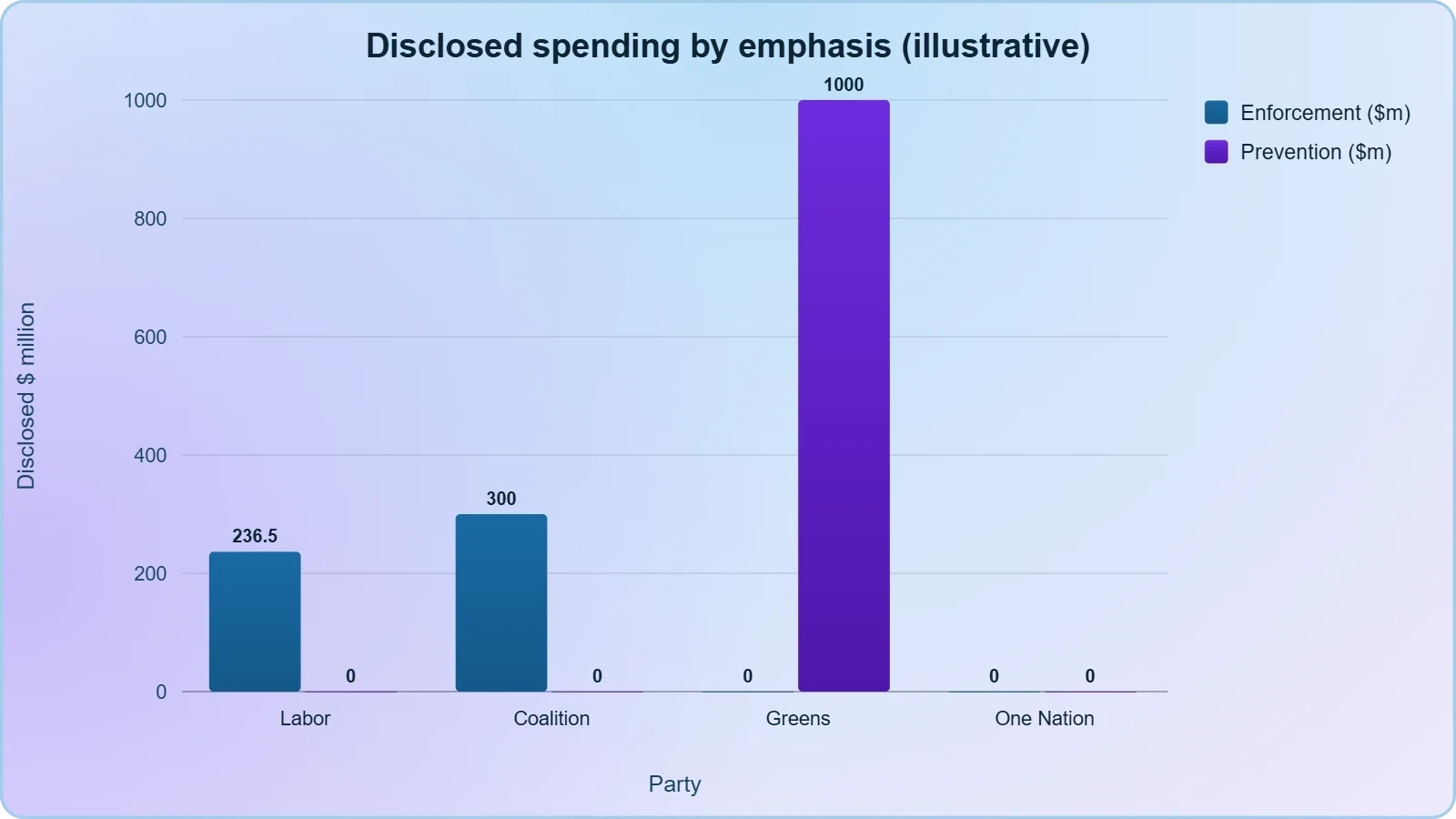
What the numbers also reveal is how much remains undisclosed. The absence of full costings for several pledges means the true fiscal footprint of each platform is unknown, and the risk of post-election revision is real. History suggests that ambitious recruitment targets are often missed and that prevention offices can take years to become operational. A disciplined voter should therefore discount promises by their implementation risk, ask what milestones will be published, and consider whether the party's broader fiscal strategy can absorb the commitments. Safety is a legitimate public good, but it is not free, and the bill always arrives.
Implementation Risk and Democratic Accountability
Implementation risk is the least discussed and most important variable in this campaign. A promise to recruit 3,000 officers is meaningless without training capacity, and a promise to build a prevention office is meaningless without governance design. The parties that publish detailed implementation plans, with timelines, responsible agencies, and evaluation frameworks, will be easier to hold to account. Those that rely on headline numbers will be harder to judge, because failure can always be attributed to circumstances rather than design. Democratic accountability depends on specificity, and specificity is precisely what campaign communication tends to avoid.
Victoria's institutions will ultimately determine outcomes more than any single announcement. The Parliamentary Budget Office can cost promises, but it cannot guarantee delivery. The public service can implement, but it needs clear mandates and stable funding. Communities can partner, but they need genuine authority rather than consultation. The election on 28 November is therefore not simply a choice between four platforms; it is a choice about how seriously the state takes the machinery of delivery. The most credible promise in this campaign may be the least dramatic: a commitment to publish, measure, and adjust as evidence accumulates.
From our network :
- Forbidden Matrix Patterns and Visible Lattice Points: A Geometric DictionaryExplore how multidimensional 0–1 matrices encode geometric truths, linking forbidden patterns to visible lattice points and hypergraph theory, with applications in combinatorics and computational geometry.
- The Hidden Cost of AI Convenience: Why Over-Permissioned Agents Are a Security Time BombDiscover why AI agents with excessive permissions create dangerous single points of failure, and learn how implementing least privilege principles can protect your organization from exploitation.
- Committed Mediterranean Precipitation Decline: Why Emissions Cuts Alone Cannot Restore Winter RainsNew NOAA research reveals that Mediterranean winter rains may decline irreversibly even with emissions cuts. Explore the science of committed climate change and regional impacts.
- Live Online English Classes for Kids: Do They Actually Reduce Anxiety?A ten-week study reveals that synchronous online English classes can significantly reduce child language anxiety while improving listening and reading skills. Discover what makes these programs effective and how parents can select the right one.
- Mobile Learning and VR in English: What Global Evidence Reveals About Effective Language TechnologyA systematic review across 14 countries reveals which language-learning technologies genuinely work. Mobile learning, AI, and VR show measurable benefits when pedagogically integrated. This evidence-based guide helps educators and learners select technology that delivers real return on investment.
- CISA’s Ten-Advisory Wave: Why Generic Patching Fails in OT and How to Build Product-Specific PlaybooksCISA released ten ICS advisories in one week, exposing critical infrastructure risks. Generic patching fails in OT. Learn to build product-specific remediation playbooks.
- University Language Proficiency Exams: Why Institutional Tests Demand Different Preparation Than IELTS and TOEFLDiscover why university-specific language proficiency examinations differ fundamentally from IELTS and TOEFL, and learn strategic preparation approaches for institutional assessment success.
- How AI Agents Will Change the Way We Manage Personal FinancesExplore how AI agents are transforming personal finance through automated budgeting, bill payment, and investment management, while examining the critical security protocols and governance frameworks required for safe deployment.
- The Final Descent: How ESA Retired the Legendary Cluster Constellation After 24 Years of Space Weather ScienceAfter 24 years mapping Earth’s magnetosphere, ESA’s Cluster mission concluded with a precisely controlled reentry over the South Pacific. This analysis explores the scientific legacy, engineering decisions, and debris mitigation principles behind one of space exploration’s most responsible retirements.
RESOURCES
- Resources will be updated soon.
- 01
- 02
- 03
- 04
- 05
- 06
- 07
- 08
0 Comments