A single day's edition of a major national newspaper is never merely a list of events; it is a carefully assembled portrait of a society negotiating its own tensions. The Hindu's coverage for 3 November 2026 demonstrates this with unusual clarity, weaving together courtroom reasoning, climate emergencies, geopolitical tremors, and the quiet economics of survival that rarely make headlines. Read as a whole rather than as isolated stories, the edition reveals a country where constitutional institutions, informal livelihoods, and technological disruption are colliding in ways that demand careful interpretation rather than reflexive reaction.
What makes this particular news cycle instructive is the way judicial observation, editorial argument, and on-the-ground reporting reinforce one another. The Supreme Court's remarks on a "protest economy," the Bombay High Court's distinction between OCI cardholders and citizens, and the Madras High Court's scrutiny of custodial conduct all point toward a single underlying question: how does a democracy balance the right to dissent against the right to earn a living? That question recurs across the edition, from the streets of Delhi to the flood alerts of Andhra Pradesh, and it gives the day's journalism a coherence that a casual reader might easily miss.
Beyond the courts, the edition captures a world in motion. Cyclone Murasu tests disaster preparedness along the southern coast, the Indian Navy demonstrates maritime resolve off Somalia, and American voters begin casting ballots in midterms that will shape global expectations. Meanwhile, editorials on artificial intelligence and privacy, Islamic marriage law, and Tamil Nadu's expenditure reform show a publication willing to engage with structural questions rather than merely report them. This analysis draws out the deeper meaning of that editorial architecture, examining what the day's reporting reveals about institutions, livelihoods, and the public's appetite for accountability.
On This Page
- The Architecture of a Modern Newsroom and Its Public Contract
- Courts, Protest, and the Contested Right to Livelihood
- Cyclone Murasu and the Test of Disaster Governance
- Security, Technology, and the Global Backdrop
- Editorial Argument and the Discipline of Public Reasoning
- Accountability, Institutions, and the Reader's Role
TL;DR A single edition of The Hindu functions as a diagnostic snapshot of Indian democracy under strain. Courts are redefining the boundary between protest and livelihood, disaster agencies are being tested by Cyclone Murasu, and security forces are proving their reach from the Bay of Bengal to the Gulf of Aden. Editorially, the paper presses on AI privacy, marriage law, and fiscal reform, while its subscription and newsletter architecture shows how modern newsrooms convert trust into sustainable revenue. The through-line is accountability: who answers when institutions, markets, or the weather fail ordinary citizens.
The Architecture of a Modern Newsroom and Its Public Contract
Behind every headline sits an operational apparatus that most readers never see, and The Hindu's digital front door makes that apparatus unusually visible. The site pairs breaking coverage with a subscription gateway, prompting returning readers to authenticate against the email tied to their account before unlocking premium stories, editorials, and opinion columns. This is not incidental housekeeping; it is the commercial contract of contemporary journalism, where investigative depth and expert commentary are funded directly by readers rather than solely by advertising. The arrangement signals a deliberate editorial posture: quality reporting is treated as a product with value, not a public utility sustained by invisible subsidy.
Equally revealing is the newsletter ecosystem arrayed across the page. A world-affairs briefing framed from an Indian perspective, a science digest, a headlines decoder built on facts and figures, an education and careers vertical, a health column authored by Ramya Kannan, a series on stories beyond the binary, and weekly book reviews together describe an audience the publication believes it has: curious, educated, internationally minded, and willing to be challenged. Each newsletter is a promise about attention, and the breadth of that promise tells us more about the paper's self-image than any mission statement could.
Subscription Economics and Reader Trust
The subscription model embedded in the page reflects a broader shift in news economics worldwide. When readers pay directly, the incentive structure tilts away from outrage-driven traffic and toward credibility, because subscribers renew on the basis of trust rather than clicks. The Hindu's explicit routing of customer support to a dedicated email address, alongside tools for managing subscriptions, suggests an institution treating its readership as a long-term relationship rather than a transient audience. That posture matters in a media environment where churn is cheap and loyalty is expensive to earn.
There is also a governance dimension to this arrangement. A publication that depends on subscriber revenue must be transparent about corrections, which is why the site maintains a dedicated corrections and clarifications channel. Accountability to readers becomes a structural feature rather than a courtesy. For analysts of media, this is the crucial insight: the business model and the editorial ethic are not separate systems but two expressions of the same institutional commitment to verifiable accuracy.
Editorial Verticals as a Map of Public Concern
The range of sections on display reads like a map of what a serious readership is expected to care about. Technology coverage sits beside science newsletters, cinema reviews beside corrections, and career guidance beside health reporting. This distribution implies an editorial theory: that a citizen's life is not segmented into politics, culture, and commerce but experienced as an integrated whole. A reader worried about exam irregularities in one column may be the same reader seeking film criticism in another, and the page is designed to serve that continuity.
Notably, the inclusion of a series on stories beyond the binary and a health column with a named author indicates a publication investing in specific, identifiable voices rather than anonymous aggregation. Named authorship is a quiet form of accountability, since a byline attaches reputation to reporting. In an era of syndicated content and algorithmic feeds, this emphasis on identifiable expertise is a differentiator, and it shapes how the edition's more contentious stories are received by an audience already primed to trust the source.
We Also Published
Courts, Protest, and the Contested Right to Livelihood
The judicial reporting in this edition forms its intellectual spine, and the Supreme Court's remarks on Delhi's demonstrations deserve close reading. The Court told traders that sustained protests generate a "protest economy," a phrase that quietly reframes dissent as an economic force with measurable costs and beneficiaries. In expressing sympathy for the livelihood rights of small traders, hawkers, and pushcart vendors, the bench acknowledged that the right to earn a living competes directly with the right to expression. This is constitutional reasoning at its most concrete, where abstract freedoms meet the daily arithmetic of a vendor's income.
What makes the observation significant is its refusal to treat either right as absolute. A protest economy implies that demonstrations create their own commercial ecosystem, sometimes sustaining those who serve crowds while impoverishing those whose stalls sit behind barricades. By naming this tension, the Court invites a more honest public conversation about how cities allocate space, time, and tolerance. The judgment does not resolve the conflict so much as legitimise it as a genuine constitutional dilemma rather than a simple matter of law and order.
OCI Status, Deportation, and the Boundaries of Citizenship
The Bombay High Court's ruling in the Imran Khan "Leave India" notice case offers a precise constitutional distinction. Observing that the rights of Overseas Citizens of India and those of full citizens operate in distinct spheres, the Court clarified that the State may deport a person in an appropriate case. This is a technical point with profound implications, because it delineates how a democracy treats those who hold partial belonging. The reasoning affirms that citizenship is not a spectrum of convenience but a defined legal status with corresponding protections and limits.
For the broader public, the ruling matters because it separates sentiment from statute. Deportation powers exercised within lawful bounds are not persecution; they are the ordinary operation of sovereign authority. Yet the Court's careful language also implies restraint, since the phrase "in an appropriate case" leaves room for proportionality. The judgment thus models a judicial temperament that resists both executive overreach and absolutist claims from those who mistake residency for citizenship.
Custodial Conduct and the Madras High Court's Scrutiny
The Madras High Court's hearing of allegations that Theni jail warders thrashed seventeen escapees after recapture, as recounted by a prisoner's mother, raises the oldest question in criminal justice: what does a state owe to those who have already been subdued? Recapture ends the immediate threat, and with it any plausible justification for retribution. The Court's willingness to hear the allegation signals that custodial violence remains a live concern in Indian jurisprudence, one that courts treat with increasing seriousness even when the complainants lack standing or resources.
This story connects directly to the edition's editorial on firecrackers and to the broader theme of institutional restraint. A democracy is measured not by how it treats its most powerful citizens but by how it treats those in its custody. When a mother must petition a High Court to be heard about her son's treatment, the machinery of accountability is functioning, but slowly. The reporting implicitly asks whether speed and transparency can be improved without waiting for judicial intervention in every case.
Cyclone Murasu and the Test of Disaster Governance
Nature supplied the edition's most urgent operational story. Cyclone Murasu made landfall in Andhra Pradesh, prompting the Chief Minister to call for efforts to prevent loss of life, and the system weakened into a cyclonic storm over the south coastal districts. Forecasters expected it to deepen into a depression by Tuesday midnight with wind speeds reaching seventy-five kilometres per hour. Heavy rain persisted in Bapatla, flash flood alerts were issued, and a yellow alert covered three Telangana districts on 4 November. A full list of affected trains was published, converting meteorological data into practical guidance for travellers.
What distinguishes this coverage is its translation of hazard into usable information. Wind speed figures and alert colours are meaningless without context, so the reporting pairs them with district-level warnings and transport disruptions. This is disaster journalism functioning as public infrastructure, and it matters because the gap between a warning and a response is often measured in hours. When a Chief Minister publicly prioritises the prevention of casualties, the statement also functions as an accountability benchmark against which the response will later be judged.
From Warning to Response: The Operational Chain
The chain from meteorological forecast to citizen action involves multiple institutions, and the edition's reporting traces it implicitly. The India Meteorological Department issues the technical assessment, state authorities translate it into alerts, and transport agencies adjust schedules. Each link can fail, and each failure has consequences measured in lives. The publication of affected train lists is a small but telling example of coordination, because it acknowledges that a cyclone is not only a weather event but a disruption to the ordinary mobility on which livelihoods depend.
Flash flood alerts in Bapatla and yellow alerts in Telangana also illustrate the graded vocabulary of risk that Indian disaster management has refined over the past two decades. These categories are not bureaucratic decoration; they trigger specific protocols for shelters, evacuations, and emergency services. When readers understand what a yellow alert means, they are better equipped to act. The reporting's value therefore lies less in dramatic imagery than in the clarity with which it converts official language into public understanding.
The Human Cost Behind the Metrics
Beneath the wind speeds and alert codes lies a human reality that the edition touches through its water audit story. An audit flagged a monthly drinking water burden of three thousand rupees on poor families in Bengaluru, a figure that reframes urban infrastructure as a household crisis. When a cyclone threatens coastal districts already stretched by such costs, the compounding effect is severe. Disaster resilience is not only about seawalls and shelters; it is about whether families have the financial buffer to absorb a week of lost wages.
This connection between climate events and household economics is one of the edition's quieter insights. A storm that damages crops and disrupts transport also destroys the daily earnings of vendors, drivers, and labourers. The reporting does not spell out this chain explicitly, but the juxtaposition of cyclone coverage with the water-burden audit invites the reader to see it. Good journalism often works through adjacency, placing stories side by side so that the structural relationship between them becomes visible.
Security, Technology, and the Global Backdrop
The edition's international and security reporting reveals a world where non-traditional threats dominate. The Indian Navy rescued a hijacked fishing vessel off Somalia and freed all twenty crew members, a operation that demonstrates maritime reach far beyond home waters. Simultaneously, Binance recovered from a major crypto hack, and Anthropic announced a new consulting venture, two technology stories that illustrate how digital infrastructure has become a domain of strategic risk and commercial ambition. Together these items sketch a security environment in which navies, exchanges, and AI laboratories are all front-line institutions.
The naval rescue deserves particular attention because it reframes the Indian Ocean as a zone of active responsibility rather than distant geography. Piracy off Somalia had receded from public memory, yet the operation shows that sea lanes remain vulnerable and that protecting them requires sustained capability. For a trading nation dependent on maritime routes, this is not a peripheral story but a core national interest. The liberation of all twenty crew members also carries a humanitarian dimension that the reporting rightly foregrounds.
Digital Risk and the Crypto Recovery
Binance's recovery from a major hack is a case study in the resilience expectations now placed on digital asset platforms. When an exchange is breached, the consequences ripple through user confidence, regulatory scrutiny, and market pricing. Recovery is therefore both a technical achievement and a reputational manoeuvre. The story matters because it illustrates the maturing of an industry that once treated security failures as existential and now treats them as operational challenges to be managed, disclosed, and remediated under public observation.
Anthropic's consulting venture points in a different direction, toward the commercialisation of artificial intelligence expertise. As AI systems become embedded in institutional decision-making, the demand for advisory services grows, and the firms building the models are increasingly positioning themselves as consultants to the organisations adopting them. This vertical integration raises questions about independence and accountability that the edition's editorial on AI training models and privacy addresses directly. The commercial and ethical dimensions of AI are, in this framing, inseparable.
American Midterms and the Global Ripple Effect
Voting in the U.S. midterm elections began as Donald Trump faced his first national test since returning to office, and the edition treats the contest as a global event rather than a domestic American one. This framing is accurate, because American legislative outcomes shape trade policy, security commitments, and climate diplomacy that affect every region. For Indian readers, the midterms matter through supply chains, technology regulation, and the stability of the international order on which export economies depend.
The editorial page's attention to the Knesset elections reinforces this global orientation. Democracies everywhere are grappling with similar pressures: polarisation, institutional trust, and the tension between security and civil liberty. By covering elections in Washington and Jerusalem alongside domestic judicial battles, the publication constructs a comparative frame in which Indian readers can locate their own challenges. This is international journalism serving a domestic analytical purpose, and it is one of the edition's most valuable functions.
- 01
- 02
- 03
- 04
Editorial Argument and the Discipline of Public Reasoning
The editorial page is where a newspaper reveals its intellectual commitments, and this edition's range is striking. Protests against SIR, dams and land rights, AI training models and privacy, Knesset elections, Tamil Nadu expenditure reform, firecrackers, the age of marriage under Islamic law, and U.S. midterms together form a syllabus of contemporary democratic dilemmas. Each topic involves a trade-off between competing goods, and the editorials' function is to make those trade-offs explicit rather than to deliver verdicts. This is the discipline of public reasoning, and it is what distinguishes opinion journalism from advocacy.
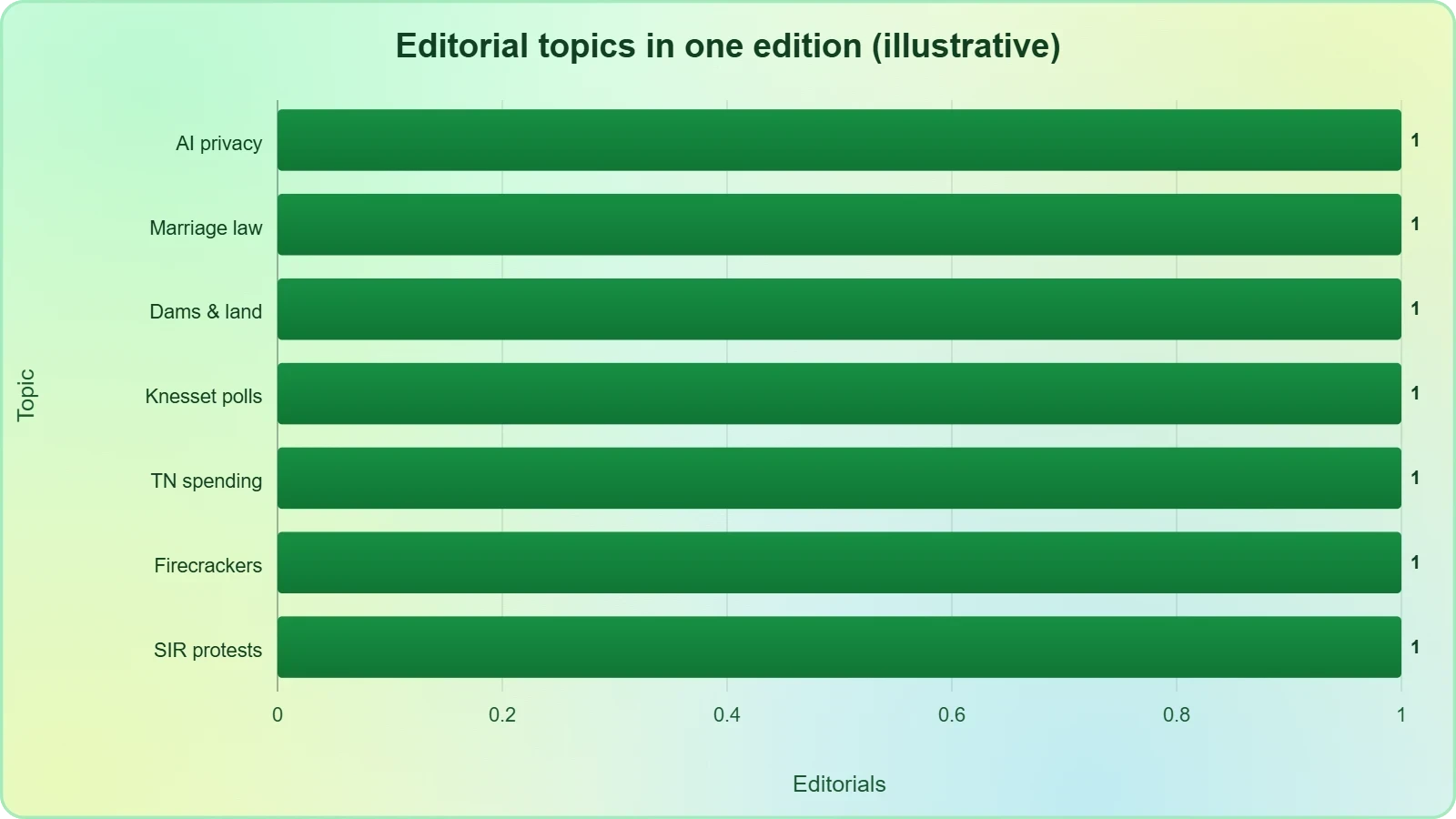
Consider the pairing of AI privacy with marriage law. One concerns the governance of data and the boundaries of algorithmic inference; the other concerns the governance of personal status and the rights of individuals within religious legal frameworks. Both involve questions of consent, autonomy, and the limits of state authority. By treating them on the same page, the edition suggests that the underlying logic of rights is continuous across domains, and that a society's approach to technology and its approach to tradition are expressions of the same constitutional values.
Land, Dams, and the Politics of Displacement
The editorial on dams and land rights engages one of India's most persistent structural conflicts. Infrastructure projects promise electricity, irrigation, and growth, but they also displace communities whose relationship to land is not merely economic. The editorial's contribution is to insist that compensation and rehabilitation are not afterthoughts but central questions of justice. When the state acquires land for public purpose, it assumes an obligation that extends beyond monetary payment to the reconstruction of livelihoods and social fabric.
This argument connects to the Supreme Court's remarks on the protest economy, because both concern who bears the cost of collective decisions. A dam benefits millions and displaces thousands, and the legitimacy of the project depends on how fairly that asymmetry is addressed. The editorial's insistence on land rights is therefore not opposition to development but a demand that development be accountable to those it transforms. This is a mature position, and it reflects the publication's long-standing engagement with questions of equity.
Fiscal Reform and the Tamil Nadu Precedent
The editorial on Tamil Nadu expenditure reform addresses a subject that rarely attracts public excitement but determines everything: how states manage their finances. Expenditure reform involves choices about subsidies, capital investment, and administrative efficiency, and those choices shape the quality of schools, hospitals, and roads. By treating fiscal discipline as a matter of governance rather than ideology, the editorial models a pragmatic approach that other states could study. The underlying argument is that sound public finance is a precondition for social welfare, not its adversary.
This connects to the audit revealing a three-thousand-rupee monthly water burden on poor families in Bengaluru. That figure is a fiscal fact with human consequences, and it illustrates why expenditure decisions matter. When public services fail, households absorb the cost, and the poorest absorb the most. The editorial page's attention to state finance is thus continuous with its reporting on urban hardship, forming a coherent argument that governance is measured in household budgets as much as in budget documents.
Accountability, Institutions, and the Reader's Role
Running through every section of this edition is a single organising question: who answers when things go wrong? The Crime Branch probes into alleged examination irregularities answer it for education, the audit of Bengaluru's water burden answers it for urban infrastructure, and the courts answer it for state conduct. Even the lighter items, such as Vir Das discussing the end of demonising the offended, touch the same nerve, because they concern how a society manages disagreement without turning it into enmity. Accountability, in this broad sense, is the edition's unifying theme.
What the publication offers its readers is not a verdict but a method. By placing judicial reasoning beside editorial argument and on-the-ground reporting, it equips an audience to form independent judgments. The subscription model, the newsletters, and the corrections channel all serve this method by sustaining the conditions under which careful reading is possible. A reader who finishes this edition has not merely consumed information; they have been walked through a set of institutional tests and invited to assess how well each institution performed.
From Information to Civic Competence
The practical value of such coverage lies in the civic competence it builds. A reader who understands what a yellow alert means, why OCI status differs from citizenship, and how a protest economy affects vendors is better equipped to participate in public debate. This is the quiet pedagogy of serious journalism, and it operates through accumulation rather than instruction. No single article teaches civic competence, but a consistent diet of well-reported stories gradually equips a reader to navigate complexity without relying on slogans.
This is also why the edition's juxtapositions matter. Placing a cyclone story beside a water-burden audit, or a naval rescue beside a crypto hack, trains the reader to see connections that specialists might miss. The publication is implicitly arguing that public life is interconnected, and that a citizen who understands one domain is better prepared to reason about another. In an age of fragmented feeds, this integrative approach is a genuine public good.
The Enduring Case for Paid, Careful Journalism
The commercial architecture described at the outset now appears in a different light. Subscription gating is not merely a revenue mechanism; it is a filter that aligns the publication's incentives with the reader's long-term interest in accuracy. When journalism is funded by attention alone, the temptation to sensationalise is structural. When it is funded by subscribers, the temptation shifts toward depth and reliability. The Hindu's model is therefore an argument about media sustainability as much as a business decision.
For readers, the implication is straightforward: careful journalism is worth paying for because it produces a different kind of understanding. The edition examined here demonstrates the difference. It does not shout; it assembles. It does not resolve every tension; it names them precisely. And in doing so, it performs the essential democratic function of helping citizens think clearly about the institutions that shape their lives, from the courtroom to the coastline to the household budget stretched by a three-thousand-rupee water bill.
From our network :
- University Language Proficiency Exams: Why Institutional Tests Demand Different Preparation Than IELTS and TOEFLDiscover why university-specific language proficiency examinations differ fundamentally from IELTS and TOEFL, and learn strategic preparation approaches for institutional assessment success.
- Committed Mediterranean Precipitation Decline: Why Emissions Cuts Alone Cannot Restore Winter RainsNew NOAA research reveals that Mediterranean winter rains may decline irreversibly even with emissions cuts. Explore the science of committed climate change and regional impacts.
- How AI Agents Will Change the Way We Manage Personal FinancesExplore how AI agents are transforming personal finance through automated budgeting, bill payment, and investment management, while examining the critical security protocols and governance frameworks required for safe deployment.
- Mobile Learning and VR in English: What Global Evidence Reveals About Effective Language TechnologyA systematic review across 14 countries reveals which language-learning technologies genuinely work. Mobile learning, AI, and VR show measurable benefits when pedagogically integrated. This evidence-based guide helps educators and learners select technology that delivers real return on investment.
- Live Online English Classes for Kids: Do They Actually Reduce Anxiety?A ten-week study reveals that synchronous online English classes can significantly reduce child language anxiety while improving listening and reading skills. Discover what makes these programs effective and how parents can select the right one.
- The Hidden Cost of AI Convenience: Why Over-Permissioned Agents Are a Security Time BombDiscover why AI agents with excessive permissions create dangerous single points of failure, and learn how implementing least privilege principles can protect your organization from exploitation.
- The Final Descent: How ESA Retired the Legendary Cluster Constellation After 24 Years of Space Weather ScienceAfter 24 years mapping Earth’s magnetosphere, ESA’s Cluster mission concluded with a precisely controlled reentry over the South Pacific. This analysis explores the scientific legacy, engineering decisions, and debris mitigation principles behind one of space exploration’s most responsible retirements.
- CISA’s Ten-Advisory Wave: Why Generic Patching Fails in OT and How to Build Product-Specific PlaybooksCISA released ten ICS advisories in one week, exposing critical infrastructure risks. Generic patching fails in OT. Learn to build product-specific remediation playbooks.
- Forbidden Matrix Patterns and Visible Lattice Points: A Geometric DictionaryExplore how multidimensional 0–1 matrices encode geometric truths, linking forbidden patterns to visible lattice points and hypergraph theory, with applications in combinatorics and computational geometry.
RESOURCES
- The Hindu : India & World News - App Store - Appleapps.apple.com... news analysis. From market trends to financial reports, stay updated on ... Some of the top publications include: The Hindu (English news daily)…
- Daily The Hindu News Analysis For UPSC Prelims and Mains Answerslegacyias.comMust-read Daily The Hindu News Analysis For UPSC with issue-based insights and relevance for Prelims & Mains answers.
- TOI Breaking News App & ePaper - App Store - Appleapps.apple.com... daily English news from India's most-read newspaper. ... ◉ Daily ePaper & Digital Newspaper: Read the Times of India ePaper and English newspaper…
- The Hindu Newspaper Analysis : r/UPSC - Redditreddit.comAug 23, 2026 ... Just a bit of context , I am a working aspirant and back when I was preparing for CGL I…
- The Hindu: Latest News today from India and the World, Breaking ...thehindu.com4 hours ago ... The Hindu Newspaper: Get latest News on Politics, Sports, Business, Arts, Entertainment and trending news Videos from The Hindu.
- COMPARATIVE CONTENT ANALYSIS OF THE HINDU AND ... - IJCRTijcrt.orgThe online versions are called online newspapers or e-newspapers. Usually, the publishers upload the print version of the daily newspaper, on the website and ...
- Editorials, Editorial Opinions, Editorial News, The Hindu Opinionthehindu.comRead the latest opinion editorials from The Hindu, offering insightful analysis and diverse perspectives on current affairs, politics, social issues, ...
- Daily Current Affairs & News Analysis for UPSC IAS Exam 2026insightsonindia.comEach article breaks down the issue into context, causes, implications, challenges, and way forward, making it ideal for UPSC understanding. How We Cover ...
- NPR - Breaking News, Analysis, Music, Arts & Podcasts : NPRnpr.orgTop stories in the U.S. and world news, politics, health, science, business, music, arts and culture. Nonprofit journalism with a mission. This is NPR.
- The Hindu ePaper | Daily News and Current Affairsepaper.thehindu.comRead today's The Hindu ePaper for the latest news, articles, and in-depth analysis. Stay informed about national and international affairs.
- Can I totally depend upon the daily news analysis of The Hindu ...quora.comFeb 8, 2018 ... I don't see the newspaper's opinion to be an issue though. I feel in general Indian media is out of…
- Most popular websites for news in the world: Monthly top 50 listingpressgazette.co.ukOct 8, 2026 ... Press Gazette's analysis of the 50 biggest English-language news websites in the world, updated monthly. By Press Gazette.
- The Hindu Analysis for IAS/UPSC - Chahal Academychahalacademy.comGet The Hindu Analysis on daily basis, Get simplified version of The Hindu Newspaper, Daily Current Affairs News Analysis is available for IAS or…
- Daily News Analysis - SuperKalamdashboard.superkalam.comDaily News Analysis on SuperKalam.
- The Washington Post - Breaking news and latest headlines, U.S. ...washingtonpost.com3 hours ago ... Breaking news, live coverage, investigations, analysis, video, photos and opinions from The Washington Post. Subscribe for the latest on ...
- 01
- 02
- 03
- 04
- 05
- 06
- 07
- 08
0 Comments