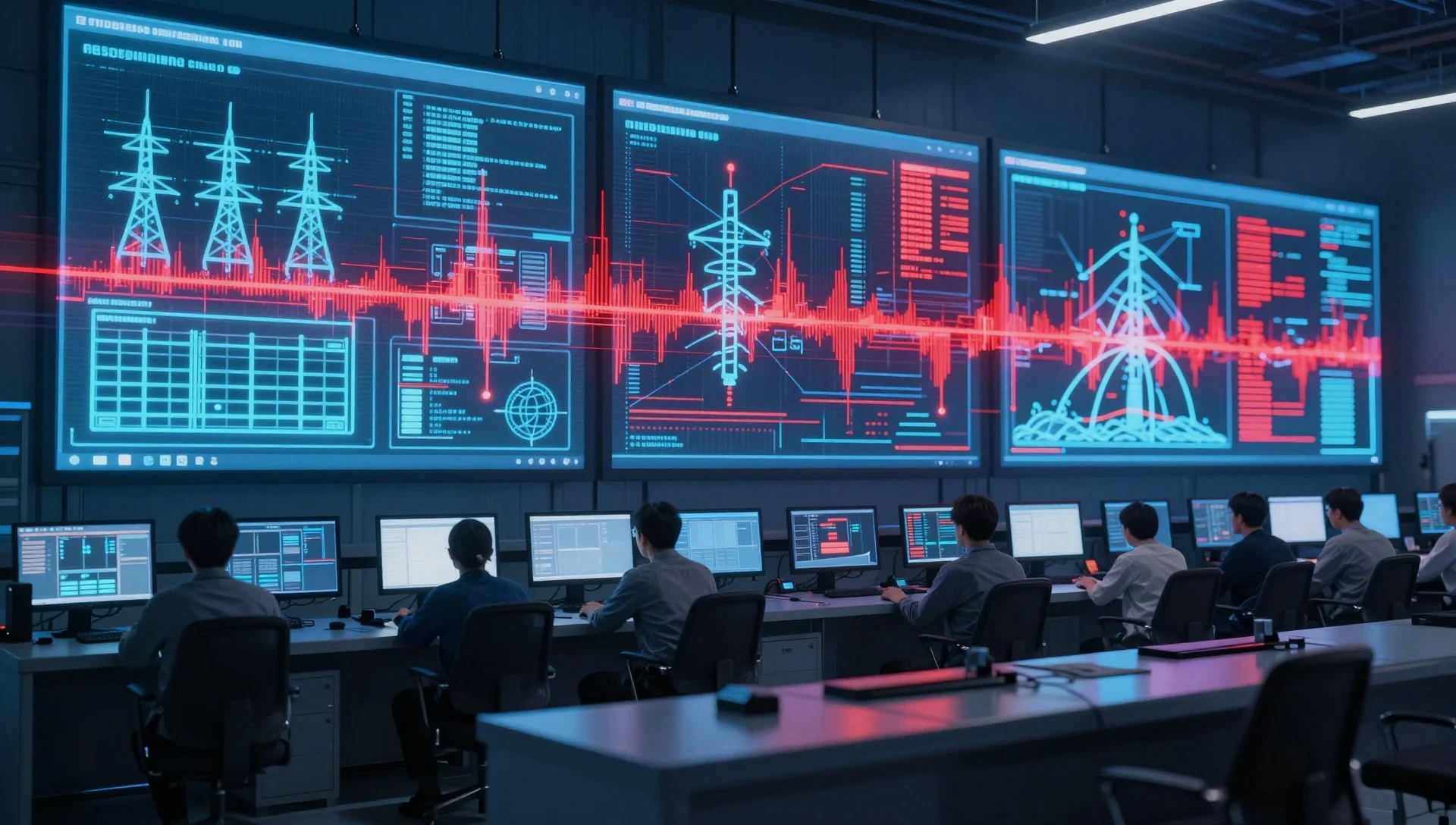
Operational technology — the hardware and software that directly monitor and manipulate physical machines — has become the most consequential cyber battleground of the decade. Unlike conventional information technology, where a breach compromises data, an OT intrusion can move valves, spin turbines, chill food, or disable a hospital ventilator.
The distinction matters because the consequences are measured in litres of sewage, megawatts of lost generation, and potentially human lives rather than in leaked records.
The 2000 Queensland incident remains the cleanest illustration of this asymmetry. Over roughly three months, radio communications to pumps failed, alarms stayed silent, and more than 800,000 litres of untreated sewage flowed into local waterways before a hacker was identified as the cause.
On This Page
That episode was treated as an anomaly; today it reads as a template. Attackers have since replicated the underlying logic — reach the controller, suppress the alarm, let physics do the damage — across water utilities, supermarkets, sugar mills, and medical device supply chains.
What has changed is not the vulnerability but the tempo and the intent. State-aligned groups now treat industrial control systems as instruments of coercion in geopolitical disputes, a practice analysts call cyber-retribution.
The evidence assembled below traces that shift from Australian water infrastructure to Iranian-linked campaigns against US utilities, from a ransomware-style disruption at a sugar producer to the dormant-access risk inside nuclear facilities, and it weighs how artificial intelligence will compress the time between intrusion and impact.
TL;DR Cyberattacks on operational technology have escalated from isolated experiments like the 2000 Queensland sewage spill to sustained, state-linked campaigns against water systems, food production, medical suppliers, and nuclear infrastructure. Roughly 30 US water utilities were targeted in methods consistent with the Iranian-backed CyberAv3ngers, while a 2025 SharePoint breach attributed to Chinese-sponsored actors touched more than 400 agencies worldwide, including the US National Nuclear Security Administration. Air gaps are eroding under digital upgrades and remote monitoring, and AI is expected to accelerate both reconnaissance and exploitation. The core message: OT security is now a matter of national and humanitarian consequence, not merely corporate IT hygiene.
The Architecture of Industrial Risk: Why OT Breaches Behave Differently
Operational technology governs the physical layer of modern civilisation: power plants, traffic signals, air traffic control, water treatment, and pipeline networks. Its design priorities historically favoured availability and safety over confidentiality, which inverts the standard IT security model.
A patch that reboots a server is routine; a patch that reboots a turbine controller is an engineering event requiring outage windows and physical verification.
This inversion explains why OT incidents escalate so quickly. When attackers reach a programmable logic controller, they inherit the plant's own authority to actuate machinery. The Queensland case demonstrated the pattern precisely: communications to pumps failed, alarms did not sound, and the system continued operating in a state its operators could not observe. Detection, not exploitation, proved the decisive weakness.
The Queensland Precedent and the Alarm-Suppression Pattern
The 2000 water treatment incident released more than 800,000 litres of untreated sewage across three months before anyone connected the failures to deliberate interference. The mechanism was unremarkable — disrupted radio links to pumps combined with silenced alarms — yet the outcome was environmental damage at industrial scale. The episode established that the most dangerous OT attacks are often quiet rather than dramatic.
That lesson recurs in every subsequent case. Attackers rarely need to destroy equipment when they can persuade operators that nothing is wrong. Alarm suppression, sensor spoofing, and communication blackouts convert a functioning plant into a blind machine.
Defenders who monitor only for outages miss the more insidious scenario: a system reporting normal while behaving abnormally.
Forensic attribution in the Queensland case arrived late, which is itself instructive. Industrial environments generate sparse logs, and legacy protocols often lack authentication entirely. Investigators reconstructing such events work from physical evidence and communications metadata rather than application logs. This evidentiary gap widens as attackers grow more disciplined about covering their access paths.
The precedent also reframes how utilities should budget. Spending concentrated on perimeter firewalls addresses the IT boundary but not the serial links and radio channels that connect pumps to controllers.
Segmentation, protocol-aware monitoring, and manual override procedures carry more weight in OT than in conventional enterprise security programmes, and they require operational engineers, not only cybersecurity staff.
From Supermarkets to Sugar Mills: The Widening Target Set
Recent incidents show no sector is exempt. Hackers remotely raised refrigerator and freezer temperatures across hundreds of French supermarkets, weaponising cold-chain controls. In June, a cybersecurity incident halted Australia's second-largest raw sugar producer, stopping milling and cane haulage, with a Russian-speaking group called The Gentleman claiming responsibility. Food and retail logistics are now front-line OT targets.
The Handala Hack group, said to operate under the Iranian government, claimed responsibility for attacks on medical equipment supplier Stryker in March. The operation remotely wiped associated devices worldwide, putting Australian hospitals on alert.
The pattern is consistent: choose a target whose disruption radiates outward through dependent institutions, then let the second-order effects amplify the message.
Each of these cases shares a structural feature — the compromised system sat inside a commercial supply chain rather than a fortified national asset. Supermarket refrigeration, sugar milling, and medical device distribution are operated by private firms with thin security margins. Attackers exploit that asymmetry deliberately, because a supplier breach reaches many downstream victims at once.
Regulatory attention has followed unevenly. Critical infrastructure laws typically designate utilities and transport, leaving food processing and logistics in a grey zone. Yet the sugar mill shutdown demonstrated that agricultural processing can halt an export supply chain as effectively as any grid failure. The designation gap is a policy vulnerability as much as a technical one.
Cyber-Retribution and the Geopolitical Logic of Infrastructure Attacks
Since US President Donald Trump launched military action against Iran, the US Cybersecurity and Infrastructure Security Agency has warned of ongoing Iranian-affiliated cyber targeting. Experts describe the pattern as cyber-retribution, in which hacking becomes a front in interstate conflict.
The targets chosen — water, food, medical supply — are calibrated for public visibility rather than military utility.
This logic changes the defender's calculus. A purely criminal actor seeks payment and therefore prefers reversible disruption. A state-aligned group seeks political signal and may accept permanent damage. When the objective is coercion, deterrence requires credible attribution and visible consequence, both of which remain difficult in industrial environments where evidence is sparse.
The CyberAv3ngers campaign against roughly 30 US water systems illustrates the operational style. The methods were consistent across targets, suggesting tooling reuse rather than bespoke engineering. Consistency lowers cost per attack and raises the political return, because a single disclosure can reference dozens of compromised utilities simultaneously. Standardisation is itself a strategic asset.
Australia's exposure compounds the problem. Its utilities are distributed across vast geography, often remotely monitored, and frequently operated by small municipal entities with limited security staffing. The Australian Signals Directorate has repeatedly flagged this combination as attractive to state actors. Geography that makes infrastructure expensive to maintain also makes it expensive to defend.
We Also Published
Dormant Access, Air Gaps, and the Nuclear Threshold
The most consequential risk lies not in immediate disruption but in persistence. In 2025, hackers sponsored by China breached more than 400 agencies worldwide through Microsoft's SharePoint. One victim was the US National Nuclear Security Administration, which manages the US nuclear stockpile and nuclear power plants aboard warships and submarines. That breach was IT, not OT, yet the distinction may prove temporary.
Raji Rajagopalan, a senior fellow at the Australian Strategic Policy Institute, said such access could later be used for an OT hack. Attackers can enter a system, remain dormant for a long time, and then move into sensitive areas when an opportunity arises.
Dormancy converts a data breach into a latent capability, held in reserve for a moment of political utility.
Why the Air Gap Is Narrowing
Nuclear facilities often use an air gap, keeping administrative systems largely separate from operating systems. Dr Rajagopalan noted that this separation is not always complete, because digital upgrades and remote monitoring can compromise it.
Every convenience added to an industrial network is a potential bridge across the gap, and maintenance contracts multiply those bridges.
The erosion is incremental and usually justified. Predictive maintenance requires telemetry; telemetry requires connectivity; connectivity requires a path from the plant floor to an analytics platform. Each step is defensible in isolation.
Cumulatively they produce exactly the environment an attacker needs: reachable, instrumented, and trusted by operators who believe the gap still holds.
Vendor access deserves particular scrutiny. Remote support sessions, firmware update channels, and third-party monitoring tools frequently cross security boundaries with credentials that outlive the engagement. The 2025 SharePoint campaign demonstrated how a widely deployed enterprise platform becomes a shared attack surface. Industrial vendors run similar platforms, often with weaker patch cadence.
Verification, not assumption, is the only defensible posture. Operators should map every path between administrative and operational networks, test whether segmentation actually blocks lateral movement, and treat remote monitoring as an attack surface requiring its own controls. An air gap that has never been tested is a belief rather than a control.
Stuxnet as Precedent, Not Fiction
A hacker triggering a nuclear meltdown may sound like fiction, but the Stuxnet worm, which damaged centrifuges at Iran's Natanz nuclear facility, showed such risks are real. Stuxnet was precise, patient, and engineered to manipulate physical equipment while reporting normal operation. It converted code into mechanical wear.
The operation behind it, widely linked to Operation Olympic Games, established a doctrinal precedent that persists. It proved that industrial sabotage could be delivered through software, attributed only slowly, and calibrated to avoid immediate escalation. Once demonstrated, the technique becomes available to any actor with comparable resources and patience.
Stuxnet's deeper lesson concerns design intent. The worm targeted specific controller configurations and manipulated sensor readings so operators would see expected values. That combination — physical effect plus false reassurance — is the same pattern seen in Queensland, scaled to national infrastructure. The technique has diffused far beyond its original authors.
Defenders should therefore treat sensor integrity as a first-class security property. Independent verification of physical state, cross-checks between redundant instruments, and manual inspection routines reduce the value of spoofed readings. If operators cannot trust what the system reports, the attacker's advantage collapses to mere access rather than control.
The Dormant-Access Threat Model
Dormant access is the connective tissue between IT breaches and OT consequences. An attacker who establishes persistence in an administrative network can wait for a maintenance window, a credential rotation gap, or a merger that reshuffles access rights. The intrusion need not be sophisticated; it need only be patient and well-placed.
Detection therefore depends on dwell-time analytics rather than perimeter alerts. Organisations should baseline normal lateral movement, flag unusual authentication from engineering workstations, and audit service accounts that bridge network zones. Most dormant access survives because nobody is looking for quiet anomalies in low-traffic segments.
The NNSA case sharpens the point. An agency managing nuclear stockpiles and naval reactor plants is precisely the kind of target where dormant access carries strategic weight. Even without direct OT compromise, the intelligence value of administrative systems — maintenance schedules, vendor lists, network diagrams — is substantial and durable.
Response planning must assume persistence rather than exclude it. That means rehearsing containment across IT and OT jointly, pre-authorising manual control procedures, and maintaining offline copies of configuration data. An organisation that discovers dormant access during a crisis has already lost the initiative.
Artificial Intelligence, Escalation, and the Defensive Agenda
Artificial intelligence is expected to make these attacks more common and faster. Reconnaissance that once required specialist knowledge — fingerprinting controllers, identifying firmware versions, mapping network topology — can increasingly be automated. The barrier to entry falls, and the population of capable actors expands accordingly.
The defensive case for AI is equally real but narrower. Anomaly detection across industrial telemetry benefits from models that learn normal process behaviour and flag deviations invisible to rule-based systems. The constraint is data quality: OT environments generate noisy, sparse, and often unlabelled telemetry, which limits what any model can reliably learn.
Automation and the Compression of Attack Timelines
Speed is the decisive variable. Human attackers operate on timescales of days or weeks; automated tooling compresses reconnaissance and exploitation into hours. For OT defenders, whose patch cycles are measured in months, that mismatch is structural. The attacker's iteration loop is simply faster than the defender's change-control process.
This asymmetry favours design choices that do not depend on rapid updates. Network segmentation, allow-listing of industrial protocols, and hardware-enforced boundaries remain effective regardless of how quickly attackers iterate. Architectural controls age better than signature-based defences in environments where patching is slow by necessity.
AI also raises the prospect of adaptive malware that modifies its behaviour to evade detection in specific plant configurations. Stuxnet required extensive prior intelligence about Natanz; future tooling may infer configuration from observed responses. That shift would reduce the lead time required for a precision attack from years to weeks.
Governments are beginning to treat this as a strategic rather than commercial question. Critical infrastructure protection increasingly includes supply-chain assurance for AI-enabled monitoring tools, because a compromised analytics platform sits inside the trust boundary. The tool that watches the plant must itself be watched.
- 01
- 02
- 03
- 04
Segmentation, Monitoring, and Manual Control
Practical defence begins with segmentation that is verified rather than assumed. Industrial networks should be divided by function, with strict controls on traffic crossing from enterprise systems into control zones. Every permitted path should be documented, justified, and monitored, because undocumented paths are where dormant access survives longest.
Protocol-aware monitoring adds the visibility that conventional tools lack. Industrial protocols such as Modbus and DNP3 were designed without authentication, so behavioural baselines matter more than signatures. A controller issuing commands outside its normal schedule is a stronger signal than any malware hash in an OT environment.
Manual control capability is the final backstop. Operators must be able to run critical processes without the digital layer, at least temporarily, and must rehearse that capability under realistic conditions. The Queensland incident showed what happens when operators cannot see or override a system that has quietly stopped telling the truth.
Supply-chain assurance completes the picture. Vendors with remote access, firmware update rights, and monitoring contracts sit inside the trust boundary. Contracts should specify security obligations, notification timelines, and audit rights. The Stryker case demonstrated how a single supplier's compromise propagates across an entire national health system.
Policy, Attribution, and the Limits of Deterrence
Deterrence in cyberspace rests on attribution and consequence, both of which are weak in industrial settings. Attribution requires evidence that adversaries are careful to obscure, and consequence requires political will that varies with domestic priorities. The result is a persistent gap between identified campaigns and meaningful response.
Regulatory frameworks are converging on mandatory incident reporting and minimum security standards for designated critical infrastructure. The unresolved question is scope: whether food processing, logistics, and medical supply chains receive the same treatment as energy and water. The evidence from recent incidents suggests they should.
International norms offer limited restraint. Attacks on civilian infrastructure sit in a legal grey zone, and cyber-retribution deliberately exploits that ambiguity. Strengthening norms requires demonstrated willingness to impose costs, which in turn requires the forensic capability to attribute industrial intrusions with confidence. That capability is unevenly distributed.
For operators, the practical conclusion is that policy will lag the threat. Security investment should therefore be justified on operational grounds — uptime, safety, regulatory readiness — rather than on the expectation of decisive government intervention. Resilience is built plant by plant, not declared at summit level.
The trajectory is clear enough. Industrial control systems were once obscure engineering artefacts; they are now strategic terrain contested by states, criminals, and soon by automated tooling. The Queensland spill, the French supermarket manipulation, the sugar mill shutdown, and the Stryker device wipe are not isolated curiosities but points on a single curve of escalating capability and intent.
What remains within the defender's control is architecture and discipline. Verified segmentation, protocol-aware monitoring, independent sensor verification, rehearsed manual control, and contractual leverage over vendors do not depend on winning an intelligence race.
They depend on treating operational technology as what it is: the physical substrate of public safety, deserving security proportionate to that role.
From our network :
- The Hidden Cost of AI Convenience: Why Over-Permissioned Agents Are a Security Time BombDiscover why AI agents with excessive permissions create dangerous single points of failure, and learn how implementing least privilege principles can protect your organization from exploitation.
- Mobile Learning and VR in English: What Global Evidence Reveals About Effective Language TechnologyA systematic review across 14 countries reveals which language-learning technologies genuinely work. Mobile learning, AI, and VR show measurable benefits when pedagogically integrated. This evidence-based guide helps educators and learners select technology that delivers real return on investment.
- Live Online English Classes for Kids: Do They Actually Reduce Anxiety?A ten-week study reveals that synchronous online English classes can significantly reduce child language anxiety while improving listening and reading skills. Discover what makes these programs effective and how parents can select the right one.
- The Final Descent: How ESA Retired the Legendary Cluster Constellation After 24 Years of Space Weather ScienceAfter 24 years mapping Earth’s magnetosphere, ESA’s Cluster mission concluded with a precisely controlled reentry over the South Pacific. This analysis explores the scientific legacy, engineering decisions, and debris mitigation principles behind one of space exploration’s most responsible retirements.
- Forbidden Matrix Patterns and Visible Lattice Points: A Geometric DictionaryExplore how multidimensional 0–1 matrices encode geometric truths, linking forbidden patterns to visible lattice points and hypergraph theory, with applications in combinatorics and computational geometry.
- How AI Agents Will Change the Way We Manage Personal FinancesExplore how AI agents are transforming personal finance through automated budgeting, bill payment, and investment management, while examining the critical security protocols and governance frameworks required for safe deployment.
- CISA’s Ten-Advisory Wave: Why Generic Patching Fails in OT and How to Build Product-Specific PlaybooksCISA released ten ICS advisories in one week, exposing critical infrastructure risks. Generic patching fails in OT. Learn to build product-specific remediation playbooks.
- Committed Mediterranean Precipitation Decline: Why Emissions Cuts Alone Cannot Restore Winter RainsNew NOAA research reveals that Mediterranean winter rains may decline irreversibly even with emissions cuts. Explore the science of committed climate change and regional impacts.
- University Language Proficiency Exams: Why Institutional Tests Demand Different Preparation Than IELTS and TOEFLDiscover why university-specific language proficiency examinations differ fundamentally from IELTS and TOEFL, and learn strategic preparation approaches for institutional assessment success.
RESOURCES
- Cyber threat to operational technologycyber.gc.cademonstrating the impact of a cyber attack against critical infrastructure, and its use during international hostilities. Escalating tensions between Iran ...
- CISA Joins Australia and Others to Publish Guidance to Isolate ...cisa.govJul 28, 2026 ... ... Operational Technology and Enabling Systems in Critical Infrastructure ... cyberattacks, to contain ongoing threats, and to facilitate the ...
- Improvements Needed in Addressing Risks to Operational Technologygao.govMar 7, 2024 ... Operational technology systems control processes or production, and are often used in critical infrastructure ... Cyberattacks pose a ...
- Malicious Cyber Actors Targeting Water and Wastewater Sector ...fbi.govJul 30, 2026 ... ... critical infrastructure asset owners and operators that malicious cyber actors (MCAs) are conducting cyber attacks targeting Operational ...
- Unsophisticated Cyber Actor(s) Targeting Operational Technologycisa.govMay 6, 2025 ... CISA is increasingly aware of unsophisticated cyber actor(s) targeting ICS/SCADA systems within U.S. critical Infrastructure sectors (Oil ...
- The dangerous blind spot in critical infrastructure cybersecurityweforum.orgOct 13, 2025 ... Operational technology can be a weak point. But times have changed ... operation, a cyber attack or another factor. The…
- Cotton to Bessent: Protect Critical Infrastructure from Cyberattackscotton.senate.govAug 5, 2026 ... “Attacks on civilian infrastructure have become a routine instrument of modern warfare, and American operational technology is a target. I…
- Protect Operational Technologies and Control Systems against ...nsa.govJul 23, 2020 ... ... cyber-attacks against critical infrastructure by exploiting Internet-accessible Operational Technology (OT) assets. Due to the increase in ...
- Significant Cyber Incidents | Strategic Technologies Program - CSIScsis.org... cyberattack that disrupted operational technology used to manage water infrastructure. ... cyberattacks on critical infrastructure by a China-linked ...
- Hackers increasingly target operational technology, with ...cybersecuritydive.comNov 18, 2025 ... ... critical infrastructure operators looking to harden their defenses. ... License. Filed Under: Vulnerability, Cyberattacks, Threats ...
- Geopolitical shifts amplify OT security risks - PwCpwc.comJan 19, 2026 ... Operational technology (OT) has become a major target in geopolitical cyber conflicts, increasing the risk to critical infrastructure and ...
- What Recent Operational Technology Cyber Incidents Mean ... - Aonaon.comPoor network design and segregation are exposing operational technology to the internet, leaving critical infrastructure vulnerable to cyber attacks.
- Securing Water and Wastewater Operational Technology ... - NISTnist.govOct 1, 2026 ... Recent cyberattacks on the U.S. water and wastewater systems (WWS) sector are highlighting the escalating threat to our nation's critical ...
- US critical infrastructure remains exposed as Congress confronts OT ...industrialcyber.coJul 22, 2025 ... ... cyberattack on its critical infrastructure. OT ... operational technology and critical infrastructure is indeed real and growing.
- Operational Technology Cybersecurity - Idaho National Laboratoryinl.govExplore Industrial Control Systems (ICS) Cybersecurity and learn how to protect critical infrastructure against cyberattacks.
- 01
- 02
- 03
- 04
- 05
- 06
- 07
- 08
0 Comments