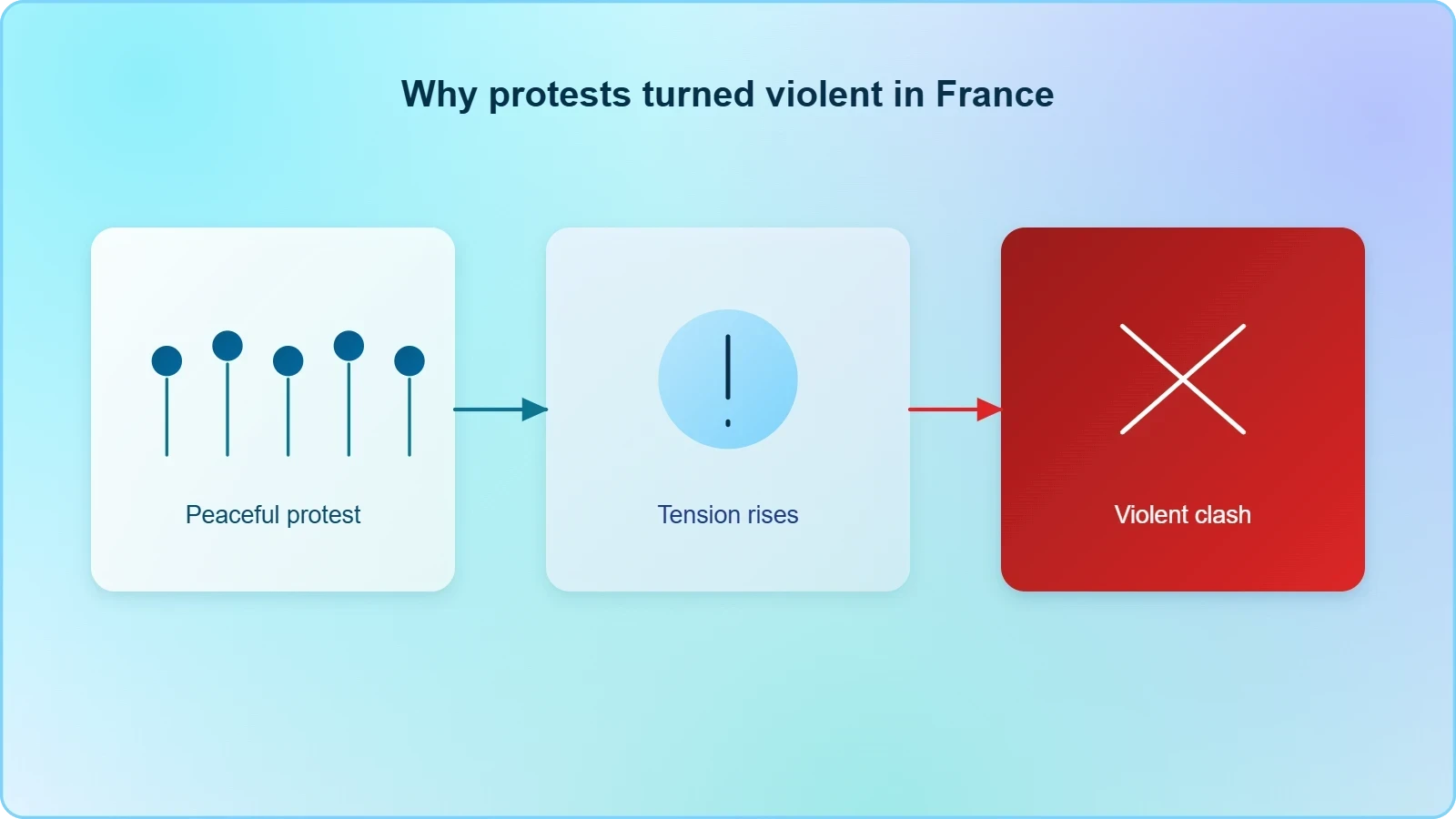
France has entered one of the most volatile passages of its modern political history, and the unrest that has swept its cities demands far more than a headline reading.
When a national motto of liberty, equality, and fraternity is publicly rewritten into a lament about misery, the gesture signals a rupture between citizens and the institutions that claim to represent them.
The violence is not an isolated eruption but the visible surface of accumulated grievance, fiscal strain, and a widening perception that ordinary people carry burdens while elites remain insulated.
On This Page
- The Anatomy of French Unrest: Grievance Before Violence
- Economic Pressure and the Erosion of Republican Trust
- Media Framing, Motto Politics, and the Battle for Meaning
- Governance Under Pressure: Order, Legitimacy, and Response
- Comparative Lens: Reading French Unrest in Global Context
- What Comes Next: Scenarios, Indicators, and Responsible Reading
Understanding this moment requires disciplined analysis rather than reflexive commentary. The available reporting confirms widespread unrest, clashes, and property damage, yet it deliberately withholds speculation about triggers, group composition, and government response.
That restraint is itself instructive: in fast-moving crises, verified facts lag behind dramatic imagery, and responsible observers must distinguish what is documented from what is merely implied. The deeper story lies in the structural pressures that make French streets a recurring stage for national frustration.
This analysis reconstructs the meaning behind the unrest, examines the economic and institutional forces that convert discontent into confrontation, and offers a framework for reading future developments with precision.
It treats the French case as a case study in how modern democracies metabolize anger, and why the phrase "why France is burning" resonates far beyond its borders.
TL;DR The unrest in France reflects deep public dissatisfaction rather than a single triggering event, with protests escalating into violence and property damage across several areas. Verified details on causes, scale, and government response remain limited, so the responsible reading is structural: fiscal pressure, perceived inequity, and eroding institutional trust are converting civic anger into street confrontation. The French motto rewritten as "misery" captures the core grievance — a gap between republican promises and lived economic reality. Observers should track verified reporting, distinguish grievance from violence, and watch how the state balances order with legitimacy.
The Anatomy of French Unrest: Grievance Before Violence
Violence in the streets rarely begins in the streets. It begins in kitchens, payroll offices, and municipal waiting rooms where citizens conclude that the system no longer hears them.
France's current wave of unrest fits this pattern: the clashes and property damage reported by outlets such as The Japan Times are symptoms, while the underlying condition is a pervasive sense of abandonment among working and middle-income households.
The rewritten motto — liberty, equality, misery — is a compact diagnosis. It asserts that the republic's founding promises have been hollowed out by economic reality, and that fraternity has been replaced by stratification.
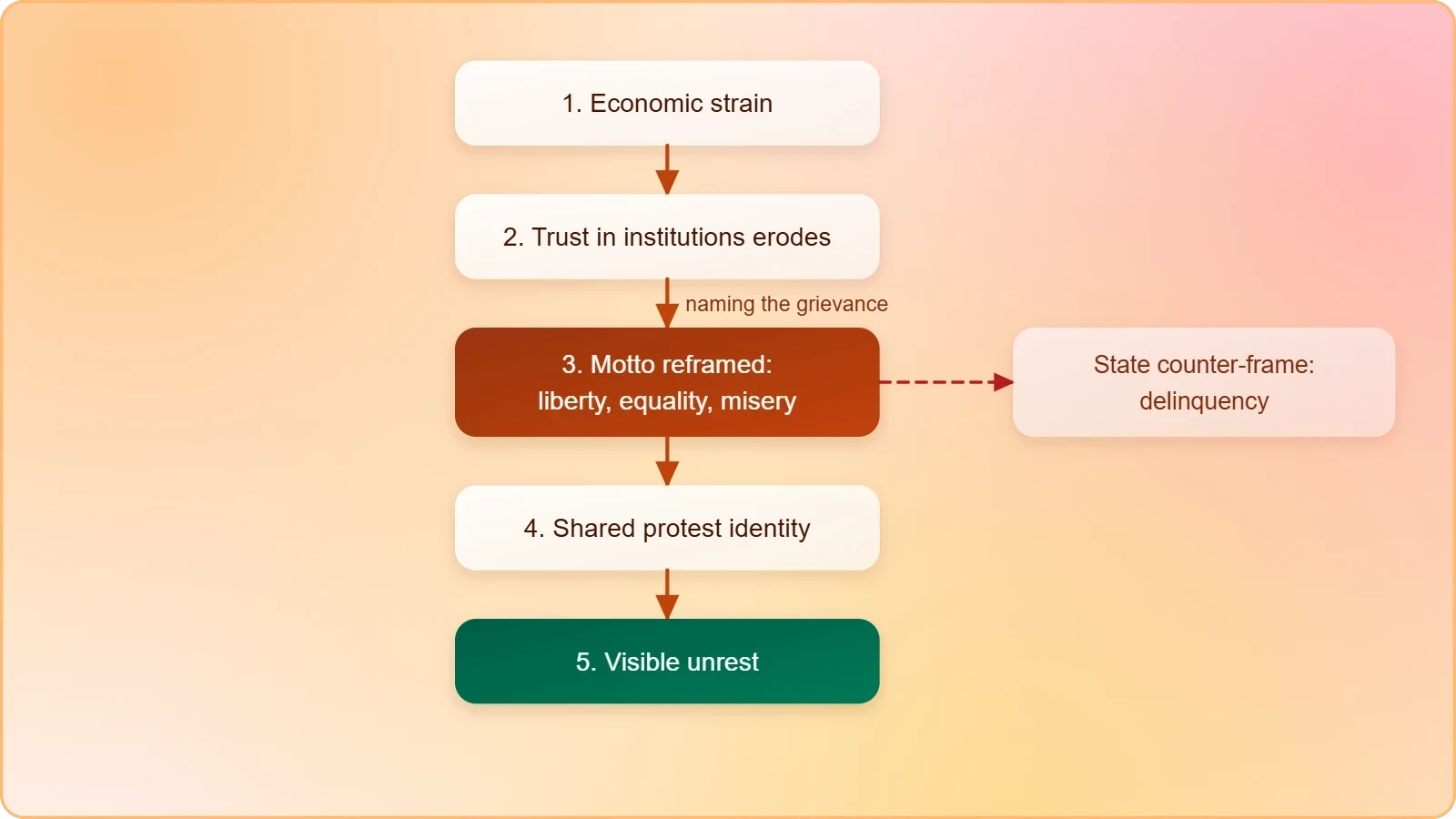
Such rhetorical framing matters because it converts diffuse hardship into a shared identity, giving protesters a vocabulary that travels faster than any policy document.
Reading the Headline as Political Evidence
A headline is a compression of argument, and the phrase "why France is burning" performs specific work. It frames the unrest as systemic rather than criminal, inviting readers to ask about causes instead of merely condemning disorder.
That framing is contested terrain, because governments prefer to characterize violence as marginal delinquency while protesters characterize it as legitimate outrage.
The source material is notably careful here. It confirms widespread unrest and international attention but declines to invent triggers, casualty figures, or organizational details. That epistemic discipline is valuable: in a crisis, the temptation to fill gaps with narrative is enormous, and premature certainty often hardens into misinformation that later complicates both reporting and policy response.
Why Trigger Events Matter Less Than Conditions
Analysts habitually search for a spark — a budget measure, a reform, an incident — yet sparks only ignite where fuel has accumulated. France's fuel includes stagnant purchasing power, housing costs that outpace wages, and a persistent perception that adjustment costs are distributed upward while protections flow downward. When those conditions persist, almost any catalyst can serve.
This is why the absence of a confirmed trigger in the source material does not weaken the analysis. It redirects attention to durable variables: inflation's bite on essentials, the geography of opportunity, and the credibility of institutions that promise redress. Violence becomes legible as a communication strategy deployed by people who believe conventional channels have failed.
Economic Pressure and the Erosion of Republican Trust
France's social model was built on a bargain: citizens accept taxation and regulation in exchange for security, mobility, and dignified public services. When that bargain appears to fail, the legitimacy deficit compounds quickly.
Purchasing power anxieties, housing scarcity, and uneven regional development feed a conviction that the republic protects the connected while asking the unconnected to absorb adjustment.
Trust erodes through small daily disappointments rather than dramatic betrayals. A delayed appointment, a shuttered local service, a wage that buys less each quarter — these accumulate into a worldview.
Once that worldview hardens, policy announcements are read as tactics rather than solutions, and even genuine reforms struggle to earn credibility with the audiences they target.
Purchasing Power as the Central Grievance
Household budgets are the most honest political barometer. When essentials consume a growing share of income, discretionary spending collapses and households feel poorer even amid aggregate growth. In France, as across Europe, energy and food price volatility has amplified that squeeze, making everyday life the arena where abstract economics becomes personal experience.
Protest movements instinctively center this grievance because it requires no technical expertise to articulate. A worker need not understand monetary policy to know that the month outlasts the salary.
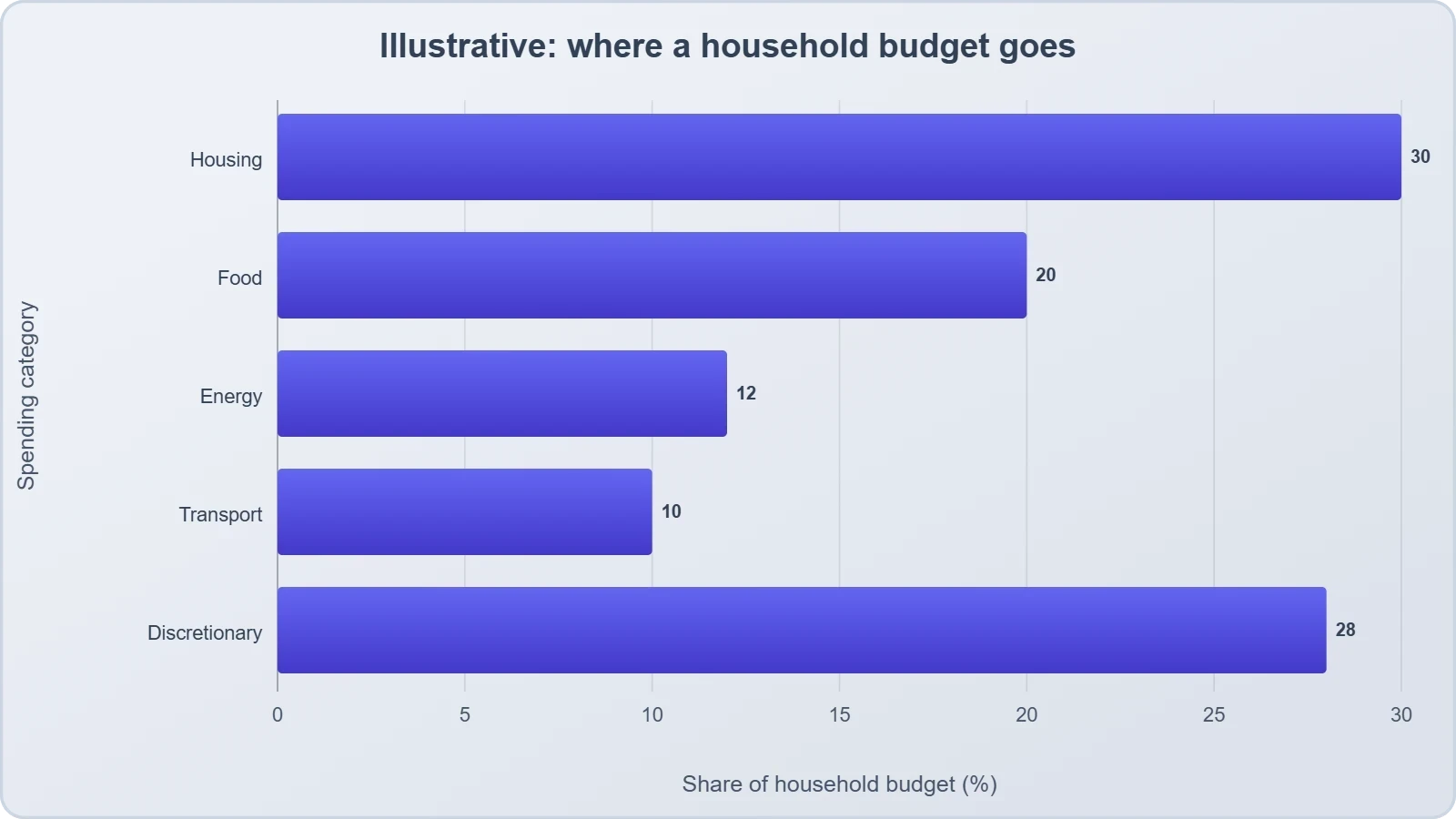
That clarity gives the grievance political force, and it explains why unrest can spread rapidly without a single coordinating organization or identifiable leadership structure.
Institutional Credibility and the Mediation Deficit
Between the citizen and the state stand mediating institutions: unions, local government, parties, and press. When those mediators are perceived as distant or captured, anger bypasses them and seeks direct expression.
France's tradition of street politics reflects both a vibrant civic culture and a recurring failure of mediation to deliver timely, visible results.
The consequence is a cycle in which protest becomes the default language of negotiation. Each cycle raises the cost of future compromise, because concessions won through disruption teach actors that disruption works.
Breaking that cycle requires institutions to demonstrate responsiveness before crises, not after them, and to communicate honestly about trade-offs rather than promising painless outcomes.
We Also Published
Media Framing, Motto Politics, and the Battle for Meaning
Every protest is also a contest over interpretation. The headline that rewrites fraternity as misery is an editorial act, compressing a complex social crisis into a memorable phrase. Such framing shapes how international audiences understand events, and it influences how domestic actors position themselves in the ensuing debate over legitimacy and blame.
Attribution matters as much as assertion. The source explicitly credits The Japan Times and confines itself to the headline's implications, refusing to manufacture details about scale, locations, or government measures.
That transparency is a model for crisis commentary: state what is known, mark the boundaries of knowledge, and direct readers toward updated reporting rather than speculation dressed as fact.
The Rhetorical Power of the Rewritten Motto
National mottos function as contracts between state and citizen. To alter one word is to allege breach of contract, and the substitution of misery for fraternity accuses the republic of abandoning solidarity.
The phrase travels well because it requires no statistics; it operates through recognition, inviting citizens to confirm that their experience matches the diagnosis.
Rhetoric of this kind can unify disparate grievances into a single narrative, which is precisely why authorities often contest it. Governments prefer granular explanations — specific reforms, specific budgets — because granularity fragments anger. Protest framing seeks the opposite: aggregation. The struggle over which frame prevails is a struggle over who gets to define the problem.
Verification Discipline in Fast-Moving Crises
Speed is the enemy of accuracy. During unrest, images circulate faster than context, and early claims harden into accepted history before correction can catch up. The disciplined approach is to separate confirmed events from attributed claims, to note what remains unknown, and to update conclusions as reliable reporting emerges rather than defending initial impressions.
This discipline serves readers better than confident speculation. It also protects public discourse from manipulation, since bad actors exploit crises to spread false narratives that deepen polarization. A citizenry trained to ask "what is verified?" is more resilient than one trained to react to the most dramatic available claim.
Governance Under Pressure: Order, Legitimacy, and Response
States facing unrest confront a genuine dilemma. Inaction invites escalation, yet heavy-handed response can validate the protest narrative and broaden participation. The optimal path is narrow: restore order proportionately while addressing grievances credibly, and communicate both commitments without appearing to trade one for the other. Few governments manage this sequence gracefully.
The source notes that government response remains unclear, which is itself significant. In the early phase of unrest, ambiguity about measures can amplify uncertainty and embolden both protesters and opportunists. Clear, consistent communication about intentions and limits is a governance tool, not merely public relations, because it shapes expectations on all sides.
Proportionality and the Legitimacy Trade-Off
Security forces operate at the intersection of law and perception. Proportionate policing preserves legitimacy by signaling that the state targets disorder rather than dissent. Disproportionate response achieves the opposite, converting bystanders into sympathizers and handing organizers a moral argument that no policy concession can easily neutralize afterward.
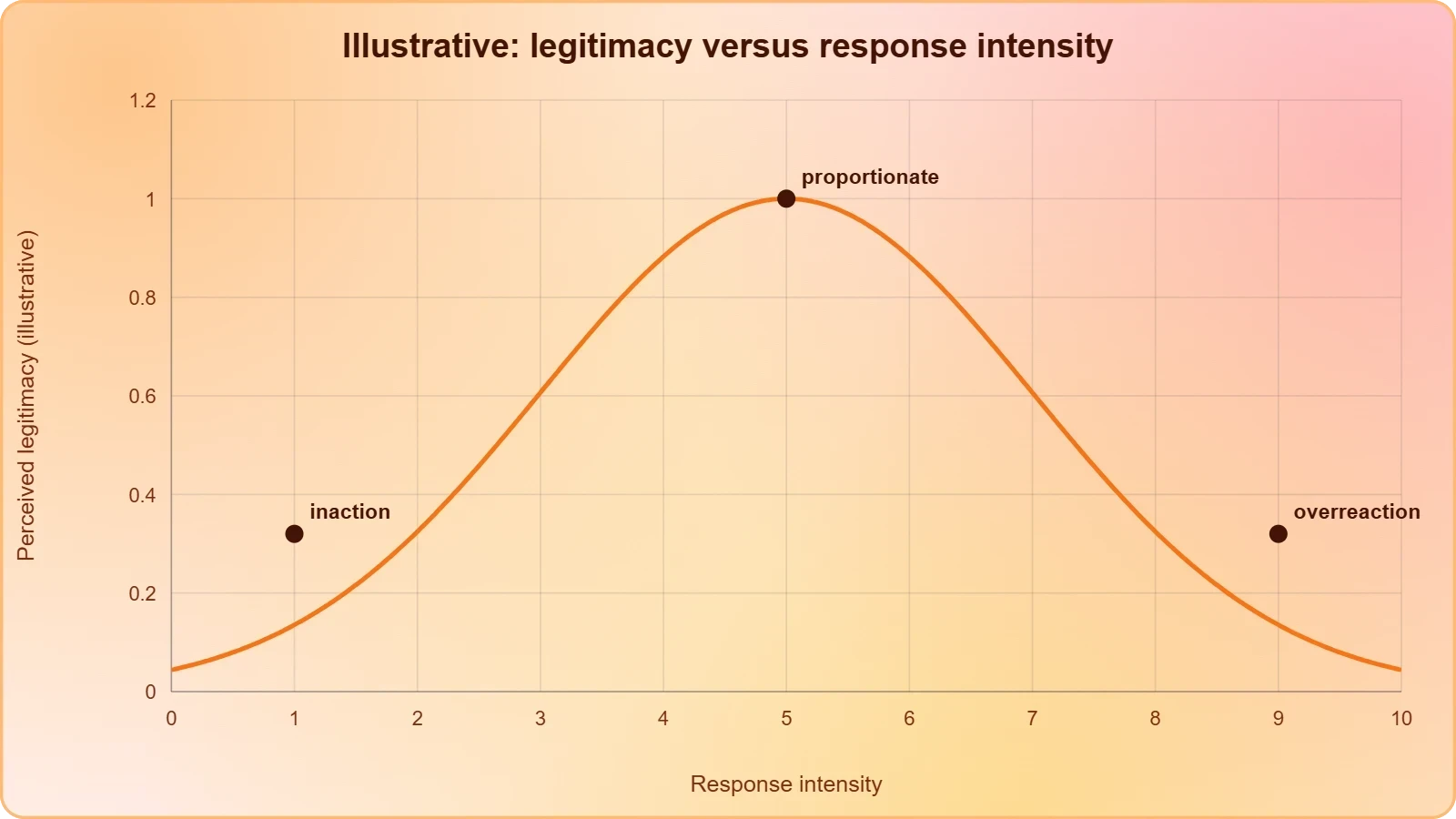
Equally, permissive drift erodes legitimacy from the other direction, as citizens conclude the state cannot protect ordinary life. The balance is inherently unstable, which is why mature democracies invest in oversight, transparent rules of engagement, and independent review. These mechanisms are not luxuries; they are the infrastructure of durable public consent.
Designing Responses That Address Root Causes
Suppressing symptoms without treating causes guarantees recurrence. Credible responses combine immediate relief for affected households with structural measures on housing, wages, and regional opportunity. Sequencing matters: relief builds the political space required for structural reform, while reform without relief reads as delay and intensifies distrust among those already skeptical.
Communication must be equally structural. Governments that explain trade-offs honestly, including who bears costs and why, earn more durable credibility than those offering painless promises. The French experience suggests that citizens tolerate difficulty when they believe the process is fair, and reject ease when they suspect it is a tactic.
Comparative Lens: Reading French Unrest in Global Context
France is not unique, but its pattern is distinctive. Across Europe and beyond, democracies are grappling with cost-of-living shocks, housing scarcity, and declining trust in mediating institutions. What distinguishes the French case is the intensity of street politics as a legitimate language of negotiation, a tradition that channels anger into visible, disruptive, and often effective collective action.
Comparative analysis guards against both exceptionalism and lazy generalization. France's institutions, labor traditions, and civic culture shape how discontent expresses itself, yet the underlying pressures are widely shared. Observers elsewhere can learn from the French sequence: grievance accumulates, mediation fails, protest escalates, and legitimacy becomes the scarce resource that determines outcomes.
Shared Pressures, Divergent Expressions
Cost-of-living anxiety is a global phenomenon, but its political expression varies by institutional design. Where unions remain strong and street protest is culturally legitimate, anger takes collective form. Where mediation is weaker or civic space narrower, discontent may express itself through electoral volatility, withdrawal, or informal disruption instead of mass mobilization.
This variation matters for prediction. The presence of visible unrest does not necessarily indicate deeper grievance than in quieter societies; it may indicate stronger traditions of collective voice. Analysts who equate silence with contentment misread the data, just as those who equate noise with collapse overstate the fragility of the systems they observe.
Lessons for Democracies Facing Legitimacy Deficits
The central lesson is that legitimacy is a stock, not a flow. It accumulates through consistent, fair, and visible responsiveness, and it depletes through perceived indifference. Governments that invest in mediation before crises — through credible unions, responsive local institutions, and honest communication — enter crises with reserves that make resolution far easier.
A second lesson concerns narrative humility. Authorities cannot fully control how events are framed, but they can avoid handing opponents powerful symbols. Disproportionate response, opaque decision-making, and dismissive rhetoric convert isolated incidents into movements. Restraint, transparency, and visible attention to grievance do the opposite, preserving space for negotiated outcomes.
What Comes Next: Scenarios, Indicators, and Responsible Reading
Forecasting unrest is less about prophecy than about identifying indicators. The trajectory of the French situation will depend on whether grievances are addressed credibly, whether response remains proportionate, and whether mediating institutions can reassert their role. Each variable is observable, and each carries implications for escalation or de-escalation that careful readers can track.
Responsible reading requires resisting two temptations: premature certainty about causes and premature dismissal of grievance. The source material models the first discipline by refusing to invent details. The second discipline belongs to readers, who should recognize that violence and legitimate complaint can coexist, and that understanding causes is not the same as excusing methods.
Indicators to Monitor in the Coming Weeks
Watch for official clarity on measures and their scope, since ambiguity tends to prolong uncertainty. Track whether response remains proportionate, because escalation signals a legitimacy crisis rather than a resolution. Monitor whether credible mediators re-enter the process, as their return indicates space for negotiation rather than confrontation.
Also observe the framing battle. If the protest narrative consolidates around shared hardship rather than isolated incidents, participation may broaden. If the state narrative successfully reasserts order and targeted reform, mobilization may fragment. Neither outcome is predetermined, and both depend on decisions made under pressure by actors with imperfect information.
Toward a More Informed Public Conversation
The most valuable contribution observers can make is disciplined attention. Consult updated reporting from reliable sources, distinguish verified facts from attributed claims, and resist the urge to convert complex crises into simple morality tales. France's unrest deserves analysis that respects both the reality of grievance and the reality of disorder.
Ultimately, the phrase "why France is burning" is a question, not a verdict. Answering it well requires economics, institutional analysis, and rhetorical awareness in equal measure. The republic's motto, however rewritten, still frames the debate: liberty to protest, equality of burden, and the fraternity that determines whether a society can repair itself.
From our network :
- Mobile Learning and VR in English: What Global Evidence Reveals About Effective Language TechnologyA systematic review across 14 countries reveals which language-learning technologies genuinely work. Mobile learning, AI, and VR show measurable benefits when pedagogically integrated. This evidence-based guide helps educators and learners select technology that delivers real return on investment.
- CISA’s Ten-Advisory Wave: Why Generic Patching Fails in OT and How to Build Product-Specific PlaybooksCISA released ten ICS advisories in one week, exposing critical infrastructure risks. Generic patching fails in OT. Learn to build product-specific remediation playbooks.
- University Language Proficiency Exams: Why Institutional Tests Demand Different Preparation Than IELTS and TOEFLDiscover why university-specific language proficiency examinations differ fundamentally from IELTS and TOEFL, and learn strategic preparation approaches for institutional assessment success.
- How AI Agents Will Change the Way We Manage Personal FinancesExplore how AI agents are transforming personal finance through automated budgeting, bill payment, and investment management, while examining the critical security protocols and governance frameworks required for safe deployment.
- Forbidden Matrix Patterns and Visible Lattice Points: A Geometric DictionaryExplore how multidimensional 0–1 matrices encode geometric truths, linking forbidden patterns to visible lattice points and hypergraph theory, with applications in combinatorics and computational geometry.
- Committed Mediterranean Precipitation Decline: Why Emissions Cuts Alone Cannot Restore Winter RainsNew NOAA research reveals that Mediterranean winter rains may decline irreversibly even with emissions cuts. Explore the science of committed climate change and regional impacts.
- Live Online English Classes for Kids: Do They Actually Reduce Anxiety?A ten-week study reveals that synchronous online English classes can significantly reduce child language anxiety while improving listening and reading skills. Discover what makes these programs effective and how parents can select the right one.
- The Hidden Cost of AI Convenience: Why Over-Permissioned Agents Are a Security Time BombDiscover why AI agents with excessive permissions create dangerous single points of failure, and learn how implementing least privilege principles can protect your organization from exploitation.
- The Final Descent: How ESA Retired the Legendary Cluster Constellation After 24 Years of Space Weather ScienceAfter 24 years mapping Earth’s magnetosphere, ESA’s Cluster mission concluded with a precisely controlled reentry over the South Pacific. This analysis explores the scientific legacy, engineering decisions, and debris mitigation principles behind one of space exploration’s most responsible retirements.
RESOURCES
- What's behind French student protests that turned violent? - Al Jazeeraaljazeera.comSep 30, 2026 ... Latour said the school protests were unfolding amid wider anger over public services, high fuel prices and pressure on household…
- France's school protests: What lies behind the anger - BBCbbc.comOct 8, 2026 ... The movement has turned violent in places – hundreds of students, teachers and police officers have been injured. Thousands of…
- France's Macron vows to hold accountable those who 'sought ... - CNNcnn.comOct 17, 2026 ... France's Macron decries violence during major protests: "Those who ... ... Organizers said far more people turned out. “There's an ...
- Students and police clash as France struggles to quell school protestsreuters.comOct 2, 2026 ... The protests erupted in the Paris region last week but have turned increasingly violent as they spread nationwide. French Interior…
- France wakes up to wreckage of a night of rioting after protests ...scrippsnews.com7 days ago ... Police detained 1,800 people after a series of peaceful protests across the country turned violent as night fell on Saturday.…
- France protest over irrigation reservoirs turns violent in La Rochellejurist.orgJul 21, 2024 ... The demonstrations underscored divisions over how best to utilize natural resources and support local agriculture amid changing climate ...
- Protests in France and Albania Turn Violent - News for Kidsnewsforkids.net5 days ago ... In France, the government is using curfews to stop violent riots. In Albania, protests against Prime Minister Edi Rama have…
- How will the riots in France affect the country's politics? - NPRnpr.org6 days ago ... But this weekend, many protests turned violent — and now French officials have implemented a curfew to quell the violence.…
- Nightly curfews set to begin in France after peaceful protests give ...wbur.org6 days ago ... France's Prime Minister gave city mayors the authority to impose nightly curfews on Monday, after protests turned violent this weekend.
- What's behind French student protests that turned violent? - Facebookfacebook.comSep 30, 2026 ... Violence are the resources for education, health, food absence, poor salaries for the families working long hours every day.
- France's police fire tear gas and water cannons as school protests ...houstonpublicmedia.orgOct 6, 2026 ... Some of the protests have turned violent, but it's not clear whether students or the police are to blame. As…
- About 400 schools in France are expected to remain closed after ...facebook.comOct 2, 2026 ... ... protests over education-related grievances turned violent in some places. 2,000 arrested in France as student protests escalate into violence.
- France's student protests have spiraled into a broader crisisnews.northeastern.edu6 days ago ... Protests turned violent as masked groups and fringe extremists joined demonstrations, clashing with police, setting fires, looting shops and ...
- France protests continue | TPR - Texas Public Radiotpr.orgOct 6, 2026 ... The students are demonstrating against decrepit facilities and a lack of teachers. But some protests turned violent last week, and…
- 01
- 02
- 03
- 04
- 05
- 06
- 07
- 08
0 Comments