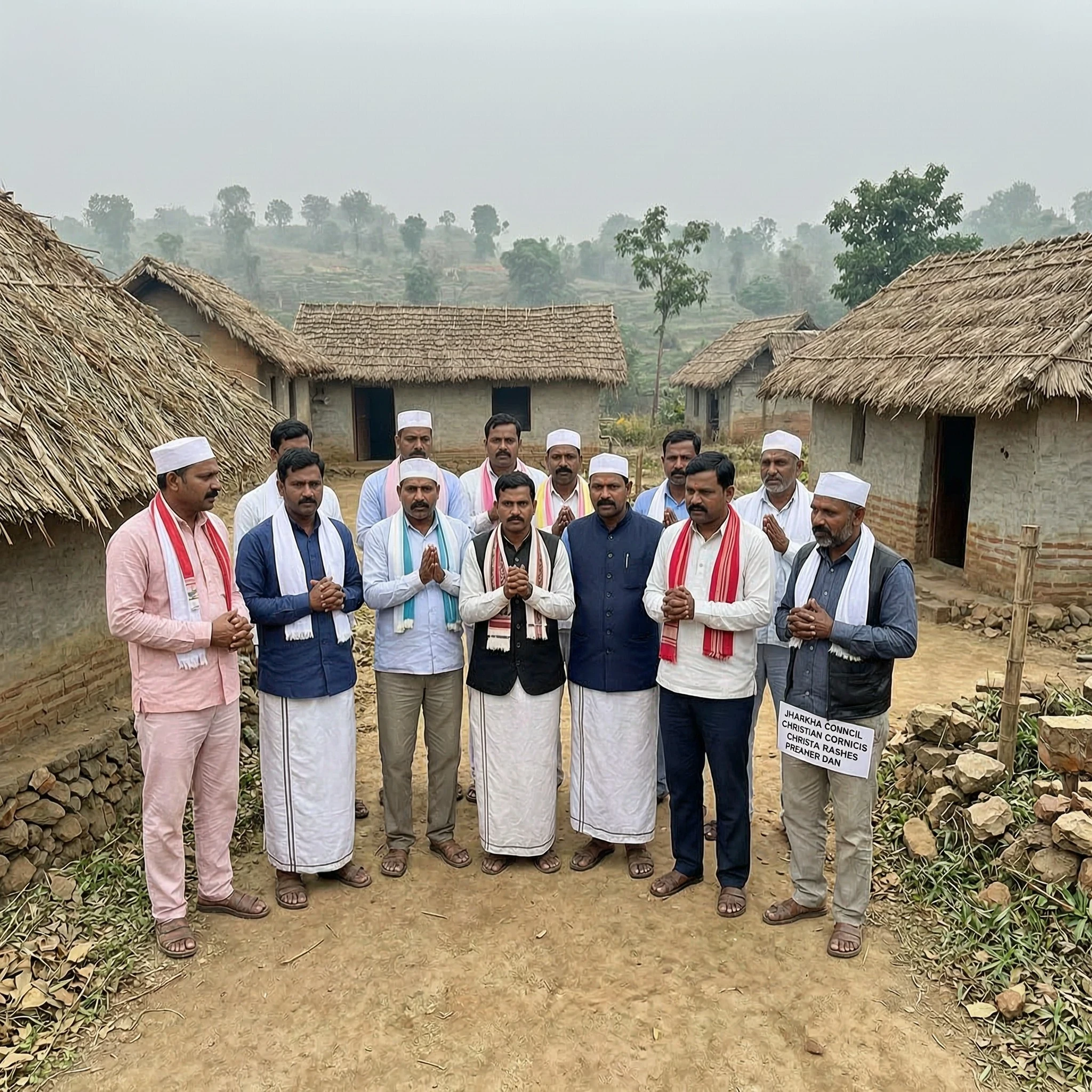
The quiet village of Bodeya, tucked into the Ranchi district of Jharkhand, has become an unlikely flashpoint in one of India's most sensitive constitutional debates. In late October 2026, its village council convened a meeting chaired by village head Anil Oraon and emerged with a unanimous resolution barring Christian preachers, priests and pastors from entering the settlement.
The decision, publicly displayed on a notice board at Bodeya Chowk, also restricts faith-healing prayer meetings and religious festivals, framing the move as a safeguard against religious propagation activities.
What makes this local resolution nationally significant is not its novelty but its lineage. Earlier the same month, the Gram Sabha of Harmu Salotoli village in Itki block reportedly adopted a similar measure and installed its own notice board restricting pastors' entry.
On This Page
Two villages, two notice boards, one unmistakable pattern: tribal communities in Jharkhand are increasingly using village-level forums to articulate anxieties about religious conversion and the preservation of indigenous traditions. The Bodeya meeting drew elected representatives, tribal organisation members and ordinary villagers, including Zila Parishad member Kiran Devi and ward member Kailash Manda.
Beneath the surface of a municipal notice lies a deeper argument about constitutional authority, cultural sovereignty and the limits of religious freedom in Scheduled Areas. Village head Soma Oraon framed the decision as preventive rather than punitive, aimed at curbing propagation.
Yet tribal leaders such as Megha Oraon of the Jharkhand Adivasi Sarna Vikas Samiti argue that conversion corrodes customs and community institutions. This analysis unpacks the legal scaffolding, the demographic anxieties and the political currents converging on that notice board.
TL;DR A village council in Bodeya, Ranchi district, has unanimously barred Christian preachers and restricted faith-healing prayer meetings, following a similar move in Harmu Salotoli village. The resolutions reflect growing tribal concern in Jharkhand over religious conversion and the erosion of indigenous Sarna traditions. Supporters invoke the constitutional powers of Gram Sabhas under the Fifth Schedule and PESA, which extend beyond development to cultural protection. Critics warn of risks to minority religious freedom and constitutional guarantees. The episode crystallises a broader national tension between community self-governance and individual rights in Scheduled Areas.
The Bodeya Resolution and Its Immediate Context
The Bodeya resolution did not emerge from nowhere; it arrived at the intersection of local grievance and organised advocacy. Village head Anil Oraon chaired the meeting, and the unanimous adoption lent the decision an appearance of collective consensus rather than factional imposition.
The public display at Bodeya Chowk transformed a private deliberation into a visible community declaration, signalling that the village intended the restriction to be known and enforced.
What the Resolution Actually Prohibits
The measure targets three distinct activities: the entry of Christian preachers, priests and pastors into the village; faith-healing prayer meetings; and prayer festivals associated with healing. Village head Soma Oraon characterised the intent as preventing religious propagation rather than persecuting believers.
The wording matters because it distinguishes between pastoral presence and proselytising activity, a line that is legally contested and socially fraught.
Enforcement mechanisms remain ambiguous. A notice board carries moral and communal weight but no statutory police power unless backed by formal Gram Sabha authority. Observers note that such resolutions often function as social sanctions first and legal instruments second, relying on community pressure rather than state machinery to achieve compliance within tightly knit tribal settlements.
The Harmu Salotoli Precedent
Days before Bodeya acted, the Gram Sabha of Harmu Salotoli village in Itki block reportedly adopted a parallel resolution and installed a notice board restricting pastors' entry. The proximity in time and similarity in substance suggest coordination or, at minimum, rapid diffusion of a template across villages. Local organisers appear to be learning from one another and replicating successful tactics.
Taken together, the two decisions indicate that tribal communities are experimenting with village-level forums as instruments of cultural policy. Whether this constitutes a spontaneous grassroots movement or an organised campaign remains debated, but the sequencing strongly implies deliberate emulation rather than coincidence, with tribal organisations providing ideological framing and logistical encouragement.
Constitutional Powers of the Gram Sabha in Scheduled Areas
The legal architecture invoked by supporters is neither obscure nor improvised. Sandeep Oraon, regional convener of the Janjati Suraksha Manch, points to the Fifth Schedule of the Constitution and the Panchayats (Extension to Scheduled Areas) Act, known as PESA.
These provisions grant Gram Sabhas in Scheduled Areas extraordinary authority, extending well beyond routine village development into cultural and religious domains.
Fifth Schedule and PESA Explained
The Fifth Schedule empowers the Governor to declare Scheduled Areas and entrusts Gram Sabhas with functions relating to community resources, land and customary law. PESA, enacted in 1996, operationalises this by mandating consultation with Gram Sabhas on matters affecting tribal life. Supporters argue that protecting religious traditions falls squarely within this mandate.
Critics counter that PESA's cultural provisions were designed to preserve customary practices, not to authorise blanket restrictions on the religious freedom of individuals or minority groups. The constitutional text is broad, and its interpretation remains contested, leaving village councils and courts to negotiate the boundary between community autonomy and fundamental rights.
The Cultural Protection Mandate
Advocates frame the resolutions as an exercise of customary self-governance rather than an assault on religious liberty. Megha Oraon of the Jharkhand Adivasi Sarna Vikas Samiti contends that conversion damages tribal customs and community institutions, and she calls for these concerns to be formally addressed. The argument positions cultural preservation as a constitutional value in its own right.
This framing resonates deeply in tribal Jharkhand, where Sarna religious identity is intertwined with land, kinship and village governance. For many residents, the notice board is less a prohibition than a declaration of cultural boundaries, asserting that the community retains authority over the spiritual life of its settlement.
Conversion, Sarna Identity and Tribal Anxieties
The resolutions cannot be understood without grasping the demographic and spiritual anxieties simmering in tribal Jharkhand. Christian missionary activity has a long history in the region, and conversion has reshaped village demographics, kinship networks and customary authority structures over generations. For many Sarna adherents, these changes feel existential rather than abstract.
The Sarna Religious Identity Question
Sarna practitioners worship nature and ancestral spirits, and their religious life is inseparable from land and community governance. The demand for a separate Sarna religious code in the national census has intensified in recent years, reflecting a desire for formal recognition. Conversion to Christianity is often perceived as a defection from this collective identity.
Megha Oraon's warning that conversion harms tribal customs and community institutions captures this sentiment precisely. When a family converts, it may withdraw from customary rituals, dispute traditional authority and realign social loyalties. Village councils view such shifts as threats to the cohesion that underpins collective land management and dispute resolution.
Faith-Healing Meetings as a Flashpoint
Faith-healing prayer meetings occupy a particularly sensitive position because they combine religious outreach with claims of miraculous cure. Such gatherings attract villagers seeking relief from illness, drawing them into Christian fellowship and, critics allege, eventual conversion. The Bodeya resolution specifically restricts these meetings and associated prayer festivals.
Defenders of the restrictions argue that healing ministries exploit vulnerability and bypass customary healing traditions. Critics respond that restricting prayer meetings infringes on religious freedom and stigmatises Christian believers. The dispute over healing is thus a proxy for a larger argument about the boundaries of permissible religious practice in tribal society.
We Also Published
Organised Advocacy and the Janjati Suraksha Manch
Behind the village resolutions stands a network of tribal organisations that have supplied both ideological framing and organisational energy. The Janjati Suraksha Manch, represented locally by regional convener Sandeep Oraon and state committee member Sunny Oraon, has been vocal in articulating the case for Gram Sabha authority over cultural matters. Its presence at the Bodeya meeting was conspicuous.
The Role of Tribal Organisations
Groups such as the Jharkhand Adivasi Sarna Vikas Samiti and the Janjati Suraksha Manch function as amplifiers, translating diffuse village anxieties into coherent public arguments. They connect local grievances to constitutional provisions, provide speakers and conveners, and help villages replicate successful tactics. Their involvement lends the movement structure and continuity.
This organisational dimension distinguishes the current wave from isolated village disputes of the past. When advocacy groups supply templates, legal language and public platforms, individual resolutions become part of a broader campaign. Observers note that the rapid replication across villages reflects deliberate coordination rather than spontaneous local initiative alone.
Political Resonance in Jharkhand
Jharkhand's political landscape is acutely sensitive to tribal identity questions, and the conversion debate intersects with electoral calculations. Parties across the spectrum have historically courted tribal voters by championing indigenous rights and cultural protection. The village resolutions therefore carry implications beyond their immediate localities.
Whether the movement translates into formal policy remains uncertain, but its symbolic weight is considerable. Each notice board reinforces the claim that tribal communities possess inherent authority over their cultural boundaries. Politicians ignore such assertions at their peril in a state where tribal identity is a decisive political currency.
Legal and Human Rights Implications
The resolutions raise thorny questions that extend far beyond Bodeya's boundaries. India's constitutional order guarantees freedom of religion to all citizens, yet also recognises community autonomy in Scheduled Areas. When these principles collide, the resolution depends on interpretation, enforcement and the willingness of authorities to intervene. No court has yet ruled directly on such village-level restrictions.
- 01
- 02
- 03
- 04
Religious Freedom Versus Community Autonomy
Articles 25 and 26 guarantee individuals and denominations the right to profess, practise and propagate religion, subject to public order, morality and health. A village council barring preachers from entry arguably restricts these rights. Supporters counter that community autonomy in Scheduled Areas carries its own constitutional weight, creating a genuine tension.
Legal scholars note that fundamental rights generally prevail over customary authority, but the precise boundary remains unsettled. The absence of litigation means the question lingers unresolved, leaving villages, administrators and believers to navigate an ambiguous legal terrain without clear guidance from the judiciary.
Enforcement and Administrative Response
Notice boards do not enforce themselves, and the administrative response has been notably muted. District authorities have not publicly clarified whether they will uphold, ignore or challenge the resolutions. This silence leaves enforcement to community pressure, raising concerns about vigilante action and the potential for coercion against religious minorities.
Human rights organisations warn that informal enforcement can escalate into harassment and violence. Without clear administrative guidance, the risk of arbitrary action against Christian families increases. The state government faces pressure to clarify its position, balancing tribal sentiment against constitutional obligations to protect minority rights.
What the Jharkhand Precedent Means for India
The Bodeya and Harmu Salotoli resolutions are local in scope but national in implication. They demonstrate how constitutional provisions designed for tribal self-governance can be mobilised to regulate religious practice, setting a precedent that other Scheduled Areas may emulate. The template is now visible, and its replication seems likely.
A Template for Other Scheduled Areas
Across central and eastern India, tribal communities face similar debates about conversion, cultural preservation and customary authority. The Jharkhand model offers a ready-made framework: convene a Gram Sabha, pass a unanimous resolution, display a notice board. Its simplicity makes it attractive and easily exportable to other states with significant tribal populations.
Whether such templates spread depends on local political dynamics and organisational networks. But the precedent establishes that village councils are willing to act on cultural anxieties, and that advocacy groups stand ready to support them. Other Scheduled Areas are watching closely, and emulation appears probable.
Balancing Tradition and Constitutional Order
The deeper question is how India reconciles community self-governance with individual rights in tribal regions. Neither pure cultural relativism nor rigid legal centralism offers a satisfactory answer. A workable resolution requires dialogue, administrative clarity and judicial guidance that respects both tribal autonomy and constitutional guarantees.
For now, the notice boards stand as symbols of an unresolved argument. They assert community authority while inviting legal challenge, and they express cultural anxiety while raising human rights concerns. How the state responds will shape the trajectory of similar disputes across India's Scheduled Areas for years to come.
From our network :
- The Final Descent: How ESA Retired the Legendary Cluster Constellation After 24 Years of Space Weather ScienceAfter 24 years mapping Earth’s magnetosphere, ESA’s Cluster mission concluded with a precisely controlled reentry over the South Pacific. This analysis explores the scientific legacy, engineering decisions, and debris mitigation principles behind one of space exploration’s most responsible retirements.
- The Hidden Cost of AI Convenience: Why Over-Permissioned Agents Are a Security Time BombDiscover why AI agents with excessive permissions create dangerous single points of failure, and learn how implementing least privilege principles can protect your organization from exploitation.
- CISA’s Ten-Advisory Wave: Why Generic Patching Fails in OT and How to Build Product-Specific PlaybooksCISA released ten ICS advisories in one week, exposing critical infrastructure risks. Generic patching fails in OT. Learn to build product-specific remediation playbooks.
- University Language Proficiency Exams: Why Institutional Tests Demand Different Preparation Than IELTS and TOEFLDiscover why university-specific language proficiency examinations differ fundamentally from IELTS and TOEFL, and learn strategic preparation approaches for institutional assessment success.
- Forbidden Matrix Patterns and Visible Lattice Points: A Geometric DictionaryExplore how multidimensional 0–1 matrices encode geometric truths, linking forbidden patterns to visible lattice points and hypergraph theory, with applications in combinatorics and computational geometry.
- How AI Agents Will Change the Way We Manage Personal FinancesExplore how AI agents are transforming personal finance through automated budgeting, bill payment, and investment management, while examining the critical security protocols and governance frameworks required for safe deployment.
- Live Online English Classes for Kids: Do They Actually Reduce Anxiety?A ten-week study reveals that synchronous online English classes can significantly reduce child language anxiety while improving listening and reading skills. Discover what makes these programs effective and how parents can select the right one.
- Mobile Learning and VR in English: What Global Evidence Reveals About Effective Language TechnologyA systematic review across 14 countries reveals which language-learning technologies genuinely work. Mobile learning, AI, and VR show measurable benefits when pedagogically integrated. This evidence-based guide helps educators and learners select technology that delivers real return on investment.
- Committed Mediterranean Precipitation Decline: Why Emissions Cuts Alone Cannot Restore Winter RainsNew NOAA research reveals that Mediterranean winter rains may decline irreversibly even with emissions cuts. Explore the science of committed climate change and regional impacts.
RESOURCES
- India's top court declines to lift village bans on Christians - UCA Newsucanews.comFeb 17, 2026 ... ... Christian missionaries, including pastors, and Christians who had converted from other religions. ... Village councils, which function as ...
- Ranchi Gram Sabha bars entry of Christian preachers, restricts faith ...facebook.com3 days ago ... ... villagers have also installed a warning board on the border of the village. ... Villagers in Jharkhand ban pastors…
- 2018 Report on International Religious Freedom: Indiastate.govIn May the Global Council of Indian Christians (GCIC) reported police in Uttar Pradesh arrested Rev. Gyan Singh and another Pentecostal Christian in the…
- IRS officer Nesha Oraon hugged women returning to their original ...facebook.comJul 10, 2026 ... Villagers in Jharkhand ban pastors and socially boycott Christians ... ” John Dayal, Secretary General of the All India Christian…
- India - State.gov2009-2017.state.govIn Orissa, governed by a coalition government that includes the BJP and the Biju Janata Dal (BJD), Hindu extremists attacked Christian villagers and churches…
- 2019 Report on International Religious Freedom: India2017-2021.state.gov... Council, other Christian organizations, and civil society ... village attacked and killed tribal Christian Prakash Lakda of Jurmu Village in Jharkhand.
- “2021 Report on International Religious Freedom: India”, Document ...ecoi.netJun 2, 2022 ... On September 21, according to media reports, a village council ... Christian pastor for alleged religious conversion in Polmi village…
- 2023 Report on International Religious Freedom: India2021-2025.state.govIn May, the Bombay High Court revoked a 2022 administrative order banning Christian Pastor Dominic D'Souza and his wife from carrying out religious activities.
- Chhattisgarh HC refuses to remove village bans on Christian ...christiantoday.co.inNov 3, 2025 ... They said village councils have no power to stop people from entering villages, and that many Christian pastors and converts…
- 2022 Report on International Religious Freedom: India2021-2025.state.govThe crowd shouted, “bring the traitor out” and “rid India of Christian priests”. Local police later arrived and arrested the pastor and his wife…
- Sixteen Christians arrested for 'forced conversions' of tribals in ...asianews.itJul 10, 2018 ... The arrests took place in the District of Dumka. The detainees are part of a group of 25 "preachers" that…
- India: Churches burnt, Christians attacked, body exhumed before ...csi-int.orgDec 19, 2025 ... Police were also pushed and shoved by mobs. A pastor's home was among those burned, and several Christian families are…
- Anti-Conversion Laws and the Governance of Belonging Under ...mdpi.com... village councils through legal mechanisms (Jharkhand). Together, they ... In Adivasi Belt of Bastar, Ban on Christian Burials by Hindutva Groups Reveals ...
- Supreme Court Dismisses Plea Challenging Chhattisgarh Gram ...livelaw.inFeb 16, 2026 ... ... Banning Entry Of Pastors, Converts Into Tribal Village. Debby Jain. 16 ... Christian Pastors and converted Christians was barred.
- No entry for Pastors? Chhattisgarh HC says tribal villages can put up ...organiser.orgNov 2, 2025 ... ... board prohibiting entry of Pastors. Facebook ... villages declaring a ban on the entry of Christian pastors and “converted…
- 01
- 02
- 03
- 04
- 05
- 06
- 07
- 08
0 Comments