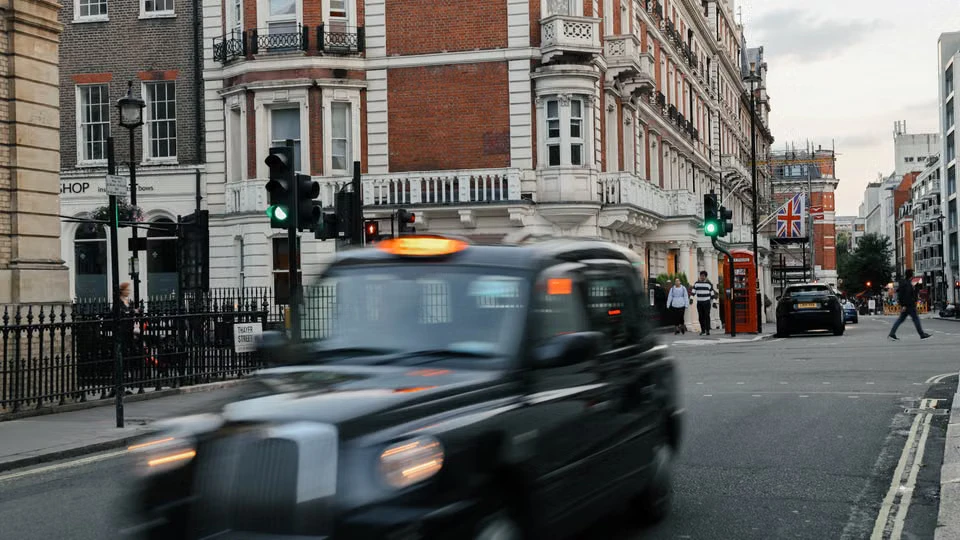
Sadiq Khan's intervention on robotaxis marks a rare moment of municipal resistance inside an otherwise accelerating national programme. The London Mayor has asked for a cap on the number of driverless vehicles permitted on the capital's streets, precisely as the UK government prepares legislation allowing fully autonomous operations.
His argument is not opposition to the technology itself, but a demand that deployment velocity match regulatory capacity. That distinction matters enormously, because it reframes the debate from whether robotaxis should exist to who controls their arrival.
The timing is instructive. Uber already runs limited self-driving rides in London using Wayve technology, with a safety driver present, under a Transport for London licence. Freenow by Lyft intends to launch fully driverless Baidu vehicles as early as next year through a national licensing scheme, while Waymo has signalled interest in the UK market.
On This Page
Roughly 24 Baidu Apollo Go cars are being tested in Brent. Each of these developments arrived before the regulatory architecture that would govern them at scale, which is exactly the sequencing Khan criticises.
The structural asymmetry at the heart of the dispute is jurisdictional. Transport for London can approve or reject fully autonomous vehicles, but it cannot manage or license robotaxi services. Ministers, by contrast, hold powers to accelerate rollout nationally.
Khan wants additional authority devolved to City Hall so that London can set volume limits, conditions and service standards. The conflict therefore concerns governance design as much as traffic management, and it will likely set a precedent for other British cities watching closely.
TL;DR Sadiq Khan has called for a cap on robotaxi numbers in London as the UK government prepares to permit fully driverless vehicles. He warns that rapid, unregulated deployment could threaten driver livelihoods, worsen congestion and affect air quality, and argues London needs devolved powers to license and limit services. Uber, Freenow by Lyft and Waymo are all positioning for the market, while driver unions protest. The dispute is fundamentally about who governs autonomous mobility at scale.
The Regulatory Vacuum Behind London's Robotaxi Debate
Autonomous vehicle policy in Britain has developed in layers that do not yet interlock. National legislation is being drafted to permit fully driverless operation, while local authorities retain only binary approval powers over individual vehicle types.
The result is a framework in which ministers can liberalise supply but city governments cannot calibrate demand, geography or service volume. Khan's request for a cap is, in practical terms, a request to close that gap before commercial operators exploit it.
Why the Current Powers Are Insufficient
Transport for London's mandate covers safety approval, not commercial licensing. It can determine whether a vehicle is fit to operate autonomously, but it cannot decide how many such vehicles may run, where they may rank, or what service obligations attach to their operation.
Private hire licensing rules were written for human drivers and do not map cleanly onto fleets managed by remote supervisors and software updates.
This limitation becomes acute when operators can obtain national licences that bypass municipal conditions. A company licensed nationally could, in principle, deploy vehicles in London without TfL controlling fleet size or geographic distribution.
Khan's warning about a "big bang without proper regulation" describes precisely this scenario: supply arriving faster than the city's ability to shape it.
The comparison with San Francisco is frequently invoked but imperfectly understood. San Francisco permitted robotaxi expansion and subsequently confronted congestion incidents, emergency vehicle interference and public backlash, prompting regulators to restrict fleet growth.
London's density, narrow Victorian road geometry and near-ten-million population make those risks more pronounced, not less, which strengthens the case for pre-emptive volume controls.
The Operators Already in Position
Three distinct commercial pathways are visible. Uber's arrangement with Wayve uses a TfL licence and retains a safety driver, positioning the company as a gradualist. Freenow by Lyft plans to import Baidu's Apollo Go platform under a national scheme, targeting fully driverless service next year. Waymo, with extensive American operating experience, is evaluating entry without a confirmed timeline.
Baidu's Brent trials provide the most concrete evidence of technical readiness. Around two dozen Apollo Go vehicles are being tested, and the company reports fully autonomous commercial service in Chinese and Emirati cities.
Independent observation during October test drives suggested competent handling of London streets, though human intervention remained common around roadworks and complex junctions.
That intervention rate is the critical variable regulators will scrutinise. A vehicle that requires remote assistance at roadworks is not equivalent to one operating unsupervised through the same environment. The gap between demonstration and dependable service defines the risk window, and it is within that window that Khan wants volume limits applied.
Labour Market Exposure and Union Pressure
Driver unions have protested outside the London headquarters of Wayve and Waymo, and the anxiety is rational rather than reflexive. London's private hire sector employs tens of thousands of drivers whose income depends on trip volume.
A capped, gradual rollout preserves transition time; an uncapped one compresses adjustment into a few years, with limited retraining infrastructure in place.
Khan explicitly linked autonomous deployment to the livelihoods of private hire and black taxi drivers. The black cab trade carries additional cultural weight, and its knowledge-based licensing model is difficult to reconcile with algorithmic navigation. Any credible policy must therefore address compensation, retraining and licensing reform, not merely vehicle counts.
Operator rhetoric emphasises partnership. Freenow's UK and Ireland general manager, Danny O'Gorman, said the company is working closely with TfL and wants to proceed properly, while conceding that post-launch regulation remains unresolved. That concession is revealing: even the operators acknowledge the governance model is incomplete.
Congestion, Air Quality and the Urban Case for Restraint
Khan's environmental argument deserves scrutiny because it cuts against the industry's usual framing. Robotaxis are marketed as congestion-reducing shared mobility, yet early evidence from American deployments suggests empty repositioning miles and induced demand can offset those gains.
A fleet that circulates while awaiting fares adds vehicle kilometres without carrying passengers, which is precisely the pattern London's congestion charge was designed to discourage.
The Empty-Mile Problem
Autonomous fleets optimise for availability, not for kerb space. Vehicles may circle rather than park, because parking costs money and waiting does not. In dense districts, that behaviour compounds congestion at exactly the moments when road capacity is scarcest. Without volume caps or kerb pricing, operators have no commercial incentive to internalise that cost.
Air quality follows the same logic. Electric robotaxis eliminate tailpipe emissions but not particulate matter from tyres and brakes, nor the congestion effects that concentrate pollution at street level.
London's narrow roads trap pollutants in ways that San Francisco's grid does not, which makes the case for measured deployment stronger rather than weaker.
Khan's framing of gradual change is therefore technically defensible. A phased rollout allows regulators to measure actual vehicle kilometres travelled, observe kerb utilisation and adjust caps accordingly. A sudden liberalisation removes that feedback loop, and correcting afterwards requires the politically difficult step of withdrawing permissions already granted.
Learning From San Francisco's Experience
San Francisco functions as the natural experiment. Robotaxis expanded rapidly, then encountered incidents involving emergency vehicles, construction zones and stalled vehicles blocking transit routes. Regulators responded by restricting fleet size and requiring reporting. The sequence, expansion followed by correction, is exactly what Khan wants London to avoid by sequencing regulation first.
The counterargument holds that San Francisco's problems reflected early technology rather than structural flaws, and that intervention rates have fallen as systems matured. That may be true, but it is a claim operators must evidence in London conditions, with its roadworks, bus lanes and complex junctions, before volume limits are lifted rather than after.
Air Quality Claims Under Examination
Electric drivetrains remove exhaust emissions, and that is a genuine gain in a city with nitrogen dioxide problems. But congestion-related pollution persists, and induced demand can increase total vehicle kilometres.
The net air quality effect therefore depends on fleet utilisation rates and whether robotaxis substitute for private cars or for public transport journeys.
Substitution risk is underappreciated. If autonomous fares undercut buses and tubes, passengers may shift from high-occupancy to low-occupancy modes, raising emissions per passenger journey. Khan's concern about air quality is thus not rhetorical; it reflects a plausible modal shift that volume caps and pricing could mitigate.
- 01
- 02
- 03
- 04
We Also Published
The Political Economy of Who Controls Autonomous Mobility
Beneath the specific dispute lies a broader question about the distribution of authority in technologically disrupted sectors. National governments typically liberalise to attract investment, while cities absorb the operational consequences.
Khan's demand for devolved licensing powers is an attempt to rebalance that arrangement, and it will be contested because it directly constrains the pace at which capital can deploy.
Investment Signals and Operator Patience
Freenow's statement that the national framework is an important investment factor is a signal, not a threat. Operators need regulatory certainty to commit capital, and fragmented municipal rules raise costs. But certainty can be delivered through clear national standards that explicitly permit city-level volume conditions, rather than through pre-emption of local authority.
The design choice matters. A framework granting cities licensing power while maintaining national safety standards would satisfy both investment needs and local accountability. A framework that centralises licensing nationally would accelerate deployment but concentrate risk, and would likely generate the kind of backlash that ultimately slows adoption more severely.
What a Workable Settlement Might Look Like
A credible settlement would combine national safety certification with municipal service licensing, volume caps tied to measured performance, mandatory reporting of intervention rates, and a transition fund for displaced drivers.
Each element addresses a specific failure mode identified in the London debate, and together they convert an adversarial standoff into a managed sequence.
Khan's call for a cap is best understood as an opening negotiating position rather than a permanent ceiling. The substantive demand is for London to hold the levers, so that expansion tracks evidence rather than ambition.
Whether ministers concede that principle will determine not just robotaxi volumes but the precedent for governing automated systems in British cities.
Precedent Beyond London
Other British cities face identical structural constraints, and most lack London's administrative capacity to negotiate. If the capital secures devolved licensing powers, comparable authorities will seek parity, producing a patchwork of local conditions. If it does not, national liberalisation will apply uniformly, and local objections will have no operational effect.
The wider implication concerns automated systems generally. Delivery robots, autonomous shuttles and eventually personal autonomous vehicles will raise the same question: whether cities can shape deployment or merely react to it.
London's robotaxi dispute is the first substantial test, and its resolution will inform how Britain governs automation in public space for years.
Also Read
From our network :
- Committed Mediterranean Precipitation Decline: Why Emissions Cuts Alone Cannot Restore Winter RainsNew NOAA research reveals that Mediterranean winter rains may decline irreversibly even with emissions cuts. Explore the science of committed climate change and regional impacts.
- The Hidden Cost of AI Convenience: Why Over-Permissioned Agents Are a Security Time BombDiscover why AI agents with excessive permissions create dangerous single points of failure, and learn how implementing least privilege principles can protect your organization from exploitation.
- The Final Descent: How ESA Retired the Legendary Cluster Constellation After 24 Years of Space Weather ScienceAfter 24 years mapping Earth’s magnetosphere, ESA’s Cluster mission concluded with a precisely controlled reentry over the South Pacific. This analysis explores the scientific legacy, engineering decisions, and debris mitigation principles behind one of space exploration’s most responsible retirements.
- Forbidden Matrix Patterns and Visible Lattice Points: A Geometric DictionaryExplore how multidimensional 0–1 matrices encode geometric truths, linking forbidden patterns to visible lattice points and hypergraph theory, with applications in combinatorics and computational geometry.
- Live Online English Classes for Kids: Do They Actually Reduce Anxiety?A ten-week study reveals that synchronous online English classes can significantly reduce child language anxiety while improving listening and reading skills. Discover what makes these programs effective and how parents can select the right one.
- Mobile Learning and VR in English: What Global Evidence Reveals About Effective Language TechnologyA systematic review across 14 countries reveals which language-learning technologies genuinely work. Mobile learning, AI, and VR show measurable benefits when pedagogically integrated. This evidence-based guide helps educators and learners select technology that delivers real return on investment.
- How AI Agents Will Change the Way We Manage Personal FinancesExplore how AI agents are transforming personal finance through automated budgeting, bill payment, and investment management, while examining the critical security protocols and governance frameworks required for safe deployment.
- University Language Proficiency Exams: Why Institutional Tests Demand Different Preparation Than IELTS and TOEFLDiscover why university-specific language proficiency examinations differ fundamentally from IELTS and TOEFL, and learn strategic preparation approaches for institutional assessment success.
- CISA’s Ten-Advisory Wave: Why Generic Patching Fails in OT and How to Build Product-Specific PlaybooksCISA released ten ICS advisories in one week, exposing critical infrastructure risks. Generic patching fails in OT. Learn to build product-specific remediation playbooks.
RESOURCES
- Sadiq Khan calls for cap on numbers of robotaxis on London streetstheguardian.com14 hours ago ... We've got to make sure the regulation is fit for purpose before ... robotaxi services, making the capital's authorities somewhat…
- How Will London's Driver Market Respond to Autonomous Vehicles?thedriverlessdigest.comApr 1, 2026 ... It will dig into the regulations that enabled robotaxi providers into London ... Black Cab drivers have a strictly regulated…
- Robotaxis in London paper - BMG Researchbmgresearch.comApr 14, 2026 ... ... robotaxi deployment in London. It concludes with a ... rules, data‑sharing requirements, operational caps and passenger safety standards.
- Anyone remember when the London cabbies protested against ...reddit.comDec 30, 2023 ... and replaced with a regulated and unionised, potentially even centrally managed, service. Like a taxi cab company?
- Robotaxis are coming to London. The city's famed black-cab drivers ...apnews.comFeb 23, 2026 ... The autonomous vehicle from British startup Wayve Technologies is on a test run ahead of the U.K. government's robotaxi trials…
- 'Robocars' will have to obey London rules, says TfL chief Andy Lordonlondon.co.ukMar 26, 2026 ... ... robotaxi” services which could come as soon as September if ... He also promised continued support for London's “iconic”…
- Robotaxi - Teslatesla.comLearn more about how Tesla is focused on creating a sustainable future by producing a fleet of autonomous vehicles for the Robotaxi network.
- Robotaxis are coming to London. Black cab drivers are skepticalorlandosentinel.comMar 9, 2026 ... ... London the latest arena in the global robotaxi competition. Related ... regulations for self-driving vehicles. The nation is seeking…
- Lyft and Baidu enter London's robotaxi battleground as testing beginsfinance.yahoo.comJul 28, 2026 ... The U.K. government is in the process of creating autonomous vehicle regulations and opened applications in May for companies interested…
- London Assembly takes hard line on robotaxis in scathing new reportprodrivermags.comOct 12, 2026 ... ... regulation to the so-called “robotaxi” market. The report, “Who's driving the future of autonomous transport in London?” raises concerns ...
- London Assembly calls for robo-cab fleet caps and stronger TfL ...taxi-point.co.ukOct 12, 2026 ... The London Assembly has called for major changes to the regulation of driverless cabs, including powers for Transport for London…
- China's Baidu tests robotaxi on London streets - Euronext Marketslive.euronext.comOct 23, 2026 ... Breach of Single Cap limits · Exceptional Market Conditions ... London and expected regulatory guidelines in the coming week. He ...
- Sadiq Khan Calls for a Cap on Robotaxis in Londonteslarobotaxi.com14 hours ago ... London's mayor says the city needs powers to limit robotaxi numbers before a "big bang" rollout, as Uber, Wayve, Waymo…
- UK launches consultation on automated vehicle regulatory frameworktraffictechnologytoday.comDec 4, 2025 ... Autonomous Vehicles & ADAS · NEW REPORT: TfL should get power to cap London robotaxi numbers. October 12, 2026 8…
- Sadiq Khan Calls for Cap on Robotaxis as Driverless Cars Prepare ...facebook.com19 hours ago ... ... London robotaxi waitlist since the first UK services started in September. Not everyone is cheering. Uber drivers are planning…
- 01
- 02
- 03
- 04
- 05
- 06
- 07
- 08
0 Comments