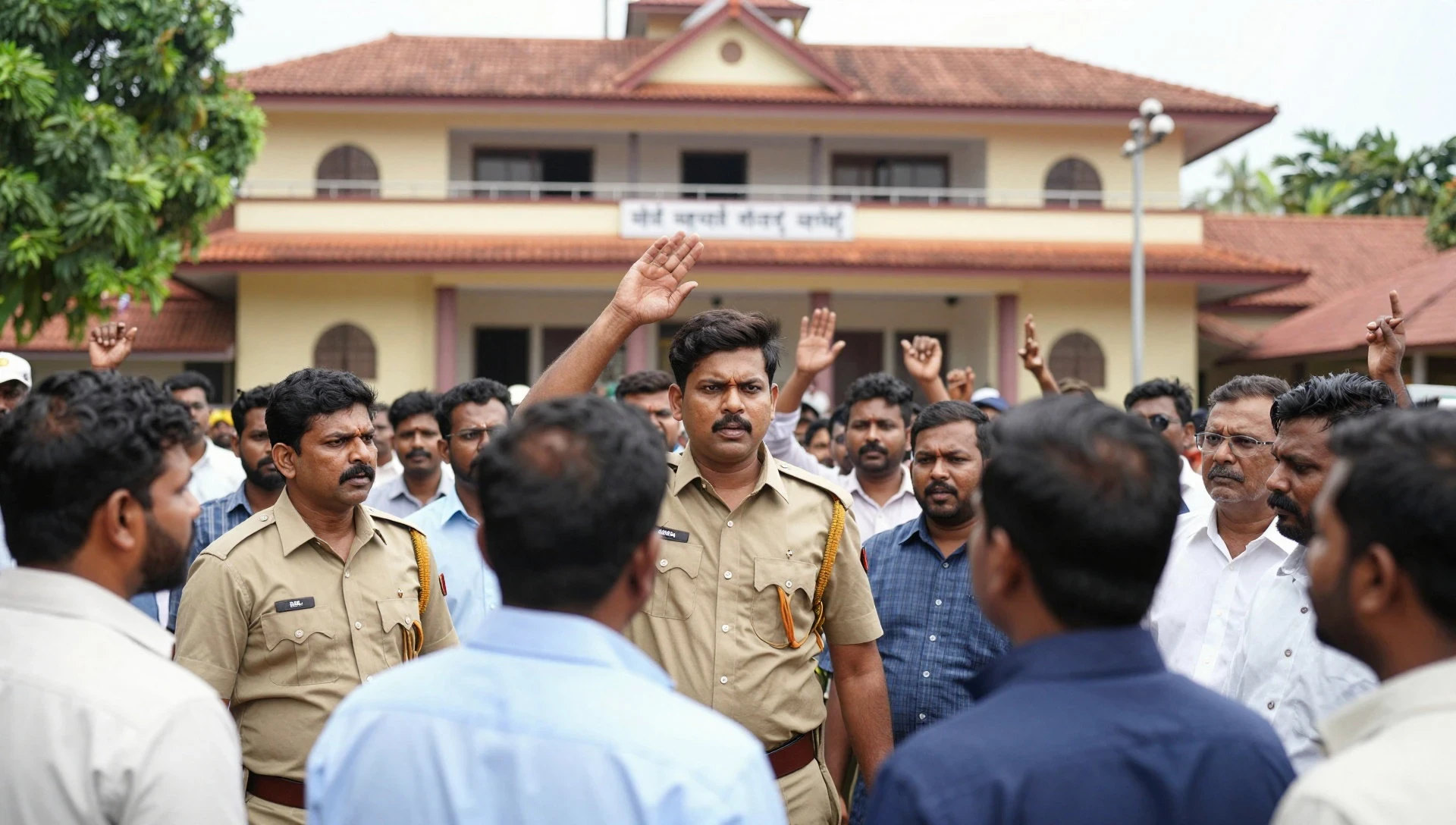
On the night of July 11, a group of more than twenty people walked into the Adoor police station in Kerala's Pathanamthitta district and assaulted a suspect held in custody.
Mobile footage of the episode, circulating widely since, shows uniformed officers standing by without intervening while the group moved through the station between roughly 10:15 pm and midnight. The visuals transformed a local custodial incident into a statewide political confrontation within days.
The suspect, Rajan Joseph, had been brought in on a defamation case. Among those seen confronting him inside the lock-up was Sreenadevi Kunjamma, an elected member of the Pathanamthitta district panchayat who had recently moved from the CPI to the Congress ahead of local body elections.
On This Page
- The Adoor Incident: What the Footage Establishes and What It Leaves Open
- Political Patronage, Police Neutrality and the Kerala Precedent
- Reading the Adoor Case Against Broader Patterns of Custodial and Political Conflict
- Comparative Context Within Indian Federalism
- What the Case Reveals About Electoral Accountability
- Procedural Reforms the Episode Suggests
- Procedural Safeguards for Police Stations: Current Gaps and Proposed Fixes
- Media, Virality and the Shaping of Public Judgment
- What Comes Next for the Adoor Investigation
- Case Trajectory: Key Milestones and Their Significance
- The Wider Lesson for Indian Federal Policing
- Institutional Trust Indicators: Kerala vs. National Benchmarks
- Conclusion: A Local Incident with National Implications
Police subsequently registered a case against twenty people over the assault, in which at least one officer was injured, yet no accused has been arrested or formally identified.
That gap between registration and enforcement is the crux of the dispute. The CPI(M) argues that a police station breached after dark is unheard of in Kerala, and that official inability to identify culprits visible on video signals political bias.
Kunjamma counters that she visited only to complete identification procedure, asked after Joseph's wellbeing, and never threatened him. She further alleges that local CPI(M) leaders have shielded Joseph, whom she accuses of insulting women.
TL;DR A viral video from Adoor police station in Kerala shows Congress-linked figures, including district panchayat member Sreenadevi Kunjamma, confronting a defamation suspect inside the lock-up while police stand by. A case was registered against twenty people, but no arrests or identifications followed, triggering CPI(M) allegations of political favouritism and counter-allegations from Kunjamma about CPI(M) patronage of the suspect. The episode tests the neutrality of Kerala's police force and the accountability of elected representatives in custodial settings.
The Adoor Incident: What the Footage Establishes and What It Leaves Open
The evidentiary core of the Adoor controversy is narrow but consequential. A video places a crowd of more than twenty people inside a functioning police station late at night, records an assault on a person in custody, and captures officers present but passive. Everything beyond those facts — motive, instruction, political direction — remains contested between the parties involved.
The Timeline and the Custodial Context
Joseph was detained in connection with a defamation complaint, a routine category of case that ordinarily proceeds through recording, verification and bail. Instead, the station became the scene of an extra-legal confrontation within hours of his arrival.
The timing matters: the group entered after 10:15 pm, an hour when station staffing is thin and supervisory oversight is weakest.
Kunjamma's stated purpose was identification procedure, a legitimate step in many complaints. Yet identification is normally conducted under documented conditions, not in a lock-up crowded with supporters. The distinction between a lawful identification visit and a collective confrontation is precisely what the footage and the FIR will have to settle.
At least one police officer was injured during the episode, according to official accounts. Injury to personnel shifts the matter from a public-order nuisance to an assault on duty staff, raising questions about why the station's own security protocols failed so completely on the night.
The Political Backdrop in Pathanamthitta
Kunjamma's recent defection from the CPI to the Congress before local body elections frames the entire dispute. In Kerala's bipolar electoral landscape, such switches carry immediate local consequences, and rival parties read every subsequent action through that lens. Her presence at the station was therefore never going to be interpreted neutrally.
The CPI(M), which controls the state government and thus the police administration, has the most to gain from framing the incident as Congress-sponsored lawlessness. Congress, meanwhile, benefits from portraying the police as selective in enforcement. Both narratives serve electoral purposes in a district where panchayat-level control is closely fought.
Kunjamma's counter-allegation that CPI(M) leaders in Adoor support Joseph adds a second layer. If local political patronage protected the suspect in the underlying defamation case, the confrontation becomes a symptom of a deeper failure in complaint handling rather than a simple case of mob politics.
Why Police Inaction Became the Central Question
Registering a case against twenty people and then identifying none of them is an unusual combination. Video evidence of an assault inside a police station should, in principle, make identification straightforward. The CPI(M)'s area secretary S.
Manoj made exactly this point, arguing that claims of inability to identify culprits demonstrate bias rather than investigative difficulty.
Kerala's police force has historically maintained a reputation for relative professionalism compared with several other Indian states. Incidents that puncture that reputation therefore attract disproportionate scrutiny. A station breached at night, with officers standing aside, undermines the institution's core claim to a monopoly on lawful force within its own premises.
We Also Published
Political Patronage, Police Neutrality and the Kerala Precedent
Kerala's political culture has long treated police stations as contested terrain between ruling and opposition parties. The Adoor episode fits a recognisable pattern in which local cadre from any party test institutional boundaries during periods of electoral flux. What distinguishes this case is the availability of video evidence that removes ambiguity about what occurred physically.
The Defection Variable and Local Body Elections
Kunjamma's move from the CPI to the Congress before local body polls is not incidental background; it is the political engine of the dispute. Defections in Kerala routinely trigger accusations that the receiving party rewards defectors with protection, and that the losing party weaponises state machinery in response.
Her status as an elected district panchayat member raises the stakes further. Elected representatives enjoy no legal immunity for participation in an assault, but their standing complicates police action, particularly when the ruling party must weigh enforcement against local political fallout in a closely balanced district.
The CPI(M)'s swift condemnation, delivered through its area secretary rather than a generic party spokesperson, indicates that the party views Adoor as a seat-level battle rather than a state-level scandal. That framing suggests the dispute will be fought through local organisational channels as much as through formal investigation.
Institutional Consequences for Kerala Police
For the police, the reputational cost lies less in the assault itself than in the apparent passivity of officers present. A force that cannot secure its own station invites questions about its capacity to protect witnesses, complainants and suspects in ordinary cases across the state.
Comparative experience across Indian states suggests that custodial incidents become politically durable when enforcement against identifiable accused stalls. The longer the Adoor case remains without arrests, the more the CPI(M)'s bias allegation will harden into accepted local narrative, regardless of the eventual investigation's findings.
Kerala's high literacy and dense media environment amplify such effects. Viral footage circulates through WhatsApp groups and regional television within hours, and public memory of the visuals will likely outlast any formal closure of the case by police or courts.
Accountability Mechanisms and Their Limits
Formal remedies exist: an FIR against twenty people, potential disciplinary review of officers present, and oversight by the State Police Complaints Authority. Each mechanism, however, depends on the political will of the same administration that the opposition accuses of partiality, creating a structural credibility problem.
Judicial intervention remains the most plausible route to independent scrutiny. Kerala's High Court has previously entertained petitions on custodial excesses, and a monitored investigation would at least establish a public record of who entered the station and what instructions, if any, officers received.
For the Congress, the risk is symmetrical. If the investigation establishes that its local leaders organised the confrontation, the party forfeits the moral advantage it currently claims. Both formations therefore have incentives to let the evidentiary record develop slowly.
Reading the Adoor Case Against Broader Patterns of Custodial and Political Conflict
Adoor is a small municipality, but the incident maps onto national debates about the boundary between political mobilisation and institutional capture. When elected representatives enter police stations to confront suspects, the separation between electoral mandate and law enforcement collapses in a way that no procedural reform easily repairs.
Comparative Context Within Indian Federalism
Kerala is not alone in facing such episodes, but its governance model makes them unusually salient. The state invests heavily in public services and literacy, and its electorate expects institutional competence. Incidents that suggest otherwise therefore generate sharper political returns than in states where public expectations of policing are already low.
Across India, custodial confrontations involving party workers tend to follow a predictable arc: viral footage, FIR, stalled identification, competing allegations, and eventual judicial monitoring. The Adoor case has already traversed the first four stages within weeks, suggesting the fifth may be the decisive one.
Federal comparisons also reveal that state police forces respond to political pressure in structurally similar ways regardless of ruling party ideology. The CPI(M)'s accusation of bias against its own government's police is therefore less paradoxical than it appears; it reflects intra-state competition rather than any principled critique of policing.
What the Case Reveals About Electoral Accountability
Kunjamma's dual role as accused-adjacent elected representative and public complainant illustrates a broader accountability gap. Elected officials can simultaneously claim procedural legitimacy and political grievance, leaving voters to adjudicate between narratives that are mutually exclusive but equally plausible on the available evidence.
The absence of arrests after more than three months, given the timestamp of the source report, is itself a data point. In comparable cases where video evidence exists, Kerala police have typically identified and arrested accused within weeks. The delay here invites scrutiny of local command decisions rather than of investigative capacity.
For voters in Pathanamthitta, the eventual resolution will matter less than the perception of who protected whom. Local body elections reward visible defence of community interests, and both parties will present their conduct in the Adoor episode as exactly that.
Procedural Reforms the Episode Suggests
Several modest reforms follow logically from the facts. Mandatory CCTV coverage of lock-up areas with tamper-proof retention would remove ambiguity about who entered and what occurred. A requirement that identification procedures be documented and conducted in designated areas rather than lock-ups would reduce confrontation risk.
Stricter rules on visitor access after specified hours, with supervisory sign-off, would address the staffing vulnerability the incident exposed. None of these measures requires new legislation; they fall within existing police manual discretion and could be implemented through departmental circulars.
Finally, prompt identification of accused visible on official footage should be treated as a minimum benchmark of institutional good faith. Where such identification stalls, an automatic referral to an independent oversight body would preserve public confidence without prejudging guilt.
Media, Virality and the Shaping of Public Judgment
The Adoor video's circulation illustrates how digital evidence now sets the tempo of political controversy. Within hours of upload, footage that might once have remained a local complaint became a statewide story with named protagonists and competing timelines. Traditional gatekeeping has effectively disappeared from this process.
Virality, however, does not guarantee accuracy. Clips are typically partial, context is stripped, and captions supplied by partisan accounts frame interpretation before viewers form independent judgments. The Adoor footage is no exception; its evidentiary value depends on authentication that only formal investigation can provide.
For media organisations, the challenge is to report the documented core without amplifying unverified claims from either side. The Hindu's account, which separates the video's contents from the parties' statements, models the appropriate approach. Much of the social media commentary has not maintained that discipline.
What Comes Next for the Adoor Investigation
Three developments will determine the case's trajectory. First, whether police move from case registration to arrest and identification. Second, whether the High Court entertains a petition for monitored investigation. Third, whether either party escalates the dispute through further public confrontations in Pathanamthitta.
Each development carries electoral consequences in a district where margins are narrow. The CPI(M)'s willingness to criticise its own government's police suggests confidence that public opinion currently favours its framing. The Congress's response will test whether that confidence is justified.
Beyond electoral calculation, the case poses a straightforward institutional question: can a police station in Kerala be treated as inviolable space, or does it remain permeable to political mobilisation? The answer will shape public trust in law enforcement far beyond Adoor's municipal boundaries.
The Wider Lesson for Indian Federal Policing
Adoor's significance extends beyond Kerala because it tests a proposition common to all Indian states: that police stations remain insulated from electoral competition. Where that insulation fails, the consequences are not merely local scandals but erosion of the baseline trust on which complaint registration depends.
Citizens decide whether to report crimes based on perceptions of police independence. If stations appear permeable to party workers, reporting rates for politically sensitive offences decline, and informal dispute resolution fills the gap. The long-term cost is measurable in under-reported crime statistics.
Kerala's response to the Adoor case will therefore be watched by administrators elsewhere. A prompt, transparent investigation that identifies and prosecutes those visible on the footage would reinforce institutional norms. Prolonged inaction would confirm the opposite, and the precedent would travel.
Conclusion: A Local Incident with National Implications
The Adoor episode compresses several enduring tensions into a single night's footage: elected representatives versus institutional procedure, ruling party versus opposition, and documented fact versus partisan narrative. Its resolution will indicate whether Kerala's reputation for institutional competence survives contact with electoral pressure.
For now, the case rests on a simple test. Twenty people are visible on video entering a police station and assaulting a suspect. Until they are identified and proceeded against, the CPI(M)'s allegation of bias will remain unanswered, and the Congress's claim of lawful conduct will remain unverified.
Both parties have reasons to prefer ambiguity, which is precisely why independent scrutiny matters. The Adoor case is small in scale but large in precedent, and the manner of its closure will be cited in arguments about Indian policing for years.
From our network :
- The Final Descent: How ESA Retired the Legendary Cluster Constellation After 24 Years of Space Weather ScienceAfter 24 years mapping Earth’s magnetosphere, ESA’s Cluster mission concluded with a precisely controlled reentry over the South Pacific. This analysis explores the scientific legacy, engineering decisions, and debris mitigation principles behind one of space exploration’s most responsible retirements.
- Forbidden Matrix Patterns and Visible Lattice Points: A Geometric DictionaryExplore how multidimensional 0–1 matrices encode geometric truths, linking forbidden patterns to visible lattice points and hypergraph theory, with applications in combinatorics and computational geometry.
- Mobile Learning and VR in English: What Global Evidence Reveals About Effective Language TechnologyA systematic review across 14 countries reveals which language-learning technologies genuinely work. Mobile learning, AI, and VR show measurable benefits when pedagogically integrated. This evidence-based guide helps educators and learners select technology that delivers real return on investment.
- The Hidden Cost of AI Convenience: Why Over-Permissioned Agents Are a Security Time BombDiscover why AI agents with excessive permissions create dangerous single points of failure, and learn how implementing least privilege principles can protect your organization from exploitation.
- Committed Mediterranean Precipitation Decline: Why Emissions Cuts Alone Cannot Restore Winter RainsNew NOAA research reveals that Mediterranean winter rains may decline irreversibly even with emissions cuts. Explore the science of committed climate change and regional impacts.
- CISA’s Ten-Advisory Wave: Why Generic Patching Fails in OT and How to Build Product-Specific PlaybooksCISA released ten ICS advisories in one week, exposing critical infrastructure risks. Generic patching fails in OT. Learn to build product-specific remediation playbooks.
- How AI Agents Will Change the Way We Manage Personal FinancesExplore how AI agents are transforming personal finance through automated budgeting, bill payment, and investment management, while examining the critical security protocols and governance frameworks required for safe deployment.
- University Language Proficiency Exams: Why Institutional Tests Demand Different Preparation Than IELTS and TOEFLDiscover why university-specific language proficiency examinations differ fundamentally from IELTS and TOEFL, and learn strategic preparation approaches for institutional assessment success.
- Live Online English Classes for Kids: Do They Actually Reduce Anxiety?A ten-week study reveals that synchronous online English classes can significantly reduce child language anxiety while improving listening and reading skills. Discover what makes these programs effective and how parents can select the right one.
RESOURCES
- Resources will be updated soon.
- 01
- 02
- 03
- 04
- 05
- 06
- 07
- 08
0 Comments