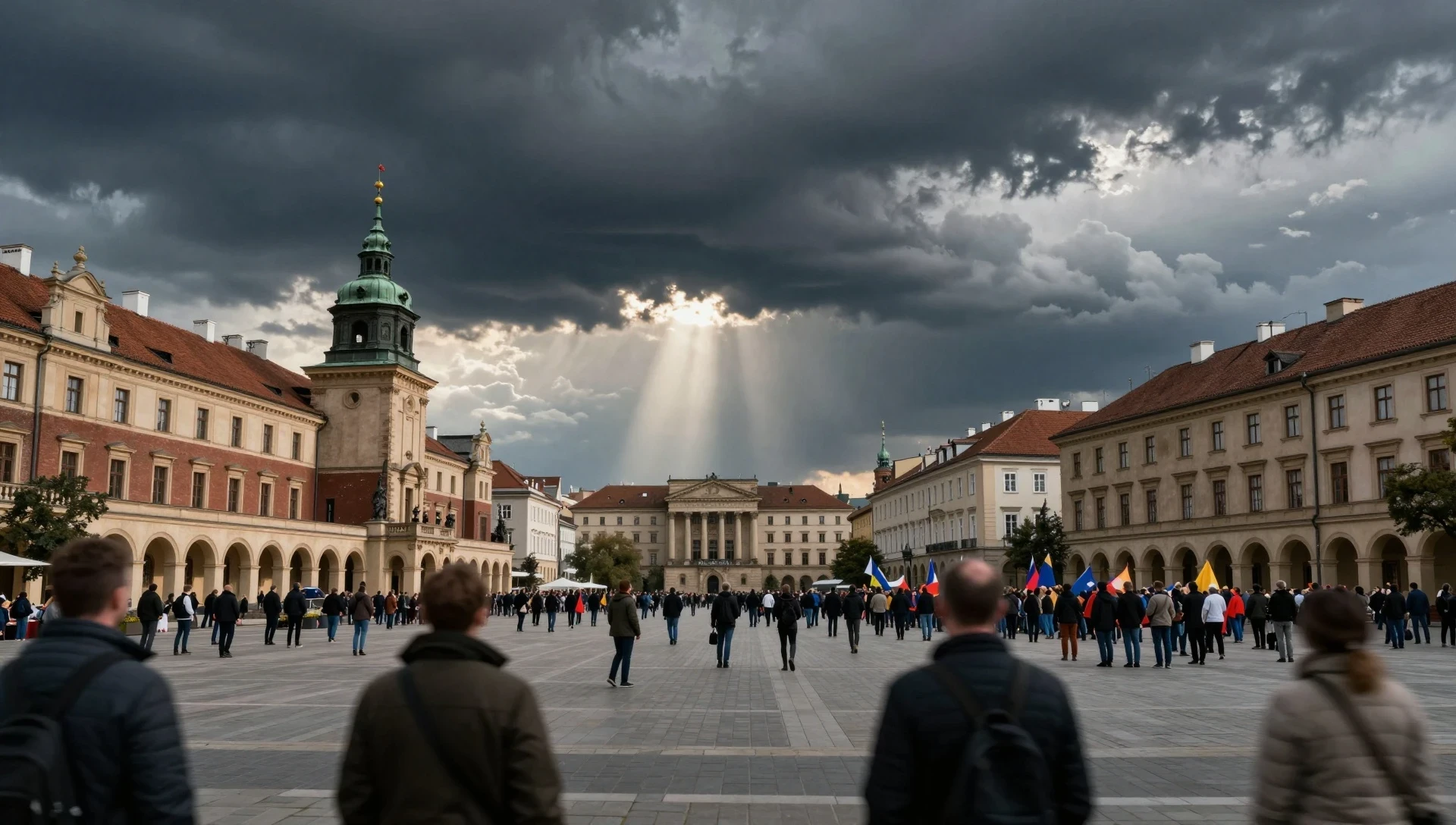
Poland's political crisis has crossed a threshold that analysts have long anticipated but rarely quantified: the transition from institutional deadlock into open conflict. A
report dated 31 October 2026 states the shift plainly, yet supplies almost no operational detail about the events, actors, or consequences involved. That evidentiary gap is itself the story, because it reveals how thin the public record becomes once a dispute leaves the negotiating table and enters the street, the courtroom, and the prosecutor's file. The declaration of open conflict matters less for what it describes than for what it signals about the durability of Poland's post-1989 constitutional settlement.
The reporting is notable for its omissions. It names no officials, no parties, no institutions, and no triggering incident; it offers no background on origins, no statements from political groups, and no assessment of whether government operations or daily life have been affected. Such silence is characteristic of fast-moving breaking coverage, where the headline assertion outruns verification. For readers, the practical implication is that the phrase "open conflict" should be treated as a classification rather than a description, one that requires corroboration from Polish domestic media, wire services, and official communiqués before any causal claim can be sustained.
This analysis treats the report as a data point about escalation framing rather than a narrative of events. It examines what "open conflict" means in comparative political science, why Poland's institutional architecture makes such escalation structurally plausible, and how information vacuums distort market and diplomatic responses. Where figures are cited, they are drawn from established comparative indices and historical baselines rather than from the source item, which contains none. The aim is to convert a sparse headline into a usable analytical framework for readers tracking Central European risk.
TL;DR A Le Monde report of 31 October 2026 asserts that Poland's political crisis has become open conflict, but supplies no actors, triggers, or consequences. Read analytically, the item is a classification event: it marks the point where institutional dispute is reframed as confrontation. Poland's semi-presidential system, fragmented party landscape, and contested judicial apparatus make such escalation structurally plausible, while the absence of verified detail creates an information vacuum that markets and allies must price. The practical takeaway is to treat the headline as a signal requiring corroboration, not as a settled account of events.
On This Page
- Decoding the Escalation: What "Open Conflict" Means in Political Analysis
- Institutional Fault Lines: Why Poland's System Amplifies Confrontation
- Consequences and Information Risk: Reading a Sparse Report Responsibly
- Market and Currency Transmission Channels
- Transmission Channels: Political Conflict to Market Pricing
- Alliance Politics and the European Dimension
- Verification Protocol for Readers and Analysts
- Verification Checklist for Escalation Claims
- Comparative Context: How Other Democracies Have Escalated
- Comparative Escalation Episodes in Democracies
- What Would Confirm or Refute the Escalation Claim
- Scenario Matrix: Confirming or Refuting Escalation
- Conclusion: A Signal Requiring Corroboration
Decoding the Escalation: What "Open Conflict" Means in Political Analysis
The phrase carries specific weight in comparative politics. Scholars typically distinguish routine contestation, institutional deadlock, and open conflict along a spectrum defined by whether actors continue to recognize shared rules of resolution. When a dispute is labeled open conflict, the implication is that at least one party has begun acting outside agreed procedures, whether through street mobilization, refusal to comply with judicial rulings, or prosecutorial action against political opponents. The Le Monde item asserts this threshold has been crossed without identifying which mechanism was used.
Defining the Threshold Between Dispute and Confrontation
Political scientists generally model escalation as a ladder rather than a binary. Routine disagreement involves bargaining within accepted institutions; deadlock arises when those institutions cannot produce outcomes; confrontation begins when actors seek resolution through means the other side deems illegitimate. The critical variable is mutual recognition of procedural legitimacy, which erodes before any single dramatic event occurs.
Comparative research on democratic backsliding, notably the V-Dem and Freedom House datasets, tracks this erosion through measurable indicators: judicial independence scores, media pluralism, and constraints on executive authority. Poland has figured prominently in these indices since 2015, with judicial independence ratings declining sharply before partial recovery in later years. The 2026 report's language suggests a further phase.
What distinguishes open conflict from mere polarization is the presence of coercive instruments. Court packing, disciplinary chambers for judges, and the use of state prosecutors against political figures all represent moves that convert legal procedure into political weaponry.
Once such instruments are deployed by both sides, the dispute acquires a retaliatory logic that is difficult to reverse.
The source's silence on specifics means analysts cannot determine which rung of the ladder has been reached. That indeterminacy is analytically consequential: a confrontation confined to parliamentary procedure carries different risk than one involving mass protests, security services, or prosecutions. The headline alone cannot distinguish between these scenarios.
Why the Source's Silence Is Analytically Significant
News reports that assert escalation without naming actors create a specific epistemic problem. Readers cannot distinguish between a genuine rupture and a rhetorical escalation by one faction. The absence of official statements is especially telling, since governments in crisis typically issue competing narratives within hours of a major development.
Le Monde's international desk generally maintains high verification standards, which suggests the underlying events were either fast-moving or subject to reporting restrictions. Either scenario implies that the Polish government's communication apparatus was not functioning normally at the moment of publication, itself a meaningful indicator of institutional stress.
For analysts, the correct response is to treat the item as a trigger for monitoring rather than a conclusion. Subsequent coverage from Polish outlets such as Gazeta Wyborcza, the PAP wire service, and international correspondents would normally fill the gaps within days. The absence of such corroboration in the source itself is a timing artifact, not evidence of fabrication.
Comparative cases illustrate the pattern. During the 2017 Polish judicial crisis, initial international reports similarly emphasized confrontation before detailed accounts of specific legislative maneuvers emerged. The lag between headline and verified detail averaged several days, during which market and diplomatic reactions were driven largely by framing rather than fact.
Historical Baselines for Polish Political Instability
Poland's post-1989 record is one of relative institutional stability punctuated by sharp episodes. The 2015 constitutional tribunal dispute, the 2017 judicial reforms, and the 2020 presidential election controversy each represented serious stress tests. None, however, was typically characterized in international media as open conflict, making the 2026 framing a departure.
Historical comparison suggests that Polish crises tend to resolve through electoral rather than extra-parliamentary mechanisms. The 2023 parliamentary election, which produced a change of governing coalition, demonstrated that voters could serve as the ultimate arbiter.
A shift toward open conflict would imply that this channel is perceived as insufficient by at least one major actor.
Regional context matters. Poland's size, NATO membership, and role as a logistics hub for support to Ukraine give its internal stability outsized significance. Instability in Warsaw reverberates through European security planning and supply chains in ways that comparable crises in smaller states would not.
The baseline expectation, therefore, is that any genuine escalation would attract immediate high-level attention from Brussels and Washington. The source's failure to mention international responses may indicate that none had yet materialized, or simply that the report was filed before reactions developed.
We Also Published
Institutional Fault Lines: Why Poland's System Amplifies Confrontation
Poland operates a semi-presidential system in which the president, prime minister, and parliament derive authority from separate electoral mandates. When these mandates point in different directions, the constitution provides few automatic tie-breakers. The resulting friction is structural rather than personal, and it explains why Polish disputes so often migrate from the legislature to the constitutional tribunal and then to the streets.
The Semi-Presidential Design and Competing Mandates
The president's veto power and role in appointments creates a second center of legitimacy that can rival the government. Where the presidency and the parliamentary majority belong to opposing camps, as has occurred repeatedly since 2015, routine governance becomes a negotiation over constitutional interpretation. Each side can claim a democratic mandate.
This design is not unique to Poland; France and Romania share elements of it. But Poland's version combines a strong presidency with a fragmented party system, producing coalition governments that are themselves unstable. The interaction of these two features raises the frequency of constitutional standoffs relative to either feature alone.
Electoral arithmetic compounds the problem. Poland's proportional representation with a 5 percent threshold for parties and 8 percent for coalitions encourages fragmentation, while the d'Hondt method allocates seats in a way that can amplify the largest bloc's advantage. The result is a parliament where majorities are constructed rather than given.
When majorities are fragile, every defection becomes a constitutional event. Governments must manage not only opposition parties but also coalition partners with distinct veto points. The 2026 report's reference to open conflict may reflect the collapse of such a coalition arrangement, though the source does not say so.
The Judicial Question as Persistent Flashpoint
No issue has generated more sustained conflict than the organization of the judiciary. Reforms introduced after 2015 altered the composition of the Constitutional Tribunal and created disciplinary mechanisms for judges. Subsequent governments have contested these changes, producing a layered dispute in which different courts recognize different legal realities.
The European Court of Justice and the European Court of Human Rights have both ruled on aspects of the Polish judicial reforms, adding an external dimension. Infringement proceedings and financial penalties tied to rule-of-law conditionality transformed a domestic argument into a question of EU membership obligations. This externalization raises the stakes of any internal confrontation.
When courts disagree about which courts are legitimate, the ordinary function of adjudication breaks down. Citizens and businesses face uncertainty about which rulings will be enforced. This condition, sometimes described as legal pluralism under stress, is precisely the environment in which open conflict becomes self-sustaining rather than episodic.
The source's failure to mention the judiciary is notable given its centrality to prior Polish crises. Either the 2026 escalation occurred on a different axis, or the report's brevity simply omitted the most likely context. Analysts should treat the judicial question as the default hypothesis until evidence points elsewhere.
Party Fragmentation and Coalition Arithmetic
Poland's party system has consolidated around two large blocs while retaining significant internal diversity. The 2023 election produced a coalition spanning parties with distinct economic and social agendas, held together primarily by opposition to the previous government. Such negative coalitions are inherently unstable once the shared adversary is removed from power.
Coalition management in Poland requires distributing ministerial posts, managing legislative calendars, and maintaining discipline across parties that compete for the same voters. Each of these tasks creates opportunities for defection.
When defections occur, governments may resort to governing by decree or by relying on opposition votes, both of which undermine the coalition's coherence.
The arithmetic of the Sejm, with 460 seats and a majority threshold of 231, leaves little margin for error. A coalition holding 248 seats, for example, can lose seventeen members before losing its majority. Small parties and independents therefore wield disproportionate influence, and their demands can become constitutional flashpoints.
If the 2026 conflict involves coalition collapse, the sequence would likely follow a recognizable pattern: a contested appointment, a failed vote, a resort to procedural improvisation, and finally a public rupture. The source's language is consistent with such a sequence, though it does not confirm it.
Consequences and Information Risk: Reading a Sparse Report Responsibly
A headline asserting open conflict in a NATO member state carries immediate practical implications, from currency and bond pricing to the scheduling of diplomatic visits and the movement of supply chains. Yet the source provides no basis for calibrating these effects. The responsible analytical response is to separate what is asserted from what is implied, and to identify the specific indicators that would confirm or refute the escalation claim.
Market and Currency Transmission Channels
The Polish zloty has historically functioned as a high-beta proxy for Central European risk sentiment. During the 2022 energy crisis and the 2023 election campaign, EUR/PLN moved in response to political uncertainty, with implied volatility rising around key votes. A genuine open-conflict scenario would likely produce sharper moves than these precedents.
Sovereign bond spreads provide a second channel. Polish ten-year yields relative to German bunds have widened during past political stress, though the European Central Bank's presence and EU cohesion funds have moderated the effect. The magnitude of any widening would depend on whether investors perceive the conflict as transient or structural.
Equity markets transmit through bank stocks, which dominate the WIG20 index. Political conflict that touches the judiciary or regulatory agencies can affect lending confidence and asset quality assessments. Foreign direct investment decisions, which operate on longer horizons, respond to perceived institutional durability rather than to individual headlines.
The critical unknown is whether the 2026 conflict affects fiscal policy or monetary independence. A dispute confined to symbolic appointments would have limited market impact; one that threatens the central bank's autonomy or the budget process would be materially different. The source does not allow this distinction.
Alliance Politics and the European Dimension
Poland's strategic importance to NATO and the EU means that internal conflict is never purely domestic. The country hosts significant alliance infrastructure and serves as a principal transit route for military and humanitarian support to Ukraine. Political paralysis in Warsaw therefore affects planning assumptions in Brussels and Washington.
EU institutions have developed instruments for responding to rule-of-law concerns, including conditionality on cohesion funds and the Article 7 procedure. These tools are slow-moving but consequential. A shift to open conflict would likely accelerate their use, though the source does not indicate whether any such steps have been taken.
Regional cooperation through the Visegrád format and the Bucharest Nine has already been strained by differing responses to the war in Ukraine. Polish instability would further complicate the construction of common positions on defense spending, energy security, and enlargement. The effects would be felt most acutely in Central European coordination.
Alliance dynamics also cut the other way. External partners may prefer to avoid public commentary during an unresolved internal crisis, which could explain the absence of international reactions in the source. Silence from allies is not necessarily indifference; it may reflect diplomatic caution pending verification.
Verification Protocol for Readers and Analysts
Given the source's limitations, a disciplined verification protocol is warranted. The first step is to check Polish-language reporting from established outlets and the PAP wire service, which would normally carry official statements and parliamentary records. The second is to monitor official government and presidential websites for communiqués.
The third step is to consult international correspondents and think tanks with permanent Warsaw presence, whose assessments typically appear within forty-eight hours. The fourth is to track market data, since currency and bond movements provide a real-time, if noisy, signal of how informed participants interpret events.
Finally, analysts should distinguish between procedural and substantive escalation. A procedural rupture, such as a refused appointment or a contested ruling, may be resolved through negotiation. A substantive rupture, involving security services or mass mobilization, carries different implications and requires different responses.
This protocol does not resolve the uncertainty created by the source. It does, however, convert an unverifiable headline into a structured monitoring plan, which is the most useful contribution analysis can make when primary reporting is thin.
Comparative Context: How Other Democracies Have Escalated
Open conflict is not unique to Poland. The United States experienced a comparable rupture around the 2021 certification of electoral results, when institutional norms were tested by extra-procedural pressure. Israel's 2023 judicial overhaul debate produced mass mobilization and unprecedented reserve-duty refusals. Each case offers reference points for interpreting sparse reports.
In both examples, the initial international coverage emphasized confrontation before detailed accounts of specific mechanisms emerged. The pattern suggests that escalation reporting follows a predictable arc: assertion, contestation, verification, and finally institutional response or resolution. Poland's 2026 report appears to sit at the first stage of this arc.
Comparative analysis also cautions against overreaction. Democracies frequently pass through periods of intense conflict without regime change. The relevant question is whether the conflict is bounded by shared acceptance of eventual arbitration, whether through elections, courts, or referendums. Unbounded conflict is the rarer and more dangerous condition.
Poland's history provides grounds for measured confidence. The country has navigated regime transition, EU accession, and repeated constitutional disputes without abandoning democratic procedures. A 2026 escalation would test that record, but the record itself suggests institutional resilience that headline framing may obscure.
What Would Confirm or Refute the Escalation Claim
Confirmation would come from specific, attributable events: a court ruling defied by a government body, a mass mobilization sustained over multiple days, or a prosecutor's action against a senior official. Each would represent a concrete departure from procedural politics and would be reported by multiple independent outlets.
Refutation would come from evidence that the "open conflict" framing reflects rhetorical escalation rather than behavioral change. If officials continue to comply with rulings, if budgets pass, and if coalition partners remain in government, the label would appear overstated. The absence of such evidence in the source leaves both possibilities open.
Intermediate scenarios are also plausible. A conflict may be open in one domain, such as judicial appointments, while remaining procedural in others, such as fiscal policy. Such partial escalation is common and often manageable, though it can metastasize if left unaddressed.
The most useful analytical posture is therefore probabilistic rather than declarative. Assigning rough likelihoods to each scenario, and updating them as verified information arrives, produces better judgments than either accepting or dismissing the headline outright.
Conclusion: A Signal Requiring Corroboration
The Le Monde report functions as a signal rather than an account. It tells readers that a reputable outlet judged Poland's crisis to have crossed into open conflict, but it does not supply the evidentiary basis for that judgment. Analysts should register the signal while withholding conclusions until corroboration arrives.
Poland's institutional architecture, judicial controversies, and coalition arithmetic all make escalation plausible. The country's record of resolving crises through elections and external pressure makes sustained rupture less likely. The balance of these factors, not the headline alone, should drive assessment.
For markets, the practical response is to monitor the transmission channels identified above and to distinguish headline-driven volatility from fundamental repricing. For policymakers, the priority is to establish facts before committing to responses that may themselves become part of the conflict.
The broader lesson concerns information quality in fast-moving political events. Sparse reports are common, and their sparseness is informative. Reading them responsibly means extracting the signal, mapping the uncertainty, and specifying what evidence would change the analysis.
From our network :
- Committed Mediterranean Precipitation Decline: Why Emissions Cuts Alone Cannot Restore Winter RainsNew NOAA research reveals that Mediterranean winter rains may decline irreversibly even with emissions cuts. Explore the science of committed climate change and regional impacts.
- How AI Agents Will Change the Way We Manage Personal FinancesExplore how AI agents are transforming personal finance through automated budgeting, bill payment, and investment management, while examining the critical security protocols and governance frameworks required for safe deployment.
- Live Online English Classes for Kids: Do They Actually Reduce Anxiety?A ten-week study reveals that synchronous online English classes can significantly reduce child language anxiety while improving listening and reading skills. Discover what makes these programs effective and how parents can select the right one.
- University Language Proficiency Exams: Why Institutional Tests Demand Different Preparation Than IELTS and TOEFLDiscover why university-specific language proficiency examinations differ fundamentally from IELTS and TOEFL, and learn strategic preparation approaches for institutional assessment success.
- The Hidden Cost of AI Convenience: Why Over-Permissioned Agents Are a Security Time BombDiscover why AI agents with excessive permissions create dangerous single points of failure, and learn how implementing least privilege principles can protect your organization from exploitation.
- The Final Descent: How ESA Retired the Legendary Cluster Constellation After 24 Years of Space Weather ScienceAfter 24 years mapping Earth’s magnetosphere, ESA’s Cluster mission concluded with a precisely controlled reentry over the South Pacific. This analysis explores the scientific legacy, engineering decisions, and debris mitigation principles behind one of space exploration’s most responsible retirements.
- Mobile Learning and VR in English: What Global Evidence Reveals About Effective Language TechnologyA systematic review across 14 countries reveals which language-learning technologies genuinely work. Mobile learning, AI, and VR show measurable benefits when pedagogically integrated. This evidence-based guide helps educators and learners select technology that delivers real return on investment.
- Forbidden Matrix Patterns and Visible Lattice Points: A Geometric DictionaryExplore how multidimensional 0–1 matrices encode geometric truths, linking forbidden patterns to visible lattice points and hypergraph theory, with applications in combinatorics and computational geometry.
- CISA’s Ten-Advisory Wave: Why Generic Patching Fails in OT and How to Build Product-Specific PlaybooksCISA released ten ICS advisories in one week, exposing critical infrastructure risks. Generic patching fails in OT. Learn to build product-specific remediation playbooks.
RESOURCES
- Political crisis turns into open conflict in Poland - Le Mondelemonde.fr2 days ago ... President Karol Nawrocki's refusal to swear in judges elected by parliament, triggered a dramatic showdown in front of the country's ...
- ACLEDacleddata.comACLED is an independent, impartial conflict monitor providing realtime data and analysis for all violent conflict and protests in all countries and ...
- Poland's Solidarity Movement (1980-1989) - Nonviolent-conflict.orgnonviolent-conflict.orgSummary of the political history ... It agreed to re-legalization of the trade union movement and open negotiations on a possible political transition.
- Health Care Organization in Poland in Light of the Refugee Crisis ...pmc.ncbi.nlm.nih.govFeb 21, 2023 ... Background: Poland is witnessing a migration crisis caused by the ongoing military conflict in Ukraine. In addition to housing and ...
- Russian Threats to NATO's Eastern Flank: Scenarios, Strategy, and ...belfercenter.orgFeb 5, 2026 ... ... political resolve necessary to address these shortfalls and support a defense effort in any future crisis or conflict. Following…
- Discourses of leadership in the 2015–2023 Poland: From conflict ...journals.sagepub.com... analysis of selected speeches of PiS politicians from the 2019 Polish ... Cap P (2022) The Discourse of Conflict and Crisis: Poland's Political…
- How the grain conflict undermines Ukrainian-Polish relationsips-journal.euMar 1, 2024 ... In addition to the direct demands from what are estimated to be 1.3 million Polish farmers, the internal political situation…
- International Crisis Groupcrisisgroup.orgThe International Crisis Group is an independent, non-profit, non-governmental organisation committed to preventing and resolving deadly conflict.
- The Implications of Poland's Presidential Election - CSIScsis.orgJun 3, 2025 ... Conflict and Humanitarian Crises · Critical Minerals · Cybersecurity ... His election is unlikely to alter the current state of…
- Between domestic politics and ecological crises: (De)legitimization ...tandfonline.comIn Poland, the difference between the outcome of the Rospuda river conflict ... Conflict analysis in the Białowieża Forest, a European biodiversity hotspot.
- Russia's Shadow War Against the West - CSIScsis.orgMar 18, 2025 ... ... political warfare, asymmetric conflict, unconventional warfare, and low-intensity conflict. ... An analysis by the Polish Ministry of ...
- Poland says it shot down Russian drones after airspace violationbbc.comSep 10, 2025 ... "This situation brings us the closest we have been to open conflict since World War Two," he said. This is…
- Between domestic politics and ecological crises: (De)legitimization ...tandfonline.comOct 21, 2019 ... We trace the emergence and evolution of Polish political environmentalism, looking at three levels of the environmental movement's legitimacy: ...
- Warsaw Summit Communiqué | NATO Official textnato.intJul 9, 2016 ... ... political will in peaceful conflict resolution, within the established negotiation frameworks. The continuing crises and instability across ...
- 01
- 02
- 03
- 04
- 05
- 06
- 07
- 08
0 Comments