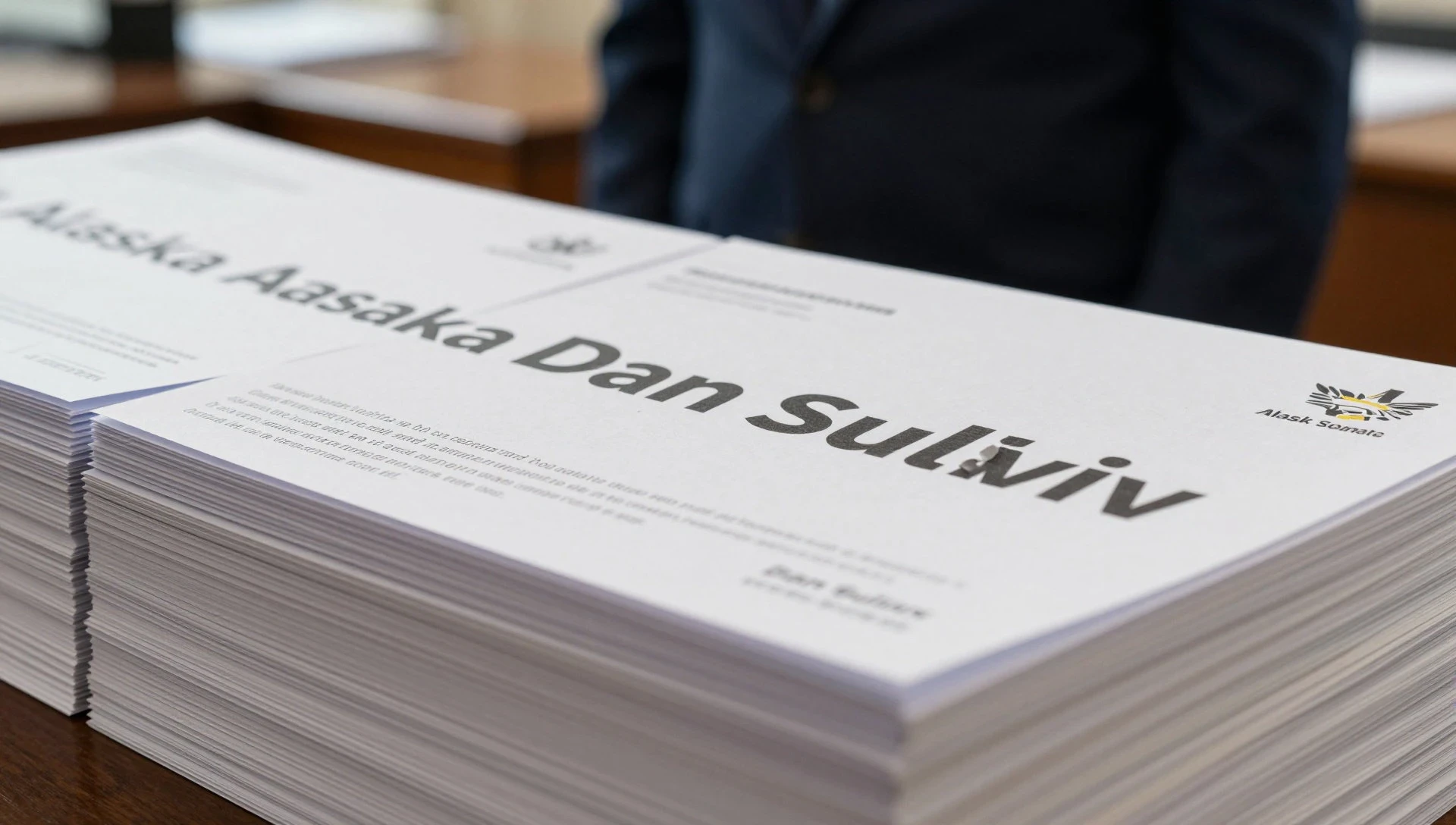
Alaska's 2026 Senate contest has become a case study in how ballot mechanics can overshadow policy debate. Two candidates listed on the same ballot share the name Dan Sullivan: the Republican incumbent and a retired teacher with no prior political experience.
The New York Times reported that aides to Democratic candidate Mary Peltola helped recruit candidates bearing names similar to the incumbent's, a disclosure that triggered a Justice Department inquiry and a public accusation of election fraud from President Donald Trump.
The episode matters beyond Alaska because it tests the legal and ethical boundaries of a tactic known as ballot stacking. That practice involves recruiting or encouraging candidates to enter a race not to win, but to redistribute votes and improve another contender's odds.
On This Page
Peltola has denied knowing about any other candidate on the ballot and rejected claims that she sought to trick voters, while a US attorney alleged Democrats organized support for Daniel J Sullivan as a sham candidate.
This analysis examines the Alaska case, the mechanics of ballot stacking, the evidentiary record from comparable races, and the regulatory gaps that allow name confusion to persist. It draws on the Florida precedent involving Alex Rodriguez, where prosecutors alleged a paid candidate was used to divert votes, and weighs whether such tactics actually change outcomes or merely corrode public confidence in electoral administration.
TL;DR Alaska's Senate race features two candidates named Dan Sullivan, prompting a Justice Department inquiry and allegations of ballot stacking by aides to Democrat Mary Peltola. The tactic, which recruits candidates to confuse voters rather than win, has a documented precedent in Florida's 2020 state Senate race. Evidence suggests name confusion can shift narrow margins, but the legal framework remains fragmented and enforcement is reactive rather than preventive.
The Alaska Ballot and the Mechanics of Name Confusion
Alaska's ballot lists four candidates, and two of them carry the name Dan Sullivan. For voters scanning a crowded ballot, the duplication creates an immediate recognition problem: the incumbent's name advantage, built over years of public exposure, is partially transferred to an unknown contender.
That transfer is the core mechanism of ballot stacking, and it operates without any candidate needing to win a single vote on merit.
How the Recruiting Allegation Emerged
The New York Times report indicated that aides to Mary Peltola helped recruit candidates with names similar to the incumbent's. The disclosure moved the story from local curiosity to federal scrutiny within days.
A Justice Department investigation followed, and President Donald Trump characterized the conduct as election fraud, raising the political temperature around an already competitive race.
Peltola's response was categorical: she stated she knew nothing about any other candidate on the ballot and was not attempting to deceive voters. That denial matters legally, because intent is the dividing line between aggressive campaign tactics and prosecutable interference.
A US attorney, however, alleged that Democrats had organized a plan to support Daniel J Sullivan as a sham candidate, a claim that shifts the inquiry toward coordination and financing.
The Four-Candidate Field and Voter Cognition
With four names on the ballot, the marginal cost of confusion is low and the marginal benefit to a trailing candidate can be decisive. Research on down-ballot voting consistently shows that low-information voters rely on name familiarity as a shortcut.
When two names match, that shortcut fails, and the resulting error is not random but directional, favoring the candidate whose name is duplicated.
Alaska's electoral system adds a layer of complexity. Ranked-choice voting, adopted for federal elections, means second and third preferences can determine the winner. A sham candidate with a familiar name can absorb first-preference votes that would otherwise flow to the incumbent, altering the elimination sequence even if the sham candidate is eliminated early.
Legal Exposure and the Intent Standard
Federal law prohibits false statements about candidates and conspiracies against voting rights, but neither statute maps cleanly onto ballot stacking. Recruiting a candidate with a common name is not itself illegal.
Prosecutors must demonstrate coordination, payment, or a deliberate scheme to deceive, which is why the Florida precedent became the template for subsequent allegations.
The Alaska inquiry will likely turn on communications between Peltola's campaign and the recruited candidate, plus any financial transfers. Absent documentary evidence of a quid pro quo, the case may stall at the threshold of intent. That gap between suspicious conduct and provable violation is the central weakness in current enforcement.
Ballot Stacking as a Strategy: Evidence and Precedents
Ballot stacking is not a novel invention, and its documented history provides the clearest guide to how the Alaska case should be assessed. The tactic appears most often in low-information, down-ballot races where name recognition substitutes for substantive evaluation.
Its effectiveness depends on three variables: the similarity of names, the number of candidates, and the margin separating the leading contenders.
The Florida 2020 Precedent
In Florida's 2020 state Senate race, Republican operative Frank Artiles allegedly recruited a candidate named Alex Rodriguez to run as an independent against Democratic incumbent Jose Javier Rodriguez. Prosecutors said Artiles paid the candidate to confuse voters and divert votes from the Democrat to the Republican challenger, Ileana Garcia. The margin in that race was narrow enough that diversion plausibly mattered.
The Florida case is instructive because it produced a paper trail. Payments, communications, and candidate recruitment records gave investigators the evidence needed to allege a scheme. In Alaska, the question is whether comparable documentation exists linking Peltola's aides to the recruitment of Daniel J Sullivan, or whether the connection rests on inference alone.
Does the Tactic Actually Work?
Empirical work on name confusion suggests modest but real effects, concentrated in races decided by a few percentage points. A duplicated name can shift one to three percent of the vote, which is negligible in a landslide but decisive in a contest decided by less than a point. The Florida outcome, where Garcia prevailed by a razor-thin margin, fits that pattern.
Alaska's ranked-choice system complicates the calculation. A sham candidate may be eliminated in an early round, and their ballots redistributed according to subsequent preferences. If those preferences favor the incumbent, the tactic backfires. This uncertainty means ballot stacking is a high-variance strategy, attractive to trailing campaigns but unreliable as a guaranteed lever.
Enforcement Gaps and Regulatory Fragmentation
State election laws vary widely on candidate filing requirements, and few explicitly address name similarity. Signature thresholds, residency rules, and filing fees create friction but do not prevent a determined operative from placing a confusable name on the ballot. Federal oversight is similarly limited, focusing on fraud rather than tactical manipulation.
The result is a reactive system. Investigations begin after ballots are printed and allegations surface, by which point the electoral harm, if any, is already embedded. Preventive measures such as disclosure of recruitment funding or mandatory name-similarity review exist in a handful of jurisdictions but are not standard practice across the United States.
We Also Published
Implications for Electoral Integrity and the 2026 Midterms
The Alaska controversy arrives during a midterm cycle in which trust in election administration is already strained. Allegations of ballot manipulation, whether substantiated or not, tend to depress confidence among supporters of the candidate who believes they were targeted.
That confidence cost is real even when the underlying tactic fails to change the outcome, and it compounds across cycles.
Political Consequences for Peltola and Sullivan
For Peltola, the allegation creates a defensive posture in a race where she cannot afford to spend weeks litigating process rather than policy. Her categorical denial may satisfy supporters, but the Justice Department inquiry keeps the story alive.
For the incumbent, the controversy reinforces a narrative of victimhood that can mobilize turnout among voters already skeptical of Democratic tactics.
The incumbent's advantage is structural: his name is the one being duplicated, which means any confusion benefits him by default. That asymmetry makes the accusation politically potent regardless of legal merit. It also explains why the Trump administration's characterization of the conduct as fraud carries weight beyond the courtroom.
What Investigators Will Examine
Federal investigators will focus on three evidentiary tracks: communications between Peltola's aides and the recruited candidate, any financial transfers or in-kind support, and the timing of the candidate's filing relative to the campaign's internal deliberations. Each track requires documentary proof rather than inference, and each is subject to legal privilege claims.
The Florida precedent suggests that payment is the decisive factor. In that case, prosecutors alleged Artiles paid the candidate, which converted a political stunt into a criminal matter. If Alaska investigators find no payment and no explicit coordination, the case may conclude with no charges, leaving the conduct legal but politically damaging.
Reform Options and Their Limits
Several reforms could reduce the frequency of ballot stacking. Mandatory disclosure of who recruited and funded a candidate's filing would create a paper trail. Name-similarity review at the filing stage, already used in some jurisdictions, could flag confusable candidates before ballots are printed. Neither measure eliminates the tactic entirely.
The deeper problem is that ballot design and candidate filing rules are state responsibilities, producing a patchwork of standards. Federal legislation could set minimum disclosure requirements, but election administration remains politically contested.
Absent reform, ballot stacking will persist as a low-cost, high-variance tactic in close races where name recognition substitutes for substantive scrutiny.
From our network :
- Committed Mediterranean Precipitation Decline: Why Emissions Cuts Alone Cannot Restore Winter RainsNew NOAA research reveals that Mediterranean winter rains may decline irreversibly even with emissions cuts. Explore the science of committed climate change and regional impacts.
- University Language Proficiency Exams: Why Institutional Tests Demand Different Preparation Than IELTS and TOEFLDiscover why university-specific language proficiency examinations differ fundamentally from IELTS and TOEFL, and learn strategic preparation approaches for institutional assessment success.
- Mobile Learning and VR in English: What Global Evidence Reveals About Effective Language TechnologyA systematic review across 14 countries reveals which language-learning technologies genuinely work. Mobile learning, AI, and VR show measurable benefits when pedagogically integrated. This evidence-based guide helps educators and learners select technology that delivers real return on investment.
- CISA’s Ten-Advisory Wave: Why Generic Patching Fails in OT and How to Build Product-Specific PlaybooksCISA released ten ICS advisories in one week, exposing critical infrastructure risks. Generic patching fails in OT. Learn to build product-specific remediation playbooks.
- How AI Agents Will Change the Way We Manage Personal FinancesExplore how AI agents are transforming personal finance through automated budgeting, bill payment, and investment management, while examining the critical security protocols and governance frameworks required for safe deployment.
- The Final Descent: How ESA Retired the Legendary Cluster Constellation After 24 Years of Space Weather ScienceAfter 24 years mapping Earth’s magnetosphere, ESA’s Cluster mission concluded with a precisely controlled reentry over the South Pacific. This analysis explores the scientific legacy, engineering decisions, and debris mitigation principles behind one of space exploration’s most responsible retirements.
- The Hidden Cost of AI Convenience: Why Over-Permissioned Agents Are a Security Time BombDiscover why AI agents with excessive permissions create dangerous single points of failure, and learn how implementing least privilege principles can protect your organization from exploitation.
- Forbidden Matrix Patterns and Visible Lattice Points: A Geometric DictionaryExplore how multidimensional 0–1 matrices encode geometric truths, linking forbidden patterns to visible lattice points and hypergraph theory, with applications in combinatorics and computational geometry.
- Live Online English Classes for Kids: Do They Actually Reduce Anxiety?A ten-week study reveals that synchronous online English classes can significantly reduce child language anxiety while improving listening and reading skills. Discover what makes these programs effective and how parents can select the right one.
RESOURCES
- Resources will be updated soon.
- 01
- 02
- 03
- 04
- 05
- 06
- 07
- 08
0 Comments