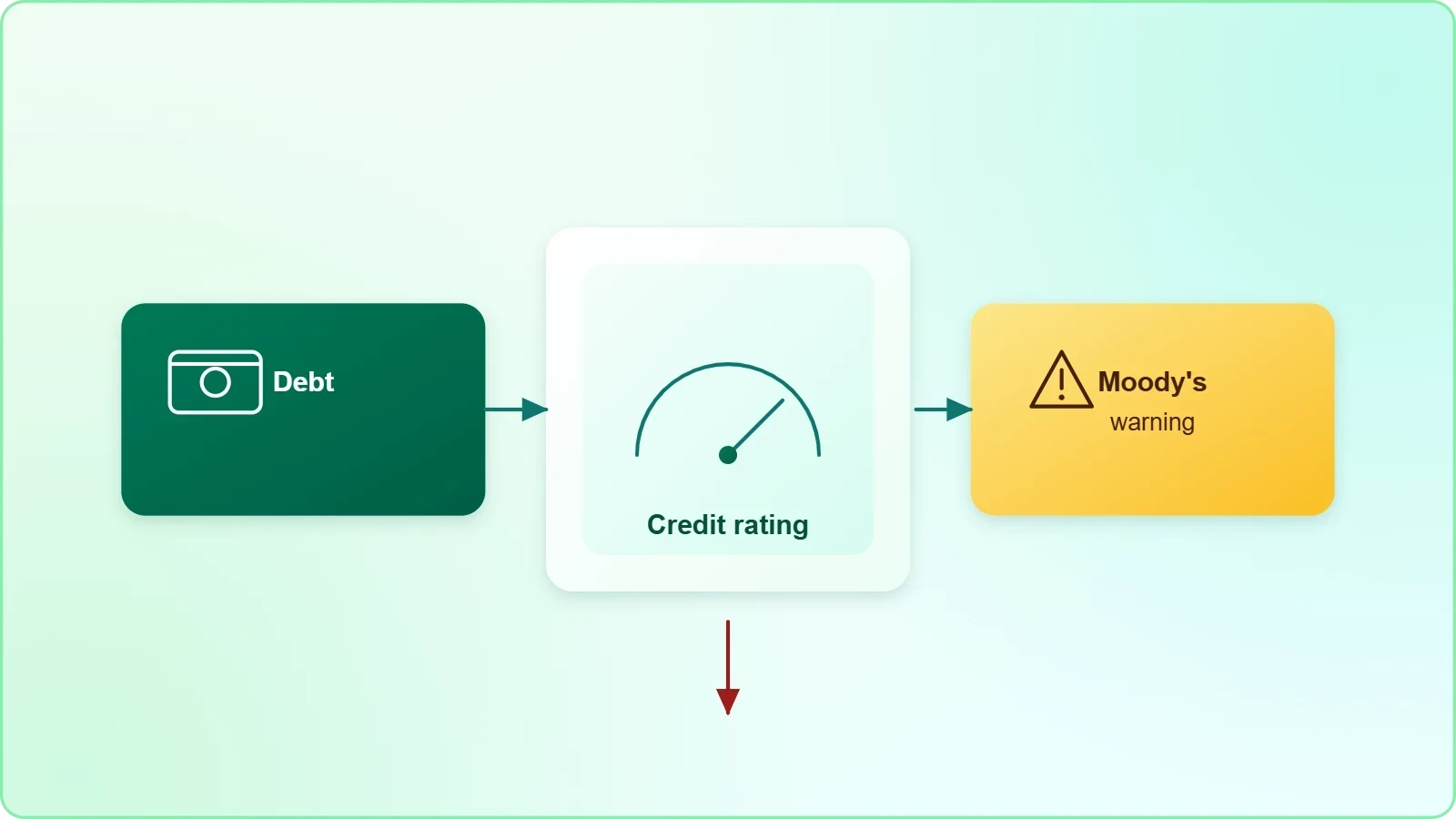
Moody's decision to affirm France's sovereign credit rating while simultaneously issuing a pointed warning about the country's debt trajectory represents one of the most consequential fiscal signals to emerge from the eurozone in recent memory.
The rating agency chose not to downgrade France, preserving the nation's standing in international bond markets for the immediate term, yet the accompanying cautionary language carries weight that extends far beyond a simple reprieve.
Investors, policymakers, and finance ministries across Europe are now parsing what this dual message means for French borrowing costs, eurozone stability, and the broader architecture of European sovereign debt.
On This Page
- The Anatomy of a Rating Warning and What It Signals
- France's Fiscal Position Within the Eurozone Framework
- Market Reactions and Investor Interpretation
- The Government's Response and Fiscal Policy Imperatives
- Implications for European Monetary Policy and Stability
- Reading the Warning Correctly: What Comes Next
The warning arrives at a moment when France is navigating a delicate fiscal landscape marked by elevated public spending, political pressure on budget consolidation, and the persistent challenge of managing debt levels that have climbed steadily over successive administrations.
Moody's withheld detailed commentary in its initial report, leaving markets to interpret the silence as either prudent restraint or an implicit signal that deeper concerns lurk beneath the surface.
The French government has not yet issued an official response, a silence that itself invites scrutiny from analysts who expect clarification on how Paris intends to address the agency's reservations.
What makes this development particularly instructive is its timing and context. European economies carrying high debt burdens have faced intensified scrutiny from rating agencies throughout the current cycle, and France's position as the eurozone's second-largest economy means its fiscal health reverberates across the entire currency union.
The warning from Moody's is not merely a technical notation on a credit report; it is a public statement that France's fiscal path requires correction, and that the patience of international creditors is neither infinite nor unconditional.
TL;DR Moody's has maintained France's sovereign credit rating but attached a formal warning about the nation's escalating debt burden, signaling that future downgrades remain possible if fiscal consolidation stalls. The decision preserves France's current borrowing position while placing Paris under heightened market scrutiny. Investors and eurozone policymakers are now watching French fiscal policy with renewed intensity, because the warning implies that the rating agency sees structural vulnerabilities in France's public finances that cannot be ignored indefinitely. The government's eventual response will determine whether this warning remains a cautionary footnote or becomes the precursor to a costly downgrade.
The Anatomy of a Rating Warning and What It Signals
A credit rating warning from Moody's is a carefully calibrated instrument of financial diplomacy, designed to communicate concern without triggering the market disruption that an actual downgrade would unleash.
When the agency affirms a rating but attaches a warning, it is effectively telling a sovereign borrower that the current assessment rests on assumptions that may not hold. For France, this means the rating remains intact only insofar as fiscal policy evolves in a direction Moody's considers credible and sustainable.
Why Affirmation Without Downgrade Matters
The decision to refrain from downgrading France carries immediate practical benefits. Pension funds, insurance companies, and institutional investors operating under mandate restrictions can continue holding French sovereign debt without forced liquidation.
This continuity protects French borrowing costs from an immediate spike and spares the government the embarrassment of a downgrade during a period of political sensitivity. The affirmation, however conditional, buys Paris time.
Yet the reprieve is inherently fragile. Rating agencies rarely issue warnings without intending to follow through if conditions fail to improve. Moody's has effectively established a benchmark against which future French budgets will be measured, and any deviation from the expected fiscal trajectory could prompt the downgrade that was avoided this time. The warning is therefore less a gesture of confidence than a deferred judgment.
The Mechanics of Sovereign Credit Assessment
Sovereign credit ratings rest on a complex calculus involving debt-to-GDP ratios, deficit trajectories, political stability, and the credibility of fiscal institutions. France's debt burden has expanded considerably, and the political environment has complicated efforts to implement structural reforms.
Moody's assessment reflects these realities, weighing the government's capacity to legislate austerity against the social and political resistance such measures inevitably provoke.
We Also Published
France's Fiscal Position Within the Eurozone Framework
France occupies a singular position within the eurozone: it is too large to fail, yet its fiscal metrics have deteriorated to a point where its creditworthiness can no longer be taken for granted. The warning from Moody's must be understood against this backdrop of systemic importance and structural vulnerability.
France's debt dynamics influence not only its own borrowing costs but also the risk premia demanded of other eurozone sovereigns.
The Contagion Calculus
When a rating agency warns Europe's second-largest economy, the implications ripple outward. Italian, Spanish, and Portuguese bond markets watch French spreads as a barometer of regional risk sentiment. A French downgrade would likely widen spreads across the periphery, raising borrowing costs for governments already burdened by heavy debt loads. Moody's is acutely aware of this contagion dynamic.
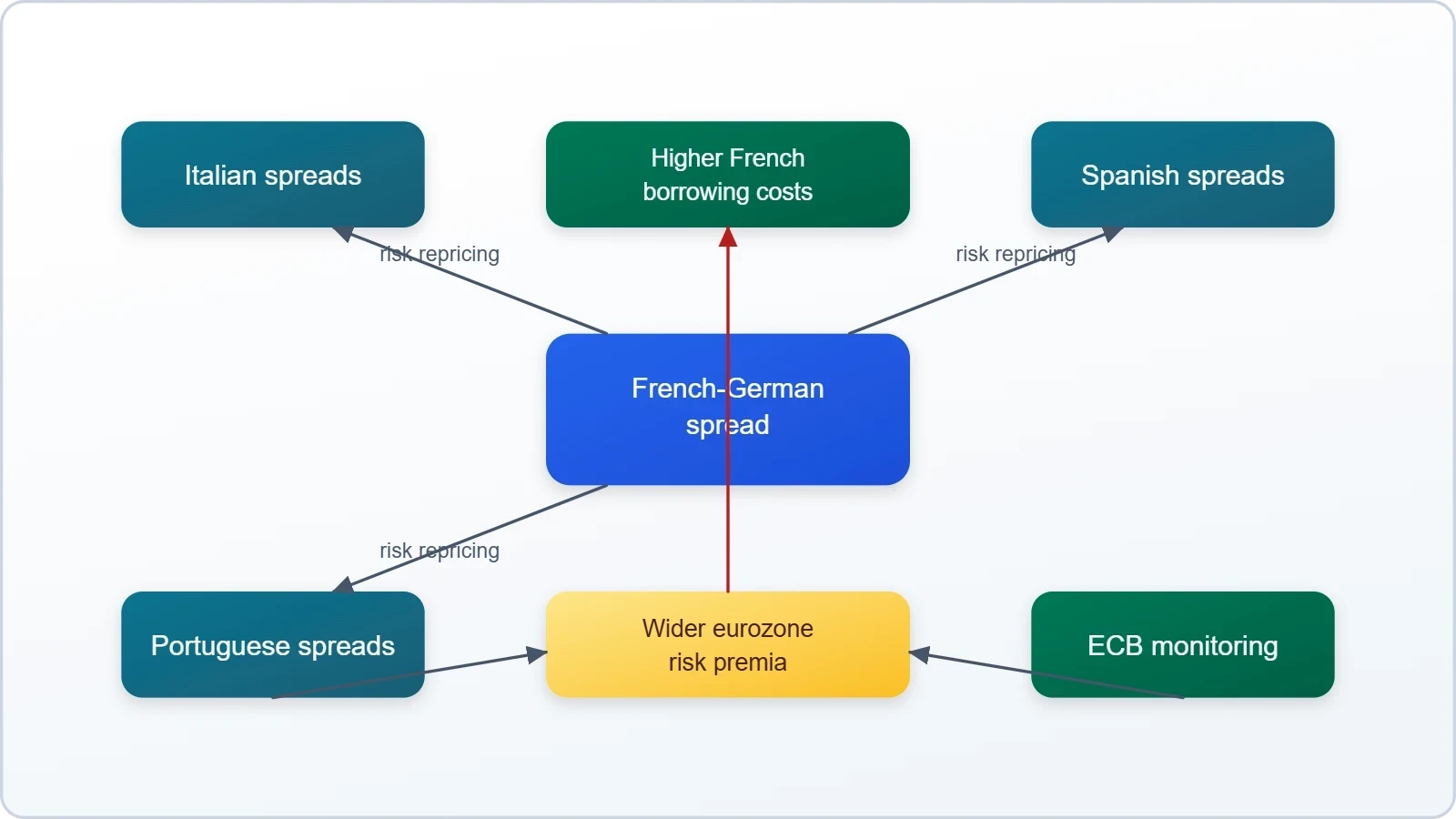
The agency's decision to warn rather than downgrade may partly reflect a desire to avoid triggering precisely this kind of regional destabilization. By affirming the rating while flagging concerns, Moody's threads a needle: it signals vigilance without detonating a market shock.
This calibrated approach reveals how rating agencies operate as quasi-regulators of sovereign confidence, balancing analytical honesty against systemic responsibility.
Political Constraints on Fiscal Consolidation
France's ability to respond to Moody's warning is constrained by domestic politics. Successive governments have struggled to implement spending reforms in the face of entrenched social resistance, and the current political environment offers little indication that austerity measures will proceed smoothly.
The warning from Moody's therefore lands in a context where the tools available to policymakers are politically costly and economically contentious.
Any credible response to the agency's concerns will require France to demonstrate a sustained commitment to deficit reduction, likely through a combination of spending restraint and revenue enhancement. Such measures invariably provoke opposition from unions, public sector workers, and political factions that view austerity as an attack on social protections. The government must therefore navigate between satisfying international creditors and maintaining domestic cohesion.
Market Reactions and Investor Interpretation
Financial markets have learned to read rating agency language with forensic precision, and Moody's warning has already begun to influence how investors price French risk. The absence of an immediate downgrade prevented a sharp selloff, but the warning introduces a risk premium that will persist until the government articulates a credible fiscal response. Bond traders are now watching French spreads against German bunds for signs of stress.
Borrowing Costs and Yield Spreads
France's borrowing costs are determined not only by its absolute credit quality but by its relative position against benchmark sovereigns. The warning from Moody's may widen the spread between French and German debt, increasing the cost of servicing France's substantial debt stock.
Each basis point of additional yield translates into meaningful fiscal expenditure over time, compounding the very debt pressures the warning highlights.
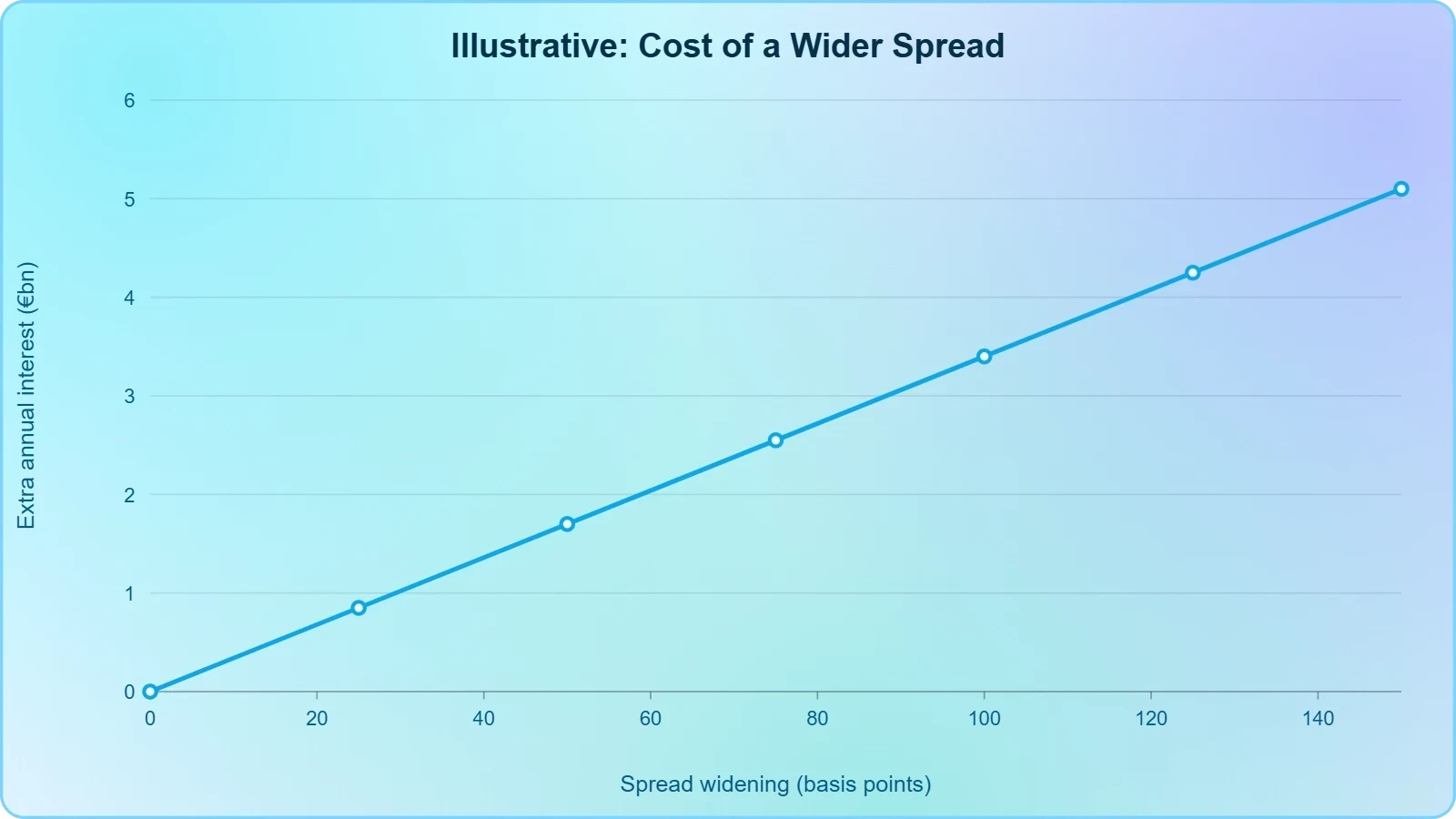
Investors holding French sovereign bonds must now weigh the possibility of a future downgrade against the current yield premium. Some may reduce exposure, while others may demand higher compensation for holding French risk.
This repricing process is gradual but consequential, and it will shape the fiscal arithmetic facing the French treasury in the months ahead.
The Psychology of Rating Signals
Rating warnings exert influence that transcends their formal regulatory function. They shape narratives, influence media coverage, and condition the expectations of market participants. A warning from Moody's becomes a reference point in every subsequent discussion of French fiscal policy, lending weight to arguments for consolidation and undermining complacency about debt sustainability.
This psychological dimension is precisely why rating agencies retain outsized influence despite decades of criticism about their methodologies and conflicts of interest. The warning functions as a coordination device, aligning market expectations around a shared assessment of risk.
Whether or not one accepts Moody's analytical framework, its pronouncements move markets because enough participants believe they do.
The Government's Response and Fiscal Policy Imperatives
The French government's silence following Moody's warning is itself a signal, albeit an ambiguous one. Official reticence may reflect a desire to craft a measured response rather than react impulsively, or it may indicate internal disagreement about how to address the agency's concerns.
Either way, the absence of immediate commentary leaves markets to speculate about the government's fiscal intentions and its capacity to deliver credible consolidation.
Crafting a Credible Fiscal Roadmap
Any response to Moody's must go beyond rhetorical reassurance. Rating agencies evaluate credibility through the lens of legislative action, budget projections, and historical follow-through. France will need to present a fiscal roadmap that demonstrates sustained deficit reduction, ideally backed by structural reforms that address the root causes of spending growth rather than relying on one-off measures or accounting maneuvers.
The government faces a fundamental tension: measures sufficient to satisfy Moody's may be politically unsustainable, while measures that are politically sustainable may fail to satisfy the agency. Resolving this tension requires either a change in the political environment that makes reform feasible or a change in the economic environment that improves fiscal outcomes without painful austerity. Neither prospect is guaranteed.
Lessons from Comparable Sovereigns
Other European economies have navigated similar warnings with varying degrees of success. Some responded with aggressive consolidation programs that restored market confidence and avoided downgrades. Others ignored the warnings, suffered downgrades, and paid higher borrowing costs for years afterward.
France's path will depend on whether its political system can generate the consensus necessary for sustained fiscal discipline.
The historical record suggests that warnings are most effective when they catalyze genuine policy change rather than merely prompting temporary gestures. Countries that treated rating warnings as opportunities for reform emerged stronger; those that treated them as public relations problems to be managed rather than fiscal problems to be solved often found themselves downgraded regardless.
- 01
- 02
- 03
- 04
Implications for European Monetary Policy and Stability
France's fiscal trajectory carries implications that extend well beyond its borders, touching the core mandate of the European Central Bank and the stability of the euro itself. The ECB has repeatedly demonstrated its willingness to intervene in sovereign bond markets when fragmentation threatens monetary transmission, but such interventions are designed to address liquidity crises rather than fundamental solvency concerns. A sustained deterioration in French creditworthiness would test the limits of these mechanisms.
The ECB's Delicate Position
The central bank faces a dilemma: it cannot allow French borrowing costs to spiral in a way that undermines the eurozone's financial stability, yet it cannot be seen as financing fiscal profligacy or circumventing the market discipline that rating agencies impose.
Moody's warning thus places the ECB in an uncomfortable position, forced to monitor French developments while hoping that fiscal policy adjusts before monetary intervention becomes necessary.
This dynamic is not new, but the scale of French debt makes it more consequential than previous episodes involving smaller eurozone economies. France is not Greece; its economy is too large and too interconnected for the eurozone to contemplate a restructuring scenario.
The warning from Moody's is therefore a reminder that even the largest European economies are subject to market discipline.
Long-Term Consequences for Eurozone Architecture
The warning also raises questions about the eurozone's fiscal architecture, which relies on a combination of national fiscal policies and supranational oversight mechanisms. France's difficulties suggest that existing frameworks may be insufficient to ensure fiscal discipline among the largest member states.
Reforms to the Stability and Growth Pact, common debt instruments, and fiscal coordination mechanisms may all be revisited in light of France's experience.
Whether such reforms materialize depends on political will across member states, which remains uncertain. What is clear is that Moody's warning has injected new urgency into debates about eurozone fiscal governance, providing ammunition to those who argue for stronger central oversight and to those who argue for greater national flexibility. The outcome of these debates will shape the eurozone's resilience for years to come.
Reading the Warning Correctly: What Comes Next
The most important lesson from Moody's warning is that credit ratings are not static verdicts but dynamic assessments that evolve with policy choices. France has been granted a window of opportunity, not a permanent reprieve.
The warning will remain in force until the agency is satisfied that fiscal trajectory has changed durably, and that satisfaction will require evidence rather than promises. Markets will watch for concrete legislative action.
Indicators to Monitor
Investors and analysts should track several indicators as they assess France's response to Moody's warning. Budget deficit projections, debt-to-GDP forecasts, parliamentary progress on spending reforms, and the spread between French and German bond yields all provide signals about whether the government is taking the warning seriously. Divergence between rhetoric and action will be punished by markets.
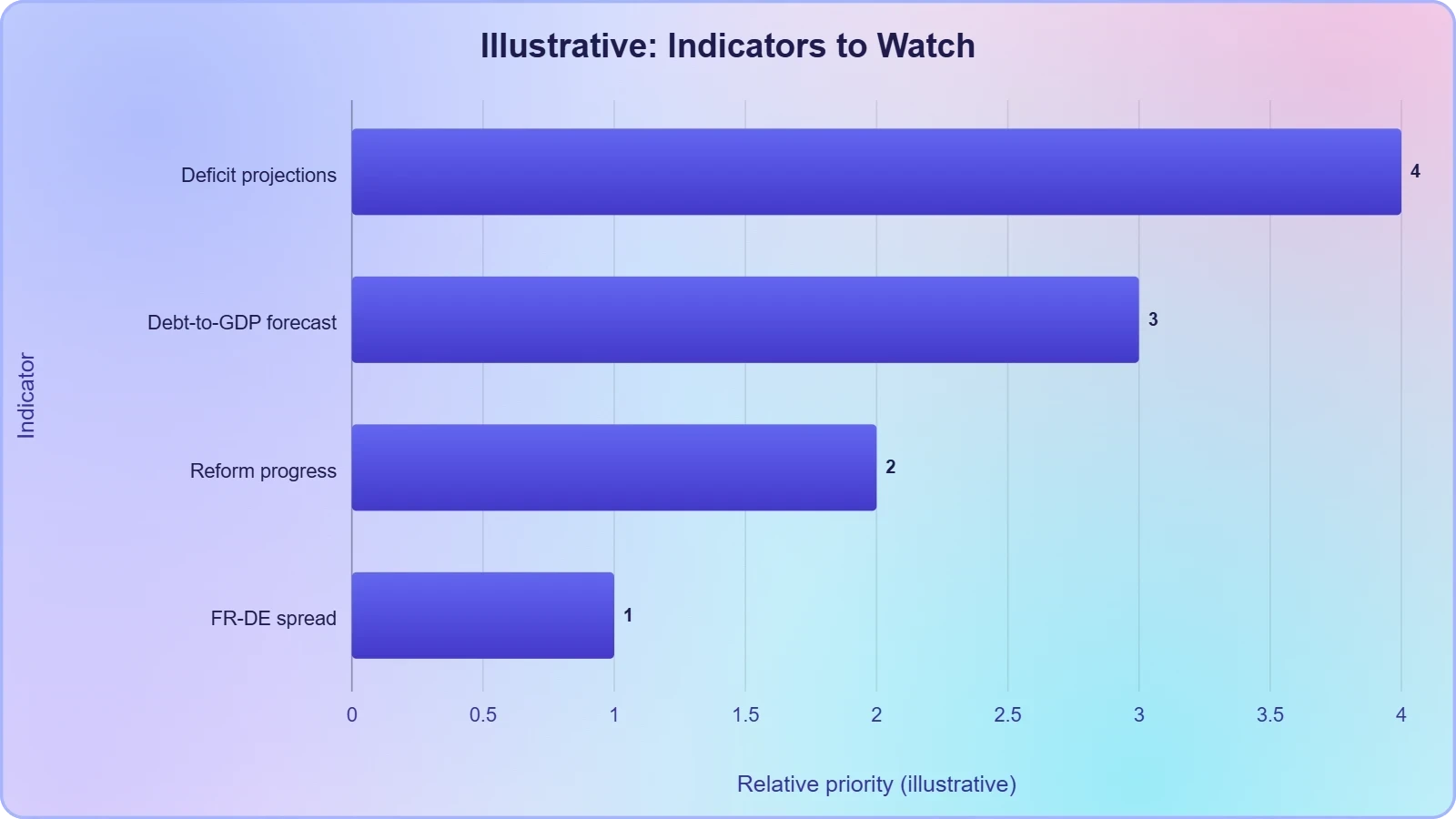
The timing of Moody's next scheduled review will also matter, as it establishes a deadline for demonstrating progress. If the government has not articulated a credible fiscal plan by that point, the risk of an actual downgrade increases substantially. The warning is therefore best understood as a countdown clock rather than a settled matter.
The Broader Fiscal Reckoning
France's situation reflects a broader fiscal reckoning facing many advanced economies that accumulated debt during successive crises and now confront the challenge of normalization. The warning from Moody's is a reminder that the era of cheap money and benign credit assessments is not guaranteed to persist. Governments that fail to adapt will face higher borrowing costs and diminished policy flexibility.
For France specifically, the path forward requires a combination of political courage, fiscal discipline, and strategic communication. The government must convince both markets and citizens that consolidation is necessary and achievable.
Whether it can do so will determine not only France's credit rating but its capacity to shape the future of the European project.
From our network :
- University Language Proficiency Exams: Why Institutional Tests Demand Different Preparation Than IELTS and TOEFLDiscover why university-specific language proficiency examinations differ fundamentally from IELTS and TOEFL, and learn strategic preparation approaches for institutional assessment success.
- Mobile Learning and VR in English: What Global Evidence Reveals About Effective Language TechnologyA systematic review across 14 countries reveals which language-learning technologies genuinely work. Mobile learning, AI, and VR show measurable benefits when pedagogically integrated. This evidence-based guide helps educators and learners select technology that delivers real return on investment.
- Committed Mediterranean Precipitation Decline: Why Emissions Cuts Alone Cannot Restore Winter RainsNew NOAA research reveals that Mediterranean winter rains may decline irreversibly even with emissions cuts. Explore the science of committed climate change and regional impacts.
- The Final Descent: How ESA Retired the Legendary Cluster Constellation After 24 Years of Space Weather ScienceAfter 24 years mapping Earth’s magnetosphere, ESA’s Cluster mission concluded with a precisely controlled reentry over the South Pacific. This analysis explores the scientific legacy, engineering decisions, and debris mitigation principles behind one of space exploration’s most responsible retirements.
- The Hidden Cost of AI Convenience: Why Over-Permissioned Agents Are a Security Time BombDiscover why AI agents with excessive permissions create dangerous single points of failure, and learn how implementing least privilege principles can protect your organization from exploitation.
- Forbidden Matrix Patterns and Visible Lattice Points: A Geometric DictionaryExplore how multidimensional 0–1 matrices encode geometric truths, linking forbidden patterns to visible lattice points and hypergraph theory, with applications in combinatorics and computational geometry.
- How AI Agents Will Change the Way We Manage Personal FinancesExplore how AI agents are transforming personal finance through automated budgeting, bill payment, and investment management, while examining the critical security protocols and governance frameworks required for safe deployment.
- CISA’s Ten-Advisory Wave: Why Generic Patching Fails in OT and How to Build Product-Specific PlaybooksCISA released ten ICS advisories in one week, exposing critical infrastructure risks. Generic patching fails in OT. Learn to build product-specific remediation playbooks.
- Live Online English Classes for Kids: Do They Actually Reduce Anxiety?A ten-week study reveals that synchronous online English classes can significantly reduce child language anxiety while improving listening and reading skills. Discover what makes these programs effective and how parents can select the right one.
RESOURCES
- Moody's Ratings changes France's outlook to negative, affirms Aa3 ...ratings.moodys.comOct 24, 2025 ... ... France's key credit challenges, in particular its wide deficits and high debt burden. ... Moody's Ratings' credit ratings and…
- France Dodges Debt Downgrade, but Is Given a Stern Warningnytimes.com1 day ago ... Moody's held the country's credit rating steady amid political uncertainty and a rise in borrowing costs that have worsened France's…
- France Credit Review & Outlook: When Credit Risk Moves Ahead of ...moodys.comMar 30, 2026 ... Moody's Ratings publishes credit ratings and provides assessment services on a wide range of debt obligations, programs and facilities, and ...
- Moody's keeps France's credit rating but places it on negative outlooklemonde.frOct 25, 2025 ... ... warned about France's 'political fragmentation' much more ... Although France's debt rating has been slipping slowly but surely –…
- Moody's - credit ratings, research, and data for global capital marketsmoodys.comMoody's. research. Oct 20, 2026. Moody's Ratings. French banks face limited immediate risk from sovereign debt woes. Banks' exposure to higher sovereign bond ...
- Moody's has maintained France's Aa3 credit rating with a negative ...facebook.com20 hours ago ... Moody's has maintained France's Aa3 credit rating with a negative outlook, warning that public debt will exceed 120% of GDP…
- France Gets Fresh Warning on Debt as Moody's Turns Negativebloomberg.comOct 25, 2025 ... Moody's Ratings cut France's credit outlook to negative from stable, adding to warnings on the country's bloated public finances as…
- AI debt and French bonds face a stress test — why it may not be overcnbc.com3 days ago ... From AI companies financing data center projects to France's heavily indebted government, credit markets are flashing warnings as investors ...
- Moody's maintains French credit rating but warns of 'negative' outlookfrance24.comOct 25, 2025 ... Credit ratings agency Moody's on Friday maintained France's Aa3 sovereign rating but downgraded its outlook to “negative” from “stable”, warning ...
- S&P accidentally announces downgrade of French debt - BBC Newsbbc.comNov 10, 2011 ... ... bond was 3.456% while the yield on a German 10-year bond was 1.776%. Another ratings agency, Moody's, warned last…
- French finance minister says deficit reduction was top priority before ...reuters.comOct 25, 2024 ... French Finance Minister Antoine Armand on Friday, following a Moody's credit rating warning on his country's debt, said that France's…
- Moody's Downgrade Signals Deeper Risk: Is U.S. Debt Undermining ...csis.orgMay 20, 2025 ... ... debt in light of Moody's downgrading of the U.S. credit rating ... French economist Jacques Rueff warned that this…
- France's political paralysis sparks fresh credit rating warningsreuters.comOct 6, 2025 ... S&P cites budget as the pressing challenge; French debt markets came under renewed pressure. LONDON, Oct 6 (Reuters) - Rating…
- France's latest debt warning describes a country where governance ...finance.yahoo.com17 hours ago ... France avoided a credit downgrade from Moody's, but the ratings agency painted a bleak picture of the eurozone's second-largest economy…
- Credit Rating - France - Trading Economicstradingeconomics.com... debt credit rating for France as reported by major credit rating agencies ... Moody's credit rating for France was last set at Aa3…
- 01
- 02
- 03
- 04
- 05
- 06
- 07
- 08
0 Comments