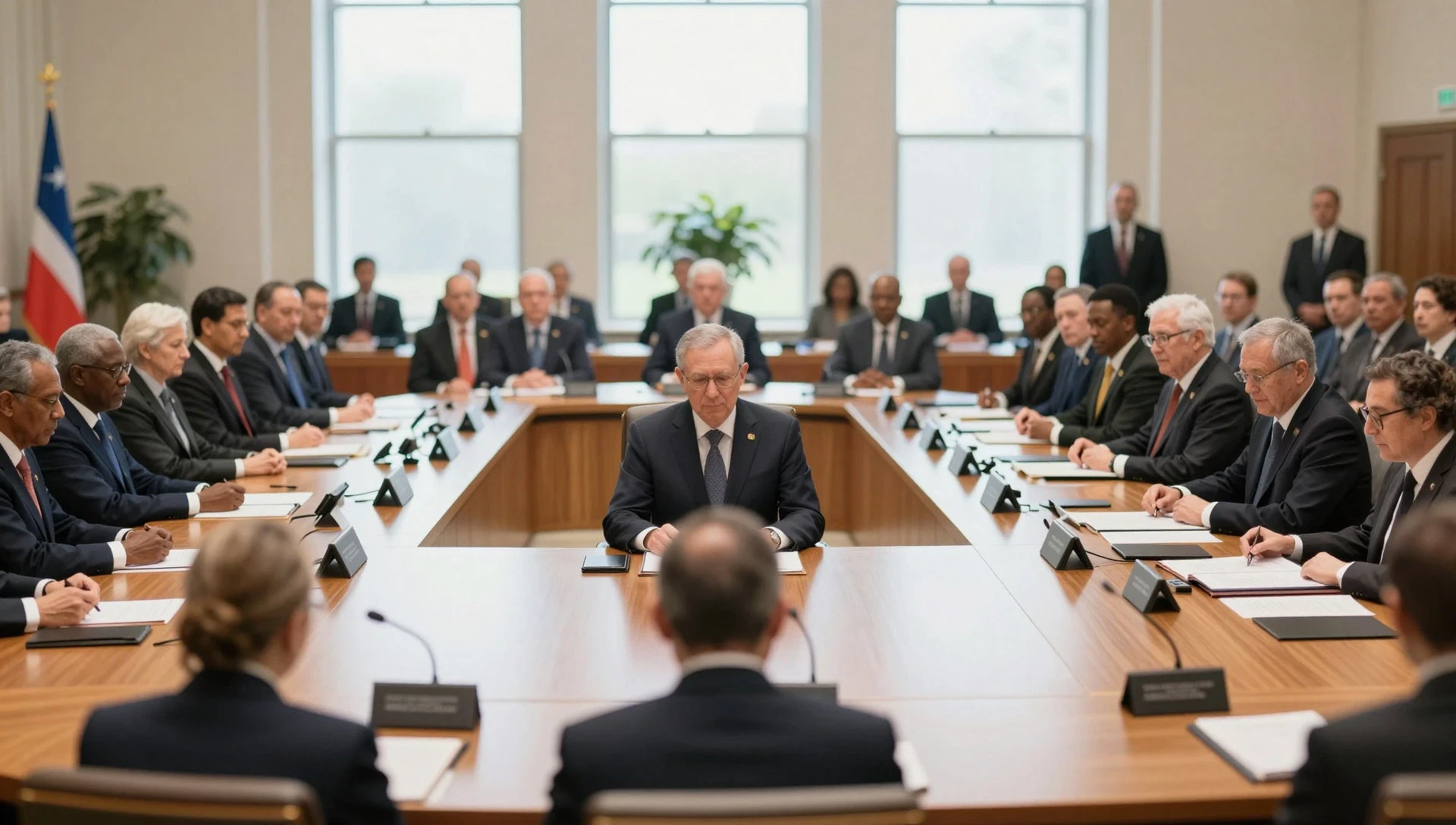
The distinction between symbolic acknowledgement and financial liability has become the central fault line in Britain's reckoning with the transatlantic slave trade. Prime Minister Andy Burnham has signalled openness to a formal state apology while explicitly ruling out reparations, a position that satisfies neither the campaigners demanding material redress nor the fiscal conservatives warning against open-ended obligations.
The intervention arrives days before the Commonwealth Heads of Government Meeting opens in Antigua on 1 November, with King Charles III touring the Caribbean amid renewed calls for contrition.
What makes the episode analytically significant is not the apology itself but the architecture of conditions attached to it. Burnham frames an apology as the entry point to a "structured dialogue" with Commonwealth nations, while insisting that contemporary British taxpayers cannot inherit legal liability for wrongs committed under different laws in a different age.
On This Page
That reasoning draws a sharp line between moral memory and monetary responsibility, and it is precisely the line that reparations advocates such as Bell Ribeiro-Addy reject as incoherent.
The political economy surrounding the debate is equally revealing. Chancellor John Healey defended the apology as "the right thing to do," yet reaffirmed that contrition carries no fiscal consequence, while Conservative leader Kemi Badenoch attacked the gesture as "global welfare" at a moment of domestic spending strain.
Beneath the rhetoric sits an unresolved question of international law and Commonwealth diplomacy: whether acknowledgement without remedy can ever produce the "equal footing" that Caribbean governments have demanded for decades.
TL;DR Prime Minister Andy Burnham has opened the door to a formal UK apology for the transatlantic slave trade but closed it firmly on financial reparations, arguing that modern Britons bear no personal liability for historical wrongs. Campaigners welcome the shift in tone yet note that an apology without remedy falls short of a state apology's full meaning, while opposition politicians warn against "global welfare." The dispute now moves to the Commonwealth summit in Antigua, where King Charles III's tour has amplified calls for acknowledgement and where the gap between symbolism and substance will be tested.
The Anatomy of a Conditional Apology
An apology offered while liability is expressly disclaimed is a diplomatic instrument with a long pedigree, and its internal logic deserves scrutiny. Burnham's formulation separates acknowledgement of historical fact from acceptance of legal or financial consequence, treating the former as a moral duty and the latter as an inherited burden no living citizen consented to. The structure is deliberate: it concedes the past without conceding the ledger.
What the Prime Minister Actually Conceded
Burnham described the transatlantic slave trade as a "brutal and barbaric violation" and accepted that Britain must face up to its past, language considerably stronger than that used by his predecessors.
He also acknowledged that Commonwealth countries have sought an honest conversation for years, and he committed to placing formal apology requests inside a structured dialogue process. These are rhetorical concessions with procedural weight.
The concession stops short of state apology, however, because a formal apology issued by a head of government carries legal and diplomatic implications that a ministerial expression of regret does not. Ribeiro-Addy's observation that an apology "costs nothing" is therefore only partly accurate: it costs no money, but it costs precedent. Once the state apologises formally, the argument over remedy shifts from whether to how much.
Burnham's Guardian essay supplies the doctrinal core of his position. British people today, he wrote, cannot be held liable for historical wrongs committed in a different age under different laws in which they played no personal part.
That is a principle of intergenerational non-liability, and it is the same principle that underpins much of modern tort and treaty law.
The Campaigners' Counter-Argument
Ribeiro-Addy, chairing the All-Party Parliamentary Group for Afrikan Reparations, welcomed the government's acceptance of its role but insisted the statement falls short of a formal state apology. Her sharper claim is conceptual: acknowledgement is not understanding, and without apology there can be no equal footing among Commonwealth nations. The argument treats apology as a precondition for parity, not a substitute for payment.
This framing reframes reparations as a question of relational justice rather than mere compensation. If the harm was structural, the remedy must restructure the relationship, and an apology that explicitly forecloses material remedy arguably entrenches the asymmetry it purports to address.
The APPG's position thus treats the apology as necessary but insufficient, a first instalment rather than a settlement.
The Caribbean dimension gives this abstraction concrete form. King Charles III's tour has included a visit in Guyana to the site of an enslaved people's rebellion against British authorities, and in the Bahamas he spoke of past suffering. These gestures carry symbolic weight, but they also raise expectations that summit diplomacy must now manage.
Timing, the Monarchy and the Summit
The sequencing is not accidental. Burnham's statement lands days before the Commonwealth Heads of Government Meeting opens in Antigua on 1 November, which the King will open as part of his regional tour.
A prime ministerial signal of openness gives Commonwealth leaders something to receive without committing the Treasury to anything, a classic pre-summit positioning move.
Healey's intervention on the BBC reinforced the same calibration, describing the apology as "the right thing to do" particularly ahead of the conference while stressing that contrition implies no financial liability. The Chancellor's phrasing suggests a coordinated communications strategy: moral generosity abroad, fiscal discipline at home, and no daylight between the two.
Badenoch's response on X completed the domestic triangle, arguing that British taxpayers should not be held financially responsible for events generations before their birth and that Labour is already overspending on welfare.
Her "global welfare" formulation converts a foreign policy question into a domestic fiscal one, which is where electoral arithmetic ultimately resides.
Reparations, Liability and the Limits of Inheritance
The reparations question is ultimately a question about what obligations can legitimately pass between generations. Burnham's answer is that moral memory passes but legal liability does not, a position that mirrors how most domestic legal systems treat inherited debt and criminal responsibility.
Critics counter that the wealth generated by slavery did pass down, embedded in institutions, infrastructure and capital stock.
The Intergenerational Liability Problem
If liability cannot be inherited, the argument runs, then neither can benefit be disgorged, and the descendants of enslaved people inherit the disadvantage without the corresponding remedy. This asymmetry is the strongest analytical objection to the non-liability doctrine. It is not a sentimental claim but a structural one about how advantage compounds across centuries.
Burnham's essay anticipates the objection by locating responsibility in the collective rather than the individual. He argues that British people today played no personal part in historical wrongs, which is true of individuals but not obviously true of the state as a continuous legal person. States do inherit treaty obligations, debts and liabilities across regimes.
The counterargument therefore turns on whether the British state is the same legal entity now as it was during the slave trade. Legally, continuity is the default assumption; politically, Burnham treats discontinuity as the operative premise. That gap between legal continuity and political discontinuity is where the entire dispute lives.
What "Structured Dialogue" Might Deliver
A structured dialogue is a procedural commitment rather than a substantive one, and its value depends entirely on what it is empowered to produce. If the dialogue's mandate excludes financial remedy by design, then it functions as a listening exercise with a predetermined conclusion. If the mandate is open, it becomes a genuine negotiating channel.
Commonwealth governments have signalled that they want more than consultation. The demand for an apology has always been coupled, in Caribbean diplomacy, with demands for debt relief, development finance and restitution of cultural artefacts.
A dialogue that addresses only the first element will likely be read as a delaying tactic rather than a good-faith opening.
There is also a diplomatic economy at work. An apology issued before the summit gives the King and Commonwealth leaders a shared achievement to point to, lowering the temperature of the meeting. An apology withheld risks turning Antigua into a forum for public criticism of the host institution's former imperial role.
Domestic Politics and the Fiscal Frame
Badenoch's "global welfare" framing is politically potent because it translates an abstract historical debate into a concrete household budget question. In an environment of strained public finances, any gesture that appears to open a fiscal channel invites the accusation of diverting resources from domestic priorities. The framing is crude but effective.
Healey's careful distinction between apology and liability is designed to neutralise exactly that attack. By insisting that contrition carries no financial consequence, the government hopes to capture the moral high ground while conceding nothing material. Whether voters accept that distinction will determine how sustainable the position proves.
The opposition's calculation is that apology without payment still reads as weakness, while the government's calculation is that apology without payment costs nothing electorally. Both may be right, which is why the issue is likely to persist rather than resolve. Symbolic politics rarely satisfies either side of a material dispute.
We Also Published
The Commonwealth Dimension and the Road to Antigua
The Commonwealth setting transforms a bilateral moral question into a multilateral diplomatic one, and multilateral settings have their own dynamics. Fifty-six member states, many with direct historical ties to the slave trade, will gather in Antigua with a shared interest in extracting something concrete from Britain. The King's presence as ceremonial head of the association complicates the politics further.
Why the Caribbean Summit Matters
Caribbean governments have coordinated their reparatory justice demands through bodies such as CARICOM, which has maintained a ten-point framework covering health, education, culture and debt relief. The summit gives that coordination a stage and gives Britain a reason to manage the agenda. Antigua is therefore both venue and pressure point.
The King's tour has already supplied symbolic material: the Bahamas address on past suffering, the Guyana visit to a rebellion site. These gestures are carefully calibrated to acknowledge without committing, and they establish a tone that the summit can build on. Whether they satisfy Caribbean expectations is a different question entirely.
For Commonwealth leaders, the value of an apology lies partly in its domestic utility. A formal British apology allows governments in the region to demonstrate to their own electorates that the campaign has yielded results. That makes the apology a currency of sorts, tradeable for political capital at home.
The Monarchy's Awkward Position
The King speaks for a monarchy that presided over the empire and the slave trade, yet he cannot commit the British state to a formal apology or to reparations. His role is ceremonial and his statements are constrained by constitutional convention. This creates an expectation gap that the tour must manage carefully.
Royal acknowledgement of suffering can go further than ministerial statements in emotional register while going less far in legal consequence. That asymmetry is useful to the government, which can point to the King's words as evidence of good faith while reserving the formal apology for the political process. The division of labour is convenient.
Republicanism in the Caribbean has gained momentum in recent years, with several states removing the monarch as head of state. An apology that arrives too late or too thin risks accelerating that drift. The summit is therefore an opportunity for the institution as much as for the government.
What to Watch After the Summit
The measurable outcomes to track are narrow: whether a formal apology is issued, whether a dialogue mechanism is established with a defined mandate, and whether any development finance commitments emerge under a different label. Rhetoric will be abundant; instruments will be scarce. The instruments are what matter.
Watch also for the language of the final communiqué. If it records an apology and a dialogue, the government will claim success. If it records demands unmet, Caribbean leaders will escalate. The communiqué is the document that converts speeches into obligations, and its drafting will be contested.
Finally, watch the domestic reaction. If the apology is received as costless, the government's position holds. If it is received as the first instalment of a bill, the political cost will mount. The gap between those two readings is the space in which this debate will continue for years.
Reading the Signal: What the Apology Debate Reveals
Strip away the personalities and the episode reveals a template for how liberal states manage historical guilt in an era of fiscal constraint. The template has three parts: acknowledge the harm, refuse the liability, and institutionalise the conversation.
It is a durable formula because it satisfies the moral demand for recognition while protecting the budget from open-ended claims.
The Recognition-Remedy Gap
The gap between recognition and remedy is not a bug in the system but a feature of it. Recognition is cheap, divisible and reversible; remedy is expensive, indivisible and binding. Governments therefore prefer recognition and describe it as a first step, which it is, while ensuring the second step is never specified.
Ribeiro-Addy's insistence that acknowledgement is not understanding targets precisely this gap. Her claim is that recognition without remedy is a way of managing the demand rather than meeting it. The distinction is analytically sound, and it explains why campaigners treat the apology as a threshold rather than a destination.
For Britain, the calculation is that the gap can be sustained because the costs of not closing it are diffuse. Commonwealth criticism is real but not existential; domestic opinion is divided but not mobilised. The gap persists because no actor has the leverage to force it closed.
Precedent and the Treasury
The Treasury's resistance to reparations is not primarily about the size of any particular payment but about the precedent such a payment would set. Once a state accepts financial liability for historical wrongs, the category of claims expands. The refusal is therefore a boundary defence, not a budget line.
This explains why Burnham's essay emphasises the different age, different laws and no personal part formulation. Each element is designed to sever the chain of liability at a different link. The argument is legalistic because the stakes are legal: an admission of liability is a door that is hard to close.
Healey's formulation that apology does not mean accepting financial liability is the same defence in plainer language. The government is trying to occupy the moral position without occupying the legal one. Whether that is coherent depends on whether apology is understood as moral or legal speech.
What a Durable Settlement Would Require
A durable settlement would need to give both sides something they can defend at home. For Britain, that means no admission of legal liability and no open-ended fiscal commitment. For Caribbean states, it means a formal apology and a mechanism with resources attached, even if those resources are labelled development finance.
The likely landing zone is therefore an apology plus a funded dialogue, with the funding routed through existing development channels rather than reparations. That structure allows Britain to deny liability while allowing Caribbean governments to claim a material outcome. It is a compromise that satisfies nobody fully, which is often the mark of a workable deal.
Whether such a deal emerges from Antigua depends on the drafting of the communiqué and the willingness of both sides to accept ambiguity. The history of the Commonwealth suggests ambiguity is its native language. The question is whether ambiguity is enough to hold the institution together.
Frequently Asked Questions
These questions capture the practical and legal issues readers most often raise when the subject of apology and reparations returns to public debate. Each answer is framed around what is actually known rather than what is hoped for, and each distinguishes between symbolic gestures and binding commitments.
Has Britain Ever Formally Apologised for Slavery?
No British government has issued a formal state apology for the transatlantic slave trade, and none has offered reparations. Individual ministers and monarchs have expressed regret and acknowledged suffering, but these statements fall short of a formal apology carrying state responsibility. Burnham's openness marks a shift in tone, not yet in policy.
What Would Reparations Actually Involve?
Reparations can take many forms: direct financial transfers, debt relief, development finance, restitution of cultural objects, or investment in health and education. Caribbean advocates have generally favoured a package rather than cash payments. The common thread is material remedy, which is precisely what the UK government has ruled out.
Why Does the Commonwealth Matter Here?
The Commonwealth provides a multilateral forum where Caribbean states can coordinate pressure on Britain and where the King's ceremonial role gives symbolic weight to the proceedings. A summit communiqué can convert rhetoric into a recorded commitment, which is why the Antigua meeting is the focal point of the current phase.
Is There a Legal Basis for Reparations Claims?
Legal claims face substantial obstacles, including statutes of limitation, sovereign immunity and the difficulty of establishing standing for descendants. Some scholars argue for state responsibility under international law, but no binding mechanism currently exists. The debate is therefore political and moral as much as legal.
What Happens If Britain Apologises Without Paying?
An apology without remedy would likely be received as a partial victory by campaigners and as a costless gesture by critics. It would lower immediate diplomatic tension while leaving the underlying demand unmet. The likely consequence is continued pressure through Commonwealth channels rather than resolution.
Conclusion: Symbolism, Substance and the Long Reckoning
The apology debate is a study in how states manage historical obligation when the moral case is conceded but the fiscal case is refused. Burnham has moved Britain's rhetorical position further than any recent predecessor while holding the financial line exactly where it has always been. That combination is coherent, defensible and unlikely to satisfy anyone.
What the Antigua summit will reveal is whether the gap between recognition and remedy can be bridged by procedure. A funded dialogue, however labelled, would give both sides something to claim. An apology alone would give campaigners a symbol and critics a target. The drafting of the communiqué will decide which outcome prevails.
The deeper point is that symbolic politics has limits, and those limits are reached when the symbolic gesture is explicitly severed from the material remedy it was meant to precede. An apology that announces its own costlessness invites the question of what it is for. That question will follow British governments for as long as the demand for remedy persists.
From our network :
- How AI Agents Will Change the Way We Manage Personal FinancesExplore how AI agents are transforming personal finance through automated budgeting, bill payment, and investment management, while examining the critical security protocols and governance frameworks required for safe deployment.
- The Final Descent: How ESA Retired the Legendary Cluster Constellation After 24 Years of Space Weather ScienceAfter 24 years mapping Earth’s magnetosphere, ESA’s Cluster mission concluded with a precisely controlled reentry over the South Pacific. This analysis explores the scientific legacy, engineering decisions, and debris mitigation principles behind one of space exploration’s most responsible retirements.
- The Hidden Cost of AI Convenience: Why Over-Permissioned Agents Are a Security Time BombDiscover why AI agents with excessive permissions create dangerous single points of failure, and learn how implementing least privilege principles can protect your organization from exploitation.
- University Language Proficiency Exams: Why Institutional Tests Demand Different Preparation Than IELTS and TOEFLDiscover why university-specific language proficiency examinations differ fundamentally from IELTS and TOEFL, and learn strategic preparation approaches for institutional assessment success.
- Live Online English Classes for Kids: Do They Actually Reduce Anxiety?A ten-week study reveals that synchronous online English classes can significantly reduce child language anxiety while improving listening and reading skills. Discover what makes these programs effective and how parents can select the right one.
- Mobile Learning and VR in English: What Global Evidence Reveals About Effective Language TechnologyA systematic review across 14 countries reveals which language-learning technologies genuinely work. Mobile learning, AI, and VR show measurable benefits when pedagogically integrated. This evidence-based guide helps educators and learners select technology that delivers real return on investment.
- Forbidden Matrix Patterns and Visible Lattice Points: A Geometric DictionaryExplore how multidimensional 0–1 matrices encode geometric truths, linking forbidden patterns to visible lattice points and hypergraph theory, with applications in combinatorics and computational geometry.
- CISA’s Ten-Advisory Wave: Why Generic Patching Fails in OT and How to Build Product-Specific PlaybooksCISA released ten ICS advisories in one week, exposing critical infrastructure risks. Generic patching fails in OT. Learn to build product-specific remediation playbooks.
- Committed Mediterranean Precipitation Decline: Why Emissions Cuts Alone Cannot Restore Winter RainsNew NOAA research reveals that Mediterranean winter rains may decline irreversibly even with emissions cuts. Explore the science of committed climate change and regional impacts.
RESOURCES
- Resources will be updated soon.
- 01
- 02
- 03
- 04
- 05
- 06
- 07
- 08
0 Comments