
Marine Le Pen’s launch of a presidential campaign amid a season of national unrest is far more than a routine political announcement; it is a calculated convergence of ambition, anxiety, and electoral arithmetic.
The veteran leader of the National Rally has chosen a moment of visible public disorder to foreground law and order, betting that a frightened electorate will reward firmness over familiarity.
Her timing is deliberate, because the streets of France are once again becoming the stage on which the country’s political future is negotiated.
On This Page
- The Strategic Logic of a Law-and-Order Launch
- France’s Protest Tradition and the Anatomy of Unrest
- The National Rally’s Long Repositioning
- Electoral Consequences of Civil Unrest
- Leadership, Temperament, and the Test of Credibility
- Europe, Alliances, and the Wider Stakes
- The Road Ahead: Risks, Opportunities, and the Verdict of Voters
The immediate backdrop is a France bracing for another weekend of mass demonstrations, with hundreds of thousands of citizens expected to march. Only a week earlier, similar gatherings degenerated into rioting and looting, leaving scars on city centres and deepening public unease.
That volatility cuts both ways for Le Pen: it validates her central message of restored authority, yet it also threatens to engulf her party in the broader backlash against instability and disorder.
Understanding this campaign requires reading beyond the headlines. It demands attention to the mechanics of French presidential politics, the sociology of protest, and the fragile psychology of a electorate caught between anger and fear.
What follows dissects the strategy, the risks, and the deeper structural forces shaping one of Europe’s most consequential electoral contests.
TL;DR Marine Le Pen has opened her presidential campaign by centring law and order, timed against a fresh wave of nationwide protests and the memory of recent rioting and looting. Her wager is that public anxiety about disorder converts into support for the National Rally, but the same unrest could equally destabilise her message and alienate moderate voters. The contest will hinge on whether she can convert anger into credible governance, and whether France’s streets calm before the ballot box decides.
The Strategic Logic of a Law-and-Order Launch
Le Pen’s decision to open her campaign on law and order is neither improvisation nor coincidence; it is the product of years of incremental repositioning. The National Rally has spent a decade sanding down its roughest edges, seeking respectability while retaining its core appeal to voters who feel abandoned by mainstream parties. Crime, insecurity, and public order have become the party’s most reliable emotional currency.
By anchoring her launch to the unrest, Le Pen frames herself as the candidate of restoration rather than rupture. She presents the state as weak, the streets as lawless, and her movement as the only credible instrument of authority.
This framing allows her to criticise incumbents without defending the record of her own party, a rhetorical advantage that has served her well in past contests.
The Electoral Arithmetic Behind the Message
French presidential elections are won in two rounds, and Le Pen’s path to the Élysée depends on broadening her base beyond the party’s traditional strongholds. Law and order is a wedge issue designed to peel away conservative voters from the mainstream right, particularly those unsettled by urban violence and perceived state impotence. Every riot becomes, in this calculus, a recruitment opportunity.
Yet the arithmetic is delicate. The same voters she courts are often those most alarmed by political extremism, and images of chaos can reinforce doubts about her capacity to govern calmly. Her campaign must therefore project toughness without menace, conviction without chaos, and control without authoritarian overtones that would frighten the centre.
Timing as a Political Instrument
The launch coincides with a weekend of expected mass mobilisation, a synchronisation that maximises media coverage and frames her announcement within the visual language of disorder. Political communication thrives on contrast, and Le Pen is deliberately placing her message of order against a backdrop of protest. The optics are engineered to linger in the public imagination.
This timing also carries risk. If the demonstrations remain peaceful, her warnings may appear exaggerated or opportunistic. If they turn violent, she gains validation but the nation gains trauma, and voters may punish all political actors, including those who appear to profit from crisis. Timing, in short, is a double-edged instrument.
We Also Published
France’s Protest Tradition and the Anatomy of Unrest
France possesses one of Europe’s most robust cultures of street protest, a tradition rooted in revolutionary history and sustained by strong trade unions and civic habits. Demonstrations are not aberrations in this political culture; they are a recognised language of negotiation between citizens and state. Understanding Le Pen’s campaign requires understanding this grammar of dissent.
Recent unrest, however, has shifted in character. What begins as organised marches can fragment into rioting and looting, blurring the line between political expression and criminal disorder. This evolution unsettles the public and complicates the narrative, because citizens may sympathise with grievances while condemning the methods used to express them.
From Grievance to Disorder
The transition from peaceful demonstration to violence is rarely spontaneous; it reflects accumulated frustration, weak local mediation, and opportunistic criminality. When looting occurs, public sympathy often evaporates, and the political centre of gravity shifts toward demands for security. Le Pen’s campaign is calibrated to capture precisely that shift.
Yet the causes of unrest cannot be reduced to criminality alone. Economic strain, perceived injustice, and distrust of institutions feed the underlying anger. A campaign that addresses only the symptoms of disorder while ignoring its sources may win applause but struggle to deliver durable governance if elected.
The Public Mood and the Fear Factor
Public opinion in such moments becomes volatile, oscillating between solidarity with protesters and revulsion at destruction. Le Pen’s message targets the latter sentiment, hoping that fear of chaos outweighs sympathy for grievance. Her success depends on whether voters perceive the unrest as a symptom of state failure rather than social distress.
Fear is a powerful but unstable political fuel. It can mobilise supporters rapidly, yet it can also exhaust them, and it may repel the moderate voters essential to a second-round victory. The campaign must therefore manage fear carefully, stoking concern without appearing to relish disorder.
The National Rally’s Long Repositioning
The National Rally’s modern identity is the product of a deliberate strategy of normalisation, often described as dédiabolisation. Under Marine Le Pen, the party has distanced itself from the overt extremism associated with its earlier era, softening rhetoric and emphasising governance credentials. This transformation is central to understanding her presidential ambitions.
Normalisation, however, is never complete. Critics argue the party’s core remains unchanged beneath a polished surface, while supporters insist the evolution is genuine and substantive. Le Pen must manage this tension carefully, reassuring new voters while retaining the loyalty of activists who joined for more radical reasons.
From Pariah to Contender
Electoral credibility has been hard-won. Successive local and national contests have moved the party from the margins toward the mainstream, and Le Pen’s repeated presidential runs have built recognition and resilience. She is no longer a protest figure alone; she is a fixture of the political landscape, expected to compete seriously.
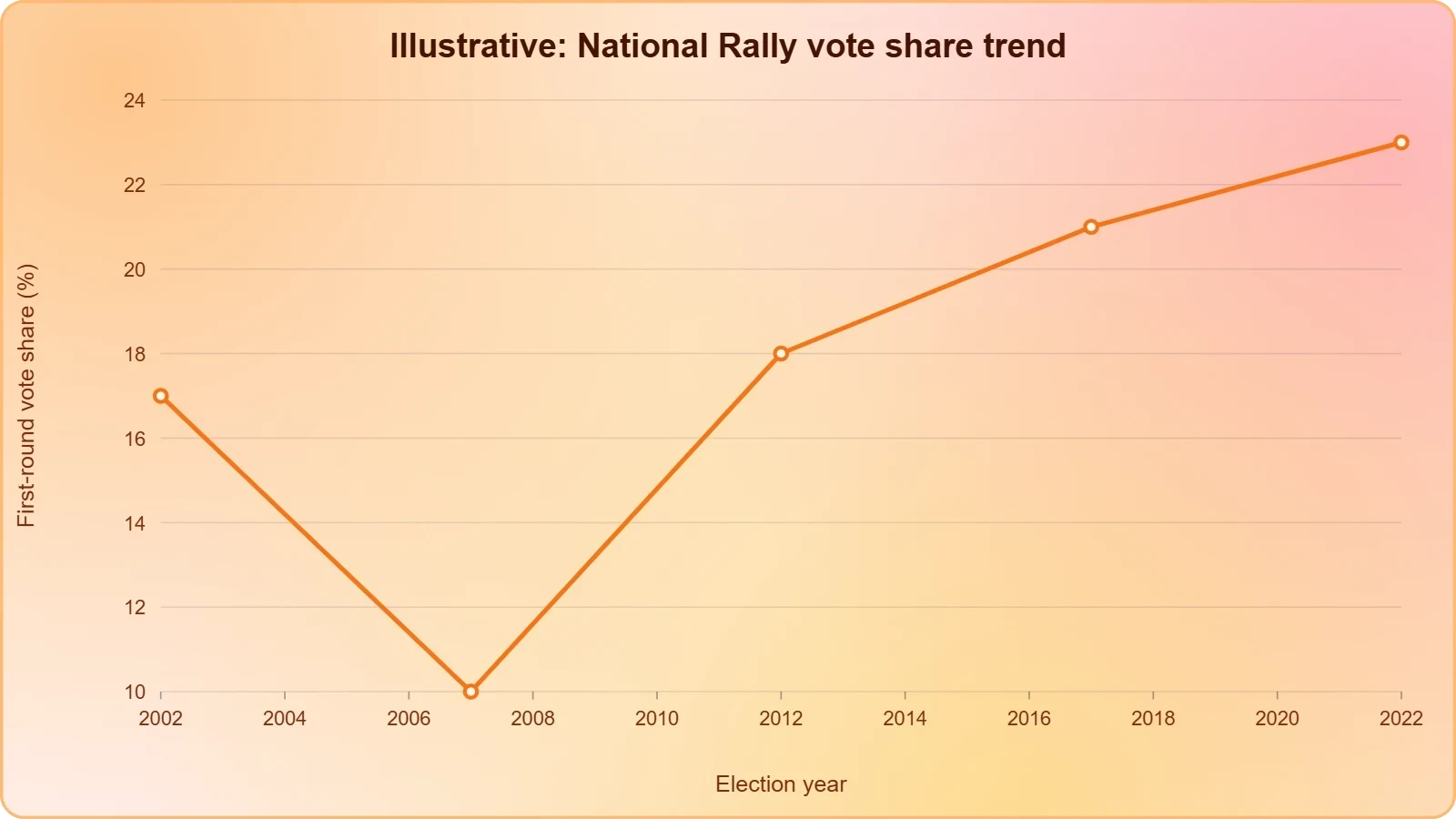
This status brings scrutiny. A contender is judged on competence, temperament, and readiness to govern, not merely on the force of grievance. The law-and-order message must therefore be paired with credible policy detail, because voters evaluating a potential president demand more than slogans and indignation.
The Limits of Normalisation
Certain positions remain obstacles to broader acceptance, particularly on immigration and national identity. Opponents will use these to argue that the party’s transformation is cosmetic. Le Pen’s campaign must decide how much of its traditional platform to foreground and how much to soften for centrist consumption.
This balancing act is the central strategic dilemma of her campaign. Too much moderation alienates the base; too little repels the centre. The unrest provides a useful distraction from these tensions, allowing the campaign to focus attention on order rather than identity, at least for now.
Electoral Consequences of Civil Unrest
Civil unrest rarely produces uniform electoral effects; it reshapes the terrain unevenly, rewarding some actors and punishing others. For Le Pen, the calculation is that disorder benefits parties of order, a pattern observed in several European contexts where security concerns boosted right-wing fortunes. Yet the evidence is mixed and context-dependent.
Voters distinguish between the causes of unrest and its management. If they blame the government for failing to maintain order, opposition candidates gain. If they blame protesters for destroying livelihoods, sympathy for grievances declines. Le Pen’s campaign seeks to steer interpretation toward the former while emphasising the latter’s costs.
Who Gains from Disorder?
Historically, incumbent governments often absorb blame for unrest, creating openings for challengers. But challengers must appear capable of restoring calm, not merely critical of chaos. Le Pen’s task is to convert anger into confidence, persuading voters that her party offers stability rather than further disruption.
Mainstream rivals will counter by portraying her as a risk to public order, arguing that her policies would provoke rather than prevent unrest. This framing contests her core claim directly, and the outcome depends on which narrative voters find more credible when they enter the polling booth.
The Moderate Voter Dilemma
Second-round victories require assembling broad coalitions, and moderate voters are the pivotal bloc. These voters may share concerns about disorder yet remain wary of the National Rally’s broader agenda. Le Pen must reassure them without alienating activists who expect ideological fidelity and rhetorical fire.
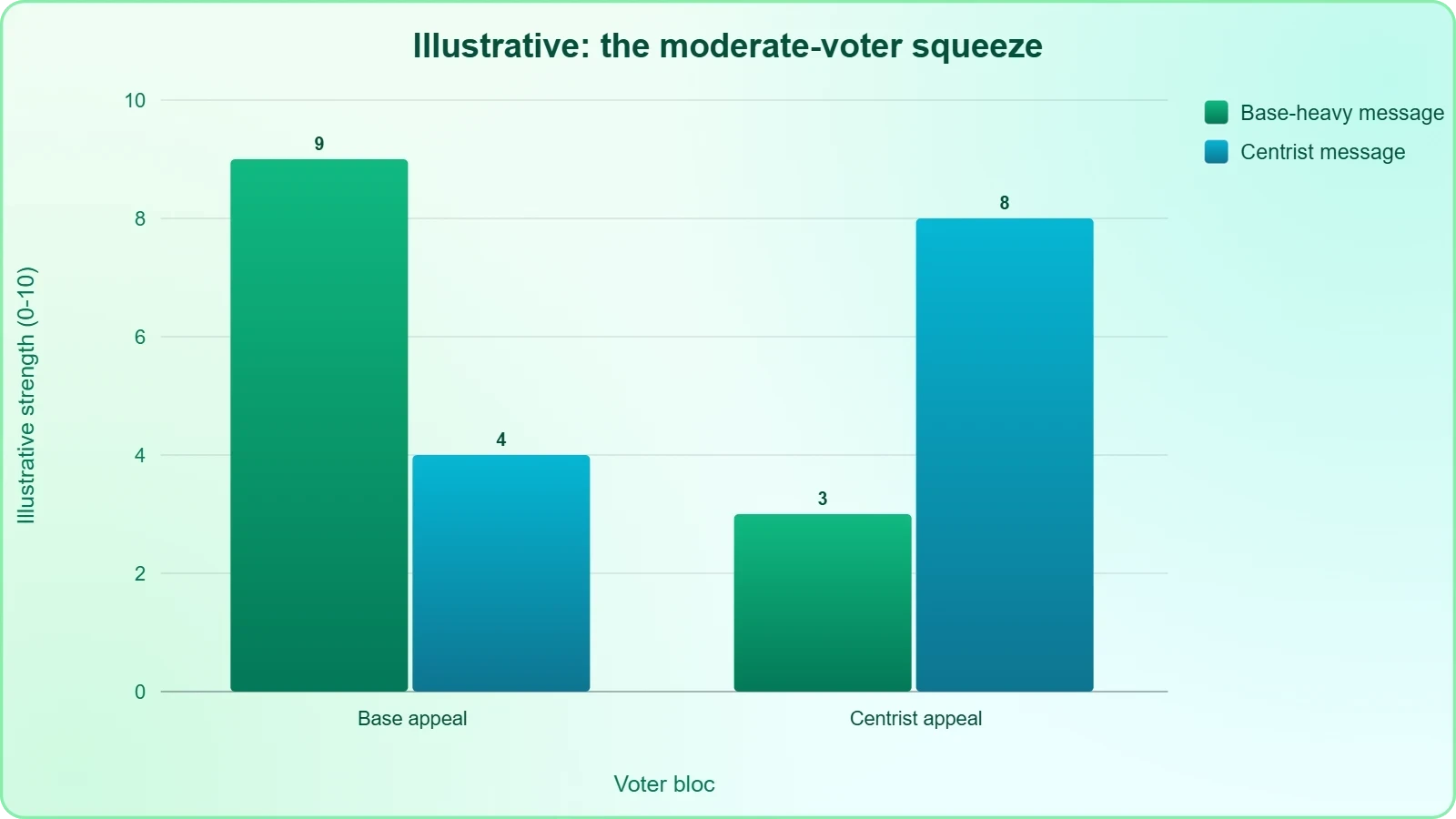
This dilemma is structural, not incidental. Every gesture toward the centre risks a corresponding loss at the base, and every appeal to the base complicates centrist outreach. The unrest intensifies this tension by raising the salience of security while simultaneously raising the stakes of temperament.
- 01
- 02
- 03
- 04
Leadership, Temperament, and the Test of Credibility
Presidential campaigns are ultimately auditions for leadership, and voters assess not only policies but temperament. Le Pen must demonstrate calm authority under pressure, particularly when the streets are volatile and the news cycle is dominated by disorder. Her demeanour will be scrutinised as closely as her programme.
Credibility is built through consistency, competence, and composure. A candidate who appears to relish crisis may unsettle voters, while one who appears overwhelmed may seem weak. Le Pen’s campaign must project steadiness, presenting her as a leader who can restore order without inflaming division or alienating allies.
The Authority Trap
Law-and-order politics carries an inherent trap: the more forcefully a candidate promises control, the more they invite scrutiny of their capacity to deliver it. Voters may ask whether harsh rhetoric would escalate tensions rather than calm them. Authority must therefore be demonstrated, not merely declared.
Le Pen’s response will likely emphasise practical measures, local policing, and institutional reform, seeking to ground her message in governance rather than grievance. Whether these proposals persuade sceptical moderates depends on detail, credibility, and the perceived sincerity of her broader transformation.
Gender, Image, and Public Perception
Political communication is never purely rational, and Le Pen’s image as a leader has been carefully cultivated over years. She presents herself as a seasoned stateswoman rather than an insurgent, drawing on experience and name recognition. This positioning aims to reassure voters who might otherwise doubt her readiness.
Yet image management has limits when events intrude. Rioting and looting create powerful visual narratives that can overwhelm carefully crafted messaging. The campaign must therefore respond swiftly and consistently, ensuring that her public statements reinforce rather than contradict the image of calm authority she seeks to project.
Europe, Alliances, and the Wider Stakes
France’s presidential contest resonates far beyond its borders, shaping European integration, security cooperation, and the balance of power within the union. A Le Pen presidency would alter the continent’s political chemistry, and allies are watching the campaign with considerable attention. The unrest adds another layer of uncertainty to an already volatile landscape.
Le Pen’s positions on sovereignty, immigration, and European institutions have long unsettled partners, and her campaign’s emphasis on order may reassure some while alarming others. The international dimension matters domestically too, because voters assess whether a candidate can represent France credibly on the world stage.
Sovereignty and Its Discontents
The National Rally’s scepticism toward supranational authority is central to its identity, and a presidential campaign inevitably raises questions about France’s future role in Europe. Le Pen must articulate a vision that satisfies sovereignty-minded supporters without triggering fears of isolation among moderate voters and international partners.
This tension is especially acute during periods of unrest, when cooperation on security and policing becomes practically relevant. A candidate promising order at home must explain how France will collaborate abroad, balancing national autonomy with the realities of interconnected governance and shared threats.
The Geopolitical Ripple Effect
European capitals will interpret the campaign as a signal about the continent’s political direction, and financial markets may react to perceived instability. The stakes extend beyond France’s borders, encompassing trade, defence, and the cohesion of the European project itself. Campaign rhetoric thus carries consequences far beyond the ballot.
Le Pen’s team will seek to project reassurance internationally, softening edges that might alarm partners while preserving the sovereignty message at home. This dual-audience communication is difficult, and inconsistencies risk being exposed by opponents and foreign observers alike during a long campaign.
The Road Ahead: Risks, Opportunities, and the Verdict of Voters
Marine Le Pen’s campaign opens in a moment of genuine uncertainty, where the streets and the ballot box are intertwined. Her law-and-order message is coherent and timely, but its success depends on events she cannot control and interpretations she can only influence. The coming weeks will test both her strategy and her temperament.
The deeper question is whether France’s unrest represents a temporary storm or a structural shift in public sentiment. If voters conclude that order has broken down and mainstream parties cannot restore it, Le Pen benefits. If they conclude that her remedies would deepen division, she falters. The verdict rests with an anxious electorate.
What to Watch in the Coming Weeks
Several indicators will reveal the campaign’s trajectory: the scale and tone of protests, the government’s response, polling shifts among moderate voters, and the consistency of Le Pen’s messaging. Each provides a signal about whether her bet on order is paying off or backfiring under scrutiny.
Attention should also focus on how rivals frame the contest. If they succeed in portraying Le Pen as a threat to stability, her central claim weakens. If they appear complacent or incompetent, her argument strengthens. The narrative battle will be as decisive as the street demonstrations themselves.
The Structural Verdict
Beyond this campaign lies a broader question about French democracy and its capacity to absorb anger without fracturing. The unrest reflects accumulated grievances that no single election can resolve, and the winner will inherit a society still negotiating its frustrations. Campaigns matter, but governance matters more.
Le Pen’s launch is therefore both a tactical move and a symptom of a deeper realignment. Whether she wins or loses, the themes she champions will shape French politics for years. The streets have spoken; the ballot box will answer, and the space between them is where the republic’s future is decided.
From our network :
- The Hidden Cost of AI Convenience: Why Over-Permissioned Agents Are a Security Time BombDiscover why AI agents with excessive permissions create dangerous single points of failure, and learn how implementing least privilege principles can protect your organization from exploitation.
- Live Online English Classes for Kids: Do They Actually Reduce Anxiety?A ten-week study reveals that synchronous online English classes can significantly reduce child language anxiety while improving listening and reading skills. Discover what makes these programs effective and how parents can select the right one.
- The Final Descent: How ESA Retired the Legendary Cluster Constellation After 24 Years of Space Weather ScienceAfter 24 years mapping Earth’s magnetosphere, ESA’s Cluster mission concluded with a precisely controlled reentry over the South Pacific. This analysis explores the scientific legacy, engineering decisions, and debris mitigation principles behind one of space exploration’s most responsible retirements.
- Mobile Learning and VR in English: What Global Evidence Reveals About Effective Language TechnologyA systematic review across 14 countries reveals which language-learning technologies genuinely work. Mobile learning, AI, and VR show measurable benefits when pedagogically integrated. This evidence-based guide helps educators and learners select technology that delivers real return on investment.
- Forbidden Matrix Patterns and Visible Lattice Points: A Geometric DictionaryExplore how multidimensional 0–1 matrices encode geometric truths, linking forbidden patterns to visible lattice points and hypergraph theory, with applications in combinatorics and computational geometry.
- CISA’s Ten-Advisory Wave: Why Generic Patching Fails in OT and How to Build Product-Specific PlaybooksCISA released ten ICS advisories in one week, exposing critical infrastructure risks. Generic patching fails in OT. Learn to build product-specific remediation playbooks.
- How AI Agents Will Change the Way We Manage Personal FinancesExplore how AI agents are transforming personal finance through automated budgeting, bill payment, and investment management, while examining the critical security protocols and governance frameworks required for safe deployment.
- University Language Proficiency Exams: Why Institutional Tests Demand Different Preparation Than IELTS and TOEFLDiscover why university-specific language proficiency examinations differ fundamentally from IELTS and TOEFL, and learn strategic preparation approaches for institutional assessment success.
- Committed Mediterranean Precipitation Decline: Why Emissions Cuts Alone Cannot Restore Winter RainsNew NOAA research reveals that Mediterranean winter rains may decline irreversibly even with emissions cuts. Explore the science of committed climate change and regional impacts.
RESOURCES
- Le Pen launches presidential campaign amid unrest in France - DWamp.dw.comAs France braces for more mass protests, far-right leader Marine Le Pen is launching her presidential campaign, putting law and order at the center…
- Le Pen's RN gathers for congress amid nationwide unrest - Le Mondelemonde.fr1 day ago ... ... protests, which brought law and order back to the forefront after a difficult start to its presidential campaign. The…
- France riots: How far-right leader Marine Le Pen is using protests ...nbcnews.com5 days ago ... In the Élysée Palace, outgoing French President Emmanuel Macron confronted the damage to both his nation's cities and his centrist…
- France's Le Pen says she will run for president after court shortens ...reuters.comJul 7, 2026 ... ... Law, Oliver Griffin and Isabella Lapadula. Verdict in Marine Le Pen's appeal trial over misuse of EU funds. French…
- Le Pen Launches Presidential Campaign, in a Twist for French Politicsnytimes.comJul 8, 2026 ... ... law and order. “You shouldn't believe a word Marine Le Pen says” Manuel Bompard, the national coordinator for the…
- Watch List: Europeans Protest Over Affordability Ahead of Electionssteptoe.com1 day ago ... This could further weaken Macron and his political allies, while potentially strengthening Le Pen's position given her focus on law…
- 'How can France stop Marine Le Pen'? Our Europe columnists ...theguardian.com4 days ago ... Guardian Europe columnists Rokhaya Diallo and Alexander Hurst answered your questions about the recent protests in France, the role of…
- Fresh clashes rock France as protesters march on - AFP.comafp.com8 hours ago ... ... Marine Le Pen's National Rally party to kick off her campaign for the presidential election. Thousands of counter-protesters chanting…
- After the violence and chaos in France, there's only one beneficiarytheguardian.com5 days ago ... The far-right leader's promise to restore order will appeal to many ahead of next year's presidential elections – the stakes…
- Marine Le Pen Seizes on French Chaos to Present Herself as ... - WSJwsj.com5 days ago ... Le Pen's long-running focus on law and order, Zulfikarpasic said ... Le Pen Seizes on Chaos in France To Bolster…
- France's riots and mounting debt reveal a country in disarray ahead ...chathamhouse.org3 days ago ... France's violent protests put further pressure on Macron's already weak government, give Marine Le Pen fresh political ammunition – and ...
- Around the world, far right blames immigrants for French protestsfrance24.com4 days ago ... ... elections, while Israel heads to the polls next week. Law-and-order Le Pen. France's far-right presidential candidate Marine Le Pen,…
- French fragmentation - Lowy Institutelowyinstitute.orgJul 10, 2023 ... Having also been defeated three times in presidential elections, Mélenchon's counterpart on the Right, Marine Le Pen, lies patiently in…
- France's government under pressure after weekend of ... - BBCbbc.com6 days ago ... Political tension grips France after rioting marred protests over the cost of living and struggling public services, Katya Adler writes.
- Marine Le Pen casts herself as the leader-in-waiting of France as ...facebook.com5 days ago ... The National Rally should refocus on Jordan Bardella's youth, energy, and political appeal, especially in light of Marine Le Pen's…
- 01
- 02
- 03
- 04
- 05
- 06
- 07
- 08
0 Comments