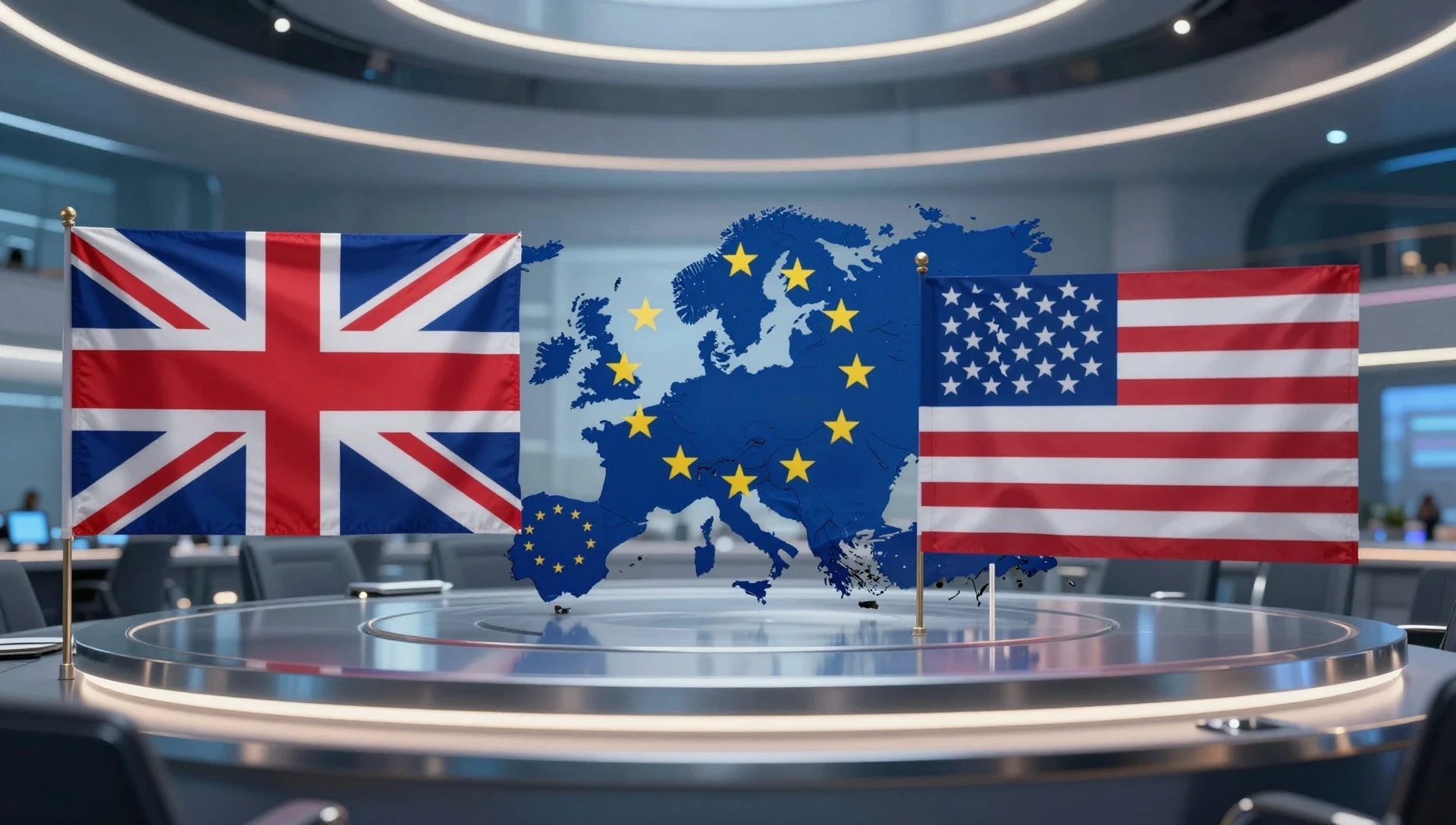
Keir Starmer's address to the British Irish Chamber of Commerce on 31 October 2026 marks a deliberate reframing of British foreign policy, not a routine diplomatic speech. The former prime minister used his first major political intervention since leaving office in July to argue that the transatlantic relationship has undergone a structural change rather than a temporary disruption.
His central claim is that Europe was caught unprepared twice: first by Russia's full-scale attack on Ukraine, which exposed thin defence inventories and fragmented procurement, and second by President Donald Trump's explicit withdrawal of American funding for European security. Starmer's conclusion is that the shift in Washington's posture will outlast Trump himself.
The argument carries weight because it separates two things that British policymakers have often bundled together. Starmer insists the military, security and intelligence alliance with the United States remains vital, while simultaneously arguing that Europe must assume greater responsibility for its own defence.
On This Page
That distinction matters for budgeting, industrial policy and force planning. It also reframes Brexit as an economic self-inflicted wound rather than a settled constitutional question, with Starmer stating plainly that leaving the European Union did serious damage to the UK economy and that a stronger Europe requires Britain at its centre.
The political context sharpens the significance. Starmer's successor, Andy Burnham, has signalled a bolder approach to Brussels and is due to attend an EU-UK summit covering food standards, energy and youth mobility. Meanwhile, UK defence secretary Wes Streeting told European defence ministers in Paris that support for Ukraine remained united and unwavering.
This analysis examines the strategic logic, the defence-industrial arithmetic and the domestic political constraints that will determine whether Starmer's diagnosis translates into durable policy.
TL;DR Keir Starmer argues that the United States is becoming a less dependable ally and that the shift is permanent rather than cyclical, requiring Europe to shoulder more of its own defence burden. He frames Brexit as economic damage, calls for closer UK-EU cooperation, and points to British nuclear weapons, the next-generation fighter programme and Ukraine security guarantees as leverage. His successor Andy Burnham is pushing a bolder EU line ahead of a summit on food standards, energy and youth mobility. The core message: Europe must organise strategically, and Britain must sit at its centre rather than at its edge.
The Strategic Logic Behind Starmer's Diagnosis
Starmer's argument rests on a claim about permanence. He describes the change in US relations under Trump as a structural shift rather than a temporary problem, and says things will not return to how they were before.
That is a testable proposition, and it carries direct consequences for how European capitals plan procurement cycles that span decades rather than electoral terms.
Why the "Permanent Shift" Claim Matters
Defence procurement operates on timelines that outlast governments. A frigate programme runs fifteen to twenty-five years from concept to decommissioning; a combat aircraft programme can exceed thirty. If European planners treat American reliability as a variable that might revert after the next US election, they will underinvest in sovereign capability and remain exposed to exactly the scenario Starmer describes.
The evidence Starmer cites is not speculative. Trump's explicit statement that the US would no longer fund European security represents a departure from the post-1945 settlement, under which Washington underwrote continental defence through NATO force posture and funding commitments.
Even if a successor administration partially reverses course, the precedent is now established: European security is a negotiable American budget line.
Starmer's framing also implicitly acknowledges a demographic and fiscal reality. American strategic attention has been shifting toward the Indo-Pacific for more than a decade, and European defence has been a declining share of US force planning regardless of who occupies the White House. Trump accelerated the trend; he did not invent it.
The Ukraine Shock as a Diagnostic Event
Starmer identifies Russia's attack on Ukraine as the first of two moments that caught Europe unprepared, and the framing is analytically useful. The war exposed not merely insufficient stockpiles but an industrial base incapable of rapid replenishment. Artillery shell production across Europe became the binding constraint within months of the invasion.
That constraint is quantifiable. European ammunition output has been measured in hundreds of thousands of shells annually against Ukrainian expenditure rates that at peak exceeded several thousand per day.
The gap between consumption and production revealed that decades of peacetime efficiency had stripped out surge capacity, leaving supply chains dependent on a handful of plants and specialised inputs.
Starmer's point is that this vulnerability was visible before the war and ignored. Treating Ukraine as a diagnostic event rather than an aberration is therefore the precondition for any credible European defence posture, and it explains why he links Ukraine security guarantees directly to Britain's own strategic relevance.
Britain's Assets in a European Framework
Starmer's list of British contributions is specific and worth examining: nuclear weapons, leadership in European defence efforts, the next-generation fighter jet programme, and a commitment to help guarantee security in Ukraine. Each represents a form of leverage that does not depend on American approval, which is precisely why he foregrounds them.
The nuclear deterrent is the clearest example. As one of two European NATO states with independent nuclear forces, the UK holds a capability that no amount of EU economic weight can substitute. That asymmetry gives London a bargaining position in European security architecture that its GDP alone would not confer.
The fighter programme matters differently. Collaborative combat aircraft development binds partner nations into shared industrial commitments spanning decades, creating dependencies that outlast political cycles. Starmer's emphasis on it signals that Britain intends to remain inside European defence-industrial structures even while outside the EU's formal institutions.
Brexit, Economics and the Case for Closer Ties
Starmer's economic argument is blunt: Brexit did serious damage to the UK economy, and a stronger Europe requires Britain at its centre. This is a notable rhetorical move from a former prime minister, because it reframes EU relations as a growth question rather than a sovereignty question, shifting the terms of debate away from identity and toward measurable output.
Quantifying the Brexit Damage
The Office for Budget Responsibility's long-run estimate put the productivity and trade penalty from leaving the EU at roughly 4 percent of GDP relative to remaining. Independent academic work has produced a range of estimates, but the direction is consistent across models: reduced trade intensity, lower investment and weaker productivity growth.
These are not abstract figures. A 4 percent GDP shortfall compounds over time, and against a defence budget that must rise to meet new commitments, the fiscal arithmetic becomes politically acute. Starmer's linkage of Brexit damage to European security is therefore not rhetorical decoration but a budget argument.
The trade friction is concentrated in services and small exporters, which face customs procedures and regulatory duplication that larger firms can absorb. That distributional pattern explains why the economic damage has been persistent rather than transitional, and why the political coalition for closer alignment has grown.
What Burnham's Approach Changes
Andy Burnham's stated intention to be bolder about closer ties with the EU, and his call for a public debate on moving closer after the next election, changes the political weather around Starmer's remarks. The two positions are complementary rather than competitive, forming a sequence in which diagnosis precedes negotiation.
The EU-UK summit agenda is instructive. Food standards, energy and youth mobility are areas where alignment produces tangible economic gains with limited sovereignty cost, which makes them politically saleable. They are also precisely the domains where divergence has generated the most friction for exporters and consumers.
Youth mobility in particular carries demographic weight. Ageing populations across Europe face labour shortages in hospitality, agriculture and care, and reciprocal mobility schemes address that gap directly. Framing such arrangements as pragmatic labour-market policy rather than as free movement by another name is the central political challenge.
The Domestic Constraints
Any move toward closer alignment runs into a structural constraint: the electorate that delivered the original departure vote remains sceptical of institutional re-entry. Burnham's call for a public debate acknowledges this, effectively proposing that the argument be won before the policy is adopted rather than after.
The constraint is asymmetric. Rejoining the customs union or single market would require accepting rule-taking without representation, a position that satisfies neither integrationists nor sovereignty advocates. The politically viable space is therefore sectoral alignment, mutual recognition and defence cooperation, which is exactly the terrain Starmer and Burnham are staking out.
Timing compounds the difficulty. Defence urgency argues for speed, while electoral caution argues for delay. The resolution likely lies in separating security cooperation, which can advance through bilateral and minilateral channels, from economic alignment, which requires the slower work of public persuasion.
We Also Published
Defence Industrial Arithmetic and the Road Ahead
Starmer's speech ultimately reduces to a resource question. If Europe must take on more responsibility for its own defence, the funding, industrial capacity and political will must be found somewhere.
The UK's position at the centre of a stronger Europe depends less on rhetoric than on whether British defence spending and production can match the commitments implied.
Spending Against Capability
NATO's 2 percent GDP guideline has functioned as a floor rather than a target, and several members have only recently crossed it. The more demanding benchmark now discussed is 3 percent or higher, which for the UK would represent tens of billions in additional annual expenditure against competing domestic priorities.
Money alone does not produce capability. Recruitment shortfalls, maintenance backlogs and slow procurement cycles mean that spending increases translate into deployable force only after multi-year lags. Starmer's emphasis on the fighter programme implicitly recognises that industrial capacity, not budget lines, is the binding constraint.
- 01
- 02
- 03
- 04
Ireland, Neutrality and the Bilateral Channel
Starmer's Dublin visit and the annual UK-Ireland summit he established with Taoiseach Micheál Martin illustrate a parallel track. Ireland is militarily non-aligned, yet Starmer stated that both countries stand together in supporting Ukraine and in shaping continental security.
That formulation is carefully calibrated. It draws Ireland into security cooperation without demanding NATO membership, and it uses the bilateral relationship to build habits of consultation that can extend to procurement, intelligence sharing and cyber defence. The channel is modest but durable.
The Irish dimension also serves a domestic purpose. It demonstrates that post-Brexit relations with European neighbours can be constructive rather than adversarial, countering the narrative that departure inevitably produced estrangement. Symbolism of this kind matters in a debate where trust has been the scarcest commodity.
What Would Confirm the Thesis
Starmer's argument will be validated or refuted by observable indicators over the next several years. European defence spending trajectories, joint procurement decisions, the pace of the fighter programme and the durability of Ukraine security guarantees all provide measurable tests of whether the structural shift he describes is being acted upon.
The most telling indicator may be institutional. If European capitals begin designing force structures and industrial plans that assume American funding is unavailable by default, the shift is real. If planning continues to assume reversion, Starmer's diagnosis will have been correct but inconsequential.
For Britain specifically, the test is whether it can convert its nuclear deterrent, defence-industrial participation and Ukraine commitment into influence over European decisions it no longer shapes through EU membership. That is the practical meaning of being at the centre of a stronger Europe rather than at its edge.
Reading the Speech as a Policy Document
Stripped of its occasion, Starmer's address functions as a policy document with three operative claims: that American reliability has permanently declined, that Brexit imposed measurable economic costs, and that Britain's security assets give it a claim on European leadership. Each claim is falsifiable, and together they define the terms of the debate his successor will inherit.
The Intelligence Alliance as the Untouched Core
Starmer explicitly preserves the military, security and intelligence alliance with Washington as vital, and this deserves emphasis. Signals intelligence cooperation, nuclear weapons design data and special operations relationships operate through channels that are largely insulated from budget politics and public diplomacy.
That insulation is the reason the transatlantic relationship can be simultaneously described as declining and indispensable. The alliance's deepest components are not funded through the mechanisms Trump has targeted, which means European defence burden-sharing and intelligence cooperation can proceed on separate tracks without contradiction.
Understanding this separation is essential to reading the speech correctly. Starmer is not announcing estrangement from Washington; he is announcing that Europe can no longer outsource the conventional defence that intelligence cooperation cannot substitute for.
Why the Framing Outlasts the Speaker
Starmer delivered the speech as a former prime minister, which grants him latitude that incumbents lack. He can state that Brexit did serious damage without immediately owning the consequences, and he can describe American retrenchment as permanent without negotiating its terms.
That latitude is precisely what makes the intervention useful to Burnham. The successor inherits a public argument already made by a predecessor from the same political tradition, which lowers the political cost of pursuing closer EU ties and provides cover for concessions at the upcoming summit.
The framing also outlasts both figures. Once a senior British leader states publicly that the transatlantic shift is structural, subsequent governments must either act on the premise or explain why they are not. That is how speeches become policy constraints.
Conclusion: The Burden-Sharing Test
The core message is ultimately about responsibility. Starmer argues that Europe was caught unprepared twice, that the American shift will not reverse, and that Britain must therefore sit at the centre of a stronger Europe rather than at its edge. The logic is coherent and the evidence supports the diagnosis.
Whether it produces results depends on execution. Defence spending must rise, industrial capacity must expand, and the political coalition for closer EU alignment must be assembled through the public debate Burnham has proposed. Speeches set direction; budgets and procurement decisions determine outcomes.
The measurable test is straightforward. If European force planning begins to assume American funding is unavailable by default, Starmer's diagnosis will have been vindicated. If planning continues to assume reversion, the speech will be remembered as accurate analysis that produced no consequence.
From our network :
- Live Online English Classes for Kids: Do They Actually Reduce Anxiety?A ten-week study reveals that synchronous online English classes can significantly reduce child language anxiety while improving listening and reading skills. Discover what makes these programs effective and how parents can select the right one.
- How AI Agents Will Change the Way We Manage Personal FinancesExplore how AI agents are transforming personal finance through automated budgeting, bill payment, and investment management, while examining the critical security protocols and governance frameworks required for safe deployment.
- The Final Descent: How ESA Retired the Legendary Cluster Constellation After 24 Years of Space Weather ScienceAfter 24 years mapping Earth’s magnetosphere, ESA’s Cluster mission concluded with a precisely controlled reentry over the South Pacific. This analysis explores the scientific legacy, engineering decisions, and debris mitigation principles behind one of space exploration’s most responsible retirements.
- Mobile Learning and VR in English: What Global Evidence Reveals About Effective Language TechnologyA systematic review across 14 countries reveals which language-learning technologies genuinely work. Mobile learning, AI, and VR show measurable benefits when pedagogically integrated. This evidence-based guide helps educators and learners select technology that delivers real return on investment.
- University Language Proficiency Exams: Why Institutional Tests Demand Different Preparation Than IELTS and TOEFLDiscover why university-specific language proficiency examinations differ fundamentally from IELTS and TOEFL, and learn strategic preparation approaches for institutional assessment success.
- CISA’s Ten-Advisory Wave: Why Generic Patching Fails in OT and How to Build Product-Specific PlaybooksCISA released ten ICS advisories in one week, exposing critical infrastructure risks. Generic patching fails in OT. Learn to build product-specific remediation playbooks.
- Forbidden Matrix Patterns and Visible Lattice Points: A Geometric DictionaryExplore how multidimensional 0–1 matrices encode geometric truths, linking forbidden patterns to visible lattice points and hypergraph theory, with applications in combinatorics and computational geometry.
- Committed Mediterranean Precipitation Decline: Why Emissions Cuts Alone Cannot Restore Winter RainsNew NOAA research reveals that Mediterranean winter rains may decline irreversibly even with emissions cuts. Explore the science of committed climate change and regional impacts.
- The Hidden Cost of AI Convenience: Why Over-Permissioned Agents Are a Security Time BombDiscover why AI agents with excessive permissions create dangerous single points of failure, and learn how implementing least privilege principles can protect your organization from exploitation.
RESOURCES
- Resources will be updated soon.
- 01
- 02
- 03
- 04
- 05
- 06
- 07
- 08
0 Comments