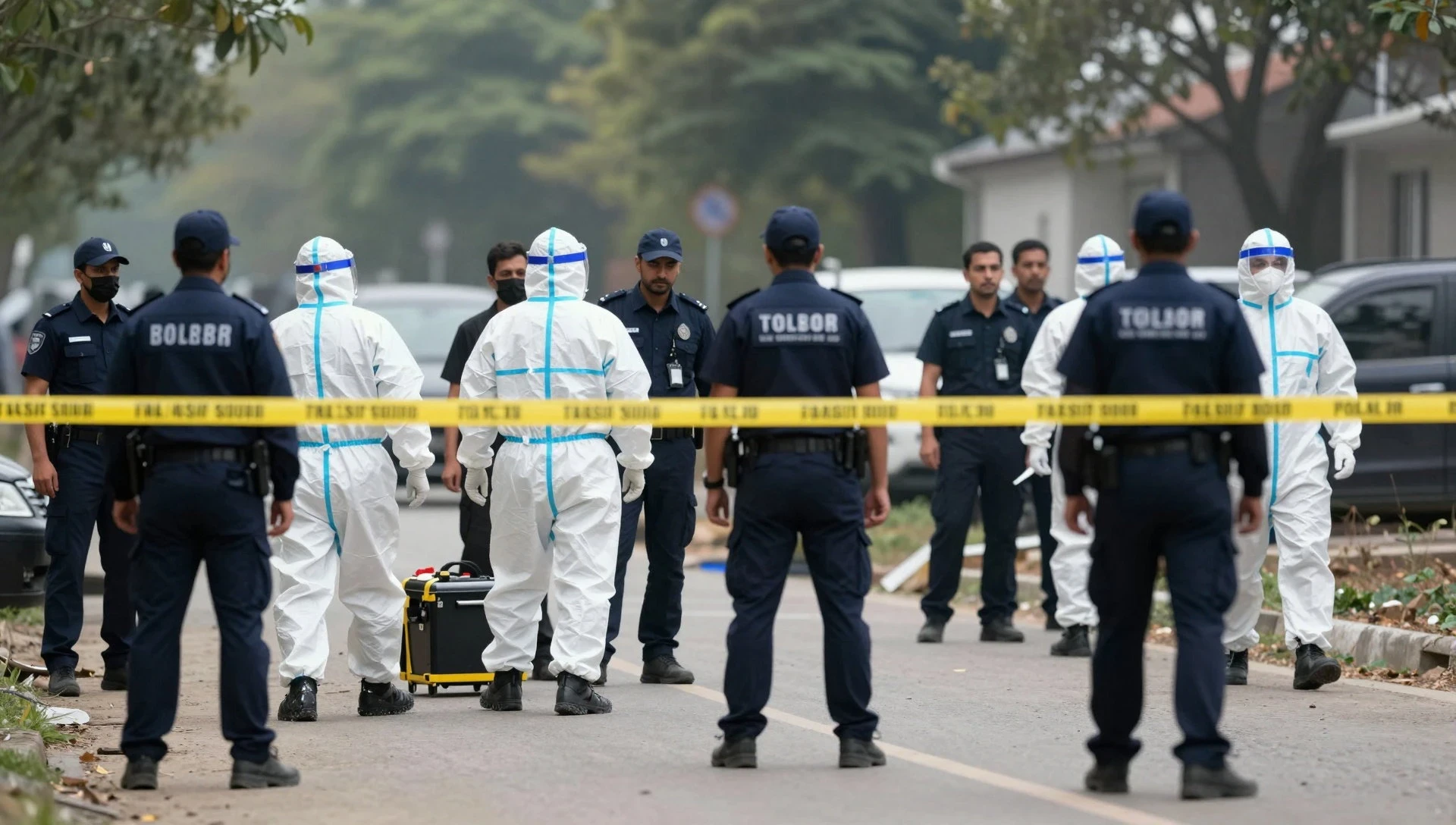
The death of former Bangladesh Air Force Flight Lieutenant KM Tahsif Souri has moved from a missing-person alert into a formal criminal inquiry, and the detention of Ahmed Shahriar Reza Dip on Thursday night at a house on Babar Road in Dhaka's Mohammadpur area marks the first custodial turn in that process.
The Police Bureau of Investigation confirmed the arrest through Additional Deputy Inspector General Anayetur Rahman Manna, who described the measure plainly as a detention for interrogation rather than a charge.
That distinction matters: Bangladesh's evidentiary threshold for custodial questioning is lower than for prosecution, and the PBI is using it to test a narrative it does not yet accept.
On This Page
The case carries unusual public weight because Souri was reportedly the person who recorded footage appearing to show former Prime Minister Sheikh Hasina departing the country by aircraft on August 5, 2024.
That single association converted an ordinary disappearance into a politically charged death, and it explains why a river recovery near the Rajabari ferry terminal has drawn national attention. Investigators now face a dual burden: establishing the mechanics of a drowning and managing the expectation that a politically significant witness deserves a transparent accounting.
What follows examines the evidentiary record as reported, the credibility of the account Dip gave questioners, and the structural pressures that shape how Bangladeshi investigators handle high-visibility deaths. The analysis separates confirmed facts from contested testimony and situates the case within the wider pattern of custodial interrogation practice in Bangladesh.
TL;DR Bangladesh's Police Bureau of Investigation detained Ahmed Shahriar Reza Dip, an associate of former Air Force Flight Lieutenant KM Tahsif Souri, for questioning after CCTV footage placed the two men together shortly before Souri disappeared. Dip told investigators the pair were chased at Mazar Basti and that Souri jumped into the Turag river while he escaped; the PBI says it is not fully convinced. Souri's body was recovered near the Rajabari ferry terminal on Monday. He had drawn national attention as the reported recorder of footage showing Sheikh Hasina leaving Bangladesh on August 5, 2024.
The Evidentiary Record Behind the Tahsif Souri Inquiry
The documented facts in this case are narrow but consequential. Souri went missing, his body was recovered from the Turag river near the Rajabari ferry terminal on Monday, and CCTV footage recorded shortly before his disappearance shows him with a man his family identified as Dip.
Everything beyond those anchors rests on testimony that investigators themselves describe as incomplete. The PBI's public posture reflects that gap: confirmation of a detention, confirmation of an interrogation, and no confirmation of a cause of death.
What the CCTV Footage Establishes and What It Does Not
Surveillance footage is often treated in public discourse as conclusive, yet its evidentiary value here is narrower than it appears. The recording places Souri and Dip together before the disappearance; it does not document a chase, a confrontation, or a entry into the water.
Family identification of the second figure adds a layer of corroboration but not independent verification. The footage therefore establishes association and timing, not causation.
Investigators will likely seek corroborating material: additional camera coverage along the route to Mazar Basti, cell-site data for both men, and any digital traces from the hours preceding the disappearance. Each of these carries its own reliability profile.
Cell-site records in dense urban areas can place a device within a broad radius rather than a precise point, a limitation that has overturned assumptions in comparable cases elsewhere in South Asia.
The gap between what a camera shows and what a court can infer is where most death investigations either consolidate or collapse. Bangladeshi prosecutors have grown more careful about surveillance evidence since appellate rulings began scrutinising chain-of-custody documentation.
If the PBI intends to build a case on the Babar Road footage, it will need to demonstrate continuity of the recording from seizure to presentation.
The Political Context of the Hasina Departure Footage
Souri's public profile rests on a single attribution: that he recorded the footage appearing to show Sheikh Hasina leaving Bangladesh by aircraft on August 5, 2024. That date corresponds to the collapse of the Awami League government amid mass protests.
Any individual linked to the visual record of that departure occupies a sensitive position in the post-transition information environment, and the sensitivity cuts in multiple directions.
For supporters of the transition, Souri was a documentary witness whose material helped establish a contested sequence of events. For those sceptical of the footage's provenance, his role invited scrutiny of authenticity and timing. Neither framing establishes anything about his death, but both shape how the public reads each new disclosure. Investigators operate inside that charged field whether they wish to or not.
Comparable cases in transitional democracies suggest that politically salient witnesses face elevated risk of both violence and evidentiary contamination. The risk is not only physical. Public speculation can harden into narrative before forensic findings arrive, and once a narrative consolidates, contrary evidence struggles for uptake. The PBI's cautious language appears calibrated against that dynamic.
Why the PBI Says It Is Not Fully Convinced
The official quoted by The Daily Star stated that investigators were not fully convinced by Dip's account and were continuing to examine other aspects of the case. That phrasing is standard in Bangladeshi investigative communication, but it carries substantive meaning.
It signals that the interrogation produced a version of events the bureau regards as incomplete, internally inconsistent, or unsupported by independent material.
Dip's account contains at least three testable propositions: that the two men travelled to Mazar Basti together, that unknown persons chased them, and that Souri entered the river voluntarily while Dip escaped. Each proposition can be checked against camera coverage, witness statements, and physical evidence from the riverbank. A single contradiction would not prove fabrication, but a cluster would justify continued detention.
The Turag river itself presents forensic complications. Currents, tidal influence, and the interval between disappearance and recovery all affect what a post-mortem can establish about drowning versus post-mortem immersion.
Bangladeshi forensic pathologists have documented these difficulties in prior river cases, and the absence of a public autopsy summary leaves the central medical question unresolved.
We Also Published
Custodial Interrogation and the Legal Architecture in Bangladesh
Bangladesh's Code of Criminal Procedure permits detention for interrogation within defined limits, and the PBI routinely invokes those provisions in death investigations where a witness's account conflicts with physical evidence.
The legal architecture is not unusual by regional standards, but its application in high-profile cases attracts sustained scrutiny from defence counsel and civil liberties organisations. The distinction between a detained associate and a named suspect is legally meaningful and publicly fragile.
Detention, Remand, and the Difference That Matters
Dip was taken into custody for interrogation, not formally arrested on a charge. In practice, the two conditions can blur in public perception, and Bangladeshi courts have repeatedly cautioned against treating interrogation detention as de facto accusation.
The PBI's decision to describe the measure in precise terms suggests awareness of that boundary and a desire to preserve flexibility as evidence develops.
Remand hearings, when they occur, require a magistrate to assess whether continued custody serves the investigation. That assessment turns on documented progress: new witnesses interviewed, forensic results obtained, inconsistencies resolved. A bureau that cannot demonstrate movement risks having remand refused, which in turn weakens its leverage over a reluctant witness.
The timing of the detention is also instructive. Dip was picked up on Thursday night, days after the body's recovery on Monday. That interval allowed investigators to review footage and conduct preliminary inquiries before committing to custody, a sequencing that suggests the decision was evidence-led rather than reactive.
How High-Profile Deaths Are Investigated in Practice
High-visibility cases in Bangladesh tend to follow a recognisable pattern: rapid public confirmation of detentions, limited disclosure of forensic detail, and periodic briefings that manage expectation without resolving ambiguity. The pattern reflects genuine investigative constraints as well as institutional caution. Premature disclosure can compromise a prosecution; excessive silence can erode public confidence.
The PBI's handling of the Souri case fits that template closely. Confirmation came through a named senior officer, the account was summarised without endorsement, and the bureau explicitly flagged its scepticism.
That combination is more transparent than silence but stops well short of the disclosure that a politically charged death would ordinarily invite.
International comparisons are instructive. In the United Kingdom, sudden deaths with suspicious features trigger mandatory coronial processes and independent police oversight. Bangladesh lacks an equivalent standing mechanism, so transparency depends on prosecutorial discretion and media pressure. That structural difference explains much of the variance in how similar cases are perceived across jurisdictions.
The Role of Forensic Pathology in River Deaths
River recoveries present some of the hardest questions in forensic pathology, and the Turag case is no exception. The central determination is whether immersion occurred before or after death, a distinction that depends on findings such as water in the lungs, diatom presence in tissue, and the pattern of injuries. Each indicator carries interpretive limits.
Diatom analysis, for instance, can support a conclusion of antemortem drowning when species matching the recovery site appear in bone marrow. But the technique requires validated laboratory protocols, and its evidentiary weight varies across jurisdictions.
Bangladeshi forensic facilities have improved in recent years, yet capacity constraints remain a documented concern in published reviews.
The interval between Monday's recovery and the earlier disappearance also matters. Decomposition progresses at rates influenced by water temperature, current, and depth, and those variables affect what a pathologist can reliably conclude.
Without a public autopsy summary, outside observers cannot assess whether the medical evidence supports, contradicts, or simply fails to resolve Dip's account.
- 01
- 02
- 03
- 04
Information Integrity and Public Trust in a Contested Case
The Souri case sits at the intersection of criminal investigation and information warfare, and that intersection is where public trust is most easily lost. A death connected to footage of a prime ministerial departure will attract speculation from actors with political incentives, and the resulting noise can obscure the evidentiary record. Investigators must work through that noise while the public forms judgments in real time.
Verification Practices for a Politically Charged Death
Responsible reporting on this case requires distinguishing between what the PBI has confirmed and what it has merely described. The detention is confirmed. The interrogation is confirmed. Dip's account is reported as his account, not as established fact.
The distinction between those categories is the difference between journalism and amplification, and it is the discipline that keeps a contested case from hardening prematurely.
Verification also means tracking the provenance of claims. The Daily Star's reporting attributes the account to an unnamed PBI official involved in the investigation, a sourcing arrangement that is standard but carries inherent limitations. Readers should weigh such attributions accordingly, recognising that official briefings serve institutional purposes as well as informational ones.
Social media introduces a further layer of distortion. Footage circulates without context, timelines compress, and unverified assertions acquire the appearance of consensus. In cases with political salience, the half-life of a false claim often exceeds that of its correction. That asymmetry is a structural feature of the information environment, not a failure of any single outlet.
What Comes Next in the Investigation
The immediate trajectory of the case depends on three developments: the completion of forensic analysis, the outcome of any remand application, and the emergence of independent witnesses from Mazar Basti. Each could shift the balance between the account Dip provided and the bureau's scepticism. Absent any of them, the case risks drifting into prolonged ambiguity.
Investigators will also need to address the political dimension without being consumed by it. Souri's association with the Hasina departure footage guarantees continued attention, but that attention does not alter the evidentiary standard.
A death investigation succeeds or fails on the strength of its physical and testimonial record, not on the prominence of the deceased.
For the public, the appropriate posture is disciplined patience. The PBI has confirmed what it can confirm and flagged what it doubts. Further disclosures will come, and each should be assessed against the record rather than against expectation.
That discipline is the only reliable protection against a case becoming a symbol before it becomes a finding.
Institutional Accountability and the Longer View
Beyond the individual case, the Souri investigation tests whether Bangladeshi institutions can handle a politically sensitive death with procedural rigour. The PBI's early conduct has been cautious and, by regional standards, reasonably transparent.
Whether that posture holds under pressure will determine how the case is remembered: as a competent inquiry or as another example of ambiguity unresolved.
The longer view matters because precedent shapes practice. A thorough, documented investigation would strengthen the bureau's standing in future cases involving public figures. A prolonged, opaque one would reinforce scepticism that already attaches to high-profile inquiries across the region. The stakes extend well past the Turag riverbank.
For now, the record contains a detention, an interrogation, a contested account, and a body recovered from a river. Those are the facts. Everything else is inference, and inference should be labelled as such until the evidence catches up with the speculation.
From our network :
- CISA’s Ten-Advisory Wave: Why Generic Patching Fails in OT and How to Build Product-Specific PlaybooksCISA released ten ICS advisories in one week, exposing critical infrastructure risks. Generic patching fails in OT. Learn to build product-specific remediation playbooks.
- Committed Mediterranean Precipitation Decline: Why Emissions Cuts Alone Cannot Restore Winter RainsNew NOAA research reveals that Mediterranean winter rains may decline irreversibly even with emissions cuts. Explore the science of committed climate change and regional impacts.
- Forbidden Matrix Patterns and Visible Lattice Points: A Geometric DictionaryExplore how multidimensional 0–1 matrices encode geometric truths, linking forbidden patterns to visible lattice points and hypergraph theory, with applications in combinatorics and computational geometry.
- How AI Agents Will Change the Way We Manage Personal FinancesExplore how AI agents are transforming personal finance through automated budgeting, bill payment, and investment management, while examining the critical security protocols and governance frameworks required for safe deployment.
- Live Online English Classes for Kids: Do They Actually Reduce Anxiety?A ten-week study reveals that synchronous online English classes can significantly reduce child language anxiety while improving listening and reading skills. Discover what makes these programs effective and how parents can select the right one.
- University Language Proficiency Exams: Why Institutional Tests Demand Different Preparation Than IELTS and TOEFLDiscover why university-specific language proficiency examinations differ fundamentally from IELTS and TOEFL, and learn strategic preparation approaches for institutional assessment success.
- Mobile Learning and VR in English: What Global Evidence Reveals About Effective Language TechnologyA systematic review across 14 countries reveals which language-learning technologies genuinely work. Mobile learning, AI, and VR show measurable benefits when pedagogically integrated. This evidence-based guide helps educators and learners select technology that delivers real return on investment.
- The Final Descent: How ESA Retired the Legendary Cluster Constellation After 24 Years of Space Weather ScienceAfter 24 years mapping Earth’s magnetosphere, ESA’s Cluster mission concluded with a precisely controlled reentry over the South Pacific. This analysis explores the scientific legacy, engineering decisions, and debris mitigation principles behind one of space exploration’s most responsible retirements.
- The Hidden Cost of AI Convenience: Why Over-Permissioned Agents Are a Security Time BombDiscover why AI agents with excessive permissions create dangerous single points of failure, and learn how implementing least privilege principles can protect your organization from exploitation.
RESOURCES
- Tahsif Souri death: PBI takes one into custody - The Daily Starthedailystar.net3 days ago ... Tahsif Souri Death Investigation: CCTV footage recorded shortly before Tahsif Souri went missing shows him with his associate.
- The Police Bureau of Investigation (PBI) has taken an associate of ...facebook.com3 days ago ... net/news/news/tahsif-souri-death-pbi-takes- one-custody-4311206. thedailystar.net. Tahsif Souri death: PBI takes one into custody. 1d. Siddharth ...
- The Police Bureau of Investigation (PBI) has taken an associate of ...instagram.com3 days ago ... Read the full story at www.thedailystar.net/news/news/tahsif-souri-death-pbi-takes-one-custody-4311206 #bangladesh #airforce #tahsifsouri ...
- The Police Bureau of Investigation (PBI) has taken Shahriar Reza ...facebook.com3 days ago ... net/bangladesh/crime/death-tahsif-souri-pbi -takes-close-acquaintance-dwip-custody- 1587571. tbsnews.net. Death of Tahsif Souri: PBI takes close ...
- Former Air Force Flight Lieutenant KM Tahsif Souri jumped into the ...instagram.com3 days ago ... Read the full story at www.thedailystar.net/news/news/tahsif-souri-death-pbi-takes-one-custody-4311206 ... Tahsif's death until the investigation ...
- Death of Tahsif Souri: PBI takes close acquaintance Dwip into custodytbsnews.net3 days ago ... The Police Bureau of Investigation (PBI) has taken Shahriar Reza Dwip, a close acquaintance of former Bangladesh Air Force flight…
- Ex-Air Force officer Tahsif's death: Friend Dwip taken into police ...en.prothomalo.com3 days ago ... ... Tahsif Souri, 28, into custody in connection with Tahsif's death. The Police Bureau of Investigation (PBI) took him into…
- Death of Tahsif Souri: Motorcycle found 3km from body recovery site ...tbsnews.netIt had no number plate and was brought to the police station. The Police Bureau of Investigation (PBI) took it into its custody this…
- UNB - United News of Bangladesh - Xx.com3 days ago ... The Police Bureau of Investigation (PBI) has taken into custody ... Tahsif Souri for questioning over his death. https://t.co/OT0r5BMm8n ...
- Tahsif Souri's death: PBI takes junior friend Dwip into custody for ...thereport.live3 days ago ... ... Tahsif Souri before he went missing has been taken into custody for questioning by the Police Bureau of Investigation…
- PBI takes Tahsif's close friend Dwip into custody over his deathjagonews24.com3 days ago ... ... Tahsif Souri shaking hands with his friend Shahriar Reza Dwip. The Police Bureau of Investigation (PBI) has taken Shahriar…
- Tahsif Souri's death: No case filed, even after 3 daysthefinancialexpress.com.bd2 days ago ... ... custody of the Police Bureau of Investigation (PBI). Those involved in the investigation see this as his “attempt to…
- 01
- 02
- 03
- 04
- 05
- 06
- 07
- 08
0 Comments