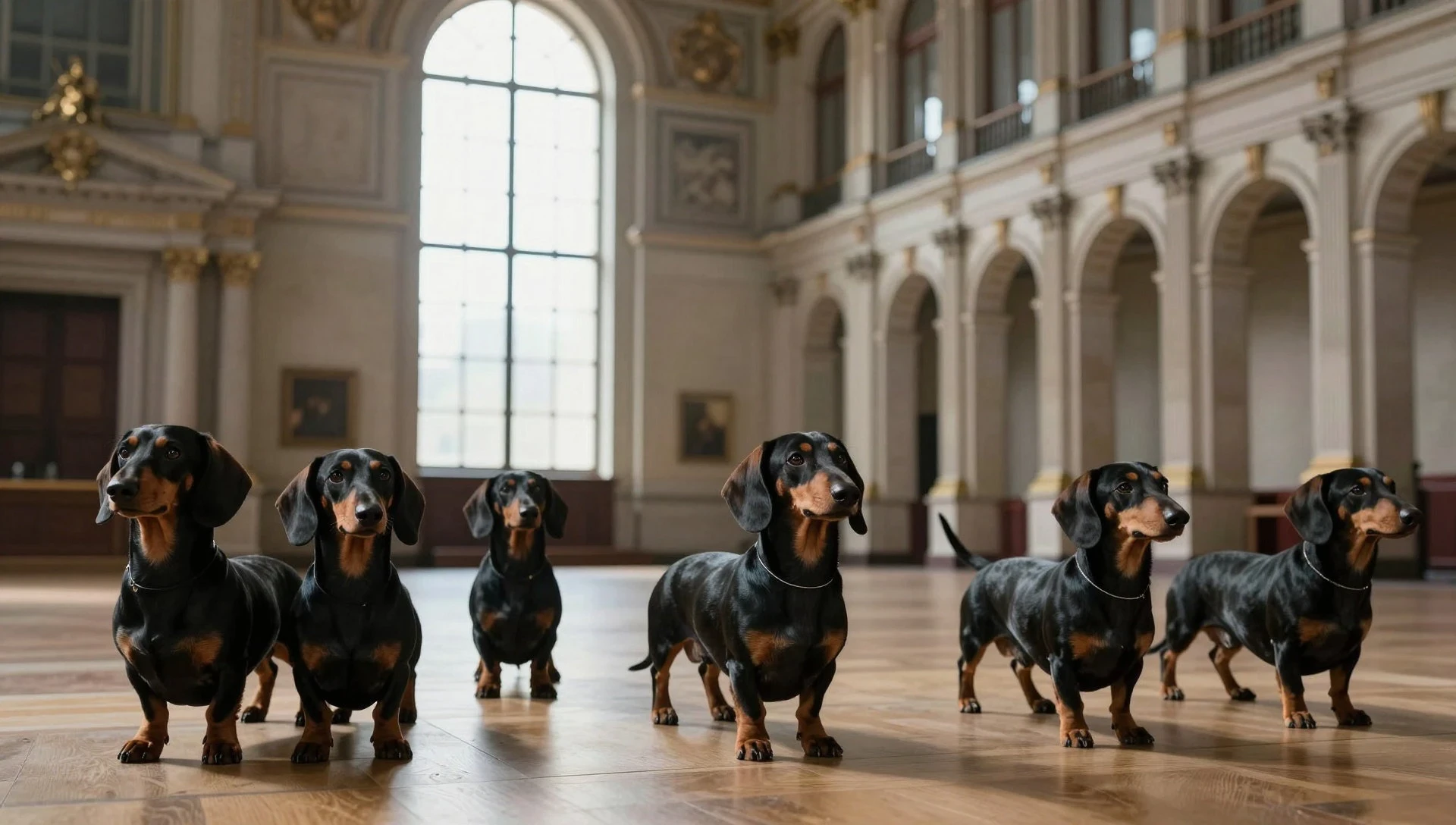
The Kunsthalle Bremen has mounted an exhibition that treats a single dog breed as a lens on more than a century of European art, commerce and wartime propaganda. Titled "The Dachshund.
An Icon off the Leash," the show runs until March 28, 2027, and assembles works by Pablo Picasso, Andy Warhol and others around a deceptively simple subject. The premise is that the dachshund's silhouette — long body, short legs, unmistakable profile — functions as a visual shorthand that artists and advertisers have exploited for decades.
Behind the humor sits a documented political record. The breed was standardized in Germany in 1879, with the German Teckel Club founded in 1888, and it became entangled in national identity well before the First World War.
On This Page
Kaiser Wilhelm II kept several dachshunds, and wartime propaganda maps paired the dog with a bulldog for Britain and a poodle for France. Curator Annett Reckert notes that the animal's easily recognizable shape makes it unusually serviceable in both fine art and advertising.
This analysis examines the exhibition's three interlocking arguments: the dachshund as an artistic model, as a commercial and political symbol, and as a case study in how national association can damage a breed's standing abroad.
It draws on the historical record around breed standards, wartime iconography and the Picasso connection to assess what the show reveals about the relationship between animals, art and politics.
TL;DR The Kunsthalle Bremen's exhibition "The Dachshund. An Icon off the Leash" (through March 28, 2027) traces how a German hunting breed became a fixture of modern art and a vehicle for wartime propaganda. Picasso painted his dachshund Lump onto a ceramic plate in 1967; Warhol and others used the breed as a studio companion and model. The show documents the dog's political career — Kaiser Wilhelm II's pets, First World War propaganda maps pairing dachshund with bulldog and poodle, and the American backlash that produced the term "liberty hounds." It argues that the breed's recognizable geometry explains its durability as a symbol.
The Dachshund as Artistic Subject and Studio Companion
The exhibition's central claim is that the dachshund's proportions make it unusually legible as an image. A long torso on short legs produces a silhouette that survives reduction, distortion and caricature without losing identity.
Curator Annett Reckert identifies this recognizability as the reason artists and advertisers have returned to the breed repeatedly, treating it as a model, a companion and a ready-made graphic device.
Picasso, Lump and the Ceramic Plate
The most celebrated object in the show connects the breed to Pablo Picasso through an accident of domestic life. In 1967, the photographer David Douglas Duncan visited Picasso with his dachshund, Lump, who jumped onto the artist's lap.
Picasso subsequently painted the dog's portrait onto a ceramic dinner plate, an object that anchors the exhibition's narrative about spontaneity and studio intimacy.
Lump remained with Picasso for six years, according to the exhibition's account, outlasting the visit that introduced them. The dog also appears in several of Picasso's paintings reinterpreting Diego Velázquez's "Las Meninas," where the animal functions as a compositional counterweight.
The recurrence matters: it shows a working artist absorbing a living animal into an ongoing series rather than treating it as a one-off curiosity.
The plate itself is instructive about Picasso's ceramic practice, in which ordinary domestic ware became a surface for rapid, confident drawing. A dachshund suits that method because its form can be rendered in a few continuous strokes.
The exhibition uses the object to argue that the breed's geometry, not sentimentality, is what made it artistically useful.
Andy Warhol's presence in the show extends the argument into the realm of reproduction and mass imagery. Warhol's dachshunds, like Picasso's, were both pets and subjects, and the pairing of the two artists suggests a continuity: the breed moves easily between high modernism and pop's serial logic. Both artists, in effect, treated the dog as a form to be repeated.
Why the Breed's Geometry Suits Visual Media
A dachshund's body length relative to leg height is extreme among dog breeds, and that ratio is what makes the animal readable at small scale. Advertising relies on instant recognition; a shape that survives a thumbnail, a stamp or a cartoon line is commercially valuable. Reckert's point is essentially about information efficiency in visual communication.
The same property explains the breed's presence in caricature. Political cartoonists need symbols that audiences decode without explanation, and the dachshund's profile does that work instantly. Once a form is that legible, it becomes available for any argument a illustrator wants to make, which is precisely what happened in the early twentieth century.
Artists also valued the breed as a studio presence rather than a subject alone. A small, sturdy dog that tolerates long sittings and stays close to the easel becomes part of the working environment.
The exhibition's framing treats companionship and modeling as connected facts, not separate anecdotes about famous painters and their pets.
The show extends this logic into installations made specifically for dogs, acknowledging that the breed's audience includes the animals themselves. That curatorial choice reframes the exhibition as something other than a conventional art-historical survey.
It asks visitors to consider how a breed shaped for hunting badgers became a cultural object with its own viewing public.
From Hunting Breed to Cultural Icon
The dachshund was bred in Germany more than 300 years ago to hunt badgers and other burrowing animals, a function embedded in its name. "Dachshund" combines the German words for badger and dog.
Short legs and a long body are working adaptations for entering dens, not decorative traits, and the breed's history begins in practical field work.
Standardization followed in the late nineteenth century. Breed standards were set in 1879, and the German Teckel Club was founded in 1888, formalizing what had been regional working practice.
These dates matter because they mark the moment the breed acquired a documented national identity, which later made it available as a symbol of Germany itself.
Once a breed is standardized and registered, it becomes a category that can be represented, judged and reproduced with consistency. That administrative step is what allows an animal to function as an icon: there must be a stable, recognizable type before caricature or advertising can rely on it. The Teckel Club's founding sits at that threshold.
The exhibition's chronology therefore runs from field utility through standardization to mass imagery. Each stage narrows the gap between the living animal and the sign. By the twentieth century, the dachshund could stand for Germany in a propaganda map without any explanatory caption, which is the endpoint of that process.
We Also Published
Political Symbolism from the Kaiser to the World Wars
The exhibition's second argument concerns power. Kaiser Wilhelm II owned several dachshunds, and in 1908 two of his dogs reportedly killed a golden pheasant at the estate of Archduke Franz Ferdinand, forcing the Kaiser to apologize.
The anecdote is minor in itself but establishes the breed's proximity to imperial authority at a moment of rising European tension.
Imperial Pets and the 1908 Incident
A diplomatic apology over a dead pheasant is a small event with a large frame. It places the German emperor's personal animals inside the ceremonial world of aristocratic hunting, where property, protocol and prestige intersect. The story circulated because it made the Kaiser's household look both grand and faintly ridiculous.
That combination is useful to an exhibition about symbolism. A monarch's pets are never entirely private; they signal taste, national preference and, in this case, a specifically German attachment. Wilhelm's dachshunds therefore did early work in linking the breed to the German state, well before wartime propagandists formalized the association.
The 1908 episode also illustrates how animal anecdotes enter political memory. The pheasant, the estate and the apology are remembered because they compress a larger story about imperial rivalry into a single incident. Archduke Franz Ferdinand's later assassination in Sarajevo gives the anecdote a retrospective weight the participants could not have anticipated.
Curators use such material to show that the dachshund's political career began in elite domestic settings rather than in mass media. The breed moved from palace to poster, and the exhibition tracks that migration as a sequence of contexts rather than a single symbolic meaning.
Wartime Propaganda and the Bulldog–Poodle Trio
During the First World War, propaganda maps and cartoons used the dachshund to represent Germany, paired with a bulldog for Britain and a poodle for France. The scheme assigned each nation a breed and let readers decode alliances and hostilities from animal silhouettes alone. It was efficient, memorable and deliberately demeaning.
The choice of breeds was not neutral. Bulldogs carried associations of tenacity and British self-image; poodles signified France in a register that could be made frivolous; the dachshund, already German, became the enemy's face. Cartography and caricature merged, turning a map of Europe into a bestiary of national character.
This is the exhibition's sharpest point about how symbols acquire force. A breed with no political content can be recruited into propaganda within a few years if the visual association is strong enough. Once established, the link proves difficult to undo, and it can outlast the conflict that created it.
The propaganda also demonstrates the cost of legibility. The same recognizable shape that made the dachshund useful to Picasso made it useful to cartoonists working for governments. Reckert's observation about the breed's form applies with equal force to art and to state messaging, which is the exhibition's central analytical claim.
The American Backlash and the "Liberty Hound"
Because of the wartime association with Germany, the dachshund's popularity in the United States fell, and some owners renamed their pets "liberty hounds." The term echoes the broader renaming campaigns of the period, in which German-sounding words were replaced in public usage. A dog breed became collateral in a cultural conflict.
The episode is a documented case of symbolic contamination. An animal with no political agency acquired an enemy identity through repetition, and private owners responded by altering what they called their pets. The shift from dachshund to liberty hound is a small linguistic event with a clear political cause.
Recovery took time. Breed popularity in the United States eventually rebounded, but the wartime association never fully disappeared from the cultural record. The exhibition treats this as evidence that symbolic meanings, once attached, persist in archives, cartoons and memory even after the political conditions that produced them change.
For contemporary readers, the lesson concerns how quickly ordinary things acquire political charge. A breed, a name, a food or a piece of clothing can be reassigned meaning by a propaganda campaign and then carry that meaning for decades. The dachshund's American decline is a compact illustration of the mechanism.
- 01
- 02
- 03
- 04
What the Exhibition Reveals About Animals, Art and National Identity
The Bremen show succeeds because it refuses to separate the charming from the political. Picasso's plate and the Kaiser's pheasant belong to the same story about a breed that became legible enough to carry meanings its breeders never intended. The exhibition's title, "An Icon off the Leash," captures that loss of control over a symbol.
Curatorial Method and the Case for a Single Breed
Focusing on one breed gives the exhibition a controlled variable. Visitors can track a single visual form across fine art, advertising, propaganda and domestic life, which makes the mechanics of symbolism easier to see than in a broad survey. The method is narrow by design and analytically effective.
The inclusion of installations made for dogs extends the argument into questions of audience. If the breed is a cultural object, then the animals themselves are participants rather than props. That curatorial decision distinguishes the show from a conventional display of paintings and prints organized around famous owners.
Reckert's commentary supplies the connective tissue. Her observation that the breed's long body and short legs produce an easily recognizable shape is not merely descriptive; it is a thesis about why certain forms become cultural shorthand. Recognizability, in this account, is a precondition for both artistic use and political abuse.
The exhibition's run until March 28, 2027 gives it an unusually long window, which suggests institutional confidence in the subject's appeal. A show about a dog breed can draw visitors who would not attend a standard art-historical exhibition, and that accessibility is part of its design rather than an accident.
Reading a Breed as a Historical Document
Treating a breed as a historical document requires evidence of the kind the exhibition assembles: dated standards, club records, propaganda artifacts and documented artworks. The dachshund's case is unusually well sourced, which is why it can support claims about symbolism that would be speculative for other animals.
The comparison with the bulldog and poodle strengthens the argument. Three breeds, three national assignments, one propaganda system. The dachshund's story is not unique in kind, only in the intensity of its wartime association and the speed of the American reaction against it.
What emerges is a model of cultural transmission in which form precedes meaning. A shape becomes recognizable, then useful, then symbolic, and finally political. The dachshund followed that sequence over roughly three centuries, from badger dens to ceramic plates to wartime maps, and the exhibition makes the sequence visible.
The show's broader implication is that national identity is often carried by trivial objects. Flags and anthems matter, but so do dog breeds, food names and cartoon animals. The dachshund's career demonstrates that the most effective symbols are frequently the ones nobody deliberately designed for the role.
Why the Subject Matters Beyond the Museum
The exhibition's relevance extends past art history into questions about how publics read symbols. The dachshund's wartime career shows that a recognizable form can be conscripted into national messaging quickly, and that the resulting association can damage ordinary people's attachments to it.
There is also a commercial dimension. Reckert's point about advertising is that recognizable shapes reduce the cost of communication. Brands rely on the same principle, which is why animal forms persist in logos and packaging long after their original associations fade or become inconvenient.
The show's long run and its inclusion of dog-facing installations suggest museums are testing broader programming models. A subject with popular appeal can carry serious historical content if the curation is disciplined, and the dachshund provides a test case for that proposition.
What remains after the visit is a specific insight: the dachshund became an icon because its shape was easy to draw, and it became political because that ease made it useful to propagandists.
Art, advertising and wartime messaging drew on the same property, and the exhibition's achievement is to show that shared mechanism clearly.
From our network :
- Forbidden Matrix Patterns and Visible Lattice Points: A Geometric DictionaryExplore how multidimensional 0–1 matrices encode geometric truths, linking forbidden patterns to visible lattice points and hypergraph theory, with applications in combinatorics and computational geometry.
- Live Online English Classes for Kids: Do They Actually Reduce Anxiety?A ten-week study reveals that synchronous online English classes can significantly reduce child language anxiety while improving listening and reading skills. Discover what makes these programs effective and how parents can select the right one.
- The Hidden Cost of AI Convenience: Why Over-Permissioned Agents Are a Security Time BombDiscover why AI agents with excessive permissions create dangerous single points of failure, and learn how implementing least privilege principles can protect your organization from exploitation.
- Committed Mediterranean Precipitation Decline: Why Emissions Cuts Alone Cannot Restore Winter RainsNew NOAA research reveals that Mediterranean winter rains may decline irreversibly even with emissions cuts. Explore the science of committed climate change and regional impacts.
- Mobile Learning and VR in English: What Global Evidence Reveals About Effective Language TechnologyA systematic review across 14 countries reveals which language-learning technologies genuinely work. Mobile learning, AI, and VR show measurable benefits when pedagogically integrated. This evidence-based guide helps educators and learners select technology that delivers real return on investment.
- CISA’s Ten-Advisory Wave: Why Generic Patching Fails in OT and How to Build Product-Specific PlaybooksCISA released ten ICS advisories in one week, exposing critical infrastructure risks. Generic patching fails in OT. Learn to build product-specific remediation playbooks.
- How AI Agents Will Change the Way We Manage Personal FinancesExplore how AI agents are transforming personal finance through automated budgeting, bill payment, and investment management, while examining the critical security protocols and governance frameworks required for safe deployment.
- University Language Proficiency Exams: Why Institutional Tests Demand Different Preparation Than IELTS and TOEFLDiscover why university-specific language proficiency examinations differ fundamentally from IELTS and TOEFL, and learn strategic preparation approaches for institutional assessment success.
- The Final Descent: How ESA Retired the Legendary Cluster Constellation After 24 Years of Space Weather ScienceAfter 24 years mapping Earth’s magnetosphere, ESA’s Cluster mission concluded with a precisely controlled reentry over the South Pacific. This analysis explores the scientific legacy, engineering decisions, and debris mitigation principles behind one of space exploration’s most responsible retirements.
RESOURCES
- The dachshund is the muse in an exhibition showcasing ... - CTPostctpost.com2 days ago ... The dachshund is the muse in an exhibition showcasing the sausage dog's history in art ... Kunsthalle Bremen in Bremen,…
- The dachshund is the muse in an exhibition showcasing the ...courant.com22 hours ago ... ... Kunsthalle Bremen on Saturday, [ ... The dachshund is the muse in an exhibition showcasing the sausage dog's history…
- The dachshund, a humorous icon with political symbolism - DW.comdw.com3 days ago ... The plate and the photos are on show at the new exhibition "The Dachshund. An Icon off the Leash "…
- The dachshund is the muse in an exhibition showcasing ... - Newsdaynewsday.com2 days ago ... The dachshund is the muse in an exhibition showcasing the sausage dog's history in art ... Kunsthalle Bremen in Bremen,…
- The dachshund is the muse in an exhibition showcasing ... - CT Insidermiddletownpress.com2 days ago ... The dachshund is the muse in an exhibition showcasing the sausage dog's history in art ... Kunsthalle Bremen in Bremen,…
- AP Trending SummaryBrief at 5:37 p.m. EDT | Nation & Worldhngnews.com1 day ago ... The dachshund is the muse in an exhibition showcasing the sausage dog's history in art ... Kunsthalle Bremen on Saturday.…
- AP Trending SummaryBrief at 3:27 p.m. EDT | Nation & Worldhngnews.com2 days ago ... The dachshund is the muse in an exhibition showcasing the sausage dog's history in art ... Kunsthalle Bremen on Saturday.…
- AP Joy Wonder Discovery SummaryBrief at 12:02 a.m. EDT - WWL-TVwwltv.com2 days ago ... The dachshund is the muse in an exhibition showcasing the sausage dog's history in art ... Kunsthalle Bremen on Saturday.…
- The dachshund is the muse in an exhibition ... - Winnipeg Free Presswinnipegfreepress.com2 days ago ... The dachshund is the muse in an exhibition showcasing the sausage dog's history in art ... Kunsthalle Bremen in Bremen,…
- The dachshund is the muse in an exhibition showcasing ... - WVNewswvnews.com2 days ago ... The dachshund is the muse in an exhibition showcasing the sausage dog's history in art ... Kunsthalle Bremen in Bremen,…
- The dachshund is the muse in an exhibition showcasing the ...news8000.comThe dachshund is the muse in an exhibition showcasing the sausage dog's history in art ... “The Dachshund: An Icon off the Leash" opens…
- The dachshund is the muse in an exhibition showcasing ... - Newsernewser.com2 days ago ... The dachshund is the muse in an exhibition showcasing the sausage dog's history in art ... Kunsthalle Bremen in Bremen,…
- AP Trending SummaryBrief at 5:37 p.m. EDT | Usdailyrecordnews.com2 days ago ... The dachshund is the muse in an exhibition showcasing the sausage dog's history in art ... Kunsthalle Bremen on Saturday.…
- AP Trending SummaryBrief at 2:46 p.m. EDT | National | newsitem.comnewsitem.com2 days ago ... The dachshund is the muse in an exhibition showcasing the sausage dog's history in art ... Kunsthalle Bremen on Saturday.…
- 01
- 02
- 03
- 04
- 05
- 06
- 07
- 08
0 Comments