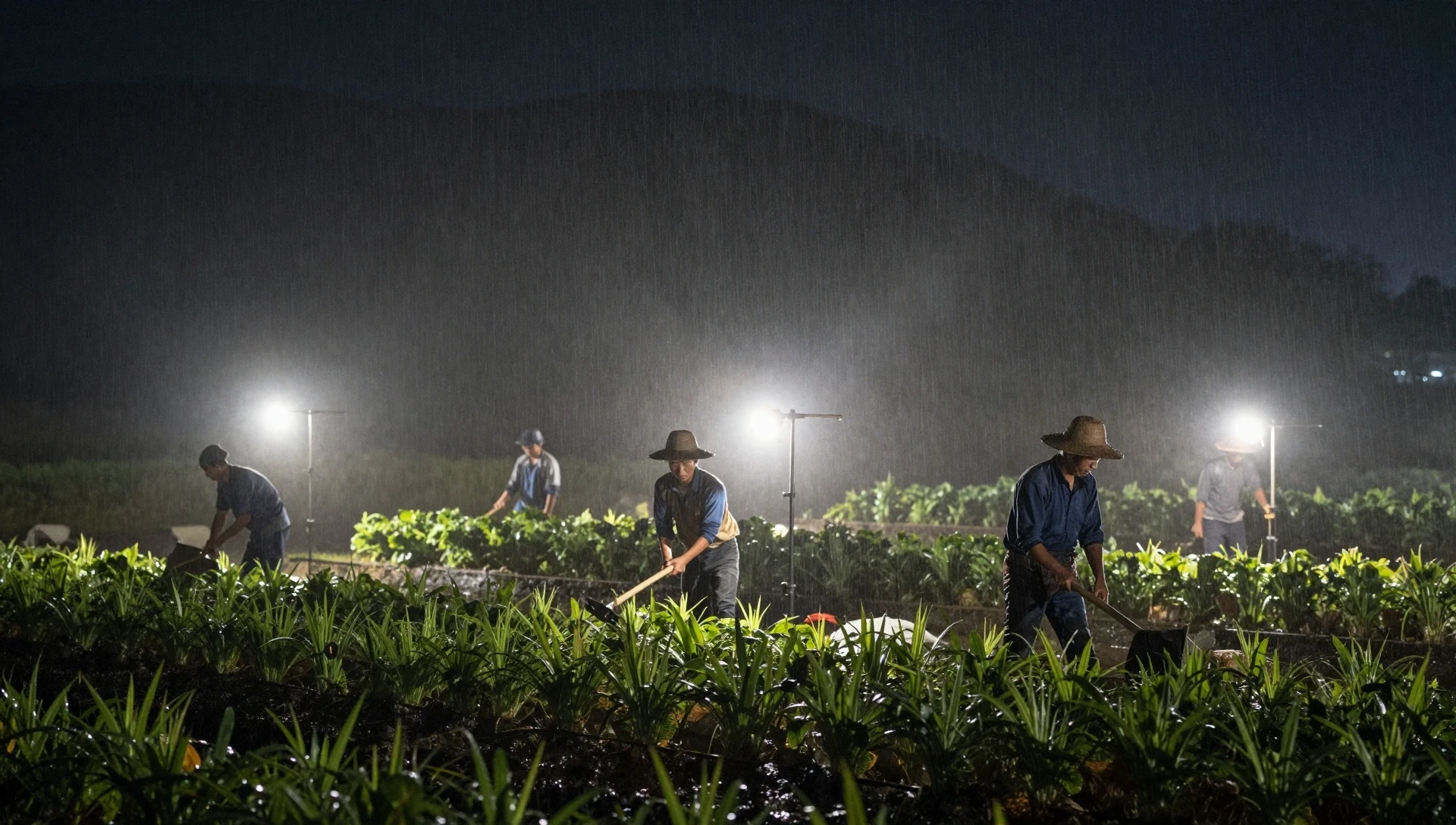
Japan's agricultural calendar is being quietly rewritten, not by policy decree or market forces, but by the relentless arithmetic of rising temperatures. Across the archipelago, growers who once began their days at dawn now report to greenhouses after sunset, harvesting flowers and vegetables under artificial light while the land cools.
This nocturnal migration represents one of the most tangible human adaptations to climate change documented in the developed world, a shift that touches food security, public health, and the cultural identity of farming itself.
The phenomenon is neither temporary nor marginal; it is a structural reorganisation of rural labour unfolding in real time.
On This Page
The numbers behind this transformation are sobering. Japan's farming population is among the oldest on earth, with roughly seventy percent of agricultural workers aged sixty-five or older. These are precisely the citizens most vulnerable to heat stress, whose bodies regulate temperature less efficiently and who often work alone on smallholdings.
When a greenhouse interior climbs past forty degrees Celsius while the outside air reads thirty-five, the margin between productivity and peril narrows to almost nothing. Farmers have responded with the only tool immediately available to them: the clock.
By moving work into the night and the earliest morning hours, they buy themselves cooler air and, quite literally, additional years of life.
What follows examines the full scope of this shift, from the personal testimonies of growers north of Tokyo to the macroeconomic losses quantified by health researchers. It considers livestock farmers racing to feed hens before the heat suppresses appetite, the regulatory framework introduced in 2025, and the technological promises of drones and robots that remain, for most farms, distant prospects.
The story of Japan's nocturnal farmers is ultimately a story about adaptation under duress, and about what happens when the climate changes faster than the institutions designed to manage it.
TL;DR Japan's farmers are shifting to night and pre-dawn work as heat waves make daytime labour dangerous, with greenhouse temperatures exceeding 40°C. Roughly 70% of farmers are 65 or older, and 59 agricultural workers died from extreme heat in 2024, more than double the 2021 figure. The sector lost about 926 million working hours to heat exposure, contributing to $46 billion in economy-wide losses, roughly 1% of GDP. Livestock farmers are also adapting through nocturnal feeding schedules, cooling systems, and water additives. New 2025 regulations require heatstroke reporting and emergency planning, while drones and robots offer future relief but remain limited on most farms.
The Human Cost of Heat in Japan's Fields
Behind every statistic about working hours lost or degrees Celsius recorded stands a specific person making a difficult calculation about risk. The Reuters reporting from farms north of Tokyo captures this calculus with unusual clarity, showing how individual growers have reorganised their entire working lives around a single environmental variable.
Heat is no longer an inconvenience to be endured during a few summer weeks; it has become the organising principle of the agricultural day, dictating when seeds are planted, when crops are harvested, and when workers retreat indoors.
Testimonies from the Greenhouse
Motoaki Iijima, a thirty-six-year-old flower farmer, harvests gerbera blooms after sunset under artificial light because his greenhouse can exceed forty degrees Celsius when outside temperatures pass thirty-five. Three years ago, a temporary worker collapsed with heatstroke while picking sunflowers, an event that permanently altered his operation.
His description of becoming "gradually nocturnal" frames the shift as survival rather than strategy, a protective response to conditions that threaten human life.
Miyoko Asada, sixty-eight, represents the other half of the adaptation: the pre-dawn shift. She arrives shortly after sunrise to harvest asters while temperatures remain manageable, describing her work as a race against the clock.
For older farmers working alone, the early morning window is not merely preferable but essential, since heat exhaustion can escalate rapidly with no colleague nearby to summon help or provide shade.
Mortality and Vulnerability Data
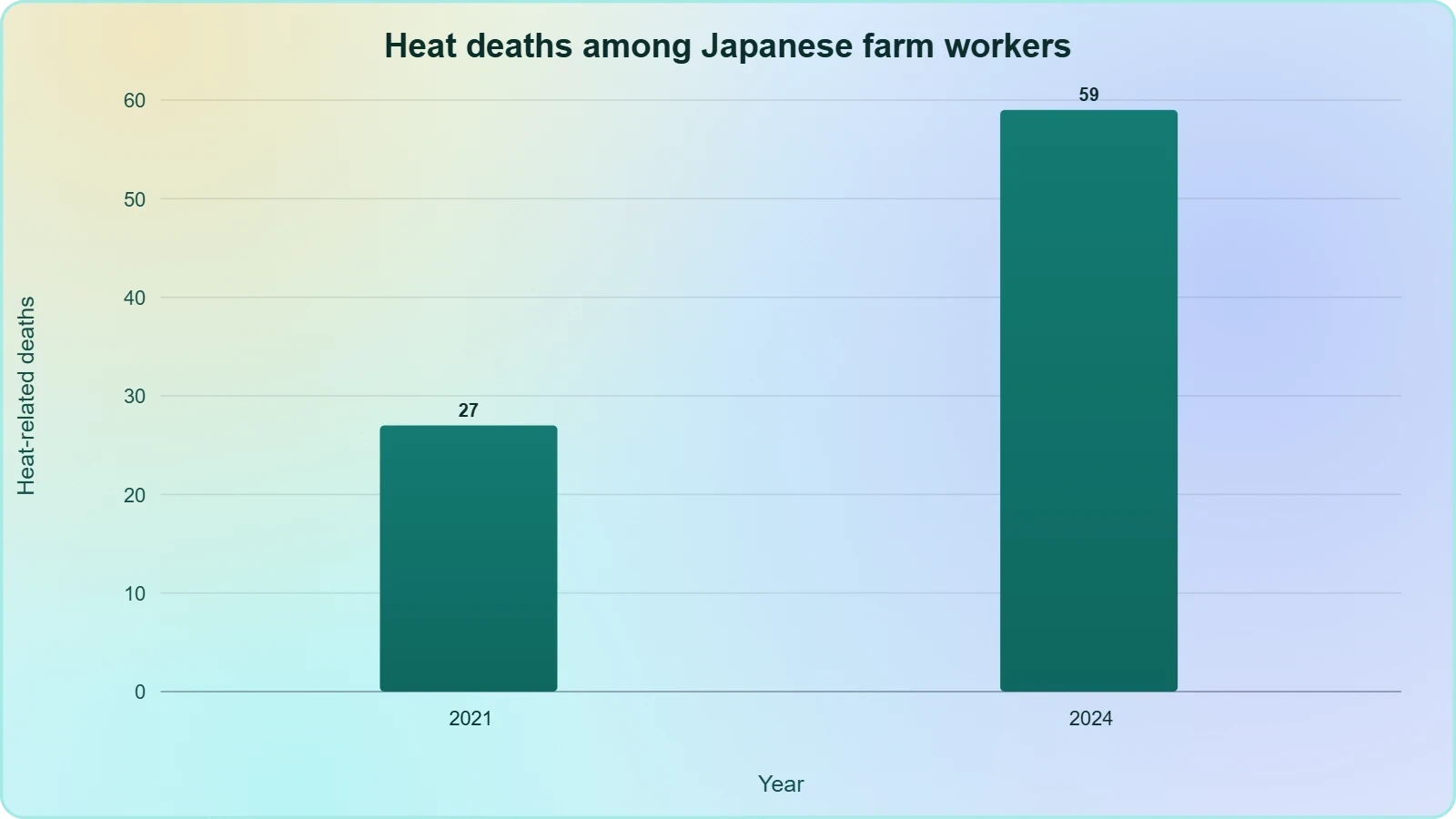
The mortality figures confirm what individual farmers already sense. In 2024, fifty-nine agricultural workers died from extreme heat exposure, more than twice the number recorded in 2021. This doubling in just three years illustrates how quickly the risk profile of outdoor labour has deteriorated, and why the nocturnal shift has spread from isolated farms to become a recognisable regional pattern across Japan's growing belts.
Economic Losses and the Productivity Drain
Heat does not merely endanger lives; it silently erodes the economic foundation of entire industries. The Lancet Countdown collaboration, which tracks the health consequences of climate change across nations, calculated that Japan's agricultural sector lost approximately 926 million working hours in 2024 due to heat exposure.
That figure represents not idle time but productive capacity forfeited, hours when workers could not safely perform the physical tasks on which harvests depend. When aggregated across all industries, the economic toll reached $46 billion, equivalent to roughly one percent of Japan's gross domestic product.
Quantifying the Hidden Tax
A one percent GDP loss may sound modest in isolation, but it compounds annually and falls disproportionately on rural communities with limited economic alternatives. Agriculture already operates on thin margins, and every lost hour translates into delayed harvests, reduced yields, and higher consumer prices.
The heat tax is invisible on any invoice, yet it is paid by every farmer who abandons a field at midday and every consumer who notices shrinking produce sections.
The working-hour metric is particularly revealing because it captures adaptation costs that mortality statistics miss. Farmers who shift to night work preserve their health but often sacrifice sleep quality, family time, and the social rhythms that sustain rural communities.
The economic calculation therefore understates the true burden, since it counts only hours not worked rather than the full human cost of reorganising life around temperature.
Comparing Sectoral Exposure
Agriculture bears the brunt of heat exposure because its work is inherently outdoor, seasonal, and difficult to automate. Construction and logistics face similar pressures but can adjust schedules across larger workforces with more flexibility.
Farming's small-scale, family-based structure means adaptation happens one household at a time, with no corporate safety net to absorb the transition costs.
Livestock Farmers and Nocturnal Feeding Strategies
Crop farmers can shift harvest hours, but livestock farmers face a more complex problem: animals eat when they are hungry, and heat suppresses appetite. Tetsuya Usuba, a forty-eight-year-old chicken farmer, has responded by turning on his barn lights at 2:30 a.m. so his 4,400 laying hens can feed before daytime temperatures climb.
This nocturnal feeding schedule is a direct physiological intervention, ensuring birds consume enough calories before the heat makes eating unappealing and dangerous.
Engineering Cooler Barns
Usuba's adaptation extends beyond scheduling. He has installed additional fans, cools the metal roof with water, and adds citric acid to the drinking water to help hens cope with heat stress. These measures represent a layered defence, combining behavioural change with physical infrastructure.
Six summers ago, he lost more than five hundred hens within three days; recently, another 130 died when temperatures exceeded thirty-five degrees, showing how fragile these gains remain.
His comparison of summer heat to avian influenza is striking and revealing. Both are existential threats that can wipe out flocks within days, but influenza arrives unpredictably while heat now returns every year with growing intensity.
For producers, this predictability offers a grim advantage: they can plan for heat, install cooling systems, and adjust schedules, whereas disease outbreaks often strike without warning.
The Limits of Animal Adaptation
Hens, like humans, have physiological thresholds beyond which cooling measures fail. When ambient temperatures exceed thirty-five degrees for extended periods, even well-ventilated barns become lethal. The citric acid and fans buy time and reduce mortality at the margins, but they cannot eliminate the fundamental vulnerability of housing thousands of animals in metal-roofed structures during increasingly severe summers.
- 01
- 02
- 03
- 04
Regulation, Technology, and the 2025 Workplace Rules
Individual adaptation has limits, and Japan's government has begun codifying protections that farmers cannot reasonably provide alone. New workplace regulations introduced in 2025 require employers to report heatstroke cases and develop emergency response plans.
These rules formalise what had previously been informal practice, creating accountability structures around a hazard that was long treated as an unavoidable feature of agricultural life rather than a reportable workplace danger.
What the New Rules Require
The reporting requirement is significant because it generates data. When heatstroke cases must be documented, patterns emerge that can inform future policy, insurance pricing, and equipment investment. Emergency plans compel farms to think through response protocols before crises occur, ensuring that when a worker collapses, someone knows whom to call and what to do.
Yet regulation alone cannot cool a greenhouse. The rules establish a floor of accountability, but the ceiling of protection depends on resources that many small farms lack. A farmer with four employees and thin margins may struggle to implement comprehensive emergency planning, particularly when the same farmer is already working nights to avoid the heat that the regulations address.
Drones, Robots, and the Automation Promise
Technological solutions, including drones and robots, are expected to reduce physical labour in the sun. Automated harvesters and spraying drones could theoretically perform the most heat-exposed tasks without human risk.
However, on many farms, adapting to heat remains a manual task and a daily race against rising temperatures, with automation arriving slowly and unevenly across regions and crop types.
The gap between technological promise and on-farm reality is widening. Large agribusinesses can invest in robotic systems, while smallholders continue to rely on schedule shifts and personal endurance. This divergence risks creating a two-tier agricultural sector, where well-capitalised operations thrive in the heat while family farms wither, accelerating the consolidation already underway in Japanese agriculture.
An Ageing Workforce Facing a Warming Climate
The intersection of demographic decline and climate change creates a vulnerability that neither trend alone would produce. Japan's farmers are older than the general population, with roughly seventy percent aged sixty-five or above.
Age reduces the body's capacity to dissipate heat through sweating and cardiovascular adjustment, meaning the same greenhouse conditions that challenge a thirty-six-year-old can be lethal to a sixty-eight-year-old within minutes of exertion.
Why Older Farmers Are More Exposed
Older farmers often work alone, manage smaller plots with fewer mechanised aids, and possess deep knowledge of traditional schedules that no longer match current temperatures. Their experience tells them when crops should be harvested, but the climate has shifted the safe window earlier and later, forcing them to abandon habits refined over decades. The cognitive adjustment required is substantial.
Social isolation compounds physical vulnerability. A farmer working alone at dawn has no colleague to notice confusion, nausea, or collapse, the early signs of heatstroke. Community networks that once provided informal oversight have thinned as rural populations decline, leaving many older growers to manage risk entirely on their own, with only a mobile phone as a lifeline.
Succession and the Future of Farming
Younger farmers like Iijima represent hope, but they are exceptions in a sector where succession is rare. His nocturnal adaptation shows that younger growers can innovate, yet the broader demographic reality means most Japanese farms will change hands or cease operation within the coming decades. Whether the next generation inherits heat-resilient practices or simply inherits heat remains an open question.
What Japan's Nocturnal Farms Reveal About Global Agriculture
Japan's experience functions as an early warning system for agricultural regions worldwide. Its combination of an ageing farm population, advanced industrial economy, and rapidly warming summers creates conditions that other developed nations will confront within decades.
The nocturnal shift documented in greenhouses north of Tokyo is not a Japanese peculiarity but a preview of adaptations that will become necessary across southern Europe, the American Southwest, and parts of Australia.
Lessons for Other Farming Regions
The first lesson is that scheduling flexibility is the cheapest adaptation available. Before investing in robotics or retrofitting barns, farmers can shift work hours to cooler periods, a change requiring no capital and delivering immediate safety benefits.
The second lesson is that regulation matters: mandatory reporting transforms heatstroke from a private tragedy into public data that drives policy and investment.
The third lesson concerns equity. Adaptation costs fall hardest on smallholders and older workers, who have the least capacity to absorb them. Without targeted support, climate adaptation will accelerate consolidation, concentrating food production in fewer, larger hands.
Japan's experience suggests that technological solutions, however promising, arrive too slowly and unevenly to protect the most vulnerable farmers.
The Road Ahead
Japan's farmers have demonstrated remarkable ingenuity in the face of rising temperatures, but ingenuity has limits. Night work protects health at the cost of sleep and social life; fans and citric acid reduce mortality but cannot eliminate it.
The deeper challenge remains unaddressed: the climate itself continues to warm, and each summer sets new records that render previous adaptations insufficient.
Ultimately, the nocturnal farm is a symptom rather than a solution. It shows that human beings can adjust to extraordinary conditions, but it also shows the price of doing so.
The farmers harvesting gerberas under artificial light at midnight are not pioneers of a new agricultural model; they are witnesses to a climate transformation that demands far more than schedule changes from the societies that depend on their labour.
From our network :
- The Hidden Cost of AI Convenience: Why Over-Permissioned Agents Are a Security Time BombDiscover why AI agents with excessive permissions create dangerous single points of failure, and learn how implementing least privilege principles can protect your organization from exploitation.
- University Language Proficiency Exams: Why Institutional Tests Demand Different Preparation Than IELTS and TOEFLDiscover why university-specific language proficiency examinations differ fundamentally from IELTS and TOEFL, and learn strategic preparation approaches for institutional assessment success.
- Committed Mediterranean Precipitation Decline: Why Emissions Cuts Alone Cannot Restore Winter RainsNew NOAA research reveals that Mediterranean winter rains may decline irreversibly even with emissions cuts. Explore the science of committed climate change and regional impacts.
- Mobile Learning and VR in English: What Global Evidence Reveals About Effective Language TechnologyA systematic review across 14 countries reveals which language-learning technologies genuinely work. Mobile learning, AI, and VR show measurable benefits when pedagogically integrated. This evidence-based guide helps educators and learners select technology that delivers real return on investment.
- CISA’s Ten-Advisory Wave: Why Generic Patching Fails in OT and How to Build Product-Specific PlaybooksCISA released ten ICS advisories in one week, exposing critical infrastructure risks. Generic patching fails in OT. Learn to build product-specific remediation playbooks.
- The Final Descent: How ESA Retired the Legendary Cluster Constellation After 24 Years of Space Weather ScienceAfter 24 years mapping Earth’s magnetosphere, ESA’s Cluster mission concluded with a precisely controlled reentry over the South Pacific. This analysis explores the scientific legacy, engineering decisions, and debris mitigation principles behind one of space exploration’s most responsible retirements.
- Forbidden Matrix Patterns and Visible Lattice Points: A Geometric DictionaryExplore how multidimensional 0–1 matrices encode geometric truths, linking forbidden patterns to visible lattice points and hypergraph theory, with applications in combinatorics and computational geometry.
- How AI Agents Will Change the Way We Manage Personal FinancesExplore how AI agents are transforming personal finance through automated budgeting, bill payment, and investment management, while examining the critical security protocols and governance frameworks required for safe deployment.
- Live Online English Classes for Kids: Do They Actually Reduce Anxiety?A ten-week study reveals that synchronous online English classes can significantly reduce child language anxiety while improving listening and reading skills. Discover what makes these programs effective and how parents can select the right one.
RESOURCES
- Resources will be updated soon.
- 01
- 02
- 03
- 04
- 05
- 06
- 07
- 08
0 Comments