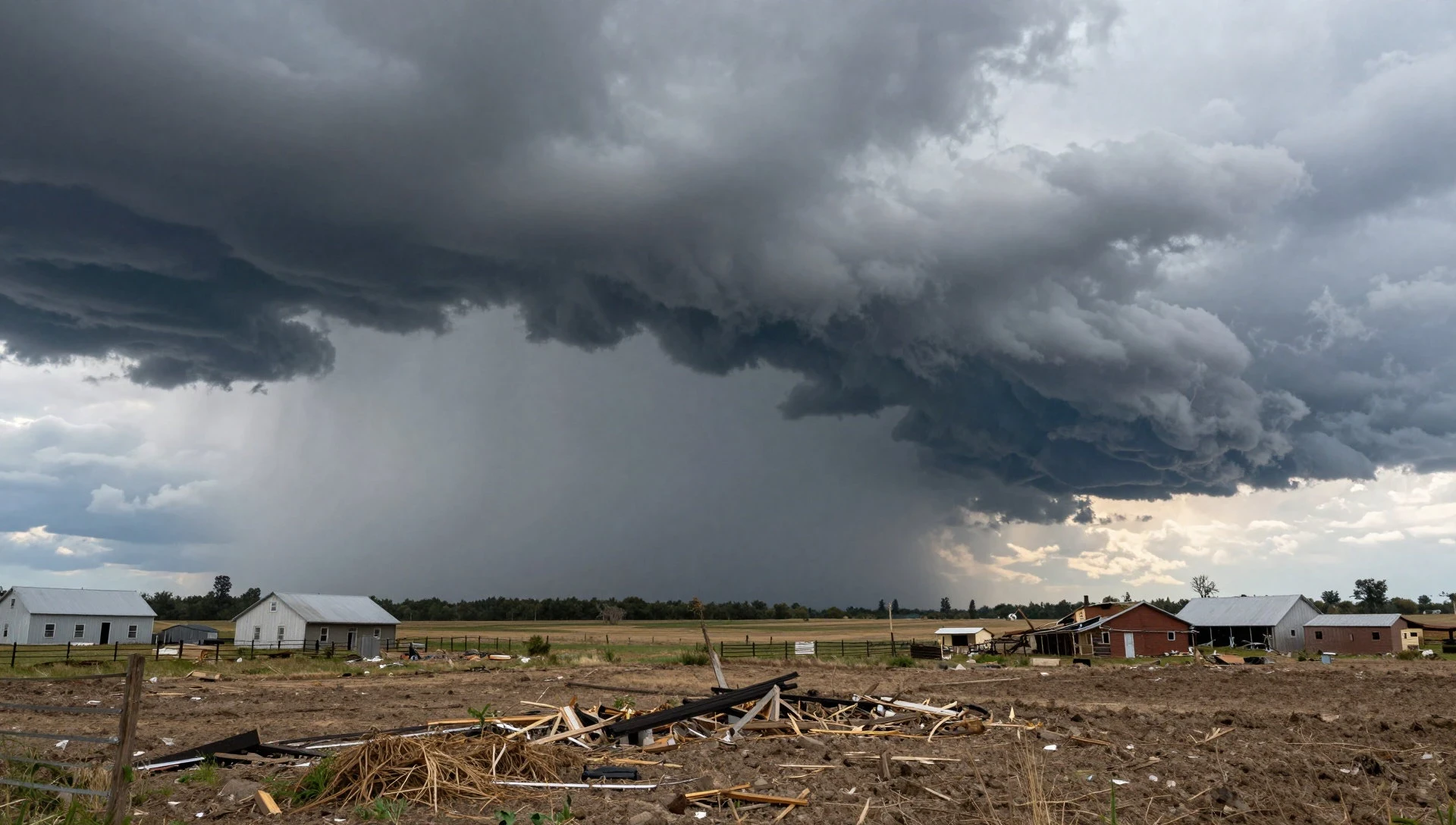
A severe, tornado-like storm struck the locality of Good Hope, roughly twelve kilometres from Yass in the New South Wales Southern Tablelands, on a Saturday afternoon, stripping roofs from buildings, toppling trees and driving golf-ball-sized hail through windows and roofing.
The State Emergency Service confirmed that six roofs were removed entirely and ten further buildings sustained roof damage, while fallen trees initially blocked road access to the community. No injuries have been reported, a fact that residents and emergency commanders alike have emphasised as the most important outcome of an event that otherwise left a trail of structural destruction across a small rural settlement.
Eyewitness accounts converge on a distinctive meteorological signature: winds arriving from conflicting directions, then twisting, accompanied by loud noise, lightning and large hail. Yass Valley councillor David Rothwell described the experience as frightening and unlike anything he had previously witnessed, while SES commander Deanne Young characterised the event as tornado-like, noting an apparent funnel forming from the clouds.
On This Page
The storm's brevity, lasting perhaps ten to fifteen minutes according to resident Tom Walsh, contrasted sharply with the scale of damage it produced, and the absence of meaningful warning has become a central point of scrutiny in the aftermath.
What follows examines the incident as a case study in severe convective weather, emergency response capacity and rural infrastructure vulnerability. It weighs the physical evidence against the official damage assessment, situates the event within the broader pattern of extreme weather affecting south-eastern Australia, and considers what the Good Hope experience reveals about warning systems, insurance exposure and community resilience in small settlements beyond the metropolitan fringe.
TL;DR A tornado-like storm struck Good Hope near Yass, NSW, on a Saturday afternoon, removing six roofs, damaging ten more, toppling trees and cutting power for roughly eight hours. No injuries were reported despite golf-ball-sized hail and winds that residents described as twisting and arriving without warning. The event, lasting only ten to fifteen minutes, displaced a shipping container some 300 metres and lifted a pergola roof approximately 120 metres. It illustrates the disproportionate impact of short-duration severe convective storms on small rural communities, the limits of current warning lead times, and the lengthy clean-up and insurance burden that follows.
The Anatomy of a Short-Duration Severe Convective Event
Severe convective storms of this type occupy a peculiar category in meteorological risk assessment: individually brief, geographically confined, yet capable of damage intensities that rival more publicised hazards. The Good Hope event compressed its entire destructive phase into roughly a quarter of an hour, which complicates both forecasting and post-event attribution. Understanding what occurred requires separating the storm's dynamics from its consequences.
Wind Behaviour and the Tornado-Like Signature
Residents consistently reported winds blowing from different directions before twisting, a pattern consistent with rotating updrafts rather than straight-line gust fronts. Commander Young's observation of an apparent funnel forming from the clouds supports this reading, though formal classification would require damage surveys. The distinction matters because tornado and microburst damage demand different engineering responses.
Damage indicators at Good Hope align with rotational signatures: roofs removed rather than uniformly pressed inward, and debris transported laterally over considerable distances. A pergola roof travelled approximately 120 metres, while a shipping container moved roughly 300 metres before striking a horse float.
Such displacement distances imply substantial aerodynamic forces acting on objects with large surface areas relative to their mass.
Tom Walsh's fifteen years in the Pilbara, where cyclones are routine, provides a useful comparative benchmark. His statement that he had never seen damage of this kind suggests intensities at the upper end of what Australian inland communities typically encounter. Cyclonic wind fields are prolonged and broadly predictable; this event was neither.
The absence of injuries, given hail described as golf-ball-sized and structural failures across sixteen buildings, reflects timing and luck as much as preparedness. Had the storm arrived during a busier period at the Good Hope Resort holiday park, the casualty profile could have differed materially. Emergency managers will note this gap between outcome and exposure.
Warning Lead Time and the Forecast Gap
Commander Young's assessment that there was little warning before the storm hit identifies the central operational weakness. Short-lived convective cells can develop and mature within timeframes shorter than public alerting cycles comfortably accommodate. The gap between detection and community notification remains a structural constraint in severe weather response.
Radar coverage across the Southern Tablelands is serviceable but not dense, and low-level rotation may not be resolved before damage occurs. Residents described the event arriving quickly, which is consistent with rapid cell intensification.
Improving lead time therefore depends less on better forecasting models than on faster dissemination once a signature is detected.
The SES response itself appears to have been efficient, with damage assessments completed and six roofs removed and ten damaged properties catalogued. That administrative clarity, however, follows the event rather than preceding it. The distinction between response capability and warning capability is frequently blurred in public discussion and deserves sharper separation.
Community-level preparedness in settlements of Good Hope's size depends heavily on informal networks rather than formal alerting infrastructure. Neighbours checking on neighbours substituted for the warning that never arrived. This informal resilience is valuable but unevenly distributed and difficult to scale across larger populations.
Infrastructure Vulnerability in Rural Settlements
The loss of power for approximately eight hours followed a pergola roof striking a power pole and bringing down lines within the holiday park. Single points of failure characterise rural distribution networks, where one damaged pole can isolate an entire community. Restoration times of this magnitude are typical but disruptive.
Road access was initially blocked by toppled trees, a recurring pattern in heavily vegetated tablelands terrain. Clearing operations must precede damage assessment and repair, creating a sequencing problem for emergency services. The SES noted this constraint explicitly, and it shaped the timeline of the response.
Building stock in small communities often predates contemporary wind-loading standards, and roof loss rates of six total removals against ten partial damages suggest construction variability. Older structures with inadequate tie-downs fail first. Retrofitting programmes exist but penetration in low-density areas remains limited by cost and awareness.
The shipping container's 300-metre displacement illustrates a broader point about unanchored assets on rural properties. Sheds, containers and outbuildings are rarely engineered for extreme wind, yet they generate debris that damages primary structures. Debris propagation effectively amplifies the storm's destructive footprint beyond its meteorological core.
Comparative Context: How This Event Sits Within Australian Severe Weather
Placing Good Hope in context requires comparison with other Australian severe weather categories, each with distinct damage profiles, warning characteristics and insurance implications. The table below contrasts the principal hazard types affecting south-eastern Australia, drawing on typical parameters rather than this single event's specifics.
Seasonal Patterns and the Southern Tablelands
The Southern Tablelands experiences warm-season convective activity between October and March, when surface heating and moisture availability support thunderstorm development. A late-October event falls squarely within this window. The region's elevated terrain can enhance lift and organise cells in ways that coastal forecasting models may underrepresent.
Golf-ball-sized hail, roughly three to four centimetres in diameter, requires strong updrafts capable of suspending such stones aloft. This implies updraft velocities in the range of ##v \approx \sqrt{\frac{4 g d \rho_i}{3 C_d \rho_a}}##, where ##d## is hailstone diameter and the density terms reflect ice and air respectively. Sustained velocities of this order indicate a well-organised storm.
Climate attribution for individual convective events remains methodologically difficult, though the broader trend toward increased atmospheric moisture and instability in south-eastern Australia is well documented. Warmer sea surface temperatures and enhanced moisture transport raise the probability of high-precipitation and hail-producing storms, even where total storm counts remain stable.
Insurance exposure in the region reflects this pattern. Hail and storm damage constitute a substantial share of household claims in inland New South Wales, and the concentration of older housing stock in small settlements amplifies loss ratios. Events like Good Hope's contribute incrementally to premium pressure across the region.
Emergency Response Capacity and the SES Model
The State Emergency Service operates as a volunteer-based organisation, and its capacity in rural areas depends on the availability of trained volunteers during working hours. A Saturday afternoon event tests this model differently than a weekday incident would. Response times and assessment completeness vary accordingly.
Commander Young's public statements indicate a structured response: damage assessment, roof removal, and coordination with power authorities. The removal of six roofs is a safety measure, eliminating loose sheeting that could become secondary debris. This procedural discipline reflects established practice rather than improvisation.
Volunteer fatigue is a persistent concern in regions experiencing repeated events. The Southern Tablelands has seen multiple severe weather incidents in recent years, and each callout draws on the same limited pool. Sustaining capability requires recruitment and training investment that small communities struggle to fund independently.
Coordination between SES, local councils and utility providers determines restoration timelines. The eight-hour power outage at Good Hope Resort reflects the sequence: debris clearance, pole replacement, line reconnection. Compressing this sequence requires pre-positioned resources, which rural areas rarely justify on cost grounds.
Economic and Insurance Implications
Six destroyed roofs and ten damaged ones represent a modest aggregate loss by metropolitan standards, but the proportional impact on a community of Good Hope's size is substantial. Repair capacity in rural areas is constrained by distance and the limited availability of tradespeople, extending displacement periods well beyond the physical repair window.
Insurance claims for storm damage typically involve excess payments that disproportionately affect lower-income households. Where roofs are removed entirely, temporary accommodation costs compound the financial burden. The absence of injuries does not imply an absence of hardship, and recovery timelines in small settlements often stretch across months.
Underinsurance is a documented problem in rural Australia, with many households carrying sums insured below replacement cost. Post-event assessments frequently reveal gaps between claim payouts and actual rebuild expenses. This shortfall falls on households, charities and, in extremis, on public disaster relief funding.
Local economic disruption extends beyond property. The Good Hope Resort's eight-hour outage affected guests and operations, and the holiday park's pergola loss represents lost amenity. For businesses dependent on seasonal visitation, even brief closures carry revenue consequences that aggregate across the regional economy.
We Also Published
- 01
- 02
- 03
- 04
Lessons for Preparedness, Policy and Community Resilience
The Good Hope event offers several transferable lessons that extend beyond its immediate geography. Short-duration convective storms will continue to produce disproportionate damage in small settlements, and the policy response must address warning dissemination, building standards and recovery support simultaneously rather than sequentially.
Improving Warning Dissemination
Current alerting relies on mobile push notifications, radio and social media, each with coverage gaps in rural areas. Mobile blackspots in the Southern Tablelands mean that app-based warnings may not reach residents in time. Redundancy across channels is essential, not optional.
Community sirens, long used in cyclone-prone regions, have limited penetration inland. Their cost per capita in low-density areas is high, which discourages adoption. Alternative approaches, including landline auto-dialling and local radio interruption protocols, deserve renewed evaluation given their lower infrastructure requirements.
Lead time improvements also depend on radar densification. The Bureau of Meteorology's network has gaps in inland New South Wales, and low-level rotation detection requires close-range Doppler coverage. Investment in this infrastructure yields measurable warning gains for exactly the kind of event that struck Good Hope.
Public education complements technology. Residents who understand the visual and auditory signatures of an approaching tornado-like storm can act faster than those awaiting an official alert. School programmes and community workshops offer low-cost pathways to improved readiness.
Building Standards and Retrofitting
Australian building standards for wind loading have strengthened over decades, but enforcement applies primarily to new construction. The existing rural housing stock, much of it built before current codes, remains vulnerable. Retrofitting roof tie-downs and bracing is technically feasible but economically challenging for individual households.
Subsidised retrofitting programmes have precedents in cyclone regions, where government funding supports structural upgrades. Extending similar logic to severe convective storm zones would require actuarial justification, but the loss data increasingly supports the case. The alternative is repeated post-event reconstruction at higher aggregate cost.
Non-habitable structures deserve attention too. The shipping container that travelled 300 metres was presumably unanchored, and such objects become projectiles in high winds. Simple anchoring requirements for rural outbuildings could reduce secondary damage substantially at modest cost.
Standards alone do not guarantee compliance, particularly in informal or owner-built structures. Inspection regimes in rural areas are thin, and enforcement capacity is limited. Education and incentive-based approaches may achieve more than regulation in these contexts.
Community Networks and Informal Resilience
The absence of injuries at Good Hope reflects, in part, the density of informal social ties in small communities. Neighbours checking on neighbours, sharing information and assisting with immediate clean-up substituted for formal systems that arrived later. This social capital is a genuine asset.
Formalising these networks through community emergency groups can extend their reach without displacing their informal character. Local knowledge of vulnerable residents, access routes and equipment availability is difficult to replicate from centralised databases. Community groups hold this information organically.
Resilience also depends on economic capacity. Households with savings and insurance recover faster; those without may never fully rebuild. Policy that addresses underlying financial vulnerability is therefore a form of disaster preparedness, even if it is rarely framed that way in emergency management literature.
The Good Hope clean-up will conclude, and attention will shift elsewhere. The test of lesson-learning is whether warning systems, building practices and community networks improve before the next short-duration storm arrives.
On current evidence, the case for investment is clear, and the cost of inaction is measurable in roofs, livelihoods and recovery years.
From our network :
- Mobile Learning and VR in English: What Global Evidence Reveals About Effective Language TechnologyA systematic review across 14 countries reveals which language-learning technologies genuinely work. Mobile learning, AI, and VR show measurable benefits when pedagogically integrated. This evidence-based guide helps educators and learners select technology that delivers real return on investment.
- The Final Descent: How ESA Retired the Legendary Cluster Constellation After 24 Years of Space Weather ScienceAfter 24 years mapping Earth’s magnetosphere, ESA’s Cluster mission concluded with a precisely controlled reentry over the South Pacific. This analysis explores the scientific legacy, engineering decisions, and debris mitigation principles behind one of space exploration’s most responsible retirements.
- Committed Mediterranean Precipitation Decline: Why Emissions Cuts Alone Cannot Restore Winter RainsNew NOAA research reveals that Mediterranean winter rains may decline irreversibly even with emissions cuts. Explore the science of committed climate change and regional impacts.
- How AI Agents Will Change the Way We Manage Personal FinancesExplore how AI agents are transforming personal finance through automated budgeting, bill payment, and investment management, while examining the critical security protocols and governance frameworks required for safe deployment.
- The Hidden Cost of AI Convenience: Why Over-Permissioned Agents Are a Security Time BombDiscover why AI agents with excessive permissions create dangerous single points of failure, and learn how implementing least privilege principles can protect your organization from exploitation.
- CISA’s Ten-Advisory Wave: Why Generic Patching Fails in OT and How to Build Product-Specific PlaybooksCISA released ten ICS advisories in one week, exposing critical infrastructure risks. Generic patching fails in OT. Learn to build product-specific remediation playbooks.
- Forbidden Matrix Patterns and Visible Lattice Points: A Geometric DictionaryExplore how multidimensional 0–1 matrices encode geometric truths, linking forbidden patterns to visible lattice points and hypergraph theory, with applications in combinatorics and computational geometry.
- Live Online English Classes for Kids: Do They Actually Reduce Anxiety?A ten-week study reveals that synchronous online English classes can significantly reduce child language anxiety while improving listening and reading skills. Discover what makes these programs effective and how parents can select the right one.
- University Language Proficiency Exams: Why Institutional Tests Demand Different Preparation Than IELTS and TOEFLDiscover why university-specific language proficiency examinations differ fundamentally from IELTS and TOEFL, and learn strategic preparation approaches for institutional assessment success.
RESOURCES
- A violent "tornado-like" storm cell has torn roofs from buildings ...facebook.com1 day ago ... A violent "tornado-like" storm cell has torn roofs from buildings, toppled trees and brought "golf-ball-sized hail" to a small rural ...
- Violent tornado-like storm tears roofs from buildings near Yassabc.net.au1 day ago ... Residents are picking up the pieces after a severe storm caused major damage. ... The system hit Good Hope, about…
- Yass Storm Disaster: Six Roofs Torn Off as Tornado - Facebookfacebook.com12 hours ago ... The severe weather struck as thunderstorms affected several regions of NSW and the ACT over the weekend. Residents are urged…
- Residents of a small community on the New South Wales Southern ...instagram.com1 day ago ... ... severe storm caused major damage. #ABCNewsACT #Storm ... #NSWSouthTablelands #GoodHope #SevereWeather #Yass #AusWeather #StormDamage #AusFlash # ...
- Rare tornado rips off roofs and blocks roads in Good Hope near Yassdailytelegraph.com.au1 day ago ... A NSW State Emergency Service (SES) spokesperson told The Daily Telegraph the tornado had damaged about 10 buildings, some of…
- Are LA natives actually worried about this “Super El Niño” winter?reddit.comSep 7, 2026 ... I keep seeing severe flooding and mudslides mentioned as the big risks. Is that realistic for most of the city,…
- Foresight (July-August 1974) - National Weather Serviceweather.govApr 3, 1974 ... produce many of the tornadoes, we don't do as well ... Fire personnel have also been trained by the Emergency…
- Which weather hazard would you rather deal with? : r/tornado - Redditreddit.comMar 6, 2023 ... Small, intense storms, both displaying downburst-streak damage, like ... Before the storm: massive preparations, filling the car with gas ...
- Natural Hazard Mitigation Plan 2025 Revision - Nez Perce Tribenezperce.orgJul 6, 2025 ... Safety. High. Page 99. Page | 91. MAI # 5: Mitigate the potential risks of damage and losses due to…
- CYCLONE YAAS 2021:nidm.gov.inMay 28, 2021 ... Earthquake, Wind, Flood, Landslide, Thunderstorm Maps and Damage Risk to Housing. ... as a very Severe Cyclonic Storm.The observed and…
- S.Hrg. 109-446 — WEATHER MODIFICATION AND S. 517, THE ...congress.gov... severe storm modification (including hurricanes and tornadoes) as well. I ... severe storm damage ranging from hail and lightning to wind and water…
- BUSHFIREbulletin - NSW Rural Fire Servicerfs.nsw.gov.auNov 17, 2007 ... as well as a tornado on the north coast and outbreak of equine ... following severe storm activity and major…
- H. Rept. 119-271 - DEPARTMENTS OF LABOR, HEALTH AND ...congress.gov... as a chronic disease as it considers best practices to improve care for people with obesity. Office of Rural Health.--The Committee is encouraged…
- Ecosystems, Livelihoods and Disasters - IUCN Portalsportals.iucn.orgproviding for safety and basic needs is clearly the domain of emergency professionals and humanitarian agencies. As the focus turns to human livelihood recovery ...
- 01
- 02
- 03
- 04
- 05
- 06
- 07
- 08
0 Comments