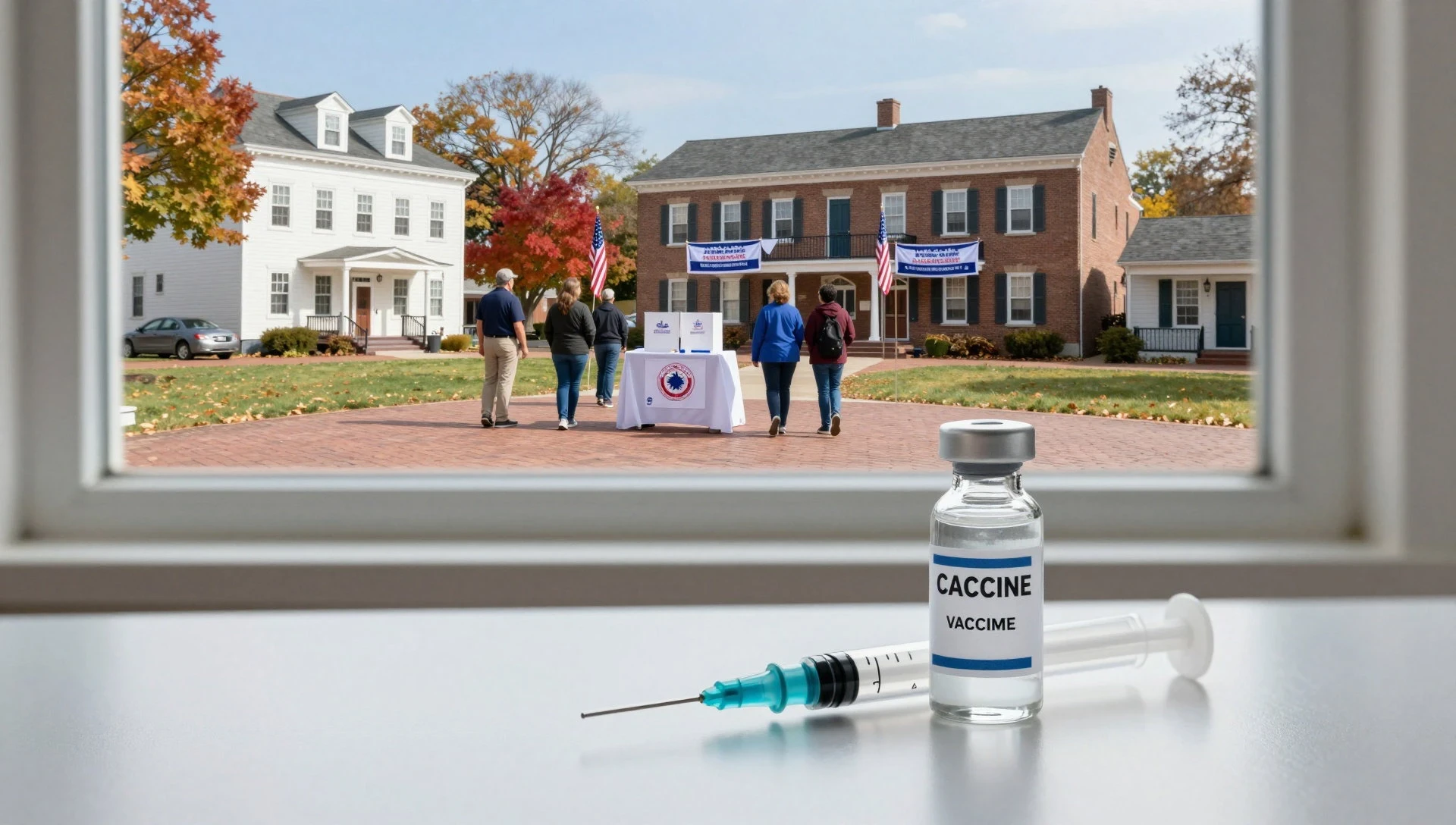
A measles outbreak in Pennsylvania has converted a routine matter of epidemiology into a live variable in the 2026 midterm elections. More than 1,300 confirmed cases and five deaths in the state this year have given Democratic candidates a concrete, locally verifiable argument against federal vaccine policy under Health and Human Services Secretary Robert F.
Kennedy Jr. The dispute is no longer abstract: it pits Governor Josh Shapiro's administration against federal health officials over case counts, mortality attribution and the credibility of state reporting.
Kennedy has publicly questioned whether the deaths were caused by measles and suggested that Shapiro's staff exaggerated the outbreak's severity. A midwife working in affected communities, who asked not to be named because of patient privacy, said the secretary is denying the science and misrepresenting the numbers, producing further confusion among families already deciding whether to vaccinate.
On This Page
- The Epidemiological and Political Anatomy of the Pennsylvania Outbreak
- Polling Evidence and the Strategic Logic of Vaccine Politics
- Institutional Trust, Science Communication and the 2026 Electoral Stakes
- From Vaccine Confidence to Institutional Credibility
- Trust Erosion Across Institutional Actors
- Electoral Consequences in Competitive Districts
- What the Outbreak Reveals About Policy Accountability
- Electoral Exposure by State
- Comparative Reading: Measles Against Other Campaign Issues
- Issue Attributes Comparison
That tension between federal messaging and frontline clinical experience is the mechanism by which a health emergency becomes a political one.
The electoral arithmetic is unusually explicit. A May Reuters/Ipsos survey found 41% of registered voters trust Democrats on vaccine policy against 25% for Republicans, while 60% disapproved of Kennedy's performance. A September follow-up found 62% concerned about measles outbreaks and 55% disapproving of President Donald Trump's handling of them.
Those margins, applied to competitive districts in Pennsylvania, Wisconsin, Utah and South Carolina, explain why public health has moved from the science pages to the campaign stump.
TL;DR A measles outbreak producing more than 1,300 cases and five deaths in Pennsylvania has become a central midterm election issue, with Democrats tying Republican candidates to HHS Secretary Robert F. Kennedy Jr. and federal vaccine policy. Polling shows a 41% to 25% Democratic advantage on vaccine trust and 60% disapproval of Kennedy, prompting a six-figure ad campaign by 314 Action across at least five states. Some Republicans, including former congressman and physician Michael Burgess, warn that vaccine messaging risks alienating swing voters in tight races.
The Epidemiological and Political Anatomy of the Pennsylvania Outbreak
The Pennsylvania outbreak is best understood as two crises running on different clocks. The epidemiological clock measures transmission chains, hospitalization rates and mortality; the political clock measures campaign calendars, ad buys and polling windows.
When the second clock accelerates faster than the first, contested claims about case counts become campaign material before epidemiological consensus can settle the underlying facts.
Case Burden and Mortality Attribution
Five deaths against 1,300-plus cases implies a crude case fatality ratio near 0.38%, or roughly one death per 260 reported infections. That figure sits within the range historical measles surveillance would predict for an undervaccinated population, which is precisely why the dispute over attribution matters.
If deaths are counted, the outbreak reads as a genuine emergency; if they are minimized, it reads as routine.
Measles is among the most transmissible pathogens known, with a basic reproduction number commonly estimated between 12 and 18. Herd immunity therefore requires roughly 92% to 95% population coverage, a threshold derived directly from that reproduction number.
Any cluster falling below it becomes a self-sustaining transmission zone, which is why localized undervaccination produces disproportionate case counts.
The political dispute over mortality attribution is therefore not a semantic sideshow. Official death counts determine public risk perception, and risk perception drives vaccination behavior. When a health secretary questions whether people died from the disease, the practical effect is to depress the perceived severity that sustains coverage above the herd immunity threshold.
Federal-State Friction and Reporting Credibility
The conflict between Governor Shapiro's administration and federal health officials introduces a second-order problem: competing official numbers. Public health response depends on a single trusted data stream, and when state and federal agencies publish divergent figures, clinicians, schools and parents must choose which to believe. That ambiguity is itself a transmission risk factor.
HHS did not respond to a request for comment, which leaves the federal position defined largely by the secretary's public statements rather than formal documentation. In governance terms, silence from the agency is not neutral; it cedes the informational field to state officials and to campaign advertising, both of which have incentives that differ from epidemiological accuracy.
Why Outbreak Geography Maps Onto Electoral Geography
Outbreaks cluster where vaccination coverage is lowest, and low-coverage clusters frequently overlap with politically competitive territory. That overlap converts a localized health event into a swing-district issue. Wisconsin, Utah and South Carolina all combine active outbreaks with Senate or gubernatorial contests, giving national campaigns a ready-made local narrative in each state.
Pennsylvania's status as a perennial battleground amplifies the effect. A state that decides presidential outcomes and hosts competitive House districts offers maximum return on any issue that can be localized. Measles, unlike abstract federal policy, produces school closures, quarantines and hospital admissions that voters can observe directly in their own communities.
Polling Evidence and the Strategic Logic of Vaccine Politics
The polling record is unusually consistent for an issue that entered the campaign late. Trust on vaccine policy favors Democrats by sixteen points, disapproval of the HHS secretary sits at sixty percent, and a clear majority expresses concern about outbreaks.
These are not marginal differences; they describe a durable public position that campaigns can build messaging around with low persuasion costs.
Reading the Trust Gap
A 41% to 25% advantage leaves 34% undecided or trusting neither party, a bloc large enough to matter in close races. The strategic question for Democrats is whether that bloc can be moved by outbreak imagery, and for Republicans whether it can be reassured without contradicting federal officials. Both paths run through the same undecided voters.
Disapproval of Kennedy at 60% is the more striking figure because it crosses the majority threshold independently of party identification. When a cabinet secretary becomes net-unpopular, association with him carries cost.
Democratic advertisers have therefore treated his name as a shorthand for federal vaccine policy rather than as an individual, extending the attack's reach beyond any single controversy.
The 314 Action Campaign and Ad-Spend Mechanics
314 Action, a political group backing Democratic candidates with science backgrounds, launched a six-figure campaign in at least five states, including Pennsylvania, beginning in April as cases climbed. The timing is instructive: advertising infrastructure was activated while the outbreak was still expanding, allowing the group to shape interpretation of events rather than merely react to them.
A six-figure buy is modest by statewide standards but substantial in a single congressional district, where it can saturate local broadcast and digital inventory for several weeks. The group's comparative advantage is candidate biography: scientists and physicians running as Democrats can deliver the vaccine message with occupational authority that a generic surrogate cannot replicate.
Republican Counter-Strategy and the Risk of Alienating Voters
Former Texas congressman and physician Michael Burgess has argued that tight races turn on many factors and questioned the wisdom of alienating potential supporters through vaccine messaging. His position reflects a recognizable electoral calculation: vaccine skepticism is concentrated in specific constituencies, and attacking it directly may cost more votes than it wins.
That calculation cuts both ways. A party that stays silent cedes the trust gap; a party that defends federal policy risks its skeptical base. The result is a split response in which some Republicans distance themselves from the secretary while others treat the outbreak as a state matter, producing an inconsistent national message that itself signals uncertainty to voters.
We Also Published
- 01
- 02
- 03
- 04
Institutional Trust, Science Communication and the 2026 Electoral Stakes
Beneath the campaign tactics sits a structural question about how institutions communicate risk. Measles is a solved problem in countries that maintain coverage above the herd immunity threshold; its return is a governance outcome, not a natural inevitability. The 2026 midterms therefore test whether voters reward or punish the political management of a preventable disease.
From Vaccine Confidence to Institutional Credibility
Vaccine confidence is a downstream measure of institutional credibility. When a health secretary disputes death attribution, the effect propagates beyond measles to every subsequent official claim about disease, treatment and risk. The reputational cost is cumulative and difficult to reverse within a single electoral cycle.
The midwife's account illustrates the transmission mechanism at ground level. Clinicians in affected communities must reconcile federal statements with what they observe in patients, and that reconciliation consumes time and trust. Where official numbers are contested, rumor fills the gap faster than any public health campaign can respond.
Electoral Consequences in Competitive Districts
Competitive districts are decided by margins small enough that a single salient local issue can shift outcomes. If measles remains active through the campaign's final weeks, school closures and quarantine notices will function as recurring reminders, keeping the issue in local news without further advertising expenditure by either side.
The asymmetry favors the party out of federal power. Opposition campaigns need only point to observable events; governing parties must defend them. With 55% disapproving of the president's handling and 60% disapproving of the secretary, the defensive burden falls heavily on Republicans in districts where outbreak coverage is highest.
What the Outbreak Reveals About Policy Accountability
Accountability requires attribution, and attribution requires agreed facts. The Pennsylvania dispute demonstrates that when senior officials contest basic epidemiological data, the political system loses the shared factual foundation on which accountability depends. Voters are then left to choose between competing narratives rather than evaluate a common record.
The longer-term risk extends past November. Coverage rates respond to confidence, and confidence responds to consistency. A single season of contested messaging can depress vaccination in subsequent years, producing outbreaks that outlast the electoral cycle that generated them. Public health, unlike campaign spending, does not reset after election day.
Comparative Reading: Measles Against Other Campaign Issues
Measles differs from most campaign issues in one decisive respect: it is measurable. Inflation, immigration and foreign policy are contested through interpretation, but case counts and deaths are countable. That measurability gives the outbreak unusual persuasive force, because voters can verify claims against local school and hospital notices.
The comparison sharpens the strategic picture. An issue that is both locally observable and nationally polled allows campaigns to run the same message across multiple states with minimal adaptation. For Democrats, that efficiency is the real prize; for Republicans, it is the real hazard, since no single counter-message travels as effectively.
The Pennsylvania outbreak ultimately demonstrates how quickly a measurable public health failure becomes a test of institutional credibility. Case counts, death attribution and vaccine trust are now campaign variables, and the polling margins are wide enough to shape strategy in multiple states. Whatever the electoral outcome, the underlying coverage gap that produced 1,300 cases will persist beyond November.
From our network :
- CISA’s Ten-Advisory Wave: Why Generic Patching Fails in OT and How to Build Product-Specific PlaybooksCISA released ten ICS advisories in one week, exposing critical infrastructure risks. Generic patching fails in OT. Learn to build product-specific remediation playbooks.
- Mobile Learning and VR in English: What Global Evidence Reveals About Effective Language TechnologyA systematic review across 14 countries reveals which language-learning technologies genuinely work. Mobile learning, AI, and VR show measurable benefits when pedagogically integrated. This evidence-based guide helps educators and learners select technology that delivers real return on investment.
- How AI Agents Will Change the Way We Manage Personal FinancesExplore how AI agents are transforming personal finance through automated budgeting, bill payment, and investment management, while examining the critical security protocols and governance frameworks required for safe deployment.
- University Language Proficiency Exams: Why Institutional Tests Demand Different Preparation Than IELTS and TOEFLDiscover why university-specific language proficiency examinations differ fundamentally from IELTS and TOEFL, and learn strategic preparation approaches for institutional assessment success.
- Live Online English Classes for Kids: Do They Actually Reduce Anxiety?A ten-week study reveals that synchronous online English classes can significantly reduce child language anxiety while improving listening and reading skills. Discover what makes these programs effective and how parents can select the right one.
- Committed Mediterranean Precipitation Decline: Why Emissions Cuts Alone Cannot Restore Winter RainsNew NOAA research reveals that Mediterranean winter rains may decline irreversibly even with emissions cuts. Explore the science of committed climate change and regional impacts.
- Forbidden Matrix Patterns and Visible Lattice Points: A Geometric DictionaryExplore how multidimensional 0–1 matrices encode geometric truths, linking forbidden patterns to visible lattice points and hypergraph theory, with applications in combinatorics and computational geometry.
- The Hidden Cost of AI Convenience: Why Over-Permissioned Agents Are a Security Time BombDiscover why AI agents with excessive permissions create dangerous single points of failure, and learn how implementing least privilege principles can protect your organization from exploitation.
- The Final Descent: How ESA Retired the Legendary Cluster Constellation After 24 Years of Space Weather ScienceAfter 24 years mapping Earth’s magnetosphere, ESA’s Cluster mission concluded with a precisely controlled reentry over the South Pacific. This analysis explores the scientific legacy, engineering decisions, and debris mitigation principles behind one of space exploration’s most responsible retirements.
RESOURCES
- Resources will be updated soon.
- 01
- 02
- 03
- 04
- 05
- 06
- 07
- 08
0 Comments