
BBC Sport has quietly built one of the most durable engagement engines in sports media, and its daily football quizzes sit at the centre of that strategy. The format is deceptively simple: a fan opens a page, faces a footballer hidden behind a handful of clues, and tries to name the player before the hints run out.
Each wrong guess peels back another layer of information, and the scoring rewards restraint rather than recklessness. Fewer clues consumed means a higher score, which transforms a casual trivia break into a small exercise in disciplined reasoning.
What makes this offering notable is not any single quiz but the ecosystem surrounding it. Alongside the guessing game, BBC Sport publishes Five in Five, a rapid-fire challenge requiring five correct answers inside five minutes, and Brainteaser, a tougher proposition that grants players five lives before revealing the solution.
On This Page
The page also nudges users toward the Match of the Day Predictor deadline, invites submissions of quiz ideas, and links to themed collections covering everything from Premier League clubs to the Lionesses' most-capped players. It is a carefully layered product designed to convert a momentary visit into a recurring habit.
Beneath the entertainment lies a broader editorial lesson about retention, habit formation, and the economics of free content in a crowded attention market. Daily puzzles create appointment behaviour, encourage return visits, and generate the kind of lightweight data that helps publishers understand their audiences.
This analysis examines how the BBC Sport quiz suite works, why its mechanics are psychologically effective, and what the model reveals about the future of fan engagement across digital sports media.
TL;DR BBC Sport has assembled a daily quiz suite for football fans, anchored by a clue-based "Who Am I?" footballer game where fewer clues yield higher scores, alongside Five in Five and Brainteaser formats. The package includes themed collections, notification sign-ups, predictor deadlines, and open calls for user-submitted quiz ideas. The strategic significance lies in habit formation, audience retention, and low-cost engagement that keeps fans returning to the platform between matchdays.
The Architecture of BBC Sport's Daily Quiz Suite
The quiz suite is best understood as a portfolio rather than a single product. Each format targets a different appetite and a different time commitment, from the sixty-second scan of a clue-based footballer puzzle to the five-minute pressure of Five in Five.
Together they cover the full spectrum of fan engagement, from idle curiosity to competitive obsession, without requiring users to install anything or pay for access.
Core Formats and Their Mechanics
The flagship guessing game hides a footballer behind progressive clues. Every incorrect answer unlocks the next hint, and the final score reflects how few clues the player needed. This inverted scoring structure rewards genuine knowledge over trial and error, creating a satisfying tension between confidence and caution that keeps players engaged until the reveal.
Five in Five compresses the experience into a timed sprint, demanding five correct answers within five minutes. Brainteaser takes the opposite approach, presenting one difficult question backed by five lives before the answer appears.
The three formats deliberately vary pacing, difficulty, and failure modes, ensuring that a player frustrated by one challenge can immediately find a more forgiving alternative.
Beyond the Headline Games
The suite extends well past its three flagship formats. Themed collections ask fans to name every club in the Premier League and EFL, or to recall the ten Lionesses with the most England caps.
These list-based challenges tap into the encyclopaedic instincts of dedicated supporters and provide natural sharing material for group chats and social feeds.
A dedicated Sports Quizzes page aggregates the full catalogue, while notification sign-ups let users receive new quizzes directly on their devices. The page also flags the Match of the Day Predictor deadline and invites fans to submit their own quiz ideas.
That final touch matters: it turns the audience from passive consumers into potential contributors, deepening their stake in the product.
Why Clue-Based Scoring Works So Well
The clue-based footballer quiz is a small masterclass in behavioural design. By making information itself the scarce resource, it converts every guess into a calculated trade-off between ambition and safety. Players who guess early risk embarrassment; players who wait too long sacrifice points. That tension is precisely what makes the format memorable and repeatable.
The Psychology of Progressive Disclosure
Progressive disclosure is a well-established principle in interface design, and the quiz applies it to knowledge testing. Each clue narrows the possibility space, allowing players to feel their understanding sharpen in real time.
The gradual reveal creates a small narrative arc within every round, transforming a static question into a miniature story with its own suspense and resolution.
Scoring that penalises extra clues adds loss aversion to the mix. Players feel the cost of each hint they request, which makes a high score genuinely earned rather than merely lucky. This design choice also flatters knowledgeable fans, giving them a measurable way to demonstrate expertise that casual viewers cannot easily replicate.
Scoring, Fairness, and Repeat Play
A scoring system only sustains repeat play if players believe it is fair. The clue-based model is transparent: everyone sees the same clues in the same order, and the penalty for each hint is clear.
That transparency builds trust, and trust is what persuades players to return the following day and try to beat their previous score.
Repeat play also depends on variety. A daily rotation of players, clubs, and question types prevents the format from becoming predictable. The themed collections serve a similar purpose, offering deeper dives for fans who want more than the standard daily dose and giving the platform reasons to surface fresh content throughout the week.
Habit Formation and the Daily Return
Daily quizzes are among the most reliable tools in the digital publisher's retention kit. They create a small, predictable ritual that slots into a fan's morning routine, much like a crossword or a word game.
Once that ritual takes hold, the platform gains a recurring touchpoint that no single match report or transfer story can match for consistency.
Appointment Behaviour in Sports Media
Sports media traditionally runs on event cycles: matchdays, transfer windows, tournament summers. Quizzes flatten that cycle by offering something worth visiting for on the quietest Tuesday. That steady drumbeat of daily content keeps the audience warm between peaks, so fans remain engaged when the next major fixture arrives.
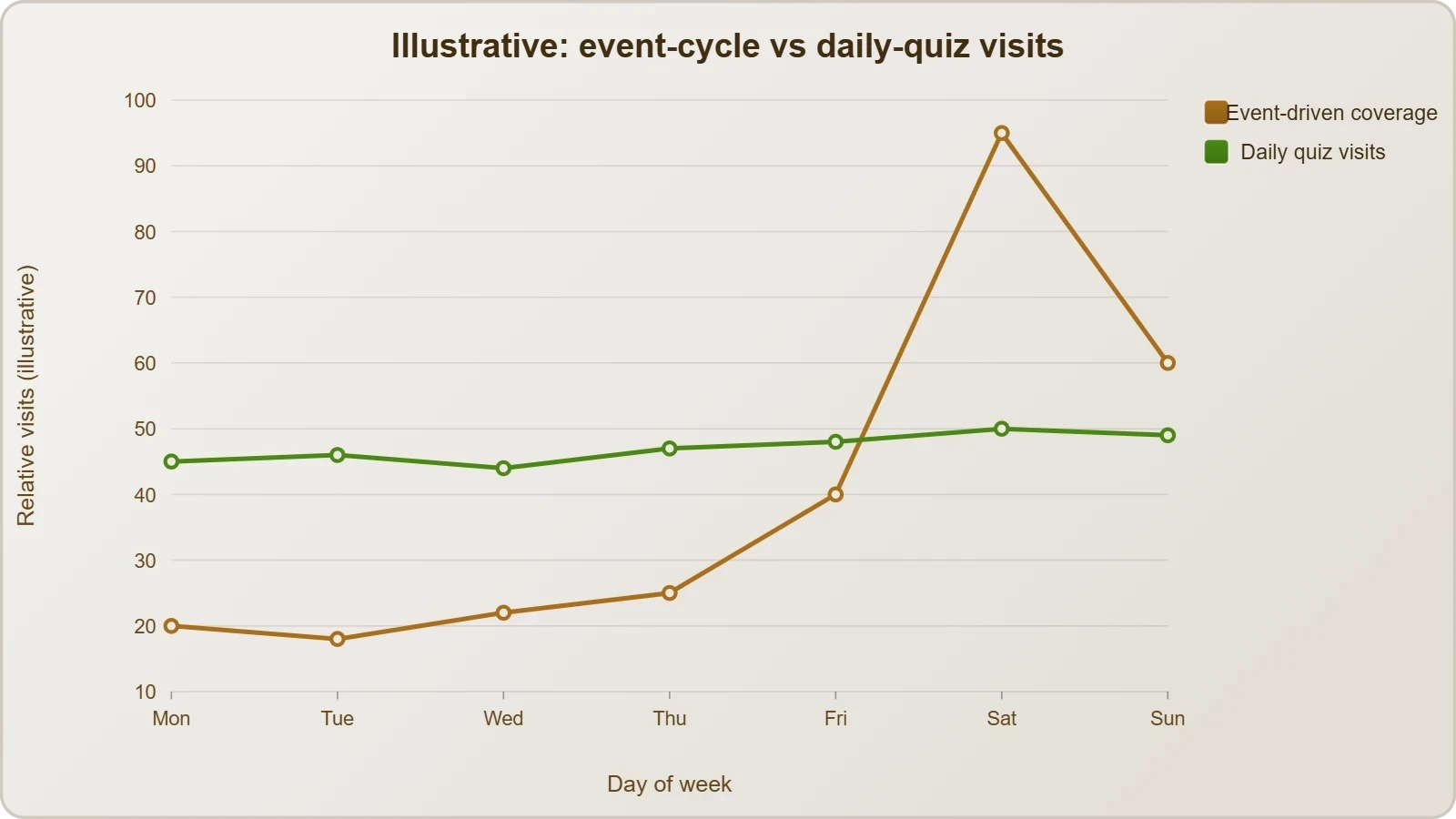
Notification sign-ups amplify the effect. By letting users opt into alerts for new quizzes, BBC Sport converts passive browsing into a direct channel. Each notification is a gentle invitation to return, and each return reinforces the habit. Over time, the quiz becomes part of the fan's daily media diet rather than an occasional diversion.
Notifications and the Opt-In Relationship
Opt-in notifications represent a meaningful shift in the publisher-reader relationship. Rather than waiting for fans to remember the site, BBC Sport can reach them directly, on their own devices, at the moment a new quiz goes live. That direct line is valuable precisely because it is voluntary and easy to revoke.
The invitation to submit quiz ideas extends this relationship further. Fans who contribute questions become invested in the product's success, and their suggestions give editors a steady stream of fresh material. It is a lightweight form of co-creation that costs little to run and generates outsized loyalty among the most engaged supporters.
Community, Competition, and Fan Identity
Football fandom is fundamentally social, and quizzes give that sociability a structured outlet. Naming every Premier League club or listing the Lionesses' most-capped players is not merely a memory test; it is a way of performing belonging.
Fans compare scores, challenge friends, and argue over answers, and each exchange extends the quiz's reach beyond the original page.
Shared Knowledge as Social Currency
Deep football knowledge functions as social currency among supporters, and quizzes provide a legitimate arena to display it. A strong score signals genuine commitment to the game, earning quiet respect in group chats and workplace conversations.
The format converts private trivia into public proof of fandom, which is precisely why players share results so readily.
Themed collections amplify this dynamic by targeting specific identity groups. Premier League and EFL club quizzes speak to tribal loyalties, while the Lionesses quiz connects fans to the women's game and its growing profile.
Each collection gives a distinct community its own reason to participate, widening the audience without diluting the core experience.
From Solo Play to Shared Challenge
Although quizzes are played alone, their value compounds when shared. A fan who scores well on a club-naming challenge has an obvious reason to post the result, and friends who see it face an implicit invitation to try. This organic circulation costs the publisher nothing while extending reach into precisely the right demographic.
Competition between friends also raises the stakes of each attempt. Knowing that a rival supports the same club or claims superior knowledge makes the next daily quiz feel like a rematch.
That interpersonal dimension is difficult to manufacture artificially, yet it emerges naturally whenever a quiz format is well designed and easy to share.
The Editorial and Business Logic Behind Free Quizzes
Free quizzes are inexpensive to produce relative to video or long-form journalism, yet they generate disproportionate engagement. A small editorial team can build a quiz in hours, and the resulting page can attract repeat visits for weeks.
For a public service broadcaster, that efficiency matters, because it stretches limited resources across a demanding content calendar.
- 01
- 02
- 03
- 04
Cost, Scale, and Public Service Value
BBC Sport's remit includes serving broad audiences with accessible, entertaining content, and quizzes fit that mandate neatly. They require no subscription, no specialist equipment, and no prior expertise beyond general football knowledge. That low barrier to entry aligns with public service principles while still delivering the engagement metrics that justify continued investment.
Scale is another advantage. Once a quiz template exists, producing new editions becomes a matter of swapping questions and clues. The marginal cost of each additional quiz is small, which means the platform can sustain a daily cadence without proportionally expanding its editorial headcount. Efficiency and consistency reinforce each other.
Data, Insight, and Audience Understanding
Every quiz attempt generates a small signal about audience knowledge and interest. Aggregate patterns reveal which clubs, players, and eras resonate most strongly, giving editors evidence to guide future coverage. These insights are modest individually but valuable in combination, especially for a broadcaster serving diverse regional audiences.
Quiz participation also indicates intent. A fan who completes a Lionesses quiz is plausibly interested in women's football coverage, and a fan who struggles with EFL clubs may still be a committed lower-league supporter. Such signals help editors tailor recommendations and schedule content more intelligently across the platform.
What This Model Signals for Sports Media
The BBC Sport quiz suite is a compact illustration of where sports media is heading. Publishers increasingly compete not just for attention during live events but for a durable place in fans' daily routines.
Quizzes, with their low cost and high repeat value, offer one of the most efficient ways to claim that place without exhausting editorial budgets.
Lessons for Publishers and Platforms
The first lesson is that interactivity beats passivity for retention. A fan who answers questions engages more deeply than one who merely scrolls headlines, and that deeper engagement translates into stronger recall and more frequent returns.
The second lesson is that variety within a suite matters as much as quality within a single format.
The third lesson concerns user contribution. Inviting quiz ideas turns the audience into a source of content, reducing editorial burden while increasing loyalty. Publishers who treat their most knowledgeable fans as collaborators, rather than merely consumers, gain both fresh material and a more invested community around their brand.
The Road Ahead for Fan Engagement
Looking forward, the quiz model is likely to evolve rather than disappear. Personalisation could tailor daily challenges to a fan's club allegiance, while leaderboards and streaks could deepen competitive motivation. The underlying principle, however, will remain unchanged: give fans a reason to return every day and reward their knowledge generously.
For BBC Sport, the quiz suite is a modest but meaningful asset within a much larger content operation. It demonstrates that engagement need not be expensive or elaborate. A well-designed question, a fair scoring rule, and a reliable daily rhythm can accomplish what far costlier productions often struggle to achieve: sustained, voluntary attention from a loyal audience.
From our network :
- Mobile Learning and VR in English: What Global Evidence Reveals About Effective Language TechnologyA systematic review across 14 countries reveals which language-learning technologies genuinely work. Mobile learning, AI, and VR show measurable benefits when pedagogically integrated. This evidence-based guide helps educators and learners select technology that delivers real return on investment.
- CISA’s Ten-Advisory Wave: Why Generic Patching Fails in OT and How to Build Product-Specific PlaybooksCISA released ten ICS advisories in one week, exposing critical infrastructure risks. Generic patching fails in OT. Learn to build product-specific remediation playbooks.
- University Language Proficiency Exams: Why Institutional Tests Demand Different Preparation Than IELTS and TOEFLDiscover why university-specific language proficiency examinations differ fundamentally from IELTS and TOEFL, and learn strategic preparation approaches for institutional assessment success.
- The Hidden Cost of AI Convenience: Why Over-Permissioned Agents Are a Security Time BombDiscover why AI agents with excessive permissions create dangerous single points of failure, and learn how implementing least privilege principles can protect your organization from exploitation.
- Forbidden Matrix Patterns and Visible Lattice Points: A Geometric DictionaryExplore how multidimensional 0–1 matrices encode geometric truths, linking forbidden patterns to visible lattice points and hypergraph theory, with applications in combinatorics and computational geometry.
- Live Online English Classes for Kids: Do They Actually Reduce Anxiety?A ten-week study reveals that synchronous online English classes can significantly reduce child language anxiety while improving listening and reading skills. Discover what makes these programs effective and how parents can select the right one.
- Committed Mediterranean Precipitation Decline: Why Emissions Cuts Alone Cannot Restore Winter RainsNew NOAA research reveals that Mediterranean winter rains may decline irreversibly even with emissions cuts. Explore the science of committed climate change and regional impacts.
- The Final Descent: How ESA Retired the Legendary Cluster Constellation After 24 Years of Space Weather ScienceAfter 24 years mapping Earth’s magnetosphere, ESA’s Cluster mission concluded with a precisely controlled reentry over the South Pacific. This analysis explores the scientific legacy, engineering decisions, and debris mitigation principles behind one of space exploration’s most responsible retirements.
- How AI Agents Will Change the Way We Manage Personal FinancesExplore how AI agents are transforming personal finance through automated budgeting, bill payment, and investment management, while examining the critical security protocols and governance frameworks required for safe deployment.
RESOURCES
- Football Quizzes - BBC Sportbbc.comThe home of Football Quizzes on BBC Sport online. Includes the latest news stories, results, fixtures, video and audio.
- BBC Sport's daily football quizzes: Who Am I?, Five in Five and ...bbc.co.ukSep 1, 2026 ... How much do you really know about football? Keep scrolling to beat all three of BBC Sport's daily quizzes.
- BBC Sport's daily football quizzes: Who Am I?, Five in Five and ...bbc.comSep 7, 2026 ... Flex your football brain with our daily quizzes · Who Am I? Guess the footballer in as few attempts as…
- Alex Kay-Jelski 🏳️ - Director of BBC Sport, Board ... - LinkedInuk.linkedin.comDirector of BBC Sport, Board member of SUAD (Alzheimer's Society) · Experience: Alzheimer's Society · Location: London · 500+ connections on LinkedIn.
- BBC Sport Publishes Daily Football Quiz Challenges - Oz Arab Mediaozarab.mediaSep 20, 2026 ... According to BBC News, BBC Sport has released its daily football quizzes, inviting fans to test how much they know…
- BBC SPORT | Football | Premier League | Fit and proper person testnews.bbc.co.ukJul 31, 2007 ... This is the Premier League's fit and proper person test: DISQUALIFYING EVENTS: A person shall be disqualified from acting as…
- BBC News - UK & World Stories - App Storeapps.apple.comFootball, Cricket, Rugby, F1 · View. CBeebies Playtime Island. Fun kids games ... Daily Mail: Breaking News Live. News, Video, Podcast & Games. View.…
- BBC Test Match Special Audio | England v Pakistan - YouTubeyoutube.comSep 10, 2026 ... Users in the UK can listen to Test Match Special on 5 Sports Extra ... Go to channel Daily Take…
- BBC Sport to launch GenAI football audio updates - Broadcastbroadcastnow.co.ukAug 14, 2025 ... Named My Club Daily, the pilot will see fans of five clubs ... These teams have been chosen to test…
- It's time for Monday's #BBCBreakfast Brain Test. Sally & Jon set the ...facebook.comOct 12, 2026 ... It's time for Monday's #BBCBreakfast Brain Test. Sally & Jon set the question and shared the answered to Friday's challenge…
- Stuart Hall (presenter) - Wikipediaen.wikipedia.orgHall also presented Quiz Ball (a BBC football quiz show) between 1971 and 1972; was the original host of the long-running sports quiz A…
- Game on: The Guardian launches new daily football quiz in ...theguardian.comOct 1, 2025 ... “In a busy news cycle, we want to offer Guardian readers a fun way to upgrade their downtime. We believe…
- Monthly Viewing by channel/service - Barbbarb.co.ukNews & Views · TV facts; How can I get Barb data? Licence fee estimator · Use a ... Average Daily Minutes. * A…
- Puzzles - GCHQgchq.gov.ukYou don't have to be a quiz champion or Mensa member to work at GCHQ, but we're a place where an analytic mindset can…
- CNN: Breaking News, Latest News and Videosedition.cnn.comView the latest news and breaking news today for U.S., world, weather, entertainment, politics and health at CNN.com.
- 01
- 02
- 03
- 04
- 05
- 06
- 07
- 08
0 Comments