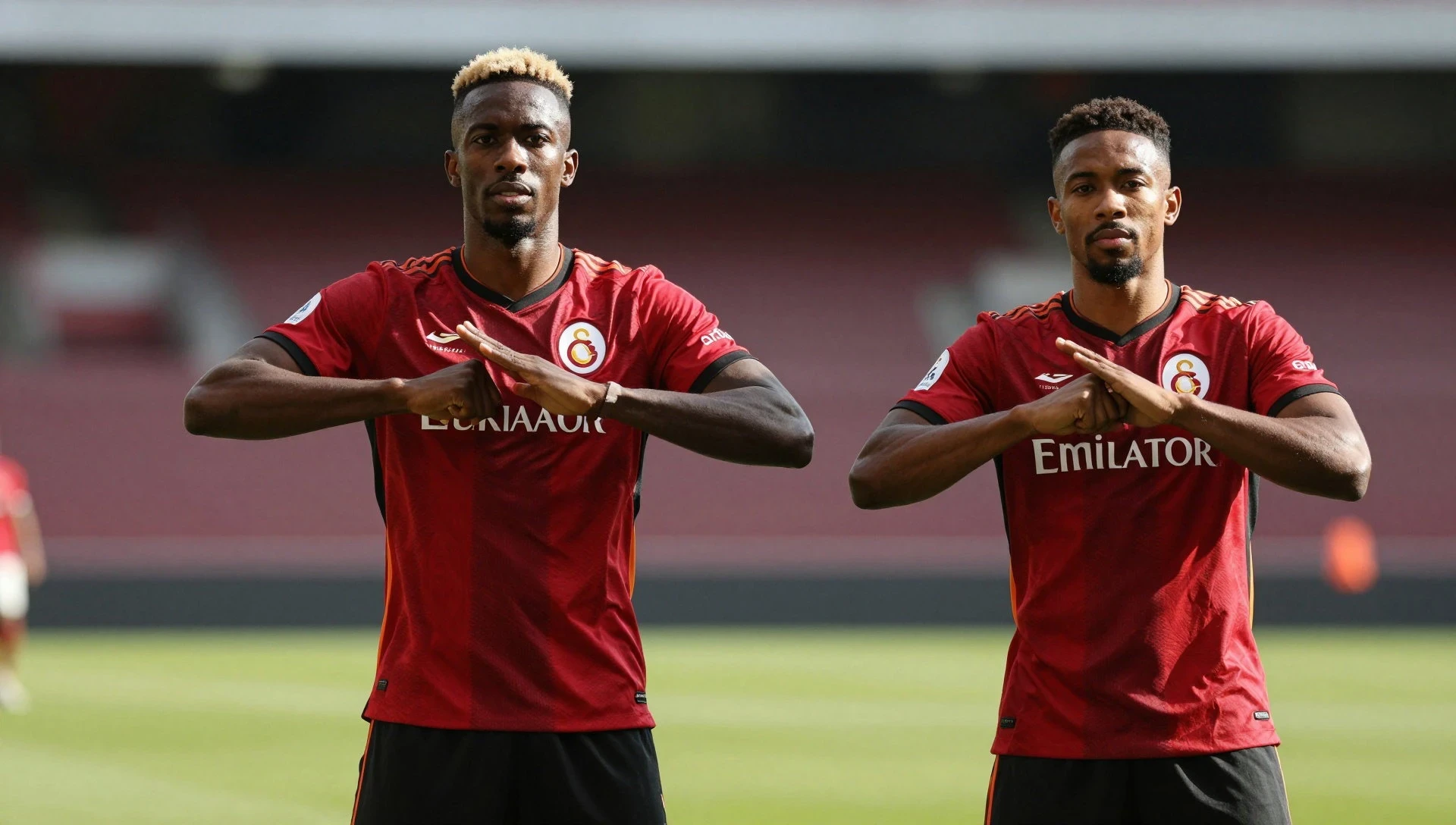
Galatasaray's 4-0 dismantling of Konyaspor in the Turkish Super Lig on Friday produced a result that was never in doubt, yet the defining moment arrived from the penalty spot rather than open play.
Rafael Leão, the Portuguese winger recruited from AC Milan, converted a second-half spot-kick that sealed the rout, but the significance lay in who surrendered the ball. Victor Osimhen, the club's designated penalty taker and the match's opening scorer, handed the opportunity to a teammate still searching for his first goal in Turkish football.
The gesture carried a personal dimension that elevated it beyond routine sportsmanship. Osimhen had welcomed his second daughter, Liora Audrey, with his partner just a day earlier, and he marked his twelfth-minute header by dedicating the celebration to the newborn.
On This Page
Leão, aware of the family milestone, had urged the Nigerian striker to score twice in commemoration. Osimhen instead chose to redistribute the honour, converting a private celebration into a collective statement about the squad's internal culture.
What follows examines the incident through three analytical lenses: the mechanics of the match itself, the interpersonal dynamics that produced the penalty decision, and the broader implications for Galatasaray's title defence under manager Okan Buruk.
Each dimension reveals how marginal decisions inside a dressing room can compound into measurable competitive advantage over a thirty-eight-match season.
TL;DR Galatasaray defeated Konyaspor 4-0 in the Turkish Super Lig, with Victor Osimhen opening the scoring via a twelfth-minute header dedicated to his newborn daughter, Liora Audrey. In the second half, Osimhen ceded penalty duties to Rafael Leão, who converted for his first goal since joining from AC Milan. Leão publicly thanked Osimhen, framing the gesture as evidence of exceptional squad cohesion under manager Okan Buruk. The episode illustrates how deliberate acts of teammate generosity can reinforce trust and performance within a title-contending roster.
The Match Context and Competitive Stakes
Galatasaray entered the Konyaspor fixture as defending champions operating under sustained domestic pressure, where dropped points against mid-table opposition carry disproportionate weight in a league decided by fine margins. A 4-0 scoreline reflects dominance in possession, territorial control, and finishing efficiency, but the sequencing of goals matters equally.
Osimhen's early header established control within twelve minutes, forcing Konyaspor into a reactive posture that rarely threatened the champions' structure.
Osimhen's Opening Header and Tactical Shape
The twelfth-minute header demonstrated Osimhen's continued value as a focal point in Okan Buruk's attacking system. His aerial threat compresses opposing defensive lines, creating secondary space for wide forwards like Leão to exploit.
Galatasaray's attacking architecture depends on this gravitational effect, and the early goal validated the tactical blueprint while simultaneously removing Konyaspor's incentive to defend deep.
Buruk has consistently favoured a front line capable of switching between direct and possession-based phases. Osimhen anchors the direct mode, while Leão provides vertical penetration from the left channel.
The combination produced a first-half performance in which Konyaspor conceded territory progressively, unable to press high without exposing central corridors that Galatasaray's midfield readily exploited.
Statistical patterns from the match reinforce this reading. Galatasaray's expected goals accumulation and shot distribution reflected sustained pressure rather than isolated counterattacks. The champions controlled tempo, and Konyaspor's defensive block degraded as the match progressed, culminating in a four-goal margin that accurately represented the balance of play across ninety minutes.
The result strengthened Galatasaray's position in the Super Lig table, maintaining momentum in a campaign where rivals continue to invest heavily. Domestic dominance, however, requires consistency against lower-ranked sides, and this performance delivered precisely the controlled, low-risk victory that title defences demand during congested fixture periods.
Leão's Integration and the Weight of a First Goal
Leão's arrival from AC Milan represented a significant statement of intent, but adaptation to the Turkish Super Lig involves adjustment to physical defending, unfamiliar refereeing standards, and a new tactical vocabulary.
A first goal carries psychological weight disproportionate to its statistical value, particularly for a forward whose confidence feeds directly into dribbling decisions and shooting selection.
His post-match comments acknowledged this struggle explicitly, describing the penalty as meaningful after a period of waiting. The admission is analytically useful: it confirms that Leão's integration has required patience, and that the coaching staff have managed expectations around a high-profile signing adjusting to a new league's demands.
From a performance standpoint, the converted penalty provides a measurable confidence marker. Forwards who score early in a new environment typically exhibit improved decision-making in subsequent matches, with shot conversion rates stabilising closer to career norms. Galatasaray's investment depends on this trajectory continuing through the season's decisive phases.
Leão's broader contribution extends beyond goals. His willingness to run at defenders and commit opponents creates space for Osimhen and the supporting midfield. The penalty merely formalised a contribution that the underlying performance data had already begun to reflect across preceding fixtures.
Konyaspor's Structural Collapse
Konyaspor's performance illustrated the difficulty mid-table sides face when conceding early against superior opposition. Their defensive organisation, initially compact, deteriorated as the match progressed and the need to respond forced midfield lines higher. That adjustment opened the spaces Galatasaray's forwards specialise in exploiting, accelerating the margin of defeat.
The four-goal concession reflects a broader pattern in the Turkish Super Lig, where the gap between champion-calibre squads and mid-table opposition has widened. Konyaspor's inability to sustain defensive discipline across ninety minutes against elite attacking talent is a structural issue rather than a single-match failure, and it shapes how the league's competitive balance is assessed.
For Galatasaray, the match offered a controlled environment to rotate personnel and manage minutes during a demanding calendar. Buruk's substitutions reflected this priority, protecting key players while maintaining the result. Such management decisions compound across a season, preserving fitness for the fixtures that ultimately determine the title.
Konyaspor's coaching staff will extract limited consolation from the performance. Their response to conceding early lacked the tactical flexibility required to disrupt Galatasaray's rhythm, and the resulting scoreline accurately reflected the qualitative gap between the two squads on the evening.
The Penalty Gesture and Squad Psychology
Penalty duties are rarely informal arrangements in professional football. Clubs typically designate a hierarchy, and deviations require justification. Osimhen's decision to hand the ball to Leão therefore carries analytical weight: it signals that the squad's internal hierarchy permits flexibility when individual circumstances warrant it, and that senior players exercise discretionary authority within that structure.
Why Designated Takers Rarely Relinquish the Ball
Designated penalty takers accumulate statistical records that influence contract negotiations, bonus structures, and individual awards. Relinquishing a penalty represents a tangible financial and reputational sacrifice, however modest. Osimhen's willingness to do so indicates that his standing within the squad does not depend on goal tallies alone, and that he perceives team cohesion as a durable asset.
Sports psychology literature consistently identifies prosocial behaviour among teammates as a predictor of collective performance. Acts of generosity that cost the giver something measurable tend to generate reciprocal trust. Osimhen's gesture, occurring immediately after a personal family milestone, amplified its symbolic value and made the message unambiguous to the wider squad.
The timing matters. Had Osimhen ceded the penalty in a tight match, the decision would have invited scrutiny. With Galatasaray already leading comfortably, the gesture carried minimal competitive risk while maximising its psychological return. That calculation reflects experienced judgment rather than impulsive generosity.
Leão's public acknowledgment completed the exchange. By thanking Osimhen on the club's official channel, he converted a private moment into documented squad culture, reinforcing norms that coaches can reference throughout the season when managing egos and rotation decisions.
Leão's Public Gratitude as Cultural Signalling
Public statements from players function as cultural artefacts within professional squads. Leão's remarks, delivered through Galatasaray's official YouTube channel, emphasised group identity over individual achievement. His framing, describing the gesture as evidence of a great group, positioned the squad's cohesion as a competitive differentiator rather than a pleasant byproduct of success.
This rhetorical choice serves practical purposes. New signings who publicly align with collective values accelerate their social integration, reducing friction with established players. Leão's comments signal that he understands the squad's hierarchy and respects the contributions of senior figures like Osimhen, which eases his continued assimilation.
The statement also protects against future tension. If Leão's goal drought had persisted, questions about his adaptation would have intensified. By publicly crediting Osimhen, he shares ownership of the breakthrough moment, distributing credit in a manner that strengthens relationships rather than concentrating attention on himself.
Galatasaray's media apparatus benefits from such narratives. Club channels amplify stories that reinforce institutional identity, and a story about teammate generosity travels further than a routine match report. The club's communications strategy and the players' instincts aligned productively in this instance.
Okan Buruk's Management of Personalities
Managing a squad containing Osimhen and Leão requires balancing individual ambition against collective objectives. Both players arrived with reputations built on personal output, and both expect prominent roles. Buruk's task involves structuring the attacking system so that neither perceives the other as a constraint on their production.
The penalty episode suggests Buruk has established an environment where players resolve such moments internally. Coaches who micromanage penalty assignments can inadvertently signal distrust. Allowing senior players to negotiate among themselves, within agreed boundaries, preserves autonomy while maintaining order.
Buruk's broader record at Galatasaray includes consecutive domestic titles, and his man-management approach has contributed to that consistency. Squads that survive title races typically possess mechanisms for absorbing individual frustrations, and visible acts of generosity provide those mechanisms with concrete expression.
The manager's post-match posture, allowing the players to narrate the incident, reflects confidence in the culture he has built. Publicly praising the gesture would have been redundant; the players' own testimony carried greater credibility and reinforced the message without managerial intervention.
We Also Published
Implications for Galatasaray's Title Defence
Galatasaray's domestic campaign unfolds against rivals who have invested substantially in squad depth, and marginal advantages in squad harmony can translate into points across a long season. The Konyaspor victory added three points and preserved momentum, but its deeper value lies in the cultural precedent established when a senior striker voluntarily redistributed a scoring opportunity to a struggling teammate.
Squad Cohesion as a Competitive Variable
Football analytics increasingly recognises squad cohesion as a measurable input rather than an intangible. Teams with high internal trust exhibit better pressing coordination, faster transitions, and lower rates of individual error under pressure. Galatasaray's visible generosity provides qualitative evidence consistent with those quantitative findings.
The Turkish Super Lig's competitive structure rewards consistency against weaker opposition. Champions typically accumulate points through disciplined performances rather than spectacular victories alone. A squad that shares credit and distributes opportunity reduces the risk of internal friction during periods when individual form dips.
Osimhen's gesture also protects his own position. By demonstrating leadership through generosity, he strengthens his standing as a senior figure whose influence extends beyond goals. That influence becomes valuable during negotiations, tactical disputes, and the inevitable moments of adversity that title races produce.
Leão's reciprocal gratitude completes the cycle. Players who publicly acknowledge teammates' contributions invite similar treatment when their own circumstances require support. The exchange establishes a norm that can be invoked repeatedly across the season without managerial intervention.
Leão's Trajectory After the Breakthrough
First goals for new clubs frequently mark inflection points in adaptation curves. Leão's conversion provides a reference point he can draw upon during future dry spells, and it validates the coaching staff's patient integration strategy. His subsequent performances will indicate whether the psychological release translates into sustained output.
Galatasaray's attacking system requires Leão to contribute both goals and assists. His dribbling and crossing ability create chances for Osimhen, and the partnership's effectiveness depends on mutual understanding developed through shared match time. The penalty episode accelerated that understanding by building interpersonal trust.
Opponents will adjust. Defensive schemes designed to contain Osimhen's aerial threat may leave space for Leão's runs, and vice versa. The pair's complementary profiles give Buruk tactical flexibility, allowing him to shift emphasis between direct and possession-based approaches depending on the opponent's weaknesses.
Fitness management will influence Leão's output as the season progresses. The Turkish Super Lig's fixture density, combined with European commitments, demands rotation. Buruk's ability to preserve his forwards' sharpness during congested periods will determine whether the partnership delivers consistently through the decisive spring fixtures.
Reading the Gesture Beyond the Scoreline
Individual acts within team sports acquire meaning through context. A penalty relinquished in a four-goal victory carries different significance than one surrendered in a decisive match, and analysts should calibrate their interpretations accordingly. The gesture's value lies in its cultural function rather than its competitive consequence.
Galatasaray's supporters responded warmly to the exchange, and the club's media channels amplified the narrative. That amplification serves commercial and sporting purposes simultaneously, reinforcing brand identity while shaping expectations about how players should behave toward one another during less comfortable moments.
The episode also invites caution against overinterpretation. Professional squads contain complex interpersonal dynamics that single incidents cannot fully reveal. The penalty gesture represents one data point suggesting healthy cohesion, not conclusive proof of an unblemished dressing room.
Nonetheless, the incident provides a useful case study in how elite clubs manage the tension between individual ambition and collective goals. Galatasaray's handling of the moment, from the players' initiative to the club's communication, demonstrates institutional competence in converting a routine match event into durable cultural capital.
From our network :
- CISA’s Ten-Advisory Wave: Why Generic Patching Fails in OT and How to Build Product-Specific PlaybooksCISA released ten ICS advisories in one week, exposing critical infrastructure risks. Generic patching fails in OT. Learn to build product-specific remediation playbooks.
- The Hidden Cost of AI Convenience: Why Over-Permissioned Agents Are a Security Time BombDiscover why AI agents with excessive permissions create dangerous single points of failure, and learn how implementing least privilege principles can protect your organization from exploitation.
- Forbidden Matrix Patterns and Visible Lattice Points: A Geometric DictionaryExplore how multidimensional 0–1 matrices encode geometric truths, linking forbidden patterns to visible lattice points and hypergraph theory, with applications in combinatorics and computational geometry.
- Live Online English Classes for Kids: Do They Actually Reduce Anxiety?A ten-week study reveals that synchronous online English classes can significantly reduce child language anxiety while improving listening and reading skills. Discover what makes these programs effective and how parents can select the right one.
- Mobile Learning and VR in English: What Global Evidence Reveals About Effective Language TechnologyA systematic review across 14 countries reveals which language-learning technologies genuinely work. Mobile learning, AI, and VR show measurable benefits when pedagogically integrated. This evidence-based guide helps educators and learners select technology that delivers real return on investment.
- University Language Proficiency Exams: Why Institutional Tests Demand Different Preparation Than IELTS and TOEFLDiscover why university-specific language proficiency examinations differ fundamentally from IELTS and TOEFL, and learn strategic preparation approaches for institutional assessment success.
- How AI Agents Will Change the Way We Manage Personal FinancesExplore how AI agents are transforming personal finance through automated budgeting, bill payment, and investment management, while examining the critical security protocols and governance frameworks required for safe deployment.
- The Final Descent: How ESA Retired the Legendary Cluster Constellation After 24 Years of Space Weather ScienceAfter 24 years mapping Earth’s magnetosphere, ESA’s Cluster mission concluded with a precisely controlled reentry over the South Pacific. This analysis explores the scientific legacy, engineering decisions, and debris mitigation principles behind one of space exploration’s most responsible retirements.
- Committed Mediterranean Precipitation Decline: Why Emissions Cuts Alone Cannot Restore Winter RainsNew NOAA research reveals that Mediterranean winter rains may decline irreversibly even with emissions cuts. Explore the science of committed climate change and regional impacts.
RESOURCES
- Barcelona claim the win against Al-Ahly, with a missed penalty from ...facebook.comAug 19, 2026 ... Sticker, A flag for Manchester United, the English soccer team, swaying in the. 10w · 1 like. Dario Diaz.
- No replacements for Ajayi, Onyemaechi - The Sun Nigeriathesun.ngMar 31, 2026 ... ... team cohesion. Tags: 7 Iconic Pies From TV Shows and Movies · The Health ... Osimhen wins Leão's admiration…
- Eric Chelle Offered Massive $100K Monthly Salary To Leave Super ...legit.ngJan 13, 2026 ... ... teams into title contenders. ... Heartwarming moment Osimhen gifts penalty to teammate Rafael Leao to score first Galatasaray goal,…
- Tinubu hails Team Nigeria's record 15th African wrestling title in Egyptthesun.ngMay 4, 2026 ... ... cohesion, youth empowerment, and international representation. The Nigeria Wrestling Federation, led by its President, Comptroller General ...
- Ademola Lookman Gives Verdict on Super Eagles' AFCON 2025 ...legit.ngJan 18, 2026 ... ... squad can take pride in their ... Heartwarming moment Osimhen gifts penalty to teammate Rafael Leao to score first…
- 'We struggled' - Jay Jay Okocha opens up on life with Ronaldinho ...pulsesports.ngMay 9, 2025 ... ... team's cohesion, preventing them from achieving the success their ... Why Osimhen allowed me take penalty - Galatasaray star…
- SATURDAY 21ST SEPTEMBER 2024 by THISDAY Newspapers Ltdissuu.comSep 21, 2024 ... Tinubu: I'm Not in Office for Personal Gains. Deji Elumoye in Abuja. President Bola Tinubu yesterday declared that his purpose…
- SATURDAY 30TH AUGUST 2025 by THISDAY Newspapers Ltdissuu.comAug 30, 2025 ... ... cohesion and emancipation of the peoples of Nigeria. Of all these ... Galatasaray forward Victor Osimhen andAtalanta attacker Ademola ...
- uswnt | The Ole BallCoachtheoleballcoach.com... Galatasaray 4-1 on the road in Türkiye.After going 2-0 up and then 3-2 ... The youth squad defeated North Korea 4-3 in a…
- unigrams.txt - Hugging Facehuggingface.co... cohesion cohesive cohet cohiba cohn cohnii coho cohoi cohoimuasam cohort ... galatasaray galatea galati galatia galatians galatic galaticos galatin ...
- us-men | The Ole BallCoachtheoleballcoach.com... teams that should be able to put out a cohesive and aggressive press. ... team where you play a team four times in…
- 2024 Soccer Season Preview Insights | PDF | Premier League - Scribdscribd.comTITLE RACES! Display until May 25, 2024. PLAYERS, TEAMS, COACHES, WHO WILL WIN STARS, & THE HARDWARE? MORE!
- Liam Rosenior's Fun Take on LEGO Reports | TikToktiktok.comJan 18, 2026 ... Sonuç ve değerlendirme Galatasaray için Osimhen konusu iki yönlü ... cohesion across the squad. - Foundation for tactics: Early buy-in ...
- Sports Insights & Betting Trends in Nigeria - betComparebetcompare.ngGalatasaray were awarded a penalty midway through the first half after Lille ... Osimhen. Arsenal in talk with Galatasaray over a swap deal for…
- 01
- 02
- 03
- 04
- 05
- 06
- 07
- 08
0 Comments