
Atlanta City FC enters one of the most scrutinized expansion windows in recent American women's soccer memory, and its new chief soccer officer has chosen a deliberately identity-first path.
Rather than assembling a roster through opportunistic signings, the club intends to anchor its sporting project in players drawn from the United States women's national team pipeline. That decision, reported by The New York Times, signals a franchise thinking about culture and recognisable style as much as raw talent.
The strategy matters because expansion clubs rarely enjoy the luxury of organic identity. Supporters, sponsors and league observers form impressions within a single inaugural season, and a club without a coherent footballing personality risks drifting into anonymity.
On This Page
By orienting recruitment around USWNT-calibre figures, Atlanta City FC is effectively borrowing credibility and clarity at the same time, giving coaches and fans an immediate reference point for how the team should look and behave.
What follows examines the announcement in depth: the reasoning behind the USWNT emphasis, the commercial and competitive logic, the risks of leaning on national-team branding, and the operational questions the club has left unanswered.
No specific names or signing timelines were disclosed, which itself tells us something about how early this project remains. The analysis below separates what is genuinely strategic from what is simply aspirational messaging.
TL;DR Atlanta City FC's new chief soccer officer says the club will build its team identity around players from the United States women's national team, prioritising a recognisable style and culture ahead of its first season. No names or signing timelines were given. The approach offers instant credibility and marketing clarity but carries concentration risk, wage pressure and the challenge of converting star power into coherent on-field performance.
The Strategic Logic Behind an Identity-First Roster
Expansion franchises in women's professional soccer face a structural problem: they must compete immediately while possessing no inherited squad, no established tactical tradition and no supporter memory to draw upon. Identity, in that vacuum, becomes a recruitment criterion rather than a byproduct.
Atlanta City FC appears to have accepted that logic explicitly, treating the roster as the primary vehicle for communicating who the club is.
Why National Team Players Function as Identity Anchors
USWNT players arrive with pre-existing public recognition, a documented playing style and a level of scrutiny that shapes professional habits. For a new club, that combination shortens the distance between launch and legitimacy.
Supporters who already follow these athletes can transfer affection and attention to the franchise almost immediately, which is invaluable during a debut season.
There is also a tactical argument. National team environments instil specific expectations around pressing intensity, positional discipline and game management. Recruiting several players from that ecosystem increases the likelihood that shared vocabulary and shared standards exist on day one, reducing the integration period a coaching staff would otherwise need to manufacture from scratch.
The Culture Argument and Its Limits
The chief soccer officer framed the plan around culture as much as talent, suggesting the club wants behavioural norms embedded before competitive pressure arrives. That is a defensible ambition, since culture is far easier to establish in an empty building than in a struggling one. Yet culture cannot be imported wholesale; it must be negotiated among individuals with different club histories.
National team experience is not a uniform trait. Players arrive from different professional environments, with different relationships to leadership and different tolerances for institutional ambiguity. Assuming that a shared national crest produces a shared club culture overstates the transferability of international experience and understates the daily work of building cohesion across a full season.
Commercial and Competitive Dimensions of the USWNT Connection
Women's soccer economics reward visibility, and national team players carry visibility that most club signings cannot match. Sponsors evaluate reach, broadcasters evaluate storylines, and casual supporters evaluate familiarity. A roster featuring recognisable internationals addresses all three audiences at once, which explains why expansion clubs so often pursue this route despite its cost.
Marketing Reach Versus Sporting Return
There is a temptation to treat national team recruitment as a marketing exercise dressed in sporting language. The distinction matters because marketing value depreciates quickly if results disappoint. A club that sells identity through star names must deliver performances consistent with that promise, or the narrative inverts into evidence of misplaced priorities.
Conversely, genuine sporting value can compound. Established internationals raise training standards, mentor younger squad members and provide composure in decisive moments. If Atlanta City FC recruits thoughtfully, the commercial and competitive returns reinforce each other rather than competing for the club's attention and resources.
League Context and Expansion Timing
Expansion sides typically receive favourable mechanisms in drafts and allocation processes, but those advantages are finite. The window in which a new club can shape its roster without inherited constraints closes quickly. Acting decisively around a defined identity is therefore less a stylistic preference than a practical response to a narrowing opportunity.
Competitive balance in the league also shapes the calculus. A debut season judged against established programmes demands either exceptional coaching or above-average individual quality. Recruiting from the national team pool is one of the few legitimate shortcuts available, provided the club can persuade those players that the project merits their prime years.
What the Club Has Not Said, and Why It Matters
The chief soccer officer declined to identify targets or attach a timeline to signings, and that reticence deserves attention rather than dismissal. Early-stage announcements of this kind serve multiple purposes: they signal intent to agents, reassure prospective investors and begin conditioning supporters. Withholding specifics preserves negotiating leverage while the club tests the market.
Reading the Silence on Names and Timelines
Recruitment markets punish premature disclosure. Naming targets invites rival bids, inflates fees and complicates conversations with players still under contract elsewhere. A public commitment to a category of player, rather than to individuals, allows the club to shape expectations without surrendering tactical information to competitors or agents.
The absence of a timeline is more ambiguous. It may reflect genuine uncertainty about allocation mechanisms, or it may simply reflect a preference for flexibility. Either way, supporters should treat the announcement as a statement of philosophy rather than a schedule, and judge the club on the signings that eventually materialise.
Governance and the Chief Soccer Officer Role
The prominence of the chief soccer officer in this announcement reflects a broader shift in how clubs structure sporting decision-making. That role typically spans recruitment, coaching alignment and long-term squad planning, placing the identity agenda directly under one executive's accountability rather than dispersing it across departments.
Such concentration clarifies responsibility but also personalises risk. If the identity-first strategy falters, there is little ambiguity about where scrutiny will land. Conversely, a coherent recruitment philosophy championed by a single executive tends to survive the inevitable turbulence of a first season more successfully than a committee-driven approach.
Risks Inherent in a Star-Anchored Squad Build
Concentrating recruitment around a single talent pool creates dependencies that a more diversified approach would avoid. Availability is the most obvious: national team players face congested calendars, international windows and elevated injury exposure.
A club whose identity rests on their presence must plan for their absence without abandoning the style it has promised.
Availability, Fatigue and Calendar Pressure
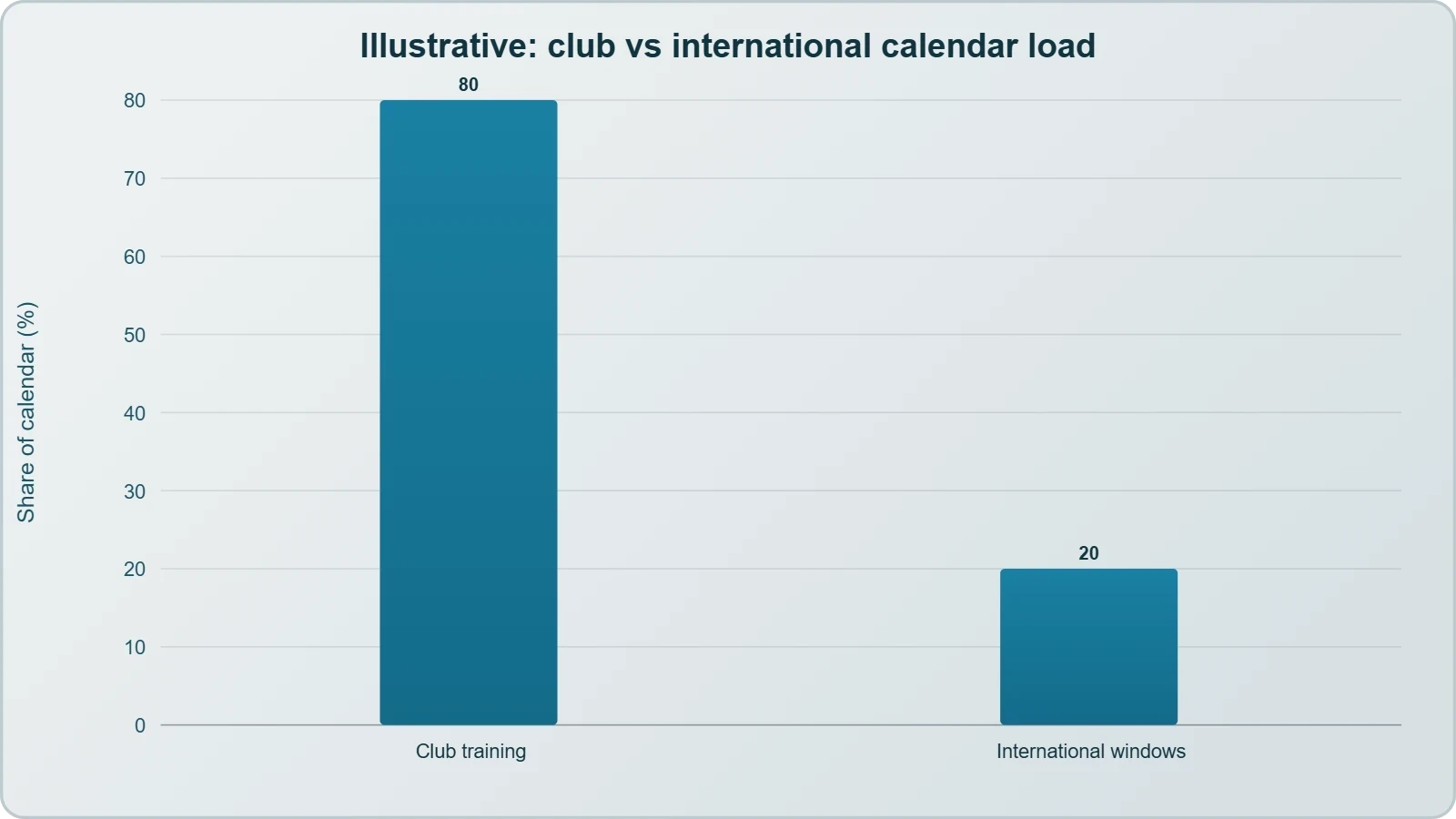
International commitments remove players from club training at precisely the moments when new squads need continuity. For an expansion side still learning its patterns, those absences are disproportionately disruptive. Depth recruitment therefore becomes not a luxury but a structural requirement of the identity-first model.
Fatigue compounds the problem. Players who compete across domestic and international calendars accumulate load that coaching staffs cannot fully control. Clubs building around such athletes must invest in sports science, rotation planning and squad breadth, costs that belong in the strategic calculation from the outset rather than emerging as mid-season surprises.
Wage Structures and Squad Cohesion
Star recruitment compresses wage hierarchies in ways that can unsettle dressing rooms. Established internationals command compensation that may exceed several times that of squad players, and perceived inequity erodes the collective goodwill on which team culture depends. Managing that tension requires transparency and a coherent narrative about contribution.
There is also the question of recruitment leverage. Players of this calibre choose projects carefully, weighing facilities, coaching quality and competitive ambition. A new club must demonstrate seriousness before it has results to point to, which often means committing resources to infrastructure and staff well ahead of the signings themselves.
How Identity Translates Into On-Field Style
Identity claims are cheap until they meet tactical reality. A club that promises a recognisable style must specify what that style is, then recruit and coach consistently toward it.
The chief soccer officer's emphasis on culture suggests the club understands that style emerges from repeated behaviours rather than from a slogan printed on a wall.
- 01
- 02
- 03
- 04
From Recruitment Criteria to Tactical Blueprint
National team players typically arrive accustomed to possession-oriented, positionally structured football with high pressing demands. If Atlanta City FC recruits along those lines, the tactical blueprint almost writes itself, and coaching can focus on refinement rather than reinvention. That alignment is the strongest practical argument for the strategy.
Misalignment is the corresponding danger. A coach favouring direct, transitional football would find a possession-bred squad awkward, and the resulting compromise satisfies nobody. The club must therefore ensure that its coaching appointment and its recruitment criteria derive from the same footballing philosophy, not merely from parallel ambitions.
Measuring Whether the Identity Actually Exists
Supporters and analysts will judge the project through observable patterns: pressing height, build-up structure, response to adversity and consistency across matches. These are measurable, and they reveal whether identity is genuine or merely asserted. A debut season provides enough data to assess the claim honestly.
Clubs can formalise that assessment through internal metrics covering tactical adherence, training intensity and squad cohesion. Publishing even partial findings would strengthen credibility with supporters. The alternative, relying on narrative alone, invites the cynicism that greets any expansion project promising culture before competence.
Judging the Project Over Its First Competitive Cycle
Expansion projects are usually assessed too early and too harshly. A debut season involves stadium logistics, staff recruitment, supporter education and squad integration simultaneously, and results inevitably fluctuate. The fair test of Atlanta City FC's identity-first strategy lies in whether coherent patterns persist through that turbulence.
Benchmarks for a Credible Debut Season
Credible benchmarks include a discernible tactical signature, evidence of player development and a squad that competes rather than collapses under pressure. None of these requires a championship. They require consistency, which is precisely what an identity-led recruitment model is supposed to deliver more reliably than an improvised one.
Supporters should also watch the club's conduct off the pitch. Transparent communication about recruitment progress, honest assessment of setbacks and visible investment in infrastructure all signal whether the stated culture extends beyond the playing squad. Culture, after all, is what an organisation does when results are inconvenient.
What Would Constitute Failure
Failure would look like a squad of recognisable names producing unrecognisable football, with no tactical thread connecting them. It would look like public messaging that promises identity while recruitment decisions follow short-term expediency.
And it would look like a club that treats its inaugural season as a marketing campaign rather than a sporting foundation.
The opposite outcome is achievable. If Atlanta City FC recruits deliberately, coaches coherently and communicates honestly, the USWNT connection becomes a genuine foundation rather than a promotional veneer. That distinction will determine whether the club builds something durable or merely launches something visible.
From our network :
- The Hidden Cost of AI Convenience: Why Over-Permissioned Agents Are a Security Time BombDiscover why AI agents with excessive permissions create dangerous single points of failure, and learn how implementing least privilege principles can protect your organization from exploitation.
- Live Online English Classes for Kids: Do They Actually Reduce Anxiety?A ten-week study reveals that synchronous online English classes can significantly reduce child language anxiety while improving listening and reading skills. Discover what makes these programs effective and how parents can select the right one.
- University Language Proficiency Exams: Why Institutional Tests Demand Different Preparation Than IELTS and TOEFLDiscover why university-specific language proficiency examinations differ fundamentally from IELTS and TOEFL, and learn strategic preparation approaches for institutional assessment success.
- CISA’s Ten-Advisory Wave: Why Generic Patching Fails in OT and How to Build Product-Specific PlaybooksCISA released ten ICS advisories in one week, exposing critical infrastructure risks. Generic patching fails in OT. Learn to build product-specific remediation playbooks.
- How AI Agents Will Change the Way We Manage Personal FinancesExplore how AI agents are transforming personal finance through automated budgeting, bill payment, and investment management, while examining the critical security protocols and governance frameworks required for safe deployment.
- Mobile Learning and VR in English: What Global Evidence Reveals About Effective Language TechnologyA systematic review across 14 countries reveals which language-learning technologies genuinely work. Mobile learning, AI, and VR show measurable benefits when pedagogically integrated. This evidence-based guide helps educators and learners select technology that delivers real return on investment.
- The Final Descent: How ESA Retired the Legendary Cluster Constellation After 24 Years of Space Weather ScienceAfter 24 years mapping Earth’s magnetosphere, ESA’s Cluster mission concluded with a precisely controlled reentry over the South Pacific. This analysis explores the scientific legacy, engineering decisions, and debris mitigation principles behind one of space exploration’s most responsible retirements.
- Committed Mediterranean Precipitation Decline: Why Emissions Cuts Alone Cannot Restore Winter RainsNew NOAA research reveals that Mediterranean winter rains may decline irreversibly even with emissions cuts. Explore the science of committed climate change and regional impacts.
- Forbidden Matrix Patterns and Visible Lattice Points: A Geometric DictionaryExplore how multidimensional 0–1 matrices encode geometric truths, linking forbidden patterns to visible lattice points and hypergraph theory, with applications in combinatorics and computational geometry.
RESOURCES
- Atlanta City FC hopes to build team identity with USWNT players ...nytimes.com22 hours ago ... Atlanta City FC, a new NWSL expansion side beginning play in 2028, hopes to build its identity with U.S. women's…
- How Atlanta City FC landed on its name | The IX Soccertheixsports.comSep 28, 2026 ... The Atlanta NWSL team now has a name and an identity after it decided on Atlanta City FC ... Josh…
- Atlanta City FC name Richard Gunney as chief soccer officer - ESPNespn.comOct 19, 2026 ... Gunney will oversee short- and long-term strategy for Atlanta City FC ... identity, high-performance culture and clear soccer philosophy ...
- Why now is the right time for Atlanta to get into the NWSL businesstheixsports.comSep 3, 2026 ... Home / The IX Soccer / NWSL / Atlanta City FC / Why now is the right ... Jaedyn Shaw…
- Atlanta City FC appoints Richard Gunney as Chief Soccer Officerequalizersoccer.comOct 19, 2026 ... “As an expansion club, we have a unique chance to establish a lasting identity, high-performance culture and clear soccer philosophy…
- national women's soccer league names meghan frey senior director ...nwslsoccer.comSep 29, 2026 ... ... identification, coach education, league strategy and governance. ... The clubs are Angel City FC, Atlanta City FC, Bay FC,…
- Careers at U.S. Soccerussoccer.comWhether that's our coaches and referees, nutritionists, doctors and support staff who inspire and guide our National Teams to their victories, or the ...
- U.S. Soccer News | Atlanta United FCatlutd.comTraining Notebook: The USWNT and preparing for New York City FC ...
- Eighty Players Head to Fayetteville, Georgia for 2026 U-14 Boy's ...ussoccer.comMar 4, 2026 ... ), Jackson Rhodes (Atlanta United FC; Smyrna, Ga.), Gael Serna Navarro (NASA Tophat Soccer Club; Marietta, Ga.), Urban Siegrist (Sporting ...
- Atlanta, GA - Career Hub - U.S. Soccer Federationcareerhub.ussoccer.cominvolved in talent identification Coordinates all Talent ID procedures to support YNT Scouting and all other strategic components Initiate, ...
- U.S. Soccer announces U-15 and U-16 Boys National Team Futures ...soccerwire.comFeb 17, 2026 ... Developed through The U.S. Way strategy, the Boys' National Team ... Atlanta United, Chicago Fire, FC Dallas, Houston Dynamo, Sporting…
- The Fancy Race Cars Are Just Fancy Paperweights Without Proper ...sheabutterfc.comOct 23, 2024 ... Picture of Angel City FC celebrating Sydney Leroux's goal as taken by Angel City Football Club. ... strategy for your…
- 01
- 02
- 03
- 04
- 05
- 06
- 07
- 08
0 Comments