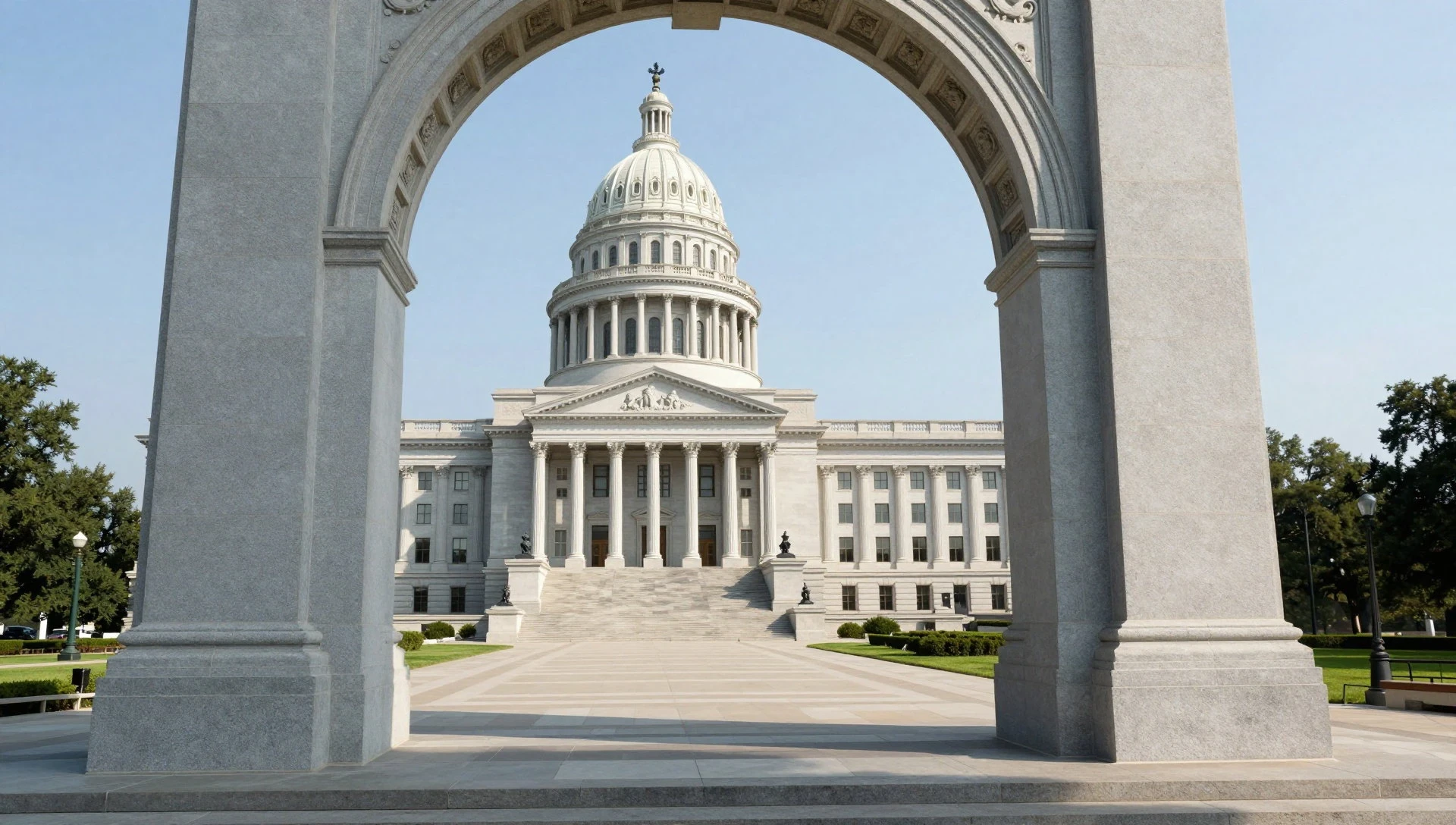
A single judicial order can reshape the calendar of any large public construction effort, and the case surrounding a memorial arch project linked to Donald Trump illustrates that principle with unusual clarity.
A judge has issued multiple deadlines that now govern how the parties proceed, injecting fresh procedural complexity into a schedule that was already politically and administratively sensitive. The original dispatch was terse, confirming the deadlines without detailing their precise dates or operational consequences, yet the underlying dynamic deserves careful reading.
Court-imposed timetables are rarely neutral housekeeping. When a federal judge sets several deadlines in a dispute over a commemorative structure, each date becomes leverage: it forces disclosure, compresses review windows, and narrows the room for delay tactics by any party.
On This Page
For a project carrying presidential associations, those mechanics matter beyond the courtroom, because construction sequencing, fundraising, permitting, and public messaging all move in step with legal milestones. The deadlines therefore function as a governance instrument as much as a scheduling device.
This analysis examines what such a ruling signifies, how judicial deadlines interact with federal project approvals, and why memorial architecture so often becomes a battleground for broader institutional questions. It also considers the practical consequences for contractors, agencies, and donors when a court inserts itself into the timeline.
Readers will find a structured breakdown of the legal mechanics, the political context, and the risk profile that now attaches to the endeavor.
TL;DR A judge has issued multiple deadlines in litigation concerning a memorial arch project associated with Donald Trump, adding procedural complexity and schedule risk to the undertaking. Judicial timetables of this kind convert a construction and commemoration question into a disciplined legal sequence, forcing the parties to meet fixed dates for filings, reviews, and compliance. The practical effect is to compress decision windows, sharpen accountability, and expose any weak points in permitting or financing. Because the original report did not specify the individual deadlines, the soundest reading is structural: expect tighter oversight, reduced tolerance for delay, and a project calendar now partly dictated by the court rather than by sponsors or agencies alone.
What the Ruling Actually Changes
At its core, the order converts an open-ended dispute into a sequenced proceeding. Rather than allowing the parties to negotiate timing informally, the court fixes dates that must be honored, and missed deadlines carry consequences ranging from sanctions to adverse inferences.
For a project of symbolic weight, that discipline is consequential because it removes the flexibility sponsors typically rely on when approvals slip.
The Mechanics of Court-Imposed Timetables
Federal judges routinely use scheduling orders to manage complex cases, setting deadlines for motions, discovery, administrative record production, and briefing. Each date is enforceable, and parties who miss them must usually seek relief formally, which itself consumes time and credibility. The cumulative effect is a case that advances on the court's clock rather than the litigants'.
In disputes touching federal approvals, the administrative record often becomes the pivotal artifact. Deadlines for its production and supplementation determine how quickly substantive arguments can be tested. Where a project involves public land, historic preservation review, or environmental assessment, the record can be voluminous, and the court's timetable effectively sets the pace of the entire review.
Why Multiple Deadlines Signal Heightened Scrutiny
Issuing several deadlines rather than a single omnibus date suggests the judge intends staged oversight, checking compliance at intervals instead of waiting for a final reckoning. That pattern typically appears when a court suspects drift, disputes over scope, or the possibility that one party will use procedural ambiguity to stall. Staged deadlines foreclose that strategy.
For sponsors, the signal is unambiguous: the court is managing the case actively. Active management raises the cost of tactical delay and increases the likelihood that substantive issues are reached sooner.
Projects that depend on momentum and public confidence are especially vulnerable to this compression, because every accelerated milestone invites scrutiny of readiness.
The Legal Architecture Behind Federal Project Disputes
Memorial projects on federal land pass through a dense lattice of statutes, from historic preservation review to environmental assessment and land-use authorization. Each layer creates a potential point of challenge, and litigation usually targets whether an agency followed required procedure rather than whether the design itself is worthy. Courts review process, not taste.
Administrative Procedure and Judicial Review
Under the Administrative Procedure Act, courts evaluate agency action against the administrative record, asking whether decisions were arbitrary, capricious, or contrary to law. That standard is deferential but not inert.
When a judge sets deadlines, the practical effect is to force the record into the open so that this review can proceed without indefinite postponement.
The distinction matters for sponsors. A favorable outcome rarely validates the project's merits; it confirms that the process was lawfully conducted. Conversely, a remand for procedural defects can halt construction even where the underlying design enjoys broad support. Legal risk in commemoration is therefore procedural risk, and it is managed through documentation discipline.
How Courts Interact With Agency Schedules
Agencies operate on their own statutory clocks, which may include comment periods, consultation requirements, and internal review. Judicial deadlines do not replace those clocks but overlay them, creating parallel obligations. Where the two conflict, agencies must often seek modification or prioritize the court's dates to avoid contempt exposure.
This overlay is where schedule complexity becomes tangible. A construction team may be ready to mobilize while counsel is still briefing, and donors may have pledged funds contingent on approvals. The court's calendar thus becomes the binding constraint, and every downstream contract inherits that uncertainty.
Political Symbolism and Public Commemoration
Commemorative architecture is never merely architectural. An arch, by form, frames passage and triumph, and attaching a political figure's name to one invites interpretation as a statement about legacy. That symbolic charge raises the stakes of every procedural ruling, because opponents and supporters read legal developments as verdicts on the underlying idea.
The Politics of Memorialization
Democracies argue about whom to honor and how, and those arguments frequently migrate into planning commissions and courtrooms. When a project is associated with a polarizing figure, procedural objections can serve as proxies for substantive opposition, and procedural defenses as proxies for political loyalty. Courts must adjudicate the former while remaining insulated from the latter.
This dynamic explains why deadlines attract attention disproportionate to their technical content. A scheduling order becomes news because it signals momentum or friction in a contest that is fundamentally about public memory. The legal calendar is read as a political weathervane, fairly or not.
Public Confidence and Institutional Trust
Visible judicial oversight can bolster confidence that a project is being handled lawfully, even among those skeptical of its purpose. Conversely, perceived procedural shortcuts can erode trust and invite further litigation. The credibility of the outcome depends heavily on whether the process appears rigorous and transparent.
For institutions managing commemorative sites, the lesson is that documentation and disclosure are reputational assets. A clean administrative record is both a legal shield and a public argument. Projects that invest in procedural care early tend to face fewer surprises when scrutiny arrives.
Schedule Risk and Construction Realities
Construction schedules are chains of dependent tasks, and legal uncertainty propagates through every link. A delayed approval can idle equipment, expire permits, and force renegotiation with subcontractors. When a court sets deadlines, it introduces a new dependency that project managers cannot control but must plan around.
Critical Path Meets Court Calendar
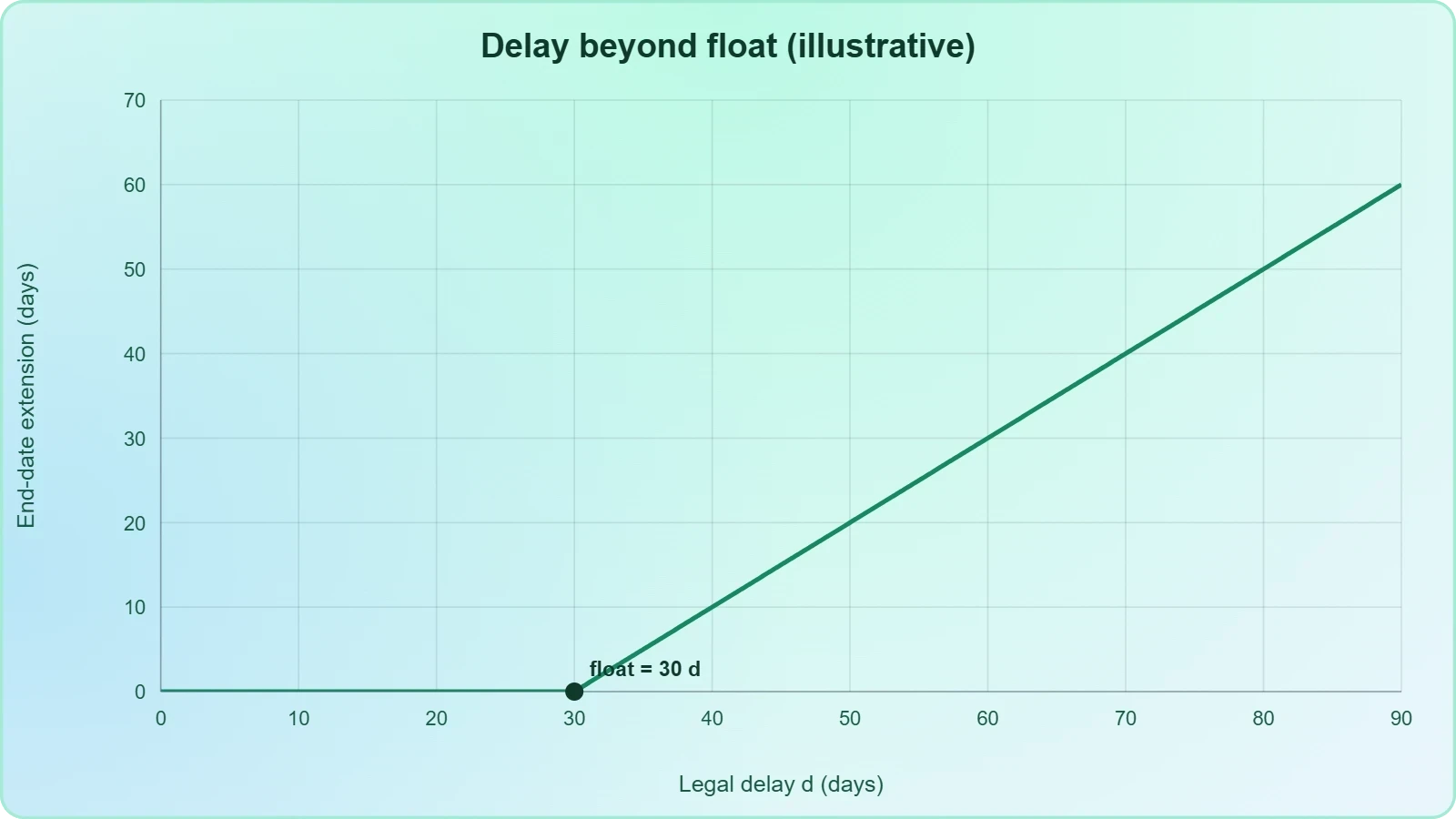
Critical path analysis identifies the sequence of tasks that determines total duration. Legal milestones now sit on that path, meaning a missed filing or an adverse ruling directly extends completion. Planners respond by building float into schedules, but float is expensive and finite, and repeated extensions erode contingency reserves.
Mathematically, the schedule impact of a legal delay can be expressed as an extension of the project duration by the delay interval, adjusted for available float:
Here ##d_{legal}## represents the legal delay and ##F_{path}## the available float on the affected path. When legal delay exceeds float, the project end date moves by the difference. This simple relation explains why even short court extensions can cascade into months of cumulative slippage.
Cost Escalation and Contractual Exposure
Delay carries direct costs: extended supervision, equipment rental, insurance, and escalation in material prices. Contracts often allocate these risks through delay clauses, but force majeure and sovereign-act provisions are contested terrain. Litigation over schedule often follows litigation over approvals, compounding legal expense.
Sponsors can mitigate exposure through phased procurement and conditional commitments, but these tools reduce efficiency. The trade-off is familiar to anyone managing public infrastructure: flexibility costs money, and rigidity costs resilience. Courts, by fixing dates, push projects toward the rigid end of that spectrum.
Governance, Transparency, and Accountability
Judicial deadlines are a transparency mechanism as much as a scheduling one. They compel parties to commit positions in writing and on the record, creating an auditable trail. For public projects, that trail is the primary evidence that decisions were reasoned rather than arbitrary, and it outlasts the news cycle.
The Value of an Auditable Record
An administrative record documents the basis for agency decisions, including studies, consultations, and public comments. When courts demand its timely production, they effectively require agencies to demonstrate diligence. A well-maintained record shortens disputes; a thin one invites remand and repetition of costly analysis.
Transparency also serves the public interest in commemoration. Citizens have a legitimate stake in how memorials are approved, funded, and built. Court-ordered disclosure gives them a window into those processes, even when the underlying dispute is technical and the documents are dense.
Accountability Across Institutions
Accountability in federal projects is distributed across branches: agencies decide, courts review, and legislatures fund. Deadlines sharpen each institution's contribution by imposing temporal discipline. When one branch delays, others feel the constraint, and the public can observe where responsibility lies.
This distribution is a feature of constitutional design, not a defect. It slows action deliberately to protect against error and abuse. The cost is friction, and memorial projects, with their symbolic weight, tend to generate more friction than most. Patience and documentation are the practical antidotes.
- 01
- 02
- 03
- 04
Reading the Report Critically
The source dispatch is deliberately sparse, confirming that deadlines exist without specifying their dates or scope. That omission is itself informative: early reporting on litigation often captures the headline development before the underlying filings are public. Analysts should treat the report as a signal of activity rather than a complete account.
What the Source Says and Does Not Say
What is established is that a judge issued several deadlines in a case involving a memorial arch project associated with Donald Trump, and that these deadlines affect the construction schedule. What remains unknown includes the specific dates, the claims at issue, the parties named, and whether any ruling addressed the merits.
Readers should resist filling those gaps with assumption. Litigation reporting improves as dockets and orders become accessible, and early summaries frequently omit procedural detail that later proves decisive. The prudent approach is to monitor primary court records rather than rely on secondary condensation.
Verification and Follow-Up
Verification requires consulting the court's docket, the scheduling order itself, and any related filings. These documents reveal the precise obligations and the judge's reasoning, which secondary reports rarely capture. For anyone with a stake in the project, primary sources are indispensable.
Follow-up should also track agency responses, because deadlines bind agencies as much as private parties. Statements from permitting authorities, preservation bodies, and project sponsors will clarify how the timetable is being operationalized. Each disclosure narrows the uncertainty that currently surrounds the schedule.
Implications for Sponsors and Observers
For sponsors, the operative lesson is that legal calendars now shape project calendars. Budgeting for legal contingency, maintaining meticulous records, and sequencing work to absorb delay are prudent responses. Assuming that political support translates into procedural speed is a recurring and costly error in public projects.
Practical Risk Management
Risk management begins with mapping every approval required and identifying which are vulnerable to challenge. Legal counsel should be integrated into scheduling from the outset, not summoned after a filing. Contracts should specify how delay is allocated, and financing should include contingency for extended timelines.
Communication matters equally. Stakeholders tolerate uncertainty better when they understand its sources and expected duration. Regular updates grounded in court records build credibility, while silence invites speculation. Transparency during litigation is a form of risk control, not merely a courtesy.
What to Watch Next
Observers should watch for the scheduling order's publication, any motions for extension, and agency statements about compliance. Each development reveals whether the case is moving toward resolution or expanding in scope. The pace of filings often predicts the pace of construction.
Ultimately, the significance of this ruling lies less in any single date than in the principle it affirms: public commemoration proceeds through law, and law imposes timetables. Whether the arch is built, delayed, or redesigned, the record of how those decisions were made will remain the durable artifact.
From our network :
- The Hidden Cost of AI Convenience: Why Over-Permissioned Agents Are a Security Time BombDiscover why AI agents with excessive permissions create dangerous single points of failure, and learn how implementing least privilege principles can protect your organization from exploitation.
- University Language Proficiency Exams: Why Institutional Tests Demand Different Preparation Than IELTS and TOEFLDiscover why university-specific language proficiency examinations differ fundamentally from IELTS and TOEFL, and learn strategic preparation approaches for institutional assessment success.
- CISA’s Ten-Advisory Wave: Why Generic Patching Fails in OT and How to Build Product-Specific PlaybooksCISA released ten ICS advisories in one week, exposing critical infrastructure risks. Generic patching fails in OT. Learn to build product-specific remediation playbooks.
- Live Online English Classes for Kids: Do They Actually Reduce Anxiety?A ten-week study reveals that synchronous online English classes can significantly reduce child language anxiety while improving listening and reading skills. Discover what makes these programs effective and how parents can select the right one.
- Forbidden Matrix Patterns and Visible Lattice Points: A Geometric DictionaryExplore how multidimensional 0–1 matrices encode geometric truths, linking forbidden patterns to visible lattice points and hypergraph theory, with applications in combinatorics and computational geometry.
- The Final Descent: How ESA Retired the Legendary Cluster Constellation After 24 Years of Space Weather ScienceAfter 24 years mapping Earth’s magnetosphere, ESA’s Cluster mission concluded with a precisely controlled reentry over the South Pacific. This analysis explores the scientific legacy, engineering decisions, and debris mitigation principles behind one of space exploration’s most responsible retirements.
- How AI Agents Will Change the Way We Manage Personal FinancesExplore how AI agents are transforming personal finance through automated budgeting, bill payment, and investment management, while examining the critical security protocols and governance frameworks required for safe deployment.
- Mobile Learning and VR in English: What Global Evidence Reveals About Effective Language TechnologyA systematic review across 14 countries reveals which language-learning technologies genuinely work. Mobile learning, AI, and VR show measurable benefits when pedagogically integrated. This evidence-based guide helps educators and learners select technology that delivers real return on investment.
- Committed Mediterranean Precipitation Decline: Why Emissions Cuts Alone Cannot Restore Winter RainsNew NOAA research reveals that Mediterranean winter rains may decline irreversibly even with emissions cuts. Explore the science of committed climate change and regional impacts.
RESOURCES
- Judge complicates construction timeline on Trump's memorial archapnews.com20 hours ago ... Judge complicates construction timeline on Trump's memorial arch project with multiple deadlines ... U.S. District Judge Tanya Chutkan, who ...
- Judge Complicates Construction Timeline on Trump's Memorial ...usnews.com20 hours ago ... Judge Complicates Construction Timeline on Trump's Memorial Arch Project With Multiple Deadlines ... U.S. District Judge Tanya Chutkan, who ...
- Judge complicates construction timeline on Trump's memorial arch ...kdhnews.com20 hours ago ... ... memorial arch, setting multiple notification deadlines before any work can begin. U.S. District Judge Tanya.
- The federal judge overseeing a lawsuit challenging the Trump ...facebook.com16 hours ago ... ... arch-lawsuit-construction- deadlines/74317062?utm_campaign=snd- autopilot. wbaltv.com. Judge complicates President Trump's memorial arch plans ...
- Trump memorial arch plan faces judge's deadlines - KOCOkoco.com19 hours ago ... A federal judge sets strict notification deadlines as Trump's planned Washington memorial arch faces legal challenges before construction can begin.
- Trump memorial arch plan faces judge's deadlines - WBAL-TVwbaltv.com19 hours ago ... A federal judge sets strict notification deadlines as Trump's planned Washington memorial arch faces legal challenges before construction ...
- Trump memorial arch plan faces judge's deadlines - WLWTwlwt.com19 hours ago ... A federal judge sets strict notification deadlines as Trump's planned Washington memorial arch faces legal challenges before construction ...
- Trump memorial arch plan faces judge's deadlines - Gulf Coast Newsgulfcoastnewsnow.com19 hours ago ... A federal judge sets strict notification deadlines as Trump's planned Washington memorial arch faces legal challenges before construction ...
- Judge complicates construction timeline on Trump's memorial arch ...fox59.com20 hours ago ... U.S. District Judge Tanya Chutkan, who ... Judge complicates construction timeline on Trump's memorial arch project with multiple deadlines.
- Judge reinforces order barring immediate work on Trump's DC archthedailyrecord.comSep 8, 2026 ... A federal judge ordered the Trump administration to give 48 hours' notice before engaging in any activity on the site…
- Trump memorial arch plan faces judge's deadlines - WJCLwjcl.com19 hours ago ... A federal judge sets strict notification deadlines as Trump's planned Washington memorial arch faces legal challenges before construction ...
- Trump memorial arch plan faces judge's deadlines - WPTZwptz.com19 hours ago ... A federal judge sets strict notification deadlines as Trump's planned Washington memorial arch faces legal challenges before construction ...
- Trump memorial arch plan faces judge's deadlines - WMTWwmtw.com19 hours ago ... A federal judge sets strict notification deadlines as Trump's planned Washington memorial arch faces legal challenges before construction ...
- The clock is running out for public feedback on Trump's 250-foot archaxios.comJun 15, 2026 ... ... US President Donald Trump's planned. White House ... monument is already moving through the federal pipeline: his proposed Arlington…
- Trump memorial arch plan faces judge's deadlines - KOATkoat.comA federal judge sets strict notification deadlines as Trump's planned Washington memorial arch faces legal challenges before construction can begin.
- 01
- 02
- 03
- 04
- 05
- 06
- 07
- 08
0 Comments