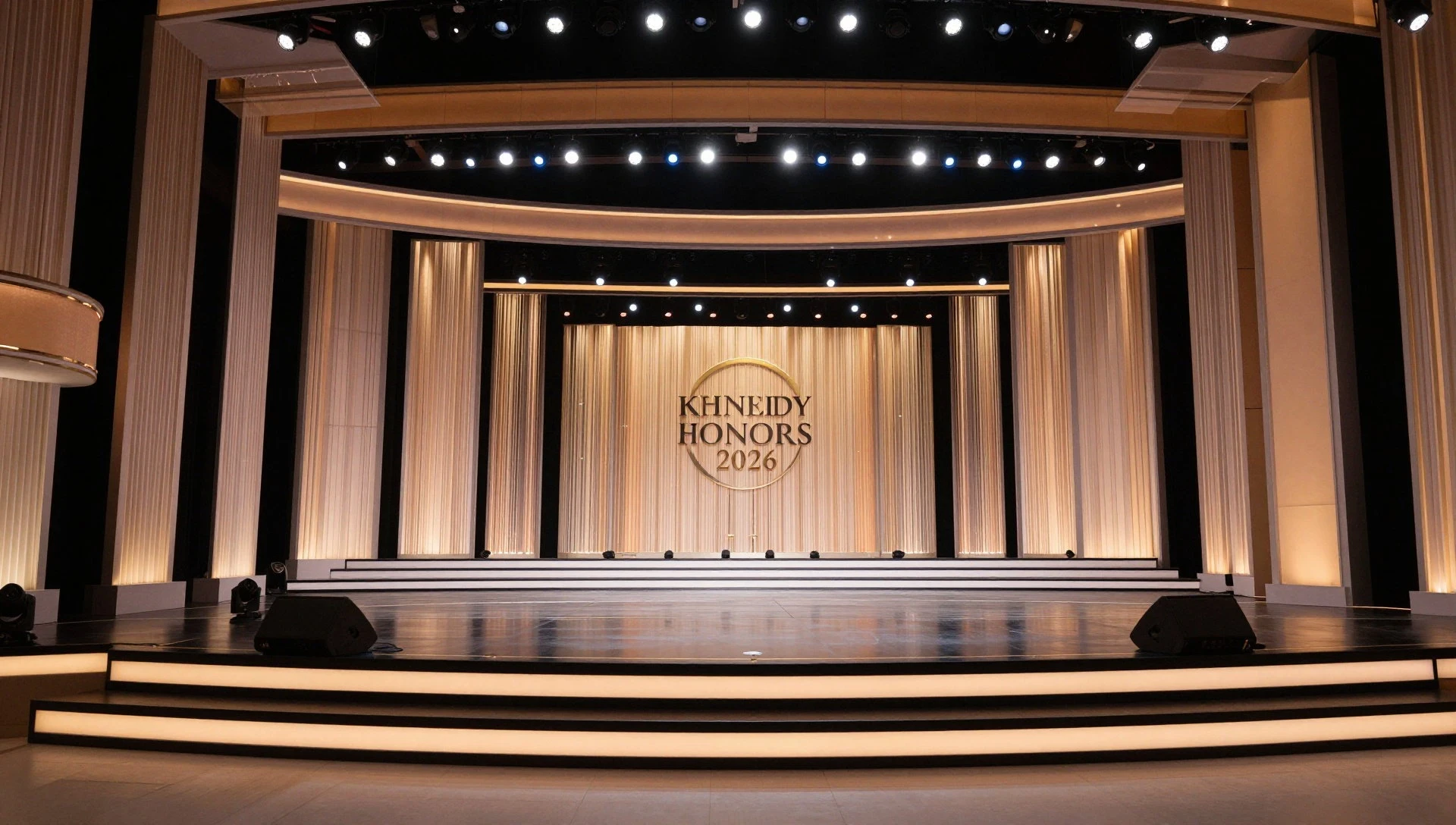
The Kennedy Center Honors have long functioned as America's most visible institutional salute to lifetime achievement in the performing arts, a December ritual where the nation's cultural establishment gathers to canonize a handful of figures whose careers have shaped the public imagination.
The 2026 announcement carries that familiar ceremonial weight, naming five artists whose combined output spans crooning, composing, acting, playwriting, and country music. Yet the headline surrounding this year's class is not the roster itself but the venue: for the first time in the institution's history, the gala will leave the Kennedy Center's opera house and relocate to Capital One Arena, a commercial sports and concert facility in downtown Washington.
That relocation is inseparable from a broader institutional drama that has enveloped the Center since 2025, when the sitting president assumed the chairmanship and began reshaping the organization's identity, governance, and even its name.
On This Page
A board aligned with the administration voted to close the main building for renovations, a judge blocked that vote, and the president threatened to cancel the renovations entirely unless his name was appended to the building.
Against that backdrop, the 49th Honors ceremony on December 7 becomes something more than an awards show; it is a test of whether a tradition nearly five decades old can survive the political weather surrounding it.
This analysis examines the 2026 honorees, the institutional mechanics behind the venue shift, and the legal and cultural questions now hanging over the Kennedy Center. It weighs what the Honors were designed to do against what they have become, and it considers how a lifetime-achievement ceremony rooted in bipartisan civility navigates an era in which cultural institutions are increasingly treated as political territory. The stakes extend well beyond one December evening in Washington.
TL;DR The Kennedy Center has named Paul Anka, David Foster, Andy Garcia, David Mamet, and Barbara Mandrell as its 2026 Honors recipients, continuing a nearly 50-year tradition of celebrating lifetime achievement in the performing arts. The December 7 ceremony, however, will be held at Capital One Arena rather than the Kennedy Center itself, reflecting the institutional turmoil that has followed the president's 2025 takeover of the board and his push to rename the institution after himself. A court has already blocked a board vote to close the main building, and the legal dispute over the Center's future remains unresolved, making this year's Honors as much a story about governance and political pressure as about artistic legacy.
The 2026 Honorees and the Tradition They Inherit
The five artists named for 2026 represent a deliberately broad cross-section of American entertainment, from the pop songwriting of the 1950s through the country stardom of the 1980s and the screen and stage work that followed.
Each honoree carries a distinct lineage, and together they illustrate how the Honors have historically balanced commercial popularity with critical and institutional recognition. The selection signals continuity even as the ceremony's setting changes.
Profiles of the Five Recipients
Paul Anka built a career that began with teenage pop hits and matured into a songwriting catalog spanning decades, including material famously recorded by Frank Sinatra. David Foster's production and composition credits thread through pop, film, and adult contemporary music, making him one of the most commercially successful arrangers of his generation. Their inclusion anchors the class in the craft of song.
Andy Garcia brings a screen career defined by dramatic range, from crime epics to quieter character work, while David Mamet represents the playwright's wing of the Honors with a body of work known for its distinctive dialogue and moral tension.
Barbara Mandrell, a country music mainstay and television presence, completes a class that spans stage, screen, and studio.
How the Honors Have Evolved Since 2025
The most recent class, honored in December 2025, included George Strait, KISS, Michael Crawford, Gloria Gaynor, and Sylvester Stallone. That ceremony marked a break with precedent when the president personally hosted the event, becoming the first occupant of the office to emcee the Honors. The broadcast aired on CBS and Paramount+, preserving the televised format audiences expect.
That hosting decision set the tone for what followed. The Honors had traditionally been staged as a bipartisan celebration, with sitting presidents attending but rarely steering the program. The 2025 ceremony repositioned the event as a platform tied to the administration, and the 2026 edition inherits that altered expectation along with its new arena setting.
The Venue Shift to Capital One Arena
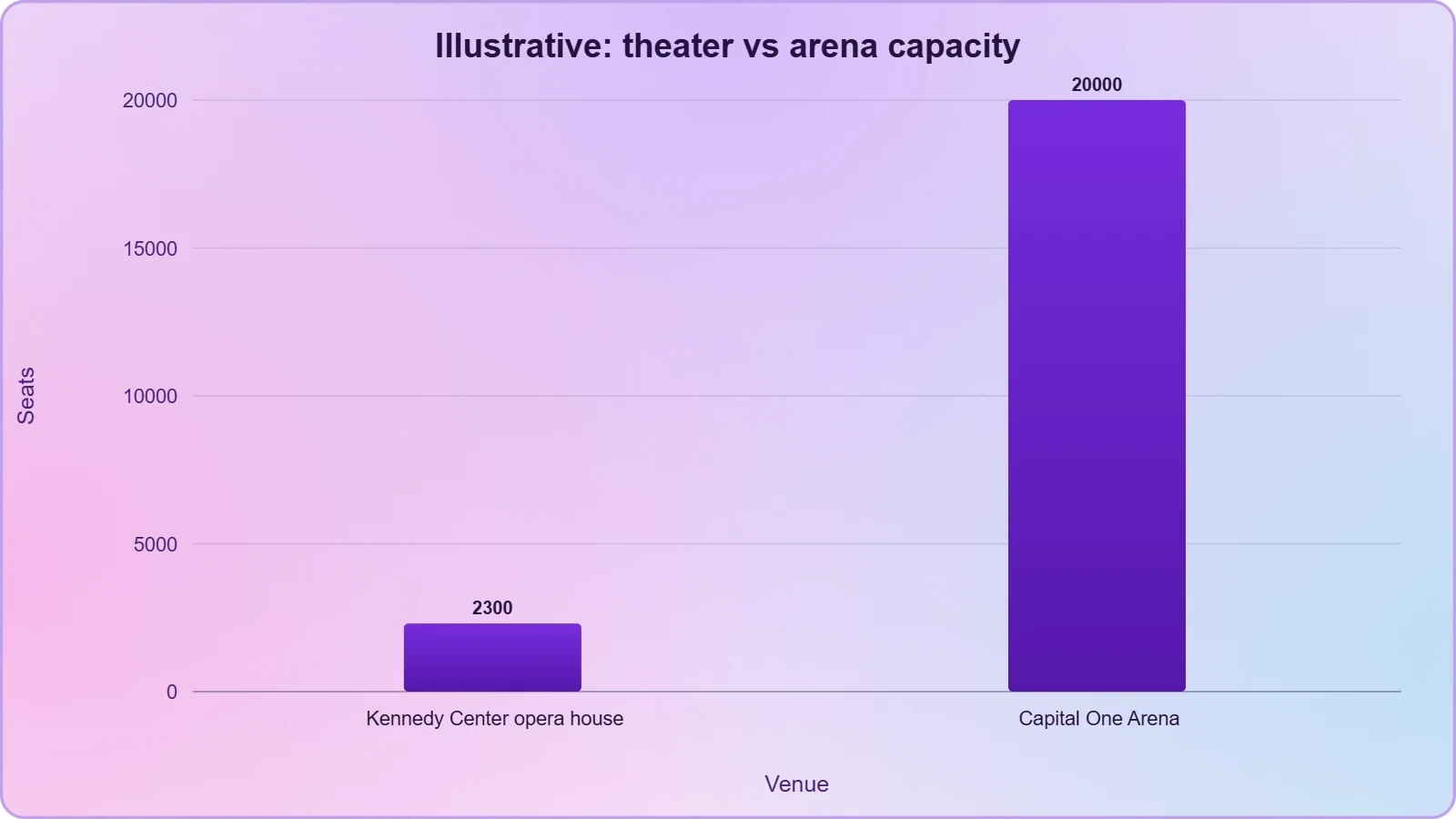
Moving the ceremony from the Kennedy Center's opera house to Capital One Arena is a logistical decision with symbolic consequences. The arena seats far more people than the Center's principal theater, which raises questions about ticketing, broadcast staging, and the intimacy that has defined the Honors for decades. It also physically separates the awards from the institution that grants them.
Logistics and Broadcast Implications
Arena-scale production changes the character of the evening. The Honors have relied on seated dinners, close camera work, and tributes staged at modest distance from the honorees themselves. Capital One Arena demands a different grammar: larger sets, longer sightlines, and a crowd whose relationship to the stage is fundamentally more distant than in a theater.
Television production teams will need to adapt the broadcast accordingly. The CBS and Paramount+ partnership established in 2025 provides a template, but arena acoustics and staging introduce variables that a theater never presents. Whether the show retains its signature warmth or drifts toward spectacle is an open production question.
Why the Move Matters Symbolically
An awards ceremony held away from its own institution sends an unmistakable signal. The Honors derive authority from the Kennedy Center's congressional charter and its position as a national cultural trust. Staging the gala elsewhere weakens that association at precisely the moment the Center's leadership is contesting its own identity.
Critics of the administration's stewardship read the move as further evidence that the institution is being repurposed. Supporters frame it as practical necessity given renovation disputes. Either interpretation concedes the same point: the venue is no longer a neutral backdrop but part of the argument itself.
The Governance Dispute Behind the Headlines
Since 2025, the president's involvement with the Kennedy Center has generated controversy and litigation. After assuming the chairmanship, he moved to rename the institution the "Trump-Kennedy Center," a step that reframed a bipartisan cultural trust as a personal legacy project. A board aligned with the administration then voted to close the main building for renovations.
The Renaming Fight and Board Actions
The renaming proposal drew immediate objections from figures across the cultural sector, who argued that the Center's name reflects a congressional dedication rather than any single administration's patronage. The board vote to close the building for renovations added a second front, raising questions about whether construction planning was being used as leverage.
When the president threatened to cancel the renovations unless his name was added to the building, the dispute moved from symbolic to structural. Renovation funding, building access, and institutional naming became entangled in a single negotiation, leaving the Center's operating plans dependent on a naming concession that many trustees oppose.
The Judicial Intervention and Ongoing Litigation
A judge previously blocked a board vote to close the center, an intervention that temporarily halted the renovation trajectory and preserved public access to the building. That ruling did not resolve the underlying dispute; it merely paused a decision that remains contested in court and in public argument.
The litigation now functions as a proxy for a larger question about who controls national cultural institutions. Trustees appointed through political channels, congressional oversight, and donor expectations all press against one another. Until a court or a settlement clarifies authority, the Center operates in a state of suspended legitimacy.
Political Pressure and the Cultural Institution
The Kennedy Center occupies an unusual position in American governance: it is a national cultural center established by federal statute, supported by both public funds and private philanthropy, and governed by a board whose composition reflects political appointment. That hybrid structure makes it vulnerable to exactly the kind of pressure now being applied.
Precedent for Presidential Involvement
Sitting presidents have long attended the Honors and have occasionally used the occasion for light cultural diplomacy. What distinguishes the current moment is the direct assumption of institutional authority, including chairmanship, naming rights, and control over renovation decisions. The shift moves the Center from ceremonial association toward operational direction.
Presidential libraries, the Smithsonian, and the National Endowment for the Arts have all weathered political transitions, but each maintains buffers between officeholders and day-to-day governance. The Kennedy Center's board structure offers fewer such buffers, which is why a single chairmanship change can cascade into renaming fights and venue relocations.
Public Reaction and Cultural Sector Response
Artists, donors, and arts administrators have responded with a mixture of public criticism and private caution. Some prominent figures have distanced themselves from the institution, while others argue that abandoning the Center cedes it entirely to political control. The debate mirrors broader tensions across museums, universities, and public broadcasting.
Audience sentiment is harder to measure. Ticket sales, broadcast ratings, and donor retention will offer the clearest signals of whether the Honors retain their cultural authority or become another partisan event. The December 7 ceremony will be watched as much for its reception as for its tributes.
What the Honors Mean for Artists and Audiences
For the five 2026 honorees, the award remains a genuine career capstone, conferred by an institution with decades of prestige behind it. None of the recipients chose the political context surrounding their recognition, and their work stands independent of it. The Honors still carry weight in the industries they represent.
- 01
- 02
- 03
- 04
The Value of Lifetime Achievement Recognition
Lifetime achievement awards serve several functions: they consolidate a career's critical standing, introduce older work to new audiences, and provide the industry with a shared ritual of respect. The Kennedy Center Honors have performed these functions since 1978, and their televised format extends that reach nationally.
For younger artists, the Honors function as a visible career ceiling, a marker of what sustained achievement looks like. For audiences, the broadcast offers curated retrospectives and performances that rarely appear elsewhere. Those benefits persist regardless of which building hosts the ceremony.
Audience Access and the Televised Experience
Television remains the primary channel through which most Americans encounter the Honors. The CBS broadcast and Paramount+ streaming availability extend the ceremony far beyond the arena's capacity, preserving national reach even as the live audience grows. That dual distribution model has become standard for prestige cultural events.
The arena setting may actually broaden access, since larger capacity allows more tickets to be distributed. Whether that translates into a more democratic ceremony or simply a more commercial one depends on production choices that will not be visible until December. The broadcast will reveal the answer.
The Road to December 7 and Beyond
The 49th Kennedy Center Honors will take place on December 7 at Capital One Arena, closing a year of institutional turbulence with an evening designed to celebrate artistic achievement.
The honorees will receive their tributes in a venue that has never hosted the ceremony, before an audience larger than the opera house could accommodate.
Unresolved Questions Facing the Institution
Several matters remain unsettled as the ceremony approaches. The legal dispute over the Center's future continues, the renaming question has not been resolved, and the renovation plans remain contingent on negotiations that could shift at any time. Each of these affects the institution's long-term standing.
The board's composition, the president's role as chairman, and the courts' willingness to intervene will determine whether the Center returns to a conventional governance model or settles into a permanently politicized one. The Honors ceremony is a single evening; the governance question spans years.
What to Watch in the Ceremony Itself
The December 7 broadcast will offer several signals worth monitoring. The tone of tributes, the presence or absence of political figures, and the production's handling of the venue change will all indicate how the institution intends to position itself going forward. Audience and critical reception will matter as much as the performances.
Beyond the evening, the more consequential question is whether the Honors can remain a shared national ritual or become another marker of cultural division. The honorees themselves, five artists with decades of work behind them, deserve an evening focused on their contributions rather than the disputes surrounding the stage they stand on.
From our network :
- The Hidden Cost of AI Convenience: Why Over-Permissioned Agents Are a Security Time BombDiscover why AI agents with excessive permissions create dangerous single points of failure, and learn how implementing least privilege principles can protect your organization from exploitation.
- Forbidden Matrix Patterns and Visible Lattice Points: A Geometric DictionaryExplore how multidimensional 0–1 matrices encode geometric truths, linking forbidden patterns to visible lattice points and hypergraph theory, with applications in combinatorics and computational geometry.
- University Language Proficiency Exams: Why Institutional Tests Demand Different Preparation Than IELTS and TOEFLDiscover why university-specific language proficiency examinations differ fundamentally from IELTS and TOEFL, and learn strategic preparation approaches for institutional assessment success.
- CISA’s Ten-Advisory Wave: Why Generic Patching Fails in OT and How to Build Product-Specific PlaybooksCISA released ten ICS advisories in one week, exposing critical infrastructure risks. Generic patching fails in OT. Learn to build product-specific remediation playbooks.
- Live Online English Classes for Kids: Do They Actually Reduce Anxiety?A ten-week study reveals that synchronous online English classes can significantly reduce child language anxiety while improving listening and reading skills. Discover what makes these programs effective and how parents can select the right one.
- How AI Agents Will Change the Way We Manage Personal FinancesExplore how AI agents are transforming personal finance through automated budgeting, bill payment, and investment management, while examining the critical security protocols and governance frameworks required for safe deployment.
- Committed Mediterranean Precipitation Decline: Why Emissions Cuts Alone Cannot Restore Winter RainsNew NOAA research reveals that Mediterranean winter rains may decline irreversibly even with emissions cuts. Explore the science of committed climate change and regional impacts.
- The Final Descent: How ESA Retired the Legendary Cluster Constellation After 24 Years of Space Weather ScienceAfter 24 years mapping Earth’s magnetosphere, ESA’s Cluster mission concluded with a precisely controlled reentry over the South Pacific. This analysis explores the scientific legacy, engineering decisions, and debris mitigation principles behind one of space exploration’s most responsible retirements.
- Mobile Learning and VR in English: What Global Evidence Reveals About Effective Language TechnologyA systematic review across 14 countries reveals which language-learning technologies genuinely work. Mobile learning, AI, and VR show measurable benefits when pedagogically integrated. This evidence-based guide helps educators and learners select technology that delivers real return on investment.
RESOURCES
- The Kennedy Center Honorskennedy-center.orgThe 48th Kennedy Center Honorees received their medallions during a special tribute ceremony held at the State Department on December 6, 2025. Honors. Watch…
- Kennedy Center Honors 2026 to Be Held, But Not at the Embattled ...billboard.comOct 2, 2026 ... The 49th annual Kennedy Center Honors will be held on Dec. 7 – the same date as last year's event…
- Kennedy Center Honors 2026 Sets Date, New Venuehollywoodreporter.comOct 2, 2026 ... The 49th Kennedy Center Honors gala is set to go ahead on Dec. 7, 2026, but not at the now-shuttered…
- Kennedy Center Honors 2026 | Facebookfacebook.com49th Kennedy Center Honors 2026, Annual Honors held on December 2026. Marilyn Rosetta. 24w · Public · No photo description available.
- Kennedy Center Honors - Wikipediaen.wikipedia.org↑ Pederson, Erik (November 2, 2026). "Kennedy Center Honorees Class Of 2026: Paul Anka, David Foster, Andy Garcia, David Mamet & Barbara Mandrell".
- 2026 Kennedy Center Honors - Gold Derbygoldderby.comMar 23, 2026 ... For certain, they will choose a country music artist (many are Republicans). They will choose a big action star (also…
- Kennedy Center Honors to be held at Capital One Arena amid fight ...pbs.orgOct 2, 2026 ... The 49th annual awards are set to take place at Washington's downtown arena, a Kennedy Center spokesperson said Friday. Few…
- Kennedy Center Honors to be held off-site for the first time in the ...nbcnews.comOct 2, 2026 ... The center announced that the celebration will be held at Capital One Arena in downtown Washington, D.C., due to the…
- Kennedy Center names 2026 honorees as Trump renovation battle ...pbs.org1 day ago ... The Kennedy Center has announced that Paul Anka, David Foster, Andy Garcia, David Mamet and Barbara Mandrell will be honored…
- This year's Kennedy Center Honors will be relocated amid ... - CNNcnn.comOct 2, 2026 ... The 2026 honorees have yet to be selected. The event has never been held off-site. During the Covid pandemic the…
- Paul Anka and David Mamet to Be Honored by a Kennedy Center in ...nytimes.com23 hours ago ... The Kennedy Center Honors, the venue's marquee event, will also ... 3, 2026, Section C, Page 4 of the New…
- 'Kennedy Center Honors' Will Add 'Trump' to Name, Move to Smaller ...variety.comFeb 28, 2026 ... ... center by cultural institutions or individual artists that left its calendar for 2026 severely underpopulated. Some who have decried…
- A special night at the Kennedy Center Honors - Instagraminstagram.comDec 10, 2025 ... The 49th Kennedy Center Honors gala is set to go ahead on Dec. 7, 2026, but not at the now-shuttered…
- Kennedy Center Honors awards moved to new venue amid Trump's ...theguardian.comOct 2, 2026 ... The Capital One Arena in Washington DC is now set to host the ceremony on 7 December, a Kennedy Center…
- Kennedy Center Honors: Will They Be Announced Next Week? Who ...showbiz411.comAug 7, 2026 ... country music icon George Strait, legendary rock band KISS (Paul Stanley, Gene Simmons, Peter Criss, Ace Frehley), Tony Award-winning star ...
- 01
- 02
- 03
- 04
- 05
- 06
- 07
- 08
0 Comments