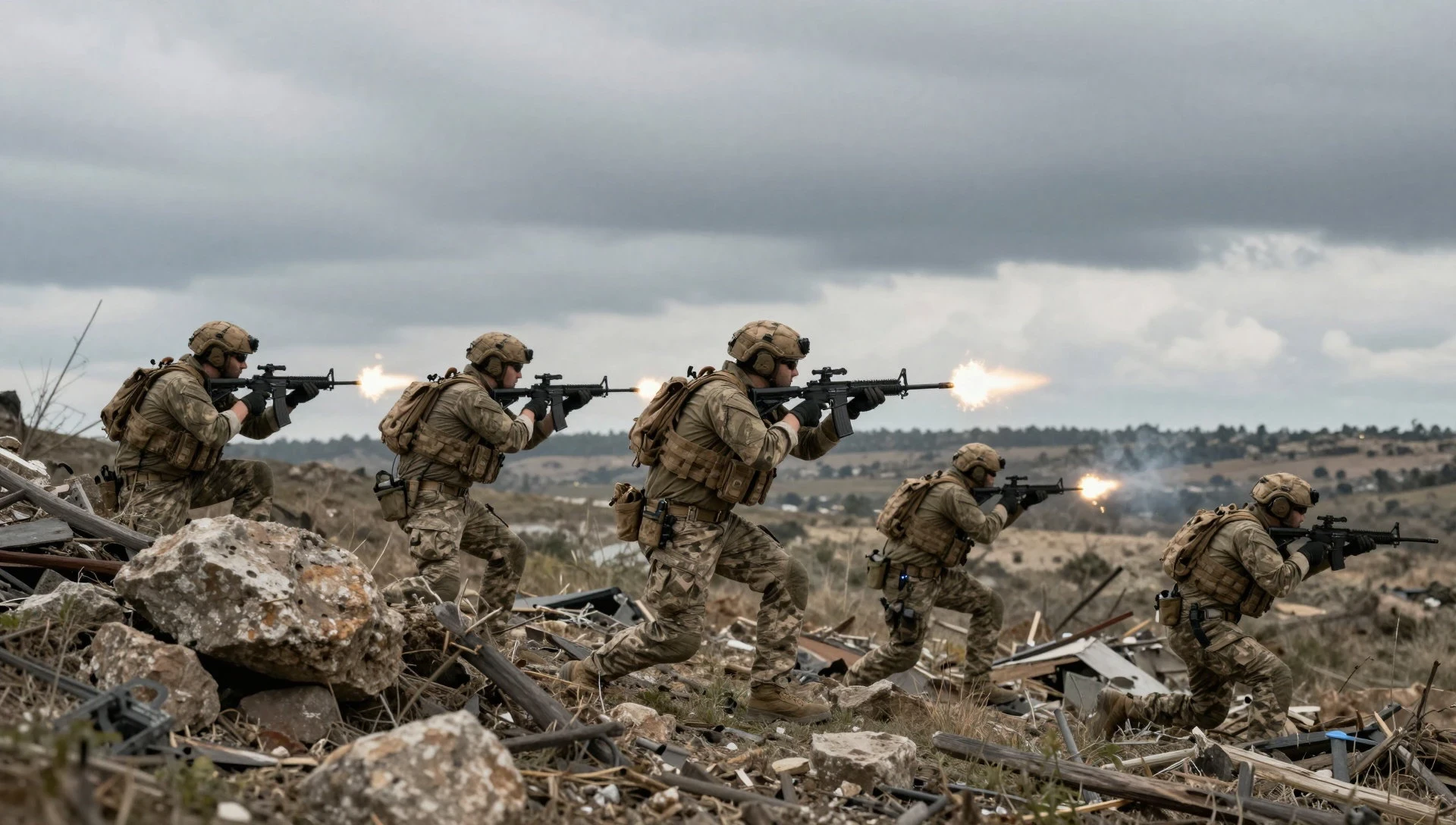
When Western officials confirmed that British troops deployed to a multinational mission in Ukraine would be permitted to return fire if attacked by Russian forces, the announcement carried consequences far beyond a single rules-of-engagement clarification.
It signalled that any future peace-support operation in Ukraine would not be a ceremonial presence but a combat-aware deployment, where deterrence and self-defence are woven into the same mandate. The disclosure, reported by Sky News, effectively draws a line: British personnel will not be passive observers if violence reaches them.
The core meaning of the report rests on a delicate balance between restraint and credibility. A peace mission that cannot defend itself invites escalation from the very forces it is meant to contain, yet a mission that fires too freely risks dragging NATO members into direct confrontation with Moscow.
On This Page
By confirming the right of self-defence, officials are signalling that deterrence begins with the safety of the troops themselves. The mission's legitimacy depends on that clarity.
Understanding this development requires reading between diplomatic lines. The statement does not declare war, nor does it promise offensive action; it establishes a defensive threshold that any professional military planner would consider standard. Yet in the charged context of the Russia-Ukraine conflict, even standard rules become politically loaded.
The following analysis examines the mission's legal foundations, its strategic logic, and the risks that accompany any Western boots on Ukrainian soil.
TL;DR British troops participating in a future multinational peace-support mission in Ukraine will be authorised to return fire if Russian forces attack them, according to Western officials cited by Sky News. The clarification establishes a defensive rules-of-engagement baseline that balances troop protection against escalation risk. It signals that any Western deployment would be combat-aware rather than symbolic, raising questions about mandate, legal authority, and deterrence credibility in a fragile ceasefire environment.
The Strategic Meaning Behind the Rules of Engagement
The confirmation that British troops may fire back when attacked is, at its heart, a statement about deterrence credibility. Peace-support missions historically collapse when peacekeepers are treated as untouchable targets, as witnessed in Bosnia and Rwanda during the 1990s.
By clarifying self-defence rights in advance, officials are signalling that any future mission will not repeat those failures. The message is directed as much at Moscow as at domestic audiences.
Why Self-Defence Clauses Matter in Peace Missions
Rules of engagement define what soldiers may do with force, and ambiguity in those rules has historically produced paralysis at decisive moments. A clear self-defence clause removes hesitation, allowing commanders to respond proportionately without waiting for political authorisation from distant capitals.
In practical terms, it converts a vulnerable observer force into a credible deterrent presence that hostile actors must calculate against.
Legal scholars note that self-defence is an inherent right under international law, codified in the UN Charter's Article 51. A mission that explicitly authorises return fire is therefore not expanding authority but acknowledging reality.
The political significance lies in saying so publicly, which transforms a quiet operational assumption into a visible commitment that allies and adversaries alike can assess.
The Difference Between Peacekeeping and Peace Enforcement
Traditional peacekeeping assumes consent from all parties and minimal use of force, while peace enforcement permits robust action to maintain peace under Chapter VII of the UN Charter. The British clarification nudges any future mission toward the enforcement end of that spectrum.
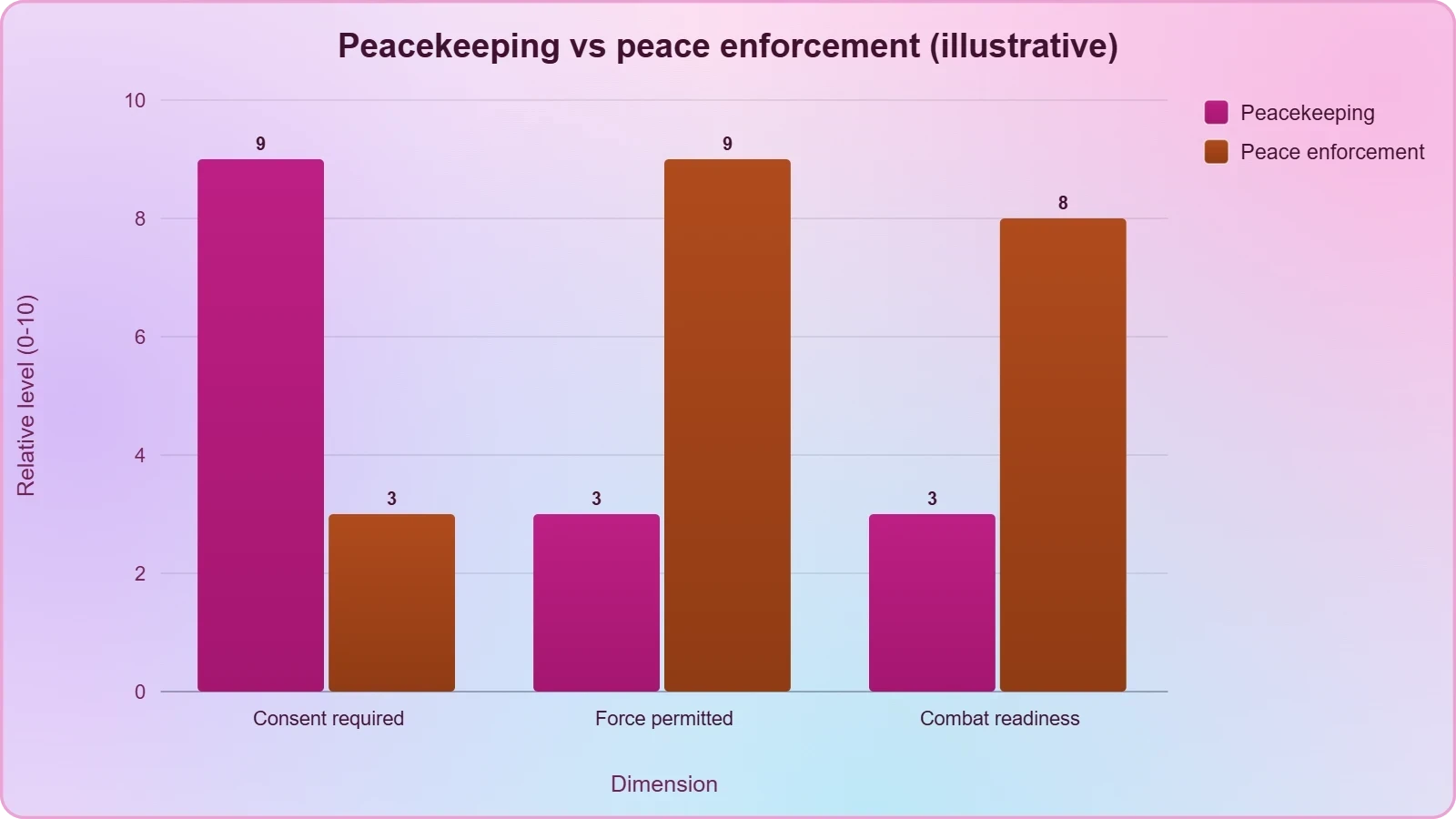
That shift matters because it changes training requirements, equipment profiles, and the political risk calculus for contributing nations.
Analysts observe that modern missions rarely fit neatly into either category. Ukraine's prospective operation would likely blend monitoring, demining, and civilian protection with a latent combat capability. The return-fire authorisation acknowledges this hybrid reality, ensuring troops are neither provocatively aggressive nor dangerously passive when the situation demands a decisive response.
Legal Foundations and International Authority
Any deployment of British troops abroad rests on a lattice of domestic and international legal authority. Parliamentary approval, the Royal Prerogative, and the specific mandate of the multinational coalition all shape what soldiers may lawfully do.
The return-fire clarification sits within this framework, confirming that self-defence is not an exception to the mandate but an intrinsic part of it. Legal precision here protects both troops and ministers.
Article 51 and the Inherent Right of Self-Defence
Under customary international law and the UN Charter, every state retains the inherent right to defend its armed forces. The equation governing proportionate response can be expressed simply as a threshold of necessity and proportionality:
This means the force used in reply must not exceed what is required to neutralise the threat, and it may only be triggered when a genuine threat exists. Officials describing the mission's rules are therefore restating settled law rather than inventing new permissions. The political weight comes from public acknowledgement, not legal novelty.
Mandate Design and Coalition Legitimacy
A multinational mission derives legitimacy from the breadth of its contributing nations and the clarity of its authorising instrument. If the mandate explicitly incorporates self-defence, contributing parliaments can approve deployment with confidence that their soldiers are not being sent into a trap. Ambiguity, by contrast, has historically deterred contributions and weakened coalition cohesion.
Western officials have been careful to frame the mission as supporting future peace rather than prosecuting the present war. That framing matters legally, because it positions the force as a post-settlement stabiliser rather than a belligerent. The return-fire rule preserves that framing while ensuring the force is not defenceless if the settlement frays.
Escalation Risk and Russian Calculations
Moscow's reaction to any Western troop presence in Ukraine will be shaped by how it reads the mission's intent. A force that can shoot back is harder to intimidate but also harder to ignore, and Russian strategists may treat it as a legitimate target in a broader confrontation.
The return-fire rule therefore cuts both ways: it deters attack while raising the stakes if deterrence fails. Officials are betting that clarity reduces miscalculation.
Deterrence Theory Applied to Tripwire Forces
Tripwire forces work by guaranteeing that any attack triggers a response larger than the aggressor anticipates. The return-fire authorisation strengthens the tripwire logic, ensuring that even a limited assault on British personnel produces immediate military consequences.
Deterrence rests on the adversary believing that cost exceeds gain, a calculation that ambiguity undermines and clarity reinforces.
Critics argue that tripwires can also become triggers, dragging reluctant allies into conflicts they hoped to avoid. The balance depends on communication channels, prior consultation, and the adversary's understanding of the rules.
Western officials appear to be managing that balance by publicising the rules in advance, giving Moscow ample notice of what will and will not be tolerated.
Scenarios That Could Test the Rules
Several scenarios could force commanders to interpret the return-fire rule under pressure. A targeted strike on a British patrol, harassment by proxy forces, or an accidental engagement near contested lines would each demand rapid judgement.
The rule provides a framework, but execution depends on training, intelligence, and the temperament of commanders on the ground.
Each scenario carries escalation potential. A proportionate response may restore deterrence, while an excessive one could trigger retaliation against the wider coalition. The mission's designers must therefore invest heavily in pre-deployment training, clear communication protocols, and political guidance that anticipates ambiguity rather than assuming it away.
Alliance Politics and the Western Coalition
The British clarification did not emerge in isolation; it reflects coordination among Western capitals about how any future Ukraine mission should operate. Allies contributing troops need shared rules so that a single nation's engagement does not drag others into unintended conflict.
Publicising the return-fire rule helps align expectations across coalition members and their domestic legislatures. Cohesion depends on transparency.
NATO, the UK, and Burden Sharing
Although the mission is multinational rather than formally NATO, the alliance's shadow looms over every decision. Britain's willingness to specify self-defence rights may encourage other European nations to contribute with confidence. Burden sharing works best when rules are uniform, and a clear baseline reduces the political friction that accompanies divergent national caveats.
London's role carries particular weight given its military capabilities and its history of expeditionary operations. By taking a public position, Britain sets a precedent that smaller contributors can reference in their own parliamentary debates. The clarification thus functions as coalition-building diplomacy as much as operational planning.
Domestic Political Constraints in the UK
British governments must manage parliamentary scepticism about foreign deployments, especially after decades of interventions with contested outcomes. Confirming self-defence rights reassures lawmakers that troops will not be placed in indefensible positions. It also pre-empts accusations that ministers are exposing service members to unnecessary risk without clear authority to respond.
Public opinion remains cautious about entanglement in Ukraine, yet surveys consistently show support for defending British personnel. The return-fire rule threads that needle, promising protection without promising offensive war. Officials can present it as prudent planning rather than escalation, a framing that survives scrutiny in both the Commons and the press.
Operational Realities for Deployed Forces
Behind the diplomatic language lies the practical question of what soldiers actually do when a mission begins. Training, equipment, intelligence support, and medical evacuation planning all shift when return fire is authorised.
Units must be prepared for contact rather than merely observation, and commanders must rehearse escalation decisions before they face them under fire. Preparation is the difference between restraint and chaos.
- 01
- 02
- 03
- 04
Training and Equipment Implications
Authorising return fire changes the equipment profile of a deployment. Armoured vehicles, counter-battery radar, and enhanced medical support become more relevant than they would be for a purely observational force. Training must emphasise proportional response, target identification, and de-escalation, ensuring soldiers understand both their rights and their limits under pressure.
Logistics also adapt. A force that may engage needs ammunition resupply chains, casualty evacuation routes, and communications resilient to jamming. Planners must assume the worst while hoping for the best, a principle that has guided military preparation for centuries. The return-fire rule simply makes that assumption explicit rather than implicit.
Command, Control, and Communication
Clear rules of engagement are only as effective as the command structure that interprets them. Commanders need authority to act quickly, while political leaders need confidence that force is used proportionately. The balance is achieved through pre-agreed thresholds, real-time reporting, and a culture that rewards disciplined judgement over reflexive aggression.
Communication with adversaries matters as much as communication within the coalition. Deconfliction channels, hotlines, and prior notification of patrol routes reduce the chance of accidental engagement. The return-fire rule works best when paired with robust communication, ensuring that force is a last resort rather than a first instinct.
What the Clarification Signals for the Future
The return-fire clarification is best understood as a signal about the shape of any future settlement rather than a description of present combat. It tells Moscow that Western troops will not be deployed as hostages, and it tells allies that Britain is prepared to shoulder real risk.
Both messages shape the bargaining environment in which peace talks might unfold. Signals matter as much as soldiers.
Implications for a Future Peace Settlement
Any durable settlement will require security guarantees that Ukraine's partners are willing to enforce. A mission with clear self-defence rights is more credible than one without, because it raises the cost of violating the agreement. The clarification therefore strengthens the architecture of deterrence that any peace deal would depend upon. Credibility is the currency of guarantees.
Yet guarantees also carry obligations. If the mission is deployed and then attacked, Western governments will face pressure to respond beyond the immediate engagement. The return-fire rule is a floor, not a ceiling, and escalation dynamics could pull contributors deeper than they intended. Policymakers must plan for that possibility rather than assume it away.
Reading the Signal Without Overreading It
Officials have been careful to describe the mission as supporting future peace, not as entering the current war. Overreading the clarification as a commitment to fight Russia would misjudge its purpose. It is a defensive baseline, designed to protect troops and preserve the mission's viability. Restraint in interpretation is itself a form of strategic discipline.
Equally, underreading it would be a mistake. The public confirmation that British troops may return fire is a meaningful shift in how Western governments discuss deployment. It acknowledges that peace missions in contested spaces are inherently dangerous, and that soldiers must be trusted to defend themselves when diplomacy fails. That acknowledgement is the real news.
From our network :
- University Language Proficiency Exams: Why Institutional Tests Demand Different Preparation Than IELTS and TOEFLDiscover why university-specific language proficiency examinations differ fundamentally from IELTS and TOEFL, and learn strategic preparation approaches for institutional assessment success.
- How AI Agents Will Change the Way We Manage Personal FinancesExplore how AI agents are transforming personal finance through automated budgeting, bill payment, and investment management, while examining the critical security protocols and governance frameworks required for safe deployment.
- Forbidden Matrix Patterns and Visible Lattice Points: A Geometric DictionaryExplore how multidimensional 0–1 matrices encode geometric truths, linking forbidden patterns to visible lattice points and hypergraph theory, with applications in combinatorics and computational geometry.
- Mobile Learning and VR in English: What Global Evidence Reveals About Effective Language TechnologyA systematic review across 14 countries reveals which language-learning technologies genuinely work. Mobile learning, AI, and VR show measurable benefits when pedagogically integrated. This evidence-based guide helps educators and learners select technology that delivers real return on investment.
- The Final Descent: How ESA Retired the Legendary Cluster Constellation After 24 Years of Space Weather ScienceAfter 24 years mapping Earth’s magnetosphere, ESA’s Cluster mission concluded with a precisely controlled reentry over the South Pacific. This analysis explores the scientific legacy, engineering decisions, and debris mitigation principles behind one of space exploration’s most responsible retirements.
- Live Online English Classes for Kids: Do They Actually Reduce Anxiety?A ten-week study reveals that synchronous online English classes can significantly reduce child language anxiety while improving listening and reading skills. Discover what makes these programs effective and how parents can select the right one.
- Committed Mediterranean Precipitation Decline: Why Emissions Cuts Alone Cannot Restore Winter RainsNew NOAA research reveals that Mediterranean winter rains may decline irreversibly even with emissions cuts. Explore the science of committed climate change and regional impacts.
- The Hidden Cost of AI Convenience: Why Over-Permissioned Agents Are a Security Time BombDiscover why AI agents with excessive permissions create dangerous single points of failure, and learn how implementing least privilege principles can protect your organization from exploitation.
- CISA’s Ten-Advisory Wave: Why Generic Patching Fails in OT and How to Build Product-Specific PlaybooksCISA released ten ICS advisories in one week, exposing critical infrastructure risks. Generic patching fails in OT. Learn to build product-specific remediation playbooks.
RESOURCES
- TIL when the UN's Nordic Battalion was sent to Bosnia in 1993 it ...reddit.comJun 30, 2021 ... What is the point of a military force that can't return fire. ... Why do Western nations send troops to…
- European Peacekeepers Could Return Fire Against Russian Forces ...united24media.com6 hours ago ... British troops and other European forces deployed to Ukraine after a ... Its rules of engagement would allow European troops…
- Nordbat 2 and Mission Command in Bosnia - The Strategy Bridgethestrategybridge.orgSep 20, 2017 ... ... return fire, regardless of the formal rules of engagement. Nordbat 2's willingness to bend or even break the rules,…
- Principles of peacekeepingpeacekeeping.un.orgJun 11, 2026 ... By contrast, peace enforcement does not require the consent of the main parties and may involve the use of military…
- Allies To Pledge 'Binding Commitments' On Ukraine's Security, Draft ...rferl.orgJan 6, 2026 ... France, the UK, and Turkey are expected to push a proposal for a peacekeeping force, with possible US logistical and…
- Lethal Force, Risk, and LSCO: Preparing for Permissive Rules of ...armyupress.army.mil... fire support NCO calls out, “Fire mission … GMTI [ground movement ... Rules of engagement (ROE) are defined as “directives issued by competent…
- Britain's pledged troops for Ukraine. Just don't ask for the details.politico.euJan 7, 2026 ... Questions over resources, terms of engagement and an endgame linger after Keir Starmer joins Emmanuel Macron in pledging troops to…
- Avoiding the Scourge of War: The Challenges of United Nations ...origins.osu.eduOct 3, 2011 ... The limited rules of engagement set forth in the mission's mandate authorized the 6,000 peacekeepers to return fire only in…
- The Use of Force in UN Peace Operations - SIPRIsipri.orgApr 12, 2026 ... ... mission might be categorized in terms of the degree of force they used. Controversy about the non-use of force…
- U.S. Security Cooperation with Ukraine - State Departmentstate.govMar 12, 2025 ... The United States has communicated to Russia that Russian reciprocity is the key to achieving peace. To date, we have…
- NATO's role in Kosovo | NATO Topicnato.intOct 15, 2026 ... This was the largest reinforcement of the peacekeeping mission in a decade, and brought the number of troops up to…
- NATO STANDARD AJP-01 ALLIED JOINT DOCTRINEcoemed.orgDec 1, 2022 ... contingent peacetime military engagement, peace support and security-themed campaigns ... and rules of engagement. In armed conflict, the ...
- Relations with Ukraine | NATO Topicnato.intOct 8, 2026 ... Today, NATO Allies are providing unprecedented levels of military assistance to Ukraine, supporting its ability defend itself against Russia's ...
- Informal meeting of Defence Ministers: Press conference by ... - EEASeeas.europa.eu... Ukraine mission. Ministers also looked into deepening the defence industrial ... rules of engagement. Every vessel seized, detained or disrupted means ...
- Secretary of State Marco Rubio Remarks to the Pressstate.govDec 19, 2025 ... I believe President Trump has had more meetings with foreign leaders and others on the war in Ukraine than on…
- 01
- 02
- 03
- 04
- 05
- 06
- 07
- 08
0 Comments