
When Asia-Pacific capitals study an American midterm election, they are not reading tea leaves for sport. They are pricing risk. The November 2026 vote arrives with the region still absorbing two shocks delivered from Washington: a tariff architecture that reshaped supply chains almost overnight, and a war with Iran that throttled the Gulf energy lifeline on which much of Asia depends.
Governments from Manila to Hanoi are asking a single, practical question — will divided government in Washington change either equation?
The short answer, according to trade specialists and regional analysts, is almost certainly no. A Democratic-controlled Congress could open investigations, summon officials, and pass symbolic resolutions, yet the structural levers of trade and war policy remain firmly in presidential hands.
On This Page
- Why the Asia-Pacific Region Is Watching Washington So Closely
- The Constitutional Wall Between Congress and the War
- Tariffs: From "Reciprocal" Duties to Forced-Labour Rationale
- The July Rebuild: Forced Labour as the New Legal Architecture
- What a Democratic Congress Could and Could Not Do
- Fiscal Scars: Subsidies, Reserves, and the Cost of Shielding Consumers
- Strategic Implications for Governments, Investors, and Exporters
What follows examines why the region's hopes for a policy correction are likely to go unmet, how the tariff regime evolved from "reciprocal" duties into a forced-labour rationale, and what the energy shock revealed about Asia's exposure to a single maritime chokepoint.
This analysis also weighs the domestic politics that constrain any congressional pushback, the veto arithmetic written into the US Constitution, and the quiet fiscal damage accumulating in smaller Southeast Asian economies.
For investors, exporters, and policymakers across the region, the midterms matter less as a turning point than as a stress test of assumptions long taken for granted.
TL;DR Asia-Pacific nations are watching the 2026 US midterms hoping for relief from punitive tariffs and the Iran war, but analysts see little prospect of change even if Democrats win Congress. Trade policy remains a presidential prerogative, and veto math makes legislative restraint nearly impossible. Meanwhile, the closure of the Strait of Hormuz exposed severe energy vulnerabilities, forcing fuel subsidies and draining reserves across Southeast Asia.
Why the Asia-Pacific Region Is Watching Washington So Closely
The region's attention is not abstract diplomacy. Asia-Pacific economies received most of the Gulf oil and gas transiting the Strait of Hormuz before hostilities began in January, making the waterway a de facto regional utility.
When Iran closed it in retaliation for US and Israeli strikes, the disruption travelled instantly through fuel markets, shipping insurance, and currency reserves.
The Energy Chokepoint That Redefined Regional Risk
The Philippines, sourcing more than ninety percent of its crude imports from the Gulf, declared a national energy emergency — a stark admission that diversification had been discussed for decades but never delivered. Other capitals discovered similar exposure hidden beneath years of comfortable pricing.
According to the ISEAS-Yusof Ishak Institute in Singapore, the conflict drained foreign exchange reserves in Cambodia, Laos, Myanmar, and East Timor. Indonesia, Malaysia, Thailand, and Vietnam responded by spending heavily on fuel subsidies, shielding consumers at considerable fiscal cost.
Public Opinion Versus Policy Leverage
Public sentiment across the region remains strongly opposed to the war, yet opposition has not translated into influence. Trade specialist Steven Okun, chief executive of APAC Advisors in Singapore, notes that a Democratic Congress might investigate the conflict and hold oversight hearings without altering its overall trajectory.
That gap between popular preference and policy outcome is the defining frustration of the moment. Regional governments can lobby, publish, and persuade, but the decision architecture in Washington was designed to resist concentrated foreign pressure on matters framed as national security.
The Constitutional Wall Between Congress and the War
Article I grants Congress the power to declare war, and that clause has become the region's quiet hope. In practice, the president has characterized the strikes on Iran as self-defence, a framing that sidesteps congressional authorization and has survived resolutions directing withdrawal of US forces.
Veto Arithmetic and the Two-Thirds Threshold
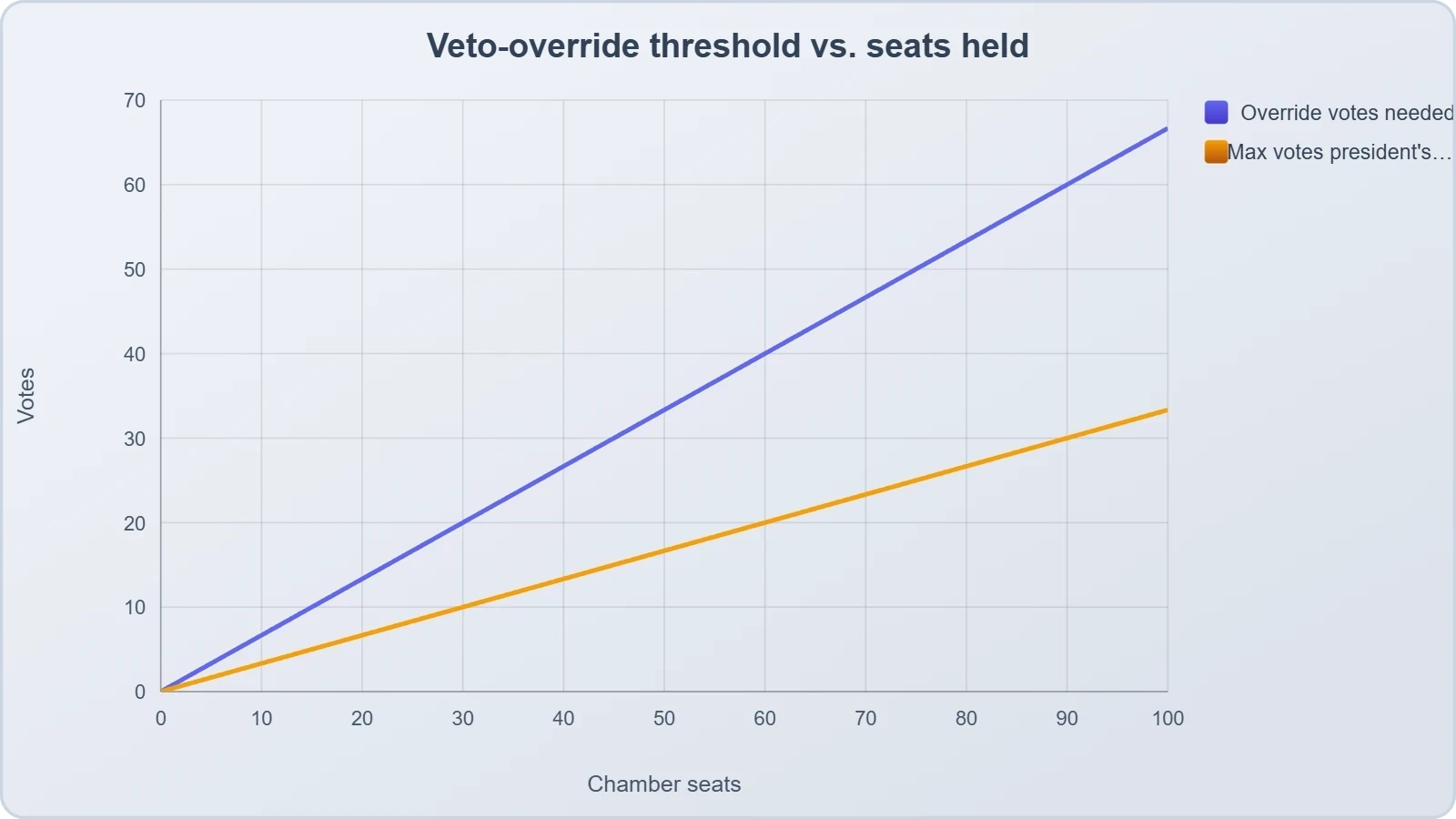
Even a determined Democratic majority faces a steep climb. Legislation restricting military operations or cutting funding would almost certainly meet a presidential veto, and overriding it requires two-thirds majorities in both chambers — a bar rarely cleared on contested foreign policy.
The mathematical reality is unforgiving. If a chamber holds ##S## seats and the president's party controls ##R## of them, an override requires roughly ##\frac{2S}{3}## votes, meaning defections must exceed one-third of the governing bloc. That threshold explains why oversight hearings, not binding statutes, remain the realistic instrument.
Oversight as Theatre With Consequences
Investigations and hearings are not meaningless. They shape public narratives, complicate appointments, and raise the political cost of escalation. Yet Okun's assessment is blunt: such pressure would not change the war's overall impact on regional energy markets or shipping lanes.
For Asian governments, this means planning must assume continuity. Energy stockpiles, diversified suppliers, and reserve buffers matter more than diplomatic appeals to a legislature that cannot command the commander-in-chief.
Tariffs: From "Reciprocal" Duties to Forced-Labour Rationale
Trade offers even less legislative traction. Last year, the president imposed "reciprocal" tariffs ranging from ten to fifty percent on roughly ninety countries to shrink the US trade deficit. Asia absorbed the heaviest blows, with Cambodia at 49 percent, Laos at 48, Vietnam at 46, and Myanmar at 45.
The Supreme Court Interlude and the July Reset
In February, the Supreme Court struck down those tariffs, a ruling that briefly raised regional hopes. By July, the administration had rebuilt the wall on new footing, imposing 10 and 12.5 percent duties on goods from sixty trading partners accused of failing to stop imports made with forced labour.
In Asia, that list includes China, Japan, South Korea, and seven Southeast Asian nations. The legal theory changed; the economic effect on exporters barely did. Companies that had rerouted supply chains after the first round found themselves recalculating again within months.
Why Congress Cannot Easily Rewind the Tariff Regime
Analysts see little room for legislators to limit presidential tariff authority, which rests on statutes delegating broad discretion over national security and emergency economic powers. Reclaiming that authority would require new legislation — and therefore a veto-proof majority that does not exist.
Regional trade ministries have adjusted accordingly, treating tariff volatility as a permanent operating condition rather than a temporary disruption. Bilateral deals, rules-of-origin engineering, and nearshoring within Asia have become standard corporate responses to an unpredictable Washington.
The July Rebuild: Forced Labour as the New Legal Architecture
The administration's second tariff wave rests on a different justification: that trading partners have failed to halt imports produced with forced labour. That framing shifts the debate from trade deficits to moral and legal compliance, making the duties harder to challenge in court or Congress.
Sixty Partners, One Accusation
Sixty trading partners received the July duties, including China, Japan, South Korea, and seven Southeast Asian nations. For exporters, the practical question is documentation — proving supply chain cleanliness has become as important as pricing and delivery schedules.
Compliance departments across Asia are now auditing subcontractors several tiers deep, a costly exercise for small and medium manufacturers. Firms that cannot demonstrate traceability face either the duty or exclusion from US buyers altogether.
Strategic Ambiguity as a Negotiating Tool
The shifting legal basis for tariffs is itself a source of leverage. Partners cannot settle permanently because the rules may change again, so each negotiation is provisional. That uncertainty extracts concessions without requiring a durable agreement.
For Asian governments, the lesson is that predictability has become a luxury good. Trade ministries now build scenarios rather than forecasts, preparing for multiple tariff regimes simultaneously.
What a Democratic Congress Could and Could Not Do
Suppose Democrats win control of one or both chambers. The realistic menu includes investigations into war conduct, hearings on tariff impacts, and legislation that signals intent. What it excludes is binding restraint on either front, given veto math and delegated authority.
Investigations, Hearings, and the Limits of Signal
Hearings can elevate regional voices and document economic harm, creating a record that future administrations might use. They cannot, however, reopen the Strait of Hormuz, refund subsidy spending, or roll back duties already collected.
Okun's conclusion bears repeating: Congress might investigate the war and hold oversight hearings, but this would not change its overall impact. Symbolic politics has real audiences, yet markets and shipping lanes respond to enforceable rules.
The Veto-Proof Majority That Rarely Exists
Overriding a presidential veto requires two-thirds in both chambers, a supermajority that has historically appeared only on rare, broadly shared priorities. Foreign policy and trade rarely qualify, especially when framed as security matters.
This asymmetry means the midterms may alter Washington's tone without altering its trajectory. For Asia, the distinction between rhetoric and policy is the difference between planning and hoping.
- 01
- 02
- 03
- 04
Fiscal Scars: Subsidies, Reserves, and the Cost of Shielding Consumers
Beyond diplomacy, the war's fiscal footprint is deepening. Fuel subsidies in Indonesia, Malaysia, Thailand, and Vietnam have protected households but consumed budget space that might otherwise fund infrastructure or education. Reserves in smaller economies have thinned.
Reserve Drain in the Smaller Economies
Cambodia, Laos, Myanmar, and Timor-Leste face declining foreign exchange reserves, according to ISEAS-Yusof Ishak Institute research. Thinner buffers reduce room to defend currencies, import essential goods, or absorb further shocks.
For these economies, the midterms are less about geopolitics than about breathing room. Any signal that energy markets might normalize would matter more than any congressional resolution.
Subsidy Politics and the Reform Dilemma
Subsidies are politically sticky. Removing them once consumers have adapted invites unrest, yet maintaining them strains budgets already pressured by weaker trade receipts. Governments face a reform dilemma with no comfortable exit.
Economists argue the crisis should accelerate diversification away from Gulf crude and toward regional suppliers, renewables, and strategic reserves. Whether political systems can deliver that shift before the next disruption is the open question.
Strategic Implications for Governments, Investors, and Exporters
The midterms will generate headlines, but the operating environment for Asia-Pacific economies is already set. Tariff volatility persists regardless of who chairs committees, and the Iran conflict continues to shape energy logistics and insurance costs across the region.
Planning for Continuity Rather Than Change
Prudent governments are building reserves, diversifying suppliers, and negotiating bilateral arrangements that reduce exposure to any single policy regime. Investors are pricing political risk as a permanent variable rather than an event to be waited out.
Exporters, meanwhile, are investing in traceability systems that satisfy forced-labour scrutiny while hedging against future legal theories. The common thread is resilience through redundancy, not reliance on Washington's goodwill.
What Would Actually Change the Calculus
Genuine change would require either a president willing to reverse course or veto-proof majorities committed to reclaiming delegated authority. Neither is on the horizon, which is why regional analysts counsel adaptation over expectation.
The deeper lesson concerns dependence. A region that sourced most of its Gulf energy through one narrow strait, and sold goods under rules set elsewhere, discovered how little control it held. The midterms merely illuminate that structural truth.
From our network :
- How AI Agents Will Change the Way We Manage Personal FinancesExplore how AI agents are transforming personal finance through automated budgeting, bill payment, and investment management, while examining the critical security protocols and governance frameworks required for safe deployment.
- University Language Proficiency Exams: Why Institutional Tests Demand Different Preparation Than IELTS and TOEFLDiscover why university-specific language proficiency examinations differ fundamentally from IELTS and TOEFL, and learn strategic preparation approaches for institutional assessment success.
- The Final Descent: How ESA Retired the Legendary Cluster Constellation After 24 Years of Space Weather ScienceAfter 24 years mapping Earth’s magnetosphere, ESA’s Cluster mission concluded with a precisely controlled reentry over the South Pacific. This analysis explores the scientific legacy, engineering decisions, and debris mitigation principles behind one of space exploration’s most responsible retirements.
- Mobile Learning and VR in English: What Global Evidence Reveals About Effective Language TechnologyA systematic review across 14 countries reveals which language-learning technologies genuinely work. Mobile learning, AI, and VR show measurable benefits when pedagogically integrated. This evidence-based guide helps educators and learners select technology that delivers real return on investment.
- CISA’s Ten-Advisory Wave: Why Generic Patching Fails in OT and How to Build Product-Specific PlaybooksCISA released ten ICS advisories in one week, exposing critical infrastructure risks. Generic patching fails in OT. Learn to build product-specific remediation playbooks.
- Committed Mediterranean Precipitation Decline: Why Emissions Cuts Alone Cannot Restore Winter RainsNew NOAA research reveals that Mediterranean winter rains may decline irreversibly even with emissions cuts. Explore the science of committed climate change and regional impacts.
- The Hidden Cost of AI Convenience: Why Over-Permissioned Agents Are a Security Time BombDiscover why AI agents with excessive permissions create dangerous single points of failure, and learn how implementing least privilege principles can protect your organization from exploitation.
- Forbidden Matrix Patterns and Visible Lattice Points: A Geometric DictionaryExplore how multidimensional 0–1 matrices encode geometric truths, linking forbidden patterns to visible lattice points and hypergraph theory, with applications in combinatorics and computational geometry.
- Live Online English Classes for Kids: Do They Actually Reduce Anxiety?A ten-week study reveals that synchronous online English classes can significantly reduce child language anxiety while improving listening and reading skills. Discover what makes these programs effective and how parents can select the right one.
RESOURCES
- War, tariffs and China: What the US midterms mean for the Asia-Pacificaljazeera.com19 hours ago ... ... war on Iran to his policies on trade and tariffs. But few ... Asia Pacific because it's not going…
- How Will the Midterm Elections Impact Asia Policy?aei.orgTPA allows the president to negotiate a trade agreement without foreign ... On the whole, the panel found that the United States needed to…
- The Fallout of the U.S.–Canada Trade War Won't Be Limited to North ...carnegieendowment.orgSep 10, 2026 ... U.S. trading partners in Asia are closely watching the dispute for signs of how it may affect their own interests.
- A U.S.-Japan Trade Impasse as Ishiba Faces Another Electioncfr.orgJul 17, 2025 ... Research Associate, Asia-Pacific Studies. Share. Log In ... How War, Tariffs, and Other Foreign Policy Issues Could Affect the U.S.…
- What do US-China tensions mean for Asia? - World Economic Forumweforum.orgDec 6, 2018 ... ... effects of the ongoing trade war between the US and China. But ... The fact that leaders at the…
- What happened when Trump met Xi? - Brookings Institutionbrookings.eduNov 5, 2025 ... On October 30, 2025, in Busan, South Korea, U.S. President Donald Trump and Chinese President Xi Jinping met for roughly…
- US Regional Foreign Policy: Unforced Diplomatic Errors Risk ...mei.eduSep 28, 2026 ... ... Asia-Pacific region to prosecute the Iran war. Such sudden drawdowns ... America's domestic political landscape heading into midterm elections ...
- An economic pillar to round out US strategy in Asia: IPEF and ...ussc.edu.auSep 18, 2023 ... ... influence Indo-Pacific trade and economic practices. Australia recognises the importance of US economic leadership to balance China's influence.
- Americans, Foreign Policy, and the 2026 Midtermsglobalaffairs.orgOct 1, 2026 ... Results and analysis of the Council's 2026 annual survey of American views on foreign policy. Americans are approaching the midterm…
- Asia and the correct response to Trump's tariffs - East Asia Forumeastasiaforum.orgAug 24, 2026 ... ... US tariff policy. With Washington potentially relinquishing its ... trade war. Both seem as though they will define the…
- US voters are angry. But on tariffs and war, the midterms won't bring ...chathamhouse.orgOct 22, 2026 ... Despite their anger, American voters are unlikely to see much immediate change to the international policies that are driving up…
- President Obama's Second Trip to Asia: Soft Power - CSIScsis.orgNov 16, 2010 ... U.S. MIDTERM ELECTIONS. Republicans sweep the House. Following ... The impact of the 112th Congress on U.S. policy in Southeast…
- Why the US midterms are a rare foreign policy electionchathamhouse.orgOct 15, 2026 ... One, voters care about foreign affairs when an administration's choices directly affect their daily lives. Two, voters care about what…
- The 2026 US Midterm Elections: Ramifications for Australiathediplomat.com8 days ago ... ... U.S. trade and industrial policy may affect Australia's economic sovereignty. The Congressional Balance of Power and U.S. Policy Continuity.
- 01
- 02
- 03
- 04
- 05
- 06
- 07
- 08
0 Comments