When the United States votes in a midterm election, the rest of the world watches with the same intensity it reserves for a presidential contest, because the outcome reshapes legislative arithmetic, regulatory posture, and the tone of American foreign policy for the two years that follow. The November 2026 midterms carried that familiar weight, and the immediate reaction from analysts, strategists, and market commentators became a story in its own right. Their assessments did not simply tally seats won and lost; they interpreted what the results signal about the country's political direction, the durability of governing coalitions, and the constraints that will bind the executive branch until the next national ballot.
What makes analyst commentary so consequential after a midterm is that it converts raw electoral data into forward-looking expectations. Investors read it for clues about fiscal policy, trade posture, and sector-level regulation. Diplomats read it for signals about treaty commitments and alliance management. Domestic political operatives read it to calibrate messaging ahead of the next cycle. The Reuters dispatch that captured these reactions distilled a moment when interpretation matters as much as the vote count itself, and understanding that interpretive layer is essential for anyone trying to forecast how Washington will behave in the months ahead.
This analysis examines the meaning embedded in that wave of expert reaction, moving beyond the headline to the structural forces beneath it. It considers how divided government changes the calculus of legislation, how markets price political uncertainty, how foreign capitals recalibrate their expectations, and how the language analysts use reveals the assumptions they hold. The goal is not to relitigate the election but to decode what the professional class of observers believes the results actually mean for governance, policy, and the country's political trajectory.
On This Page
- The Interpretive Weight of Midterm Outcomes
- Divided Government and the Mechanics of Gridlock
- Market Pricing of Political Uncertainty
- Foreign Capitals Recalibrate Their Expectations
- The Language and Framing of Expert Commentary
- What the Results Signal About America's Political Direction
- From Interpretation to Action: What Comes Next
TL;DR The 2026 US midterm results prompted a broad wave of analyst reaction that focused less on individual races and more on what divided power means for legislative gridlock, regulatory direction, and America's global posture. Experts framed the outcome as a constraint on executive ambition rather than a mandate for any single faction, emphasizing that divided government tends to produce negotiated budgets, slower confirmations, and cautious foreign policy. Markets and foreign capitals alike read the results as a signal of continuity punctuated by friction, and the analytical consensus held that the true meaning of the midterms will be revealed in the bargaining that follows, not in the vote tallies themselves.
The Interpretive Weight of Midterm Outcomes
Midterm elections occupy a peculiar place in American political life because they rarely deliver the sweeping clarity that presidential years promise. Voters often use them to check rather than to affirm, producing outcomes that split power between branches and parties. Analysts responding to the 2026 results understood this instinctively, and their commentary reflected a shared recognition that the meaning of a midterm lies in the balance it strikes rather than in any single verdict. The Reuters report captured a professional class reading the returns as a signal about the limits of any one faction's ability to impose its agenda on the country.
That interpretive framing matters because it shapes how the political and financial worlds behave in the aftermath. When analysts conclude that power is divided, they adjust their expectations for what legislation can pass, which appointments will clear, and how aggressively regulators will act. These expectations then feed into investment decisions, diplomatic calculations, and campaign strategies. The midterm result thus functions as an input into a much larger machine of prediction and positioning, and the quality of that input depends heavily on how carefully observers distinguish between noise and durable signal.
Reading Results Through the Lens of Divided Power
The dominant analytical theme after any midterm that splits control of Washington is the return of divided government, and the 2026 commentary followed that pattern closely. Experts emphasized that divided power does not mean paralysis so much as renegotiation, forcing the executive to bargain for budgets, appointments, and legislative priorities. This reframing is important because it replaces the dramatic language of victory and defeat with the more accurate vocabulary of leverage and constraint, which better describes how policy actually gets made when neither party holds a decisive advantage across the institutions of government.
Analysts also cautioned against overreading the results as a repudiation or an endorsement of any single figure. Midterm outcomes are shaped by local conditions, turnout patterns, economic sentiment, and the specific candidates on the ballot, and responsible commentary resists the temptation to compress all of that into a national narrative. The more measured assessments stressed that the results reveal the boundaries of political possibility rather than a clear mandate, and that the governing coalition's real test will come in how it navigates those boundaries during the legislative sessions that follow.
Why Expert Reaction Functions as a Leading Indicator
Analyst commentary is often dismissed as mere punditry, but in practice it operates as a leading indicator for institutional behavior. When respected observers converge on a view about what the results mean, that consensus shapes how investors allocate capital, how foreign ministries draft their talking points, and how party leaders frame their internal strategies. The Reuters dispatch documenting the reaction therefore captured something more than opinion; it recorded the early formation of a shared interpretation that will influence decisions across government, business, and diplomacy in the coming months.
This is why the language analysts choose carries real weight. Phrases like divided government, constrained mandate, and policy gridlock are not neutral descriptions; they are frames that guide behavior. A market that believes gridlock is likely will price in lower volatility around fiscal decisions, while a foreign capital that reads the results as a signal of continuity will avoid disruptive repositioning. Understanding the interpretive layer of midterm coverage thus requires attention to the specific frames analysts deploy and the assumptions those frames carry about how Washington will function.
Divided Government and the Mechanics of Gridlock
The most consistent thread running through post-election analysis is the expectation that divided government will slow the pace of major legislation while preserving the machinery of routine governance. Analysts pointed out that budgets, appropriations, and judicial confirmations become the central battlegrounds when sweeping policy packages lose their path to passage. This is not a novel observation, but its repetition across so many expert assessments reflects a shared confidence that the structural logic of divided power will dominate the next two years, shaping everything from spending levels to the speed at which agencies can implement existing statutes.
Gridlock, however, is a misleading word if it suggests total stasis. In practice, divided government produces a distinctive kind of productivity: negotiated packages, targeted tax provisions, and bipartisan agreements on narrow issues where incentives align. Analysts who understand Washington's rhythms emphasized that the absence of grand legislation does not mean the absence of governance, and that the real action shifts to oversight hearings, agency rulemaking, and the appropriations process. Reading the midterm results correctly therefore requires looking past the headline of stalemate toward the quieter mechanisms through which policy still advances.
Budgetary Bargaining as the Central Arena
When power is split, the budget becomes the primary instrument of policy, and analysts anticipated that the 2026 results would intensify the annual ritual of negotiation over spending levels and priorities. Each side enters those talks with leverage derived from the electoral map, and the resulting agreements tend to reflect the lowest common denominator rather than either party's ideal. Experts noted that this dynamic produces predictable patterns: short-term continuing resolutions, last-minute deals, and occasional shutdown brinkmanship, all of which introduce uncertainty into economic forecasting and complicate planning for agencies that depend on stable appropriations.
The analytical consensus held that the budget process would reveal more about the true balance of power than any post-election press conference. If one faction can credibly threaten a shutdown or force concessions on specific programs, that signals real leverage regardless of seat counts. Conversely, if negotiations produce broadly acceptable compromises with minimal drama, it suggests that both sides have accepted the constraints of divided power. Watching how the first budget cycle unfolds after the midterms is therefore one of the most reliable ways to test whether the analysts' expectations were correct.
Confirmation Battles and the Regulatory Slowdown
Beyond budgets, the Senate's confirmation role becomes a critical channel through which divided government expresses itself. Analysts highlighted that judicial and executive appointments can proceed more slowly when the chamber is closely divided, and that the composition of courts and agencies has long-term consequences that outlast any single election cycle. The 2026 commentary reflected an awareness that the midterm results would shape the pace of confirmations, and that this slower tempo could leave regulatory bodies operating with reduced capacity or with leadership that reflects a different ideological balance than the executive might prefer.
This regulatory dimension is often underappreciated in popular coverage, which tends to focus on legislation. Yet agencies implement the laws that Congress passes, and the direction of an agency can shift dramatically depending on who leads it. Analysts who track this dimension emphasized that divided government often produces a kind of regulatory drift, where existing rules are enforced unevenly and new rules face heightened scrutiny. For businesses and investors, this translates into a more complex compliance environment and a greater premium on legal and regulatory expertise.
Market Pricing of Political Uncertainty
Financial markets are often described as forward-looking machines, and their reaction to the midterm results offered a useful case study in how political information gets priced. Analysts observed that markets tend to prefer predictability over ideological alignment, and that divided government, paradoxically, can be read as a stabilizing outcome because it reduces the probability of abrupt policy shifts. The Reuters coverage of expert reaction reflected this view, with commentators noting that the results were absorbed without the kind of volatility that accompanies genuine uncertainty about the direction of governance.
This does not mean markets are indifferent to politics. Sector-specific reactions can be pronounced when the results alter the prospects for regulation, taxation, or subsidy in particular industries. Analysts emphasized that the aggregate market response often masks significant dispersion beneath the surface, with some sectors benefiting from the expected policy mix and others facing headwinds. Understanding the midterm's market meaning therefore requires disaggregating the headline index moves into their component parts and asking which specific policy expectations drove the differences.
Volatility, Risk Premia, and the Gridlock Dividend
The concept of a gridlock dividend has become a staple of market commentary, and the 2026 reaction illustrated its logic. When neither party can impose sweeping changes, the range of possible policy outcomes narrows, which reduces the risk premium investors demand for holding assets exposed to political decisions. Analysts noted that this narrowing of outcomes can support valuations even when the underlying economic fundamentals are mixed, because the reduction in tail risk is itself valuable. The midterm results, read through this lens, were interpreted as a modest positive for markets seeking stability.
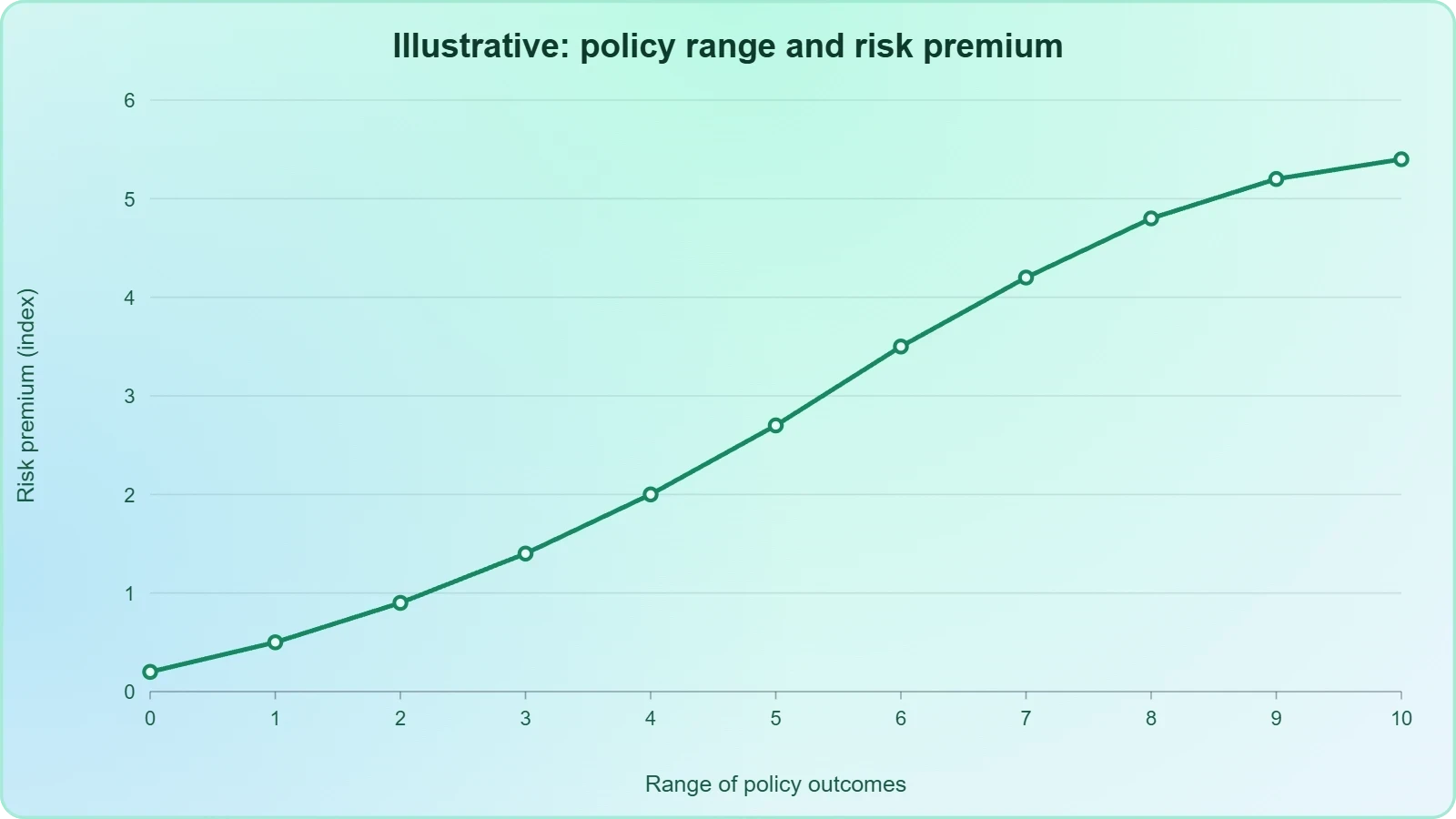
Yet the dividend is not unlimited, and analysts were careful to note its boundaries. Gridlock can also mean delayed responses to genuine problems, whether in infrastructure, fiscal sustainability, or crisis management. If the political system proves unable to address a pressing issue, the resulting uncertainty can eventually outweigh the benefits of predictability. The professional reaction to the midterms therefore combined relief at the absence of radical change with a cautionary note about the costs of prolonged inaction on issues that cannot be deferred indefinitely.
Foreign Capitals Recalibrate Their Expectations
American midterms resonate far beyond the country's borders because the United States remains the anchor of the global security and financial architecture. Analysts in foreign capitals read the 2026 results for signals about the durability of commitments, the likely direction of trade policy, and the willingness of Washington to engage internationally. The Reuters dispatch captured a moment when diplomats and international analysts were actively recalibrating their assumptions, and their reactions revealed how much of global planning depends on predictions about American political stability and the continuity of its external posture.
The professional reaction abroad tended to be more measured than domestic commentary, reflecting an understanding that midterms rarely produce abrupt shifts in foreign policy. Analysts emphasized that the institutional and bureaucratic machinery of American diplomacy has its own momentum, and that even significant electoral changes often translate into adjustments of tone rather than transformations of substance. This perspective is valuable because it tempers the dramatic narratives that dominate domestic coverage and reminds observers that the country's international role is shaped by structural factors that outlast any single election cycle.
Alliance Management and Strategic Continuity
For allies, the central question after any American election is whether the security guarantees and cooperative arrangements they depend on will remain intact. Analysts responding to the 2026 results generally concluded that the fundamentals of alliance management would persist, even as specific policies might face renegotiation. This assessment rested on the observation that treaty commitments and defense relationships are embedded in institutions and budgets that change slowly, and that the political incentives for maintaining them are broadly shared across the American spectrum despite periodic friction over burden-sharing and cost allocation.
The commentary also noted that allies would watch the confirmation of key diplomatic and defense officials as a signal of the administration's priorities. Personnel choices often reveal more about a government's intentions than campaign rhetoric, and foreign capitals are adept at reading these signals. Analysts emphasized that the midterm results would shape the pool of confirmable officials and the scrutiny they face, which in turn affects how quickly and how coherently the United States can project its positions abroad during the remainder of the term.
Trade Policy and the Negotiating Environment
Trade is another domain where midterm results carry immediate implications, because tariff policy, trade agreements, and export controls are all sensitive to legislative dynamics. Analysts observed that divided government tends to complicate the approval of new trade agreements while preserving existing arrangements, creating a status quo bias that trading partners must factor into their planning. The 2026 reaction reflected this expectation, with commentators noting that the results were unlikely to produce dramatic trade liberalization but could affect the intensity of enforcement actions and the willingness to escalate disputes.
For multinational firms and exporting nations, this translates into a planning environment characterized by continuity punctuated by episodic friction. Analysts advised watching the appropriations process and the composition of key committees, since these determine the resources available for trade enforcement and the political incentives that shape it. The professional consensus held that the midterm results would not fundamentally alter the direction of American trade policy but would influence its tempo and its tactical emphasis, which is precisely the kind of nuance that sophisticated observers are paid to detect.
We Also Published
The Language and Framing of Expert Commentary
The words analysts choose are never incidental, and the vocabulary that dominated post-midterm commentary reveals a great deal about the assumptions embedded in professional political analysis. Terms like divided government, constrained mandate, and policy gridlock carry implicit theories about how power operates and what voters intend. The Reuters dispatch, by cataloguing the reactions of multiple analysts, inadvertently documented the shared lexicon of the expert class, and examining that lexicon is a useful way to understand how political meaning gets constructed in the public sphere.
Framing matters because it shapes what audiences consider relevant and what they ignore. When commentary emphasizes gridlock, it directs attention toward legislative outcomes and away from administrative action, judicial appointments, and state-level policy. When it emphasizes mandates, it directs attention toward public opinion and away from structural constraints. Analysts who are conscious of these framing effects can offer more complete assessments, while those who are not may inadvertently narrow the public's understanding of what the election actually changed and what it left untouched.
Frames That Clarify and Frames That Distort
Some frames genuinely clarify. The concept of divided government, for instance, accurately describes a structural condition and helps observers predict legislative behavior with reasonable reliability. Other frames can distort by implying more coherence than the evidence supports. The notion of a national mood, for example, can obscure the fact that midterm outcomes are aggregates of many local decisions driven by distinct concerns. Analysts who distinguish between clarifying and distorting frames produce more useful commentary, and the best post-election analysis tends to be explicit about which frames it is using and why.
The professional reaction to the 2026 midterms showed considerable sophistication on this front, with many commentators explicitly cautioning against overinterpretation. They noted that the results could support multiple narratives and that the choice among them depends on assumptions that are themselves contestable. This intellectual honesty is valuable because it prevents the public from treating any single interpretation as definitive. It also creates space for the kind of ongoing assessment that allows expectations to be revised as new information about governance emerges in the months after the election.
How Narratives Consolidate After Elections
In the days and weeks following an election, competing interpretations gradually consolidate into a dominant narrative that shapes subsequent coverage and public understanding. Analysts play a central role in this consolidation, as their commentary provides the raw material from which narratives are built. The 2026 reaction followed this pattern, with early assessments converging on themes of constraint, continuity, and negotiated governance. Once consolidated, such narratives become difficult to dislodge even when new evidence complicates them, which is why the initial wave of expert reaction carries outsized influence.
Understanding this consolidation process helps explain why the Reuters dispatch matters beyond its immediate content. By recording the reactions as they formed, it captured the moment when interpretation was still fluid and multiple readings remained viable. Later coverage would inevitably simplify, selecting the most memorable frames and discarding the nuances. The value of the original reporting lies precisely in its preservation of that early complexity, offering a window into how the professional class first made sense of an outcome whose full implications will only become clear over time.
- 01
- 02
- 03
- 04
What the Results Signal About America's Political Direction
Beneath the tactical commentary lies a larger question: what do the midterm results reveal about the trajectory of American politics itself? Analysts approached this question with appropriate caution, noting that midterms are snapshots rather than forecasts and that their meaning depends heavily on the longer arc of partisan realignment, demographic change, and institutional evolution. The 2026 reaction reflected a professional consensus that the results signaled continuity in the broad contours of American politics while leaving open the possibility of significant change in specific policy domains and in the intensity of political competition.
This nuanced reading contrasts with the more dramatic interpretations that often dominate public discourse. Analysts emphasized that the country's political direction is shaped by forces that operate over years and decades, and that a single election cycle rarely reverses them. The midterms may accelerate or slow certain trends, but they do not determine the destination. Understanding the results correctly therefore requires situating them within longer-term patterns and resisting the temptation to treat any single outcome as a definitive verdict on the nation's future.
Partisan Realignment and the Long View
The concept of partisan realignment has long fascinated political analysts, and midterm results are often scrutinized for signs that longstanding coalitions are shifting. The 2026 commentary reflected this interest, with observers examining whether the results suggested durable changes in the geographic or demographic bases of the major parties. Most concluded that the evidence pointed to incremental movement rather than dramatic realignment, but they noted that incremental changes can accumulate into significant transformations over multiple cycles, making each election a data point in a longer story.
Analysts also emphasized the importance of down-ballot results, which often receive less attention than national headlines but can reveal more about the grassroots strength of parties and the issues that motivate voters. State legislative outcomes, gubernatorial races, and ballot initiatives all provide evidence about the direction of public opinion on specific questions. The professional reaction to the 2026 midterms included careful attention to these lower-profile results, recognizing that they often foreshadow the national debates that will dominate future elections and shape the policy environment in which businesses and citizens operate.
Institutional Trust and the Health of Democratic Norms
Another theme in post-election analysis concerned the health of democratic institutions and the public's trust in them. Analysts noted that midterm elections are themselves a test of institutional resilience, and that the peaceful transfer or sharing of power according to established rules is a signal of democratic health. The 2026 reaction included commentary on turnout, the conduct of elections, and the willingness of losing candidates to accept results, all of which are indicators of how well the political system is functioning and how much confidence citizens can place in its outcomes.
This dimension is particularly important because trust in institutions affects everything from economic behavior to international credibility. When analysts express confidence that elections were conducted fairly and that results will be respected, they reinforce the stability that markets and allies depend on. Conversely, doubts about institutional integrity can introduce uncertainty that ripples through financial and diplomatic channels. The professional reaction to the midterms therefore carried implications beyond politics, touching on the foundations of the country's economic and strategic position in the world.
From Interpretation to Action: What Comes Next
The final dimension of the analyst reaction concerns the transition from interpretation to action. Once observers have formed a view about what the results mean, that view begins to shape behavior across government, markets, and civil society. The 2026 commentary marked the beginning of this transition, as strategists adjusted their plans, investors revised their positioning, and officials prepared for the negotiations that would define the next two years. Understanding the midterms therefore requires following the thread from expert assessment through to concrete decisions, because it is in those decisions that the election's true meaning becomes visible.
Analysts emphasized that the coming months would provide the real test of their interpretations. Budget negotiations, confirmation battles, and the first major legislative initiatives would reveal whether the expected dynamics of divided government actually materialized. If they did, the professional consensus would be validated and would likely harden into conventional wisdom. If they did not, the commentary would need revision, and the willingness of analysts to update their views would itself be a measure of the health of the interpretive process that surrounds American politics.
Watchpoints for the Coming Legislative Cycle
For those seeking to track the midterms' consequences, analysts identified several concrete watchpoints. The first is the budget process, where the contours of divided government become immediately visible. The second is the pace of confirmations, which reveals the practical limits of executive authority. The third is the pattern of oversight activity, which often intensifies when power is split. Together, these watchpoints provide a practical framework for assessing whether the expectations formed in the aftermath of the election are being borne out by events on the ground.
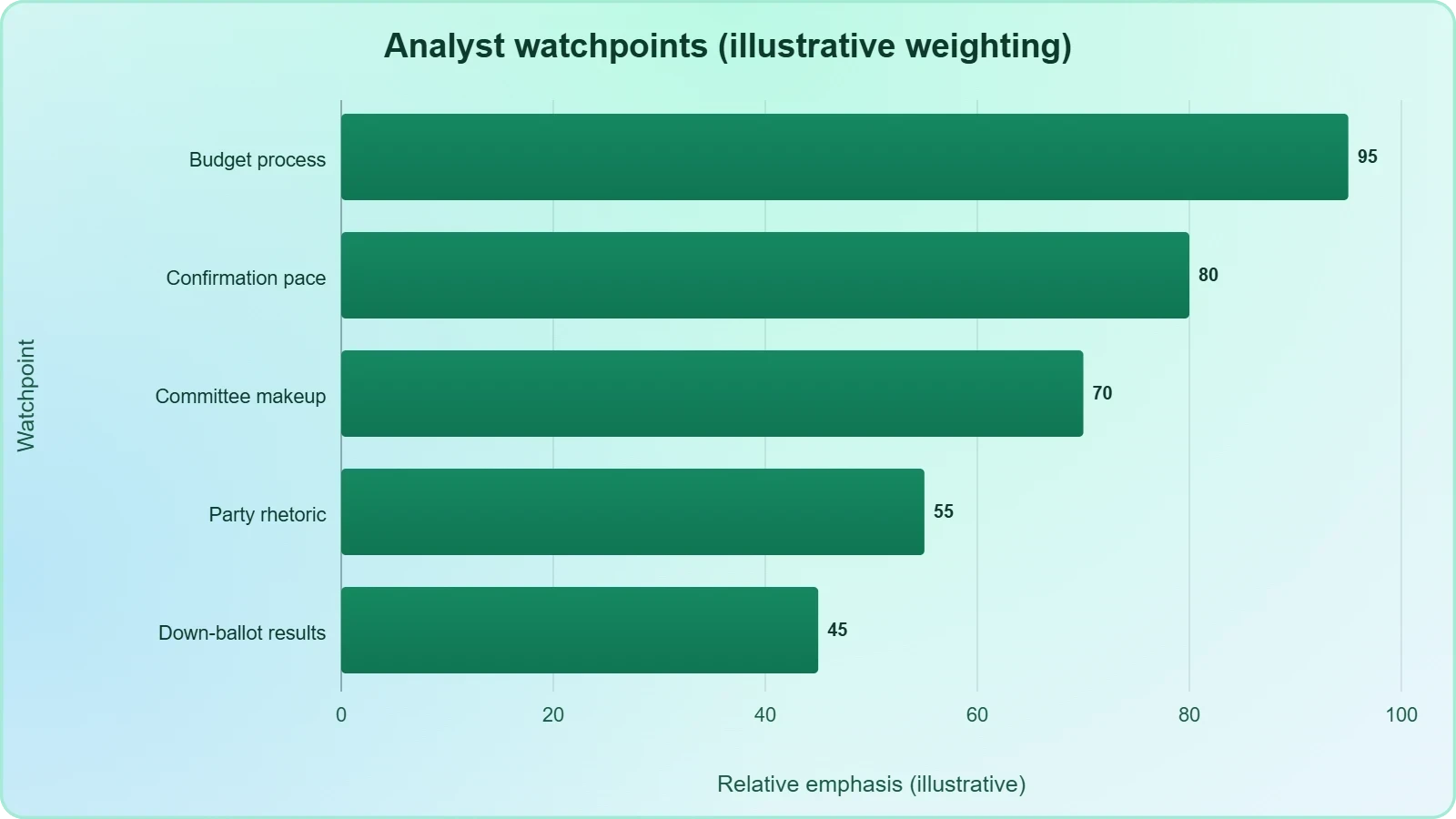
Beyond these institutional indicators, analysts also recommended attention to the rhetorical strategies adopted by party leaders. The language used to describe the results, the issues emphasized in public statements, and the coalitions cultivated in the months after the election all provide evidence about how the political class interprets its own situation. These signals are often more revealing than formal policy announcements because they reflect the underlying calculations that drive behavior. Watching them closely allows observers to anticipate shifts before they become fully visible in legislative outcomes.
Why This Cycle's Interpretation Will Endure
The interpretations formed in the immediate aftermath of an election tend to endure because they become embedded in the assumptions of the institutions that act on them. Investors who price in gridlock allocate capital accordingly, and their allocations create realities that reinforce the original expectation. Diplomats who assume continuity plan their engagements on that basis, and their plans shape the diplomatic calendar. This reflexive quality means that the analyst reaction documented by Reuters is not merely a description of the election but a contributing factor in determining what the election will ultimately mean.
Recognizing this reflexive dimension is essential for anyone seeking to understand American politics. The meaning of an election is not fixed at the moment the votes are counted; it is constructed through the interpretations and actions that follow. The 2026 midterms will be remembered not only for their results but for how the professional class made sense of them and how those interpretations shaped the governance that followed. In that sense, the analyst reaction is not a footnote to the story but a central chapter in it, and reading it carefully offers genuine insight into the direction of American political life.
From our network :
- Forbidden Matrix Patterns and Visible Lattice Points: A Geometric DictionaryExplore how multidimensional 0–1 matrices encode geometric truths, linking forbidden patterns to visible lattice points and hypergraph theory, with applications in combinatorics and computational geometry.
- University Language Proficiency Exams: Why Institutional Tests Demand Different Preparation Than IELTS and TOEFLDiscover why university-specific language proficiency examinations differ fundamentally from IELTS and TOEFL, and learn strategic preparation approaches for institutional assessment success.
- Committed Mediterranean Precipitation Decline: Why Emissions Cuts Alone Cannot Restore Winter RainsNew NOAA research reveals that Mediterranean winter rains may decline irreversibly even with emissions cuts. Explore the science of committed climate change and regional impacts.
- The Final Descent: How ESA Retired the Legendary Cluster Constellation After 24 Years of Space Weather ScienceAfter 24 years mapping Earth’s magnetosphere, ESA’s Cluster mission concluded with a precisely controlled reentry over the South Pacific. This analysis explores the scientific legacy, engineering decisions, and debris mitigation principles behind one of space exploration’s most responsible retirements.
- CISA’s Ten-Advisory Wave: Why Generic Patching Fails in OT and How to Build Product-Specific PlaybooksCISA released ten ICS advisories in one week, exposing critical infrastructure risks. Generic patching fails in OT. Learn to build product-specific remediation playbooks.
- Live Online English Classes for Kids: Do They Actually Reduce Anxiety?A ten-week study reveals that synchronous online English classes can significantly reduce child language anxiety while improving listening and reading skills. Discover what makes these programs effective and how parents can select the right one.
- The Hidden Cost of AI Convenience: Why Over-Permissioned Agents Are a Security Time BombDiscover why AI agents with excessive permissions create dangerous single points of failure, and learn how implementing least privilege principles can protect your organization from exploitation.
- How AI Agents Will Change the Way We Manage Personal FinancesExplore how AI agents are transforming personal finance through automated budgeting, bill payment, and investment management, while examining the critical security protocols and governance frameworks required for safe deployment.
- Mobile Learning and VR in English: What Global Evidence Reveals About Effective Language TechnologyA systematic review across 14 countries reveals which language-learning technologies genuinely work. Mobile learning, AI, and VR show measurable benefits when pedagogically integrated. This evidence-based guide helps educators and learners select technology that delivers real return on investment.
RESOURCES
- Top takeaways from the US midterm elections - Reutersreuters.com5 hours ago ... Top takeaways from the US midterm elections. By Tim Reid and ... Analysts react to US midterm election results. 2…
- QUOTES-Analysts react to US midterm election resultsfidelity.com2 hours ago ... MICHAEL ARONE , CHIEF INVESTMENT STRATEGIST, STATE STREET GLOBAL ADVISORS, BOSTON : "I don't think the big risk to markets…
- Proposition 50 [Ballot] - Legislative Analyst's Office - CA.govlao.ca.govNov 4, 2025 ... These maps were based on the 2020 U.S. Census and have been used since the 2022 congressional elections. PROPOSAL. California's…
- Oil edges down as investors await US midterm election resultsreuters.com3 hours ago ... Eight analysts polled by Reuters had expected, on average, a rise of about 880,000 barrels in crude inventories. Gasoline stocks…
- Analysts react to US midterm election results - The Lufkin Daily Newslufkindailynews.com2 hours ago ... SINGAPORE, Nov 4 (Reuters) - Democrats notched early Senate wins, fuelling bets they could wrest control of the chamber from…
- Midterm election results: Live updates for key races across the U.S.abc7news.com2 hours ago ... ABC has live updates on the 2026 midterm elections with real-time results, vote counts and the latest election news from…
- REACTION: Milei's Decisive Midterm Election Victoryamericasquarterly.orgOct 27, 2025 ... ... elections, as well as statements from President Donald Trump, who had conditioned a U.S. economic lifeline for Argentina on…
- Midterm election results: Live updates for key races across the U.S.abc7ny.com1 hour ago ... In his first reaction to tonight's results, President Donald Trump wrote on social media that if he had been on…
- Midterm mindset seeping into the U.S. stock marketrbcwealthmanagement.comSep 9, 2026 ... Voter concerns leading up to the election are wide-ranging. RBC Capital Markets equity analysts seem mostly unfazed by the election ...
- Exposing and Disrupting Federal Attempts to Interfere in the 2026 ...democracyforward.orgOct 9, 2026 ... ... elections, with significant implications for the midterms and American democracy. ... results of the 2020 presidential election. May-June ...
- Analysts react to US midterm election results - TradingViewtradingview.comAnalysts react to US midterm election results. Nov 3, 2026, 18:55 GMT-8. Read the full article. Get unlimited access to articles from Reuters and…
- What will happen if Trump rejects the midterm results?chathamhouse.orgSep 14, 2026 ... The administration's efforts to undermine confidence in the US electoral system could spark a political crisis in November – with ...
- Around the halls: Brookings scholars react to the 2018 midtermsbrookings.eduNov 9, 2018 ... With the results of the midterm elections (mostly) in, we asked Brookings scholars for their reactions to what happened and…
- What the Midterm Elections Will Mean for Markets | Morningstarmorningstar.comOct 8, 2026 ... As voters focus on AI data centers and affordability, the market impact will depend on the results ... The United…
- US midterm results spark positive reactions from global marketsworldfinance.comGlobal markets cheered as midterm election results demonstrated the restoration of checks and balances in the US Government. ... analyst at investment firm ...
- 01
- 02
- 03
- 04
- 05
- 06
- 07
- 08
0 Comments