Economic journalism occupies a peculiar position in public life: it must translate the abstractions of monetary policy, labor statistics, and corporate earnings into narratives that a commuter can absorb between subway stops. Marketplace, the American Public Media program distributed through NPR stations and published at marketplace.org, has refined this translation into something close to an art form since its debut in 1989. The program's signature opening line — "Let's do the numbers" — signals a deliberate editorial contract with its audience: rigorous reporting delivered without condescension, and complex financial machinery rendered legible without being flattened into slogans.
What distinguishes the Marketplace ecosystem is its insistence that economics is fundamentally a human story rather than a spreadsheet exercise. A segment on rising grocery prices becomes a portrait of a family recalibrating its weekly budget; a report on Federal Reserve rate decisions becomes an exploration of what borrowing costs mean for a small business owner weighing expansion. This editorial philosophy has earned the program a substantial and loyal listenership across public radio stations, alongside a digital presence that extends its reporting to readers who encounter the brand through npr.org and marketplace.org rather than through broadcast.
Understanding Marketplace as a media property requires looking beyond its content to its institutional architecture. It operates within the public broadcasting tradition, funded through a combination of station carriage fees, corporate sponsorships, philanthropic support, and listener contributions — a financial model that shapes both its editorial independence and its vulnerabilities. The following analysis examines the program's structure, its editorial methodology, its digital strategy, and the broader role it plays in American economic literacy, drawing on publicly documented information about the organization and its place in the media landscape.
On This Page
- The Institutional Identity of Marketplace Within Public Media
- How Marketplace Translates Economics for a General Audience
- The Digital Strategy Behind marketplace.org
- The Funding Model and Its Editorial Consequences
- Economic Literacy and the Public Interest Mission
- Marketplace's Place in the Broader Media Ecosystem
- Reading Marketplace Critically: What Audiences Should Know
TL;DR Marketplace is a public radio business and economics program produced by American Public Media and distributed through NPR stations, with a digital footprint anchored at marketplace.org. Its editorial model prioritizes accessible, human-centered economic reporting for a general audience, blending daily market coverage with explanatory journalism and investigative work. The program's funding structure — sponsorships, station fees, and listener support — underpins its independence while exposing it to the same pressures facing public media broadly. This analysis maps the program's history, editorial approach, digital strategy, and competitive position within economic journalism.
The Institutional Identity of Marketplace Within Public Media
Marketplace began broadcasting in 1989 as a joint venture involving the BBC and Public Radio International before American Public Media assumed stewardship, and it has since grown into one of the most widely carried business programs in American public radio. Its identity is inseparable from the public broadcasting ecosystem: it reaches audiences primarily through local station carriage, which means its distribution depends on relationships with hundreds of independent stations rather than a single network feed. That structural arrangement gives the program national reach while anchoring it in local listening habits.
The organization operates from studios in Los Angeles, with bureaus and correspondents positioned to cover financial centers including New York and Washington. This geographic distribution matters editorially, because economic news is generated in specific places — the Federal Reserve, the Securities and Exchange Commission, corporate headquarters, and trading floors — and proximity to those institutions shapes what a newsroom can report and how quickly. Marketplace's footprint reflects a deliberate investment in being present where economic decisions are actually made.
Ownership, Funding, and Editorial Independence
American Public Media, part of the broader Minnesota-based American Public Media Group, produces Marketplace and holds the editorial infrastructure behind it. Funding flows from several streams: corporate underwriting credits, which are tightly regulated to avoid the appearance of advertising; carriage fees paid by stations; grants from foundations; and direct contributions from listeners. This diversified model is designed to insulate editorial decisions from any single funder, though critics of public media routinely scrutinize the influence of corporate sponsors on coverage priorities.
The program maintains published editorial standards governing conflicts of interest, and its underwriting rules prohibit sponsors from influencing content. Nevertheless, the economics of public media have tightened over the past decade as station revenues have faced pressure, and Marketplace has not been immune to the cost discipline affecting the sector. Understanding this financial context is essential to interpreting the program's strategic choices, including its expansion into podcasts, live events, and syndicated content beyond its core radio broadcast.
Editorial Format and Daily Rhythm
The flagship daily program runs in the evening drive-time slot and follows a consistent architecture: a lead economic story, a rotating cast of regular segments, and a closing market summary. Recurring features — including the "Marketplace Morning Report," which delivers pre-dawn briefings on business news — create appointment listening that stations can schedule predictably. This rhythmic consistency is a strategic asset in an era of fragmented attention, giving audiences a reliable daily touchpoint rather than an algorithmic feed.
Beyond the daily show, the Marketplace portfolio includes explanatory and investigative programming that extends the brand's range. These formats allow the newsroom to pursue longer investigations and narrative series that would not fit a tightly timed daily broadcast, and they serve as the intellectual backbone that distinguishes the program from headline aggregation. The result is a layered editorial product: fast daily coverage on the surface, deeper reporting underneath.
How Marketplace Translates Economics for a General Audience
The central editorial challenge for any economics outlet is the gap between technical precision and public comprehension. Marketplace addresses this through a consistent set of techniques: sourcing real people affected by economic trends, using plain-language explanations of mechanisms like inflation indexing or bond yields, and structuring stories around concrete consequences rather than abstract indicators. The approach reflects a conviction that economic literacy is a civic good, not a specialist pursuit, and that audiences can handle complexity when it is properly sequenced.
This methodology has practical implications for sourcing. Rather than relying exclusively on economists and analysts, the newsroom routinely interviews workers, consumers, and small business owners, positioning expert commentary as context rather than the story itself. The technique is not unique to Marketplace, but its disciplined application across decades has made the program a reference point for how broadcast economics journalism can remain rigorous while staying accessible to listeners without finance backgrounds.
Story Selection and the Human-Interest Lens
Story selection at Marketplace tends to favor economic developments with visible human stakes: housing affordability, wage growth, student debt, retirement security, and the cost of everyday goods. This orientation does not mean the program avoids macroeconomics; rather, it treats macro data as the frame within which individual experience is situated. A report on GDP growth will typically include a segment on what that growth means for a specific community or industry, bridging the statistical and the personal.
The human-interest lens also shapes how the program handles controversy. Coverage of layoffs, for instance, tends to foreground affected workers rather than corporate strategy alone, and reporting on trade policy examines consequences for specific manufacturing towns. This editorial instinct aligns with public radio's broader audience expectations and helps explain the program's durability: listeners return because the coverage feels connected to their own economic lives.
Explanatory Journalism and Investigative Depth
Marketplace has invested in explanatory formats that unpack economic concepts over multiple segments, and in investigative reporting that examines corporate behavior, labor practices, and financial misconduct. These efforts extend the program's remit beyond daily news, positioning it as a source for understanding systemic issues rather than merely tracking them. Investigative work in particular requires resources — legal review, document analysis, extended reporting time — that only a well-resourced newsroom can sustain.
The combination of accessible daily coverage and deeper investigative work creates a credibility loop: audiences trust the brand for quick explanations, which gives investigative pieces a larger platform when they publish. This dynamic is common among established news organizations, but it is especially important in public media, where trust is the primary currency and where funding depends on the perception of editorial integrity.
We Also Published
The Digital Strategy Behind marketplace.org
The marketplace.org website functions as more than an archive; it is a distinct editorial surface with its own publishing rhythm. Articles are written for readers who may never hear the broadcast, and the site organizes content around topics, programs, and recurring series. This dual-track approach — broadcast and digital — reflects a broader shift in public media toward multiplatform publishing, where a single newsroom serves audiences across radio, web, podcast, and social channels without diluting its editorial standards.
The site's architecture supports discovery through topic hubs, program pages, and newsletter products that push reporting directly to subscribers. For a public media organization, the website also serves a fundraising function, hosting membership appeals and sponsor acknowledgments. This blending of journalism and institutional communication is standard across public media, though it requires careful separation to preserve the perception of editorial independence that audiences expect from the brand.
Audience Reach and Distribution Channels
Marketplace reaches audiences through three primary channels: terrestrial radio carriage, podcast distribution, and web publishing. Each channel has distinct audience behavior — radio listeners tune in at fixed times, podcast audiences consume on demand, and web readers arrive through search and social referral. Managing these channels requires editorial teams to think about format adaptation, since a story that works as a four-minute broadcast segment may need restructuring for a written article or an extended podcast conversation.
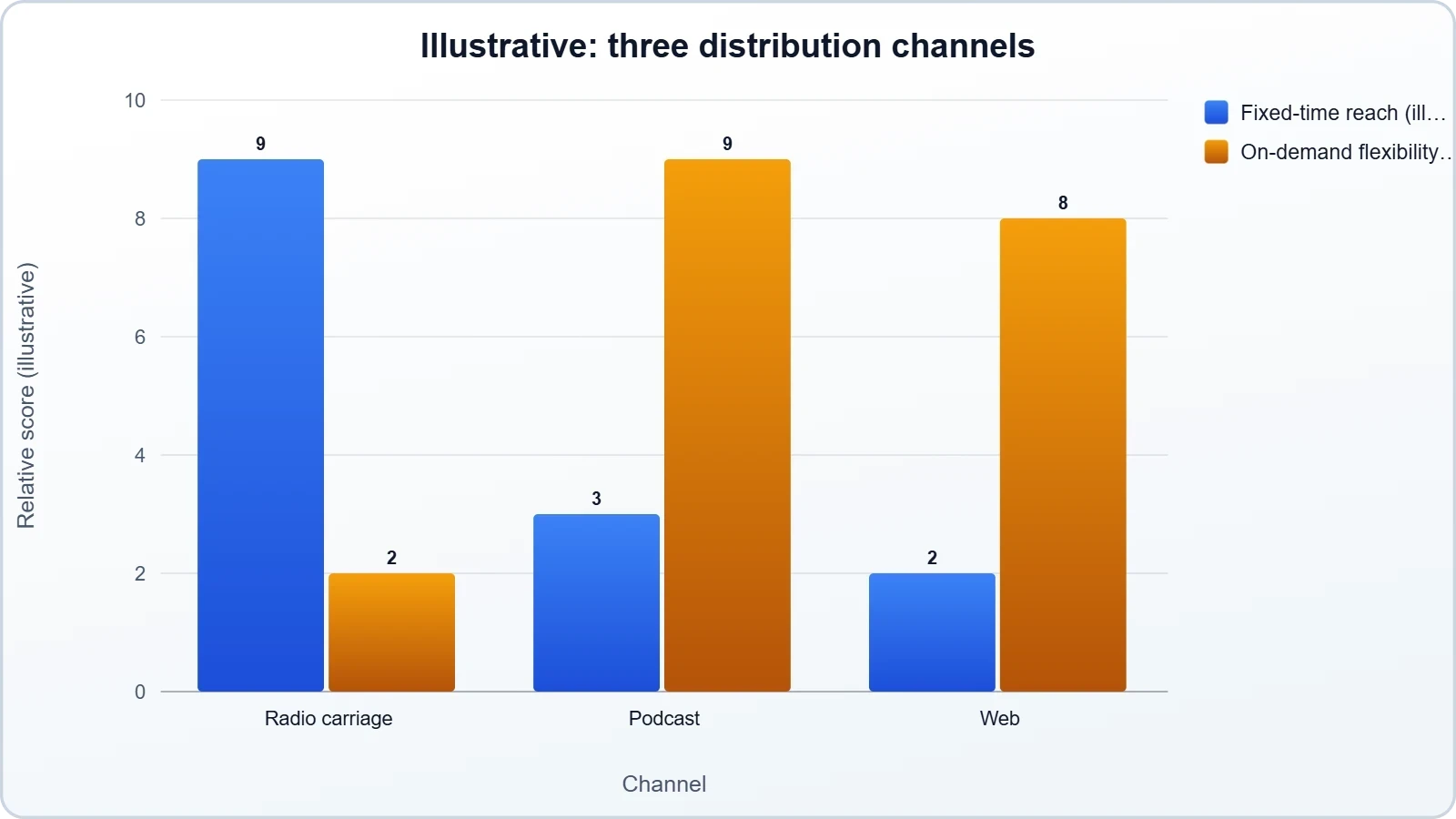
The program's podcast strategy has been particularly consequential, as on-demand audio has become a dominant format for news consumption among younger demographics. By making its reporting available through podcast platforms, Marketplace extends its reach beyond the broadcast schedule and captures listeners who may not have a public radio station preset in their car. This channel diversification is a defensive necessity as well as an opportunity, given declining linear radio listening among younger cohorts.
Competitive Position in Economic News
Marketplace competes in a crowded field that includes legacy business publications, cable business networks, and a growing array of digital-native financial media. Its differentiation rests on accessibility, public media credibility, and a distinctive audio identity. Where competitors may target investors or policy specialists, Marketplace addresses a general audience that wants to understand economic forces without specialized training, and that positioning has proven durable across decades of media disruption.
The competitive landscape has shifted with the rise of financial content on social platforms, where short-form video and influencer commentary compete for attention. Marketplace's response has been to emphasize the depth and reliability that distinguish professional journalism from algorithmic commentary, leaning on its newsroom credentials and its public service mission. Whether that positioning can sustain audience growth in a fragmenting media environment remains an open strategic question for the organization.
The Funding Model and Its Editorial Consequences
Public media financing is a subject of perennial debate, and Marketplace's model illustrates the tensions involved. Corporate underwriting provides a significant share of revenue, but underwriting credits are governed by rules that distinguish them from commercial advertising: they identify sponsors without persuasive language or calls to action. This distinction is central to public media's claim to editorial independence, though critics argue that the line between acknowledgment and promotion can blur in practice, particularly when sponsors are large financial institutions whose activities the newsroom covers.
Listener contributions and station carriage fees form the other pillars of the model. Membership drives, conducted on-air and online, convert audience loyalty into revenue, which creates an incentive to cultivate a devoted listenership. This dynamic is generally healthy for editorial quality, since it rewards substantive reporting over clickbait, but it also means that audience demographics — disproportionately educated and higher-income — shape the program's commercial appeal to sponsors and its fundraising potential.
Sponsorship, Underwriting, and Trust
The trust relationship between Marketplace and its audience depends on transparent separation between business operations and editorial decisions. The organization publishes standards governing this separation, and its newsroom operates with editorial independence from the sponsorship sales team. In practice, maintaining this firewall requires constant vigilance, especially when coverage touches on sectors — banking, technology, energy — where major sponsors operate. Public scrutiny of these arrangements is a feature of the system, not a bug.
Research on public media audiences consistently finds high levels of trust relative to commercial news sources, a finding that has commercial as well as civic value. For Marketplace, that trust is the foundation of its brand equity, and any perception of sponsor influence would erode it quickly. The organization's incentive structure therefore aligns with editorial integrity, even as financial pressures create temptations to accommodate sponsors more generously than the rules strictly require.
Financial Pressures on Public Broadcasting
The economics of public broadcasting have tightened considerably as traditional revenue sources face headwinds. Corporate underwriting budgets fluctuate with the business cycle, foundation grants are competitive, and station revenues have been pressured by changes in listening habits and membership behavior. These pressures have prompted public media organizations, including Marketplace's parent, to pursue cost efficiencies, consolidate operations, and diversify into new products such as live events and premium podcast content.
These adjustments are not unique to Marketplace; they reflect a sector-wide recalibration. The strategic question is whether diversification can replace declining traditional revenue without compromising the editorial mission. For audiences, the practical consequence is a media brand that must balance public service commitments against the financial discipline required to sustain operations, a tension familiar to every mission-driven newsroom in the country.
- 01
- 02
- 03
- 04
Economic Literacy and the Public Interest Mission
Marketplace's public interest mission extends beyond reporting to the broader goal of economic literacy. In a democracy where policy debates routinely hinge on fiscal and monetary questions, the capacity of ordinary citizens to understand inflation, taxation, trade, and labor markets has direct civic consequences. The program's accessible style is therefore not merely a marketing choice but a contribution to public understanding, one that complements the work of educators, civic organizations, and other journalism outlets engaged in similar efforts.
This mission framing also shapes how the program handles politically charged economic topics. Rather than adopting partisan positions, Marketplace tends to explain mechanisms and present competing interpretations, allowing listeners to form judgments. That approach has limits — some economic questions involve genuine normative disagreements that cannot be resolved by explanation alone — but it reflects the public media tradition of serving a broad audience with diverse political commitments.
Coverage Priorities in a Changing Economy
Recent years have presented an unusually dense sequence of economic storylines: pandemic-era supply disruptions, rapid inflation and subsequent monetary tightening, labor market shifts including remote work, and the rise of artificial intelligence as an economic force. Marketplace has covered each of these with its characteristic blend of daily reporting and explanatory depth, translating central bank decisions and labor statistics into narratives about household budgets and business decisions.
The program's coverage priorities also reflect structural changes in the economy itself, including the growth of gig work, the concentration of corporate power, and the uneven geography of economic opportunity. These are stories that resist simple summary, and covering them well requires sustained attention rather than episodic reporting. Marketplace's format, with its recurring segments and thematic series, provides a structure for that sustained attention.
Audience Trust and Media Credibility
Trust in news media has declined across most Western democracies, and economic journalism is not exempt from that trend. Marketplace's position within public media gives it certain advantages — a reputation for nonpartisan reporting, a funding model less dependent on engagement metrics — but it also exposes it to the political critiques directed at public broadcasting generally. Maintaining credibility requires consistent transparency about methods, corrections, and funding.
The program's long tenure provides a reservoir of institutional trust that newer outlets lack, but longevity alone does not guarantee relevance. Audience trust must be continually renewed through accurate reporting and clear communication about editorial standards. For a program whose value proposition is helping people understand a complex economy, that trust is the essential asset on which everything else depends.
Marketplace's Place in the Broader Media Ecosystem
Marketplace occupies a distinctive niche that sits between general news and specialist financial media. It is not a wire service, a trade publication, or an investor-focused outlet; it is a public-facing interpreter of the economy, and that positioning gives it a role that few competitors replicate. The program's influence extends through its audience of educators, policymakers, and ordinary citizens who rely on it as a primary source for economic understanding, and through its role as a training ground for journalists who go on to careers across the industry.
The broader media ecosystem has changed dramatically since the program's founding, with the collapse of local business journalism, the rise of platform-distributed content, and the fragmentation of audiences across devices and formats. Marketplace has adapted by extending its distribution and diversifying its products, but the underlying mission — helping a general audience make sense of the economy — has remained remarkably stable. That continuity is itself a strategic asset in a volatile media environment.
Comparative Positioning Among Economic News Outlets
Compared with cable business networks, Marketplace devotes less airtime to market minutiae and more to explanatory context; compared with digital-native financial publications, it emphasizes audio and broadcast formats and reaches a broader, less specialized audience. These differences are matters of editorial strategy rather than quality, but they define the program's competitive identity. Its public media affiliation also distinguishes it from commercial competitors in terms of funding and perceived independence.
The comparison extends to international coverage. Marketplace draws on a network of correspondents and partner organizations to report on global economic developments, giving its audience exposure to economic conditions beyond the United States. This international dimension is increasingly important as supply chains, currency markets, and trade policy connect domestic economic experience to global forces that audiences need to understand.
Future Directions and Strategic Questions
The strategic questions facing Marketplace mirror those facing public media broadly: how to sustain revenue as traditional sources tighten, how to reach younger audiences who consume news through social platforms and podcasts, and how to maintain editorial independence under financial pressure. The program's investments in podcasting and digital publishing represent partial answers, but the underlying tension between mission and sustainability remains unresolved across the sector.
Technological change adds another layer of uncertainty. Artificial intelligence is reshaping both the production of news and the economics of information distribution, and newsrooms are experimenting with AI-assisted tools while grappling with questions of accuracy, attribution, and labor impact. For a program whose value rests on human judgment and editorial trust, navigating these changes carefully will be essential to preserving the credibility that has sustained it for more than three decades.
Reading Marketplace Critically: What Audiences Should Know
For audiences seeking to use Marketplace well, a degree of media literacy is valuable. Understanding the program's funding model, its editorial standards, and its format constraints helps listeners interpret what they hear and recognize the boundaries of any single outlet's coverage. No newsroom can cover every economic development, and every format involves trade-offs between depth and timeliness, breadth and specialization. Recognizing those trade-offs is part of consuming economic journalism responsibly.
The program's strengths — accessibility, human-centered reporting, public media credibility — are genuine, but they coexist with limitations inherent to its format. A half-hour daily broadcast cannot exhaustively analyze complex policy questions, and the need to serve a general audience means some technical nuance is necessarily compressed. Audiences who understand these constraints can supplement Marketplace's reporting with specialist sources while still benefiting from its explanatory clarity and its consistent focus on the human consequences of economic change.
Evaluating Economic News Sources
Evaluating any economic news source involves asking several questions: who funds it, what its editorial standards are, how it handles corrections, and whether its coverage reflects a range of perspectives. Marketplace performs reasonably well on these criteria by the standards of public media, with published standards and a funding model designed to protect editorial independence. Audiences can apply the same framework to commercial outlets, where advertising relationships and ownership structures may create different pressures.
The broader point is that economic literacy includes media literacy. Understanding how economic news is produced — the sourcing conventions, the format constraints, the funding structures — helps audiences assess reliability and recognize bias, whether subtle or overt. Marketplace's transparency about its model makes it a useful case study for developing these skills, even for listeners who ultimately prefer other sources for their economic information.
Practical Takeaways for Listeners and Readers
Listeners who want to get the most from Marketplace can adopt a few practical habits: follow the program across formats to capture both daily coverage and deeper series, use the website to explore topics introduced on air, and cross-reference major claims with primary sources such as government statistical releases and central bank statements. These habits transform passive listening into active engagement with economic information, which is ultimately the program's stated goal.
For readers encountering the brand through npr.org or marketplace.org, the same principles apply. The website's archives and topic pages offer a way to trace how coverage of a given issue has evolved, and the program's explanatory pieces are designed to be read independently of the broadcast. Used thoughtfully, these resources support a more informed understanding of the economic forces shaping everyday life, which is precisely the public service that Marketplace has aimed to provide since its founding.
From our network :
- Committed Mediterranean Precipitation Decline: Why Emissions Cuts Alone Cannot Restore Winter RainsNew NOAA research reveals that Mediterranean winter rains may decline irreversibly even with emissions cuts. Explore the science of committed climate change and regional impacts.
- Forbidden Matrix Patterns and Visible Lattice Points: A Geometric DictionaryExplore how multidimensional 0–1 matrices encode geometric truths, linking forbidden patterns to visible lattice points and hypergraph theory, with applications in combinatorics and computational geometry.
- Mobile Learning and VR in English: What Global Evidence Reveals About Effective Language TechnologyA systematic review across 14 countries reveals which language-learning technologies genuinely work. Mobile learning, AI, and VR show measurable benefits when pedagogically integrated. This evidence-based guide helps educators and learners select technology that delivers real return on investment.
- The Final Descent: How ESA Retired the Legendary Cluster Constellation After 24 Years of Space Weather ScienceAfter 24 years mapping Earth’s magnetosphere, ESA’s Cluster mission concluded with a precisely controlled reentry over the South Pacific. This analysis explores the scientific legacy, engineering decisions, and debris mitigation principles behind one of space exploration’s most responsible retirements.
- Live Online English Classes for Kids: Do They Actually Reduce Anxiety?A ten-week study reveals that synchronous online English classes can significantly reduce child language anxiety while improving listening and reading skills. Discover what makes these programs effective and how parents can select the right one.
- The Hidden Cost of AI Convenience: Why Over-Permissioned Agents Are a Security Time BombDiscover why AI agents with excessive permissions create dangerous single points of failure, and learn how implementing least privilege principles can protect your organization from exploitation.
- How AI Agents Will Change the Way We Manage Personal FinancesExplore how AI agents are transforming personal finance through automated budgeting, bill payment, and investment management, while examining the critical security protocols and governance frameworks required for safe deployment.
- University Language Proficiency Exams: Why Institutional Tests Demand Different Preparation Than IELTS and TOEFLDiscover why university-specific language proficiency examinations differ fundamentally from IELTS and TOEFL, and learn strategic preparation approaches for institutional assessment success.
- CISA’s Ten-Advisory Wave: Why Generic Patching Fails in OT and How to Build Product-Specific PlaybooksCISA released ten ICS advisories in one week, exposing critical infrastructure risks. Generic patching fails in OT. Learn to build product-specific remediation playbooks.
RESOURCES
- Resources will be updated soon.
- 01
- 02
- 03
- 04
- 05
- 06
- 07
- 08
0 Comments