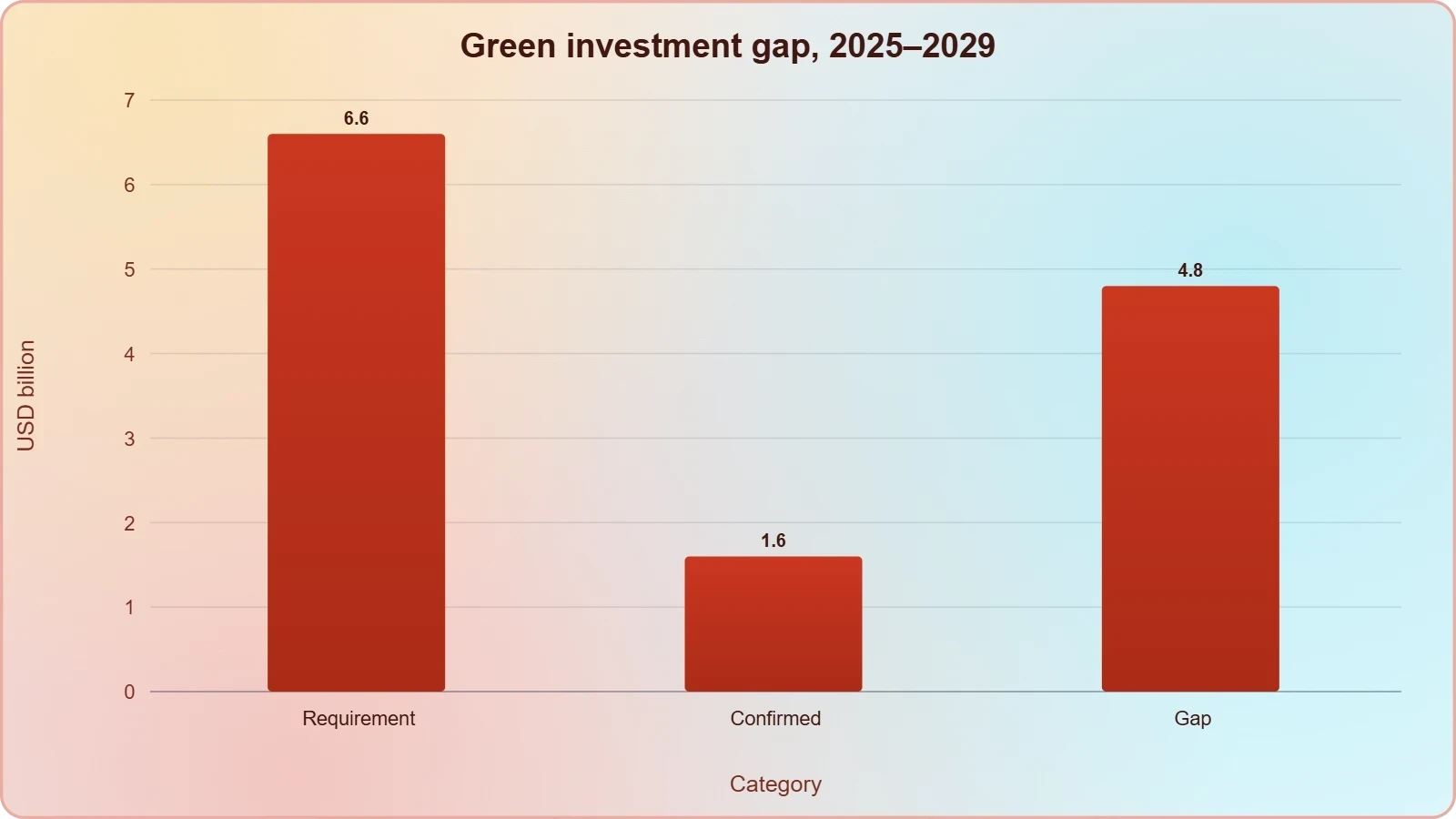
Bangladesh's readymade garment industry stands at a defining crossroads, and the numbers tell a story far more consequential than a simple budget shortfall. According to estimates presented at a Dhaka gathering of financiers, policymakers, and industry leaders, the sector requires roughly $6.6 billion between 2025 and 2029 to finance its green transition, yet only about $1.6 billion has been confirmed, with a further $175 million still in the pipeline. That leaves an estimated $4.8 billion gap, or roughly 73 percent of the total requirement, a deficit that threatens to stall the industry's shift toward sustainable manufacturing at precisely the moment global buyers are raising their environmental expectations.
The event, titled "Unlocking Green Finance Pathways for Bangladesh's RMG Sector" and jointly organised by LightCastle Partners and Policy Exchange Bangladesh, framed the shortfall not as an isolated financing problem but as a structural test of the country's economic resilience. Speakers argued that without easier access to green finance, deeper investment, and stronger coordination among government, financial institutions, and industry stakeholders, the sector risks losing competitive ground in international markets. The discussion also placed small and medium-sized garment manufacturers at the centre of the challenge, noting that these factories often lack the capital and technical capacity to adopt environmentally sustainable production practices, even as decarbonisation becomes essential to long-term viability.
What makes this story resonate beyond Bangladesh's borders is the way it connects climate policy, trade competitiveness, and financial architecture in a single narrative. The ongoing global energy crisis has sharpened the case for energy security and reduced dependence on fossil fuels, while the programme's social dimension, organised under Oporajita Phase 2 and implemented by LightCastle Partners under Bunon 2030, ties the green transition to the livelihoods of women garment workers. The following analysis examines the scale of the gap, the barriers to closing it, and the practical mechanisms that could convert ambition into bankable projects.
On This Page
TL;DR Bangladesh's readymade garment sector needs about $6.6 billion for green investment across 2025–2029 but has confirmed only around $1.6 billion, leaving a $4.8 billion shortfall of roughly 73 percent. Experts at a Dhaka event organised by LightCastle Partners and Policy Exchange Bangladesh warned that the gap could slow sustainable manufacturing and weaken export competitiveness. Proposed remedies include simplified financing procedures, government-backed credit guarantees, stronger public-private collaboration, and targeted support for smaller factories, all framed within a just transition for women workers under the Oporajita Phase 2 and Bunon 2030 initiatives.
The Scale and Structure of the Green Investment Gap
The headline figure of $4.8 billion is best understood as an arithmetic expression of ambition colliding with reality. The sector's projected requirement of $6.6 billion for the 2025–2029 window reflects the capital intensity of modernising factories, installing energy-efficient machinery, adopting cleaner dyeing and finishing processes, and meeting the traceability and reporting standards that global apparel buyers increasingly demand. Against that need, confirmed financing of approximately $1.6 billion plus $175 million in the pipeline covers barely a quarter of the total, leaving a shortfall that is both large in absolute terms and strategically dangerous in its timing.
Why the Requirement Is So Large
Green investment in apparel manufacturing is not a single purchase but a portfolio of upgrades spanning energy generation, water treatment, waste management, and building efficiency. Factories pursuing internationally recognised green certifications must often retrofit boilers, install solar rooftop systems, upgrade effluent treatment plants, and redesign production lines to reduce emissions per unit of output. Each intervention carries its own capital cost, payback period, and technical risk, and together they push the sector's financing needs into the billions. The requirement is further inflated by the fact that many factories operate on thin margins, meaning that even profitable upgrades require external capital rather than retained earnings.
The global energy crisis has added urgency to this calculus. Volatile fossil fuel prices have made energy security a boardroom priority, and investments that reduce dependence on imported fuel now offer both environmental and operational returns. Decarbonisation, once framed as a reputational nicety, has become a competitiveness imperative, because buyers in Europe and North America are embedding carbon reporting into sourcing decisions. The research presented at the Dhaka event identifies decarbonisation as essential to the industry's long-term sustainability, which reframes the $6.6 billion requirement as the price of staying relevant rather than an optional luxury.
The Composition of Confirmed Financing
Confirmed financing of roughly $1.6 billion arrives through a mix of development finance, commercial lending, and donor-supported programmes, each with distinct terms and conditions. Multilateral and bilateral development institutions typically provide concessional loans and technical assistance, while commercial banks such as City Bank PLC and BRAC Bank PLC bring local market knowledge and client relationships. The $175 million pipeline represents projects under negotiation or awaiting approval, a modest buffer that could shrink if macroeconomic conditions tighten. The composition matters because concessional finance can de-risk early-stage projects, but it cannot substitute for the scale of commercial capital needed to close a gap measured in billions.
Barriers That Keep Capital From Reaching the Factory Floor
A financing gap of this magnitude rarely stems from a single cause, and the Dhaka discussion identified a cluster of interlocking barriers that keep capital from flowing to the factories that need it most. On the demand side, many garment manufacturers lack the technical capacity to prepare bankable green project proposals, and smaller factories in particular struggle to document energy savings, emission reductions, and repayment capacity in the language that lenders require. On the supply side, financial institutions face their own constraints, including limited expertise in assessing green technologies, cautious risk appetites, and balance sheets already exposed to the sector's cyclical fortunes.
Procedural Complexity and Risk Perception
Speakers at the event repeatedly emphasised the need to simplify financing requirements and procedures, a signal that bureaucratic friction is itself a barrier. Green finance often arrives bundled with elaborate documentation, third-party verification, and reporting obligations that large exporters can absorb but smaller manufacturers cannot. When the transaction cost of accessing a loan approaches the value of the efficiency gains it finances, rational factory owners defer the investment. Risk perception compounds the problem, because lenders may view unfamiliar green technologies as unproven, even when international evidence demonstrates reliable energy savings and attractive payback periods across multiple markets and factory types.
Government-backed credit guarantees emerged as a practical remedy in the discussion, and the logic is straightforward. By sharing default risk with the state, guarantees can persuade commercial banks to lend to smaller factories and to accept longer tenors that match the payback profile of green assets. Hasan Khaled Foisal, additional secretary to the finance ministry, stressed stronger public-private collaboration to expand access to sustainable financing, signalling that the government recognises its role as a risk absorber. The challenge lies in designing guarantee schemes that are generous enough to move lending without creating moral hazard or fiscal exposure that outlasts the transition period.
The Small Factory Blind Spot
Small and medium-sized garment manufacturers occupy an awkward position in the green finance landscape. They are numerous, collectively significant in output and employment, and often the least equipped to invest in sustainability. Tier-one exporters with global brand relationships can access preferential financing and technical support tied to buyer programmes, while smaller suppliers operate further from those channels. The event's call for greater financial and technical support for smaller factories reflects a recognition that a transition confined to large, visible exporters would leave a substantial share of the sector's emissions untouched and would deepen inequality within the industry.
We Also Published
Decarbonisation as a Competitiveness Strategy
The framing of decarbonisation as a competitiveness issue rather than a compliance burden represents one of the more consequential shifts in the sector's strategic thinking. Apparel buyers in Europe and North America are under mounting pressure from regulators, investors, and consumers to demonstrate supply chain sustainability, and they are transmitting that pressure upstream to manufacturers. Factories that can document credible emission reductions, water savings, and responsible labour practices are increasingly preferred suppliers, while those that cannot face the risk of order diversion. In this environment, green investment becomes a market access strategy, and the financing gap becomes a threat to export earnings rather than merely an environmental shortfall.
Energy Security and the Fossil Fuel Question
The global energy crisis has sharpened the economic case for reducing dependence on fossil fuels, and Bangladesh's garment sector is particularly exposed. Factories that rely on natural gas or imported fuel for boilers and generators have absorbed price shocks that erode already thin margins, while those with rooftop solar, efficient cogeneration, or waste heat recovery have cushioned the blow. Energy security and decarbonisation therefore converge: the same investments that lower emissions also reduce vulnerability to fuel price volatility and supply disruption. This convergence strengthens the investment case and gives lenders a commercial rationale that extends beyond environmental virtue.
Yet the financing gap suggests that the commercial case alone is insufficient to mobilise capital at the required scale. If every green investment offered an unambiguous, risk-adjusted return, commercial banks would compete to fund it and the gap would close on its own. The persistence of a 73 percent shortfall implies that perceived risks, information asymmetries, and structural constraints are suppressing lending below the socially optimal level. That diagnosis points toward interventions that change the risk-return calculus, including guarantees, blended finance, and technical assistance that reduces project preparation costs for smaller factories.
Traceability and the Reporting Burden
As buyers demand granular data on emissions, water use, and labour conditions, factories face a reporting burden that itself requires investment in measurement systems and management capacity. Traceability requirements cascade through supply chains, and a manufacturer that cannot provide credible data may lose access to premium buyers regardless of the physical sustainability of its operations. This creates a paradox for smaller factories: they most need the market access that green credentials confer, yet they are least able to afford the systems that generate those credentials. Technical support and shared infrastructure, such as sector-level measurement platforms, could reduce this burden and widen participation in the transition.
Policy Instruments and Public-Private Collaboration
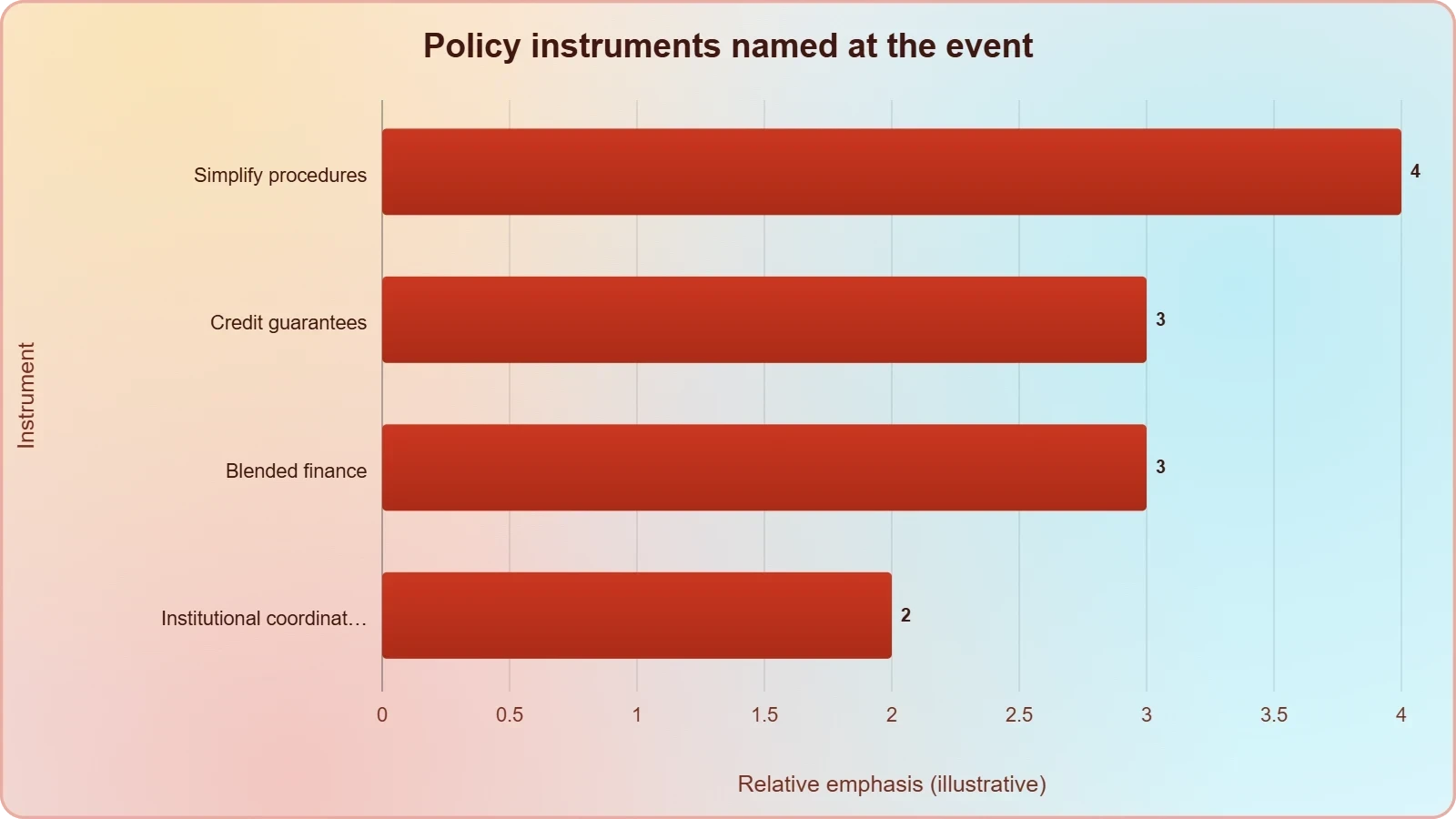
The policy menu outlined at the Dhaka event is pragmatic rather than radical, focusing on mechanisms that can be implemented within existing institutional frameworks. Simplifying financing requirements and procedures tops the list, because complexity disproportionately burdens the smaller factories that most need capital. Government-backed credit guarantees follow, offering a way to transfer a portion of default risk from commercial lenders to the public balance sheet in exchange for expanded lending to green projects. Stronger partnerships among government agencies, financial institutions, industry owners, and development partners round out the approach, reflecting the recognition that no single actor can close a gap of this size alone.
Designing Credit Guarantees That Work
A credit guarantee scheme succeeds when it changes lender behaviour without becoming a subsidy that crowds out private risk assessment. Well-designed guarantees typically cover a defined share of losses, require lenders to retain skin in the game, and price the guarantee to reflect underlying risk. For Bangladesh's garment sector, the design challenge is to reach smaller factories whose credit profiles are opaque while avoiding the temptation to guarantee loans that would have been made anyway. Pairing guarantees with technical assistance, so that borrowers receive help preparing projects and lenders gain confidence in green technologies, can improve both uptake and repayment performance over time.
Blended finance offers a complementary route, combining concessional capital from development partners with commercial funding to improve risk-adjusted returns on green projects. Development partners active in the sector, including the European Union delegation represented at the event, can provide first-loss tranches, subordinated debt, or grants for project preparation that make otherwise marginal investments viable. The Infrastructure Development Company Limited, with its mandate for infrastructure and clean energy financing, illustrates the kind of institution that can anchor such structures. The key is to ensure that concessional support is time-bound and targeted, so that it catalyses private capital rather than substituting for it indefinitely.
Coordination Across Institutions
Coordination failures are a recurring theme in development finance, and the garment sector's green transition is no exception. Ministries, regulators, banks, development partners, and industry associations each control pieces of the puzzle, and misalignment among them can delay projects or duplicate effort. The event's call for stronger cooperation reflects a practical need for a coordinating mechanism that maps available financing, matches it to project pipelines, and resolves regulatory bottlenecks. Such a mechanism need not be a new bureaucracy; it could be a standing platform convened by the finance ministry with participation from the central bank, commercial lenders, and development partners.
- 01
- 02
- 03
- 04
The Just Transition Dimension and Women Workers
Beneath the financing arithmetic lies a human story that the Oporajita Phase 2 initiative brings into focus. Bangladesh's garment sector employs millions of workers, a large share of them women, and the shift toward sustainable manufacturing will reshape labour demand in ways that are not automatically beneficial. Automation accompanying green upgrades may displace some roles while creating others that require new skills, and the costs of transition may fall disproportionately on workers with the least capacity to absorb them. A just transition framework ensures that environmental progress does not come at the expense of the livelihoods it is meant to sustain, and that women workers have a voice in shaping the changes that affect them.
Skills, Livelihoods, and Programme Design
LightCastle Partners is implementing the Oporajita programme under Bunon 2030, an initiative that aims to promote sustainable and inclusive development while safeguarding women garment workers' livelihoods. The design logic is that green investment and social inclusion are complementary rather than competing objectives: factories that upgrade their environmental performance also need workers trained in new processes, and women who gain those skills become more valuable to employers. Programmes that combine technical training with support for career progression can convert the transition into an opportunity for advancement rather than a source of vulnerability, provided that financing reaches the factories where these workers are concentrated.
The emphasis on smaller factories connects directly to this social dimension. Women workers are heavily represented in smaller and mid-sized suppliers that lack the resources to invest in either sustainability or workforce development. If green finance flows only to large, visible exporters, the workers in smaller factories may face both environmental risk and economic stagnation. Targeting finance and technical support toward these enterprises therefore serves an equity objective alongside an environmental one, and it aligns the interests of workers, factory owners, and buyers who depend on a stable, capable supplier base.
Investment Opportunities and the Road Ahead
Despite the daunting arithmetic, the Dhaka discussion also identified emerging investment opportunities that could absorb capital productively if the right structures are in place. Energy efficiency retrofits, rooftop solar installations, effluent treatment upgrades, and cleaner dyeing technologies all offer measurable savings and emissions reductions, and each represents a bankable project category when bundled and standardised. The challenge is aggregation: individual projects are often too small for institutional investors, so intermediaries that pool projects, standardise documentation, and share due diligence costs can unlock financing that would otherwise remain inaccessible to individual factories.
Standardisation and Project Pipelines
Standardisation is the quiet enabler of scale in green finance. When lenders can evaluate a rooftop solar project using a common template, with predictable technical parameters and verified savings, the cost of assessing each loan falls and the appetite to lend rises. Industry associations and development partners can accelerate this process by publishing reference designs, pre-qualifying technology vendors, and maintaining a pipeline of shovel-ready projects. A visible pipeline also signals demand to investors, allowing them to allocate capital with confidence that projects exist and that sponsors are credible, which is precisely what a 73 percent shortfall currently obscures.
The road ahead will require sustained effort across several fronts simultaneously. Government must simplify procedures and back guarantees with credible fiscal support; financial institutions must build green finance expertise and expand lending to smaller factories; development partners must provide concessional capital and technical assistance that catalyses private investment; and industry must organise itself to present bankable projects at scale. None of these conditions is sufficient alone, and the failure of any one could leave the gap stubbornly open. The sector's competitiveness, its workers' livelihoods, and its environmental footprint all depend on whether these pieces come together in the next few years.
What Success Would Look Like
Success would be visible in several ways: a narrowing of the financing gap as confirmed commitments approach the $6.6 billion requirement; a growing share of smaller factories accessing green finance through guarantees and simplified procedures; measurable reductions in emissions and energy intensity across the sector; and evidence that women workers have gained skills and security through the transition. These outcomes are interdependent, and progress on one reinforces progress on others. The Dhaka event did not produce a single solution, but it clarified the problem with unusual precision, and that clarity is itself a precondition for the coordinated action the sector now needs.
From our network :
- How AI Agents Will Change the Way We Manage Personal FinancesExplore how AI agents are transforming personal finance through automated budgeting, bill payment, and investment management, while examining the critical security protocols and governance frameworks required for safe deployment.
- Live Online English Classes for Kids: Do They Actually Reduce Anxiety?A ten-week study reveals that synchronous online English classes can significantly reduce child language anxiety while improving listening and reading skills. Discover what makes these programs effective and how parents can select the right one.
- The Hidden Cost of AI Convenience: Why Over-Permissioned Agents Are a Security Time BombDiscover why AI agents with excessive permissions create dangerous single points of failure, and learn how implementing least privilege principles can protect your organization from exploitation.
- CISA’s Ten-Advisory Wave: Why Generic Patching Fails in OT and How to Build Product-Specific PlaybooksCISA released ten ICS advisories in one week, exposing critical infrastructure risks. Generic patching fails in OT. Learn to build product-specific remediation playbooks.
- Forbidden Matrix Patterns and Visible Lattice Points: A Geometric DictionaryExplore how multidimensional 0–1 matrices encode geometric truths, linking forbidden patterns to visible lattice points and hypergraph theory, with applications in combinatorics and computational geometry.
- University Language Proficiency Exams: Why Institutional Tests Demand Different Preparation Than IELTS and TOEFLDiscover why university-specific language proficiency examinations differ fundamentally from IELTS and TOEFL, and learn strategic preparation approaches for institutional assessment success.
- Mobile Learning and VR in English: What Global Evidence Reveals About Effective Language TechnologyA systematic review across 14 countries reveals which language-learning technologies genuinely work. Mobile learning, AI, and VR show measurable benefits when pedagogically integrated. This evidence-based guide helps educators and learners select technology that delivers real return on investment.
- Committed Mediterranean Precipitation Decline: Why Emissions Cuts Alone Cannot Restore Winter RainsNew NOAA research reveals that Mediterranean winter rains may decline irreversibly even with emissions cuts. Explore the science of committed climate change and regional impacts.
- The Final Descent: How ESA Retired the Legendary Cluster Constellation After 24 Years of Space Weather ScienceAfter 24 years mapping Earth’s magnetosphere, ESA’s Cluster mission concluded with a precisely controlled reentry over the South Pacific. This analysis explores the scientific legacy, engineering decisions, and debris mitigation principles behind one of space exploration’s most responsible retirements.
RESOURCES
- EIB Global and BRAC Bank unlock €60 million to accelerate ...eib.orgJul 8, 2026 ... The project will support green and circular investments across Bangladesh's ... It's the EU contribution to narrowing the global investment…
- Bangladesh's RMG sector faces $4.8 billion green financing gaptbsnews.netThey stressed that green investment, accessible financing and stronger collaboration are essential for the sector to remain competitive in global markets ...
- Green finance panel for Bangladesh RMG sector Dhaka 2026facebook.com3 days ago ... Bridging Bangladesh's RMG green financing gap requires more than ... green investment across Bangladesh's RMG sector. To explore the ...
- How do cities turn bold climate ideas into bankable investments ...instagram.comAug 6, 2026 ... Bangladesh's RMG sector faces an estimated USD 4.8 billion green financing gap between 2025 and 2029. ... Green Finance Pathways…
- Stakeholders chart practical path to expand green finance across ...swisscontact.orgJul 23, 2026 ... The discussion, titled “Bridging the Green Finance Gap in Bangladesh's RMG ... They noted that green investments often compete with ...
- Greening Bangladesh's Garment Industry and Exploring Pathways ...tessforum.orgJun 10, 2026 ... ... Bangladesh's green transition in the textile and RMG sector. Under ... green investments in Bangladesh, including renewable energy and ...
- Financing the Green Transition of Bangladesh's RMG Sectorlightcastlepartners.comJun 9, 2026 ... The challenge is that the investment requirement is significantly larger than the finance currently available. The Scale of the Financing…
- RMG sector faces $4.8 billion shortfall in green investmentthedailystar.net5 hours ago ... Bangladesh's readymade garment (RMG) sector faces a $4.8 billion financing gap against an estimated $6.6 billion investment requirement for ...
- Speakers stress green investment to boost RMG competitivenessbssnews.net6 days ago ... ... Bangladesh's ready-made garment (RMG) ... green investment financing gap, barriers to accessing finance and emerging investment opportunities.
- Garment sector faces $4.8b shortfall in green investmentthedailystar.net3 days ago ... Bangladesh's readymade garment (RMG) sector faces a $4.8 billion financing gap against an estimated $6.6 billion investment requirement for ...
- RMG sector faces $4.8b financing gap for green transitionthefinancialexpress.com.bd6 days ago ... Bangladesh's ready-made garment (RMG) sector faces a financing gap of around US$4.8 billion against its estimated investment requirement of ...
- Drivers, barriers, and strategies for sustainable industrial green ...sciencedirect.com... investment, and gaps in technical expertise. The second factor, termed Institutional and ... Green RMG factories in Bangladesh. Available at: 〈https ...
- Bangladesh Textile Journal BTJ's Post - LinkedInlinkedin.com4 days ago ... Bangladesh's ready-made garment sector faces an estimated $4.8 billion green financing gap against a total investment requirement of $6.6 ...
- How Bangladesh Can Bridge the $4.8 Billion Green Financing Gapbangladeshtextilejournal.com4 days ago ... Bangladesh's ready-made garment sector faces an estimated $4.8 billion green financing gap against a total investment requirement of $6.6 ...
- Policy Packages for Bangladesh's Circular Garment and Textile ...switchtocircular.euFeb 18, 2025 ... Bangladesh Investment. Development Authority. (BIDA), NBR, MoC. 7. Address Logistics and Infrastructure. Gaps. Invest in recycling facilities,.
- 01
- 02
- 03
- 04
- 05
- 06
- 07
- 08
0 Comments