When Russia's Foreign Ministry confirmed in November 2026 that its proposal to relocate the United Nations headquarters from New York to Sochi remained formally on the table, the announcement carried far more diplomatic weight than its practical prospects suggested. Kirill Logvinov, who directs the ministry's department for international organizations, framed the matter around a single governing principle: whether a host country faithfully meets its international obligations. That framing transforms what could be dismissed as a symbolic gesture into a pointed critique of the United States as custodian of the world's premier multilateral institution.
The proposal itself is not new. Foreign Minister Sergey Lavrov first raised the idea of moving UN headquarters to the Black Sea resort city of Sochi a year earlier in New York, and Logvinov's remarks to TASS served chiefly to keep the initiative alive rather than to advance it. His candor was notable: he acknowledged that relocation is theoretically possible, that many member states harbor grievances against the current host, and yet that no realistic prospect exists for such an initiative being tabled in New York at this stage. The statement thus operates simultaneously as diplomacy, grievance and realism.
Understanding why this proposal persists despite its acknowledged improbability requires examining the mechanics of host-country obligations, the history of headquarters relocation debates, and the political economy of institutional siting. The analysis below traces the legal architecture that binds the United States as host, the practical criteria any alternative venue would need to satisfy, and the strategic logic that makes Sochi valuable to Moscow precisely because the move will not happen.
On This Page
- The Legal Architecture of UN Headquarters and Host-Country Obligations
- Sochi as a Symbolic Counterweight in Russian Diplomacy
- Historical Precedents for Relocating International Institutions
- The Grievance Politics Behind Host-Country Criticism
- What the Sochi Proposal Reveals About the Current World Order
- Practical Realities That Keep the United Nations in New York
TL;DR Russia's Foreign Ministry has reaffirmed that its proposal to move the United Nations headquarters from New York to Sochi remains open for consideration, with Kirill Logvinov arguing that the core question is whether the host country honors its international obligations. Logvinov conceded that relocation is theoretically possible and that many member states resent American stewardship, but he also acknowledged there is no realistic prospect of the initiative being tabled in New York now, given the infrastructure, transport, security and financial criteria any new host must meet. The proposal functions less as a viable plan than as a sustained diplomatic pressure campaign against the United States.
The Legal Architecture of UN Headquarters and Host-Country Obligations
The question of where the United Nations sits is governed not by sentiment but by a dense web of treaty commitments, bilateral agreements and institutional precedent. The 1947 Headquarters Agreement between the United Nations and the United States establishes the legal framework under which American authorities must grant access, privileges and immunities to delegates, staff and accredited representatives. Logvinov's emphasis on whether the host country meets its international obligations speaks directly to this instrument, which critics argue has been applied unevenly when politically inconvenient delegations seek visas or access.
The 1947 Headquarters Agreement and Its Contested Application
The Headquarters Agreement obliges Washington to facilitate the transit of persons with official UN business and to refrain from imposing impediments on the Organization's functioning. In practice, visa denials and travel restrictions affecting certain delegations have generated recurring complaints at the General Assembly, and those grievances form the evidentiary backbone of Russia's argument. Logvinov's formulation that many member states hold grievances against the United States is therefore not an isolated claim but a reference to a documented pattern of disputes that surfaces whenever host-country conduct is debated.
Legal scholars note that the agreement contains dispute-resolution provisions, yet enforcement remains politically fraught because the host state is also the institution's largest financial contributor and a permanent Security Council member. This asymmetry means that any challenge to American stewardship must navigate a forum where the United States retains substantial leverage. The result is a persistent gap between the letter of host-country obligations and the practical remedies available to aggrieved member states, a gap that Moscow exploits rhetorically with considerable consistency.
Why Relocation Requires More Than a Simple Vote
Moving the United Nations is not a matter of a single resolution. Any relocation would require the General Assembly to approve a new site, negotiate a fresh headquarters agreement with the receiving state, and secure the cooperation of the host country being left behind. Because the current host sits on the Security Council with veto power, and because budgetary authority is dispersed across committees, the procedural hurdles are formidable. Logvinov's admission that no realistic prospect exists for tabling the initiative in New York reflects a clear-eyed reading of these institutional realities.
Beyond procedure, the physical and administrative apparatus of the United Nations is deeply embedded in Manhattan. The Secretariat, the General Assembly hall, the Security Council chamber, the extensive conference-interpretation infrastructure and thousands of staff households are all anchored to a site developed over eight decades. Transplanting that ecosystem would entail renegotiating thousands of contracts, rebuilding secure communications systems and relocating a diplomatic community that has organized itself around New York's geography. These are not insurmountable obstacles in principle, but they are decisive in practice.
Sochi as a Symbolic Counterweight in Russian Diplomacy
Sochi's selection as the proposed destination is anything but arbitrary. The Black Sea resort has served as the stage for the 2014 Winter Olympics and the 2018 FIFA World Cup, and it hosts the annual Valdai Discussion Club, where President Vladimir Putin has repeatedly addressed global audiences. By naming Sochi, Moscow signals that it possesses world-class conference infrastructure, international hospitality credentials and a symbolic claim to global stature. The city functions as a showcase of Russian organizational capacity rather than a literal logistical blueprint.
Infrastructure, Transport and Security Criteria
Logvinov was explicit that any new location would need to satisfy demanding criteria: infrastructure, transport access and security. Sochi possesses an international airport, modern hotel stock built for the Olympics, and a compact geography that could theoretically accommodate a diplomatic campus. Yet the same criteria cut against the proposal. A UN headquarters requires permanent, purpose-built facilities with hardened security, extensive interpretation and media infrastructure, and residential capacity for a multinational civil service. Sochi's seasonal economy and constrained road and rail links to the rest of Russia complicate any serious assessment.
Security considerations are equally consequential. The United Nations operates in environments where host-state protection is guaranteed by treaty and backed by institutional capacity. Relocating to a site near a conflict-adjacent region would raise questions about long-term stability, insurance and the safety of staff families. These practical objections are precisely why Logvinov's own assessment was so measured: he described relocation as theoretically possible while emphasizing that no one has an interest in an unjustified move that would cost a large amount of money.
The Diplomatic Value of an Unlikely Proposal
The strategic logic of maintaining an improbable proposal is well established in diplomatic practice. By keeping the Sochi idea alive, Moscow sustains a narrative that the United States is an unreliable custodian of multilateral institutions, a theme that resonates with states that have experienced visa difficulties or sanctions. The proposal costs little to maintain and generates periodic headlines, each of which reinforces the underlying critique. Logvinov's interview with TASS was itself an act of agenda-setting rather than a prelude to negotiation.
This approach also positions Russia as a defender of institutional equity, appealing to Global South members who have long complained about Western dominance of multilateral bodies. Even states that would never support relocating to Sochi may find the underlying grievance persuasive, and that ambiguity is useful. The proposal thus functions as a rhetorical instrument that extracts diplomatic value from the mere act of raising a question, regardless of whether the question ever receives a formal answer.
Historical Precedents for Relocating International Institutions
Debates over where international institutions sit are as old as the institutions themselves. The League of Nations settled in Geneva after a contest that reflected Swiss neutrality and accessibility. The United Nations chose New York in 1946 after a fierce competition involving Philadelphia, San Francisco and European candidates, with the Rockefeller family's donation of East River land proving decisive. Each of these decisions embedded political assumptions about which power would anchor the postwar order, and each generated lasting resentments among the states that lost out.
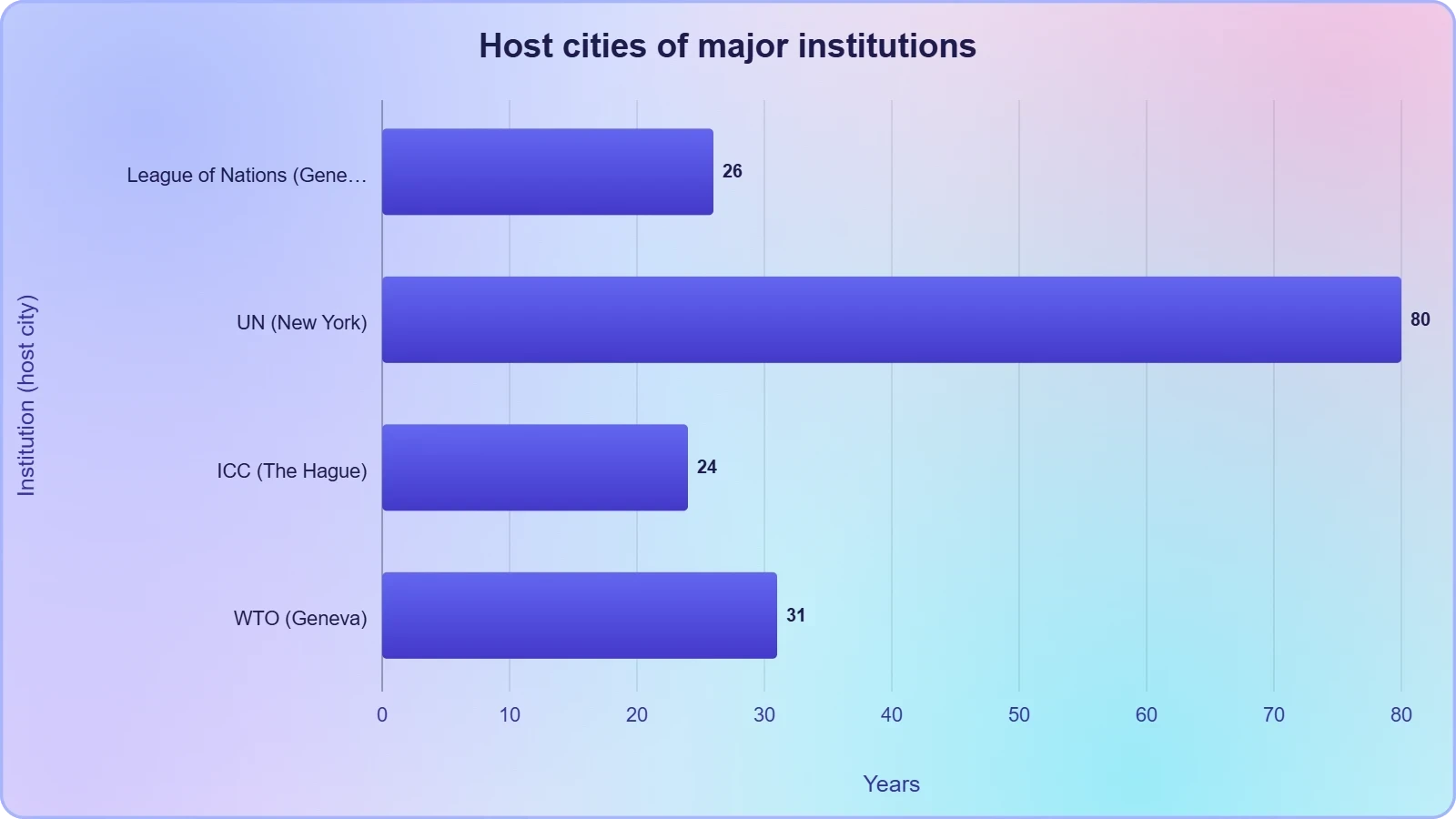
From Geneva to New York: Lessons in Institutional Siting
The League's experience illustrates how host-city choices shape institutional culture. Geneva offered neutrality and a tradition of internationalism, but the League's failure to prevent war discredited the model and influenced the decision to site its successor in the United States. New York represented American power, financial capacity and media reach. The lesson for contemporary debates is that headquarters decisions are never purely logistical; they encode judgments about which country is trusted to steward collective security, and those judgments are always contested.
More recent precedents include the relocation of the International Criminal Court's outreach functions and the establishment of UN offices in Nairobi and Vienna, which demonstrate that institutional decentralization is feasible when political will and funding align. Yet no full headquarters has ever been moved from one great power to another. The historical record therefore supports Logvinov's cautious framing: relocation is theoretically possible, but the precedents suggest it requires a rupture in the international order far more profound than the disputes of the present moment.
Comparative Costs of Institutional Relocation
Estimating the cost of moving the United Nations is an exercise in informed speculation, but the scale is instructive. The organization's New York campus represents billions of dollars in real estate, and the operational costs of relocation would include new construction, secure communications, staff relocation and the disruption of ongoing diplomatic business. Comparable relocations of major agencies, such as the movement of portions of the European Union's apparatus between Brussels, Strasbourg and Luxembourg, have generated recurring expense and administrative friction that persist decades after the decision.
These figures explain why Logvinov emphasized that a move would cost a large amount of money and that no one has an interest in an unjustified relocation. Even states sympathetic to the critique of American stewardship would hesitate to fund a relocation that diverts resources from development, peacekeeping and humanitarian programs. The financial argument thus reinforces the political one, creating a coalition of convenience between those who defend the current arrangement and those who simply cannot justify the expense.
- 01
- 02
- 03
- 04
The Grievance Politics Behind Host-Country Criticism
Logvinov's observation that many member states have grievances against the United States is the analytical heart of the matter. Those grievances are not confined to Russia or its allies. They surface regularly among African, Asian and Latin American delegations that have encountered visa delays, banking restrictions or travel impediments when attending UN business. The host-country relationship has therefore become a proxy for broader debates about whether the multilateral system is genuinely equitable or structurally tilted toward Western powers.
Visa Disputes and Access as Recurring Flashpoints
Visa disputes are the most visible manifestation of host-country friction. When delegates are denied timely entry, the affected states argue that the Headquarters Agreement has been breached and that the institution's universality is compromised. The United States counters that security and immigration law must be applied, and that no host can be expected to suspend its own legal processes. This tension is structural rather than incidental, and it recurs whenever geopolitical relations deteriorate, making it a reliable barometer of broader institutional health.
The dispute-resolution machinery available to aggrieved states is limited. Consultations through the host-country committee can produce dialogue but rarely binding outcomes, and the political costs of escalating a complaint are high for smaller states dependent on American aid or market access. This asymmetry means that grievances accumulate without resolution, providing persistent rhetorical material for states seeking to challenge the status quo. Logvinov's remarks draw on this reservoir of unresolved complaint rather than inventing a new grievance.
How Multilateral Institutions Manage Host-Country Friction
International organizations have developed informal mechanisms for managing host-country friction, including dedicated liaison offices, regular consultations and quiet diplomacy. These mechanisms can defuse individual disputes but cannot address the underlying structural imbalance. Some scholars have proposed rotating headquarters arrangements or strengthened dispute-resolution procedures, but such reforms require the consent of the very states that benefit from the current arrangement. The result is institutional inertia punctuated by periodic crises that are managed rather than resolved.
For Russia, this inertia is an opportunity. Each unresolved grievance validates the argument that the current host arrangement is defective, and each new dispute provides fresh evidence for the case. The Sochi proposal therefore does not need to succeed to be useful; it needs only to remain on the table, available for invocation whenever host-country conduct becomes contentious. That is precisely the posture Logvinov adopted, and it explains why the proposal persists despite his own acknowledgment of its impracticality.
We Also Published
What the Sochi Proposal Reveals About the Current World Order
The Sochi proposal is best understood as a diagnostic instrument rather than a policy blueprint. Its persistence reveals that the postwar settlement, which placed the United Nations in the United States, is increasingly contested by states that regard the arrangement as an artifact of a vanished power distribution. Logvinov's careful language, acknowledging both theoretical possibility and practical impossibility, captures the ambivalence of a revisionist power that wants to delegitimize the status quo without bearing the costs of replacing it.
Signals, Leverage and the Limits of Symbolic Diplomacy
Symbolic diplomacy has real effects even when it produces no material change. By keeping the relocation question alive, Moscow signals to like-minded states that alternatives to Western-centered multilateralism are imaginable, and it invites them to articulate their own grievances. The proposal also provides leverage in unrelated negotiations, since host-country conduct can be raised whenever Washington seeks cooperation on UN reform or budget matters. These are modest but tangible returns on a low-cost diplomatic investment.
The limits of symbolic diplomacy are equally real. Repeated invocation of an unimplementable proposal risks diminishing returns, as audiences learn to discount the rhetoric. Logvinov's own acknowledgment that no realistic prospect exists for tabling the initiative suggests awareness of this risk. The proposal therefore functions best as a periodic reminder rather than a continuous campaign, deployed when host-country controversies create receptive audiences and set aside when attention moves elsewhere.
Implications for Multilateral Legitimacy
The deeper implication concerns multilateral legitimacy. Institutions derive authority not only from their mandates but from the perception that they are fairly hosted and equally accessible. When host-country conduct generates persistent complaint, that perception erodes, and the institution's capacity to convene and persuade diminishes accordingly. The Sochi proposal exploits this vulnerability, but the vulnerability itself is real and predates Russian advocacy. Addressing it would require reforms that the current host has little incentive to accept.
For observers of global governance, the episode offers a case study in how institutional geography becomes politicized when power distributions shift. The United Nations remains in New York because the costs of moving it exceed the benefits for nearly every member state, including many that criticize American stewardship. That equilibrium is stable but not permanent, and proposals like Sochi's serve as reminders that stability depends on continued performance of host-country obligations rather than on the mere fact of historical precedent.
Practical Realities That Keep the United Nations in New York
Whatever the rhetorical value of the Sochi proposal, the practical realities that anchor the United Nations in New York remain decisive. The organization's physical plant, its contractual relationships, its staff community and its relationship with the world's largest media market all create powerful path dependencies. Relocation would require not merely a political decision but a multi-year logistical undertaking that would disrupt the institution's core functions during a period of considerable global instability.
Cost, Continuity and Institutional Inertia
Institutional inertia is often dismissed as bureaucratic resistance, but in this case it reflects a rational assessment of risk. The United Nations operates continuously, with Security Council sessions, peacekeeping mandates and humanitarian coordination that cannot pause for a move. Any relocation would require parallel operations, temporary facilities and a transition period measured in years. The costs of disruption, both financial and diplomatic, would fall on member states that have little appetite for such expenditure when budgets are already strained.
Logvinov's acknowledgment that a move would cost a large amount of money and that no one has an interest in an unjustified relocation is therefore a concession to reality rather than a rhetorical retreat. It also reflects an understanding that the proposal's value lies in its existence rather than its execution. By conceding the practical obstacles, he preserves credibility while keeping the underlying critique intact, a balance that experienced diplomats recognize as the hallmark of a well-calibrated intervention.
What Would Have to Change for Relocation to Become Viable
For relocation to become genuinely viable, several conditions would need to converge. A major shift in the distribution of global power would have to make the current host arrangement untenable for a decisive coalition of member states. A credible alternative site would need to offer infrastructure, security and political neutrality acceptable to that coalition. And a financing mechanism would need to be agreed, since no single state is likely to bear the cost alone. None of these conditions currently obtains, and Logvinov's assessment implicitly recognizes the gap.
The more probable trajectory is incremental reform rather than relocation. Strengthened consultation mechanisms, clearer dispute-resolution procedures and greater transparency around host-country decisions could address some grievances without the disruption of a move. Such reforms would require cooperation from the United States, which has historically resisted binding constraints on its host-country discretion. The Sochi proposal may therefore contribute indirectly to reform by keeping the issue salient, even as its literal objective remains out of reach.
From our network :
- CISA’s Ten-Advisory Wave: Why Generic Patching Fails in OT and How to Build Product-Specific PlaybooksCISA released ten ICS advisories in one week, exposing critical infrastructure risks. Generic patching fails in OT. Learn to build product-specific remediation playbooks.
- Forbidden Matrix Patterns and Visible Lattice Points: A Geometric DictionaryExplore how multidimensional 0–1 matrices encode geometric truths, linking forbidden patterns to visible lattice points and hypergraph theory, with applications in combinatorics and computational geometry.
- Mobile Learning and VR in English: What Global Evidence Reveals About Effective Language TechnologyA systematic review across 14 countries reveals which language-learning technologies genuinely work. Mobile learning, AI, and VR show measurable benefits when pedagogically integrated. This evidence-based guide helps educators and learners select technology that delivers real return on investment.
- How AI Agents Will Change the Way We Manage Personal FinancesExplore how AI agents are transforming personal finance through automated budgeting, bill payment, and investment management, while examining the critical security protocols and governance frameworks required for safe deployment.
- The Final Descent: How ESA Retired the Legendary Cluster Constellation After 24 Years of Space Weather ScienceAfter 24 years mapping Earth’s magnetosphere, ESA’s Cluster mission concluded with a precisely controlled reentry over the South Pacific. This analysis explores the scientific legacy, engineering decisions, and debris mitigation principles behind one of space exploration’s most responsible retirements.
- Committed Mediterranean Precipitation Decline: Why Emissions Cuts Alone Cannot Restore Winter RainsNew NOAA research reveals that Mediterranean winter rains may decline irreversibly even with emissions cuts. Explore the science of committed climate change and regional impacts.
- The Hidden Cost of AI Convenience: Why Over-Permissioned Agents Are a Security Time BombDiscover why AI agents with excessive permissions create dangerous single points of failure, and learn how implementing least privilege principles can protect your organization from exploitation.
- University Language Proficiency Exams: Why Institutional Tests Demand Different Preparation Than IELTS and TOEFLDiscover why university-specific language proficiency examinations differ fundamentally from IELTS and TOEFL, and learn strategic preparation approaches for institutional assessment success.
- Live Online English Classes for Kids: Do They Actually Reduce Anxiety?A ten-week study reveals that synchronous online English classes can significantly reduce child language anxiety while improving listening and reading skills. Discover what makes these programs effective and how parents can select the right one.
RESOURCES
- Resources will be updated soon.
- 01
- 02
- 03
- 04
- 05
- 06
- 07
- 08
0 Comments