When Booking Holdings disclosed that a single regulatory action had carved a $1 billion charge out of its third-quarter results, the announcement landed with unusual force for a company whose brands — Booking.com, Priceline, Agoda, Kayak and OpenTable — sit at the center of global travel commerce. The disclosure, tied to an action by the U.S. Federal Trade Commission, did not arrive with a detailed narrative of wrongdoing or a granular breakdown of the mechanics behind the number. Instead, it presented investors with something rarer and arguably more unsettling: a material financial hit attached to a regulatory matter the company acknowledged only in outline, leaving the market to price the uncertainty as much as the charge itself.
That silence is the story. A $1 billion charge is not a rounding error even for a business of Booking's scale, and the way a company frames such an event — or declines to frame it — shapes how analysts, auditors and shareholders interpret the underlying risk. The disclosure lowered reported quarterly performance, which means the charge flowed directly into the earnings investors use to value the stock. Understanding what this episode reveals about regulatory exposure in platform-based travel, how material charges are communicated, and what investors should watch next requires reading between the lines of a deliberately terse announcement.
This analysis examines the Booking Holdings disclosure from several angles: the nature of FTC enforcement in the digital travel sector, the accounting and market mechanics of a billion-dollar charge, the strategic implications for a company built on cross-border intermediation, and the broader pattern of regulatory costs now embedded in platform business models. The goal is not to speculate beyond the facts but to situate a sparse disclosure within the frameworks that give it meaning.
On This Page
- The Anatomy of a Billion-Dollar Regulatory Charge
- The FTC's Expanding Reach into Digital Travel
- Reading the Earnings Impact and Investor Signals
- Strategic Implications for Booking's Platform Model
- Regulatory Costs as a Structural Feature of Platform Economics
- What to Watch Next and How to Interpret Future Disclosures
TL;DR Booking Holdings reported that its third-quarter results were reduced by a $1 billion charge connected to a U.S. Federal Trade Commission action, without disclosing further detail on the underlying matter. The charge is material, flows directly into reported earnings, and signals that regulatory enforcement has become a first-order financial variable for large travel platforms. Investors should treat the disclosure as a marker of unresolved regulatory risk rather than a closed event, and monitor subsequent filings for the specific legal theory, any remediation obligations, and whether further charges are possible.
The Anatomy of a Billion-Dollar Regulatory Charge
A charge of this magnitude rarely appears in isolation. In corporate accounting, a charge represents a reduction in earnings tied to an anticipated outflow, an impairment, or a settlement obligation, and its classification matters enormously. Whether Booking recorded the $1 billion as an accrued liability, a provision for a probable loss, or an impairment of an intangible asset determines how it flows through the income statement and what it implies about the company's own assessment of the matter's resolution. The sparse disclosure leaves that classification ambiguous, which is precisely why analysts will press for clarity in follow-up filings and earnings calls.
The timing is equally instructive. Third-quarter results for a travel platform capture the peak summer booking season in the Northern Hemisphere, a period when revenue and margins are typically at their strongest. A charge landing in that window does not merely reduce a number; it distorts year-over-year comparisons and can obscure underlying operating momentum. Investors must therefore separate the operating performance of the core business from the one-time regulatory hit, a distinction the company's brief statement did not make explicit.
How Material Charges Are Recognized and Communicated
Under U.S. GAAP, a company recognizes a loss contingency when it is probable that a liability has been incurred and the amount can be reasonably estimated. A $1 billion figure implies management concluded that both conditions were met, at least in part, which is itself a significant signal about the company's internal legal assessment. The decision to disclose the charge without detailing the FTC's theory of the case suggests a deliberate communications strategy: satisfy the disclosure obligation, avoid characterizing the allegations, and preserve negotiating room.
That strategy carries trade-offs. Terse disclosure can invite market speculation and volatility, while overly detailed disclosure can prejudice legal positions. Booking appears to have chosen the narrow path, reporting the financial impact while withholding the narrative. For investors, the practical consequence is that the charge's full meaning cannot be derived from the announcement alone; it must be reconstructed from subsequent regulatory filings, legal proceedings, and management commentary.
Why the Sparse Framing Matters to Markets
Markets price information asymmetrically. When a company discloses a large charge but withholds the underlying legal theory, investors must assign probabilities to a range of outcomes — a negotiated settlement, a contested litigation, a broader industry inquiry, or a one-time event. Each scenario carries different implications for future cash flows and for the company's regulatory standing. The absence of detail therefore functions as a risk premium, and the stock's reaction will reflect not the charge itself but the market's estimate of what remains unknown.
Booking's decision to keep the disclosure minimal may also reflect legal caution. Publicly characterizing an FTC action before positions are settled can complicate negotiations and invite additional scrutiny. Yet the same restraint can erode investor confidence if it persists across multiple reporting periods. The balance between legal prudence and market transparency is one of the most delicate judgments a general counsel and CFO must make jointly, and this episode places that judgment on public display.
The FTC's Expanding Reach into Digital Travel
The Federal Trade Commission has steadily broadened its enforcement posture toward digital intermediaries, and travel platforms occupy a particularly exposed position. Booking.com and its sister brands sit between consumers and a fragmented supply of hotels, airlines and experiences, aggregating inventory, setting display rankings, and shaping prices through algorithms and promotional mechanics. That intermediary role invites scrutiny on multiple fronts: advertising claims, fee transparency, cancellation and refund practices, and the treatment of small suppliers who depend on the platform for distribution.
The FTC's authority in these areas derives from its mandate against unfair or deceptive acts or practices, a standard broad enough to encompass marketing representations, disclosure adequacy, and consumer harm. For a global platform operating across dozens of jurisdictions, the American regulator's reach is only one layer of a much denser compliance environment. The $1 billion charge suggests the matter is substantial enough to warrant a material provision, which in turn implies the agency's concerns extend beyond a narrow technical violation.
Consumer Protection Themes in Platform Enforcement
Recent FTC activity in the travel and hospitality space has centered on transparency. Regulators have questioned whether consumers see the true all-in price of a booking, whether resort fees and service charges are adequately disclosed, and whether cancellation policies are presented clearly enough for informed consent. For an intermediary that earns commissions on completed bookings, any enforcement action touching these areas carries direct revenue implications, because remedies often include changes to how prices are displayed and how fees are structured.
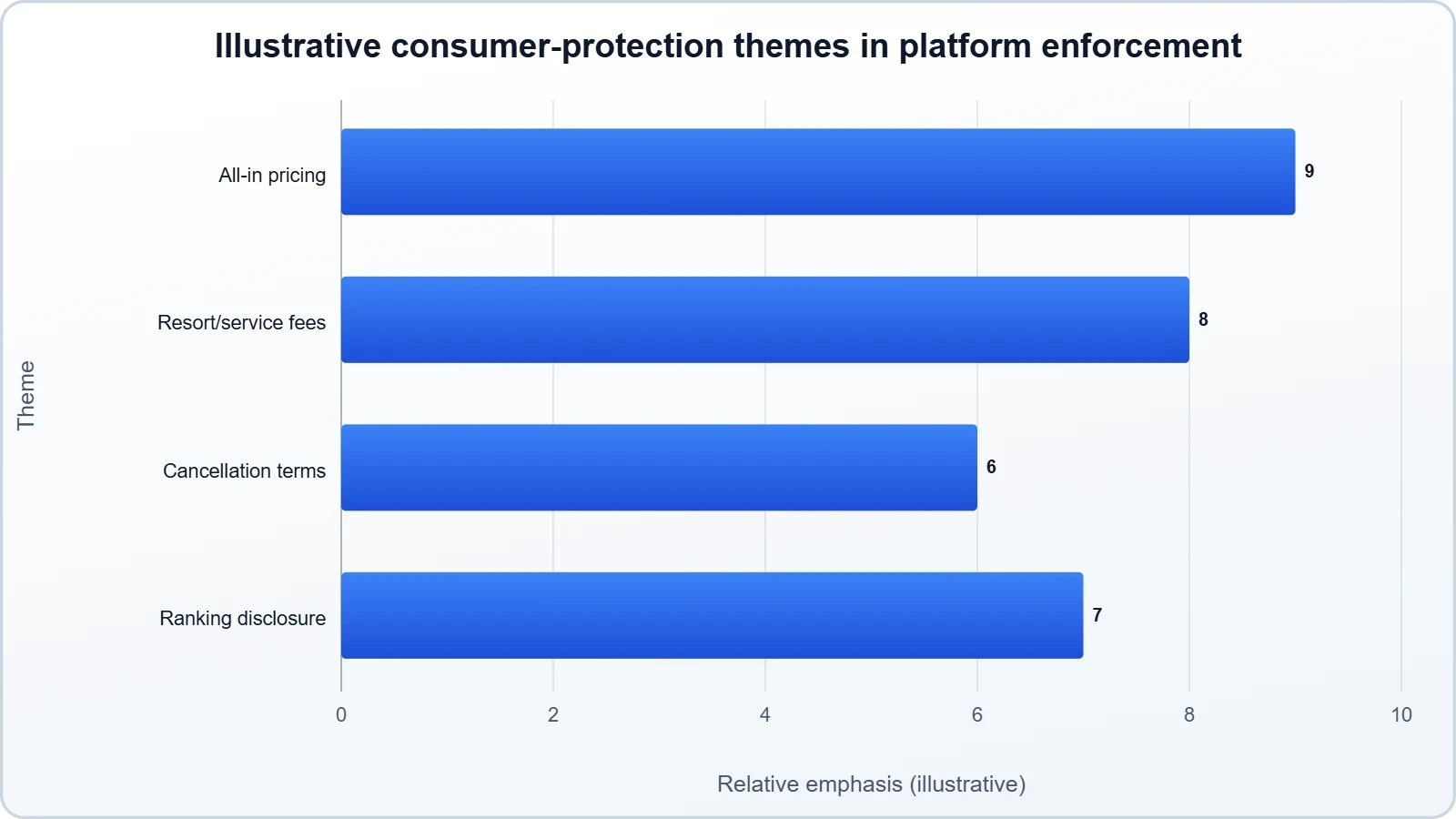
Beyond pricing, the agency has shown interest in how platforms rank and promote listings. If a platform's algorithm favors properties that pay higher commissions, and if that preference is not disclosed, regulators may view the practice as deceptive. Booking's scale makes it a natural target for precedent-setting action, and the charge suggests the company has concluded that some resolution is probable. The precise theory, however, remains undisclosed, leaving the industry to infer the boundaries from the outcome.
Cross-Border Complications for a Global Intermediary
Booking Holdings operates across Europe, Asia, the Americas and the Middle East, which means a U.S. enforcement action sits alongside parallel regimes such as the European Union's Digital Services Act and Digital Markets Act, national consumer authorities, and sector-specific tourism regulators. A settlement with the FTC may set expectations that other jurisdictions seek to match, creating a cascade of compliance obligations. The $1 billion charge may therefore represent only the first visible cost of a multi-jurisdictional adjustment.
Currency and tax interactions further complicate the picture. A charge recognized in U.S. dollars against earnings generated in euros, pounds and other currencies is subject to translation effects, and its tax deductibility depends on the nature of the payment and the jurisdictions involved. These technical dimensions rarely surface in a brief disclosure, but they materially affect the net cash impact and the timing of outflows, which is why detailed filings will matter more than the headline number.
Reading the Earnings Impact and Investor Signals
For equity analysts, the central question is whether the charge is a one-time event or the leading edge of a recurring cost. A one-time charge is typically excluded from adjusted earnings and treated as non-recurring, allowing investors to value the underlying business on normalized cash flows. A recurring pattern of regulatory costs, by contrast, must be embedded in forecasts as a permanent drag on margins. The distinction hinges on whether the FTC matter is resolved or merely acknowledged, and the disclosure does not settle that question.
Booking's core operating metrics — room nights, gross bookings, and take rates — remain the primary drivers of its valuation. A $1 billion charge does not change the demand for travel or the company's competitive position, but it does affect reported profitability, book value, and potentially covenant calculations if the company carries debt. Investors should watch whether the charge is cash or non-cash, whether it is tax-deductible, and whether management adjusts its guidance to exclude it.
Separating Operating Performance from Regulatory Noise
The most useful analytical discipline in situations like this is to reconstruct the underlying quarter. If the charge reduced reported performance, then pre-charge figures reveal how the core business actually performed during the peak travel season. Analysts will compare those reconstructed numbers against consensus estimates and against the prior year to determine whether demand, pricing power, and marketing efficiency remained intact. A strong underlying quarter paired with a large charge tells a very different story from a weak quarter compounded by regulatory costs.
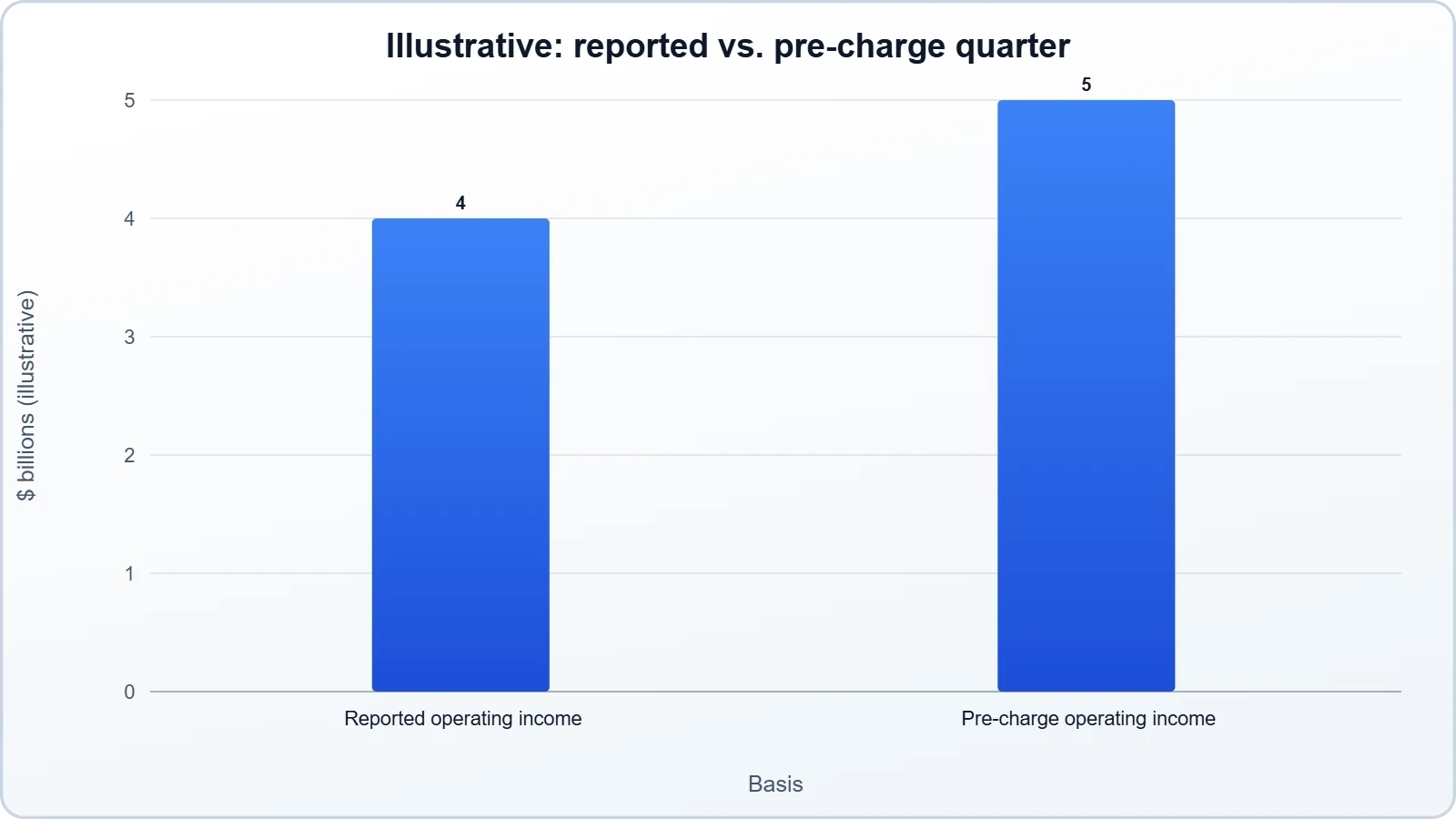
Management's commentary will be scrutinized for signals about the durability of the charge. Language indicating that the matter is substantially resolved would support treating it as non-recurring; language suggesting ongoing investigation or potential additional exposure would argue for caution. Because the initial disclosure provided no such guidance, the market's interpretation will depend heavily on the next round of filings and any settlement announcements.
What the Disclosure Does Not Say
The most consequential information is absent. The announcement does not identify the specific conduct under investigation, the time period covered, whether the matter involves civil penalties or consumer redress, or whether other parties are implicated. It does not state whether the charge reflects a negotiated figure or a conservative estimate, nor whether the company expects insurance recovery or indemnification. Each omission represents a variable that could shift the ultimate financial outcome in either direction.
For sophisticated investors, this absence is itself a data point. Companies typically disclose more when they are confident the matter is contained and less when negotiations are fluid. The minimal framing may indicate that discussions with the FTC are ongoing and that the company wishes to avoid statements that could be used against it. Alternatively, it may reflect a judgment that the matter is immaterial to operations and warrants only the required disclosure. Distinguishing between these interpretations requires watching for follow-up signals.
- 01
- 02
- 03
- 04
Strategic Implications for Booking's Platform Model
Booking Holdings has built its franchise on scale, brand breadth, and the efficiency of connecting demand to supply across borders. Regulatory costs of this magnitude test the resilience of that model by raising the fixed cost of compliance and potentially constraining the commercial practices that drive conversion. If remedies require changes to how prices are displayed or how listings are ranked, the company may need to redesign elements of its user experience, which can affect conversion rates and marketing efficiency.
The charge also arrives at a moment when the travel industry is navigating post-pandemic demand normalization, currency volatility, and intensifying competition from alternative accommodation platforms and direct-booking channels. A billion-dollar hit to earnings reduces the capital available for reinvestment, share repurchases, or acquisitions, though Booking's cash generation is substantial enough to absorb it without threatening solvency. The strategic question is less about survival than about opportunity cost and management attention.
Compliance as a Competitive Variable
In platform industries, compliance capability is increasingly a source of competitive advantage. Companies that invest early in transparent pricing, clear disclosure, and robust consumer redress mechanisms may face lower regulatory risk and fewer disruptive remedies. Those that treat compliance as a cost center can find themselves absorbing large charges and operational mandates at inconvenient moments. Booking's experience may prompt a reassessment of how it allocates resources to regulatory affairs across its brand portfolio.
The broader industry will be watching closely. If the FTC action results in operational remedies that change how online travel agencies present prices or rank properties, competitors such as Expedia and smaller regional platforms will face pressure to adapt. A precedent set with the market leader can ripple through the sector, raising compliance costs industry-wide and potentially accelerating consolidation among players unable to absorb them.
We Also Published
Regulatory Costs as a Structural Feature of Platform Economics
The Booking disclosure fits a broader pattern in which regulatory costs have become a structural feature of platform economics rather than an occasional disruption. Digital intermediaries that aggregate supply, influence pricing, and mediate consumer choice attract sustained regulatory attention because their decisions have wide distributional consequences. As authorities in the United States, Europe and Asia develop more sophisticated tools for scrutinizing these platforms, the associated costs — legal, compliance, remediation, and reputational — are becoming embedded in operating models.
For investors, this means that valuation frameworks must increasingly account for regulatory risk as a persistent variable rather than a tail event. Companies with strong compliance cultures and transparent practices may earn a valuation premium, while those with recurring enforcement issues may face a discount. The $1 billion charge is a vivid reminder that the gap between these outcomes can be measured in billions, and that the market's assessment of regulatory risk is itself a driver of shareholder value.
Comparing Regulatory Exposure Across the Travel Sector
Not all travel platforms carry equal regulatory exposure. Companies with diversified revenue streams, strong direct relationships with consumers, and proactive disclosure practices may be better positioned to absorb enforcement actions. Those heavily dependent on intermediary commissions and algorithmic ranking face greater scrutiny because their business models directly shape market outcomes. Booking's scale places it at the high end of this spectrum, which helps explain why a single FTC action could produce a charge of this size.
The comparison also highlights the importance of jurisdictional diversification. A platform with concentrated exposure to one regulator's interpretation faces greater risk than one with a balanced global footprint. Booking's extensive European operations, for instance, subject it to the EU's evolving digital rulebook alongside U.S. requirements, creating overlapping obligations that demand coordinated compliance strategies and sophisticated legal management.
The Long Arc of Enforcement and Compliance
Regulatory enforcement rarely ends with a single charge. Agencies often follow initial actions with monitoring, reporting requirements, and periodic reviews, each of which imposes ongoing costs and management attention. For Booking, the $1 billion charge may be the most visible element of a longer engagement with the FTC that includes compliance commitments, operational changes, and reporting obligations. Investors should expect the total cost of the matter to exceed the headline figure once these ancillary requirements are accounted for.
The long arc also shapes industry behavior. When a market leader absorbs a large charge, competitors reassess their own practices, and the sector as a whole may move toward greater transparency. This dynamic can be beneficial for consumers and for the credibility of the industry, even as it raises costs in the short term. The question for investors is whether the resulting environment favors scale players with the resources to comply or creates openings for nimble challengers.
What to Watch Next and How to Interpret Future Disclosures
The next phase of this story will unfold through regulatory filings, earnings calls, and any settlement announcements. Investors should focus on four signals: the specific legal theory underlying the FTC action, the cash versus non-cash nature of the charge, the presence of any additional accruals, and management's characterization of the matter's resolution status. Each signal will refine the market's estimate of the total cost and the likelihood of recurrence, and together they will determine whether the charge is remembered as an isolated event or as the beginning of a more expensive regulatory era.
It is also worth monitoring how Booking's peers respond. If competitors disclose similar provisions or adjust their practices, the episode may mark a sector-wide inflection point in regulatory costs. If the matter remains confined to Booking, the market may treat it as company-specific. Either way, the disclosure has already changed the conversation around platform regulation in travel, and the full implications will only become clear as more information enters the public domain.
Key Metrics and Filings to Monitor
Analysts should track the company's quarterly provisions, legal expense disclosures, and any changes to risk factors in its annual report. The 10-Q and 10-K filings will provide the accounting detail absent from the initial announcement, including the classification of the charge and any related contingencies. Management commentary on the earnings call will offer qualitative context, particularly regarding the status of discussions with the FTC and the company's assessment of additional exposure.
Beyond the financial statements, regulatory dockets and press releases from the FTC may reveal the scope of the action and any parallel proceedings. Industry associations and competitor disclosures can provide comparative context. Taken together, these sources will allow investors to move from the sparse initial disclosure to a more complete understanding of the matter and its implications for Booking's valuation and strategy.
Framing the Charge Within a Longer Investment Horizon
For long-term investors, the significance of a $1 billion charge depends on its relationship to the company's earning power. Booking generates substantial annual cash flow, and a charge of this size, while painful, is absorbable within a single year's results. The more important question is whether the underlying regulatory issue signals a durable change in the company's operating environment. If it does, the charge is a symptom of a structural shift; if it does not, it is a costly but finite event.
The disciplined approach is to separate the accounting event from the strategic signal, to demand more information before drawing conclusions, and to update estimates as filings and proceedings unfold. The disclosure's brevity is frustrating, but it is also a reminder that regulatory matters are resolved through processes that unfold over time. Investors who track those processes carefully will be better positioned to distinguish a one-time hit from a lasting change in the economics of online travel.
From our network :
- Committed Mediterranean Precipitation Decline: Why Emissions Cuts Alone Cannot Restore Winter RainsNew NOAA research reveals that Mediterranean winter rains may decline irreversibly even with emissions cuts. Explore the science of committed climate change and regional impacts.
- Live Online English Classes for Kids: Do They Actually Reduce Anxiety?A ten-week study reveals that synchronous online English classes can significantly reduce child language anxiety while improving listening and reading skills. Discover what makes these programs effective and how parents can select the right one.
- How AI Agents Will Change the Way We Manage Personal FinancesExplore how AI agents are transforming personal finance through automated budgeting, bill payment, and investment management, while examining the critical security protocols and governance frameworks required for safe deployment.
- Mobile Learning and VR in English: What Global Evidence Reveals About Effective Language TechnologyA systematic review across 14 countries reveals which language-learning technologies genuinely work. Mobile learning, AI, and VR show measurable benefits when pedagogically integrated. This evidence-based guide helps educators and learners select technology that delivers real return on investment.
- The Hidden Cost of AI Convenience: Why Over-Permissioned Agents Are a Security Time BombDiscover why AI agents with excessive permissions create dangerous single points of failure, and learn how implementing least privilege principles can protect your organization from exploitation.
- Forbidden Matrix Patterns and Visible Lattice Points: A Geometric DictionaryExplore how multidimensional 0–1 matrices encode geometric truths, linking forbidden patterns to visible lattice points and hypergraph theory, with applications in combinatorics and computational geometry.
- CISA’s Ten-Advisory Wave: Why Generic Patching Fails in OT and How to Build Product-Specific PlaybooksCISA released ten ICS advisories in one week, exposing critical infrastructure risks. Generic patching fails in OT. Learn to build product-specific remediation playbooks.
- University Language Proficiency Exams: Why Institutional Tests Demand Different Preparation Than IELTS and TOEFLDiscover why university-specific language proficiency examinations differ fundamentally from IELTS and TOEFL, and learn strategic preparation approaches for institutional assessment success.
- The Final Descent: How ESA Retired the Legendary Cluster Constellation After 24 Years of Space Weather ScienceAfter 24 years mapping Earth’s magnetosphere, ESA’s Cluster mission concluded with a precisely controlled reentry over the South Pacific. This analysis explores the scientific legacy, engineering decisions, and debris mitigation principles behind one of space exploration’s most responsible retirements.
RESOURCES
- Resources will be updated soon.
- 01
- 02
- 03
- 04
- 05
- 06
- 07
- 08
0 Comments