When the Latrobe Council quietly approved a 26-megawatt artificial intelligence research facility at the former Wesley Vale pulp mill in north-west Tasmania, it did so without a public advertising period and without a single vote from elected councillors. The decision, formalised by council staff and the general manager under an existing use class in the state planning scheme, has become a flashpoint for a much larger question: whether Australia's planning frameworks are structurally equipped to scrutinise the risks, power demands, and community impacts of the AI infrastructure boom now arriving at their doorstep.
The project belongs to Firmus, a company co-founded by Jonathan Levee, which intends to convert an existing warehouse into a computing and research hub dedicated to testing how AI workloads can respond more flexibly to electricity grid conditions, including the use of battery storage to reduce reliance on diesel generators during outages. Separately, Firmus still intends to build a full AI data centre of the same capacity on the same site, a proposal the Latrobe Council has referred to the state government for assessment as a major project. The company holds ambitions for three AI data centres across Tasmania and withdrew a planned public offering on the Australian stock market last month after investor appetite cooled.
What makes the Wesley Vale case instructive is not the facility itself but the procedural gap it exposes. Outgoing Latrobe Mayor Peter Freshney described the approval as standard for applications fitting the appropriate use class, with no discretionary matters requiring council deliberation, yet conceded the episode revealed the planning scheme's limits and that the process felt rushed. Local resident Erin Woodcock said she felt excluded and that details about the project next door, including possible risks, remained unclear and worrying. Planning and Housing Minister Kerry Vincent defended the process as entirely appropriate, while critics renewed calls to modernise state planning rules built for an older industrial economy.
On This Page
- The Wesley Vale Approval and the Procedural Gap It Exposed
- Why Planning Schemes Struggle With Emerging Technologies
- Firmus, Capital Markets, and the Commercial Backdrop
- The National Pattern of Local Resistance to AI Infrastructure
- What the Wesley Vale Case Means for AI Infrastructure Governance
- Conclusion: From Procedural Compliance to Substantive Legitimacy
TL;DR A 26-megawatt AI research facility at Tasmania's former Wesley Vale pulp mill was approved by council staff without public advertising or a councillor vote, because the application fit an existing use class under the state planning scheme. The decision has renewed calls to reform planning rules that critics say cannot rigorously assess emerging technologies, their electricity demands, and their community impacts. Firmus, the developer, also plans a separate AI data centre at the same site, has ambitions for three Tasmanian data centres, and withdrew a stock market offering after investor interest cooled. The case sits within a wider Australian pattern of local resistance to AI infrastructure.
The Wesley Vale Approval and the Procedural Gap It Exposed
The approval at Wesley Vale is best understood as a collision between an old regulatory instrument and a new class of industrial activity. Tasmania's planning scheme classifies land use into defined categories, and where an application fits cleanly within a permitted use class, it can be processed administratively rather than politically. That design exists to keep routine development moving without burdening elected officials with every shed and warehouse conversion. The difficulty is that an AI research facility with substantial computing load, backup generation requirements, and grid-interactive experimentation does not map neatly onto the categories the scheme was written to handle.
Because no discretionary matters were triggered, the application bypassed public advertising and councillor deliberation entirely. Council staff assessed it, and the general manager formalised the outcome. Outgoing Mayor Peter Freshney framed this as standard practice rather than impropriety, but he also acknowledged that the case demonstrated the planning scheme's limits and that the process appeared rushed. That dual character, procedurally correct yet substantively thin, is precisely what has animated reform calls. The approval was lawful; the question is whether lawfulness alone constitutes adequate scrutiny for infrastructure whose downstream effects on power networks and neighbourhoods may be considerable.
What the Facility Actually Does
Firmus co-founder Jonathan Levee has described the site as a place where Tasmanian engineers can test ways to make AI computing more flexible and responsive to electricity grid conditions. The research focus is on demand flexibility: how large computing loads might modulate their consumption in response to grid signals, and how technologies such as batteries could reduce reliance on diesel generators during outages. This is a meaningful technical agenda, because AI data centres are unusually power-hungry and their load profiles are less predictable than traditional industrial consumers. A facility explicitly designed to experiment with grid interaction is, in principle, a more sophisticated proposition than a passive server farm.
The 26-megawatt figure places the facility in a serious industrial category. For context, that capacity is comparable to the demand of thousands of homes, and it must be supplied reliably. The research framing matters because it shapes how the project is classified and therefore how it is assessed. A facility described as research and development fits an existing use class; a facility described as a data centre may attract major project scrutiny. The same site, the same capacity, and much the same physical footprint can therefore travel down two very different regulatory pathways depending on how the applicant characterises the activity.
The Parallel Data Centre and the Major Project Referral
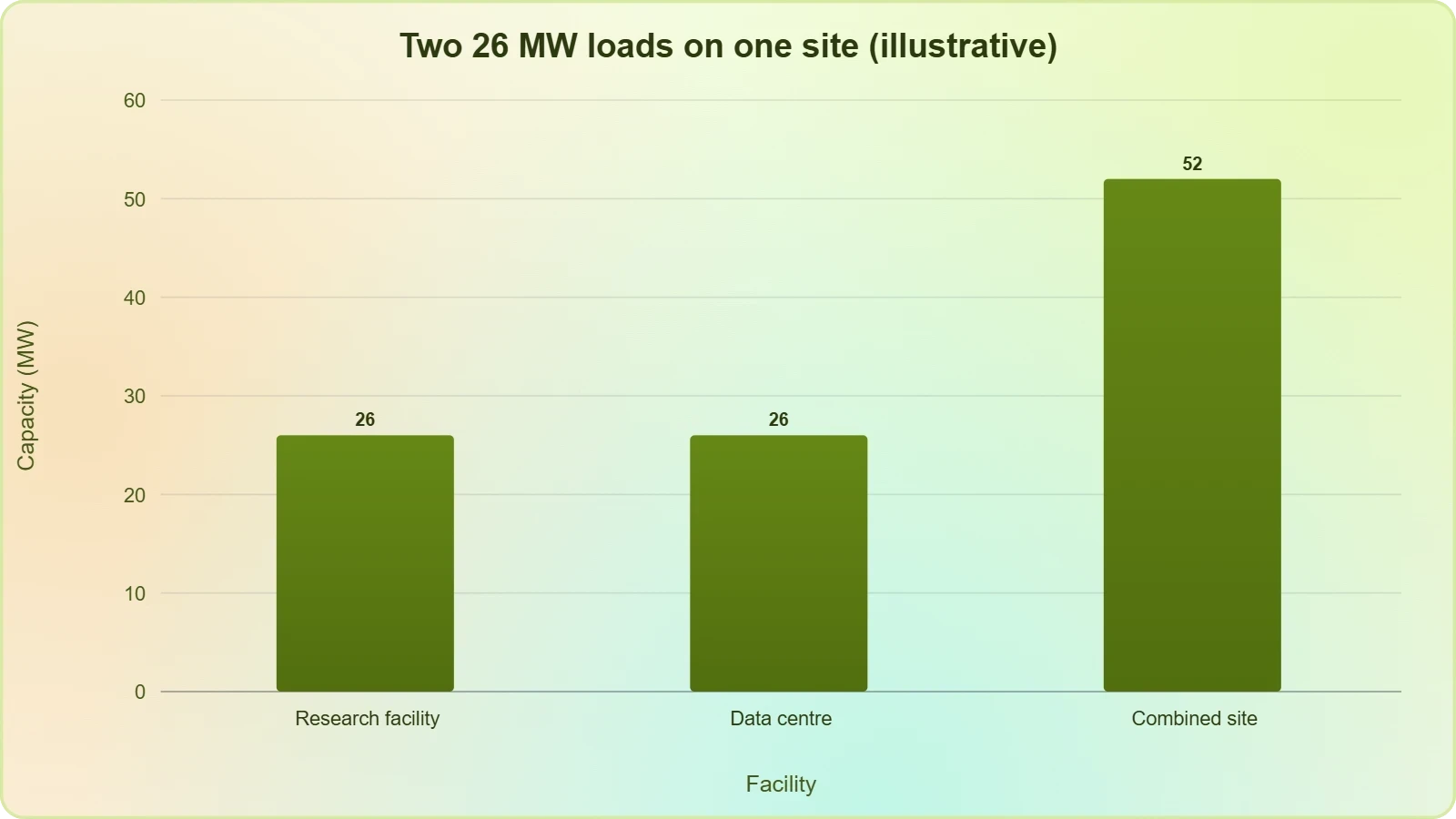
Alongside the research facility, Firmus still plans to build an AI data centre at the same Wesley Vale site, also rated at 26 megawatts. The Latrobe Council has asked the state government to assess that proposal as a major project, a route that typically involves broader environmental, economic, and community consideration than an administrative approval. The contrast is stark and instructive: one project at the site received staff-level sign-off, while the other has been escalated for state-level assessment. Residents who felt excluded from the first process may find the second considerably more transparent, though the sequencing raises awkward questions about cumulative impacts.
Two 26-megawatt facilities on a single site imply a combined load that any grid operator would need to plan around carefully. Assessing them through separate regulatory channels risks fragmenting exactly the kind of cumulative analysis that communities and network planners most need. The major project referral is a more rigorous instrument, but it arrives after the research facility has already been approved. Reform advocates point to this sequencing as evidence that the planning scheme lacks a mechanism for treating related developments at a single site as an integrated proposition, particularly when emerging technologies are involved.
Why Planning Schemes Struggle With Emerging Technologies
Planning schemes are conservative instruments by design. They encode settled assumptions about what activities produce what impacts, and they allocate scrutiny accordingly. A warehouse conversion is assumed to be a modest, contained change; a heavy industrial plant is assumed to require environmental assessment. AI computing infrastructure confounds these assumptions because it is physically unremarkable but operationally intensive. It occupies an existing building, employs relatively few people, and generates little visible pollution, yet it can draw tens of megawatts of power, require substantial backup generation, and place real strain on local grid capacity. The scheme sees a warehouse; the reality is closer to a power station's customer.
This mismatch is not unique to Tasmania. Planning systems across Australia and internationally are grappling with the same problem as data centre demand accelerates. The categories were drafted for a world where industrial intensity correlated with physical footprint and visible emissions. Emerging technologies break that correlation, and when they do, administrative approval routes designed for low-impact uses can end up processing high-impact proposals. The reform argument is therefore not that council staff acted improperly, but that the classification system itself needs updating so that intensity, not just use type, determines the level of scrutiny applied.
The Community Trust Dimension
Resident Erin Woodcock's response captures a dimension that procedural correctness cannot address: the sense of exclusion. She said she felt left out of the process and that details about the project next door, including possible risks, were unclear and worrying. Unconfirmed minutes from the October council meeting record residents asking about the building's size and location, its power supply, planned diesel generator use, and the council's capacity to assess the project's scale and complexity. These are not unreasonable questions, and the fact that they were asked at a meeting rather than answered through a formal public consultation process illustrates the gap.
Trust in planning systems depends on visible process as much as substantive outcome. When a significant facility is approved without advertising or a vote, residents may reasonably infer that scrutiny was minimal, even where the law permitted exactly that. The risk is cumulative: each administratively approved project of this kind makes the next one harder to defend, and erodes confidence in the institutions that will need community cooperation as AI infrastructure expands. Minister Kerry Vincent's defence that the process was entirely appropriate is legally sound but does little to rebuild that confidence.
The Political Economy of Reform
Calls to update state planning rules have intensified because the Wesley Vale case is not isolated. Across Australia, AI projects have encountered local opposition, including a Melbourne community that used cars and bins to block power pole installation for a nearby centre. Such resistance is often characterised as nimbyism, but it frequently reflects genuine informational deficits: residents cannot assess risks they have not been told about, and they cannot negotiate conditions they were never invited to discuss. Reform advocates argue that earlier, structured engagement would reduce conflict rather than inflame it, giving developers a clearer social licence and communities a meaningful voice.
The political economy is complicated by the fact that AI infrastructure is simultaneously desired and resisted. Governments want the investment, the jobs, and the strategic positioning; communities want assurance about power, noise, traffic, and environmental impact. A planning scheme that processes such projects administratively satisfies the first constituency while alienating the second. The reform conversation is therefore about designing a middle pathway: one that preserves administrative efficiency for genuinely low-impact uses while creating a clear, predictable escalation route for high-intensity emerging technologies, triggered by measurable criteria rather than applicant framing.
We Also Published
Firmus, Capital Markets, and the Commercial Backdrop
The regulatory story sits against a commercial one that is equally revealing. Firmus has plans for three AI data centres in Tasmania, an ambitious pipeline for a single developer in a small jurisdiction. Last month the company withdrew a planned public offering on the Australian stock market after investor interest cooled. That withdrawal matters because it signals that the capital environment for AI infrastructure is not uniformly exuberant. Investors are beginning to discriminate between projects on the basis of power access, planning certainty, and revenue visibility, and a developer whose flagship site has attracted community controversy may find that discount reflected in its cost of capital.
Planning risk is a real financial variable. When a project's approval pathway depends on how the activity is characterised, and when that characterisation is contested locally, lenders and equity investors must price in the possibility of delay, condition, or reversal. The withdrawal of the offering suggests the market applied exactly that logic. For Tasmania, the episode raises a strategic question: the state has abundant renewable electricity and available industrial land, advantages that make it attractive for power-intensive computing, but those advantages are only realisable if the planning system can process such projects credibly and predictably.
Power, Grid Flexibility, and the Diesel Question
The research facility's stated purpose, exploring how AI computing can respond to grid conditions and how batteries might reduce reliance on diesel generators during outages, touches on one of the most consequential technical questions in the sector. Data centres are typically designed for constant, high-reliability load, which makes them inflexible consumers. As grids absorb more variable renewable generation, flexibility becomes valuable, and a computing facility that can modulate its demand in response to signals could in principle support rather than strain the network. That is the promise the research agenda holds out.
The diesel question, however, is where technical ambition meets community concern. Residents asked specifically about planned diesel generator use, and their worry is understandable: backup generation implies emissions, noise, and fuel storage in the vicinity. If the research succeeds in demonstrating that battery storage can substitute for diesel during outages, the outcome would be genuinely beneficial. But the demonstration phase itself may involve diesel use, and that is precisely the kind of detail that a public advertising period would have surfaced and allowed residents to interrogate before approval rather than after.
What the Withdrawn Offering Signals
A withdrawn public offering is not a failure, but it is a signal. It indicates that the company and its advisers judged market conditions unfavourable at that moment, and that proceeding would have priced the business below expectations. For a developer with three data centres planned, the timing of capital raising is tightly coupled to planning milestones. An approved research facility is a modest de-risking event; a fully assessed major project approval for the data centre would be a far more significant one. The sequencing of regulatory decisions therefore directly shapes the company's access to capital.
This coupling explains why developers often prefer administrative approval routes: they are faster and more certain, which lowers financing costs. It also explains why reform advocates are wary of leaving the choice of route to the applicant. When speed confers a financial advantage, there is a structural incentive to characterise projects in ways that fit permitted use classes, even where the substantive impacts warrant broader assessment. The Wesley Vale case illustrates the tension without necessarily implying any impropriety: the incentive exists regardless of the applicant's intentions, and good regulatory design should account for it.
The National Pattern of Local Resistance to AI Infrastructure
Wesley Vale is one node in a broader Australian pattern. AI projects have faced local opposition in multiple jurisdictions, most visibly in Melbourne, where a community used cars and bins to block power pole installation for a nearby centre. Such actions are often dismissed as reflexive opposition, but they typically arise from a specific grievance: residents learn about infrastructure that affects them only once construction is imminent, and they have no formal channel to raise concerns. The Melbourne blockade was not a rejection of AI as such; it was a protest against a process that had left the affected community without a meaningful say.
This pattern has implications beyond individual projects. Australia's ambitions in AI depend on building physical infrastructure: data centres, transmission connections, substations, and cooling systems. Each of these requires land, power, and community acceptance. If the default experience of host communities is exclusion followed by construction, resistance will compound, timelines will lengthen, and costs will rise. The alternative is to treat community engagement as infrastructure in its own right, resourced and scheduled early rather than treated as a compliance formality at the end of the process.
Lessons From Comparable Jurisdictions
Other jurisdictions are experimenting with approaches that could inform Australian reform. Some have introduced intensity-based thresholds, where electricity demand above a specified level automatically triggers enhanced assessment regardless of the stated use. Others require cumulative impact statements for multiple developments on a single site, closing the gap that allowed the Wesley Vale research facility to be approved before the data centre assessment began. A third approach involves pre-application community consultation, mandatory for large projects, which shifts engagement earlier and gives residents information before positions harden.
None of these mechanisms is exotic or untested. They represent incremental adjustments to planning systems that already contain analogous provisions for other intensive uses. The obstacle is not design difficulty but political will and administrative capacity. Councils, particularly in regional areas, often lack the technical resources to assess complex proposals, a concern residents raised directly at the October meeting when they asked about the council's capacity to evaluate the project's scale and complexity. Reform must therefore address capability as well as rules.
The Role of State Governments
State governments occupy a pivotal position because planning schemes are state instruments. Tasmania's minister has defended the existing process as appropriate, which is defensible on the narrow question of legality but leaves the broader reform question unanswered. States also control the major project pathway, which offers a more rigorous alternative when invoked. The Latrobe Council's request that the data centre be assessed as a major project shows that local authorities can escalate when they recognise the limits of their own instruments, but relying on ad hoc escalation is not a substitute for systematic rules.
A more durable approach would see states define clear criteria for AI and other high-intensity digital infrastructure, specifying when administrative approval is sufficient and when enhanced assessment is mandatory. Such criteria would give developers predictability, give communities assurance, and give councils a defensible basis for demanding resources. The Wesley Vale case provides a concrete illustration of why this matters: two 26-megawatt facilities on one site, processed through two different pathways, with the less scrutinised one approved first.
What the Wesley Vale Case Means for AI Infrastructure Governance
The deeper significance of the Wesley Vale approval lies in what it reveals about the governance of AI infrastructure as a category. AI is often discussed as a software phenomenon, a matter of models, compute, and data. But its physical substrate, the data centres and power connections that make computation possible, is expanding rapidly and landing in specific places with specific communities. The regulatory frameworks that govern those places were not designed with AI in mind, and the mismatch is now producing decisions that are legally sound but substantively contested. Governance of AI must therefore include planning, not just algorithms.
This has implications for how governments think about AI strategy. A jurisdiction that wants to attract AI investment needs more than cheap power and available land; it needs a planning system that can process proposals credibly, predictably, and with community consent. Predictability cuts both ways: developers benefit from clear rules that specify what scrutiny applies, and communities benefit from knowing that intensity, not framing, determines the level of assessment. The Wesley Vale case suggests Tasmania has an opportunity to lead on this question rather than react to it project by project.
Transparency as Infrastructure
One practical lesson is that transparency functions as a form of infrastructure in its own right. Had the research facility application been advertised, residents could have examined the diesel generator plans, the power supply arrangements, and the building specifications before approval. Some of their concerns might have been allayed; others might have led to conditions. Either way, the outcome would have carried more legitimacy. The cost of advertising is modest; the cost of eroded trust, as the Melbourne blockade demonstrates, can be considerably higher in delays and conflict.
Developers also have an interest in this. A project approved after visible consultation is more durable than one approved administratively and contested thereafter. Firmus now faces a situation where its research facility is approved but its social licence is thin, and its larger data centre proposal will be assessed in an atmosphere shaped by the controversy over the smaller one. Earlier, structured engagement might have produced a smoother path for the entire pipeline, including the capital raising that was ultimately withdrawn.
The Reform Window
Reform windows open when a case makes an abstract problem concrete, and Wesley Vale has done that. The outgoing mayor's acknowledgement that the scheme's limits were exposed, the residents' documented questions, the minister's defence of legality, and the parallel major project referral together form a textbook illustration of the gap between procedural compliance and substantive scrutiny. Whether that window is used depends on whether state governments treat AI infrastructure as a distinct planning category requiring tailored rules, or continue to process it through categories inherited from an earlier industrial era.
The stakes extend beyond Tasmania. Australia's AI ambitions will require substantial physical build-out, and every facility will need a host community. A planning system that routinely excludes those communities will generate resistance that slows the very build-out it is meant to enable. Conversely, a system that engages early, assesses intensity honestly, and treats cumulative impacts seriously can accelerate development by reducing conflict. The choice is not between growth and scrutiny; it is between predictable scrutiny and unpredictable conflict, and the Wesley Vale case has made that choice visible.
Conclusion: From Procedural Compliance to Substantive Legitimacy
The Wesley Vale approval will be remembered less for what it permitted than for what it revealed. A 26-megawatt AI research facility moved through the Tasmanian planning system without advertising or a councillor vote because it fit an existing use class, and every official involved can point to the law in defence. Yet the outgoing mayor conceded the scheme's limits, a resident described feeling excluded, and the parallel data centre proposal has been escalated for major project assessment. The gap between what is lawful and what is legitimate has rarely been so clearly drawn in a single case.
Reform, when it comes, should aim at that gap rather than at any individual decision. Intensity-based thresholds, cumulative impact requirements, mandatory pre-application consultation, and council capability funding are all available and tested instruments. They would give developers the predictability they need to raise capital, give communities the information they need to assess risk, and give councils the tools they need to scrutinise projects beyond their current capacity. The alternative, continued reliance on categories drafted for an earlier economy, will produce more lawful approvals and more avoidable conflict.
For the AI industry, the lesson is that physical infrastructure carries social and political risk that software does not. A model can be deployed globally in an afternoon; a data centre must be sited, powered, cooled, and accepted locally. Companies that treat planning and community engagement as core competencies, rather than as obstacles to be routed around, will build more durable operations. Tasmania, with its renewable energy advantages and its contested planning framework, is an early test of whether that lesson is learned or repeated.
From our network :
- The Final Descent: How ESA Retired the Legendary Cluster Constellation After 24 Years of Space Weather ScienceAfter 24 years mapping Earth’s magnetosphere, ESA’s Cluster mission concluded with a precisely controlled reentry over the South Pacific. This analysis explores the scientific legacy, engineering decisions, and debris mitigation principles behind one of space exploration’s most responsible retirements.
- Live Online English Classes for Kids: Do They Actually Reduce Anxiety?A ten-week study reveals that synchronous online English classes can significantly reduce child language anxiety while improving listening and reading skills. Discover what makes these programs effective and how parents can select the right one.
- Forbidden Matrix Patterns and Visible Lattice Points: A Geometric DictionaryExplore how multidimensional 0–1 matrices encode geometric truths, linking forbidden patterns to visible lattice points and hypergraph theory, with applications in combinatorics and computational geometry.
- How AI Agents Will Change the Way We Manage Personal FinancesExplore how AI agents are transforming personal finance through automated budgeting, bill payment, and investment management, while examining the critical security protocols and governance frameworks required for safe deployment.
- CISA’s Ten-Advisory Wave: Why Generic Patching Fails in OT and How to Build Product-Specific PlaybooksCISA released ten ICS advisories in one week, exposing critical infrastructure risks. Generic patching fails in OT. Learn to build product-specific remediation playbooks.
- The Hidden Cost of AI Convenience: Why Over-Permissioned Agents Are a Security Time BombDiscover why AI agents with excessive permissions create dangerous single points of failure, and learn how implementing least privilege principles can protect your organization from exploitation.
- Mobile Learning and VR in English: What Global Evidence Reveals About Effective Language TechnologyA systematic review across 14 countries reveals which language-learning technologies genuinely work. Mobile learning, AI, and VR show measurable benefits when pedagogically integrated. This evidence-based guide helps educators and learners select technology that delivers real return on investment.
- Committed Mediterranean Precipitation Decline: Why Emissions Cuts Alone Cannot Restore Winter RainsNew NOAA research reveals that Mediterranean winter rains may decline irreversibly even with emissions cuts. Explore the science of committed climate change and regional impacts.
- University Language Proficiency Exams: Why Institutional Tests Demand Different Preparation Than IELTS and TOEFLDiscover why university-specific language proficiency examinations differ fundamentally from IELTS and TOEFL, and learn strategic preparation approaches for institutional assessment success.
RESOURCES
- Resources will be updated soon.
- 01
- 02
- 03
- 04
- 05
- 06
- 07
- 08
0 Comments