Military superiority has never been a reliable proxy for political legitimacy, and the confrontation involving the United States, Israel and Iran has made that distinction impossible to ignore. When two of West Asia's most consequential powers — Turkey and Saudi Arabia — publicly resist further escalation, the message is not sympathy for Tehran's conduct but a sober calculation about what sustained bombing can realistically achieve. Strength on the battlefield may degrade a adversary's capabilities, yet it cannot manufacture consent, rebuild institutions, or persuade neighbours that their security is being protected rather than gambled with.
The Istanbul gathering of European and Middle Eastern foreign ministers on October 23 crystallised a widening consensus that additional strikes would expand the confrontation instead of resolving it. What gave the meeting its weight was the diversity of the participants: states with competing interests, divergent alliances and different readings of Iran's regional role nonetheless converged on the same caution. Turkey, a NATO member commanding one of the alliance's largest militaries, has long balanced rivalry with Iran against pragmatic economic engagement. Saudi Arabia, the anchor of Gulf security and global energy diplomacy, has viewed Iranian influence through the prism of regime survival. Both, however, recognise that an open, region-wide war serves nobody's interests.
Beneath the diplomatic language lies a structural question about how power actually works in West Asia. The Mecca defence understanding linking Turkey, Saudi Arabia and Pakistan signals a quiet push toward regional strategic autonomy, born of mounting doubt about the predictability and side effects of outside military intervention. This analysis examines why military advantage fails to translate into political settlement, how the Strait of Hormuz and hydrocarbon supplies magnify every escalation, and what the Turkish-Saudi opposition reveals about a region increasingly determined to set its own terms.
On This Page
- The Gap Between Military Strength and Political Legitimacy
- The Istanbul Meeting and the Diplomacy of Shared Caution
- Energy, the Strait of Hormuz and the Economics of Escalation
- The Mecca Understanding and the Push for Strategic Autonomy
- Spillovers Beyond West Asia: Indo-Pacific and Global Order
- Reading the Strategic Signal Correctly
TL;DR Turkey and Saudi Arabia have openly opposed further strikes on Iran, exposing a gap between military capability and political acceptance that defines West Asia's strategic dilemma. Their stance is not endorsement of Iran but a rejection of strategic recklessness, reflecting fears that escalation would destabilise energy markets, the Strait of Hormuz and the wider region. The Istanbul foreign ministers' meeting and the Mecca defence understanding point toward growing regional appetite for strategic autonomy and scepticism about outside intervention. The core lesson is that deterrence and war are different instruments, and conflating them risks a conflict whose consequences would extend far beyond the Middle East.
The Gap Between Military Strength and Political Legitimacy
Firepower can destroy targets, but it cannot confer legitimacy on the political order that follows. This is the central paradox of the current confrontation: the United States and Israel possess overwhelming military advantages, yet neither can compel Turkey, Saudi Arabia or the broader Islamic world to accept the political consequences of sustained strikes on Iran. Coercion without consent produces fragile outcomes, and in a region where legitimacy is contested along sectarian, nationalist and dynastic lines, military victory often sows the seeds of the next conflict rather than closing the current one.
Why Deterrence Differs From Recklessness
The Turkish and Saudi position rests on a distinction that policymakers in Washington and Jerusalem would do well to internalise: deterrence and strategic recklessness are not the same thing. Deterrence signals that aggression carries unacceptable costs; recklessness assumes that every use of force improves the strategic picture. Ankara and Riyadh accept the logic of credible deterrence while rejecting open-ended escalation, because they understand that a cornered Iran may lash out through proxies, maritime disruption or missile salvos that no amount of air superiority can fully neutralise.
This distinction matters because it reframes the debate away from a binary of war or appeasement. Regional powers are arguing for calibrated pressure paired with diplomatic off-ramps, a posture that preserves leverage without triggering the cascade of retaliation that a broader campaign would invite. Their opposition is therefore a strategic signal, not a moral endorsement of Tehran's behaviour, and treating it as the latter misreads the region's actual calculus.
The Weight of Two Indispensable Powers
Neither Turkey nor Saudi Arabia can be ignored in any durable settlement. Turkey straddles Europe, the Black Sea, the Caucasus and West Asia, controls the Bosphorus passage and fields one of NATO's largest armies. Saudi Arabia anchors Gulf security, shapes global energy markets through OPEC+ and carries substantial diplomatic weight across the Islamic world. A strategy that alienates both simultaneously is a strategy operating without regional buy-in, and history suggests such ventures rarely produce stable outcomes.
Their combined opposition also constrains the practical logistics of any campaign. Overflight rights, basing access, intelligence sharing and post-conflict reconstruction all depend on regional cooperation. When the two most capable regional actors withhold that cooperation, military planners face a narrower set of options and a higher probability of unintended escalation, which is precisely the scenario their caution is designed to prevent.
The Istanbul Meeting and the Diplomacy of Shared Caution
The October 23 gathering of European and Middle Eastern foreign ministers in Istanbul deserves closer reading than a routine communiqué. Its significance lay less in any binding agreement than in the composition of the room: states with different strategic interests, different alliance commitments and different threat perceptions arrived at a common caution about escalation. That convergence is itself a diplomatic fact with consequences, because it narrows the political space for unilateral action and signals that the costs of further strikes would be borne internationally rather than confined to the belligerents.
Convergence Without Consensus
It would be a mistake to describe the Istanbul participants as holding a unified position. Turkey and Saudi Arabia arrive at their opposition from different premises, and European ministers carry their own domestic and transatlantic constraints. Yet convergence without full consensus is often how diplomacy actually works: parties agree on what they oppose even when they disagree on what they want. That minimal common ground — no wider war — is precisely the foundation on which de-escalation frameworks are built, and it explains why the meeting carried more weight than its modest formal outcomes suggested.
Reading the Mecca Defence Understanding
The Mecca defence understanding involving Turkey, Saudi Arabia and Pakistan adds a further layer that analysts should not overlook. It points to regional efforts to construct strategic autonomy amid growing doubts about the predictability and side effects of outside military intervention. Such arrangements do not necessarily exclude external partners, but they do signal that regional capitals want insurance against being dragged into conflicts whose escalation they cannot control, and that they intend to hedge against the unreliability of distant guarantors.
For Washington and its allies, this is a warning as much as an opportunity. A region building its own security architecture may become a more capable partner over time, but it will also be a more independent one, less inclined to rubber-stamp campaigns it considers reckless. The Mecca framework therefore reframes the question from whether outside powers can impose a settlement to whether they can persuade regional actors that the settlement serves their interests.
We Also Published
Energy, the Strait of Hormuz and the Economics of Escalation
Any discussion of strikes on Iran is inseparable from the Strait of Hormuz, through which a substantial share of global seaborne oil and liquefied natural gas normally transits. Military escalation in the Gulf does not merely threaten tankers; it reprices risk across every hydrocarbon market, insurance contract and shipping route on the planet. Saudi Arabia's opposition to further strikes is therefore partly an energy-market calculation: a disrupted Hormuz would harm Riyadh's own export revenues and destabilise the very consumers its long-term strategy depends upon.
The Hydrocarbon Chokepoint
The chokepoint logic is straightforward but frequently underestimated. Even the credible threat of closure forces insurers to raise premiums, charterers to reroute vessels and refiners to pay for alternative supply, transmitting a regional military event into a global inflationary shock. For import-dependent economies in Asia and Europe, the difference between a contained confrontation and an open war is measured in energy bills, industrial output and political stability, which is why the Indo-Pacific outlook on this conflict is far from detached.
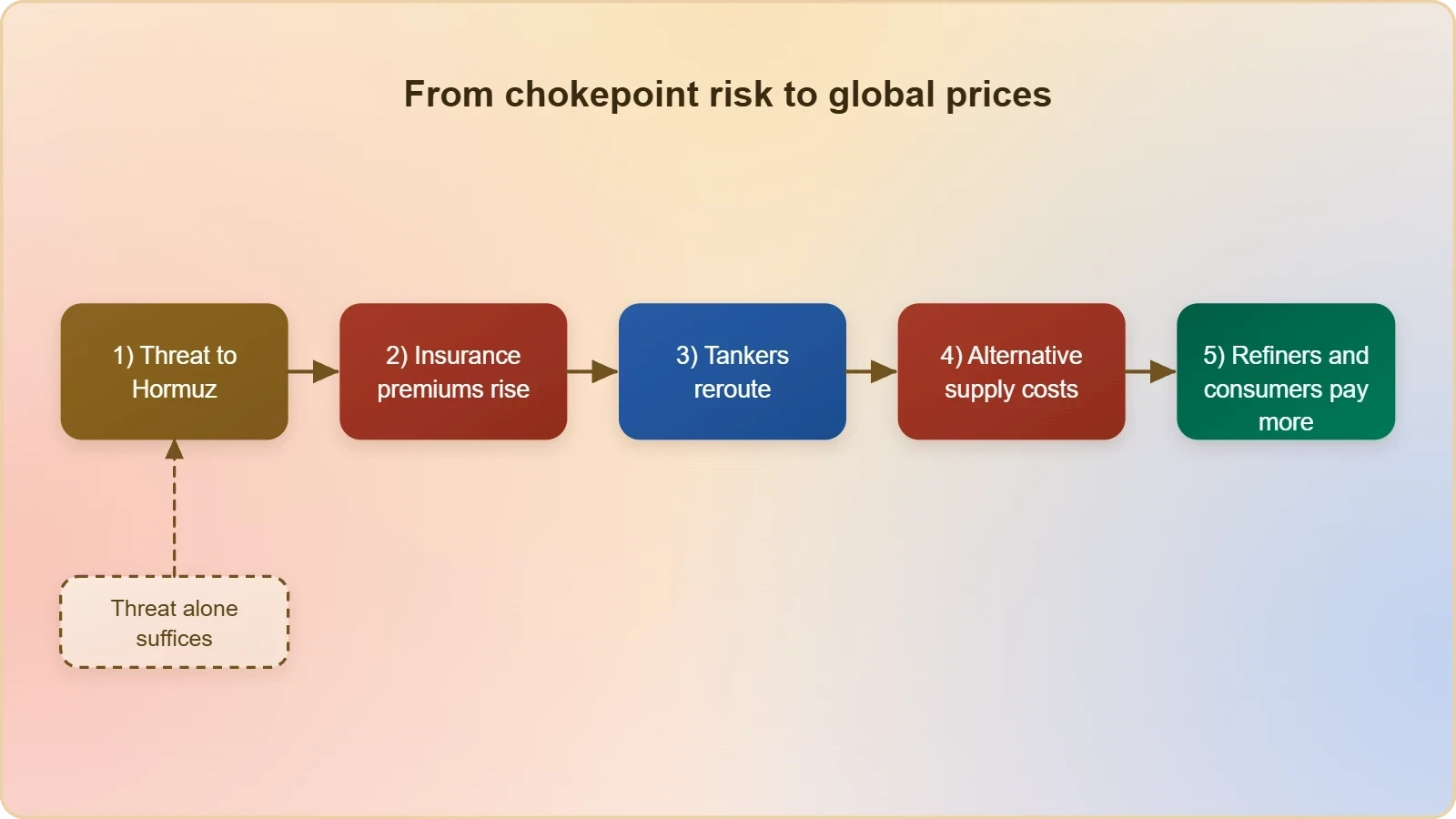
Iran understands this leverage intimately, and that understanding shapes its deterrent posture. The threat of disruption is more useful to Tehran than disruption itself, because actual closure would invite overwhelming retaliation while the mere possibility extracts concessions and raises the cost of coercion. Any strategy that ignores this asymmetry risks triggering the very disruption it seeks to prevent.
Why Gulf States Prefer Stability Over Victory
Gulf states have spent decades diversifying their economies away from pure hydrocarbon dependence, and those diversification plans require calm seas, predictable shipping and confident investors. A regional war would derail tourism, logistics, financial services and sovereign wealth strategies simultaneously. Saudi Arabia's caution is thus not timidity but portfolio management at the national scale: the kingdom's Vision-style economic transformation depends on an environment in which risk premiums stay low and capital keeps flowing.
Turkey's calculus runs along parallel lines from a different starting point. As a manufacturing and trade hub with deep commercial ties across the region, Ankara benefits from open borders and functioning energy corridors. Its opposition to escalation reflects an economic interest in regional connectivity as much as a security interest in avoiding refugee flows and proxy spillover, and those twin motives make its position durable rather than tactical.
- 01
- 02
- 03
- 04
The Mecca Understanding and the Push for Strategic Autonomy
The Mecca defence understanding among Turkey, Saudi Arabia and Pakistan is best understood as an insurance policy against unpredictability. It does not announce a new bloc or a formal alliance with mutual defence obligations, but it does signal that regional capitals are hedging against the possibility that outside guarantors may act on priorities they do not share. Strategic autonomy in this context means the capacity to shape outcomes rather than merely react to them, and it reflects a broader pattern across the Global South.
Hedging Against Unreliable Guarantors
For decades, Gulf security rested on a simple bargain: external powers provided protection in exchange for influence over energy and basing. That bargain is being renegotiated as regional capitals question whether their protectors will always prioritise their security over their own domestic politics and strategic distractions. Hedging is the rational response, and it takes forms ranging from diversified arms procurement to new regional consultative mechanisms that reduce dependence on any single patron.
Turkey's participation in such arrangements is particularly telling. As a NATO member with its own independent defence industry and a history of purchasing decisions that strained alliance relations, Ankara embodies the tension between alliance membership and strategic autonomy. Its willingness to join regional frameworks alongside Saudi Arabia and Pakistan suggests that even formal allies now seek multiple layers of security assurance rather than relying on a single hierarchy.
Implications for US and Israeli Planning
For Washington and Jerusalem, the rise of regional autonomy complicates campaign planning in ways that are easy to underestimate. Overflight permissions, intelligence cooperation, basing access and post-strike stabilisation all depend on regional goodwill, and that goodwill is now conditional rather than automatic. A strategy that treats regional capitals as passive platforms for power projection will find itself increasingly isolated, while one that treats them as stakeholders with legitimate concerns may preserve the cooperation it needs.
Israel faces a parallel calculation. Its security doctrine has long emphasised pre-emptive action against perceived existential threats, but pre-emption in a region of hedging states carries diplomatic costs that compound over time. The more Israel and the United States act without regional consultation, the more they accelerate the very autonomy that reduces their future freedom of action, a dynamic that deserves sober strategic reflection.
Spillovers Beyond West Asia: Indo-Pacific and Global Order
The confrontation's consequences radiate well beyond the Middle East. Energy-importing economies across the Indo-Pacific watch the Strait of Hormuz with acute concern, because their industrial models depend on predictable hydrocarbon flows and stable shipping lanes. ASEAN states, Japan, South Korea and India all have stakes in avoiding a Gulf war, and their diplomatic weight, though often quiet, reinforces the case for restraint that Turkey and Saudi Arabia are making more loudly.
The Indo-Pacific Outlook
For Indo-Pacific capitals, a Gulf conflict is a distraction from their primary strategic concerns and a direct threat to their economic stability. It diverts naval assets, raises insurance costs and complicates the trade routes on which their growth depends. Their preference for de-escalation is not passive; it reflects a clear-eyed assessment that a war in one theatre weakens deterrence and attention in another, creating openings that rivals may exploit.
This interconnectedness means that regional opposition to escalation is amplified by global stakeholders who rarely speak in unison. When energy importers, shipping nations and financial centres all prefer restraint, the political cost of proceeding with further strikes rises accordingly, and that cost is measured not only in diplomatic capital but in market confidence and alliance cohesion.
What a Settlement Would Require
A durable settlement would require more than a ceasefire. It would need credible security assurances for Gulf states, a mechanism for monitoring and verifying restraints, economic pathways that give Iran a stake in compliance, and a regional consultative architecture that gives Turkey, Saudi Arabia and others genuine ownership of the outcome. None of these elements is easy, but each is more achievable through negotiation than through escalation, and their absence is precisely why military campaigns tend to produce unresolved conflicts rather than settled ones.
The lesson for policymakers is that legitimacy is a strategic asset, not a moral luxury. A settlement endorsed by the region's major powers will hold; one imposed against their objections will require permanent enforcement and will generate permanent resistance. Recognising this is not weakness but realism, and it is the realism that Ankara and Riyadh are urging on their partners.
Reading the Strategic Signal Correctly
The Turkish and Saudi opposition to further strikes on Iran is not a diplomatic footnote but a strategic signal that deserves to be read with precision. It says that military superiority, however overwhelming, cannot substitute for political acceptance, and that regional powers will increasingly withhold cooperation from campaigns they consider reckless. For planners in Washington and Jerusalem, the choice is not between strength and weakness but between two kinds of strength: the kind that imposes and the kind that persuades.
Deterrence Without Catastrophe
The most defensible path forward combines credible deterrence with deliberate restraint. That means maintaining the capability to impose costs on aggression while keeping diplomatic channels open, supporting regional security architectures rather than supplanting them, and treating the Strait of Hormuz as a shared interest rather than a bargaining chip. Such an approach is slower and less dramatic than a bombing campaign, but it is more likely to produce an outcome that endures because it is accepted rather than merely enforced.
Turkey and Saudi Arabia are, in effect, asking their partners to distinguish between winning a battle and winning a peace. Their opposition is a warning that the second is far harder than the first, and that a region-wide war would leave everyone weaker, including those who believe they can control its escalation. That warning deserves a serious answer rather than dismissal.
The Cost of Ignoring Regional Voices
History offers abundant evidence that campaigns launched without regional consent tend to produce prolonged instability, refugee crises, radicalisation and reconstruction burdens that outlast the governments that initiated them. The Middle East has lived through several such episodes, and the memory of them shapes the caution now emanating from Ankara and Riyadh. Ignoring that memory is not a sign of resolve but a failure of strategic imagination.
The deeper point is that legitimacy compounds over time just as resentment does. A settlement that regional powers own will attract resources, cooperation and quiet enforcement; one imposed against their objections will attract obstruction, hedging and eventual reversal. The choice facing policymakers is therefore not merely tactical but foundational, and the voices from Istanbul and Mecca are pointing toward the more durable option.
From our network :
- Live Online English Classes for Kids: Do They Actually Reduce Anxiety?A ten-week study reveals that synchronous online English classes can significantly reduce child language anxiety while improving listening and reading skills. Discover what makes these programs effective and how parents can select the right one.
- The Hidden Cost of AI Convenience: Why Over-Permissioned Agents Are a Security Time BombDiscover why AI agents with excessive permissions create dangerous single points of failure, and learn how implementing least privilege principles can protect your organization from exploitation.
- Committed Mediterranean Precipitation Decline: Why Emissions Cuts Alone Cannot Restore Winter RainsNew NOAA research reveals that Mediterranean winter rains may decline irreversibly even with emissions cuts. Explore the science of committed climate change and regional impacts.
- CISA’s Ten-Advisory Wave: Why Generic Patching Fails in OT and How to Build Product-Specific PlaybooksCISA released ten ICS advisories in one week, exposing critical infrastructure risks. Generic patching fails in OT. Learn to build product-specific remediation playbooks.
- Mobile Learning and VR in English: What Global Evidence Reveals About Effective Language TechnologyA systematic review across 14 countries reveals which language-learning technologies genuinely work. Mobile learning, AI, and VR show measurable benefits when pedagogically integrated. This evidence-based guide helps educators and learners select technology that delivers real return on investment.
- How AI Agents Will Change the Way We Manage Personal FinancesExplore how AI agents are transforming personal finance through automated budgeting, bill payment, and investment management, while examining the critical security protocols and governance frameworks required for safe deployment.
- University Language Proficiency Exams: Why Institutional Tests Demand Different Preparation Than IELTS and TOEFLDiscover why university-specific language proficiency examinations differ fundamentally from IELTS and TOEFL, and learn strategic preparation approaches for institutional assessment success.
- The Final Descent: How ESA Retired the Legendary Cluster Constellation After 24 Years of Space Weather ScienceAfter 24 years mapping Earth’s magnetosphere, ESA’s Cluster mission concluded with a precisely controlled reentry over the South Pacific. This analysis explores the scientific legacy, engineering decisions, and debris mitigation principles behind one of space exploration’s most responsible retirements.
- Forbidden Matrix Patterns and Visible Lattice Points: A Geometric DictionaryExplore how multidimensional 0–1 matrices encode geometric truths, linking forbidden patterns to visible lattice points and hypergraph theory, with applications in combinatorics and computational geometry.
RESOURCES
- Resources will be updated soon.
- 01
- 02
- 03
- 04
- 05
- 06
- 07
- 08
0 Comments