The naming of three police generals as suspects in an illegal wiretapping investigation represents one of the most consequential institutional crises to confront Indonesia's National Police in recent memory. At its core, the case alleges that senior officers orchestrated unauthorized surveillance of the president, state officials, political figures, journalists, leaders of mass organizations, civil society figures, and businesspeople, all without proper legal process. The allegations extend beyond mere eavesdropping: investigators say the suspects also accessed computer systems unlawfully and attempted to delete electronic evidence, conduct that transforms a surveillance scandal into a potential obstruction-of-justice matter with far-reaching legal and political implications.
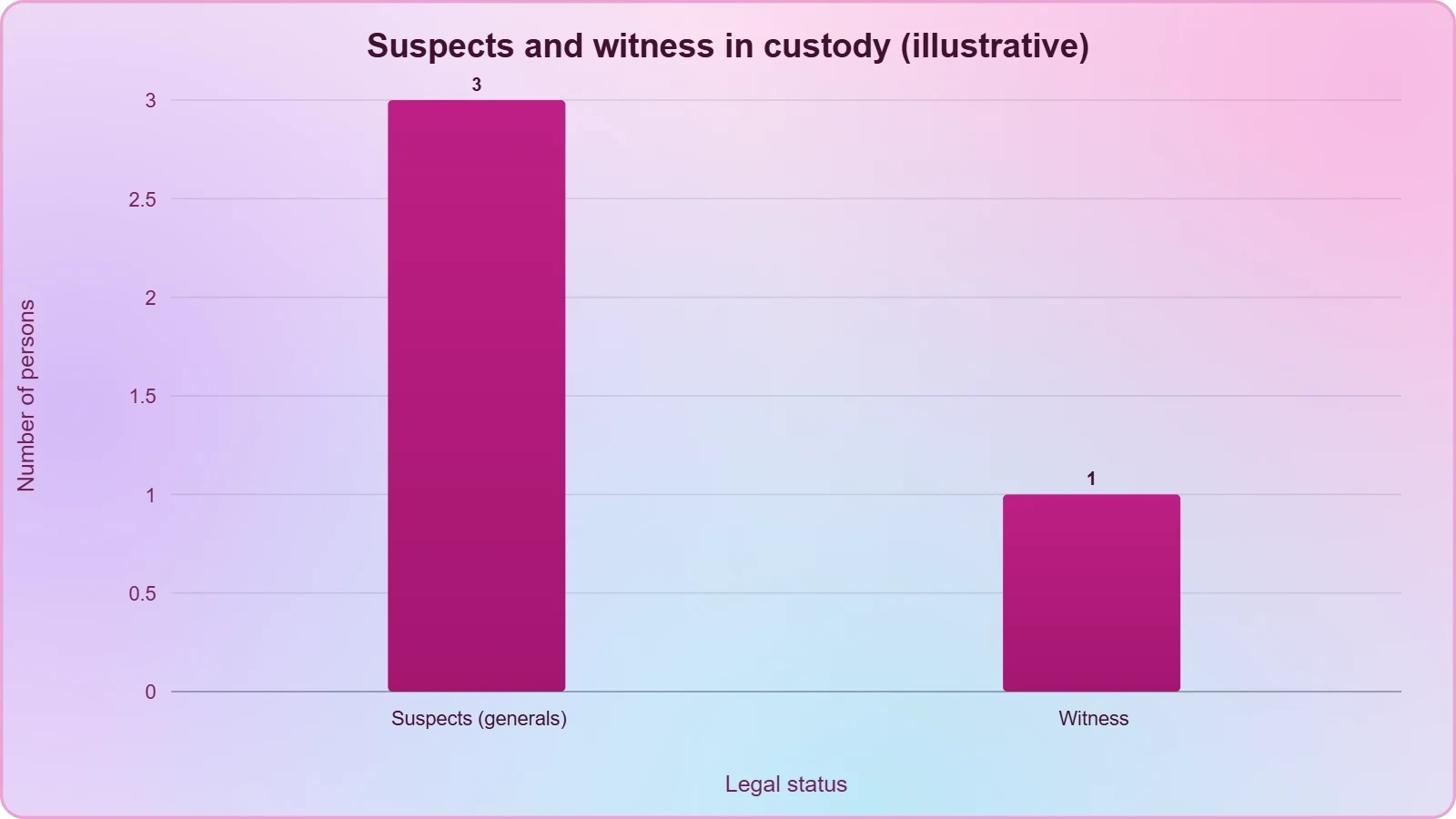
What elevates this story beyond a routine law-enforcement inquiry is the identity of those implicated. The suspects are believed to include former police chief Gen. Listyo Sigit Prabowo, who was reassigned roughly a month before the announcement to serve as presidential chief of staff. That detail alone reframes the investigation as a test of whether Indonesia's security apparatus can police itself when the accused sit at the apex of the institution and remain close to the center of executive power. The announcement, delivered by the head of the National Police's Criminal Investigation Agency at a press conference in South Jakarta, confirmed that all suspects are in custody and that a fourth individual is being questioned as a witness.
Observers have noted that authorities appear to be seeking to downplay the scandal, a posture that carries its own risks. When senior generals are accused of tapping the phones of a sitting president and senior civilian figures, public confidence in the neutrality of the police and the integrity of the governing coalition becomes the real currency at stake. The case therefore functions as a stress test for democratic oversight in Southeast Asia's largest economy, raising questions about chain of command, civilian control of security institutions, and the durability of legal process when the accused wield institutional leverage.
On This Page
TL;DR Indonesian police have named three police generals as suspects in an illegal wiretapping investigation involving unauthorized access to phone numbers and computer systems, plus alleged attempts to delete electronic evidence. Targets reportedly included the president, state officials, political figures, journalists, civil society leaders, and businesspeople. The suspects, believed to include former police chief Gen. Listyo Sigit Prabowo — now presidential chief of staff — are in custody, with a fourth person questioned as a witness. The case tests institutional accountability, civilian oversight, and the political stability of the governing coalition.
The Anatomy of the Alleged Wiretapping Operation
The investigation centers on a coordinated scheme that allegedly combined signals interception with digital intrusion. According to the disclosed details, the suspects accessed phone numbers and computer systems without the legal warrants or judicial authorization that Indonesian law requires for surveillance. The scope of the alleged targeting is unusually broad, spanning the presidency, state institutions, political parties, newsrooms, mass organizations, civil society, and the private sector. Such breadth suggests not an isolated lapse but a structured capability deployed for purposes that investigators have yet to fully characterize in public.
The Mechanics of Unauthorized Surveillance
Illegal wiretapping in a modern telecommunications environment rarely means a single tapped line. It typically involves a combination of lawful interception infrastructure repurposed for unauthorized targets, exploitation of insider access to carrier systems, and the use of forensic tools to extract data from devices. The allegation that computer systems were accessed unlawfully points toward this broader technical footprint. Investigators must establish who authorized each interception, which systems were compromised, and whether the surveillance produced material that was subsequently used for political or personal leverage rather than legitimate law enforcement.
The evidentiary dimension is equally significant. The accusation that suspects attempted to delete electronic evidence introduces a second layer of alleged wrongdoing that can be prosecuted independently of the wiretapping itself. Digital forensics teams would need to reconstruct deleted logs, metadata, and access records to establish a timeline. In jurisdictions where obstruction charges carry substantial penalties, this element can prove decisive, because it shifts the burden of explanation onto the accused and complicates any defense that the surveillance was merely procedural error rather than deliberate misconduct.
Targets, Scope, and Legal Thresholds
The roster of alleged targets reads like a map of Indonesian public life: the president, state officials, political figures, journalists, leaders of mass organizations, civil society figures, and businesspeople. Each category carries distinct legal protections. Surveillance of journalists raises press-freedom concerns, while monitoring civil society figures touches on constitutional guarantees of expression and association. Tapping the phones of political figures and businesspeople invites scrutiny of whether intercepted material was used to influence negotiations, coalition arrangements, or commercial outcomes, which would convert a security matter into a governance crisis.
Indonesian law permits wiretapping only under defined conditions, typically requiring authorization from a competent authority and a nexus to serious crime. The allegation that no proper legal process was followed is therefore the crux of the case. Prosecutors will need to demonstrate that the suspects acted outside those statutory boundaries, and defense counsel will likely argue that some interceptions fell within lawful intelligence mandates. The resolution of that dispute will shape how courts interpret surveillance authority for years, setting precedent for the balance between state security and civil liberties.
The Generals at the Center of the Inquiry
The institutional weight of the case derives from the rank of those accused. Three police generals have been formally designated as suspects, a status under Indonesian criminal procedure that signals investigators have gathered sufficient preliminary evidence to focus suspicion. All are in police custody, and a fourth individual is being questioned as a witness. The decision to name generals rather than quietly reassign them reflects a degree of institutional willingness to proceed, though the timing and framing of the announcement have drawn skepticism from observers who detect an effort to manage the narrative.
Gen. Listyo Sigit Prabowo and the Reassignment Question
Gen. Listyo Sigit Prabowo's trajectory is central to public interpretation of the case. As former police chief, he commanded the institution now investigating conduct attributed in part to him. His reassignment roughly a month before the suspects were named, to the position of presidential chief of staff, has fueled speculation about whether the move was a routine rotation, a strategic insulation of a close ally, or an attempt to distance the presidency from an unfolding scandal. Each interpretation carries different implications for the credibility of the investigation and the independence of the prosecutorial process.
The optics are delicate. A former police chief serving as presidential chief of staff while under suspicion in a wiretapping case involving the president's own communications creates an apparent conflict of interest that is difficult to explain away. Critics argue that proximity to executive power should trigger recusal or temporary suspension, while supporters may frame the reassignment as unrelated to the investigation. How the government handles this tension will be read internationally as a signal of whether accountability applies equally to the well-connected and the ordinary.
Custody, Witness Testimony, and Due Process
The procedural posture matters as much as the allegations. All suspects are in custody, which under Indonesian law enables investigators to hold and interrogate them while building a case file. A fourth person is being questioned as a witness, a status that can evolve into suspect designation if evidence emerges. Due process requires that the suspects be informed of the charges, granted access to counsel, and brought before a court within statutory timelines. Any deviation, whether through prolonged detention or restricted access to lawyers, would undermine the legitimacy of the eventual prosecution.
Transparency will be tested at every stage. The public announcement at a press conference in South Jakarta established a baseline of official acknowledgment, but the evidentiary record remains largely undisclosed. Independent monitoring by civil society organizations, press councils, and legal aid groups will be essential to verify that the investigation proceeds on evidence rather than political convenience. The credibility of the National Police's Criminal Investigation Agency is itself on trial, since it must demonstrate that it can investigate its own senior leadership without fear or favor.
We Also Published
Political Fallout and the Governing Coalition
The scandal arrives at a moment of acute sensitivity for the Prabowo-Subianto administration. A wiretapping operation allegedly directed at the president's own communications, if substantiated, would represent an extraordinary breach of executive security and a profound embarrassment for a government that has staked its reputation on stability and continuity. The fact that the alleged architect of the operation now serves as presidential chief of staff compounds the political difficulty, forcing the administration to defend both its security apparatus and its personnel decisions simultaneously.
Coalition Dynamics Under Pressure
Coalition politics magnify the stakes. Indonesia's governing coalition is broad and includes parties whose leaders may themselves have been among the alleged surveillance targets. If intercepted material was used to influence political negotiations, coalition partners have strong incentives to demand a thorough accounting. Conversely, if the investigation is perceived as selective or as a vehicle for settling internal scores, it could fracture the alliance. The government's instinct to downplay the scandal, noted by observers, suggests an awareness that escalation could destabilize the coalition's legislative agenda and public standing.
Public opinion will be shaped by how transparently the case unfolds. Indonesian voters have demonstrated increasing sensitivity to corruption and abuse-of-power narratives, and a wiretapping scandal involving the president's own phone touches a nerve that transcends partisan affiliation. Civil society organizations and independent media are likely to sustain pressure for disclosure of the investigation's findings. The administration's response, whether it embraces accountability or retreats into procedural opacity, will influence its political capital well beyond the immediate news cycle.
Institutional Trust and Democratic Oversight
Beyond coalition arithmetic, the case raises structural questions about civilian control of security institutions. When senior police officers are accused of surveilling elected officials and journalists, the integrity of the separation between security apparatus and political authority comes into question. Democratic oversight mechanisms, including parliamentary committees, judicial review, and independent watchdogs, must be activated to restore confidence. The absence of robust oversight would leave the public with little assurance that similar operations could not recur, eroding trust in the very institutions meant to protect citizens.
International observers will also be watching. Indonesia's reputation as a consolidating democracy in Southeast Asia rests partly on the professionalism of its security forces and the independence of its courts. A credible, transparent prosecution of senior generals would strengthen that reputation, demonstrating that accountability reaches the highest ranks. A perceived cover-up, by contrast, would invite criticism from human rights organizations, foreign governments, and investors who factor governance quality into their assessments of political risk in the region's largest economy.
- 01
- 02
- 03
- 04
Legal Framework Governing Surveillance in Indonesia
Indonesia's surveillance regime is fragmented across multiple statutes, a structural weakness that complicates both prosecution and defense in this case. Wiretapping authority is scattered among laws governing criminal procedure, electronic information and transactions, terrorism, corruption, and narcotics. Each statute defines different authorization thresholds, oversight bodies, and permissible targets. This patchwork creates ambiguity about which legal basis applies to a given interception, and that ambiguity is precisely the terrain on which the current dispute will be fought in court and in public debate.
Statutory Authority and Its Limits
The Electronic Information and Transactions Law provides the primary framework for digital interception, but it has been amended repeatedly amid controversy over its breadth. Criminal procedure rules require judicial authorization for certain investigative techniques, yet intelligence gathering often operates under separate executive authorities with lighter oversight. The allegation that the suspects bypassed proper legal process suggests either that they relied on an intelligence mandate stretched beyond its lawful scope or that they acted entirely outside any recognized authority. Distinguishing between these scenarios is essential to determining individual culpability.
Prosecutors will need to map each alleged interception to a specific statutory provision and demonstrate that the conditions for lawful surveillance were not met. Defense counsel may counter that the operations fell within classified intelligence directives, raising the thorny question of how courts adjudicate claims involving state secrets. The case could therefore produce important jurisprudence on the justiciability of intelligence activities and the extent to which executive secrecy can shield security officials from criminal accountability in a democratic system.
Evidence Tampering and Obstruction
The allegation of attempted evidence deletion adds a dimension that is legally distinct from the surveillance itself. Obstruction of justice provisions penalize the destruction or concealment of evidence with intent to impede an investigation. Proving intent requires forensic reconstruction of system logs, access records, and deletion timestamps. If investigators can establish that specific individuals ordered or executed deletions after learning of the inquiry, those acts could carry penalties comparable to or exceeding the underlying wiretapping offense, and they would severely undermine any defense narrative of good-faith procedural error.
Digital forensics will be pivotal. Modern enterprise and telecommunications systems retain extensive metadata even after content is deleted, including access logs, authentication records, and backup snapshots. Investigators with proper technical capacity can reconstruct a timeline of who accessed which systems and when. The credibility of the prosecution may ultimately hinge on the quality of this forensic work, which is why independent expert review and chain-of-custody documentation will be closely scrutinized by defense teams and by the public alike.
Implications for Press Freedom and Civil Liberties
The inclusion of journalists, civil society figures, and leaders of mass organizations among the alleged targets transforms this from a security scandal into a civil liberties crisis. Surveillance of newsrooms strikes at the heart of investigative reporting, chilling sources and deterring whistleblowers who rely on confidential communication. When state security officials can monitor journalists without legal process, the public's ability to hold power accountable erodes, and the marketplace of ideas narrows in ways that are difficult to reverse even after the immediate case concludes.
Chilling Effects on Investigative Journalism
Journalists in Indonesia have long operated in a contested environment where press freedom has improved since the reform era but remains vulnerable to pressure. The revelation that their phones may have been tapped by senior police officers sends a powerful signal to sources: conversations assumed confidential may not be. That chilling effect can suppress reporting on sensitive topics, from corruption to security force conduct, precisely the areas where public scrutiny matters most. Press councils and media associations are likely to demand safeguards, including transparency about which journalists were targeted and why.
The legal protections for journalistic sources vary across jurisdictions, but the principle that newsgathering deserves special solicitude is widely recognized. If the investigation confirms that journalists were surveilled without cause, the case could catalyze reform of Indonesia's surveillance laws, including stronger judicial authorization requirements and explicit carve-outs protecting press freedom. Such reform would be a meaningful legacy, but it depends on the investigation producing credible findings rather than being quietly contained for political convenience.
Civil Society and the Right to Dissent
Civil society organizations and mass organizations play a vital role in Indonesia's democratic ecosystem, advocating on issues from environmental protection to labor rights. Surveillance of their leaders, if confirmed, would represent an attempt to monitor and potentially intimidate lawful advocacy. The constitutional guarantees of expression and association are foundational, and any state practice that targets activists for their peaceful activities raises serious human rights concerns. International organizations are likely to document the case and press for accountability, linking it to broader trends in regional surveillance practices.
The response of Indonesia's human rights institutions will be closely watched. A robust investigation that protects victims and punishes perpetrators would reinforce the principle that security powers are bounded by law. A weak response, by contrast, would signal that surveillance of civil society carries little risk for officials, encouraging further abuses. The case thus serves as a bellwether for the health of Indonesia's democratic institutions and their capacity to constrain the security apparatus in an era of expanding digital surveillance capabilities worldwide.
What Comes Next: Accountability, Reform, and Public Trust
The path forward hinges on whether the investigation can maintain independence under intense political pressure. Three generals in custody, a former police chief serving in the presidential office, and a roster of alleged targets spanning the highest reaches of Indonesian public life create a combustible combination. The National Police's Criminal Investigation Agency must demonstrate that its evidence is robust, its procedures lawful, and its conclusions resistant to interference. Anything less will be read as a managed outcome designed to protect the powerful while appeasing public opinion with symbolic gestures.
Scenarios for the Investigation's Trajectory
Several trajectories are plausible. In the most accountable scenario, prosecutors build a transparent case, courts adjudicate guilt or innocence on evidence, and the episode catalyzes surveillance-law reform with stronger judicial oversight. In a containment scenario, the investigation proceeds slowly, charges are narrowed, and the political costs are absorbed through quiet reassignments. A third possibility involves the case becoming a vehicle for internal police factional struggles, with accountability selectively applied. Which scenario unfolds will depend on the balance of institutional pressures and the vigilance of civil society and media.
Each scenario carries distinct consequences for public trust. A credible prosecution would demonstrate that Indonesia's institutions can correct themselves, reinforcing confidence in the rule of law. Containment would breed cynicism and likely depress trust in both the police and the presidency, with downstream effects on governance and investment climate. Factional instrumentalization would corrode the police's internal cohesion and professional reputation. The stakes therefore extend well beyond the individuals named as suspects, touching the foundational question of whether power in Indonesia is genuinely subject to law.
Reform Agendas and Institutional Safeguards
Regardless of the case's outcome, the episode has exposed gaps in Indonesia's surveillance governance that demand legislative attention. A comprehensive reform agenda would include consolidated statutory authority for interception, mandatory prior judicial authorization for all surveillance of civilians, independent oversight of intelligence activities, robust whistleblower protections, and mandatory disclosure of aggregate surveillance statistics. Such measures would align Indonesia with international norms and reduce the risk of future abuses, while preserving legitimate law enforcement capabilities under clear legal boundaries.
Institutional safeguards within the police are equally important. Internal affairs mechanisms must be insulated from command influence, and promotion decisions should weigh integrity as heavily as operational performance. The reassignment of a former police chief to a senior presidential role while under suspicion illustrates the need for clearer conflict-of-interest rules governing the movement of security officials into political positions. These reforms are technical but consequential, determining whether accountability is a lived principle or a rhetorical aspiration invoked only when scandals surface.
The wiretapping case against three Indonesian police generals is ultimately a test of whether the country's democratic institutions can hold senior security officials accountable when the alleged victims include the president himself. The answer will emerge not from press conferences but from the painstaking work of prosecutors, forensic experts, and courts operating under public scrutiny. For Indonesia's citizens, journalists, and civil society, the case is a reminder that surveillance powers, left unchecked, can reach anyone. The response to this scandal will define the boundaries of those powers for a generation.
From our network :
- Mobile Learning and VR in English: What Global Evidence Reveals About Effective Language TechnologyA systematic review across 14 countries reveals which language-learning technologies genuinely work. Mobile learning, AI, and VR show measurable benefits when pedagogically integrated. This evidence-based guide helps educators and learners select technology that delivers real return on investment.
- Forbidden Matrix Patterns and Visible Lattice Points: A Geometric DictionaryExplore how multidimensional 0–1 matrices encode geometric truths, linking forbidden patterns to visible lattice points and hypergraph theory, with applications in combinatorics and computational geometry.
- CISA’s Ten-Advisory Wave: Why Generic Patching Fails in OT and How to Build Product-Specific PlaybooksCISA released ten ICS advisories in one week, exposing critical infrastructure risks. Generic patching fails in OT. Learn to build product-specific remediation playbooks.
- University Language Proficiency Exams: Why Institutional Tests Demand Different Preparation Than IELTS and TOEFLDiscover why university-specific language proficiency examinations differ fundamentally from IELTS and TOEFL, and learn strategic preparation approaches for institutional assessment success.
- Live Online English Classes for Kids: Do They Actually Reduce Anxiety?A ten-week study reveals that synchronous online English classes can significantly reduce child language anxiety while improving listening and reading skills. Discover what makes these programs effective and how parents can select the right one.
- Committed Mediterranean Precipitation Decline: Why Emissions Cuts Alone Cannot Restore Winter RainsNew NOAA research reveals that Mediterranean winter rains may decline irreversibly even with emissions cuts. Explore the science of committed climate change and regional impacts.
- How AI Agents Will Change the Way We Manage Personal FinancesExplore how AI agents are transforming personal finance through automated budgeting, bill payment, and investment management, while examining the critical security protocols and governance frameworks required for safe deployment.
- The Hidden Cost of AI Convenience: Why Over-Permissioned Agents Are a Security Time BombDiscover why AI agents with excessive permissions create dangerous single points of failure, and learn how implementing least privilege principles can protect your organization from exploitation.
- The Final Descent: How ESA Retired the Legendary Cluster Constellation After 24 Years of Space Weather ScienceAfter 24 years mapping Earth’s magnetosphere, ESA’s Cluster mission concluded with a precisely controlled reentry over the South Pacific. This analysis explores the scientific legacy, engineering decisions, and debris mitigation principles behind one of space exploration’s most responsible retirements.
RESOURCES
- Resources will be updated soon.
- 01
- 02
- 03
- 04
- 05
- 06
- 07
- 08
0 Comments