
Nigeria's state-owned energy champion is preparing to test the appetite of private capital in a way that few African national oil companies have attempted. NNPC Limited, the commercial entity carved out of the old Nigerian National Petroleum Corporation, is weighing the sale of a 5% to 10% equity stake to investors, with the domestic market as the primary venue and London or New York floated as possible secondary listings. The signal matters far beyond the balance sheet of a single company: it is a statement that a state monopoly once synonymous with opacity now wants to be valued by the market, scrutinised by shareholders, and judged against the governance standards that global investors apply to any listed enterprise.
The mechanics of the proposal are deliberately modest. Group Chief Executive Officer Bashir Bayo Ojulari framed the offering as a way for ordinary Nigerians to own a piece of the national oil company while the federal government retains operational control, and he cautioned that preparations could take at least a year. No timetable, no valuation, and no final decision have been announced, and the ultimate call rests with shareholders. What is clear is the hierarchy of motives: transparency and corporate governance come first, capital raising second. That ordering is unusual in sovereign energy privatisations, where cash is typically the headline objective, and it tells us how NNPC's leadership wants the transaction to be read.
The timing is instructive. Interest in Nigerian public offerings has been rekindled by the Dangote Petroleum Refinery share sale, which closed on 27 October 2026 and reportedly attracted orders worth roughly N6.4 trillion, or about $4.78 billion, against a target near $1.6 billion. That oversubscription, almost three times the goal, demonstrated that domestic retail and institutional investors will mobilise for a credible industrial asset. NNPC is now positioned to ride that wave of confidence, using the Petroleum Industry Act 2021 as its legal foundation and the 2022 conversion into a limited liability company as its institutional springboard.
On This Page
TL;DR NNPC Limited is exploring an initial public offering of 5% to 10% of its shares, aimed primarily at Nigerian investors with London or New York as possible secondary venues. Leadership says the transaction is designed first to strengthen transparency and corporate governance, with capital raising as a secondary benefit, and that preparations could take at least a year. The plan rests on the Petroleum Industry Act 2021, which transformed the former state corporation into a commercially run limited liability company in July 2022, obliged to operate profitably, pay dividends, and retain 20% of profits for growth. Momentum has been boosted by the heavily oversubscribed Dangote Petroleum Refinery offer, though no timetable or valuation has been fixed and shareholders hold the final decision.
The Strategic Logic Behind a Partial Equity Sale
A 5% to 10% float is a carefully calibrated instrument. It is large enough to create a genuine market for the shares, establish a price discovery mechanism, and bring in institutional investors who will demand quarterly reporting and board accountability. Yet it is small enough to leave the federal government with an unassailable controlling position, preserving the state's grip on strategic energy policy while importing the discipline of public ownership. This is the classic "golden share" architecture used by governments from Brasília to Riyadh, and it allows NNPC to borrow the credibility of capital markets without surrendering the levers of national resource management.
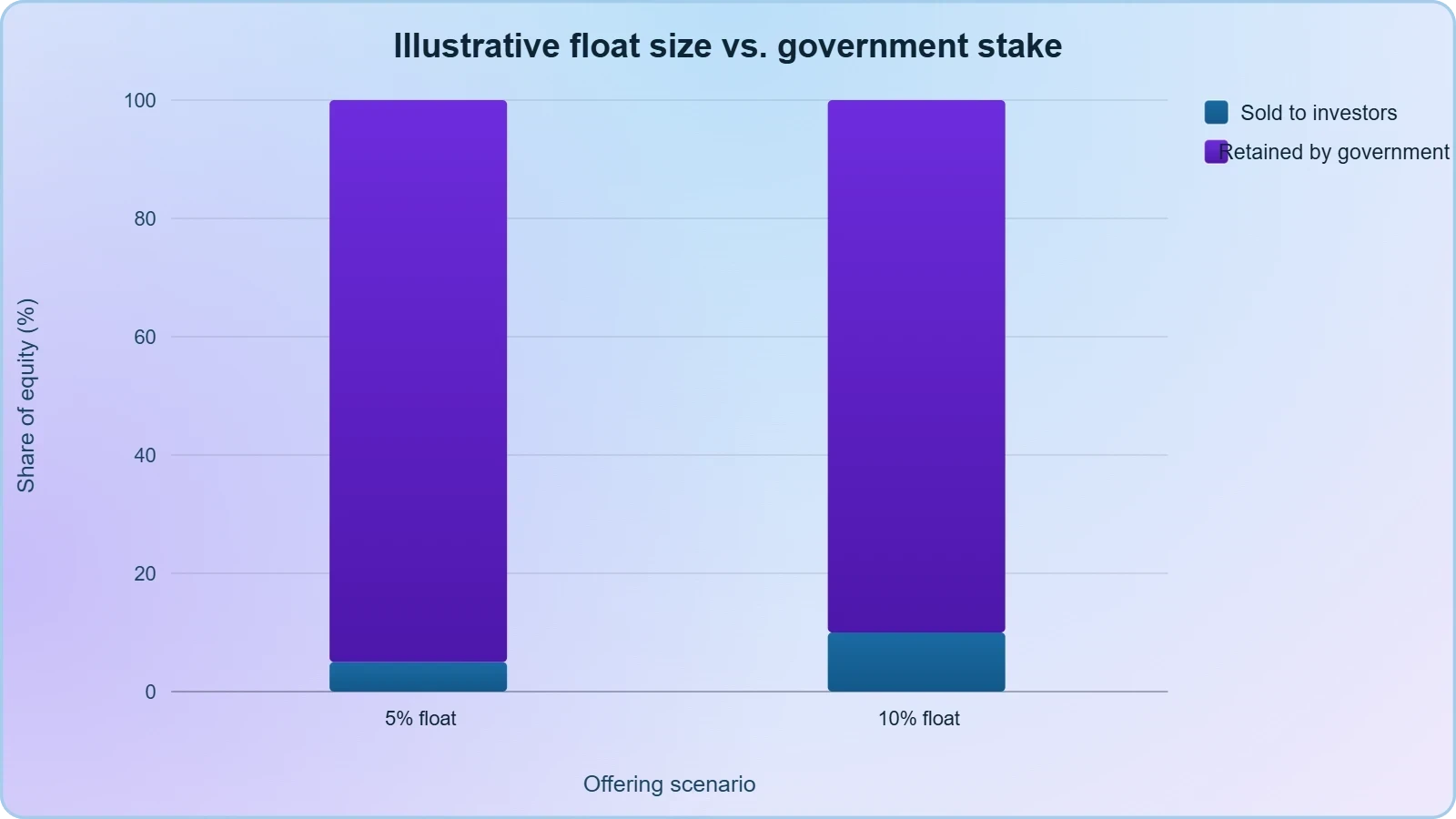
The governance rationale deserves particular attention. Ojulari has been explicit that the offering is intended to close gaps in financial reporting and governance identified during earlier listing preparations. That admission is revealing: the process of becoming listable is itself a reform mechanism. Audited accounts, independent directors, related-party disclosure rules, and investor relations functions are not cosmetic additions; they are structural constraints that make mismanagement harder and more visible. For a company that has historically been a conduit for fiscal transfers and fuel subsidy obligations, the discipline of a shareholder register is a meaningful institutional shift.
Why Transparency Precedes Capital
Placing governance ahead of fundraising in the stated hierarchy is a strategic choice with real consequences. If capital were the primary goal, NNPC would likely pursue a larger float, a higher valuation, and a faster timetable. Instead, the company appears to be treating the IPO as a catalyst for internal reform, using the prospect of public scrutiny to force through reporting standards that might otherwise languish. This sequencing also protects the government politically: a modest, domestically focused sale is far easier to defend to a Nigerian public wary of foreign control of national resources than a large strategic divestment to international majors.
The secondary listing question in London or New York adds another layer. A dual listing would expose NNPC to the disclosure regimes of the Financial Conduct Authority or the Securities and Exchange Commission, raising the bar for accounting quality and board independence. It would also broaden the investor base to include global energy funds and sovereign wealth vehicles. But it introduces currency, regulatory, and reputational complexity, which is why the domestic market remains the anchor and any international venue is described only as possible.
The Petroleum Industry Act as Institutional Bedrock
None of this would be legally possible without the Petroleum Industry Act 2021, which dissolved the old corporation and created NNPC Limited in July 2022 as a commercially oriented limited liability company. The statute imposes three obligations that fundamentally reshape the entity's relationship with the state: it must operate profitably without government subvention, it must pay dividends to shareholders, and it must retain 20% of profits to fund growth. These are not aspirational clauses; they are enforceable duties that convert the company from a spending arm of government into a business with its own capital structure.
The dividend obligation is especially significant because it creates a direct financial claim for any private shareholder. Once outside investors own equity, they will expect distributions calibrated to profitability rather than to political convenience. That expectation will collide, at times, with the fiscal pressures of a government accustomed to drawing on oil revenues. Managing that tension transparently is precisely the governance challenge the IPO is meant to institutionalise, and it explains why the company is moving cautiously rather than rushing to market.
We Also Published
Reading the Dangote Signal and Domestic Investor Appetite
The Dangote Petroleum Refinery offer is the immediate backdrop against which NNPC's ambitions must be assessed. When a single industrial share sale attracts orders worth about N6.4 trillion against a target of roughly $1.6 billion, it reveals a domestic capital market hungry for large, credible assets. Nigerian pension funds, insurance companies, and retail investors have accumulated substantial liquidity, and they have demonstrated a willingness to deploy it when the issuer is well known and strategically important. NNPC, as the country's largest energy institution, fits that profile almost perfectly.
Yet the comparison also carries cautionary lessons. Oversubscription of that magnitude creates allocation challenges, and the final proceeds depend on the post-offer process rather than headline demand. NNPC's leadership will be watching closely to see how the refinery manages allotment, secondary market performance, and investor relations after listing. A strong aftermarket would validate the domestic route; a weak one would strengthen the case for anchoring the offer with international institutional investors through a London or New York tranche.
What Retail Participation Really Means
Ojulari's emphasis on letting Nigerians own shares in the national oil company is more than rhetoric. Broad retail participation can build a political constituency for reform, making it harder for future governments to reverse governance improvements or raid the company's finances. When millions of citizens hold shares, the company acquires a public shareholder base that will scrutinise dividend policy, executive pay, and capital allocation. This is the same logic that underpinned the wave of mass retail offerings in Europe during the 1980s and 1990s, from British Gas to Deutsche Telekom.
There are practical constraints, however. Retail-heavy offerings require extensive investor education, robust subscription infrastructure, and clear allocation rules to avoid the perception of favouritism. Nigeria's capital market regulators will need to ensure that the process is accessible beyond Lagos and Abuja, reaching savers in Kano, Port Harcourt, and Enugu. The credibility of the entire reform narrative depends on whether ordinary citizens feel they received a fair opportunity to participate, not merely a symbolic allocation.
The Secondary Listing Calculus
A London or New York listing would signal that NNPC meets the disclosure standards of the world's most demanding markets. It would also provide access to deep pools of institutional capital, potentially supporting a higher valuation than a purely domestic offer could achieve. For global energy investors seeking exposure to African upstream and midstream assets, a liquid, well-governed NNPC share would be an attractive instrument. The prestige factor should not be dismissed either: a New York listing places the company alongside the world's largest energy corporations.
Against these benefits stand considerable costs. Dual listing entails compliance with two regulatory regimes, additional audit and legal expenses, and exposure to litigation risk in foreign jurisdictions. Currency mismatch is another concern, since NNPC's revenues are dollar-denominated while a domestic listing would trade in naira. Management has wisely described the international venue as possible rather than planned, preserving flexibility while the domestic anchor is secured first. That sequencing reflects prudence rather than indecision.
Governance Reform as the Real Prize
Strip away the listing mechanics and the most consequential element of this proposal is the governance transformation it forces. NNPC has spent years working to close gaps in financial reporting and corporate governance identified during earlier listing preparations, and those efforts are now being stress-tested by the prospect of public shareholders. Independent audits, transparent procurement, and clear separation between commercial and policy functions are the operational substance of the reform. Without them, a listing would merely transfer shares in an opaque entity; with them, it creates a genuinely accountable company.
The historical context is sobering. Nigeria's state oil company has long been criticised for opaque finances, subsidy obligations that blurred commercial and fiscal roles, and governance arrangements that left accountability diffuse. The Petroleum Industry Act was designed precisely to break that pattern by creating a commercially run entity with a board, a dividend policy, and a statutory duty to operate without government funds. The IPO would complete that arc by introducing external shareholders with a legal right to information and a financial incentive to enforce standards.
Financial Reporting and the Audit Trail
Public listing demands audited financial statements prepared to international standards, quarterly disclosures, and segment reporting that separates upstream, midstream, refining, and retail activities. For NNPC, this means exposing the profitability of individual business units to public view, a level of granularity that state-owned enterprises typically resist. Investors will want to know which divisions generate cash and which consume it, how joint ventures are accounted for, and what contingent liabilities exist from legacy obligations. The preparation process is therefore as much an accounting exercise as a strategic one.
The company's admission that gaps were found during earlier preparations is a sign of candour rather than weakness. Identifying and remediating reporting deficiencies before a listing is precisely what a responsible issuer should do. The risk lies in the timeline: Ojulari's estimate of at least a year may prove optimistic if auditors uncover deeper structural issues. Investors should watch for the appointment of reputable international auditors, the publication of consolidated accounts, and the establishment of an independent audit committee as leading indicators of readiness.
Dividend Policy and the 20% Retention Rule
The statutory requirement to retain 20% of profits for growth creates a defined dividend framework that private investors can model. If NNPC earns a profit of ##P##, the maximum distributable amount is ##0.8P##, subject to board discretion and capital needs. This formula gives shareholders a predictable claim while preserving reinvestment capacity for upstream expansion, refinery upgrades, and gas infrastructure. It also imposes discipline on management, since any deviation from the retention rule would require justification to a public shareholder base.
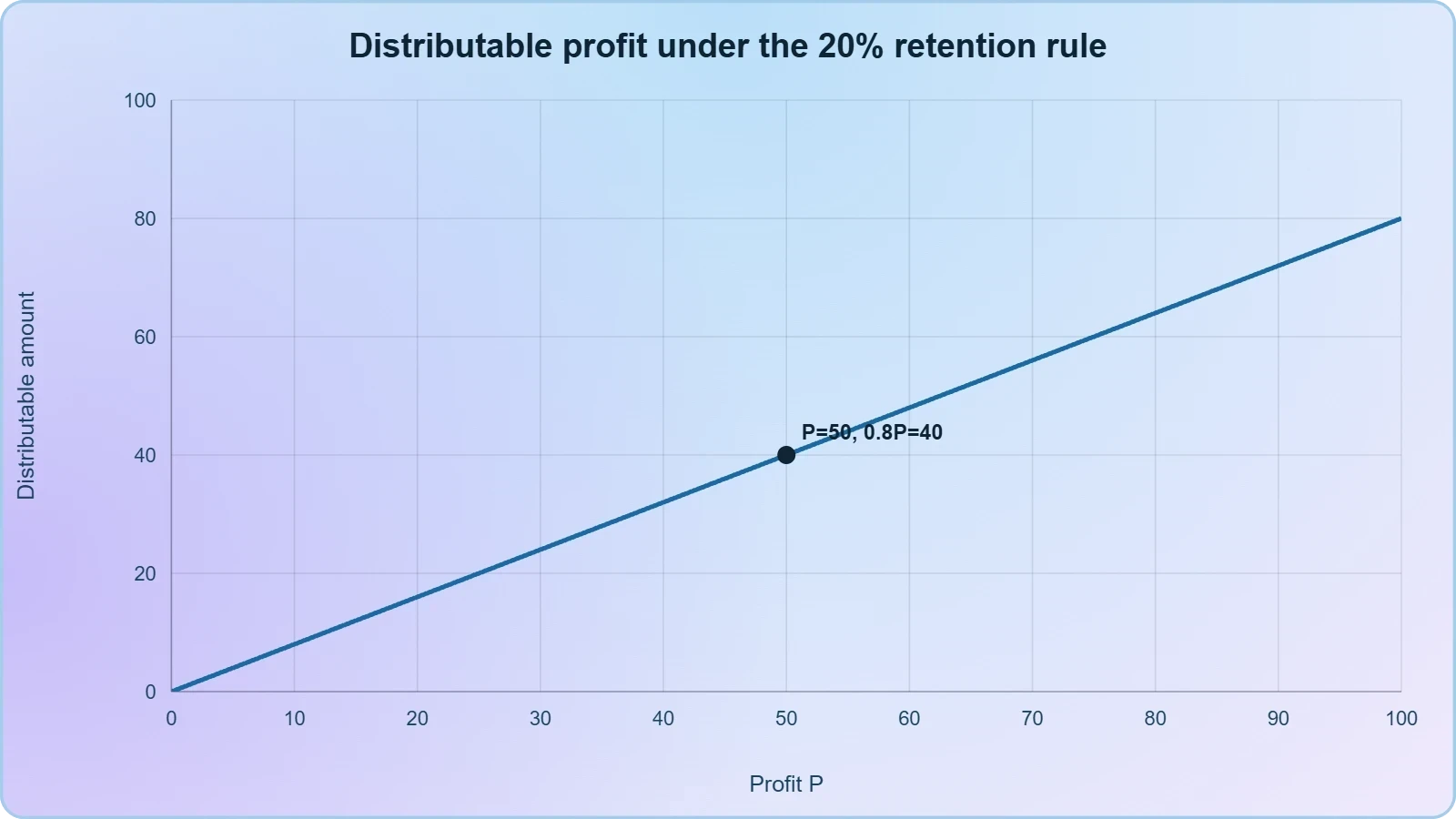
For the federal government, the dividend stream represents a new form of fiscal revenue that is tied to commercial performance rather than discretionary transfers. That alignment of incentives is one of the most underappreciated benefits of the reform. When the state owns 90% to 95% of a dividend-paying company, its fiscal interest coincides with the interests of minority shareholders: both want profitable operations, efficient capital allocation, and credible accounts. The IPO thus converts a potential conflict into a shared objective.
- 01
- 02
- 03
- 04
Valuation, Timing, and the Road to Market
No valuation has been disclosed, and that silence is itself informative. Pricing a national oil company requires resolving several complex questions: how to value legacy assets, how to treat contingent liabilities from joint ventures, how to account for fuel subsidy obligations, and what discount to apply for country risk and governance uncertainty. International comparables such as Saudi Aramco, Petrobras, and Equinor offer reference points, but NNPC's asset mix and fiscal entanglement make direct comparison difficult. A credible valuation will require months of independent technical and financial due diligence.
The timeline is similarly open. Management has said preparations could take at least a year, and an earlier target of listing on the Nigerian Exchange by 2028 was later described as unfixed. That flexibility is sensible given the complexity involved, but it also creates uncertainty for investors trying to position ahead of the event. The final decision rests with shareholders, meaning the federal government as majority owner, which introduces a political dimension that no amount of technical preparation can fully neutralise.
Comparable Transactions and Market Benchmarks
Global energy listings provide useful benchmarks. Saudi Aramco's 2019 offering, though far larger, demonstrated how a state oil company can access public capital while retaining government control. Petrobras has long operated as a listed entity with a controlling state shareholder, offering a model of dual-class governance and periodic political tension. Norway's Equinor shows how a state-majority company can maintain world-class governance and investor confidence. NNPC's challenge is to borrow the best elements of these models while adapting to Nigeria's fiscal and political realities.
The Dangote refinery offer provides a domestic benchmark that is arguably more relevant than any international comparison. Its oversubscription suggests that Nigerian investors will pay premium valuations for strategic industrial assets with credible management. If NNPC can demonstrate comparable governance quality, it may achieve a valuation that surprises sceptical observers. The key variable is not the size of the oil reserves but the credibility of the institutional framework surrounding them.
Risks That Could Derail the Offering
Several risks could delay or derail the transaction. Governance setbacks, such as the discovery of undisclosed liabilities or a political dispute over control, would undermine investor confidence. Oil price volatility affects valuation and dividend capacity, and a sustained downturn would make the offer less attractive. Regulatory friction between the Nigerian Exchange Commission and international regulators could complicate a dual listing. Finally, political change could alter the government's commitment to the reform agenda, particularly if fiscal pressures make dividend payments politically awkward.
Each of these risks is manageable but none is trivial. The most important mitigant is transparency: the more NNPC discloses about its finances, governance, and strategy before the offer, the more resilient the transaction will be to shocks. A well-prepared, domestically anchored offering with a clear governance narrative stands a far better chance than a rushed sale driven by fiscal urgency. The company's stated preference for governance over capital is therefore not merely rhetorical; it is the strategic key to a successful listing.
Implications for Nigeria's Capital Market and Fiscal Future
A successful NNPC listing would be transformative for Nigeria's capital market. It would add a mega-cap energy stock to the Nigerian Exchange, deepen liquidity, and provide a benchmark against which other energy assets could be valued. Pension funds seeking long-duration assets would gain a new investment avenue, and the market's overall capitalisation would rise substantially. The presence of a well-governed national champion could also attract foreign institutional investors who have historically been cautious about Nigerian equities, improving the market's international profile.
The fiscal implications are equally significant. A listed NNPC with a defined dividend policy would provide the government with a more predictable revenue stream than discretionary oil revenue transfers. That predictability could improve budget planning and reduce the temptation to raid the company's finances during periods of fiscal stress. Over time, the discipline of public ownership could strengthen Nigeria's sovereign credit narrative, lowering borrowing costs and improving investor sentiment across the economy.
Deepening Domestic Institutional Investment
Nigeria's pension industry has grown rapidly, accumulating assets that need productive deployment. A large, liquid energy stock would give fund managers a new vehicle for long-term investment, reducing reliance on government bonds and bank equities. The Dangote offer demonstrated that domestic institutions will mobilise for the right asset; NNPC could institutionalise that appetite by providing a permanent, tradeable exposure to the country's most important industry. That would deepen the market's maturity and reduce its dependence on foreign portfolio flows.
Retail participation adds a further dimension. If millions of Nigerians become shareholders, the capital market acquires a broader social base and a stronger political constituency. Financial literacy initiatives that accompany the offer could have lasting benefits, encouraging savings and investment beyond the immediate transaction. The experience of markets such as India, where retail participation has grown dramatically, suggests that well-designed public offerings can catalyse a lasting cultural shift toward equity ownership.
Regional and Continental Precedent
NNPC's move would resonate across Africa, where several state-owned enterprises are considering partial privatisation. The success or failure of this offering will shape how other governments approach similar transactions, providing a template for balancing state control with market discipline. A well-executed listing could encourage peers in Angola, Algeria, and beyond to follow suit, deepening continental capital markets and improving governance across the energy sector. Conversely, a botched offering would reinforce scepticism and delay reform elsewhere.
The continental dimension extends to competition for capital. As African markets develop, they compete for a limited pool of international investment. A credible NNPC listing would signal that Nigeria offers investable, well-governed assets, improving its position relative to regional peers. It would also strengthen the case for deeper regional capital market integration, potentially paving the way for cross-border listings and shared regulatory standards. The transaction is therefore more than a national event; it is a continental statement.
What Investors and Policymakers Should Watch Next
The next twelve to eighteen months will reveal whether NNPC's reform rhetoric translates into institutional reality. The most important leading indicators are the appointment of independent directors, the publication of audited consolidated accounts, the selection of advisers, and the clarity of the dividend policy. Each of these steps will signal how serious the company is about meeting the standards that public investors expect. Absent visible progress on these fronts, the offering will struggle to attract credible institutional demand, regardless of how attractive the underlying assets may be.
Policymakers should watch the fiscal implications closely. A successful listing would create a new relationship between the state and its most important commercial asset, one based on dividends rather than discretionary transfers. That shift could improve budget discipline and reduce the political temptation to use the company as a fiscal buffer. But it also requires the government to accept the constraints that come with minority shareholders, including transparency obligations and limits on political interference. The willingness to accept those constraints will determine whether the reform is genuine or cosmetic.
Signals of Genuine Reform
Genuine reform would be visible in several concrete ways. Independent directors with international experience would join the board, and their appointments would be announced transparently. Audited financial statements would be published on a predictable schedule, with segment reporting that allows investors to assess each business unit. Related-party transactions would be disclosed and approved through formal governance channels. Executive compensation would be tied to performance metrics that shareholders can monitor. These are the hallmarks of a company that is genuinely preparing for public ownership rather than merely announcing an intention to do so.
Conversely, warning signs would include vague timelines, reluctance to disclose financial details, and governance appointments that appear politically motivated. Investors should be sceptical of announcements that emphasise the size of the opportunity without addressing the quality of the institutional framework. The history of state enterprise privatisation is littered with offerings that raised capital without delivering governance improvement, leaving minority shareholders exposed to the same opacity that plagued the pre-listing entity. NNPC's stated priorities suggest awareness of this risk, but execution will be the true test.
The Long-Term Reform Trajectory
Beyond the immediate transaction, the deeper question is whether Nigeria can sustain a multi-year reform trajectory across changes of government. The Petroleum Industry Act provides a legal foundation, but laws are only as strong as the political commitment behind them. A successful IPO would create a constituency of shareholders, domestic and international, with a vested interest in preserving governance standards. That constituency could outlast individual administrations and provide institutional continuity for the reform agenda, which is ultimately the most valuable outcome the offering could deliver.
The broader lesson for resource-rich economies is that commercial discipline and state ownership are not inherently incompatible. Norway, Saudi Arabia, and Brazil have all demonstrated that state-controlled energy companies can operate with high governance standards and access public capital. Nigeria's challenge is to adapt those models to its own institutional context, building credibility through transparency and delivering on commitments. If NNPC succeeds, it will have shown that a national oil company can be both a strategic asset and a well-governed public enterprise, a combination that has eluded many of its peers.
From our network :
- How AI Agents Will Change the Way We Manage Personal FinancesExplore how AI agents are transforming personal finance through automated budgeting, bill payment, and investment management, while examining the critical security protocols and governance frameworks required for safe deployment.
- University Language Proficiency Exams: Why Institutional Tests Demand Different Preparation Than IELTS and TOEFLDiscover why university-specific language proficiency examinations differ fundamentally from IELTS and TOEFL, and learn strategic preparation approaches for institutional assessment success.
- The Final Descent: How ESA Retired the Legendary Cluster Constellation After 24 Years of Space Weather ScienceAfter 24 years mapping Earth’s magnetosphere, ESA’s Cluster mission concluded with a precisely controlled reentry over the South Pacific. This analysis explores the scientific legacy, engineering decisions, and debris mitigation principles behind one of space exploration’s most responsible retirements.
- Forbidden Matrix Patterns and Visible Lattice Points: A Geometric DictionaryExplore how multidimensional 0–1 matrices encode geometric truths, linking forbidden patterns to visible lattice points and hypergraph theory, with applications in combinatorics and computational geometry.
- CISA’s Ten-Advisory Wave: Why Generic Patching Fails in OT and How to Build Product-Specific PlaybooksCISA released ten ICS advisories in one week, exposing critical infrastructure risks. Generic patching fails in OT. Learn to build product-specific remediation playbooks.
- Committed Mediterranean Precipitation Decline: Why Emissions Cuts Alone Cannot Restore Winter RainsNew NOAA research reveals that Mediterranean winter rains may decline irreversibly even with emissions cuts. Explore the science of committed climate change and regional impacts.
- Mobile Learning and VR in English: What Global Evidence Reveals About Effective Language TechnologyA systematic review across 14 countries reveals which language-learning technologies genuinely work. Mobile learning, AI, and VR show measurable benefits when pedagogically integrated. This evidence-based guide helps educators and learners select technology that delivers real return on investment.
- Live Online English Classes for Kids: Do They Actually Reduce Anxiety?A ten-week study reveals that synchronous online English classes can significantly reduce child language anxiety while improving listening and reading skills. Discover what makes these programs effective and how parents can select the right one.
- The Hidden Cost of AI Convenience: Why Over-Permissioned Agents Are a Security Time BombDiscover why AI agents with excessive permissions create dangerous single points of failure, and learn how implementing least privilege principles can protect your organization from exploitation.
RESOURCES
- NNPC considering 5% share sale in domestic IPO, London, Newfacebook.com18 hours ago ... Ojulari: NNPC considering 5% share sale in domestic IPO, London, New York listing Bayo Ojulari, group chief executive officer (GCEO)…
- Ojulari: NNPC considering 5% share sale in domestic IPO, London ...thecable.ng... Limited, says the company is considering floating between 5 percent ... Ojulari: NNPC considering 5% share sale in domestic IPO, London, New York…
- NNPC eyes 10% equity sale, London, New York listings - Facebookfacebook.com15 hours ago ... NNPC eyes 10% equity sale, London, New York listings The Nigerian National Petroleum Company Limited ...
- Imran Muhammad on X: "NNPC Eyes 5–10% Domestic IPO as First ...x.com22 hours ago ... ... listing later in London or New York, according to CEO Bashir Bayo Ojulari ... E.g NGIC, NGML, NGPIC, NNPC…
- Nigerian National Petroleum Company (NNPC) plans to sell a 5 ...instagram.com7 hours ago ... ... listing in London or New York, Bayo Ojulari, the company's chief executive officer, has said. Ojulari told Reuters on…
- NNPC eyes 10% equity sale, London, New York listingspunchng.com2 hours ago ... The Nigerian National Petroleum Company Limited is considering selling 5-10% of its equity in an IPO, with a primary focus…
- Nigerian National Petroleum Company (NNPC) plans to sell a 5 ...instagram.com21 hours ago ... ... public offering aimed mainly at domestic investors, with a possible second listing in London or New York, Bayo Ojulari,…
- NNPC eyes 10% stake sale in landmark Nigerian IPO - BusinessDaybusinessday.ng21 hours ago ... Read also: Dangote Refinery prepares for early December listing on NGX after record IPO ... The choice between London and…
- NNPC Moves to Sell Shares to Nigerians After Dangote Refinery's ...legit.ng5 hours ago ... NNPC considers London, New York listings · Dangote Refinery's IPO attracts massive demand · Chinese investors target Nigeria's struggling ...
- NNPC considers 5% to 10% stake sale in planned IPO - Nairametricsnairametrics.com21 hours ago ... The Nigerian National Petroleum Company Limited (NNPC Ltd.) is ... listing in London or New York. The disclosure comes shortly…
- Nigeria's NNPC improving transparency ahead of IPO, CEO saysreuters.comNov 4, 2025 ... Nigeria's oil law required NNPC to list within six months after the law was passed in 2021. It has yet…
- NNPC considers 10% stake sale, eyes London, New York stock ...firstzealmediacastblog.wordpress.com9 hours ago ... By Trust Ittai The Nigerian National Petroleum Company Limited (NNPC) is considering selling between five and 10 per cent of…
- Is NNPC listed on the stock exchange?nnpcnews.com.ngApr 28, 2026 ... Listing requires conducting an initial public offering to sell shares to the public. ... New York Stock Exchange and the…
- Home - Atlass Portfolio Limitedatlassportfolios.com87tn into banking system. | Jaiz Bank's Assets Hit N1.69tn as Deposits Rise toN1.52tn. | NNPC eyes 10% equity sale, London, New York listings.…
- NNPC Share Price Explained (Myths vs Reality)nnpcnews.com.ngApr 3, 2026 ... If your broker says they can sell you NNPC shares, find a new broker. ... listings on the New York…
- 01
- 02
- 03
- 04
- 05
- 06
- 07
- 08
0 Comments