
The question of what it means to be English has rarely sat comfortably inside the tidy boxes of a government form. When Andy Burnham, the Mayor of Greater Manchester, signalled that he would likely back a Liberal Democrat bill adding "black English" and "Asian English" to the census ethnicity options, he touched a nerve that runs far deeper than administrative taxonomy. The proposal, introduced in Parliament by Liberal Democrat MP Josh Babarinde, challenges a quiet assumption embedded in official statistics for decades: that the only tick-box English identity available is "white English." Burnham's tentative endorsement, framed as a rejection of divisive politics, places him within a broader argument about belonging, representation, and the stories a nation tells about itself through its data.
The political choreography around the bill is as revealing as its substance. Liberal Democrat leader Ed Davey pressed the Prime Minister directly on whether the government would support the plan, arguing that it is wrong to insist a person must be white to be English and describing the contrary position as racist. Notably, he praised Conservative leader Kemi Badenoch for rejecting those exclusionary views, a cross-party gesture that Burnham echoed. The exchange suggests a rare moment of convergence in an otherwise fractious Parliament, where identity, statistics, and electoral strategy intersect. For observers of British politics, the episode offers a window into how parties position themselves on race and nationhood ahead of future contests.
Beneath the headlines lies a technical and philosophical puzzle about measurement. Censuses do not merely count people; they construct categories, and those categories shape funding formulas, equality monitoring, service planning, and public perception for a decade at a time. Adding new ethnicity options is therefore never a neutral act. It requires consultation with the Office for National Statistics, cognitive testing of question wording, and careful consideration of how respondents interpret terms like "English" alongside "British," "Asian," and "black." This analysis examines the proposal's meaning, the arguments on each side, the mechanics of census classification, and what the debate reveals about identity in modern Britain.
On This Page
- The Political Origins of the Census Ethnicity Proposal
- Why Census Categories Carry Political Weight
- The Arguments For and Against New Ethnicity Options
- Cross-Party Dynamics and the Politics of Unity
- What the Census Debate Reveals About Modern Britain
- Practical Implications for Policy, Data, and Public Services
- Conclusion: A Small Tick-Box With Large Consequences
TL;DR Andy Burnham has indicated he would likely support a Liberal Democrat bill that would add "black English" and "Asian English" as census ethnicity options, arguing it could counter divisive politics and bring people together. The bill, introduced by MP Josh Babarinde, was raised in Parliament by Lib Dem leader Ed Davey, who insisted it is wrong to claim a person must be white to be English and praised Conservative leader Kemi Badenoch for rejecting exclusionary views. Currently the only English option on the census is "white English." The debate sits at the intersection of identity, official statistics, party politics, and the practical mechanics of how the Office for National Statistics designs and tests ethnicity questions.
The Political Origins of the Census Ethnicity Proposal
The bill did not emerge from nowhere. Josh Babarinde, the Liberal Democrat MP who introduced it on a Wednesday sitting, has positioned the measure as a corrective to a statistical blind spot. Under the current census ethnicity question, a person who identifies as English but is not white has no dedicated option that reflects both dimensions of their identity. They may select "Asian" or "black" categories, or "white English," but the combination of Englishness with a minority ethnic background is not directly captured. The bill would create additional options such as "black English" and "Asian English," allowing respondents to record a dual identity that many already hold in everyday life.
Ed Davey's Challenge to the Prime Minister
Ed Davey's intervention at Prime Minister's Questions gave the proposal national prominence. He asked directly whether the government would back the plan, and he framed the underlying principle in stark moral terms: it is wrong to claim that a person must be white to be English. He characterised arguments to the contrary as racist and said such views should be rejected outright. The Lib Dem leader also noted that Conservative leader Kemi Badenoch had rejected those views, and he praised her for doing so, a gesture that softened the partisan edge of the exchange and signalled that the issue need not divide along conventional party lines.
Davey's framing matters because it shifts the debate from technical classification to first principles. By describing the exclusionary position as racist, he set a boundary around acceptable argument, while his praise for Badenoch created space for Conservatives to distance themselves from narrower conceptions of Englishness. The move was strategically astute: it placed pressure on the Prime Minister without appearing merely partisan, and it invited cross-party cooperation on a sensitive subject. For a party that often campaigns on civil liberties and constitutional reform, the census question fits neatly into a broader narrative about fairness and representation.
Burnham's Cautious Endorsement
Andy Burnham's response was notably measured. He said he had not examined the details of the bill but that he would want to support it as a way to counter divisive politics. His language centred on unity rather than confrontation: the country, he argued, needs to move past a decade of division and bring people together, and he is willing to work with anyone in Parliament who shares that aim. He also praised Badenoch for her comments on race. The mayor's stance reflects his political style, which favours bridge-building rhetoric and positions him as a figure above Westminster squabbling, even as he engages with a national controversy.
Burnham's caution is also pragmatic. As Mayor of Greater Manchester, he presides over one of the most diverse urban regions in England, where questions of identity, integration, and representation are daily realities rather than abstract debates. Endorsing the bill allows him to signal solidarity with minority communities without committing to legislative specifics he has not studied. It also keeps him aligned with a unifying message that could serve him in future national contests. The conditional phrasing, however, leaves room to adjust his position should the bill's details prove contentious or the government oppose it.
Why Census Categories Carry Political Weight
A census is often described as a snapshot of a nation, but it is more accurately a set of decisions about what to count and how to count it. Ethnicity questions in particular shape how public bodies allocate resources, monitor discrimination, and design services. Local authorities use census data to plan housing, education, and health provision; equality bodies use it to track disparities; researchers use it to study integration and social mobility. When a category is absent, the people it would have described become statistically less visible, and their needs can be harder to evidence in funding bids or policy reviews.
The Architecture of Ethnicity Classification
Ethnicity classification in the United Kingdom has evolved through successive censuses, with categories added, merged, and reworded in response to consultation and social change. The Office for National Statistics runs extensive testing before each census, including cognitive interviews to check how respondents understand terms and whether question wording produces reliable answers. Adding "black English" and "Asian English" would require deciding whether these sit within existing high-level groups or form new ones, how they interact with "British" identities, and whether they should be available across the whole of the UK or only in England. Each choice carries implications for comparability with previous data.
The technical challenge is compounded by the layered nature of identity in Britain. Many people hold multiple affiliations simultaneously: they may be British, English, Pakistani, Nigerian, or Caribbean in different contexts and to different degrees. Survey methodologists know that forced-choice questions can flatten this complexity, which is why some censuses include write-in options and multiple-tick questions. The bill's supporters argue that adding explicit options acknowledges a reality that existing categories obscure, while critics worry about fragmenting categories that underpin long-standing statistical series used to measure inequality over time.
Identity, Language, and the Meaning of Englishness
The deeper argument concerns language and belonging. Englishness has historically been coded as white in official statistics and in much public discourse, a legacy that the bill seeks to disrupt. Yet the term "English" also carries civic and cultural meanings that are not racial: residence, citizenship, accent, allegiance to place, and participation in shared institutions. Davey's claim that it is wrong to insist a person must be white to be English appeals to this civic conception. The counterargument, which he labelled racist, treats Englishness as an ethnic inheritance rather than a civic affiliation, and it is this conception the bill implicitly challenges.
Public opinion on such questions is rarely monolithic. Surveys have repeatedly shown that people define national identity through a mixture of civic and ethnic criteria, with younger and more urban populations leaning toward inclusive definitions. The census, because it is universal and official, becomes a symbolic battleground where these competing definitions are negotiated. A tick-box is never just a tick-box: it is a statement about who belongs, who is counted, and whose story the state is prepared to record. That is why a seemingly minor administrative change can generate national headlines and cross-party debate.
The Arguments For and Against New Ethnicity Options
Supporters of the bill advance several interlocking arguments. First, they contend that existing categories misrepresent the population by forcing people with dual identities into boxes that capture only one dimension. Second, they argue that recognition matters: when the state records a identity, it signals that the identity is legitimate and worthy of consideration in policy. Third, they maintain that better data improves outcomes, because services can be targeted more precisely and inequalities among specific groups can be identified rather than averaged away within broad categories. These arguments resonate with a long tradition of census reform driven by communities seeking visibility.
The Case for Recognition and Better Data
From a data perspective, the case is straightforward. If a significant number of people identify as both English and a minority ethnicity, then a census that cannot capture this combination produces an incomplete picture. Researchers studying integration, discrimination, and social mobility may miss patterns that only appear when dual identities are recorded. Public bodies allocating resources may under-serve communities whose needs are hidden within aggregate categories. Recognition and measurement are therefore two sides of the same coin: acknowledging an identity in the question makes it visible in the data, and visible data makes it harder to ignore in policy.
The symbolic dimension should not be underestimated either. For individuals who have long been told, implicitly or explicitly, that their Englishness is conditional, an official tick-box can be a meaningful affirmation. It says that the state recognises their lived reality and does not require them to choose between their heritage and their nationality. In a country whose national story has often been told in monochrome, adding colour to the official record is, for supporters, a modest but significant step toward a more accurate and inclusive self-portrait.
Concerns About Fragmentation and Comparability
Critics raise practical and conceptual objections. Changing categories can break comparability with previous censuses, making it harder to track trends over time. Statisticians must weigh the value of new granularity against the cost of disrupted time series. There are also questions about where new options sit within the hierarchy of the question: should "black English" be a sub-option under a broader black category, a standalone tick-box, or a write-in? Each design choice affects how respondents answer and how analysts interpret the results. These are not trivial matters; they determine whether the data is usable for the purposes supporters intend.
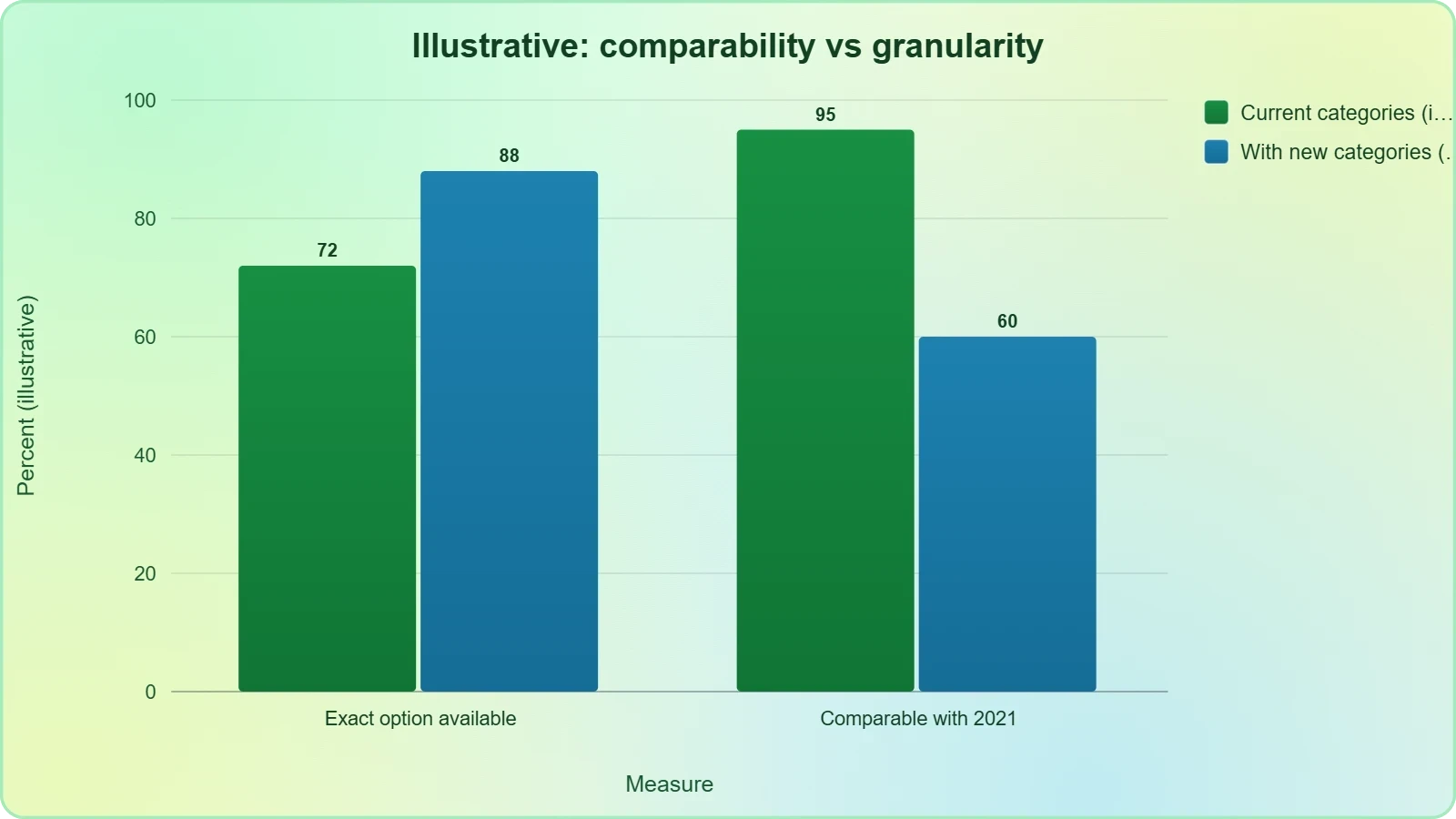
Some also worry about the politics of classification itself. Once the state begins defining who counts as English, it invites debate about boundaries: which combinations qualify, whether "English" should be tied to residence or descent, and how the categories interact with the separate "British" identity. There is a risk that well-intentioned reform generates new exclusions even as it remedies old ones. The responsible path, most methodologists argue, is careful consultation, transparent testing, and a clear rationale for every change, so that the resulting categories are defensible to the populations they describe.
Cross-Party Dynamics and the Politics of Unity
The most striking feature of the exchange was its cross-party character. Davey praised Badenoch; Burnham praised Badenoch; and the debate was framed less as a left-right contest than as a disagreement between inclusive and exclusive conceptions of nationhood. This is unusual in contemporary British politics, where identity issues often map onto partisan divides. The convergence suggests that the bill's supporters are deliberately building a broad coalition, appealing to liberals, centrists, and conservatives alike on the principle that Englishness should not be racially defined. Whether that coalition holds as the bill progresses remains to be seen.
Badenoch's Intervention and Its Significance
Kemi Badenoch's rejection of exclusionary views on English identity gave the debate a distinctive shape. As Conservative leader, her stance complicates any attempt to portray the issue as a simple clash between progressive and conservative positions. Her comments were seized upon by both Davey and Burnham as evidence that the principle enjoys support across the spectrum. For Badenoch, the intervention may serve multiple purposes: it distances her party from narrower conceptions of Englishness, it signals a modernising instinct, and it positions her as a figure willing to take on contentious arguments within her own coalition.
The significance extends beyond personalities. If the Conservative leadership accepts that Englishness is not exclusively white, then the political space for explicitly racialised definitions narrows considerably. That shifts the debate toward questions of design and implementation: how to word the options, where to place them, and how to ensure the data is robust. In this sense, the cross-party convergence may be more consequential than any single speech, because it changes the terms on which the argument will be conducted and raises the cost of opposing the bill on principle.
Burnham's National Ambitions and Local Base
Burnham's intervention also invites speculation about his national ambitions. As a mayor with a substantial platform and a reputation for independent-mindedness, he is frequently discussed as a potential future leadership contender. Supporting the bill allows him to articulate a unifying vision that contrasts with the confrontational style often associated with Westminster politics. His emphasis on moving past a decade of division and bringing people together is a classic mayoral framing, but it also travels well nationally. Whether or not he seeks higher office, the stance reinforces his brand as a politician who prefers construction to conflict.
At the same time, his caution is instructive. By saying he had not examined the details, he preserved flexibility and avoided committing to specifics that could later prove awkward. This is the behaviour of an experienced politician managing a complex issue in a diverse city-region. Greater Manchester's communities span a wide range of ethnic backgrounds, and any position on census categories will be scrutinised locally as well as nationally. Burnham's balancing act reflects the reality that identity politics is not abstract for a mayor whose constituents live its consequences daily.
We Also Published
- 01
- 02
- 03
- 04
What the Census Debate Reveals About Modern Britain
Beyond the immediate politics, the bill illuminates a broader transformation in how Britain understands itself. The country's population is more diverse than at any point in its history, and its national identities are correspondingly plural. Yet its official categories have evolved slowly, often lagging behind the lived experience of the people they describe. The proposal to add "black English" and "Asian English" is an attempt to close that gap, and the fact that it has attracted cross-party support suggests a growing consensus that the gap matters. The debate is therefore a proxy for a larger conversation about representation, recognition, and the kind of society Britain aspires to be.
From Monochrome to Plural Identity
For much of the twentieth century, Englishness was represented in official and popular culture as a singular, homogeneous identity. That representation was always partly fictional, but it shaped institutions, expectations, and statistics. The post-war period, devolution, and successive waves of migration have steadily pluralised the reality, and the census has followed at a distance. Each reform, from the introduction of ethnic monitoring to the addition of mixed and multiple heritage categories, has been contested and then normalised. The current bill belongs to that lineage, and its supporters hope it will follow the same trajectory from controversy to common sense.
The pluralisation of identity also complicates the work of statisticians. Categories that work well for one purpose may fail for another: a question designed to measure discrimination may need different options from one designed to plan language services. The census must serve many masters, and its categories are inevitably a compromise. Recognising this does not diminish the case for reform; it simply clarifies that the goal is not a perfect taxonomy but a defensible one that reflects the population's self-understanding as closely as practicable.
The Road Ahead for the Bill
The bill's path through Parliament is uncertain. Private members' bills rarely become law without government support, and the Prime Minister's response to Davey's question was not detailed in the source reporting. Much will depend on whether the government chooses to adopt the proposal, whether the Office for National Statistics endorses the approach, and whether consultation reveals sufficient demand. The cross-party endorsements from Davey, Burnham, and Badenoch improve the bill's prospects by signalling that opposition cannot be dismissed as partisan, but they do not guarantee legislative success.
Whatever the outcome, the debate has already achieved something significant: it has placed the relationship between Englishness and ethnicity squarely on the national agenda. That alone may influence future census planning, even if this particular bill stalls. The conversation about who counts as English is not new, but its migration from the margins to the floor of Parliament marks a shift in its status. For communities that have long felt invisible in official statistics, the attention is welcome, and the cross-party tone offers a model for how contentious identity questions might be handled with civility.
Practical Implications for Policy, Data, and Public Services
Should the bill succeed, the practical consequences would ripple through public administration. Local authorities, health bodies, and education providers rely on census ethnicity data to identify disparities and allocate resources. New categories would allow finer-grained analysis, potentially revealing inequalities that aggregate figures conceal. For example, if "black English" respondents show different outcomes from other black groups, targeted interventions could follow. Conversely, if the new categories fragment existing groups, some analyses may lose statistical power. The net effect depends on how the data is used and how robust the sample sizes prove to be for each new category.
Data Users and Analytical Consequences
Analysts will need to decide how to harmonise new categories with historical data. One approach is to map new options back to broader groups for trend analysis while preserving granularity for cross-sectional work. This dual approach is common in survey research, where changing questions are reconciled through careful documentation and derived variables. The Office for National Statistics would likely publish guidance on such mappings, enabling researchers to compare across censuses without losing the benefits of the new detail. The quality of that guidance will determine whether the reform enhances or complicates the evidence base.
Public services, meanwhile, will need to update their monitoring forms and systems to reflect the new options. This is not a trivial administrative task: it involves changes to databases, reporting templates, and training for staff who collect and interpret the data. The costs are modest relative to the potential benefits, but they are real, and they argue for a phased implementation with clear communication. If the reform is handled well, it could improve the accuracy of equality monitoring across the public sector; if handled poorly, it could create confusion and inconsistent practice.
Lessons From Previous Census Reforms
History offers useful lessons. The addition of "mixed" categories in earlier censuses was initially controversial but is now widely accepted and analytically valuable. Similarly, the inclusion of a question on national identity alongside ethnicity gave researchers a richer picture of how people describe themselves. Each reform required consultation, testing, and a period of adjustment during which data users adapted their methods. The current proposal is likely to follow a similar arc: initial debate, methodological scrutiny, gradual adoption, and eventual normalisation. The key is to manage the transition transparently so that confidence in the data is preserved.
There is also a lesson about language. Terms such as "black English" and "Asian English" will need careful definition and testing to ensure respondents interpret them consistently. Cognitive interviews can reveal whether people understand the options as intended, and pilot studies can test response patterns. Without this groundwork, even well-intentioned categories can produce misleading data. The bill's supporters would be wise to welcome such scrutiny rather than resist it, because robust methodology strengthens the case for reform and protects the credibility of the resulting statistics.
Conclusion: A Small Tick-Box With Large Consequences
The debate over "black English" and "Asian English" is, on its surface, a technical question about survey design. In practice, it is a referendum on how Britain defines belonging. Andy Burnham's tentative support, Ed Davey's moral clarity, and Kemi Badenoch's rejection of exclusionary views together suggest that the principle of inclusive Englishness enjoys broad elite support. Whether that translates into legislative change depends on the government, the statisticians, and the public consultation that must follow. But the conversation itself has value: it forces the country to articulate what it means by English, and to decide whether the answer should be recorded in the next census.
For communities long accustomed to being partially visible in official data, the proposal offers the prospect of fuller recognition. For policymakers, it promises better evidence on which to base decisions. For politicians, it provides a stage on which to demonstrate their conception of nationhood. These interests do not always align, and the resulting debate will be messy. Yet the cross-party tone of the opening exchanges is encouraging, suggesting that identity questions can be discussed with civility rather than caricature. The census is updated roughly once a decade; the choices made now will shape the statistical portrait of England for years to come.
From our network :
- How AI Agents Will Change the Way We Manage Personal FinancesExplore how AI agents are transforming personal finance through automated budgeting, bill payment, and investment management, while examining the critical security protocols and governance frameworks required for safe deployment.
- Committed Mediterranean Precipitation Decline: Why Emissions Cuts Alone Cannot Restore Winter RainsNew NOAA research reveals that Mediterranean winter rains may decline irreversibly even with emissions cuts. Explore the science of committed climate change and regional impacts.
- Mobile Learning and VR in English: What Global Evidence Reveals About Effective Language TechnologyA systematic review across 14 countries reveals which language-learning technologies genuinely work. Mobile learning, AI, and VR show measurable benefits when pedagogically integrated. This evidence-based guide helps educators and learners select technology that delivers real return on investment.
- CISA’s Ten-Advisory Wave: Why Generic Patching Fails in OT and How to Build Product-Specific PlaybooksCISA released ten ICS advisories in one week, exposing critical infrastructure risks. Generic patching fails in OT. Learn to build product-specific remediation playbooks.
- The Final Descent: How ESA Retired the Legendary Cluster Constellation After 24 Years of Space Weather ScienceAfter 24 years mapping Earth’s magnetosphere, ESA’s Cluster mission concluded with a precisely controlled reentry over the South Pacific. This analysis explores the scientific legacy, engineering decisions, and debris mitigation principles behind one of space exploration’s most responsible retirements.
- Live Online English Classes for Kids: Do They Actually Reduce Anxiety?A ten-week study reveals that synchronous online English classes can significantly reduce child language anxiety while improving listening and reading skills. Discover what makes these programs effective and how parents can select the right one.
- The Hidden Cost of AI Convenience: Why Over-Permissioned Agents Are a Security Time BombDiscover why AI agents with excessive permissions create dangerous single points of failure, and learn how implementing least privilege principles can protect your organization from exploitation.
- University Language Proficiency Exams: Why Institutional Tests Demand Different Preparation Than IELTS and TOEFLDiscover why university-specific language proficiency examinations differ fundamentally from IELTS and TOEFL, and learn strategic preparation approaches for institutional assessment success.
- Forbidden Matrix Patterns and Visible Lattice Points: A Geometric DictionaryExplore how multidimensional 0–1 matrices encode geometric truths, linking forbidden patterns to visible lattice points and hypergraph theory, with applications in combinatorics and computational geometry.
RESOURCES
- 'Black English' and 'Asian English' should be census options, MPs saytheguardian.com2 days ago ... Exclusive: Cross-party call for ethnicity options to be broadened beyond 'English' being only within 'White' category.
- Census should include black English and Asian English options ...bbc.com18 hours ago ... 'Englishness is an ethnicity'. Babarinde told the BBC he had brought forward the PMB because there were "some corners of…
- List of ethnic groups - GOV.UKethnicity-facts-figures.service.gov.uk1. 2021 Census · Asian or Asian British · Black, Black British, Caribbean or African · Mixed or multiple ethnic groups · White ·…
- Census should include black English and Asian English options ...bbc.co.uk18 hours ago ... 'Englishness is an ethnicity'. Babarinde told the BBC he had brought forward the PMB because there were "some corners of…
- Ethnic group, England and Wales: Census 2021ons.gov.ukNov 29, 2022 ... "Asian Welsh" and "Black Welsh" ethnic groups were included on the census questionnaire in Wales only, these categories were new…
- Updates to Race/Ethnicity Standards for Our Nationcensus.govDec 20, 2024 ... The updated standards have seven co-equal minimum categories for data on race and ethnicity: American Indian or Alaska Native, Asian,…
- Eastbourne MP Josh Babarinde has proposed the next census ...facebook.com6 hours ago ... ... ethnicity options to allow people to define themselves as black English or Asian English. More here: https://bbc.in/4BWuY2e · May…
- MPs Back Calls for 'Black English' and 'Asian English' Options on ...the-european.eu5 hours ago ... The proposed English Ethnic Identity (Census Particulars) Bill, which Babarinde has dubbed the St George's Bill, would expand the ethnicity ...
- National identity question in the 2021 Censusons.gov.ukSep 22, 2021 ... ... options for the ethnic group question. Neither 'Black English' nor 'Asian English' were suggested as additions to the high-level…
- Ethnic group, national identity, language and religion in Wales ...gov.walesNov 29, 2022 ... "Asian Welsh" and "Black Welsh" ethnic groups were included on the census questionnaire in Wales only, these categories were new…
- Lib Dem MP brings 'St George's bill' to add Black English and Asian ...politics.co.uk21 hours ago ... Lib Dem MP brings 'St George's bill' to add Black English and Asian English to census ... ethnicity options in…
- Key facts about Asian Americans | Pew Research Centerpewresearch.orgMay 1, 2025 ... The Asian population in the United States is diverse and growing quickly. It includes more than two dozen origin groups…
- Classification of ethnicity in the United Kingdom - Wikipediaen.wikipedia.orgThe codes used are based on the categories used in the 2001 UK census, with ... British Asians, who did not feel "black". A…
- A rich portrait of the country's religious and ethnocultural diversitywww150.statcan.gc.caOct 26, 2022 ... ... population reported being South Asian ... In fact, the Black population reported over 300 different ethnic or cultural origins…
- English Language Acquisition Status – Census Comparison Student ...documentation.calpads.orgReport 2.10: English Language Acquisition Status – Census Comparison Student List (Fall 1) ... Asian) and no other race category roll up to Filipino(400).…
- 01
- 02
- 03
- 04
- 05
- 06
- 07
- 08
0 Comments