
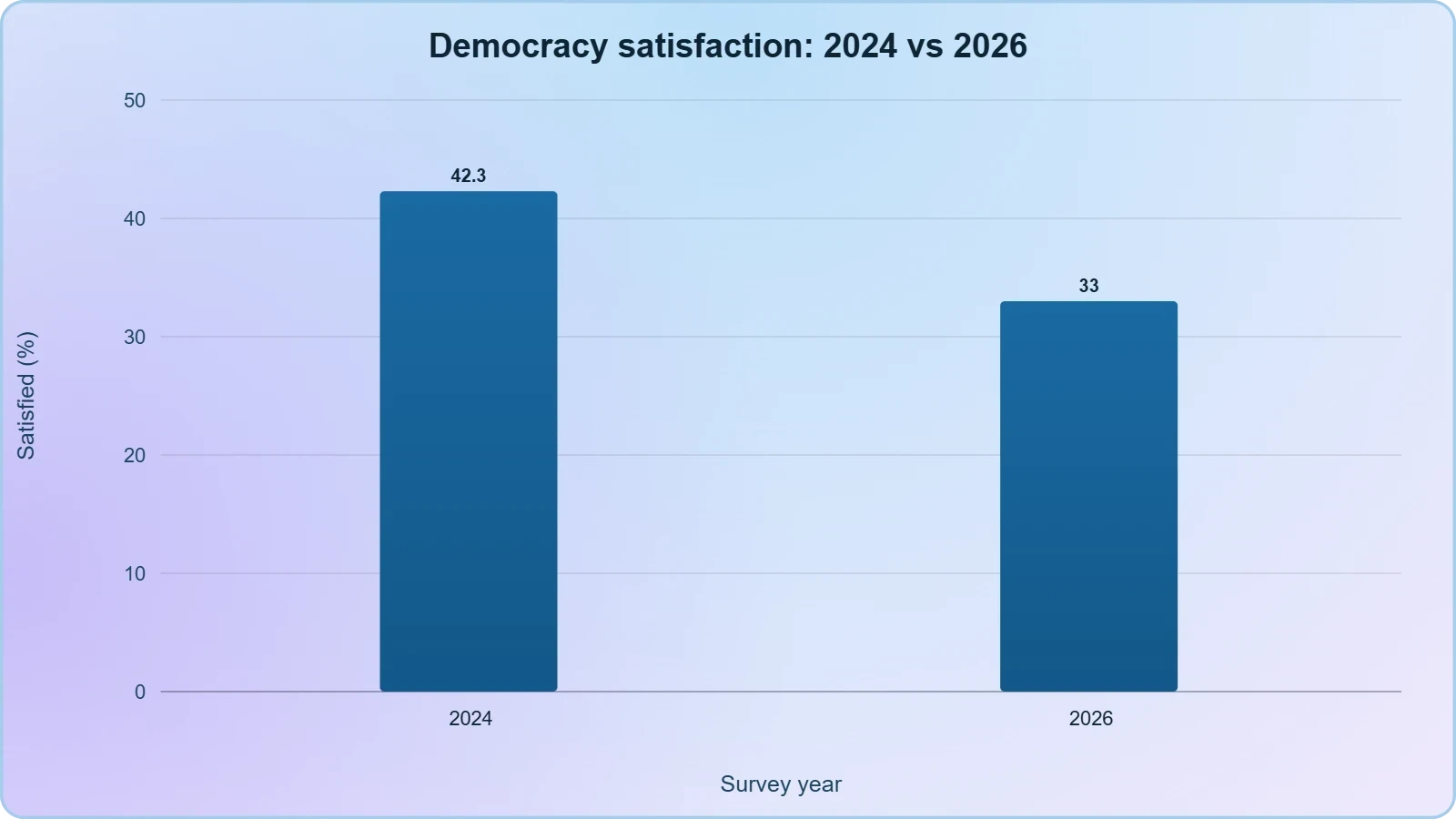
The Leipzig Authoritarianism Study has long served as one of the most closely watched barometers of political sentiment in Germany, and its 2026 edition delivers a sobering verdict. Only about one-third of Germans now express satisfaction with the way their democracy functions, the lowest reading since the research began in 2002. The decline is neither marginal nor isolated: satisfaction dropped from 42.3 percent in 2024 to roughly 33 percent in the latest wave, a fall of nearly ten percentage points in a single cycle. For a country that has built its postwar identity around democratic stability, the numbers carry weight beyond the survey itself.
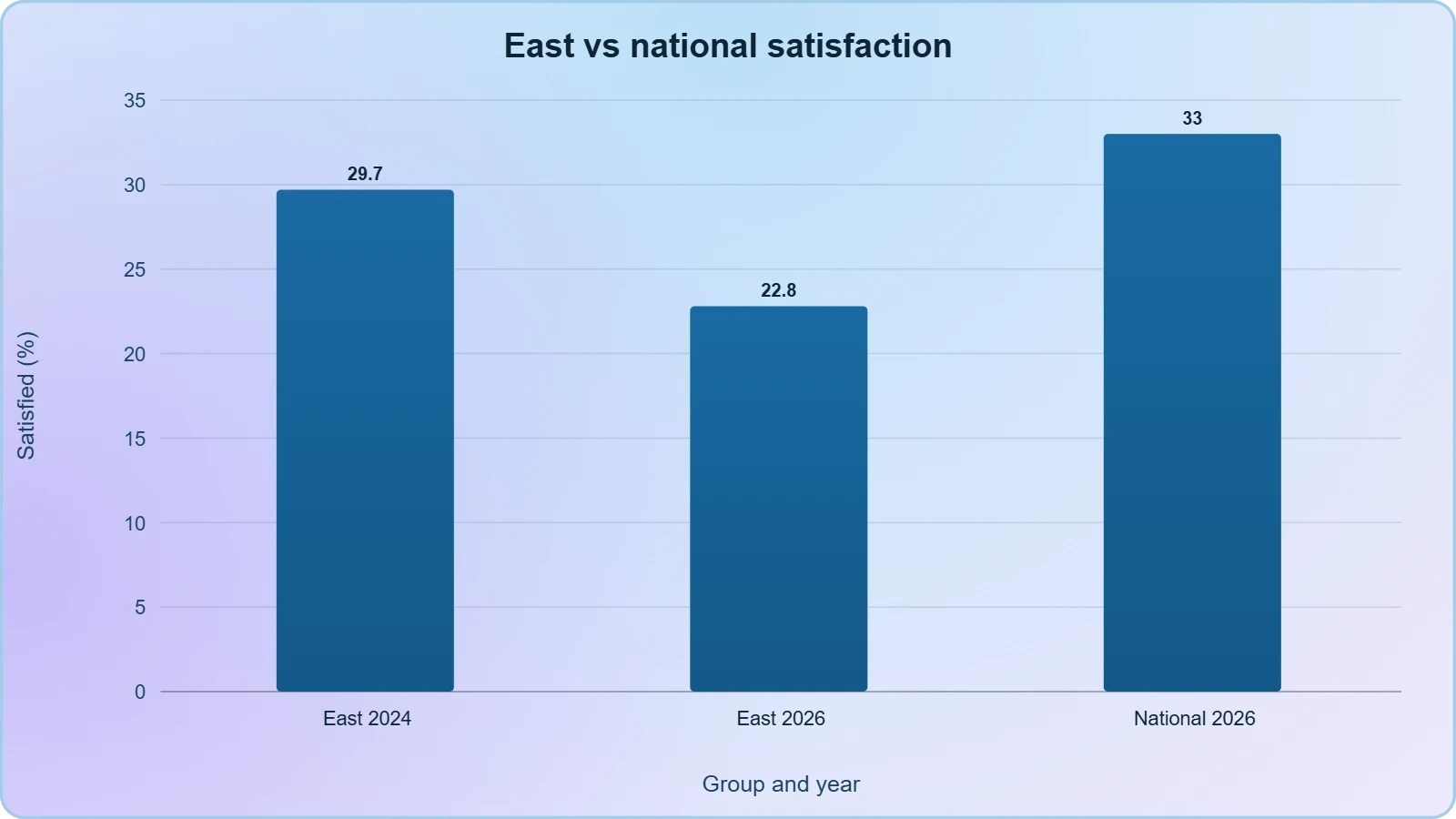
The regional split sharpens the picture considerably. In the former East German states, satisfaction sits at just 22.8 percent, down from 29.7 percent the previous year, meaning fewer than one in four eastern respondents approves of how democracy is working in practice. Meanwhile, abstract support for the democratic idea remains high at 89.3 percent, though this marks the first time the figure has slipped below the 90 percent threshold. That gap between embracing democracy as a principle and rejecting its current performance is the study's central tension, and it raises difficult questions about legitimacy, representation, and the emotional distance between citizens and institutions.
The research, conducted by the Else-Frenkel-Brunswik-Institut at the University of Leipzig, surveyed 2,500 people between mid-March and early June. Alongside the democracy findings, it recorded troubling levels of chauvinistic and antisemitic sentiment: 34.9 percent clearly agreed that Germany is being dangerously overrun by foreigners, with another 24.4 percent partly agreeing, while 15.5 percent clearly agreed that Jewish influence in Germany remains too great, joined by 21.7 percent partial agreement. These attitudes do not exist in a vacuum; they interact with the dissatisfaction data in ways that policymakers ignore at their peril.
On This Page
- The Democracy Satisfaction Collapse in Numbers
- Abstract Support Versus Lived Experience
- Chauvinism, Antisemitism, and the Authoritarian Undercurrent
- The Bundeswehr's Chinese Drone Ban and Strategic Autonomy
- The Altglietzen Tragedy and Institutional Failure
- Connecting the Threads: What This Week Reveals About Germany
TL;DR A new Leipzig Authoritarianism Study finds that only about one-third of Germans are satisfied with how their democracy works, the lowest level since the survey began in 2002, with satisfaction falling from 42.3 percent to roughly 33 percent. In the former East German states, approval drops to 22.8 percent. Abstract support for democracy remains at 89.3 percent but has fallen below 90 percent for the first time. The study also documents significant chauvinistic and antisemitic attitudes. Separately, the Bundeswehr has banned Chinese-made drones on security grounds, and a 22-year-old man under investigation for child sexual abuse material died after being found with the body of a missing 13-year-old girl near the Polish border.
The Democracy Satisfaction Collapse in Numbers
The headline figure of the Leipzig study is deceptively simple: roughly one in three Germans is satisfied with the functioning of their democracy. What makes the finding consequential is the trajectory rather than the snapshot. A drop of almost ten percentage points in two years suggests something more than routine midterm disillusionment; it points to a structural erosion of confidence that has been building across multiple election cycles, economic disruptions, and public debates over migration, energy policy, and institutional accountability. When satisfaction falls this sharply, the question shifts from whether citizens are unhappy to why the slide has accelerated so quickly.
From 42.3 Percent to 33 Percent: Reading the Decline
The movement from 42.3 percent in 2024 to approximately 33 percent in the current survey represents the steepest single-cycle decline recorded in the study's history. Researchers at the Else-Frenkel-Brunswik-Institut have emphasized that such shifts rarely occur without corresponding changes in how citizens perceive government responsiveness. The timing coincides with a period of coalition instability, budget disputes, and heated argument over migration policy, all of which tend to depress confidence in the machinery of representative government. The decline is therefore best read as a verdict on performance rather than a rejection of the democratic form itself.
Analysts caution that satisfaction surveys capture mood as much as measurement. A respondent who says democracy is not working may mean that their specific concerns, whether housing, wages, or local security, are going unaddressed. The distinction matters because it separates diffuse alienation from targeted grievance, and the remedies differ accordingly. If the dissatisfaction is concentrated among voters who feel unheard by mainstream parties, then the appropriate response involves representation and responsiveness rather than constitutional reform. The Leipzig data alone cannot settle that question, but it establishes the scale of the problem with unusual clarity.
The East-West Gap and Its Persistent Logic
The regional divergence remains one of the most durable features of German political sociology. Satisfaction in the former East German states stands at 22.8 percent, down from 29.7 percent, leaving eastern approval roughly ten points below the national average. Three and a half decades after reunification, the gap persists across income, institutional trust, and media consumption patterns. Researchers have long linked eastern dissatisfaction to experiences of economic restructuring, demographic decline, and a sense that western institutions were transplanted rather than grown. The current reading suggests those historical grievances remain live and politically salient.
What complicates the picture is that eastern Germany also records stronger attachment to certain community structures and local identities. The dissatisfaction is not simple apathy; it often coexists with high civic engagement at the municipal level. This paradox, where citizens distrust national institutions while investing heavily in local ones, has been documented repeatedly since 2002. For policymakers, the implication is that rebuilding trust may require working through local intermediaries rather than broadcasting national messages. The Leipzig study's regional breakdown provides the empirical foundation for that approach, even if it does not prescribe the remedy.
We Also Published
Abstract Support Versus Lived Experience
The most analytically interesting finding in the Leipzig study is the divergence between principle and practice. Nearly nine in ten respondents endorse democracy as an idea, yet only a third are satisfied with its operation. This is not a contradiction so much as a diagnostic: citizens are saying they believe in the destination while doubting the vehicle. Political scientists describe this pattern as "dissatisfied democrats," a category that has expanded across Western democracies in recent years. The German data now places the country firmly within that broader trend, and the sub-90 percent reading for abstract support suggests the buffer of unconditional legitimacy is thinning.
Why the 89.3 Percent Threshold Matters
For more than two decades, support for democracy as a concept hovered comfortably above 90 percent, functioning as a kind of cultural floor beneath German politics. Crossing below that line, even marginally, signals that the floor itself may be shifting. Researchers treat such thresholds cautiously because survey methodology and question framing influence results, but the direction of travel is consistent with other indicators. When abstract endorsement begins to erode alongside satisfaction, the combination is more worrying than either trend alone, because it suggests that disappointment with performance is starting to contaminate the underlying commitment to the system.
The distinction has practical consequences for how institutions communicate. If citizens still believe in democracy but distrust its current custodians, the remedy lies in accountability, transparency, and visible responsiveness. If belief in the system itself is weakening, the challenge becomes more fundamental and more difficult to address through ordinary politics. The Leipzig data does not yet prove the latter, but the 89.3 percent figure is a warning that the reservoir of diffuse support is no longer replenished automatically. Each generation must be persuaded, and persuasion requires performance as well as rhetoric.
Institutional Trust and the Responsiveness Deficit
Surveys across Europe consistently show that satisfaction with democracy tracks perceptions of responsiveness more closely than it tracks economic output. Citizens forgive hardship when they believe institutions are listening; they grow alienated when decisions appear remote or preordained. Germany's coalition politics, with its elaborate compromise machinery and lengthy decision cycles, can read as paralysis to voters accustomed to faster feedback. The Leipzig findings should therefore be interpreted alongside trust indicators for parliament, parties, and media, all of which have softened in recent years. The responsiveness deficit is the connective tissue linking these separate measurements into a single story of institutional distance.
There is also a media dimension. Fragmented information ecosystems reward outrage and penalize nuance, which tends to amplify perceptions of dysfunction regardless of underlying performance. Researchers have noted that citizens who rely primarily on social platforms report lower institutional trust than those who consume public broadcasting, even controlling for ideology. This does not mean the dissatisfaction is manufactured, but it does mean that the measurement of satisfaction is entangled with the measurement of media diet. The Leipzig study's contribution is to provide a stable, long-running instrument against which these shifting currents can be tracked year after year.
Chauvinism, Antisemitism, and the Authoritarian Undercurrent
Beyond the democracy metrics, the Leipzig study documents attitudes that many observers find deeply troubling. More than a third of respondents clearly agreed that Germany is being dangerously overrun by foreigners, with nearly a quarter partly agreeing, meaning roughly six in ten lean toward that statement to some degree. On the question of Jewish influence, 15.5 percent clearly agreed it remains too great, joined by 21.7 percent partial agreement. These are not fringe numbers; they represent substantial minorities of the adult population, and they coexist with the dissatisfaction data in ways that demand careful interpretation rather than dismissal.
Reading the Chauvinism and Antisemitism Findings
The Else-Frenkel-Brunswik-Institut has tracked authoritarian and prejudiced attitudes since 2002, and the current wave suggests consolidation rather than sudden eruption. Chauvinistic sentiment often correlates with economic anxiety, regional decline, and perceived cultural loss, which helps explain its stronger presence in certain eastern districts. Antisemitic attitudes, by contrast, draw on older and more varied reservoirs, including conspiracy thinking that flourishes in periods of institutional distrust. The overlap between democracy dissatisfaction and prejudiced attitudes is statistically meaningful: respondents who feel unheard by mainstream institutions are more likely to endorse hostile narratives about outsiders and minorities.
Researchers stress that correlation is not causation in either direction. Prejudice can drive political alienation just as alienation can license prejudice. What the longitudinal data does show is that these attitudes have become more openly expressed, a shift that may reflect changing social norms as much as changing beliefs. The willingness to agree with such statements in a face-to-face or online survey is itself a political act, signaling alignment with movements that reject established taboos. For civil society organizations, the findings underscore the importance of local engagement and education, since national campaigns rarely reach the populations most susceptible to these narratives.
The Bundeswehr's Chinese Drone Ban and Strategic Autonomy
In a separate but thematically related development, the German military has banned the use of Chinese-made drones, including for training purposes. The Defense Ministry cited security-related information as the basis for the decision and indicated that existing systems will be replaced by German or European products. The move reflects a broader European reassessment of supply chain dependencies in defense procurement, where hardware manufactured by geopolitical rivals can carry embedded risks ranging from data exfiltration to remote disablement. Even training drones, which carry no weapons, can collect imagery and telemetry that reveal operational patterns and readiness levels.
Security Rationale Behind the Procurement Shift
The Bundeswehr's decision fits within a wider pattern of European defense establishments scrutinizing Chinese-origin technology across telecommunications, surveillance, and now unmanned systems. Security services have warned for years that commercial drones often include data links that route through foreign servers, creating potential vulnerabilities that are difficult to audit. By mandating replacement with German or European alternatives, the ministry is prioritizing supply chain integrity over cost. The tradeoff is real, since Chinese drones are typically cheaper and more readily available, but defense officials appear to have concluded that the savings do not justify the exposure.
The ministry has preserved flexibility by allowing the military to purchase inexpensive off-the-shelf drones for training with minimal bureaucracy, provided they meet security criteria. This pragmatic carve-out acknowledges that training needs volume and affordability, and that not every exercise requires top-tier equipment. The policy therefore balances two imperatives: protecting sensitive operations from foreign surveillance and maintaining realistic, cost-effective training for soldiers who will eventually operate more sophisticated systems. Analysts see the move as part of a longer-term effort to build European drone manufacturing capacity, which remains fragmented and underinvested relative to demand.
Implications for European Defense Industrial Policy
The ban arrives amid a broader push for European strategic autonomy in defense production. Germany has committed to increased military spending, and procurement decisions now carry industrial policy weight as much as operational logic. Replacing Chinese drones with domestic or European models supports local manufacturers, though critics note that European firms may struggle to match the price points and iteration speed of global competitors. The long-term question is whether security-driven procurement can coexist with the cost discipline that taxpayers expect, or whether the continent will accept higher prices as the price of resilience.
For NATO partners, the German decision signals alignment with a shared threat assessment regarding Chinese technology. Similar reviews are underway in several member states, and the alliance has begun coordinating standards for drone security certification. The Bundeswehr's approach, combining a hard ban on Chinese systems with a flexible exception for low-cost training equipment, may become a template for other militaries navigating the same tradeoffs. What remains unresolved is the timeline for replacement and the cost of retrofitting existing inventories, details the ministry has not disclosed publicly.
- 01
- 02
- 03
- 04
The Altglietzen Tragedy and Institutional Failure
A grim criminal case has added another dimension to the week's news. A 22-year-old man died in hospital from severe head injuries after police discovered him alongside the body of a 13-year-old girl who had gone missing from Berlin. The man attempted to shoot himself when officers found him in the small town of Altglietzen near the Polish border on Sunday. Prosecutors in Berlin confirmed that the man had been under investigation since January 2025 on suspicion of possessing child sexual abuse material. The girl had left her home for school the previous Tuesday and never arrived, triggering a search that ended in the most painful way imaginable.
Timeline of the Investigation and Discovery
The sequence of events raises uncomfortable questions about how a suspect under active investigation for child sexual abuse material could remain in proximity to a child. The girl disappeared after leaving for school, and the discovery days later in a different federal state suggests movement across jurisdictions that may have complicated the search. German federalism divides policing responsibilities among states, and coordination failures in missing-child cases have been documented before. Prosecutors have not disclosed whether the suspect was under surveillance or subject to restrictions during the investigation, leaving the public to speculate about gaps in monitoring.
The case has intensified debate over how authorities handle individuals suspected of possessing abuse material, particularly when no prior contact offense has been established. Civil liberties advocates caution against preemptive detention based on suspicion alone, while child protection organizations argue that risk assessment protocols need strengthening. The tragic outcome in Altglietzen will likely accelerate calls for reform, including better information sharing between state police forces and more rigorous monitoring of suspects awaiting charging decisions. Whether such reforms can prevent future tragedies is uncertain, but the political pressure for action is now considerable.
Public Trust and the Handling of Sensitive Cases
Cases involving violence against children carry outsized weight in public consciousness, and their handling can shape trust in institutions far beyond the specific facts. The Leipzig study's finding that only a third of Germans are satisfied with their democracy gains an additional layer of meaning when read alongside such incidents. When institutions appear to fail in protecting the most vulnerable, abstract debates about democratic performance become concrete and personal. The connection is not causal, but it is cumulative: each visible failure adds to a reservoir of skepticism that surveys then measure.
Officials have emphasized that the investigation into the girl's death is ongoing and that the suspect's death limits the possibility of criminal accountability. The focus now shifts to a review of how the missing-person search was conducted and whether earlier intervention was possible. For the family and community in Altglietzen, no procedural review can undo the loss. For the wider public, the case serves as a reminder that institutional competence is measured not only in macroeconomic statistics but in the mundane, critical work of keeping children safe.
Connecting the Threads: What This Week Reveals About Germany
Read together, these developments sketch a portrait of a country navigating multiple forms of institutional stress. The democracy satisfaction data captures a diffuse but measurable loss of confidence. The prejudice findings reveal the attitudinal consequences of that loss, as alienation finds expression in hostility toward outsiders and minorities. The drone ban reflects a strategic response to external risk, while the Altglietzen tragedy exposes the human cost when protective systems fail. None of these stories causes the others, but they share a common substrate: the perception that institutions are not delivering what citizens expect of them, whether in representation, security, or protection of the vulnerable.
From Data to Political Consequence
The Leipzig study's value lies in its longevity. Because the same instrument has been applied since 2002, researchers can distinguish durable trends from temporary fluctuations, and the current readings suggest a durable deterioration rather than a blip. Political consequences are already visible in party system fragmentation and the rise of movements that channel dissatisfaction. Whether these movements offer constructive remedies or merely amplify grievance remains an open question, but their electoral traction is a rational response to the responsiveness deficit documented in the data. Mainstream parties ignore this at their own risk.
For observers outside Germany, the findings carry comparative lessons. Similar patterns of declining satisfaction alongside stable abstract support appear across Western democracies, suggesting common structural causes: slow decision-making, media fragmentation, and the difficulty of delivering visible results in complex economies. Germany's experience is distinctive in its east-west dimension and its historical burden of memory, but the underlying dynamic is widely shared. The country's response, whether through institutional reform, local engagement, or renewed political competition, will be watched closely as a test case for democratic renewal in advanced economies.
What to Watch in the Coming Months
Several indicators will reveal whether the current trajectory continues or stabilizes. Upcoming state elections in eastern Germany will provide a real-world test of whether dissatisfaction translates into protest voting at the scale the survey suggests. Defense procurement decisions will show how quickly the drone ban is implemented and at what cost. And the Altglietzen investigation will determine whether procedural reforms follow the tragedy or whether attention fades as it often does. Each of these arenas offers a concrete measure of institutional responsiveness, which the Leipzig data identifies as the central variable in democratic satisfaction.
The broader lesson is that legitimacy is not a fixed asset but a renewable resource that requires constant maintenance. Surveys capture the state of that resource at a moment in time, but the work of replenishing it happens in parliaments, town halls, courts, and families. Germany's one-third satisfaction figure is a warning, not a verdict. Whether it becomes a turning point or a waypoint depends on decisions made in the months ahead, by officials who now have unusually clear data about what citizens think and why they think it.
From our network :
- Committed Mediterranean Precipitation Decline: Why Emissions Cuts Alone Cannot Restore Winter RainsNew NOAA research reveals that Mediterranean winter rains may decline irreversibly even with emissions cuts. Explore the science of committed climate change and regional impacts.
- University Language Proficiency Exams: Why Institutional Tests Demand Different Preparation Than IELTS and TOEFLDiscover why university-specific language proficiency examinations differ fundamentally from IELTS and TOEFL, and learn strategic preparation approaches for institutional assessment success.
- Live Online English Classes for Kids: Do They Actually Reduce Anxiety?A ten-week study reveals that synchronous online English classes can significantly reduce child language anxiety while improving listening and reading skills. Discover what makes these programs effective and how parents can select the right one.
- Mobile Learning and VR in English: What Global Evidence Reveals About Effective Language TechnologyA systematic review across 14 countries reveals which language-learning technologies genuinely work. Mobile learning, AI, and VR show measurable benefits when pedagogically integrated. This evidence-based guide helps educators and learners select technology that delivers real return on investment.
- How AI Agents Will Change the Way We Manage Personal FinancesExplore how AI agents are transforming personal finance through automated budgeting, bill payment, and investment management, while examining the critical security protocols and governance frameworks required for safe deployment.
- Forbidden Matrix Patterns and Visible Lattice Points: A Geometric DictionaryExplore how multidimensional 0–1 matrices encode geometric truths, linking forbidden patterns to visible lattice points and hypergraph theory, with applications in combinatorics and computational geometry.
- The Final Descent: How ESA Retired the Legendary Cluster Constellation After 24 Years of Space Weather ScienceAfter 24 years mapping Earth’s magnetosphere, ESA’s Cluster mission concluded with a precisely controlled reentry over the South Pacific. This analysis explores the scientific legacy, engineering decisions, and debris mitigation principles behind one of space exploration’s most responsible retirements.
- CISA’s Ten-Advisory Wave: Why Generic Patching Fails in OT and How to Build Product-Specific PlaybooksCISA released ten ICS advisories in one week, exposing critical infrastructure risks. Generic patching fails in OT. Learn to build product-specific remediation playbooks.
- The Hidden Cost of AI Convenience: Why Over-Permissioned Agents Are a Security Time BombDiscover why AI agents with excessive permissions create dangerous single points of failure, and learn how implementing least privilege principles can protect your organization from exploitation.
RESOURCES
- Leipzig Authoritarianism Study: Germans more satisfied ... - EurekAlert!eurekalert.orgNov 9, 2022 ... The percentage of people who are satisfied with constitutional democracy rises from 65 per cent to 90 per cent in…
- 2026 Leipzig Authoritarianism Study - Democracy under pressureidw-online.de6 hours ago ... This is primarily due to a sharp decline in confidence among respondents in eastern Germany (85.7 per cent). Satisfaction with…
- UNIVERSITÄT LEIPZIG (@UniLeipzig) on Xx.comNov 13, 2024 ... ... satisfaction with democracy as practised in Germany is declining ... UNIVERSITÄT LEIPZIG on X: "Study on authoritarianism by #UniLeipzig ...
- The impact of political marginalization in the former German ...frontiersin.orgOct 30, 2025 ... ... German Democratic Republic on satisfaction ... Leipzig Research Centre for Civilization Diseases, University of Leipzig, Leipzig, Germany.
- Germany news: Only 1/3 of Germans satisfied with state of democracydw.com2 hours ago ... ... Germany, according to a new report from the Leipzig Authoritarianism Study . This marked a steep decline from the…
- Socialist Values and the Development of Democratic Support in the ...sites.pitt.eduABSTRACT. Through the use of a three-wave panel study of citizens of the former East German city of Leipzig, the article explores the changes…
- Leipzig Authoritarianism Study 2024 published - mySciencemyscience.orgNov 13, 2024 ... ... German states, satisfaction with democracy as it is practised in Germany is at its lowest level since 2006. These…
- Social Media and Democracy: The Impact of Populist Radical Right ...tandfonline.com... Germany affects satisfaction with democracy and political trust. Drawing on ... Existing research suggests that PRRP electoral successes can reduce democratic ...
- Exploring Different Types of the Authoritarian Syndrome: A Latent ...jspp.psychopen.eu[1] Else-Frenkel-Brunswik-Institute, University of Leipzig, Leipzig, Germany. ... We asked for satisfaction with democracy with three individual items that ...
- The Wall in the Mind – Revisited Stable Differences in the Political ...tandfonline.comJun 27, 2022 ... ... satisfaction with democracy between Eastern and Western Germany. ... Learning Democracy: Democratic and Economical Values in Unified Germany.
- Case Study: Leipzig - New Americanewamerica.orgBy 1989, many people in East Germany were pushing for democratic reforms and had begun gathering at peace prayer events hosted at the Protestant…
- A data set for mental and physical stress, loneliness, and life ...link.springer.comJul 1, 2025 ... The data set is part of the Saxon Longitudinal Study (SLS), first conducted in 1987 in the former German Democratic…
- Do Citizens' Assemblies Really Strengthen the Resilience of ...bosch-stiftung.deApr 2, 2025 ... ... study by the University of Leipzig. According to the study, 90% of those surveyed agree with democracy ... Germany…
- Models Wanted Become an Ambassador for Studying in Germany ...instagram.comAug 12, 2026 ... Trust in democracy is strong: around 75% of young people are satisfied with the German democracy and continue to trust…
- Study reveals surge in xenophobic and anti-Muslim sentiment in ...aa.com.trNov 13, 2024 ... The study conducted by Leipzig University scholars Prof. ... The survey also revealed a sharp decline in satisfaction with German…
- 01
- 02
- 03
- 04
- 05
- 06
- 07
- 08
0 Comments