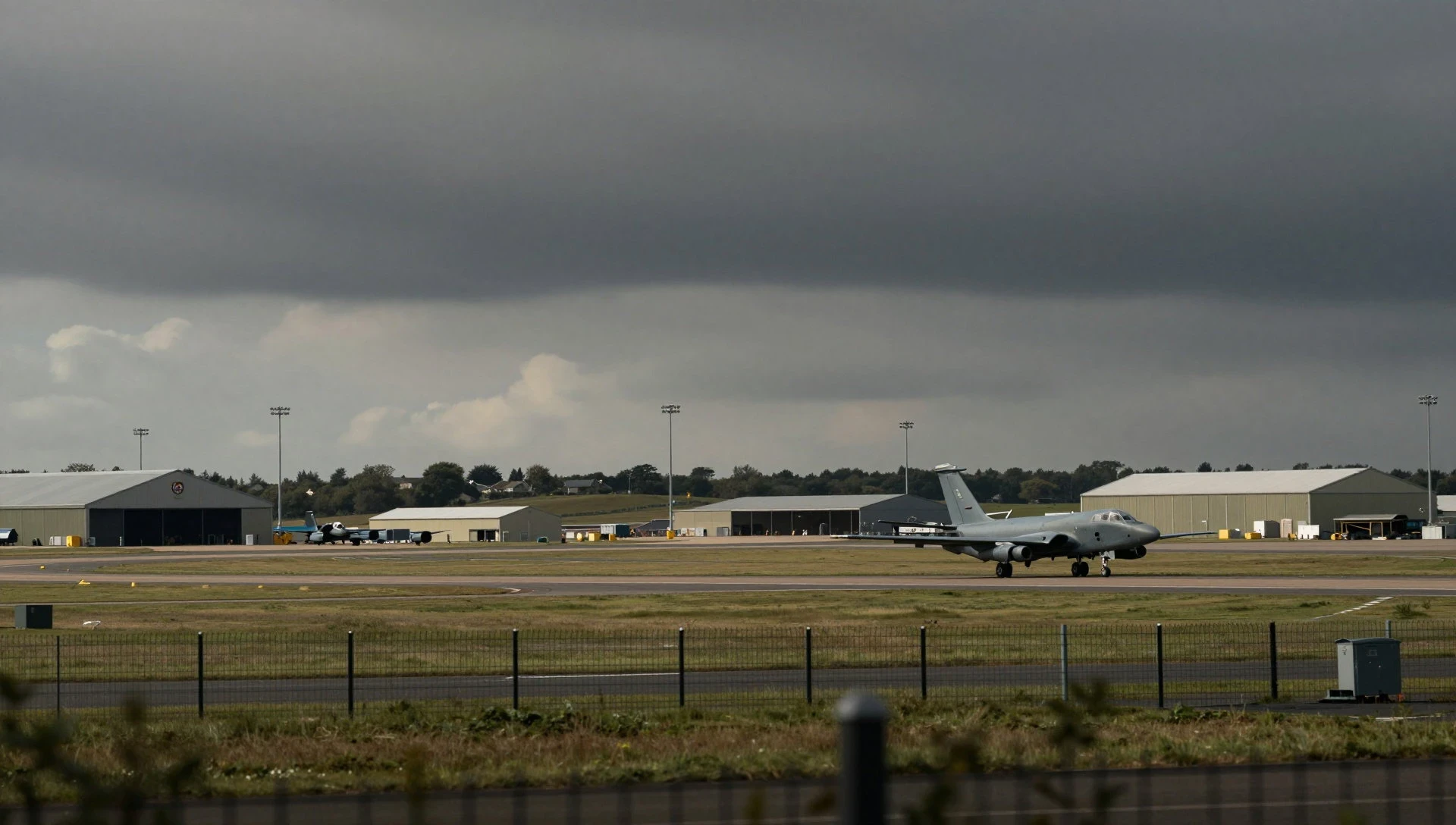
When United States prosecutors unsealed an updated indictment in Manhattan federal court, they did more than add names to a criminal docket. They sketched the outline of a transnational coercion campaign allegedly orchestrated by an Iran-aligned network that stretches from Tehran and Baghdad to the suburbs of London and the American heartland. The charges describe three men accused of plotting nearly twenty attacks, including strikes on Jewish communities in Europe and the United States and on Britain's RAF Fairford airbase, a facility that hosted American bombers used in operations against Iran. The case sits at the intersection of terrorism, diplomacy, and domestic security, and it raises uncomfortable questions about how far a state-aligned network can reach inside allied nations.
The alleged architecture of the plot matters as much as the targets themselves. Prosecutors say the defendants drew on contacts inside Britain to scout and plan operations on behalf of a network that included Iran's Islamic Revolutionary Guard Corps and the Iraqi armed group Kata'ib Hizballah, both designated by Washington as foreign terrorist organizations. One defendant, described as a Kata'ib Hizballah commander and an Iranian-Iraqi dual national, allegedly used coded messages to relatives from jail to arrange payments to people who could carry out attacks, and he reportedly kept coordinating with co-defendants in the days before the Fairford incident. That detail, if proven, would suggest a command structure resilient enough to function through incarceration.
British authorities moved in late September after receiving information about suspicious vehicles near the military compound, establishing a safety zone, evacuating homes, and deploying security forces alongside a bomb disposal unit. Five people were arrested, and American bombers stationed at Fairford were withdrawn once the alleged plot surfaced. In October, UK authorities separately charged two twenty-four-year-old men under the National Security Act, one accused of assisting Iran's intelligence service and granted conditional bail, the other facing a charge of entering a prohibited place for a purpose prejudicial to the UK tied to an alleged reconnaissance visit to Fairford in August. Tehran has denied involvement, and the legal proceedings now test how allied justice systems handle overlapping allegations of espionage and violence.
On This Page
TL;DR US prosecutors have charged three men over an alleged Iran-linked terror campaign targeting Jewish communities in Europe and the United States and Britain's RAF Fairford airbase, which hosted American bombers used against Iran. The indictment names an Iranian-Iraqi dual national described as a Kata'ib Hizballah commander, an Iranian national, and an Iraqi national; only the dual national is in custody. Prosecutors allege nearly twenty planned attacks, coded jailhouse messages arranging payments, and British contacts used for planning. UK police detained five people near Fairford in late September, and two men were later charged under the National Security Act. Tehran denies involvement.
The Anatomy of the Alleged Campaign
The indictment's central claim is that a coordinated network sought to convert ideological alignment into physical violence across three continents. Prosecutors describe a campaign of nearly twenty planned attacks, a figure that implies sustained planning rather than opportunistic plotting. The targets allegedly included Jewish communities in Europe and the United States, a choice that places the case within a broader pattern of antisemitic violence linked to state-aligned actors. RAF Fairford, a Royal Air Force station used by the US for operations against Iran, appears as a symbolic and operational target, one that would signal retaliation for American military pressure. The geography of the alleged conspiracy, spanning Britain, Europe, and America, suggests a network comfortable operating across jurisdictions.
The Defendants and Their Alleged Roles
The updated indictment names three men: an Iranian-Iraqi dual national, an Iranian national, and an Iraqi national. Only the dual national is in custody, a fact that shapes the case's immediate trajectory. Prosecutors describe him as a Kata'ib Hizballah commander who pleaded not guilty in June to charges of plotting at least eighteen attacks in Europe and who has called himself a prisoner of war. That self-description is legally significant, because it frames his conduct as belligerency rather than terrorism. The other two defendants remain at large, and their absence complicates any near-term trial and underscores how transnational cases often proceed unevenly.
US Attorney Jamie McDonald said the defendants helped organize a campaign of terror for groups affiliated with Iran, language that positions the case as a state-linked enterprise rather than isolated criminality. The allegation that the detained commander used coded messages to relatives from jail to arrange payments to potential attackers is among the most consequential claims in the indictment. If substantiated, it would demonstrate that incarceration did not sever operational control. Prosecutors further allege he continued coordinating with co-defendants in the days before the Fairford incident, a timeline that places him at the center of the alleged conspiracy even while behind bars.
The Network Behind the Plot
Prosecutors identify the network as including Iran's Islamic Revolutionary Guard Corps and Kata'ib Hizballah, both designated by the United States as foreign terrorist organizations. The IRGC's involvement, as alleged, would elevate the case from a criminal conspiracy to an instrument of state policy, while Kata'ib Hizballah's role would illustrate how Iraqi armed groups can serve as operational proxies. The indictment's reference to an "Iran-aligned network" is deliberately broad, allowing prosecutors to describe coordination without asserting direct orders from Tehran. That framing matters diplomatically, because it preserves ambiguity even as it signals a coherent threat architecture.
The use of British contacts to plan attacks suggests the network cultivated local knowledge rather than relying solely on foreign operatives. Such contacts can provide reconnaissance, logistics, and cover, and they complicate counterterrorism because they blur the line between foreign direction and domestic facilitation. The case therefore illustrates a familiar pattern in modern security threats: a state-aligned core that outsources tactical work to sympathizers and criminal intermediaries. For investigators, the challenge is not only identifying the core but mapping the periphery, where ideological sympathy, financial incentive, and personal loyalty can overlap in ways that are difficult to disentangle.
The Fairford Incident and the British Response
RAF Fairford occupies a distinctive place in the story because it converts an abstract threat into a concrete security operation. In late September, UK authorities detained several men near the military compound after receiving information about suspicious vehicles. They established a safety zone, evacuated homes, and dispatched security forces together with a bomb disposal unit. Five people were arrested. The sequence of measures, from intelligence tip to evacuation to explosive ordnance deployment, reflects a mature counterterrorism playbook that treats unverified threats as potentially lethal until proven otherwise. It also reveals how quickly a quiet corner of rural England can become the front line of a geopolitical confrontation.
Why the Base Mattered
Fairford was used by the United States for operations against Iran, which explains why it would appear on a target list compiled by an Iran-aligned network. The base's role as a staging point for American bombers gave it operational significance beyond its physical footprint. Once the alleged plot was discovered, US bombers stationed there were withdrawn, a decision that carries both tactical and symbolic weight. Militarily, the withdrawal reduces exposure; politically, it signals that the threat was assessed as credible enough to alter force posture. For analysts, the episode illustrates how bases in allied countries can become targets precisely because they project power elsewhere.
The base's vulnerability is partly a function of its geography. Located in the English countryside, it depends on perimeter security, local policing, and national intelligence to detect threats before they reach the fence line. The alleged reconnaissance visit in August, which UK prosecutors link to one of the two men charged under the National Security Act, suggests that hostile actors may have been probing those defenses. Reconnaissance is often the quiet precursor to violence, and its detection can be the difference between a disrupted plot and a successful attack. The case therefore highlights the value of low-level intelligence work that rarely attracts public attention.
The UK Legal Track
In October, UK authorities separately charged two twenty-four-year-old men under the National Security Act. One is accused of assisting Iran's intelligence service and was granted conditional bail; the other faces a charge of entering a prohibited place for a purpose prejudicial to the UK, related to an alleged reconnaissance visit to Fairford in August, and was remanded in custody. The use of the National Security Act, rather than terrorism legislation, reflects the case's espionage-adjacent character. It also demonstrates that allied legal systems can pursue parallel tracks, one focused on violence and another on intelligence gathering, even when the underlying threat is intertwined.
The bail decision for the man accused of assisting Iran's intelligence service will likely attract scrutiny, given the seriousness of the allegation. Conditional bail is not unusual in cases where the evidence is documentary or where flight risk is assessed as manageable, but it can create public anxiety when the alleged conduct involves a foreign state. The remand of the second man, by contrast, signals that courts view the reconnaissance allegation as sufficiently grave to justify detention. Together, the two decisions illustrate how judges weigh risk, evidence, and the nature of the alleged relationship with a hostile state.
Command and Control From a Cell
The most unsettling allegation in the indictment concerns communication from custody. Prosecutors claim the detained dual national, described as a Kata'ib Hizballah commander, used coded messages to relatives from jail to arrange payments to people who could carry out attacks. If true, this would mean that a prison cell functioned as a command post, with family members acting as unwitting or willing conduits. The claim also implies that the network had a financial mechanism ready to compensate operatives, a detail that transforms the conspiracy from ideological fervor into a transactional enterprise. Prisons are designed to incapacitate, but they are not impermeable, and the case exposes the gap between physical detention and operational isolation.
The Mechanics of Coded Messaging
Coded messages to relatives are a low-tech solution to a high-surveillance problem. Prison communications are monitored, but family conversations carry an expectation of privacy that can create blind spots. Codes can be as simple as references to family events, religious phrases, or mundane purchases that signal payments or instructions. Investigators who detect such patterns must then prove intent, which is legally demanding. The indictment's reliance on this allegation suggests prosecutors believe they can demonstrate a consistent pattern rather than a single ambiguous message. That evidentiary burden will shape the trial and may determine whether the command-and-control theory survives scrutiny.
The financial dimension adds another layer of complexity. Arranging payments to potential attackers requires intermediaries, and intermediaries leave traces. Money transfers, whether through informal hawala networks, cryptocurrency, or conventional banking, can be reconstructed by financial intelligence units. The allegation that payments were being arranged from jail therefore invites a parallel investigation into how the network moved funds across borders. Such inquiries often produce evidence that is more durable than intercepted communications, because financial records persist and can be corroborated. If prosecutors can trace the money, they can strengthen the claim that the conspiracy was operational rather than aspirational.
The Prisoner-of-War Claim
The detained commander has called himself a prisoner of war, a characterization that carries legal and political implications. If accepted, it would frame his actions as part of an armed conflict governed by international humanitarian law rather than a criminal conspiracy. US prosecutors reject that framing, treating him as a defendant in a federal court. The dispute matters because it touches on the broader question of how states classify Iran-aligned actors: as soldiers, terrorists, or criminals. Each label carries different legal consequences, and each shapes the diplomatic narrative that surrounds the case. The court's treatment of the claim will be watched closely by both defense and prosecution.
Prisoner-of-war status is ordinarily reserved for members of organized armed forces under recognized command and wearing distinctive insignia. A Kata'ib Hizballah commander might argue that his group functions as a militia engaged in hostilities, but US law does not recognize such groups as lawful belligerents. The claim is therefore unlikely to succeed in a federal courtroom, yet it serves a rhetorical purpose. It positions the defendant as a combatant rather than a criminal, which can mobilize sympathy among supporters and complicate extradition or transfer requests. The legal reality and the political message are deliberately divergent, and both will shape how the case unfolds.
We Also Published
Tehran's Denial and the Diplomacy of Deniability
Tehran has denied involvement in the alleged Fairford plot, a response that fits a familiar pattern in Iranian denials of covert operations abroad. Deniability serves multiple purposes: it preserves the option of plausible distance, it avoids providing adversaries with a formal casus belli, and it allows aligned groups to act with a degree of autonomy that complicates attribution. The US indictment's language reflects this ambiguity, describing an "Iran-aligned network" rather than asserting direct orders from Tehran. That phrasing is legally prudent and diplomatically useful, because it allows Washington to signal resolve without closing the door on future negotiations. The case thus becomes a study in how states manage attribution when evidence is suggestive but not conclusive.
The Politics of Attribution
Attribution in state-linked terrorism is rarely binary. Intelligence agencies distinguish between direction, encouragement, and tolerance, and each carries different policy implications. The indictment's reference to the IRGC and Kata'ib Hizballah suggests a structure in which state and proxy interests overlap without necessarily converging in a single chain of command. Critics of the US approach argue that broad designations can sweep up actors whose connection to the state is tenuous, while supporters contend that ambiguity is precisely how Iran maintains plausible deniability. The Fairford case sits squarely within that debate, and its outcome may influence how future administrations frame similar allegations.
The diplomatic context matters as well. The charges were announced at a moment of heightened tension between Washington and Tehran, and they will inevitably be read through that lens. For the United States, the indictment demonstrates that alleged Iranian plotting carries legal consequences even when it occurs on allied soil. For Iran, the charges can be portrayed as politically motivated, particularly given the long history of mutual recrimination. The risk is that legal proceedings become proxies for geopolitical confrontation, with each side using court filings and public statements to advance a narrative. Courts are not immune to that pressure, but they remain the forum where evidence must ultimately be tested.
Allied Cooperation Under Strain
The case also tests the machinery of allied cooperation. US prosecutors relied on British authorities to disrupt the alleged Fairford plot, and UK police acted on intelligence about suspicious vehicles. That collaboration reflects years of investment in counterterrorism partnerships, but it also exposes friction points. Different legal systems classify conduct differently, and the use of the National Security Act alongside US terrorism charges illustrates how allies can pursue the same threat through distinct legal channels. Coordination is essential, yet it can create complications when defendants face proceedings in multiple jurisdictions or when evidence must be shared under strict rules.
Extradition is another potential friction point. The two defendants not in US custody remain at large, and their location is unclear. If they are in Iran or Iraq, extradition is unlikely, which means the case may proceed against the detained commander alone. That outcome would narrow the trial's scope but not its significance, because the indictment's broader allegations would still be aired. For allies, the case reinforces the value of intelligence sharing while highlighting the limits of legal cooperation when suspects are beyond reach. The lesson is that disruption and prosecution are complementary but not interchangeable tools.
- 01
- 02
- 03
- 04
What the Case Reveals About Modern Proxy Conflict
The Fairford allegations illuminate a form of conflict that sits below the threshold of open war but above the level of ordinary crime. State-aligned networks can plan violence abroad, recruit local contacts, move money, and maintain command links even through incarceration. They exploit the seams between legal systems, the gaps in prison monitoring, and the ambiguities of attribution. The response requires more than arrests; it demands sustained intelligence work, financial tracing, and legal coordination across borders. The case is therefore less a single incident than a window into a persistent condition, one in which the line between terrorism and statecraft is deliberately blurred by the actors who benefit from the confusion.
The Financial Forensics
Money is the connective tissue of any conspiracy, and the allegation that payments were arranged from jail places financial forensics at the center of the investigation. Investigators will likely examine transfers to family members, informal value transfer systems, and any cryptocurrency wallets linked to the defendants. Each channel leaves a different trace, and each requires a different legal instrument to access. The challenge is not merely technical but jurisdictional, because funds may move through countries with weak oversight. Successful prosecution often depends on building a financial narrative that complements the communications evidence, showing that intent was matched by capability. That narrative, if convincing, can transform a circumstantial case into a compelling one.
Financial tracing also serves a preventive purpose. Identifying how a network pays operatives allows authorities to disrupt future plots before they mature. Sanctions, asset freezes, and banking alerts can raise the cost of violence, even when they cannot eliminate it. The Fairford case may therefore produce lessons for financial intelligence units well beyond the courtroom. If prosecutors can demonstrate that coded family messages were used to authorize payments, banks and remittance services may adjust their monitoring to flag similar patterns. Deterrence in this domain is cumulative, built from cases that reveal how adversaries adapt to surveillance.
Lessons for Allied Security
For allied security services, the case reinforces several familiar lessons. First, military bases abroad are attractive targets precisely because they project power, and their defense depends on local intelligence as much as on perimeter security. Second, prison communications require continuous scrutiny, because incarceration does not guarantee isolation. Third, legal tools must be flexible enough to address conduct that straddles terrorism and espionage. Fourth, public communication matters, because allegations of state involvement carry diplomatic consequences that can outlast the trial. The case's value lies not only in its verdict but in the institutional adjustments it prompts across intelligence, law enforcement, and finance.
The broader strategic picture is one of persistent friction between Iran and its adversaries, played out through proxies, plots, and legal proceedings. Each incident tests the resilience of alliances and the credibility of deterrence. The Fairford case will not resolve that friction, but it will add to the accumulated record that shapes future policy. For analysts, the task is to distinguish signal from noise, recognizing that not every plot reflects a coherent strategy and not every denial is credible. The truth usually lies in the details of money, communications, and movement, which is why the indictment's specifics matter more than its rhetoric.
Reading the Indictment Without Overreading It
Indictments are advocacy documents as much as legal instruments. They select facts, arrange them in a narrative, and use language that shapes perception before a single witness testifies. The Fairford indictment is no exception. Its references to a "campaign of terror," coded messages, and nearly twenty planned attacks are designed to convey coherence and intent. Defense lawyers will challenge that coherence, arguing that proximity to a network is not the same as participation in a plot. Readers should therefore hold two ideas simultaneously: the allegations are serious and detailed, and they remain allegations until proven. That discipline is essential in a case with obvious geopolitical stakes.
Evidence, Inference, and Proof
The gap between evidence and inference is where most terrorism prosecutions are won or lost. Prosecutors must show that the defendants not only associated with a network but agreed to commit specific acts. Coded messages can be interpreted in multiple ways, and payments to relatives may have innocent explanations. The strength of the case will depend on corroboration: intercepted communications, financial records, travel patterns, and witness testimony. Each piece must fit together without requiring the jury to accept a grand theory on faith. The indictment's detail suggests prosecutors believe they have that corroboration, but the trial will reveal whether the mosaic holds.
Inference is unavoidable in national security cases, because intelligence agencies rarely disclose their full sources. Courts have developed doctrines to manage classified evidence, including protective orders and substitutions, but these mechanisms can complicate a defendant's ability to mount a defense. The tension between secrecy and fairness is inherent in such prosecutions, and it will shape the Fairford case as it has shaped others. Observers should watch how judges balance those interests, because the precedents set here will influence future cases involving state-linked terrorism. The legal process is not merely a forum for this dispute; it is part of the broader contest over how democracies confront covert threats.
The Public Narrative
Public understanding of the case will be shaped less by court filings than by headlines, and headlines favor simplicity. The risk is that nuance disappears, leaving a binary choice between believing the allegations wholesale or dismissing them as politics. A more careful reading recognizes that states sometimes exaggerate threats and sometimes understate them, and that courts exist precisely to sort credible claims from convenient ones. The Fairford case deserves scrutiny of its evidence, attention to its legal mechanics, and skepticism toward both official narratives and reflexive denials. That posture is not cynicism; it is the minimum requirement for informed citizenship in an era of transnational security threats.
The case also invites reflection on how democracies balance security with liberty. Arrests near a military base, evacuations of homes, and charges under national security statutes are all exercises of state power that require justification. When the alleged threat is real, those measures are prudent; when it is exaggerated, they can erode trust. The only reliable safeguard is transparency where possible and rigorous judicial oversight where secrecy is necessary. The Fairford proceedings will test whether allied systems can deliver both. Their outcome will matter not only to the defendants but to the publics whose safety and freedoms are at stake.
From our network :
- Mobile Learning and VR in English: What Global Evidence Reveals About Effective Language TechnologyA systematic review across 14 countries reveals which language-learning technologies genuinely work. Mobile learning, AI, and VR show measurable benefits when pedagogically integrated. This evidence-based guide helps educators and learners select technology that delivers real return on investment.
- CISA’s Ten-Advisory Wave: Why Generic Patching Fails in OT and How to Build Product-Specific PlaybooksCISA released ten ICS advisories in one week, exposing critical infrastructure risks. Generic patching fails in OT. Learn to build product-specific remediation playbooks.
- Live Online English Classes for Kids: Do They Actually Reduce Anxiety?A ten-week study reveals that synchronous online English classes can significantly reduce child language anxiety while improving listening and reading skills. Discover what makes these programs effective and how parents can select the right one.
- Committed Mediterranean Precipitation Decline: Why Emissions Cuts Alone Cannot Restore Winter RainsNew NOAA research reveals that Mediterranean winter rains may decline irreversibly even with emissions cuts. Explore the science of committed climate change and regional impacts.
- University Language Proficiency Exams: Why Institutional Tests Demand Different Preparation Than IELTS and TOEFLDiscover why university-specific language proficiency examinations differ fundamentally from IELTS and TOEFL, and learn strategic preparation approaches for institutional assessment success.
- How AI Agents Will Change the Way We Manage Personal FinancesExplore how AI agents are transforming personal finance through automated budgeting, bill payment, and investment management, while examining the critical security protocols and governance frameworks required for safe deployment.
- Forbidden Matrix Patterns and Visible Lattice Points: A Geometric DictionaryExplore how multidimensional 0–1 matrices encode geometric truths, linking forbidden patterns to visible lattice points and hypergraph theory, with applications in combinatorics and computational geometry.
- The Final Descent: How ESA Retired the Legendary Cluster Constellation After 24 Years of Space Weather ScienceAfter 24 years mapping Earth’s magnetosphere, ESA’s Cluster mission concluded with a precisely controlled reentry over the South Pacific. This analysis explores the scientific legacy, engineering decisions, and debris mitigation principles behind one of space exploration’s most responsible retirements.
- The Hidden Cost of AI Convenience: Why Over-Permissioned Agents Are a Security Time BombDiscover why AI agents with excessive permissions create dangerous single points of failure, and learn how implementing least privilege principles can protect your organization from exploitation.
RESOURCES
- Three Iranian-Backed Operatives Indicted for Their Roles in Nearly ...justice.gov22 hours ago ... “This eight-count indictment shows the determination of Iran to commit terrorist attacks ... RAF Fairford Terrorist Plot. On Aug. 22,…
- U.K. charges 2 men arrested over alleged Iran-linked terror plot ...cbsnews.comOct 27, 2026 ... U.K. charges 2 men arrested over alleged Iran-linked terror plot against RAF Fairford air base used by U.S. ... investigation.…
- Three Iranian-Backed Operatives Indicted For Their Roles In Nearly ...justice.gov20 hours ago ... “This eight-count indictment shows the determination of Iran to commit terrorist attacks ... RAF Fairford Terrorist Plot. For example, on…
- US charges 3 over alleged Iran-linked terror plots - DW Newsdw.com6 hours ago ... US prosecutors claim the three men were planning a "campaign of terror" against Jewish communities and a UK airbase. The…
- Two in court over alleged Iran-linked plot at RAF Fairford - BBCbbc.comOct 27, 2026 ... Eight men have been arrested as part of the counter-terror police investigation. Assistant Commissioner Laurence Taylor said the release of ...
- AP report: U.S. Air Force removes all bombers from British air base ...pbs.orgOct 4, 2026 ... ... -run military air base in England used to strike Iran following an investigation into a planned terror attack at…
- British counterterrorism police said they have rearrested two men in ...facebook.comOct 20, 2026 ... Two men rearrested in RAF Fairford Iran plot investigation. Fierce ... Iran linked to suspected RAF Fairford terror plot near…
- RAF Fairford terror plot: What to know about possible Iran link - Axiosaxios.comSep 28, 2026 ... ... RAF Fairford in Fairford, England, on Monday. Photo: Leon Neal/Getty Images. Iran on Monday denied any involvement in a…
- Seventh arrest in suspected Iran-linked terror plot near US air base ...wpde.comOct 6, 2026 ... Six other men in their 20s have since been released on bail while the investigation continues ... A B-1 bomber…
- US charges three men over terror plots, including planned assault ...abc.net.au19 hours ago ... A sign for the Royal Air Force Fairfield base seen through a chain link and razor. RAF Fairford has been…
- Seventh arrest in suspected Iran-linked terror plot near US air base ...mycbs4.comOct 6, 2026 ... A B-1 bomber takes off from RAF Fairford in Fairford, England, Tuesday, Sept. ... indictment. Federal prosecutors said Reyes was…
- Questions remain over Iran's link to alleged RAF Fairford bomb plottheguardian.comSep 28, 2026 ... Though the five were arrested on suspicion of carrying explosives and involvement in a terror plot, after more than 24…
- US charges three over alleged Iran-linked plots, UK air base attacksana.sy6 hours ago ... ... plot against Britain's RAF Fairford air base. A superseding eight-count indictment unsealed Tuesday names Mohammad Baqer al-Saadi, a dual ...
- Base in UK faced Iran-linked threats to kill US troops and destroy ...opb.orgOct 7, 2026 ... ... RAF Fairford air base, in Fairford, England Tuesday, Sept. 29, 2026 ... Iran, but police so far have released…
- 5 men arrested near U.S. base bailed as UK police probe if ... - NPRnpr.orgSep 28, 2026 ... They are investigating a possible link to Iran, Russia or non-state militant groups. RAF Fairford has also been the focus…
- 01
- 02
- 03
- 04
- 05
- 06
- 07
- 08
0 Comments