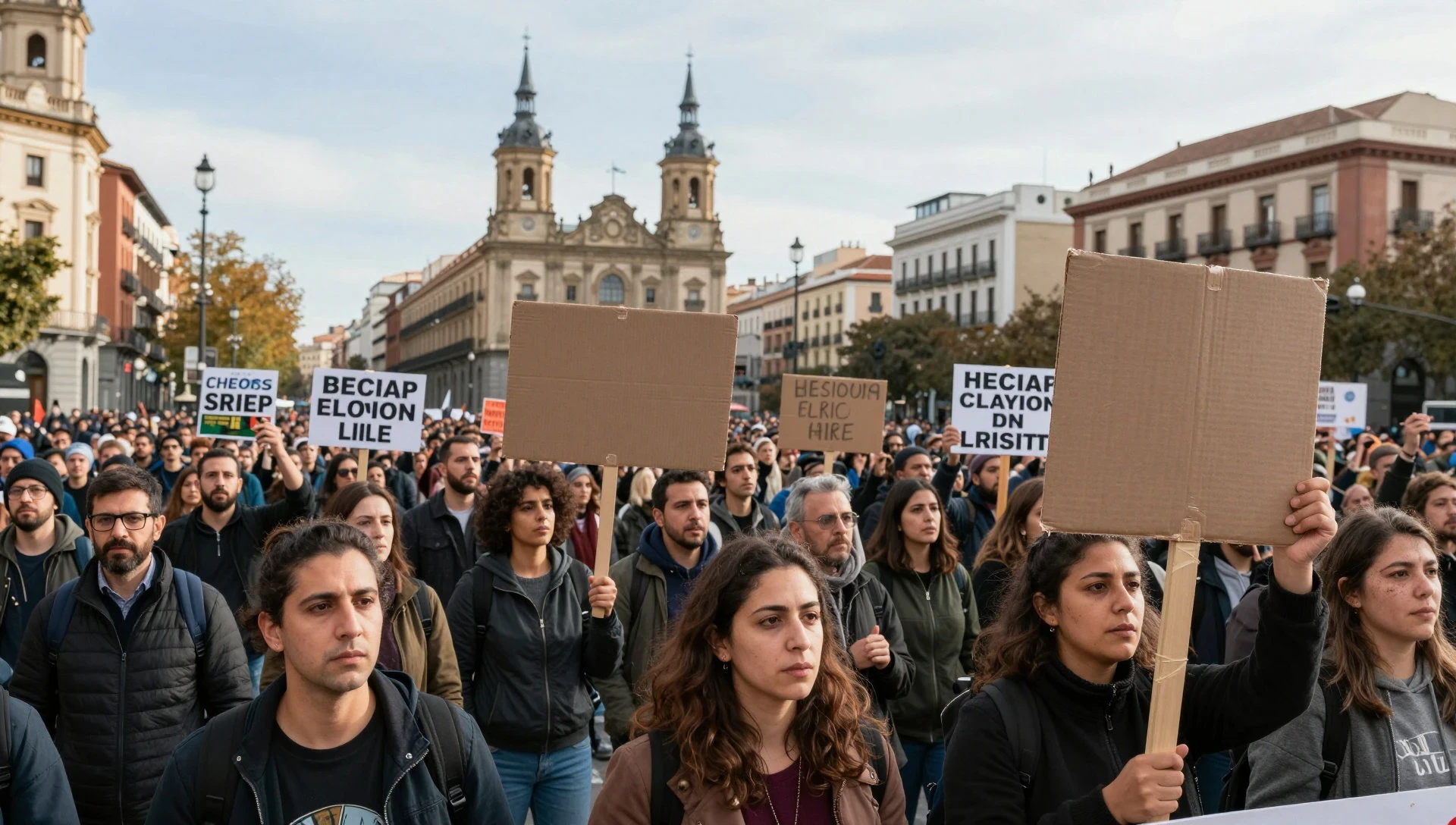
On 11 November 2026, Spain witnessed something that inverts the familiar choreography of European labour politics: a nationwide general strike called not against the government, but with the governing socialist leadership openly behind it. The mobilisation, organised by major labour and tenants' unions over housing costs, wages and public services, fell just eighteen days before snap general elections scheduled for 29 November.
In the conventional grammar of protest, strikes are weapons aimed at incumbents. In Spain's autumn of 2026, the incumbent appeared to be holding the weapon alongside the strikers, converting a day of industrial action into an explicit campaign mobilisation.
The episode matters far beyond the Iberian peninsula because it tests a question that now runs through Western democracies: what happens when ruling parties stop fearing street protest and start borrowing it? Spain's housing crisis, with rents and purchase prices having outpaced wages for a decade in major cities, has become the raw material of a new political alignment in which the centre-left presents itself as the defender of tenants and workers against market forces.
On This Page
The strike therefore reads less as a rupture between state and society than as a carefully staged demonstration of whose side the state claims to be on.
This analysis examines the "upside-down" strike as a case study in the co-option of protest. It traces how the event was framed, what it reveals about the relationship between unions and governing parties, how opposition and populist movements responded, and what the episode suggests about the future of street politics when the street and the state march in the same direction.
The stakes are institutional as much as electoral, touching on the credibility of unions, the authenticity of protest, and the boundaries between civil society and party strategy.
TL;DR Spain's 11 November 2026 general strike over housing, wages and public services took place eighteen days before snap elections on 29 November, with the governing socialists openly backing the action — turning traditional union pressure into an explicit campaign mobilisation and raising questions about ruling parties co-opting street protest to preempt populist backlash.
The Anatomy of an Upside-Down Strike
A general strike ordinarily signals a breakdown in the relationship between organised labour and the state. Workers withdraw their labour to impose costs on employers and, indirectly, on a government that must manage the disruption. The Spanish action of 11 November 2026 broke that template.
The call came from major labour and tenants' unions, the grievances were housing costs, wages and public services, and the governing socialist leadership did not merely tolerate the stoppage — it openly backed it. The state, in effect, joined the picket line rather than facing it.
That inversion deserves precise description. The strike was not a wildcat eruption but an organised, union-led event with a clear bargaining agenda. Housing costs formed the emotional core, reflecting a decade in which rental and purchase prices in Madrid, Barcelona and other urban centres have climbed far faster than average earnings.
Wages and public services rounded out the platform, tying the action to the broader cost-of-living squeeze that has reshaped European politics since the pandemic and the energy shock that followed.
The Chronology and the Electoral Calendar
The timing is the story. Eighteen days separated the strike from the snap general elections of 29 November 2026, a gap short enough to fuse industrial action and electoral campaigning into a single political sequence. A snap election is one called before the scheduled end of a parliamentary term, and its announcement compresses political time: parties must mobilise quickly, and every public event acquires campaign weight. The strike, falling inside that compressed window, could not be read as ordinary labour relations.
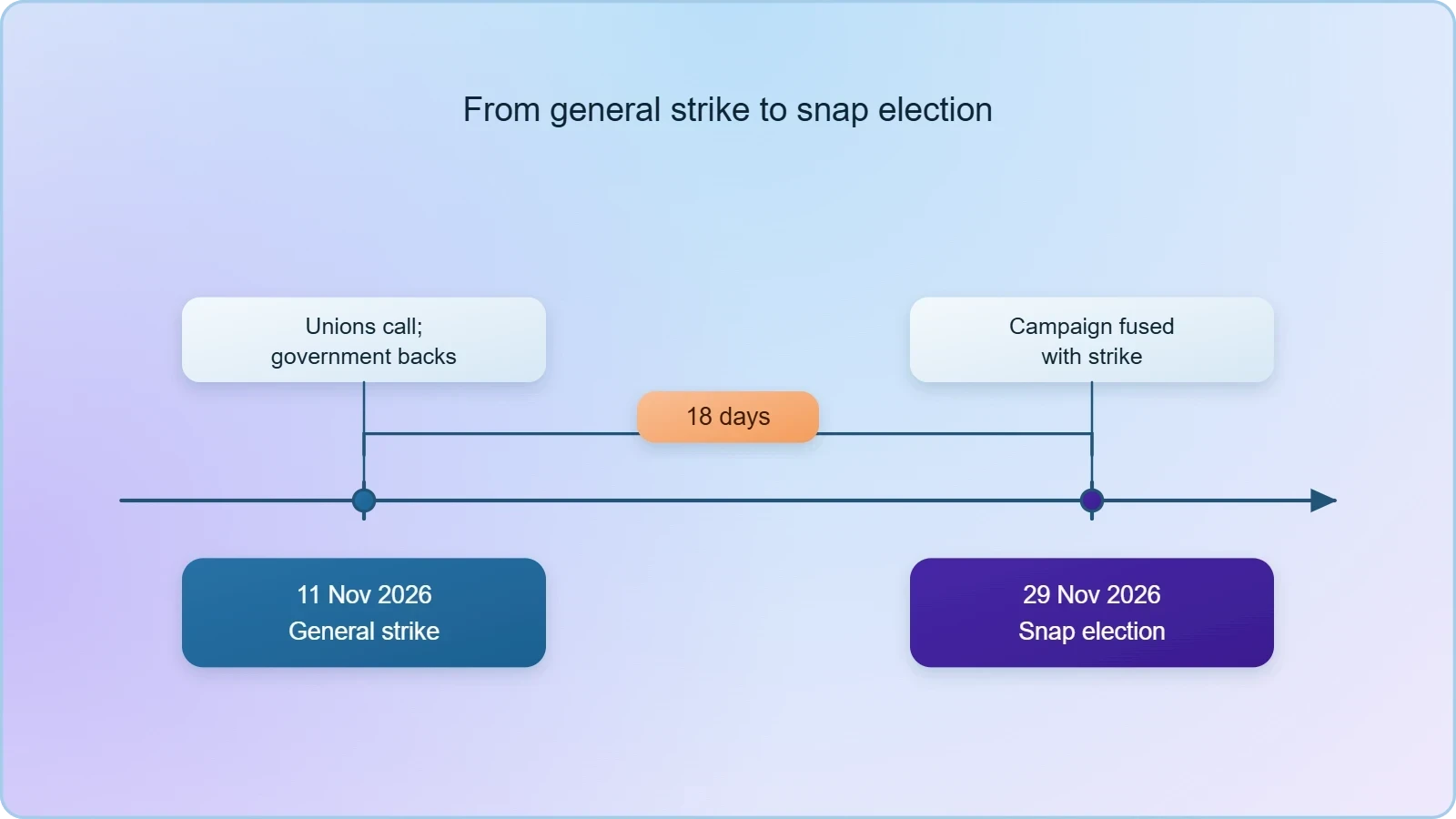
Union calendars and electoral calendars rarely coincide so neatly. When they do, the interpretive possibilities multiply. Supporters could present the strike as proof that the government listens to working people and stands with them against speculative housing markets. Critics could present it as a staged spectacle, a government borrowing the moral authority of protest to disguise its own responsibility for the housing crisis. Both readings were available on the same day, from the same images of crowded demonstrations.
Who Called It and Who Backed It
The distinction between calling and backing is constitutionally significant. Unions called the strike; the governing socialists backed it. That division preserves the formal independence of organised labour while producing a de facto alliance. Unions retain their standing as representatives of workers, and the party gains the reflected legitimacy of a movement it did not have to organise. The arrangement is elegant, and it is precisely this elegance that raises the questions explored below.
Tenants' unions added a newer ingredient to the traditional labour coalition. Housing activism has grown across European cities as rent burdens have intensified, and tenant organisations bring a younger, urban and often precariously housed constituency that overlaps imperfectly with classic industrial union membership. Their presence in the coalition signalled that the strike was about consumption costs as much as production conditions, broadening its appeal beyond the factory floor and the public-sector workplace.
Why Ruling Parties Now Borrow the Street
For much of the twentieth century, the street belonged to the opposition. Strikes, marches and occupations were instruments of parties and movements locked out of power, and governments responded with negotiation, concession or coercion. The rise of populist movements across Europe has scrambled that geometry.
Incumbents now face challengers who claim to speak for "the people" against "the elite", and the traditional centre-left has found itself cast, uncomfortably, as part of the elite. Borrowing the language and theatre of protest is one response to that predicament.
The logic is defensive as much as offensive. If a populist challenger can plausibly claim that the ruling party has abandoned ordinary workers, then a government that visibly marches alongside those workers denies the challenger its most potent narrative. The upside-down strike is thus a form of narrative preemption: by occupying the protest space first, the incumbent makes it harder for rivals to occupy it later. Whether the manoeuvre succeeds depends on whether voters read the alliance as conviction or as choreography.
The Housing Crisis as Political Fuel
Housing has become the pressure point of European politics because it combines a tangible daily grievance with a clear villain narrative. Rents and purchase prices in Spain's major cities have risen sharply relative to wages, and the burden falls hardest on younger adults, migrants and urban service workers.
A government that can position itself against landlords, speculative buyers and short-term rental platforms speaks directly to that constituency without needing to defend its broader economic record.
The tenants' union dimension sharpens this advantage. Housing activism is newer, less institutionalised and often more confrontational than traditional unionism, which gives it an authenticity that established parties lack. By aligning with tenant organisations, the governing socialists could borrow some of that energy while steering it toward electoral participation.
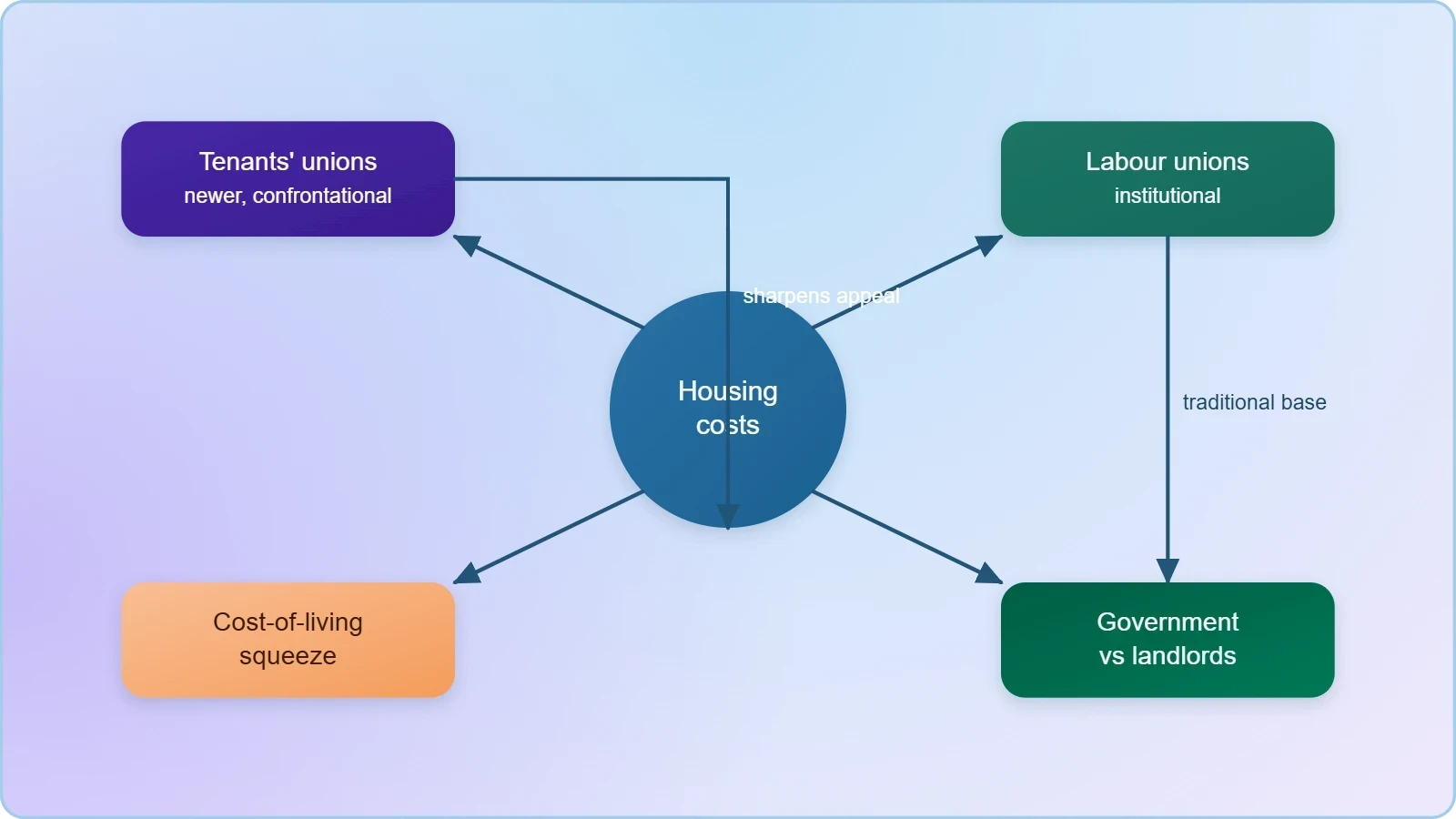
The risk is that the borrowed energy refuses to be steered, and that movements accustomed to confrontation find parliamentary channels insufficient once the campaign ends.
Unions Between Movement and Government
For organised labour, the alliance is a gamble with a long history behind it. Unions gain influence when sympathetic parties govern, but they lose credibility when they appear to be an appendage of the state. The classic dilemma of social partnership is that proximity to power buys concessions at the price of militancy.
A union that calls a strike the government supports must persuade its members that the action is pressure rather than theatre, and that the government is a partner in struggle rather than its target.
Spanish labour history makes this tension especially acute. Unions built their legitimacy in opposition to authoritarian rule and have long guarded their independence from governing parties. Backing from the socialist leadership therefore cuts both ways: it raises the political salience of the strike, but it also invites the charge that the unions have become transmission belts for party strategy. The strike's success as industrial action and its success as electoral mobilisation may pull in opposite directions.
The Populist Backlash Problem
The upside-down strike is best understood as a response to a specific fear: that populist movements will capture the grievances of working and renting voters before mainstream parties can address them. Across Europe, parties of the radical right and anti-establishment left have built support by presenting themselves as the only authentic voice of people left behind by consensus politics. Housing costs, stagnant wages and strained public services are precisely the grievances such movements harvest. A governing party that ignores them cedes the terrain.
Preemption, however, carries its own risks. When an incumbent adopts the symbols of protest, it validates the premise that the system is failing, which is the populist argument. The government says, in effect, that housing is a crisis and that it stands with those who suffer it. That message may win sympathy, but it also concedes that the crisis exists on the government's watch. The challenger can then ask why, if the situation is so dire, the incumbents did not act during their years in office.
Authenticity as the Scarce Resource
In this contest, authenticity is the scarce resource. Protest derives its power from the perception that participants have something at stake and are acting outside institutional channels. When a governing party joins a protest, it risks diluting that perception for everyone involved. Voters may conclude that the demonstration was a campaign event, that the unions were props, and that the grievances, however real, were being managed rather than addressed. The upside-down strike can thus undermine the very authenticity it seeks to borrow.
Unions face a parallel exposure. Their leverage rests on the credible threat of disruption and the moral authority of representing workers against employers. If the government supports the strike, the disruption loses its target and the moral authority becomes ambiguous. Members may ask what, precisely, the action is pressuring.
The answer — that it pressures the electorate rather than the state — is politically candid but industrially awkward, and it may weaken the union's standing in future negotiations.
Opposition Dilemmas
Opposition parties confront a mirror-image problem. Denouncing a strike over housing and wages risks appearing indifferent to hardship, while endorsing it hands the government a victory. The safest course is usually to support the grievances while attacking the government's record, a position that allows a party to stand with workers and against incumbents simultaneously. But that position is crowded when the incumbents are already standing with the workers, and it becomes harder to sustain as the campaign intensifies.
Populist challengers have the most to lose from the manoeuvre and the most incentive to reframe it. Their claim to authenticity depends on the incumbent being part of a detached elite. A governing party marching with strikers disrupts that image, so the populist response is typically to insist that the alliance is fake: that the government is using workers as scenery and that real change requires replacing the ruling class entirely. Whether voters accept that framing determines whether preemption works.
We Also Published
- 01
- 02
- 03
- 04
Comparative Lessons from European Protest Politics
Spain is not the first European democracy to blur the line between governing and protesting, but it has done so with unusual clarity. France has a long tradition of strikes that pressure the state from outside, with unions often opposing governments of the left as readily as those of the right. Greece has seen sustained street mobilisation against austerity during periods when governing parties were themselves products of protest movements. Spain's upside-down strike differs in that the initiative came from unions while the government backed it, preserving formal separation while producing practical alignment.
The comparison illuminates a broader shift. As populist challengers have grown, mainstream parties across the continent have experimented with movement-style politics: leaders who present themselves as outsiders, campaigns built around rallies, and policy announcements staged as confrontations with vested interests. The upside-down strike is an extension of this repertoire into the domain of industrial action. It treats the picket line as a campaign platform and the union as a coalition partner in the electoral rather than the bargaining sense.
Where the Model Travels and Where It Does Not
The model travels best where unions remain strong, housing costs are acute and a centre-left party governs or competes closely. Spain satisfies all three conditions. Countries with weaker union density, more dispersed housing pressure or different party systems may find the template harder to execute. In economies where collective bargaining coverage is low, a general strike carries less weight, and a government's endorsement of one may look like symbolism without substance.
The model also depends on the credibility of the grievances. Housing costs in Spain are not a manufactured issue; they reflect measurable pressure on household budgets, particularly for younger urban residents. Where grievances are genuine and widely felt, a governing party can align with them without appearing cynical. Where they are narrower or contested, the same manoeuvre risks looking opportunistic, and the borrowed authenticity evaporates quickly under scrutiny.
Institutional Consequences
Beyond any single election, the upside-down strike raises institutional questions. If governing parties routinely back strikes, the distinction between state and civil society thins, and the strike loses its function as a signal of breakdown. Unions may find that their most powerful weapon is most effective when the government opposes them, which creates a perverse incentive against cooperation. Employers, meanwhile, may discount the significance of industrial action if they expect the state to side with workers.
There is also a question of accountability. When a government supports a strike over public services, it is in part striking against its own administration. The spectacle can energise supporters, but it complicates the attribution of responsibility that democratic elections depend on.
Voters need to know whom to credit and whom to blame, and an incumbent that stands on both sides of a dispute makes that judgment harder, which may ultimately erode rather than restore trust.
Reading the Signals Before 29 November
With eighteen days between the strike and the vote, the campaign entered its decisive phase with the governing socialists having staked a claim to the protest constituency. The immediate question is whether that claim translates into turnout and support among the voters most affected by housing costs. Younger urban renters, public-sector workers and lower-income households are the natural audience, but they are also the groups most likely to distrust institutional politics. A government that marches with them must persuade them that marching matters.
The signals to watch are not polling numbers alone but the behaviour of the organisations involved. If unions maintain independent pressure after the election, the alliance will look like a genuine convergence of interests. If they demobilise once the vote is over, the strike will be remembered as a campaign instrument. Similarly, the response of tenant organisations will indicate whether housing activism has been absorbed into party politics or retains its separate, more confrontational identity.
What Would Confirm the Preemption Thesis
The preemption thesis holds that the governing party backed the strike to deny populist challengers their anti-elite narrative. Evidence consistent with that thesis would include a campaign focused heavily on housing and living costs, sustained efforts to associate the government with union and tenant leaders, and a rhetorical emphasis on the government's willingness to confront vested interests. The thesis would be strengthened if opposition and populist parties spent the campaign attacking the authenticity of the alliance rather than its substance.
Evidence against the thesis would include a strike that proceeded largely on union terms, with the government following rather than leading, and a campaign that returned quickly to other themes. In that case, the government's backing would look like a response to genuine social pressure rather than a strategic manoeuvre.
The distinction matters because it determines whether the upside-down strike is a new model of governance or a one-off adaptation to an unusually compressed electoral calendar.
What Would Refute It
Refutation would also come from the unions themselves. If labour leaders publicly distanced themselves from the governing party after the strike, insisting on their independence and criticising the government's housing record, the idea of a coordinated co-option would weaken. Unions have their own interests and constituencies, and they may well use the strike to extract concessions rather than to deliver votes. In that reading, the government's support was a concession to labour rather than a strategy imposed on it.
The most likely outcome lies between the two readings. Political alliances of this kind are rarely pure strategies or pure responses; they emerge from overlapping interests in which each side gains something and risks something. The governing socialists gained visibility and a claim to the protest constituency; the unions gained political salience and a government sympathetic to their demands. Both also incurred the risk of appearing instrumental, and the election will reveal which risk mattered more.
The Wider Meaning for Democratic Protest
The Spanish episode compresses a larger question about the health of democratic representation. Protest has traditionally functioned as a channel for those outside power, a way of forcing attention onto grievances that institutions neglect. When incumbents adopt protest tactics, that channel becomes congested. The gesture that once signalled exclusion now signals alignment, and voters must work harder to distinguish genuine grievance from strategic performance. The result can be a general scepticism toward all mobilisation, which serves no one.
There is a defensible case for the upside-down strike. If a government genuinely shares the grievances of strikers, refusing to say so out of deference to constitutional convention may be worse than the alternative. Housing costs are real, wages have lagged, and public services face pressure. A ruling party that acknowledges these facts and aligns with those affected is doing something legitimate, even if the timing is electorally convenient. The problem is not the alignment itself but the difficulty of proving sincerity when the calendar is so suggestive.
Protest, Representation and Trust
Representation depends on clarity about who speaks for whom. Unions speak for workers, tenant organisations for renters, parties for voters. When these roles overlap, the clarity blurs. A voter watching a socialist leader march with strikers may reasonably ask whether the leader is representing the government, the party, the workers or the campaign.
The upside-down strike does not answer that question; it multiplies it, and the multiplication is the point, because ambiguity allows each audience to see what it wants to see.
Trust is the casualty of that ambiguity. Democratic systems rely on citizens believing that institutions mean what they say and that protest means what it has historically meant. An incumbent borrowing the street may win a news cycle, but it also teaches voters that political signals are fungible.
Over time, that lesson corrodes the credibility of every signal, including the ones the incumbent will need when it faces a genuine crisis and asks the public to trust its word.
What Spain 2026 Leaves Behind
Whatever the electoral result on 29 November, the 11 November strike has left a template. It demonstrates that a governing party can align with a general strike without formally calling it, preserving the fiction of union independence while capturing the political benefit. Other centre-left parties facing populist pressure will study the manoeuvre. Some will attempt it; others will conclude that the risks of inauthenticity outweigh the gains, particularly where unions are weaker or grievances less acute.
The deeper legacy concerns the relationship between protest and power. For decades, the health of democracy was measured partly by the vibrancy of extra-parliamentary mobilisation. If mobilisation becomes an instrument of incumbents, that measure loses its meaning. The challenge for the next generation of democratic politics is to preserve space for genuine dissent while acknowledging that the boundary between state and street has never been as clean as the textbook suggests. Spain's upside-down strike made that boundary visible by crossing it in daylight.
Disclaimer: This article is an analytical commentary on political events and does not constitute electoral, financial or investment advice. All factual details are drawn from the source brief; interpretations are the author's own.
Disclaimer: This article is for general information and education only. It describes what historical prices and technical indicators showed on the date mentioned and does not predict future movements. It is not investment advice, a recommendation, or an offer to buy or sell any security. Indicators are calculated from past data and can mislead, and all investments carry risk. Please consult a SEBI-registered investment adviser before making any financial decision.
From our network :
- The Final Descent: How ESA Retired the Legendary Cluster Constellation After 24 Years of Space Weather ScienceAfter 24 years mapping Earth’s magnetosphere, ESA’s Cluster mission concluded with a precisely controlled reentry over the South Pacific. This analysis explores the scientific legacy, engineering decisions, and debris mitigation principles behind one of space exploration’s most responsible retirements.
- The Hidden Cost of AI Convenience: Why Over-Permissioned Agents Are a Security Time BombDiscover why AI agents with excessive permissions create dangerous single points of failure, and learn how implementing least privilege principles can protect your organization from exploitation.
- How AI Agents Will Change the Way We Manage Personal FinancesExplore how AI agents are transforming personal finance through automated budgeting, bill payment, and investment management, while examining the critical security protocols and governance frameworks required for safe deployment.
- Live Online English Classes for Kids: Do They Actually Reduce Anxiety?A ten-week study reveals that synchronous online English classes can significantly reduce child language anxiety while improving listening and reading skills. Discover what makes these programs effective and how parents can select the right one.
- Committed Mediterranean Precipitation Decline: Why Emissions Cuts Alone Cannot Restore Winter RainsNew NOAA research reveals that Mediterranean winter rains may decline irreversibly even with emissions cuts. Explore the science of committed climate change and regional impacts.
- Forbidden Matrix Patterns and Visible Lattice Points: A Geometric DictionaryExplore how multidimensional 0–1 matrices encode geometric truths, linking forbidden patterns to visible lattice points and hypergraph theory, with applications in combinatorics and computational geometry.
- University Language Proficiency Exams: Why Institutional Tests Demand Different Preparation Than IELTS and TOEFLDiscover why university-specific language proficiency examinations differ fundamentally from IELTS and TOEFL, and learn strategic preparation approaches for institutional assessment success.
- Mobile Learning and VR in English: What Global Evidence Reveals About Effective Language TechnologyA systematic review across 14 countries reveals which language-learning technologies genuinely work. Mobile learning, AI, and VR show measurable benefits when pedagogically integrated. This evidence-based guide helps educators and learners select technology that delivers real return on investment.
- CISA’s Ten-Advisory Wave: Why Generic Patching Fails in OT and How to Build Product-Specific PlaybooksCISA released ten ICS advisories in one week, exposing critical infrastructure risks. Generic patching fails in OT. Learn to build product-specific remediation playbooks.
RESOURCES
- Millions join Spain's first general strike in 14 years in protest at ...theguardian.com3 days ago ... The long-simmering frustration at soaring housing prices across Spain ... The snap vote was called by the Socialist prime minister,…
- Spain Hit by General Strike as Cost of Living Takes Center ... - WSJwsj.com3 days ago ... The protests come weeks before Spain's Nov. 29 snap elections, putting pressure on Prime Minister Pedro Sanchez. This summary was…
- Spain's general strike demands solutions to housing crisis - NPRnpr.org3 days ago ... Spain's workers hold a general strike over housing costs before national election · Protesters march in Madrid, defying rain and…
- Millions of Spanish Workers Stage First General Strike in 14 Yearstime.com2 days ago ... 29 national election, in which rising rents and cost-of-living have become defining issues. Prime Minister Pedro Sánchez's government called ...
- Spain approves housing reforms after nationwide strike over costsaljazeera.com2 days ago ... ... snap election outcome. Listen (3 mins) ... Protesters march under the rain during a nationwide general strike over the…
- Spanish unions call general strike for November 11, weeks before ...reuters.comOct 8, 2026 ... The protest will take place a few weeks before a snap election in which rising rents and evictions have become…
- Italy, Spain, Belgium, Portugal: Social unrest spreads across Europe ...lemonde.frOct 20, 2026 ... Spain: Housing crisis sparks protests six weeks ahead of snap elections ... general strike" on November 11, in coordination with…
- Spain braces for nationwide strike as anger over housing, costs ...aljazeera.com4 days ago ... Spain is bracing for a nationwide general strike over soaring rents and the cost ... snap elections. Wednesday's strike could…
- Millions join Spain housing strike, scores arrested in clashes - Reutersreuters.com2 days ago ... More than 3 million Spaniards took to the streets on Wednesday as part of a mostly peaceful general strike protesting…
- Clashes erupt in Barcelona after thousands join Spain general strikebbc.com3 days ago ... The strike was triggered by widespread protests over affordable housing and rising living costs ... snap elections last month after ...
- Spain: Housing crisis prompts general strike, mass nighttime protestsdw.com3 days ago ... ... strike. The crisis has triggered snap elections to take place on November 29 ... cost of living crisis and…
- General strike over housing brings out tens of thousands in Spainafp.com3 days ago ... ... protesters marched across Spain on ... strike over housing affordability and purchasing power just weeks before an early general…
- Spain's general strike puts housing crisis at centre of ... - France 24france24.com3 days ago ... The expected disruptions to public transport and the widespread closure of businesses come less than three weeks before a snap…
- General strikes to paralyze Spain as demonstrators clash with policecnbc.com3 days ago ... ... national general strike to take place as part of ongoing demonstrations over the country's housing and cost of living…
- Spain's Prime Minister Pedro Sánchez calls early election - BBCbbc.comOct 5, 2026 ... Spanish PM Sánchez calls early election after housing protests ... Protesters gather in Spain for first general strike in 14…
- 01
- 02
- 03
- 04
- 05
- 06
- 07
- 08
0 Comments